Search the phrase “TB-500 for inflammation” and you will encounter confident language: a peptide that calms the immune system, resolves chronic swelling, and repairs damaged tissue. That framing runs well ahead of the evidence. TB-500 is a synthetic peptide fragment derived from thymosin beta-4 (Tβ4), a naturally occurring 43-amino-acid protein involved in cell migration and tissue repair. It is not an approved drug for any chronic inflammatory condition anywhere in the world, and—critically—there are no completed human efficacy trials of the TB-500 fragment itself. So the honest version of the title question is not “how well does this therapy work?” but rather “does the preclinical biology justify calling this an open research question worth studying at all?”1
This article treats it exactly that way. Below, we separate three things that marketing routinely blurs together: (1) what is genuinely known about the parent molecule thymosin beta-4, much of which comes from real animal studies and a handful of small human trials of the full-length protein; (2) what is known specifically about the short TB-500 fragment, which is far less; and (3) the leap of faith required to move from “interesting cytoskeletal biology in rodents” to “promising therapy for chronic inflammatory disease in humans.” That leap has not been made. Understanding why is more useful than any dosage chart.
Everything that follows is educational and describes laboratory and animal research. Nothing here is medical advice, a treatment recommendation, or an endorsement of human use. TB-500 is sold and handled as a research chemical, not a medicine, and the regulatory sections at the end explain why that distinction is legally and scientifically load-bearing.
What TB-500 Is and Where It Comes From
To understand TB-500 you first have to understand thymosin beta-4. The parent protein was isolated from calf thymus and characterized by Low, Hu, and Goldstein in the early 1980s, who determined its complete 43-residue amino acid sequence and named it thymosin beta-4.1 Despite the “thymosin” name—which reflects its original discovery in thymic tissue—the protein is not a thymic hormone in any classical sense. It is one of the most abundant intracellular proteins in mammalian cells and is found across essentially all vertebrate tissues, from blood platelets to brain, where its dominant job is binding and sequestering monomeric actin.2,16
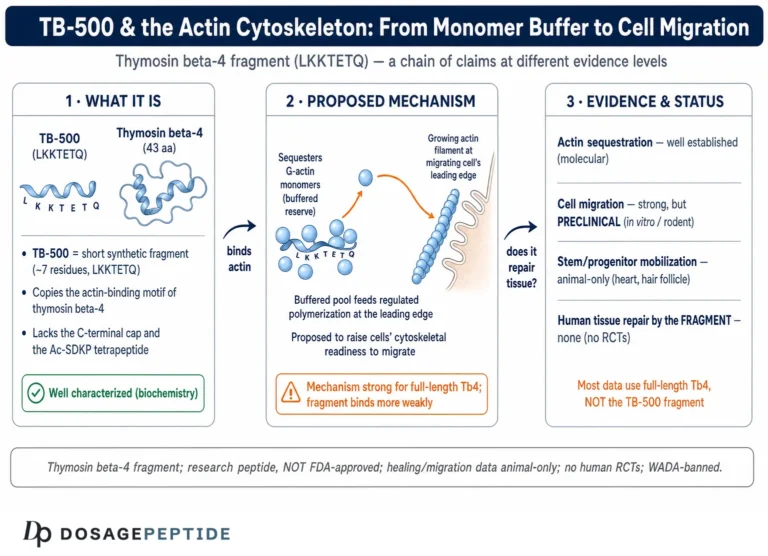
Thymosin beta-4 carries a short, strongly conserved motif—the sequence LKKTET, beginning at residue 17—that is frequently described as its actin-binding motif and is preserved across the whole family of beta-thymosins.2,16 This is the pharmacologically interesting neighborhood of the molecule, and it is the region that TB-500 attempts to reproduce.
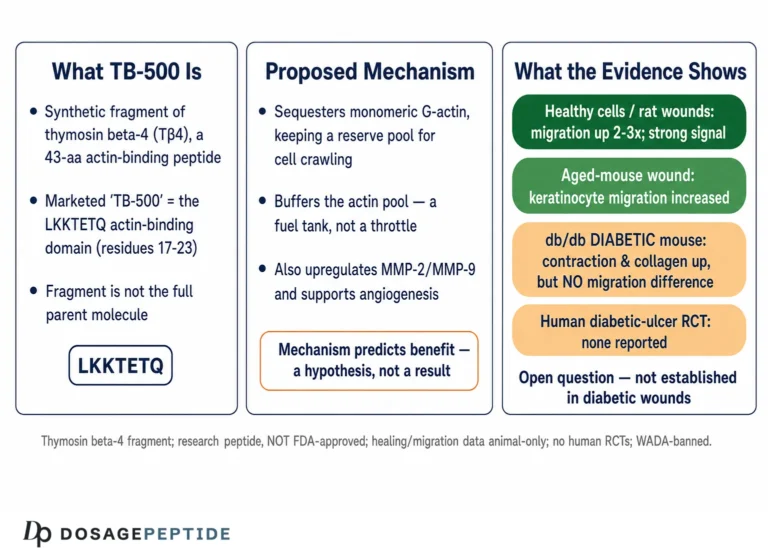
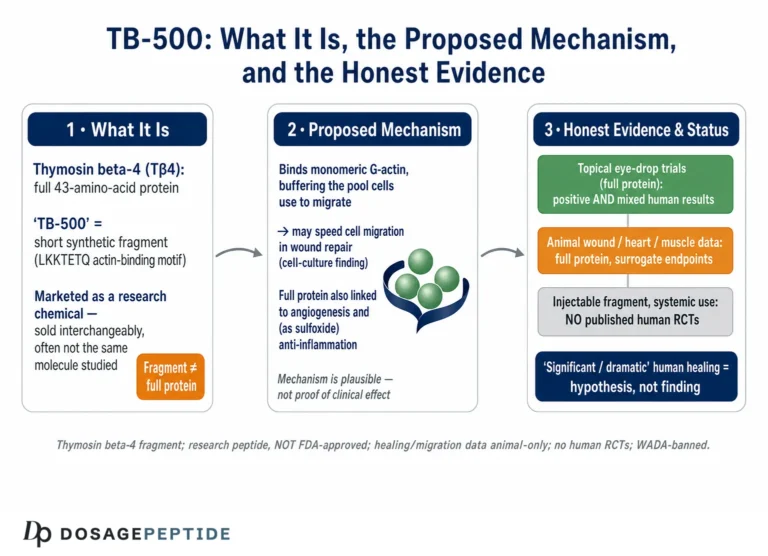
Here is where careful language matters. TB-500, as sold in the research-chemical market, is not full-length thymosin beta-4. It is most commonly described as a short, N-terminally acetylated fragment spanning roughly residues 17–23 of Tβ4—the heptapeptide Ac-LKKTETQ—built around that conserved actin-binding motif.12 Full-length Tβ4 has 43 amino acids; the TB-500 fragment has about seven. That is not a trivial difference. A fragment can retain some of a protein’s activities, lose others, gain none of the ones that depend on the missing 36 residues, and behave completely differently in terms of stability, distribution, and metabolism. Much of the confusion around TB-500 comes from vendors and secondary articles quietly substituting the substantial literature on the full protein for evidence about the fragment, as if they were interchangeable. They are not.
Complicating matters further, the endogenous processing of thymosin beta-4 also releases a separate, even shorter tetrapeptide—Ac-SDKP (N-acetyl-seryl-aspartyl-lysyl-proline)—cleaved from the N-terminus of the parent protein. Ac-SDKP has its own well-studied anti-inflammatory and anti-fibrotic biology, which is often cited loosely as if it were a property of TB-500.10,11 But Ac-SDKP is not the LKKTETQ fragment; they are different molecules from different parts of the same parent. When someone claims “TB-500 reduces fibrosis via NF-κB,” the underlying data very often come from Ac-SDKP or from full-length Tβ4—not from the heptapeptide being sold under the TB-500 label.
Why would anyone build a fragment in the first place? The rationale is partly practical and partly historical. A full 43-residue protein is more expensive to synthesize at scale and can be harder to keep stable in solution; a short peptide is cheaper, easier to make to a consistent specification, and—if it happens to carry the “business end” of the molecule—might reproduce the desired activity in a more tractable package. The name “TB-500” itself originated in the research-chemical and veterinary-adjacent supply chain rather than from a peer-reviewed drug-development program, which is part of why its exact identity is described inconsistently across sources. Some vendors list it as the 17–23 heptapeptide Ac-LKKTETQ; others describe a slightly longer or differently acetylated construct. That definitional fuzziness is itself a warning sign: a compound with a well-run clinical program has a single, unambiguous chemical identity, a defined manufacturing specification, and a body of data tied to that exact structure. TB-500 has none of these in the way an approved drug does.
It is also worth being clear about what the “origin” story does and does not license. Thymosin beta-4 is a real, extensively characterized endogenous protein with decades of legitimate cell-biology research behind it. That pedigree is frequently borrowed to lend gravity to TB-500. But an endogenous molecule being important in normal physiology does not mean that injecting a synthetic fragment of it is safe, effective, or even biologically equivalent. Insulin is endogenous and life-saving; that tells you nothing about whether an arbitrary insulin fragment would help anyone. The endogenous-origin argument establishes plausibility for studying the molecule, not efficacy for using it.
So the accurate one-sentence definition is: TB-500 is a synthetic acetylated peptide modeled on the actin-binding fragment of thymosin beta-4, marketed for laboratory research, whose relationship to the parent protein’s documented effects is plausible in theory but largely untested in the exact form being sold. For readers comparing formats and how the compound is discussed in a research context, DosagePeptide maintains a compound-specific reference on the TB-500 research overview.
How TB-500 Is Thought to Work: Molecular Mechanisms
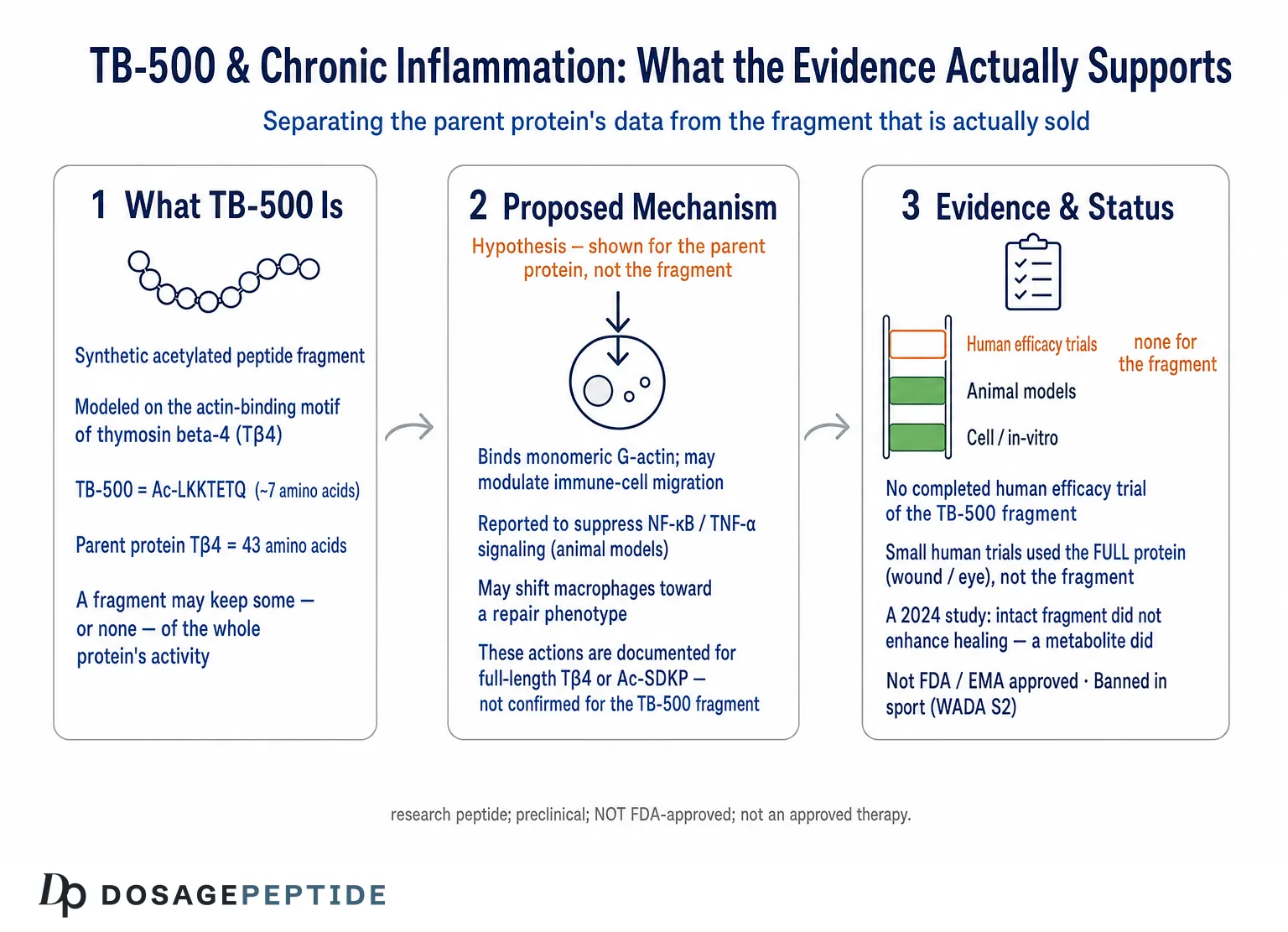
The proposed mechanisms below are drawn overwhelmingly from studies of full-length thymosin beta-4 or its Ac-SDKP fragment. They describe a coherent and genuinely interesting biology—but read them as hypotheses about how a Tβ4-derived fragment might influence inflammation, not as demonstrated actions of the TB-500 heptapeptide in humans.
Actin sequestration. The best-defined molecular role of thymosin beta-4 is binding monomeric G-actin in roughly one-to-one fashion, maintaining a buffered pool of unpolymerized actin and modulating the assembly and disassembly of the cytoskeleton.16 Because cell migration, shape change, and the movement of immune cells all depend on actin dynamics, a molecule that tunes actin behavior can, in principle, influence how inflammatory cells traffic into and out of injured tissue. In sepsis-type models, this cytoskeletal role is invoked to explain reduced endothelial injury.
NF-κB and Toll-like receptor signaling. Several animal studies of thymosin beta-4 report suppression of the NF-κB pathway—the master transcriptional switch for pro-inflammatory gene expression. In liver-injury models, Tβ4 has been reported to block phosphorylation of the inhibitory protein IκB, thereby preventing NF-κB activation and downstream production of pro-inflammatory cytokines including TNF-α, IL-1β, and IL-6.9 A 2021 review summarizing the field frames Tβ4 as alleviating inflammatory damage by regulating NF-κB and Toll-like receptor pathways and reducing cytokine release.9
microRNA-146a and macrophage behavior. In neurological-injury work, thymosin beta-4 treatment has been reported to raise expression of microRNA-146a (miR-146a), a negative regulator of the TLR signaling cascade, while suppressing the downstream signaling proteins IRAK1 and TRAF6.13 This is a plausible molecular route by which a Tβ4-derived molecule could dampen an over-active innate immune response. The same body of work associates Tβ4 with shifts in macrophage phenotype and cytokine balance—away from a purely destructive inflammatory posture toward a repair-oriented one.9,13
Angiogenesis and tissue remodeling. The actin-binding region of thymosin beta-4 has been shown to promote angiogenesis—the formation of new blood vessels—which is relevant because resolving chronic inflammation frequently requires re-perfusing and rebuilding damaged tissue rather than merely silencing cytokines.4 In cardiac work, Tβ4 forms a complex with the adaptor protein PINCH and integrin-linked kinase (ILK), activating the survival kinase Akt/PKB and improving cell survival after ischemic injury.3
The Ac-SDKP anti-fibrotic axis. Separately, the Ac-SDKP tetrapeptide has anti-inflammatory, anti-fibrotic, and pro-angiogenic properties documented across cardiovascular, renal, pulmonary, hepatic, and autoimmune models. Mechanistically it has been reported to suppress TNF-α-induced ICAM-1 expression in endothelial cells via inhibition of IκB kinase and NF-κB, and to reduce MCP-1, α-SMA, and TGF-β1 expression—the drivers of inflammatory collagen deposition.10,11
| Proposed mechanism | Anti-inflammatory relevance | Strongest evidence source |
|---|---|---|
| G-actin sequestration | Modulates immune-cell migration and endothelial integrity | Full-length Tβ4, in vitro / animal16 |
| NF-κB / IκB suppression | Lowers TNF-α, IL-1β, IL-6 transcription | Full-length Tβ4, animal9 |
| miR-146a up-regulation | Dampens TLR/IRAK1/TRAF6 innate signaling | Full-length Tβ4, neuro models13 |
| Angiogenesis / Akt survival | Supports tissue repair after injury | Full-length Tβ4, cardiac3,4 |
| Anti-fibrotic (TGF-β, MCP-1) | Reduces inflammation-driven scarring | Ac-SDKP fragment, animal10,11 |
How the pieces might fit together in chronic inflammation. It helps to see why this particular collection of mechanisms is attractive to inflammation researchers in the first place. Chronic inflammatory disease is rarely a matter of a single overactive cytokine; it is a self-sustaining loop in which tissue injury recruits immune cells, those cells release mediators that cause further injury, and impaired repair leaves the tissue primed for the next round. A molecule that could simultaneously (a) restrain the pro-inflammatory transcriptional program through NF-κB and TLR modulation, (b) shift resident macrophages from a destructive toward a reparative phenotype, and (c) support angiogenesis and cell survival so damaged tissue actually heals, would be attacking the loop at several points at once. That multi-pronged “pro-resolution” profile—dampening inflammation while actively promoting repair—is exactly what makes the thymosin-beta-4 family theoretically interesting for conditions where conventional anti-inflammatory drugs suppress symptoms without healing the underlying tissue.3,9
Why plausibility is not proof. The trouble is that an elegant, internally consistent mechanistic story is the starting point of drug development, not the finish line. The history of anti-inflammatory therapeutics is littered with compounds that suppressed NF-κB beautifully in a dish, shifted macrophage markers convincingly in a mouse, and then did nothing useful—or caused harm—in patients. Redundancy in inflammatory signaling means blocking one node is often compensated by another; effects that are protective in acute injury can be counterproductive in chronic disease; and a mechanism demonstrated with continuous expression of a full protein may simply not occur when a short, rapidly cleared fragment is dosed intermittently. The mechanisms below should therefore be read as reasons the compound is worth studying, not as an account of what it does in a person with an inflammatory condition.
Notice the right-hand column. Every well-supported mechanism traces to the parent protein or the Ac-SDKP fragment—not to the Ac-LKKTETQ heptapeptide sold as TB-500. That gap is the central caveat of this entire article.
What the Evidence Actually Shows on Inflammation
Graded honestly, the evidence base for a Tβ4-derived molecule in chronic inflammatory conditions sits at the preclinical level: cell culture and animal models, generating hypotheses rather than confirming clinical benefit. There is meaningful animal signal, but no confirmatory human inflammatory-disease trial of TB-500.
Experimental colitis. One of the more directly relevant studies used a recombinant adeno-associated virus to deliver thymosin beta-4 in a mouse model of chemically induced colitis. Systemic Tβ4 was reported to suppress colonic inflammation, markedly reducing the elevated TNF-α expression in injured colonic tissue—with the authors concluding that suppression of TNF-α is an essential mechanism of Tβ4-mediated alleviation of colitis.8 This is an inflammatory-bowel-disease-adjacent model, and it is a genuine positive signal—but it used gene-delivered full-length protein in mice, not injected TB-500 fragment, and mouse colitis is an imperfect stand-in for human ulcerative colitis or Crohn’s disease.
Sepsis and endothelial injury. Systemic administration of thymosin beta-4 has been reported to decrease TNF-α levels in murine sepsis models, with the cytoskeletal actin-buffering role invoked to explain reduced endothelial damage and limited microthrombus formation.9 Sepsis is an acute, catastrophic inflammatory state rather than a chronic condition, so its relevance to, say, rheumatoid arthritis or inflammatory bowel disease is indirect.
Fibrosis-driven organ inflammation. The Ac-SDKP literature is the most quantitatively developed. In rat models of renal injury, Ac-SDKP attenuated renal inflammation and tubulointerstitial fibrosis, with treated animals showing less severe interstitial disease.10 In angiotensin-II–induced hypertensive rats, Ac-SDKP reduced cardiac collagen cross-linking and inflammation, acting through reductions in MCP-1, NF-κB, α-SMA, and TGF-β1.11 These are among the cleanest anti-inflammatory datasets in the whole Tβ4 family—but, again, they belong to Ac-SDKP.
Human data—on the full protein only. A limited number of small human trials have tested full-length thymosin beta-4 formulations, principally in wound-type indications rather than chronic systemic inflammation. A topical Tβ4 gel (RGN-137) was studied for pressure ulcers and reported as safe and well tolerated, with the mid-dose accelerating healing versus placebo in a Phase II setting.6 Ophthalmic Tβ4 was evaluated in dry-eye and neurotrophic-keratopathy trials, with reported improvements in corneal healing and reductions in ocular-surface staining.4,5 A topical Tβ4 program for the severe blistering disease epidermolysis bullosa also advanced through regulatory review.7 These trials are the strongest human evidence in the entire family—yet every one of them used full-length thymosin beta-4, in wound or ocular indications, not the TB-500 fragment in a chronic inflammatory disease.
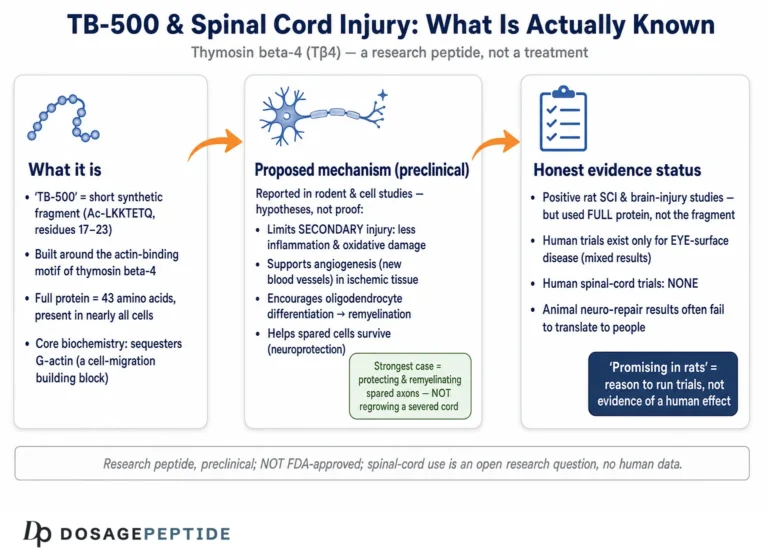
Neurological and autoimmune-adjacent models. A further strand of preclinical work has examined thymosin beta-4 in stroke, traumatic brain injury, experimental autoimmune encephalomyelitis (an animal model of multiple sclerosis), and diabetic peripheral neuropathy, where the reported effects on oligodendrocyte progenitors, neurovascular remodeling, and miR-146a–mediated dampening of TLR signaling overlap with the anti-inflammatory mechanisms already discussed.13 These models are relevant to the broad question because neuroinflammation is a chronic, self-sustaining process, and they add breadth to the case that Tβ4 biology can modulate inflammation across organ systems. But they carry all the same caveats—full protein rather than fragment, induced rather than spontaneous disease, rodent rather than human—and the neurological work in particular relied heavily on the parent protein and on manipulating downstream microRNAs, not on demonstrating that the TB-500 heptapeptide does the same thing.
How to grade this on an evidence hierarchy. It is worth stating plainly where all of this sits. The conventional evidence pyramid runs, from weakest to strongest: mechanistic/in-vitro work, then animal studies, then case reports, then small uncontrolled human studies, then randomized controlled trials, then systematic reviews of multiple trials. The TB-500 fragment specifically has essentially nothing above the bottom two tiers. Full-length thymosin beta-4 reaches the small-controlled-trial tier, but only in wound and ocular indications—not chronic inflammatory disease. There is no systematic review establishing efficacy, no large randomized trial, and no regulatory approval anywhere. On any honest reading of the hierarchy, the correct label for TB-500 in chronic inflammation is “preclinical hypothesis,” full stop.
The distilled honest verdict: there is real, hypothesis-generating animal evidence that thymosin-beta-4 biology can restrain inflammatory signaling, and small human trials that the parent protein is tolerable and may aid wound healing. There is no completed human trial demonstrating that TB-500 treats any chronic inflammatory disease. Anyone who tells you otherwise is overselling.
TB-500 Versus Full-Length Tβ4 and Related Peptides
Because the marketing around TB-500 leans so heavily on borrowed evidence, it is worth laying out the comparisons explicitly.
TB-500 versus full-length thymosin beta-4. The parent protein is 43 amino acids and carries the full repertoire of documented activities—actin sequestration, angiogenesis, ILK/Akt survival signaling, and the anti-inflammatory effects catalogued above. TB-500 reproduces only the short actin-binding neighborhood. The theoretical appeal of a fragment is practical: shorter peptides are cheaper to synthesize and may be more soluble and stable. The risk is that a fragment simply does not do what the whole protein does. A 2024 analytical study drove this point home in a striking way. Investigators quantified TB-500 and its metabolites in vitro and in rats and then screened them for wound-healing activity—and reported that the intact Ac-LKKTETQ fragment did not enhance wound-healing activity, whereas one of its metabolites, Ac-LKKTE, did.12 If replicated, that finding suggests any activity attributed to TB-500 may actually belong to a breakdown product, not the molecule in the vial—an unusually direct warning against equating the fragment with the parent.
TB-500 versus Ac-SDKP. As noted, Ac-SDKP is a different fragment (the N-terminal tetrapeptide) with the strongest anti-inflammatory/anti-fibrotic dataset in the family. It is not what is being sold as TB-500, and its renal and cardiac results cannot be credited to the heptapeptide.10,11
TB-500 versus BPC-157. In the research-chemical community, TB-500 is frequently paired with BPC-157, a synthetic peptide derived from a gastric protein, on the theory that one favors systemic tissue turnover and the other local repair. This pairing is a community convention, not an evidence-based combination—no controlled human trial has ever tested the blend as a blend, and combining two under-studied compounds multiplies rather than resolves uncertainty. DosagePeptide discusses why researchers document the pairing in the BPC-157 + TB-500 blend explainer, with format-specific references for the 10 mg blend vial and the separate-vial stack format.
| Attribute | Full-length Tβ4 | TB-500 (Ac-LKKTETQ) | Ac-SDKP |
|---|---|---|---|
| Length | 43 aa | ~7 aa | 4 aa |
| Core motif | Contains LKKTET | Built on LKKTETQ | SDKP (N-terminal) |
| Human trial data | Small trials (wound/ocular)5,6,7 | None completed12 | Preclinical10,11 |
| Inflammation evidence | Animal (NF-κB, miR-146a)9,13 | Inferred, unproven | Animal (anti-fibrotic)10,11 |
Why the fragment-versus-parent distinction keeps mattering. A fair objection is: surely a fragment built around the actin-binding motif retains the actin-related activity, so isn’t the borrowing at least partly justified? Sometimes, for the specific narrow activity the motif encodes—possibly. But inflammation is not governed by actin binding alone. The NF-κB suppression, the miR-146a induction, the ILK/Akt survival signaling, and the anti-fibrotic TGF-β effects each depend on the molecule’s broader structure and its interactions with partner proteins such as PINCH and integrin-linked kinase.3,9,13 There is no guarantee—and, for most of these pathways, no direct evidence—that a seven-residue fragment reconstitutes them. The fragment might capture the cytoskeletal piece while losing most of the anti-inflammatory repertoire that makes the parent interesting for inflammatory disease in the first place. That is the precise scenario in which borrowing the parent’s data to market the fragment becomes actively misleading rather than merely optimistic.
The comparison makes the core problem visible at a glance: the columns with the most evidence are not the column being sold as TB-500.
Research Models and Methodology
Interpreting Tβ4 inflammation research requires understanding how it is generated, because the methodology sets hard limits on what the results can mean for chronic human disease.
In vitro systems. Much mechanistic work uses cultured cells—endothelial cells, macrophages, fibroblasts, keratinocytes—exposed to a peptide and assayed for cytokine output, NF-κB activation, migration, or actin dynamics. Cell culture is excellent for isolating a mechanism, such as the ICAM-1/NF-κB suppression reported for Ac-SDKP.11 Its weakness is context: a monolayer of one cell type in a dish cannot reproduce the multicellular, multi-organ dysregulation of a chronic inflammatory disease, and concentrations used in vitro may bear no relationship to what a tissue would ever encounter in vivo.
Rodent disease models. The in vivo work leans on induced-disease models—chemically induced colitis, ligation-induced myocardial infarction, ureteral-obstruction or angiotensin-II renal/cardiac fibrosis, endotoxin sepsis, and stroke or traumatic-brain-injury models.3,8,9,10,11,13 These are powerful because they allow controlled dosing, tissue sampling, and mechanistic readouts. But induced models are acute and synchronized—disease is triggered on a known day and treatment is often given at or near that moment—whereas human chronic inflammatory conditions smolder for years with genetic, microbial, and environmental drivers no rodent model captures. A compound that blunts a freshly induced injury in a mouse has cleared a very low bar relative to modifying entrenched human disease.
Delivery method confounds. A recurring methodological wrinkle is that several of the strongest Tβ4 anti-inflammatory results used gene-based delivery (for example, adeno-associated-virus-driven expression in the colitis study) or the full recombinant protein—not injection of a synthetic short fragment.8 Continuous endogenous expression of a 43-residue protein is pharmacokinetically nothing like a bolus of a seven-residue peptide with a short plasma half-life. Results from one delivery paradigm do not transfer cleanly to the other.
The measurement problem for the fragment. Studying TB-500 itself is genuinely hard because it is rapidly metabolized. The 2024 UHPLC-mass-spectrometry study that tracked TB-500 and its metabolites in rats exists precisely because you cannot understand the fragment’s activity without knowing what it degrades into—and that study’s finding that a metabolite, not the parent fragment, carried the wound-healing signal is a methodological cautionary tale for the whole field.12 It means that even well-designed fragment experiments may be measuring the wrong molecule.
What a rigorous fragment study would look like. It is instructive to spell out the study that the field is missing, because the gap between it and what exists defines the problem. A properly designed evaluation of TB-500 for a chronic inflammatory condition would use the exact, chemically verified fragment (not the full protein or Ac-SDKP); include measurement of the parent peptide and its metabolites so that any observed effect can be attributed to the right molecule; use a disease model that reflects chronic rather than acutely induced inflammation, ideally with spontaneous or long-established pathology; incorporate blinded outcome assessment and adequate randomization to avoid the biases that inflate positive findings; and pre-register its endpoints. Very little of the existing Tβ4 literature meets all of these criteria simultaneously, and none of it does so for the TB-500 fragment in a chronic inflammatory disease. That is not a criticism of the individual studies, many of which are careful mechanistic work; it is a statement about how far the aggregate falls short of what a therapeutic claim would require.
Publication and translation gradients. Finally, the literature skews toward positive results, and the broadest claims often appear in narrative reviews that aggregate heterogeneous models. The 2021 Frontiers in Endocrinology review is a useful, sober summary of the field’s scope, but a review cataloguing preclinical promise is not the same as trial evidence of benefit.9 Researchers designing new work should read the primary studies, note the exact molecule, species, model, and delivery route used, and resist importing conclusions across those boundaries.
Safety and Tolerability in the Research Record
Because there are no completed human trials of the TB-500 fragment, its human safety profile is effectively unknown. What exists is indirect: safety data on full-length thymosin beta-4 formulations, and general preclinical toxicology, neither of which can be assumed to apply to the fragment sold as TB-500.
What the full-protein trials reported. The small human studies of full-length Tβ4—topical for pressure ulcers and epidermolysis bullosa, ophthalmic for dry eye—have generally reported good tolerability, with most treatment-related adverse events mild and transient and no dose-limiting toxicities identified at the doses studied.5,6,7 Reported pharmacokinetics for those formulations describe modest, short-lived systemic exposure consistent with the peptide’s short half-life. This is genuinely reassuring—for those formulations, in those indications. It says little about repeated systemic injection of a synthetic fragment over months.
Preclinical toxicology. Standard rodent and larger-animal toxicology of thymosin beta-4 has not flagged serious organ toxicity at the doses studied, and animal studies have not shown serious adverse effects even at relatively high doses. But the absence of a documented signal in short-duration animal studies is not the same as demonstrated long-term human safety, and it does not address idiosyncratic reactions, immunogenicity from repeated dosing, or interactions with disease states and other compounds.
Theoretical concerns that deserve emphasis. Two mechanistic properties warrant caution rather than reassurance. First, thymosin beta-4 is pro-angiogenic—it promotes new blood-vessel growth.4 Pro-angiogenic activity is desirable for wound repair but is precisely the wrong property in the setting of a growing tumor, which is one reason unsupervised use of any pro-angiogenic peptide is a theoretical concern that has not been resolved by human data. Second, pro-migratory and pro-survival signaling is a double-edged sword in any tissue where you do not want cells migrating or surviving. These are hypotheses, not documented harms—but they are exactly the kind of question a completed clinical program would be designed to answer, and no such program exists for TB-500.
The immunogenicity question. There is a specific safety dimension that short-duration animal work and topical human trials are poorly positioned to detect: whether repeated systemic exposure to a synthetic peptide provokes an immune response against it. Peptides administered chronically can, in some cases, elicit anti-drug antibodies, and where the target resembles an endogenous molecule there is at least a theoretical concern about antibodies cross-reacting with the body’s own protein. Nothing in the published record establishes that this happens with TB-500—but nothing rules it out either, because the studies capable of answering it (long-term, repeated-dose human trials with immunogenicity assays) have not been done. This is precisely the category of risk that only a formal clinical program surfaces, and its absence from the record should be read as ignorance, not as safety.
Half-life and exposure. Thymosin beta-4’s plasma half-life is short—on the order of minutes to a few hours—while its downstream effects on actin dynamics and tissue remodeling may persist longer. Phase I pharmacokinetics of full-length Tβ4 formulations described modest, short-lived systemic exposure consistent with that short half-life. For the TB-500 fragment, no human pharmacokinetic data exist at all, and the 2024 rodent metabolite work suggests the fragment is rapidly broken down into products with their own distinct activities.12 This means that even the basic exposure question—what is actually circulating, and for how long, after a dose—is unresolved for the compound as sold.
Product-quality risk. A distinct and very real safety issue is that research-chemical TB-500 is not manufactured to pharmaceutical standards. Independent testing of grey-market peptides has repeatedly found products that are underdosed, mislabeled, or contaminated. Because none of this material is subject to the identity, purity, and endotoxin controls required of a medicine, the actual contents of any given vial are uncertain—a hazard entirely separate from the intrinsic pharmacology of the molecule. In any laboratory setting, third-party analytical verification of identity and purity is a baseline expectation, not an optional extra.
Handling and Reconstitution in a Research Context
This section describes general laboratory handling of lyophilized research peptides for completeness. It is not a dosing protocol, not a protocol for human or animal administration, and not an endorsement of use. TB-500 is not a medicine.
Research-grade TB-500 is typically supplied as a lyophilized (freeze-dried) white powder in a sealed vial, most commonly in the 2–10 mg range. Lyophilized peptides are generally stored cold and protected from light and moisture; the dry powder is far more stable than any solution made from it. A common laboratory practice is to allow a cold vial to reach room temperature before opening to reduce condensation, which introduces moisture that accelerates degradation.
Reconstitution in a research setting is normally performed with bacteriostatic or sterile water, added slowly down the inside wall of the vial rather than directly onto the powder, and dissolved by gentle swirling rather than vigorous shaking—peptides can be shear-sensitive, and foaming is a sign of overly aggressive mixing. The concentration is set by the ratio of solvent volume to peptide mass, which determines how much peptide is present per unit volume. Once reconstituted, a peptide solution is markedly less stable than the dry powder and is typically kept refrigerated and used within a limited window, again shielded from light.
Concentration arithmetic (illustrative only). The one genuinely useful, non-clinical calculation is how solvent volume sets concentration. If a 10 mg vial is reconstituted with 2 mL of solvent, the resulting concentration is 5 mg/mL, or 5000 mcg/mL. The table below shows how the same 10 mg of peptide yields different concentrations depending on solvent volume—pure arithmetic, presented so researchers can interpret the literature, not a recommendation to prepare or administer anything.
| Vial contents | Solvent added | Resulting concentration | Amount per 0.1 mL |
|---|---|---|---|
| 10 mg | 1 mL | 10 mg/mL (10,000 mcg/mL) | 1000 mcg |
| 10 mg | 2 mL | 5 mg/mL (5000 mcg/mL) | 500 mcg |
| 10 mg | 5 mL | 2 mg/mL (2000 mcg/mL) | 200 mcg |
Documentation matters in any research context: recording lot numbers, reconstitution dates, solvent, storage conditions, and—ideally—third-party identity and purity data creates the traceability that makes results interpretable and reproducible. DosagePeptide maintains format-specific reference pages, such as the 20 mg blend vial reference, that catalogue how these variables are commonly documented. None of that changes the fundamental status of the compound: it is an experimental research chemical, and the handling notes here exist to support careful laboratory work, not human use.
Limitations and the Human-Evidence Gap
Every honest assessment of TB-500 returns to the same structural problem: the size of the gap between the biology and the marketing. It is worth naming the specific limitations rather than gesturing at them.
The molecule studied is usually not TB-500. This is the deepest issue. The bulk of the anti-inflammatory literature concerns full-length thymosin beta-4 or the Ac-SDKP tetrapeptide. The synthetic Ac-LKKTETQ fragment sold as TB-500 has a thin evidence base of its own, and the most direct experiment on it suggested that its apparent activity may actually belong to a metabolite.12 Borrowing the parent protein’s data to sell the fragment is the field’s central credibility problem.
No completed human efficacy trial for the fragment. There is no published human study demonstrating that TB-500 treats colitis, arthritis, tendinopathy, or any other chronic inflammatory condition. The human trials that do exist tested the full protein, in wound and ocular indications, at small scale.5,6,7 “Promising in mice” and “proven in patients” are separated by the majority of drug candidates that fail in exactly that gap.
Model-to-human translation is weak. Induced, acute rodent models poorly reproduce entrenched, multifactorial human chronic inflammation, and the strongest results often relied on gene delivery of the full protein rather than fragment injection.8 These are not pedantic distinctions; they are the reasons preclinical enthusiasm so often fails to translate.
Dose, exposure, and long-term safety are undefined for the fragment in humans. Without human pharmacokinetic or dose-ranging data for TB-500 specifically, there is no evidence-based way to say what exposure would even be studied, let alone what would be safe over the months-to-years timescale that chronic disease implies. Pro-angiogenic and pro-survival mechanisms make long-term safety a real open question, not a settled one.4
Product quality is uncontrolled. Grey-market material carries identity, purity, dose-accuracy, and contamination risks that have nothing to do with the peptide’s intrinsic biology and everything to do with the absence of pharmaceutical manufacturing controls.
Put together, these limitations mean the fair answer to the title is: TB-500 is a legitimate object of preclinical research interest, but it is not an established or even clinically tested therapy for any chronic inflammatory condition. The most defensible next step is not use—it is properly controlled study of the actual fragment, in relevant models and eventually humans, with the honesty to distinguish it from its better-studied relatives. Readers tracking how this literature evolves can follow the ongoing coverage on the DosagePeptide research blog.
Regulatory Status
The regulatory picture is unambiguous and reinforces every caveat above: TB-500 is not an approved therapy, and its legal status is that of a research chemical, not a medicine.
United States (FDA). TB-500 is not approved by the U.S. Food and Drug Administration for any indication. Its standing as a pharmacy-compounding ingredient under section 503A is unsettled and in active flux. TB-500 (as a thymosin-beta-4 fragment) was reviewed as a bulk drug substance and placed in the FDA’s Category 2—the category for substances that raise significant safety concerns—but that status has since been contested. In April 2026 the FDA removed TB-500, along with roughly a dozen other peptides, from the Category 2 list, and a Pharmacy Compounding Advisory Committee meeting scheduled for July 2026 is set to evaluate whether it should be formally listed. What is not in dispute is that it is neither an approved nor an authorized compounding ingredient, and that its 503A eligibility remains under active FDA review.15 In practice this means it can only be sold labeled “for research use only,” not as a treatment, and marketing it for the diagnosis, cure, mitigation, treatment, or prevention of disease would render it an unapproved new drug.
Europe (EMA) and elsewhere. There is likewise no European Medicines Agency marketing authorization for TB-500 as a medicine, and no comparable approval in other major jurisdictions. Some full-length thymosin beta-4 formulations have advanced through parts of the regulatory process for specific wound and ocular indications—for example, a topical program for epidermolysis bullosa progressed to late-stage trial planning7—but progression through trial design is not approval, and none of that applies to the TB-500 fragment as a systemic anti-inflammatory therapy.
Why “research use only” is not a loophole. The research-chemical framing is sometimes read as a wink—a way to sell an unapproved compound while nominally staying within the rules. It is more useful to read it literally. A substance in this category has not cleared the evidentiary bar that separates a chemical of interest from a therapeutic product: adequate and well-controlled human trials demonstrating that a defined preparation, at a defined exposure, produces more benefit than harm for a defined condition. Everything in this article—the fragment-versus-parent confusion, the absence of completed human efficacy trials, the undefined human pharmacokinetics, the uncontrolled product quality—is the concrete content behind that legal label. The label is not an arbitrary bureaucratic hurdle standing between researchers and a proven therapy; it is an accurate summary of how much is still unknown.
Anti-doping (WADA). For athletes, the status is settled and strict. TB-500 and thymosin beta-4 are prohibited at all times under Section S2 of the World Anti-Doping Agency Prohibited List, which covers peptide hormones, growth factors, related substances, and mimetics.14 WADA-accredited laboratories can detect thymosin beta-4 by liquid chromatography–tandem mass spectrometry, and a positive finding carries the standard sanction range for such violations. Any athlete subject to testing should treat TB-500 as an outright banned substance.
What the status means in plain terms. “Research use only” is not a marketing flourish; it is a legal category that reflects the absence of the safety and efficacy evidence a medicine must have. TB-500 has not been shown to be safe and effective for any human condition, has never completed a human efficacy trial in its fragment form, and is banned in sport. The compound is legitimately interesting to study—and, at the same time, is neither approved nor appropriate to treat as a therapy. Both statements are true, and holding them together is the whole point of an evidence-cautious reading.
Frequently Asked Questions
Is TB-500 an approved treatment for chronic inflammatory conditions?
No. TB-500 is not approved by the FDA, EMA, or any comparable authority for any inflammatory condition—or any condition at all. It is sold as a research chemical, and there are no completed human efficacy trials of the TB-500 fragment for inflammatory disease. Framing it as a therapy overstates the evidence.12,14
Is TB-500 the same thing as thymosin beta-4?
No, and this is the single most important distinction. Thymosin beta-4 is a natural 43-amino-acid protein. TB-500 is a much shorter synthetic fragment—commonly described as the acetylated ~17–23 region, Ac-LKKTETQ—built around Tβ4’s actin-binding motif. Most published anti-inflammatory data concern the full protein or the separate Ac-SDKP fragment, not the TB-500 heptapeptide.1,2,12
What does the anti-inflammatory evidence actually consist of?
Primarily animal and cell-culture studies of full-length Tβ4 and Ac-SDKP: suppression of NF-κB signaling and TNF-α in colitis, sepsis, and liver-injury models; up-regulation of miR-146a in neurological models; and anti-fibrotic effects of Ac-SDKP in renal and cardiac models.8,9,10,11,13 These are hypothesis-generating preclinical findings, not proof of clinical benefit for the TB-500 fragment.
Have any humans been studied with these peptides?
Yes—but with full-length thymosin beta-4, not TB-500, and in wound-healing and eye conditions rather than chronic systemic inflammation. Small trials of topical Tβ4 (pressure ulcers, epidermolysis bullosa) and ophthalmic Tβ4 (dry eye) reported acceptable tolerability and some healing signals.5,6,7 None of these establish that the TB-500 fragment works for inflammatory disease.
Why do so many sources sound so confident about TB-500?
Because they substitute the substantial literature on the parent protein and Ac-SDKP for evidence about the fragment, and because they report animal results as if they were human outcomes. A 2024 study even found that intact TB-500 did not enhance wound healing in its assays, whereas a metabolite did—suggesting the fragment’s reputation may rest partly on a molecule it degrades into.12
Is TB-500 banned in sports?
Yes. TB-500 and thymosin beta-4 are prohibited at all times under WADA’s Section S2, and accredited laboratories can detect thymosin beta-4 by mass spectrometry. Athletes subject to testing should treat it as a banned substance with meaningful sanctions.14
What is known about its safety?
For the TB-500 fragment specifically in humans: essentially nothing, because no human trial has been completed. Full-length Tβ4 formulations were generally well tolerated in small trials, and animal toxicology has not flagged serious harm at the doses studied—but pro-angiogenic and pro-survival mechanisms raise theoretical long-term concerns, and grey-market product quality is uncontrolled.4,5,6
How should a researcher think about TB-500 today?
As an early-stage research compound with an interesting mechanistic rationale and a large evidence gap—not as a therapy. Careful work would study the actual fragment, distinguish it from its relatives, verify material identity and purity independently, and avoid importing conclusions from full-length-protein studies.9,12
References
- Low TL, Hu SK, Goldstein AL. Complete amino acid sequence of thymosin beta 4, a peptide isolated from thymus with biological activity. Proc Natl Acad Sci USA. 1981;78(2):1162–1166.
- Distribution of thymosin beta 4 in vertebrate classes. PubMed PMID 6838210. https://pubmed.ncbi.nlm.nih.gov/6838210/
- Bock-Marquette I, Saxena A, White MD, DiMaio JM, Srivastava D. Thymosin beta4 activates integrin-linked kinase and promotes cardiac cell migration, survival and cardiac repair. Nature. 2004;432(7016):466–472. PMID 15565145. https://pubmed.ncbi.nlm.nih.gov/15565145/
- Sosne G, et al. Primary mechanisms of thymosin beta4 repair activity in dry eye disorders and other tissue injuries. Invest Ophthalmol Vis Sci (IOVS). https://iovs.arvojournals.org/article.aspx?articleid=2423767
- Safety and Efficacy of Thymosin Beta 4 Ophthalmic Solution in Patients With Dry Eye. ClinicalTrials.gov NCT01387347. https://clinicaltrials.gov/study/NCT01387347
- Study of Thymosin Beta 4 (RGN-137) in Patients With Pressure Ulcers. ClinicalTrials.gov NCT00382174. https://clinicaltrials.gov/study/NCT00382174
- Thymosin beta4: potential to treat epidermolysis bullosa and other severe dermal injuries. Eur J Dermatol. 2019. PMID 31649007. https://pubmed.ncbi.nlm.nih.gov/31649007/
- Recombinant adeno-associated virus carrying thymosin beta4 suppresses experimental colitis in mice. PMC5236504. https://www.ncbi.nlm.nih.gov/pmc/articles/PMC5236504/
- Xing Y, et al. Progress on the function and application of thymosin beta4. Front Endocrinol (Lausanne). 2021;12:767785. PMC8724243. https://www.ncbi.nlm.nih.gov/pmc/articles/PMC8724243/
- N-acetyl-seryl-aspartyl-lysyl-proline (Ac-SDKP) attenuates renal inflammation and tubulointerstitial fibrosis in rats. PubMed PMID 21042772. https://pubmed.ncbi.nlm.nih.gov/21042772/
- N-acetyl-seryl-aspartyl-lysyl-proline reduces cardiac collagen cross-linking and inflammation in angiotensin II-induced hypertensive rats. PubMed PMID 23834332. https://pubmed.ncbi.nlm.nih.gov/23834332/
- Simultaneous quantification of TB-500 and its metabolites in in-vitro experiments and rats by UHPLC-Q-Exactive orbitrap MS/MS and their screening by wound-healing activities in vitro. J Chromatogr B. 2024. https://www.sciencedirect.com/science/article/pii/S1570023224000412
- Thymosin beta4 as a restorative/regenerative therapy for neurological injury and neurodegenerative diseases (miR-146a mechanism). Expert Opin Biol Ther. 2015. https://www.tandfonline.com/doi/full/10.1517/14712598.2015.1005596
- World Anti-Doping Agency. The Prohibited List (Section S2: Peptide Hormones, Growth Factors, Related Substances and Mimetics). 2026. https://www.wada-ama.org/en/prohibited-list
- U.S. Food and Drug Administration. Bulk Drug Substances Nominated for Use in Compounding Under Section 503A (category evaluations; peptides removed from Category 2, April 2026; Pharmacy Compounding Advisory Committee meeting, July 2026). https://www.fda.gov/drugs/human-drug-compounding/bulk-drug-substances-used-compounding-under-section-503a-fdc-act
- Safer D, Elzinga M, Nachmias VT. Thymosin beta 4 and Fx, an actin-sequestering peptide, are indistinguishable. J Biol Chem. 1991;266(7):4029–4032. PMID 1999398. https://pubmed.ncbi.nlm.nih.gov/1999398/
Educational and research-use disclaimer: This article is provided solely for scientific and educational purposes. TB-500 (a thymosin beta-4 fragment) is an experimental research compound. It is not approved by the FDA, EMA, or any other regulatory authority for the treatment of any condition, it has not completed human clinical trials in its fragment form, and it is not a therapy. Nothing here is medical advice or a recommendation to purchase, possess, or administer this compound to humans or animals. Any laboratory work involving research chemicals must comply with all applicable institutional, local, and national regulations. Statements about mechanisms and preclinical findings describe published laboratory and animal research and should not be interpreted as evidence of clinical safety or efficacy.