BPC-157 is not an established treatment for joint pain or inflammation, and no regulator has approved it for any indication. Nearly all of the supporting research is in rats, mice, and cell cultures; the human record amounts to a handful of small studies. The animal work is genuinely interesting — effects on tendon and ligament repair, angiogenesis, and inflammatory signalling are reported consistently across labs — but consistent rodent findings are not evidence that the peptide relieves joint pain in a person. This page sets out what that research shows, what it cannot show, how BPC-157 differs from NSAIDs and corticosteroids, and what is known about its safety.
Everything below is educational and describes research findings. BPC-157 is not approved by the U.S. Food and Drug Administration (FDA) or the European Medicines Agency (EMA) for any human indication, and nothing here is medical advice, a protocol, or an endorsement of use. Where the underlying science is thin or contested, we say so plainly rather than filling the gap with optimism.
What BPC-157 Is and Where It Came From
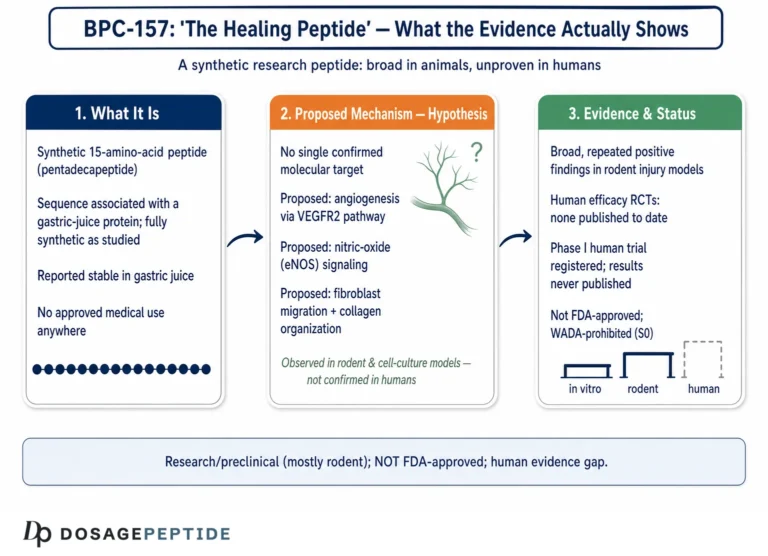
BPC-157 is a chain of fifteen amino acids — a pentadecapeptide — with the sequence Gly-Glu-Pro-Pro-Pro-Gly-Lys-Pro-Ala-Asp-Asp-Ala-Gly-Leu-Val.1 Its story begins in the early 1990s at the University of Zagreb in Croatia, where Predrag Sikiric and colleagues were studying the cytoprotective properties of gastric juice. The team identified a larger protective protein present in human gastric secretions and characterized a partial sequence from it; BPC-157 was first described in this context and formally introduced in the literature around 1993.1,2 The “BPC” abbreviation stands for Body Protection Compound, reflecting the original interest in how the stomach lining shields itself from an extraordinarily hostile chemical environment.
An important nuance often lost in popular summaries: although the sequence is said to be derived from a protein fragment found in gastric juice, BPC-157 as used in research is chemically synthesized, not extracted from human tissue. It also shows no meaningful sequence homology to known gut peptide hormones, which means it is not simply a fragment of a familiar signaling molecule with a familiar receptor.1 That lack of an obvious cognate receptor is one reason the mechanism has remained difficult to pin down after three decades of study.
The name itself is worth unpacking, because it encodes an assumption that colors how the compound is discussed. “Body Protection Compound” frames BPC-157 as inherently protective, and the number 157 refers to its position in the characterization of the parent gastric protein rather than to any pharmacological ranking. This nomenclature came from the original cytoprotection research program, and it has traveled with the peptide into popular usage where the “protection” framing is sometimes treated as an established property rather than a research hypothesis. A neutral reading keeps the name as a historical label, not a summary of proven function. Whether the molecule protects human tissue in any clinically meaningful way is precisely the question that remains open.
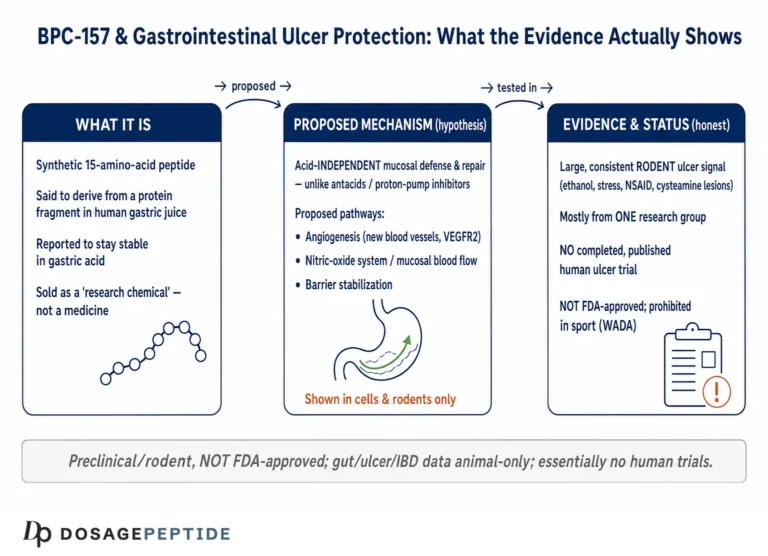
The peptide is frequently described in the literature as “stable gastric pentadecapeptide BPC 157.” The “stable” label refers to a repeatedly reported property: unusual resistance to degradation in human gastric juice, where it is said to survive exposure to hydrochloric acid and pepsin for extended periods without breaking down the way most peptides would.2 This proposed stability is part of what made the compound attractive to its original investigators, because peptides given orally are usually destroyed before they can act. It is worth flagging early, however, that stability in gastric juice is not the same as favorable, well-characterized pharmacokinetics in the human bloodstream — a distinction we return to in the section on limitations.
Nearly the entire foundational body of work on BPC-157 originates from a single research lineage centered on the Zagreb group and its collaborators. Over roughly thirty years, that program has published studies spanning the gastrointestinal tract, tendons, ligaments, muscle, bone, blood vessels, the cardiovascular system, and the nervous system, building a picture of a broadly “organoprotective” molecule.2,3 The breadth is striking, and it cuts two ways. On one hand, a peptide reported to help so many different tissues might be acting on a fundamental, shared repair pathway. On the other hand, a compound reported to benefit virtually every organ system, largely from one investigative source, invites the same skepticism any “cures-everything” claim should. Independent replication across laboratories — the ordinary machinery by which science becomes trustworthy — remains comparatively limited relative to the volume of primary reports.
For readers coming to this compound through the recovery and performance world, BPC-157 is most often discussed alongside soft-tissue and tendon injury, and it is frequently paired with the actin-binding peptide TB-500. Dosage-focused reference material, such as the BPC-157 dosage protocol overview, catalogs how the peptide is typically presented in a research setting — as a lyophilized powder in a vial, reconstituted before use — but presentation format tells you nothing about whether a compound works in humans, and it should not be read as endorsement. What follows is an attempt to separate the mechanistic story from the evidentiary reality.
Proposed Molecular Mechanism
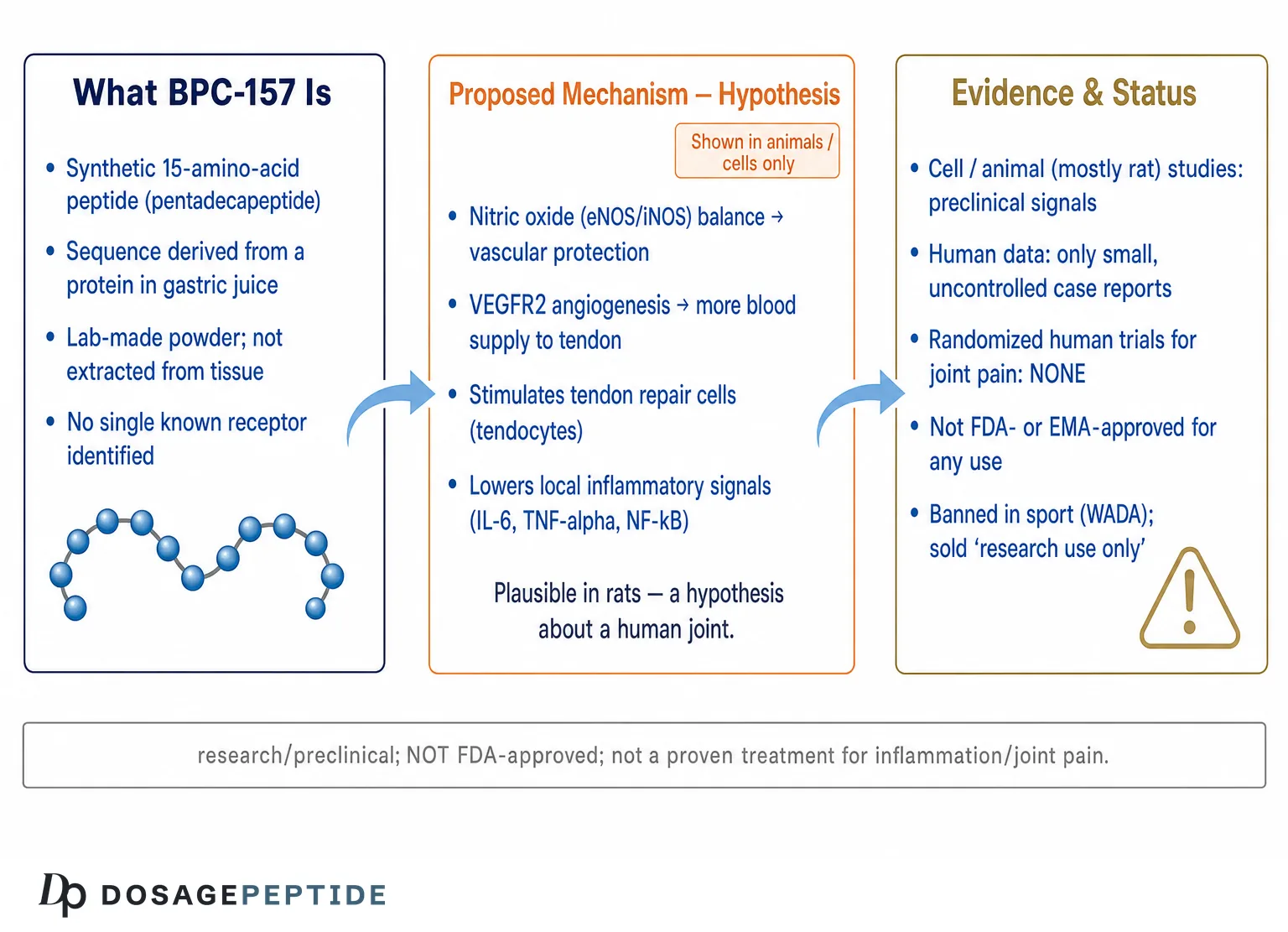
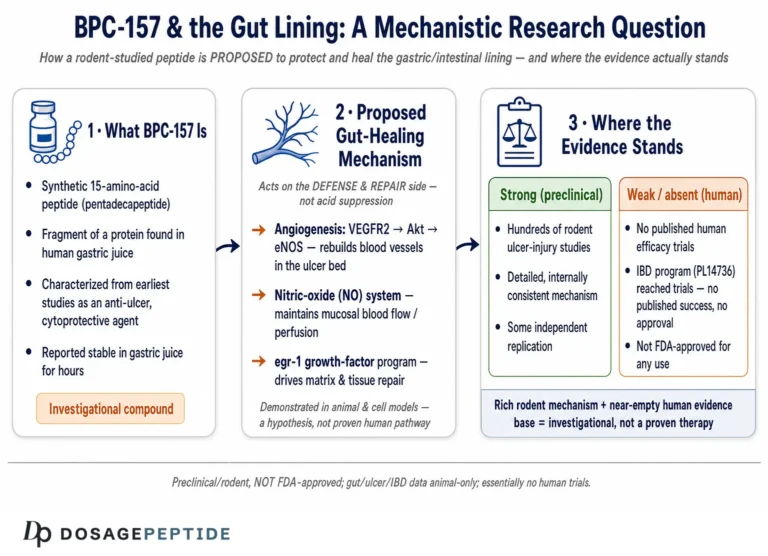
Unlike a classic drug that binds one well-defined receptor, BPC-157 is described in the literature as acting on several interlocking pathways at once. No single, universally accepted receptor has been identified, and much of the “mechanism” is inferred from downstream changes measured in animal tissue rather than from direct binding studies. With that caveat, four proposed threads recur across the primary reports.
The nitric oxide (NO) system. The most consistently emphasized mechanism in the Zagreb literature is interaction with nitric oxide signaling. Studies report that BPC-157 modulates endothelial nitric oxide synthase (eNOS) activity and NO release, and one line of work describes activation of a Src–Caveolin-1–eNOS pathway influencing vascular tone.4 Rather than simply raising NO, the peptide is proposed to normalize NO availability — supporting protective endothelial NO while restraining the inducible, inflammation-associated form (iNOS).3,4 Because NO governs blood-vessel dilation, perfusion, and platelet behavior, this is invoked to explain reported effects in ischemia, wound healing, and blood-pressure regulation in animal models.
Angiogenesis and VEGFR2. A second thread is the promotion of new blood-vessel formation. Preclinical work links BPC-157 to upregulation of vascular endothelial growth factor receptor 2 (VEGFR2) and downstream Akt–eNOS signaling, which in cell and animal studies is associated with endothelial cell migration and capillary formation.5 In poorly vascularized tissues such as tendon and ligament, where limited blood supply is thought to slow healing, enhanced angiogenesis is the proposed link between the peptide and the faster tissue repair reported in rodent injury models.
Growth factor and tendon-cell effects. Beyond vasculature, in vitro studies report that BPC-157 acts on the tendon cells (tendocytes/tendon fibroblasts) themselves. One frequently cited paper found that the peptide increased expression of the growth hormone receptor in cultured tendon fibroblasts and enhanced their proliferation, suggesting a direct cellular effect on the repair machinery rather than a purely indirect, vascular one.6 Related work describes promotion of tendon explant outgrowth, cell survival, and cell migration through pathways including FAK–paxillin signaling, which governs how cells adhere to and remodel the surrounding matrix.7
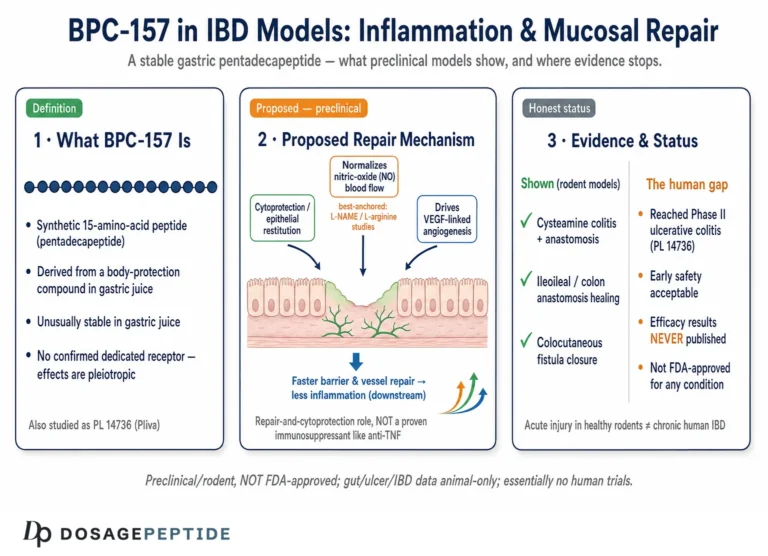
Inflammatory signaling. The fourth thread — the one most relevant to this article’s title — is modulation of inflammation. In rodent injury and ulcer models, BPC-157 has been reported to reduce concentrations of pro-inflammatory cytokines such as interleukin-6 (IL-6) and tumor necrosis factor-alpha (TNF-α), with some reports attributing this to reduced nuclear factor-kappa B (NF-κB) signaling at the transcriptional level.3,8 The framing that appears throughout the literature is that BPC-157 appears to dampen excessive local inflammation without producing the broad immunosuppression associated with steroids — a distinction that is mechanistically plausible in animals but has not been established as clinically meaningful in humans.
| Proposed pathway | Reported effect in models | Relevance to inflammation / joints | Evidence type |
|---|---|---|---|
| Nitric oxide (eNOS / iNOS balance) | Normalized NO availability, vascular protection | Perfusion and endothelial protection at injury sites | Rodent, in vitro3,4 |
| VEGFR2–Akt–eNOS angiogenesis | New capillary formation, endothelial migration | Blood supply to hypovascular tendon/ligament | Rodent, cell culture5 |
| Growth hormone receptor / tendocytes | Increased tendon-cell proliferation | Direct repair-cell stimulation | In vitro6,7 |
| NF-κB / cytokine modulation | Lower IL-6, TNF-α in tissue | Reduced local inflammatory signaling | Rodent3,8 |
Taken together, these mechanisms form a coherent story: better blood supply, stimulated repair cells, and calmer local inflammation could plausibly accelerate healing of an injured joint or tendon. But it is essential to read the table’s right-hand column honestly. Every entry is grounded in animal or cell-culture work. A mechanism that is real in a rat tendon is a hypothesis — not a fact — about a human knee.
The Key Evidence and Its Honest Level
The most useful thing this article can do is state the evidence hierarchy clearly, because the gap between the compound’s reputation and its evidentiary support is the whole story. BPC-157’s evidence sits almost entirely at the preclinical level: in vitro experiments and animal studies, predominantly in rats. There are no adequately powered, randomized, placebo-controlled human trials demonstrating that BPC-157 treats inflammation or joint pain. That single sentence is the honest ceiling on any claim.
Within the preclinical tier, the strongest and most reproducible-looking signals concern tendon and soft-tissue healing. The landmark study is Staresinic and colleagues (2003), published in the Journal of Orthopaedic Research, in which rats underwent complete transection of the Achilles tendon.9 Animals given BPC-157 showed faster gap closure, greater fibroblast density, earlier collagen alignment, more neovascularization, and higher load-to-failure tensile strength at day 14 compared with controls, alongside earlier return of weight-bearing. Companion in vitro work in the same report found that BPC-157 directly stimulated tendocyte proliferation, indicating the effect was not solely secondary to inflammation control. A related study by Krivic and colleagues (2006) reported improved tendon-to-bone healing and, notably, counteraction of the healing impairment caused by systemic corticosteroids.10
These are legitimate, peer-reviewed findings, and they are the reason the compound is taken seriously as a research candidate. But three qualifications must travel with them. First, they are in rodents, whose healing biology, dosing scale, and injury context differ substantially from humans. Second, a large share of this work traces to overlapping author groups, so independent, multi-center replication is thinner than the raw publication count suggests. Third, positive animal results in musculoskeletal repair have a long history of failing to translate into human benefit; the graveyard of “worked in rats” regenerative therapies is crowded.
On the specific question of joints and inflammation in humans, the direct evidence is minimal and low in quality. The most cited human report is a small retrospective chart review by Lee and Padgett describing intra-articular BPC-157 injection for various types of knee pain, in which a majority of a handful of patients reported symptomatic improvement.11 A retrospective case series with roughly a dozen patients, no control group, no blinding, and self-reported outcomes is hypothesis-generating at best. It cannot establish efficacy, cannot separate the peptide’s effect from placebo or natural recovery, and cannot speak to safety in any rigorous way. Treating it as proof that BPC-157 “works” for joint pain would be a serious misreading of what a case series can do.
| Evidence tier | What exists for BPC-157 | What it can support |
|---|---|---|
| In vitro / cell culture | Tendocyte proliferation, endothelial migration, NO signaling6,7 | Mechanistic plausibility only |
| Animal studies (mostly rat) | Achilles/tendon-to-bone healing, cytokine reduction, GI protection3,9,10 | Preclinical proof-of-concept; not human efficacy |
| Human case reports / retrospective series | One small knee-pain chart review11 | Hypothesis-generating; no efficacy claim |
| Randomized controlled human trials | None published for joint pain / inflammation | — |
So where does that leave the title? BPC-157 is best described as a preclinical candidate with an interesting mechanistic profile and encouraging animal data in tissue repair, and essentially no rigorous human evidence for treating inflammation or joint pain. Calling it a “missing link” presumes a level of validation that does not exist. The intellectually honest position is that it is an open question — a compound worth studying, not a therapy worth claiming.
How BPC-157 Compares to Conventional Approaches
Because the title implicitly contrasts BPC-157 with existing options for inflammation and joint pain, it is worth laying out how the proposed mechanism differs from established anti-inflammatory strategies — while keeping firmly in mind that “different mechanism” is not the same as “better,” or even “effective.”
Versus NSAIDs. Nonsteroidal anti-inflammatory drugs (ibuprofen, naproxen, aspirin) work by inhibiting cyclooxygenase enzymes, reducing prostaglandin-driven pain and inflammation. They are genuinely effective analgesics with well-characterized human evidence and well-characterized risks (gastrointestinal bleeding, renal and cardiovascular effects). Critically, NSAIDs relieve symptoms; they do not accelerate structural tissue repair, and chronic use may actually blunt some healing processes. The theoretical contrast drawn in the BPC-157 literature is that the peptide is proposed to promote repair rather than merely suppress symptoms, and animal studies even report that BPC-157 can reverse NSAID-induced gastrointestinal damage.2,3 That contrast is mechanistically real in rodents but has not been demonstrated to yield superior outcomes — or any validated outcome — in humans.
Versus corticosteroids. Corticosteroid injections are powerful anti-inflammatories used for joint pain, but they carry a well-known trade-off: repeated use can weaken tendon and cartilage over time. The intriguing preclinical wrinkle is that BPC-157 has been reported to counteract corticosteroid-induced impairment of tendon healing in rats.10 This makes the peptide a mechanistically interesting research counterpoint to steroids. It does not make it a proven adjunct, and no human data support combining or substituting it for standard care.
Versus TB-500 (Thymosin Beta-4). Within the peptide-research world, BPC-157 is most often compared and combined with TB-500. The two are proposed to act through distinct routes: TB-500 is an actin-sequestering peptide that binds monomeric G-actin and influences cytoskeletal dynamics, cell migration, and angiogenesis, whereas BPC-157 is associated with the NO system, VEGFR2 angiogenesis, and growth-factor/tendocyte effects. Because the pathways are described as complementary — broad cell migration and remodeling for TB-500, localized angiogenesis and tendon-cell signaling for BPC-157 — the two are frequently discussed together in a research context, as in the BPC-157 and TB-500 blend explainer and the corresponding BPC-157 + TB-500 blend dosage per day. It bears repeating that TB-500 is also an unapproved, preclinical compound, so combining two experimental peptides compounds the uncertainty rather than resolving it — there is no human trial evidence that either the blend or its components treats joint disease.
| Approach | Primary mechanism | Human evidence | Repair vs. symptom relief |
|---|---|---|---|
| NSAIDs | COX inhibition → lower prostaglandins | Extensive, approved | Symptom relief; may blunt healing |
| Corticosteroids | Broad immunosuppression | Extensive, approved | Symptom relief; repeated use may weaken tissue |
| BPC-157 | NO / VEGFR2 / tendocyte / NF-κB (proposed) | Preclinical only; not approved | Repair-promotion hypothesized in animals |
| TB-500 | Actin sequestration, cell migration | Preclinical only; not approved | Remodeling hypothesized in animals |
The comparison table is useful precisely because it makes the asymmetry visible. NSAIDs and corticosteroids occupy the “extensive human evidence, approved” rows; BPC-157 and TB-500 do not. Whatever theoretical advantages the peptides carry in mechanism, they lack the one thing that matters most for a treatment claim — controlled evidence that they help people safely. A different mechanism is a reason to run trials, not a reason to skip them.
Research Models and Methodology
Understanding how BPC-157 has been studied clarifies both the strength and the limits of the data. The overwhelming majority of BPC-157 research uses rodent models — principally rats, with some mouse work — complemented by in vitro cell-culture experiments. The typical study design induces a controlled injury or pathological state, administers BPC-157 (or vehicle) by injection, and measures healing, functional, biochemical, or histological outcomes over days to weeks.
The injury models are diverse, which is part of why the literature spans so many organ systems. In musculoskeletal work, common paradigms include surgical transection of the Achilles tendon, detachment of tendon or muscle from bone with subsequent reattachment, muscle crush injuries, ligament transection, and fracture or bone-defect models.9,10 Gastrointestinal models include chemically or NSAID-induced ulcers and colitis. Vascular and organ-protection models include mesenteric artery occlusion and ischemia–reperfusion injury.3 Outcomes are assessed with biomechanical testing (load-to-failure tensile strength), histology (fibroblast density, collagen organization, capillary counts), functional scoring (weight-bearing, locomotion), and molecular assays (cytokine levels, VEGFR2 and eNOS expression).
Two methodological features deserve scrutiny. First, dosing in these studies is generally expressed per kilogram of body weight and often given by intraperitoneal or intramuscular injection, and the doses used span a wide range across papers. Extrapolating from a milligram-per-kilogram rodent dose to a fixed microgram human dose is not straightforward, and allometric scaling assumptions introduce real uncertainty. Second, because a substantial fraction of studies originates from related research groups using shared methods, the risk of systematic bias — in model selection, outcome measurement, or publication of positive results — is not negligible. This is not an accusation of misconduct; it is a structural observation about how confidence is built in science. Confidence comes from diverse, independent laboratories converging on the same finding, and that convergence is still limited for BPC-157 relative to its publication volume.
The in vitro work adds mechanistic resolution but carries its own caveats. Cell-culture systems — cultured tendon fibroblasts, human umbilical vein endothelial cells (HUVECs), and similar — allow researchers to isolate specific effects such as proliferation, migration, or NO release.4,6,7 These experiments are valuable for identifying candidate pathways, but a peptide’s behavior in a dish, at controlled concentrations, in a single cell type, may not reflect its behavior in a living organism with intact circulation, immune surveillance, and metabolism.
It is also worth naming what the field has not done well, because those omissions shape how much confidence the data can bear. Relatively few BPC-157 studies are preregistered, dose–response relationships are inconsistently characterized across papers, blinding of outcome assessors is not always described, and sample sizes in individual experiments are often modest. Head-to-head comparisons against active standards of care — for example, BPC-157 versus an established regenerative or anti-inflammatory intervention under identical conditions — are uncommon. None of these gaps prove the effects are illusory, but each one widens the confidence interval around them. A mature evidence base for a candidate therapy typically includes large, preregistered, blinded animal studies with clear dose–response curves, replicated independently, before human testing begins; BPC-157’s literature is broad in scope but uneven on exactly these quality dimensions, and that unevenness is a genuine limit on interpretation.
A recurring gap across the methodology is pharmacokinetics. A 2022 study in Frontiers in Pharmacology examined the absorption, distribution, metabolism, and excretion of BPC-157 in rats and dogs — useful animal PK data, but still animal data.12 Human pharmacokinetic characterization remains scarce. Without knowing how the compound is absorbed, distributed, metabolized, and cleared in people, and how those parameters relate to any effect, it is impossible to design rational human dosing. Educational reference tools such as a reconstitution and dose-volume calculator can compute how a given powder mass maps to an injection volume, but arithmetic about concentration is not evidence about biological effect or safety, and should never be mistaken for it.
In short, the methodology behind BPC-157 is real science that has produced reproducible-looking signals in animals, while leaving the questions that matter most for humans — dose, exposure, and clinical outcome — largely unanswered.
Safety and Tolerability
Safety discussions of BPC-157 tend to be reassuring, and that reassurance is worth examining carefully, because it rests on a much weaker foundation than the confident tone often implies. The core claim in the literature is that BPC-157 has demonstrated a favorable safety profile in animal studies: a striking absence of reported toxicity, no established lethal dose, and no obvious adverse organ effects at the doses tested. A 2025 literature and patent review in Pharmaceuticals notes that no toxic dose has been determined to date and that animal studies have not reported deaths or gross abnormalities attributable to the peptide.1
That sounds encouraging, but “no toxicity has been found in animals” is a fundamentally different statement from “this compound is safe in humans.” The absence of documented harm in rodent studies designed to detect efficacy is not the same as a formal toxicology program, and it is certainly not the same as the long-term human safety data generated by an approved drug’s development pathway. Several specific limitations should temper any sense of security:
No systematic human safety data. There is no completed, published program of human safety studies establishing tolerability, dose-limiting toxicity, or long-term effects. The same 2025 review notes that regulatory approval has not been granted precisely because of the absence of sufficient, comprehensive clinical studies.1 Anecdotal “well-tolerated” reports from unregulated use are not safety data in any scientific sense; they lack denominators, controls, follow-up, and independent adverse-event capture.
The angiogenesis double edge. The very mechanism proposed to underlie BPC-157’s benefits — promotion of new blood-vessel growth — is also a theoretical safety concern. Angiogenesis is a double-edged process: tumors depend on it to grow and metastasize. A compound that robustly stimulates vessel formation raises a legitimate, if unproven, question about its effect on undiagnosed or pre-existing malignancy. The 2025 review explicitly flags concerns related to angiogenesis stimulation and metabolite activity as areas requiring caution.1 This is not a demonstrated harm; it is an unresolved risk that human trials would need to characterize.
Product-quality risks in unregulated supply. Because BPC-157 is not an approved pharmaceutical, material obtained outside a controlled research supply chain has no guarantee of identity, purity, sterility, or correct concentration. Contaminants, incorrect peptides, endotoxin, and mislabeled quantities are real quality-control hazards with injectable substances, and these risks are independent of the molecule’s intrinsic pharmacology. Much of the perceived “risk” in real-world use may stem from product quality rather than the peptide itself — a distinction that is impossible to police without regulation.
Unknown interactions and populations. Effects during pregnancy and lactation, in children, in people with cancer or vascular disease, and in combination with medications are essentially uncharacterized. “No known interactions” in this context usually means “none have been studied,” which is not the same as “none exist.”
The honest bottom line on safety is asymmetric with the optimistic tone often attached to it: animal data have not surfaced obvious toxicity, which is a reasonable starting point for further study, but the human safety of BPC-157 is genuinely unknown. Absence of evidence of harm is not evidence of safety, and the specific theoretical concern around angiogenesis is not something that reassurance can wave away — it is something only rigorous clinical study could resolve.
Handling and Reconstitution in a Research Context
This section is included for completeness and describes how BPC-157 is handled as a laboratory research material. It is not instructions for human use, which would be inappropriate for an unapproved compound, and it should be read purely as description of research-context practice.
BPC-157 is supplied for research as a lyophilized (freeze-dried) white powder in a sealed glass vial, typically in quantities such as 5 mg or 10 mg. Lyophilized peptide is comparatively stable and is generally stored cold and protected from light and moisture until it is reconstituted — that is, dissolved into liquid. In a research setting the standard diluent is bacteriostatic water (sterile water containing a small amount of benzyl alcohol as a preservative), which is added slowly against the inside wall of the vial rather than injected directly onto the powder, allowing the peptide to dissolve gently without excessive agitation. The vial is swirled, not shaken, because vigorous shaking can shear and denature peptides.
Once reconstituted, BPC-157 in solution is far less stable than the dry powder and is generally kept refrigerated at roughly 2–8 °C and shielded from light, with the understanding that a dissolved peptide has a limited useful window. General handling principles for research peptides — cold storage of powder, careful reconstitution, refrigeration of solution, avoidance of repeated freeze–thaw cycles — are covered in generic terms in a peptide reconstitution and storage reference. The arithmetic of converting a powder mass and a diluent volume into a concentration is straightforward chemistry, but it is worth stating plainly that computing a concentration says nothing about whether a dose is safe or effective — it is bookkeeping, not pharmacology.
Concentration and volume relationships are the one genuinely objective part of handling. If a 10 mg vial is reconstituted with 2 mL of bacteriostatic water, the resulting concentration is 5 mg/mL, or 5000 mcg per mL; a 0.1 mL volume would then contain 500 mcg. These relationships are deterministic and are the sort of thing a dosage reference index tabulates. The table below illustrates the arithmetic only, not a recommendation.
| Vial mass | Bacteriostatic water added | Concentration | Volume containing 250 mcg |
|---|---|---|---|
| 5 mg | 2 mL | 2.5 mg/mL (2500 mcg/mL) | 0.10 mL |
| 5 mg | 1 mL | 5 mg/mL (5000 mcg/mL) | 0.05 mL |
| 10 mg | 2 mL | 5 mg/mL (5000 mcg/mL) | 0.05 mL |
| 10 mg | 3 mL | 3.33 mg/mL (3333 mcg/mL) | 0.075 mL |
None of this addresses the questions that actually matter for whether BPC-157 could ever be a treatment: what exposure a given amount produces in the human body, what that exposure does biologically, and whether it is safe over time. Handling is the easy, knowable part. The hard, unknown part is everything downstream of the injection — which is exactly what has not been studied in humans.
Limitations and the Human-Evidence Gap
If a single section deserves the most weight in an honest treatment of BPC-157, it is this one, because the limitations are not peripheral caveats — they define the compound’s actual status. The central problem is stark: after roughly three decades of research and a large preclinical literature, there is still no robust human clinical trial evidence that BPC-157 treats inflammation, joint pain, or anything else.
The translation gap. Rodent healing biology is not human healing biology. Rats heal faster, scale differently, and are studied under controlled injury conditions that do not replicate chronic human joint disease, degenerative osteoarthritis, or the multifactorial reality of a painful human knee. The history of regenerative medicine is littered with compounds that produced beautiful rat data and then failed — for efficacy or safety — when finally tested in people. There is no reason to assume BPC-157 is exempt from this pattern, and every reason to withhold judgment until human data exist.
The clinical-trial vacuum. A widely referenced point in the compound’s history is that a company (PharmaCotherapia) reportedly initiated an early-phase human trial in the mid-2010s, but results were never submitted or published, and the program did not deliver the foundational human safety and pharmacokinetic data such a trial is designed to produce. For completeness, this was not the only human program: earlier, the Zagreb group and the Croatian firm Pliva ran Phase II trials of BPC-157 (as PL-14736 / PLD-116) for inflammatory bowel disease, but those data were, likewise, never fully published in the peer-reviewed literature — so they do not change the core picture of no completed, published trial for joint pain or inflammation. As a result, the human doses discussed in unregulated settings are extrapolations from animal work, not conclusions from human studies. The published human record consists of a handful of small, uncontrolled reports — most prominently the retrospective knee-pain series discussed earlier — which cannot substitute for randomized controlled trials.11,12
Source concentration and independent replication. The concentration of the primary literature within a limited set of related research groups means the ordinary error-correcting process of science — independent labs, adversarial replication, systematic reviews with low risk-of-bias — is underdeveloped for this molecule. This does not mean the findings are wrong; it means they are less thoroughly stress-tested than the publication count might suggest.
Publication and reporting bias. Preclinical literatures skew toward positive findings. Studies showing that a compound “works” are more likely to be written up and published than those showing nothing, which can inflate the apparent consistency of an effect. Without preregistered animal protocols and negative-result reporting, the true signal-to-noise ratio is hard to know.
Unknown pharmacokinetics in humans. As noted, human PK is essentially uncharacterized.12 Not knowing how long the peptide persists, where it distributes, or how it is cleared in people makes rational human dosing impossible and makes any claim about a specific “effective dose” unsupportable.
The cumulative effect of these limitations is not that BPC-157 is disproven — it is that the compound remains an unanswered question. The appropriate scientific stance is neither dismissal nor enthusiasm but suspended judgment: a candidate that merits properly designed human trials, and whose therapeutic claims should wait for them. Framing it as a “missing link” for joint pain inverts the burden of proof. In medicine, a compound is not assumed effective until proven otherwise; it is assumed unproven until rigorous evidence says otherwise, and for BPC-157 that evidence does not yet exist.
Regulatory Status
BPC-157 occupies an unusual and shifting regulatory position, and getting the details right matters because the space is full of misconceptions. The single most important fact is unchanged and unambiguous: BPC-157 is not approved as a drug by the FDA, the EMA, or any comparable regulator for any human indication. It is an investigational, unapproved compound, legally handled as a research chemical rather than a medicine.1
The regulatory story in the United States has centered on pharmacy compounding under Section 503A of the Federal Food, Drug, and Cosmetic Act. In 2023, the FDA placed BPC-157 into the “Category 2” grouping of bulk drug substances — substances identified as raising significant safety concerns or lacking sufficient data — which effectively barred compounding pharmacies from using it. The agency cited issues including insufficient safety characterization, uncertainty about the peptide, and questions around impurities and immunogenicity.13 That action is what pushed BPC-157 firmly out of the legitimate compounded-medication space and into a purely research-only status.
More recently, the picture shifted again. In 2026, reporting and regulatory documents indicate that the FDA removed BPC-157 from the Category 2 list amid a fresh review cycle and withdrawn nominations under the 503A framework.13 It is crucial to interpret this correctly, because it is widely misread. Removal from the Category 2 restricted list does not mean the FDA approved BPC-157, and it does not mean the peptide was added to the list of substances permitted for compounding. It reflects a procedural change in an ongoing review, not an endorsement of safety or efficacy. The compound remains unapproved, and its evidentiary status — preclinical, with no adequate human trials — is exactly what it was before.
Several practical regulatory realities follow from this status. BPC-157 sold in the research market is labeled “for research use only” and “not for human consumption,” and such material is not manufactured to pharmaceutical quality standards. In sport, the situation is also relevant: BPC-157 is prohibited by the World Anti-Doping Agency (WADA), which lists it among non-approved substances banned at all times, so athletes subject to anti-doping rules face sanctions for its use regardless of the FDA picture. And because it is not an approved drug, there is no regulated manufacturing oversight, no approved labeling, and no post-market safety surveillance of the kind that governs medicines.
| Body / framework | Status of BPC-157 |
|---|---|
| FDA (drug approval) | Not approved for any human indication1 |
| FDA 503A compounding | Placed in Category 2 (2023); removed from that list amid review (2026) — not an approval and not added to permitted bulks13 |
| EMA | No marketing authorization |
| WADA (sport) | Prohibited at all times (non-approved substance) |
| Commercial labeling | “Research use only; not for human consumption” |
The regulatory takeaway aligns with the scientific one. Every layer of oversight that would normally certify a compound as a treatment — approval, quality manufacturing, sanctioned clinical use — is absent for BPC-157. Its shifting position on a compounding list is a procedural detail, not a change in what the science shows. Until adequate human trials exist and a regulator grants approval, BPC-157 remains a research compound, and describing it as a treatment for inflammation or joint pain would be inaccurate.
Frequently Asked Questions
Is BPC-157 an approved treatment for joint pain or inflammation?
No. BPC-157 is not approved by the FDA, EMA, or any comparable regulator for joint pain, inflammation, or any other human condition. It is an investigational, research-only compound. The bulk of the evidence is preclinical — cell-culture and animal (mostly rat) studies — and there are no adequately designed, randomized, placebo-controlled human trials demonstrating that it treats inflammatory or joint conditions. Any framing of it as an established therapy is inaccurate.
What does the research actually show about BPC-157 and healing?
In animal and in vitro models, BPC-157 has been associated with faster tendon and soft-tissue healing, increased angiogenesis, stimulation of tendon cells, and reduced local inflammatory cytokines.6,7,9,10 These are legitimate peer-reviewed preclinical findings, and they are why the compound is studied. But they are not human efficacy data. Positive rodent results in regenerative medicine frequently fail to translate to humans, so the honest reading is “promising in animals, unproven in people.”
Is BPC-157 considered safe?
Its human safety is genuinely unknown. Animal studies have not established a toxic dose or surfaced obvious organ toxicity, which is a reasonable starting point for further study, but that is not the same as demonstrated human safety.1 There are specific unresolved concerns — notably that its pro-angiogenic mechanism could theoretically affect undiagnosed tumor growth — plus real product-quality risks with unregulated injectable material. Absence of evidence of harm is not evidence of safety.
How does BPC-157 differ from NSAIDs or corticosteroids?
NSAIDs and corticosteroids are approved, well-studied anti-inflammatories that relieve symptoms; they are not designed to accelerate structural tissue repair, and both carry known risks with prolonged use. BPC-157 is proposed, in animals, to promote repair through angiogenesis, nitric oxide signaling, and tendon-cell stimulation rather than simply suppressing inflammation.3,10 A different mechanism, however, is not the same as proven benefit — the peptide has no controlled human evidence, whereas the conventional drugs do.
Why are BPC-157 and TB-500 often discussed together?
They are proposed to act through complementary pathways — TB-500 through actin sequestration and broad cell migration, BPC-157 through localized angiogenesis and tendon-cell signaling — so they are frequently paired in research discussions and blends. Importantly, both are unapproved, preclinical compounds. Combining two experimental peptides multiplies uncertainty rather than resolving it, and there is no human trial evidence that either alone or together treats joint disease.
Has BPC-157 ever been tested in human clinical trials?
Very little. An early-phase human trial was reportedly initiated in the mid-2010s, but results were never published, leaving no foundational human safety or pharmacokinetic data.12 The published human record consists of a few small, uncontrolled reports, most notably a retrospective knee-pain chart review.11 These are hypothesis-generating at best and cannot establish efficacy or safety. Human pharmacokinetics — how the peptide behaves in the body — remains essentially uncharacterized.
What is BPC-157’s current legal and regulatory status?
It is unapproved everywhere as a drug. In the U.S. it was placed in the FDA’s 503A Category 2 (restricted for compounding) in 2023 and later removed from that list amid an ongoing review in 2026 — a procedural change that is not an approval and does not permit compounding.1,13 It is sold only as “research use only” material and is prohibited in sport by WADA. Nothing about its regulatory status establishes it as a treatment.
References
- Józwiak M, Bauer M, Kamysz W, Kleczkowska P. Multifunctionality and Possible Medical Application of the BPC 157 Peptide—Literature and Patent Review. Pharmaceuticals (Basel). 2025;18(2):185. Available at: https://pmc.ncbi.nlm.nih.gov/articles/PMC11859134/
- Seiwerth S, Milavic M, Vukojevic J, et al. Stable Gastric Pentadecapeptide BPC 157 and Wound Healing. Front Pharmacol. 2021;12:627533. Available at: https://pmc.ncbi.nlm.nih.gov/articles/PMC8275860/
- Sikiric P, Boban Blagaic A, Strbe S, et al. The Stable Gastric Pentadecapeptide BPC 157 Pleiotropic Beneficial Activity and Its Possible Relations with Neurotransmitter Activity. Pharmaceuticals (Basel). 2024;17(4):461. Available at: https://pmc.ncbi.nlm.nih.gov/articles/PMC11053547/
- Hsieh MJ, et al. Modulatory effects of BPC 157 on vasomotor tone and the activation of the Src-Caveolin-1-endothelial nitric oxide synthase pathway. Sci Rep / PMC. 2020. Available at: https://www.ncbi.nlm.nih.gov/pmc/articles/PMC7555539/
- Hsieh MJ, Liu HT, Wang CN, et al. Therapeutic potential of pro-angiogenic BPC157 is associated with VEGFR2 activation and up-regulation. J Mol Med (Berl). 2017;95(3):323-333. Available at: https://pubmed.ncbi.nlm.nih.gov/27847966/
- Chang CH, Tsai WC, Hsu YH, Pang JHS. Pentadecapeptide BPC 157 Enhances the Growth Hormone Receptor Expression in Tendon Fibroblasts. Molecules / PMC. Available at: https://www.ncbi.nlm.nih.gov/pmc/articles/PMC6271067/
- Chang CH, Tsai WC, Lin MS, Hsu YH, Pang JHS. The promoting effect of pentadecapeptide BPC 157 on tendon healing involves tendon outgrowth, cell survival, and cell migration. J Appl Physiol. 2011. Available at: https://journals.physiology.org/doi/abs/10.1152/japplphysiol.00945.2010
- Yuan C, et al. From Regeneration to Analgesia: The Role of BPC-157 in Tissue Repair and Pain Management. Int J Mol Sci. 2026;27(6):2876. Available at: https://pmc.ncbi.nlm.nih.gov/articles/PMC13026520/
- Staresinic M, Sebecic B, Patrlj L, et al. Gastric pentadecapeptide BPC 157 accelerates healing of transected rat Achilles tendon and in vitro stimulates tendocytes growth. J Orthop Res. 2003;21(6):976-983. Available at: https://onlinelibrary.wiley.com/doi/10.1016/S0736-0266(03)00110-4
- Krivic A, Anic T, Seiwerth S, et al. Achilles detachment in rat and stable gastric pentadecapeptide BPC 157: promoted tendon-to-bone healing and opposed corticosteroid aggravation. J Orthop Res. 2006;24(5):982-989. Available at: https://onlinelibrary.wiley.com/doi/abs/10.1002/jor.20096
- Lee E, Padgett BJ. Intra-Articular Injection of BPC 157 for Multiple Types of Knee Pain (retrospective chart review). Altern Ther Health Med. 2021;27(4):8-13. Available at: https://asipp.org/wp-content/uploads/Intra-Articular-Injection-of-BPC-157-for-Multiple-Types-of-Knee-Pain-2021-Alternative-Therapies-in-Health-and-Medicine.pdf
- He L, et al. Pharmacokinetics, distribution, metabolism, and excretion of body-protective compound 157, a potential drug for treating various wounds, in rats and dogs. Front Pharmacol. 2022;13:1026182. Available at: https://pmc.ncbi.nlm.nih.gov/articles/PMC9794587/
- U.S. Food and Drug Administration. Interim policy on compounding using bulk drug substances under Section 503A (Category 2 list); Pharmacy Compounding Advisory Committee (PCAC) briefing materials on BPC-157; and FR Doc. 2015-27412 (List 1/List 2 framework). Landing page: https://www.fda.gov/drugs/human-drug-compounding/bulk-drug-substances-used-compounding-under-section-503a-fdc-act ; PCAC materials: https://www.fda.gov/advisory-committees/human-drug-advisory-committees/pharmacy-compounding-advisory-committee
Educational and research-use disclaimer: This article is provided for educational and informational purposes only and describes preclinical and early research on BPC-157. BPC-157 is an unapproved, investigational compound. It is not approved by the FDA, EMA, or any comparable authority for the treatment of inflammation, joint pain, or any other condition, and it is not a proven therapy. Nothing here is medical advice, a treatment recommendation, a dosing protocol, or an endorsement of human use. Any references to handling or reconstitution describe laboratory research practice only. Individuals with medical conditions should consult a qualified, licensed healthcare professional and rely on approved, evidence-based treatments.