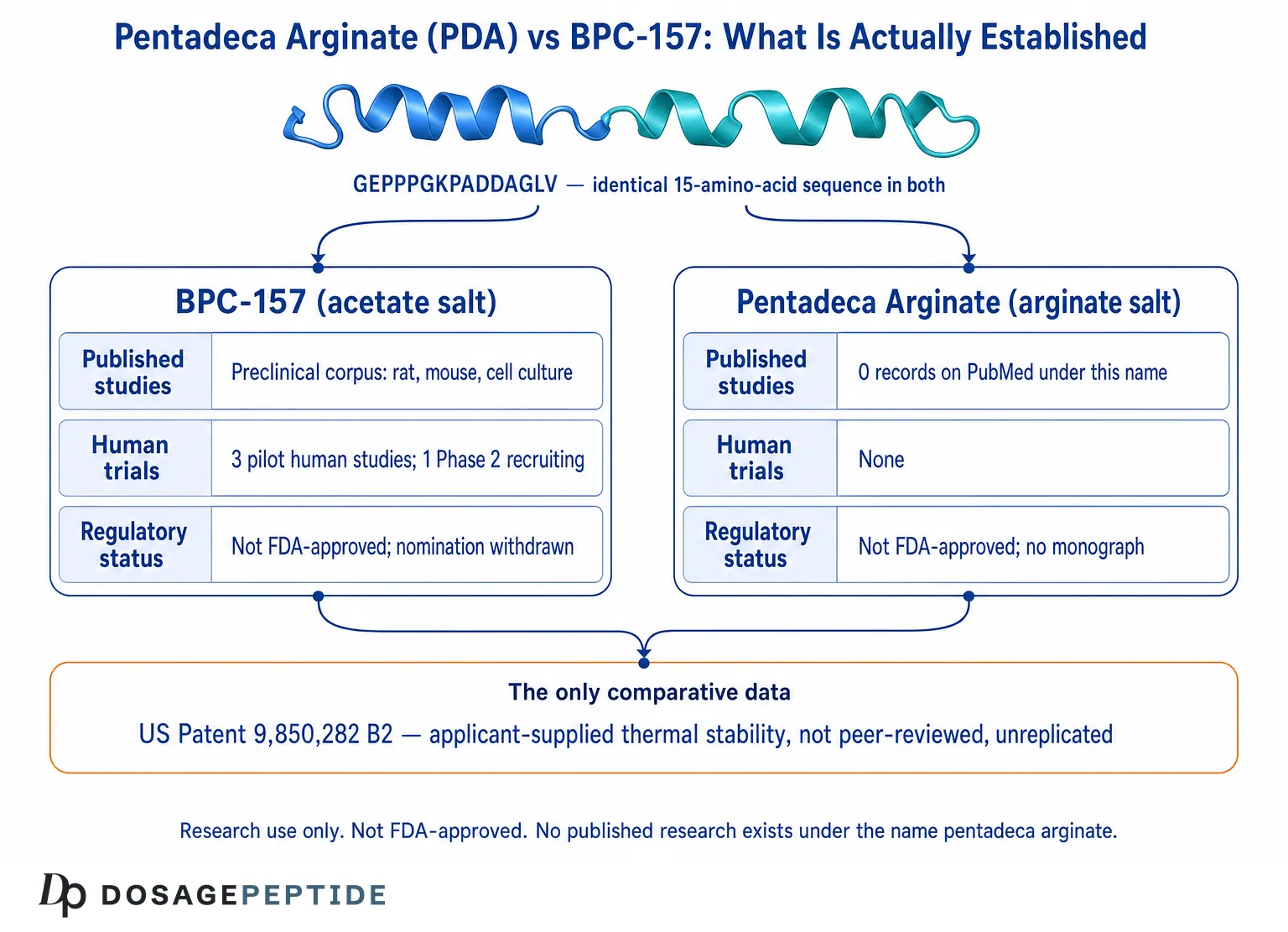
Pentadeca Arginate (PDA) is not a new peptide. It is the same 15–amino–acid sequence as BPC-157 — GEPPPGKPADDAGLV — supplied as an arginine (arginate) salt instead of the conventional acetate salt. As of August 2026 a PubMed search for “pentadeca arginate” returns zero results[1], ClinicalTrials.gov lists zero registered studies under that name, and every efficacy claim circulating for PDA is extrapolated from BPC-157 rodent work. The “more stable, better absorbed” positioning that defines PDA in the marketplace has no peer-reviewed support: the only head-to-head stability data that exist anywhere sit in a 2013 patent application filed by a commercial party, and the specific figures repeated in marketing copy do not appear even there.
Pentadeca Arginate vs BPC-157: the honest comparison
| Attribute | Pentadeca Arginate (PDA) | BPC-157 (acetate/free base) |
|---|---|---|
| Peptide sequence | GEPPPGKPADDAGLV (15 residues) | GEPPPGKPADDAGLV (15 residues) — identical |
| What differs | Counter-ion (arginine) as marketed | Counter-ion (acetate), the standard salt after solid-phase synthesis |
| Peer-reviewed studies under this name | Zero on PubMed[1] | 173 indexed records for “pentadecapeptide BPC 157” (August 2026), overwhelmingly animal and in-vitro |
| Registered clinical trials | Zero on ClinicalTrials.gov | Three records; one Phase 2 trial recruiting since Feb 2026[13] |
| Published human efficacy data | None | None of consequence; only three small pilot studies[5] |
| Comparative stability data (arginate vs acetate) | No peer-reviewed study. Accelerated thermal-degradation data appear only in a commercial patent, unreplicated[9] | |
| Comparative pharmacokinetic data | None published | None published for this comparison |
| FDA approval status | Not FDA-approved for any indication | Not FDA-approved for any indication[15] |
| FDA compounding position | Not named in any FDA list, nomination or advisory-committee agenda | Listed on FDA’s significant-safety-risk page under “nominated but withdrawn” (previously category 2)[10] |
| WADA status (2026 List) | Same sequence, so same S0 exposure | Prohibited at all times under S0 Non-Approved Substances[15] |
| Evidence tier | Research chemical with no published data under this name | Preclinical/animal-heavy; one Phase 2 trial ongoing, no results posted |
That table is the article in miniature. If you were hoping to find a column where PDA holds a documented advantage, there is not one — not because PDA has been tested and failed, but because it has barely been tested at all as a distinct entity, and what testing exists has never been through peer review. Everything below explains why that distinction matters and what the underlying BPC-157 record does and does not support. If you are new to the terminology used here, our peptide research glossary defines salt forms, counter-ions and evidence tiers.
What is pentadeca arginate (PDA), chemically?
“Pentadeca” simply means fifteen. It is shorthand for pentadecapeptide — a peptide of fifteen amino acids. “Arginate” refers to the counter-ion the peptide is paired with in the finished powder. So “pentadeca arginate” is a descriptive trade name meaning, roughly, “the fifteen-residue peptide, as an arginine salt.” It is not a systematic chemical name assigned by IUPAC, and it does not appear in any pharmacopoeia, in the FDA’s compounding nomenclature, or in the peer-reviewed literature.
The sequence is BPC-157’s sequence
The peptide underneath the name is Body Protection Compound 157, a partial sequence of a larger protein originally identified in human gastric juice. Its primary structure is Gly-Glu-Pro-Pro-Pro-Gly-Lys-Pro-Ala-Asp-Asp-Ala-Gly-Leu-Val (GEPPPGKPADDAGLV), molecular weight approximately 1,419 Da — the sequence and mass reported in the original Zagreb tendon work[2]. No vendor selling PDA claims a different sequence. Several state outright that the two are the same molecule in different salt forms.
That matters because sequence identity means every pharmacological argument made for PDA is, by construction, an argument about BPC-157. There is no PDA-specific receptor story, no PDA-specific mechanism, no PDA-specific animal model. When a marketing page describes PDA’s effect on angiogenesis or tendon fibroblasts, it is describing rodent and cell-culture experiments performed on BPC-157 acetate, sometimes twenty years ago.
What a “salt form” actually changes — and what it does not
A salt form changes the counter-ion, not the covalent peptide. BPC-157 carries three acidic side chains (one glutamate, two aspartates) against a single lysine, giving the peptide a net negative charge at physiological pH. Peptides made by solid-phase synthesis normally emerge as trifluoroacetate salts because trifluoroacetic acid is used in resin cleavage and purification; that TFA is then usually exchanged for acetate, which regulators view more favourably. Pairing the peptide with arginine instead is chemically coherent. What is missing is public characterisation of the material actually being sold: there is no published ion-chromatography, NMR or elemental analysis of a marketed “PDA” lot confirming its counter-ion identity or stoichiometry.
Does a counter-ion swap change how a peptide behaves? Honestly: sometimes, and it is an empirical question every time. Counter-ion identity has been shown to influence lyophilisation behaviour, reconstituted-solution pH and peptide aggregation for at least one clinical-stage peptide, where acetate counter-ions sublimed away during freeze-drying and the peptide then aggregated under mechanical stress[7]. But a 2025 head-to-head study that directly compared trifluoroacetate and hydrochloride salt forms of a therapeutic peptide hydrogel found no significant difference in biostability, cytotoxicity, drug release or rheology for the properties relevant to its intended use[6]. In other words, salt form can matter, frequently does not, and is never assumed — it is measured, then published, then replicated.
How much published research exists on pentadeca arginate?
None. This is the single most important fact in the article, and it deserves to be stated without hedging. A PubMed query for the exact phrase “pentadeca arginate” returns zero indexed records — and so does the looser query pairing “pentadeca” with “arginate” anywhere in the record[1]. Querying “BPC 157” with “arginate” also returns zero. ClinicalTrials.gov returns zero studies for “pentadeca arginate”. There is no PDA toxicology package, no peer-reviewed PDA stability study, no PDA bioavailability curve, no PDA safety series — not a poor one, not a small one, none.
By contrast, “pentadecapeptide BPC 157” retrieves 173 indexed records as of August 2026. That is a real literature, but it is a literature about a differently-named, differently-formulated material, and, as reviewed below, it is dominated by animal work. Extrapolating from BPC-157 acetate rodent data to a human using an arginate-salt product involves two separate leaps: species and formulation. Neither is trivial, and marketing copy that presents PDA as “the researched one” is collapsing both leaps into silence.
What does the BPC-157 evidence base actually show?
Preclinical: broad, consistent, and almost entirely in animals
The BPC-157 preclinical record is genuinely large. In transected rat Achilles tendon, BPC-157 improved load-to-failure, Young’s modulus, functional index scores and histological organisation compared with saline controls across a 14-day time course[2]. In cultured rat tendon fibroblasts, it accelerated explant outgrowth, improved survival under hydrogen-peroxide stress and increased migration in a dose-dependent manner, with dose-dependent phosphorylation of FAK and paxillin[3]. A 2017 study in Journal of Molecular Medicine reported pro-angiogenic activity in chick chorioallantoic membrane and endothelial tube-formation assays, faster blood-flow recovery in a rat hind-limb ischaemia model, and upregulation plus internalisation of VEGFR2 with downstream Akt–eNOS activation[4].
Two caveats belong alongside that list, and reviewers make both. First, a substantial share of the corpus comes from a single research group in Zagreb, and independent replication by unaffiliated laboratories is limited. Second, the models are rats, mice, chick membranes and cell culture — not people. A 2025 narrative review in Current Reviews in Musculoskeletal Medicine concluded that despite broad preclinical support, human data are extremely limited and that BPC-157 should be considered investigational, its use approached with caution, pending well-designed clinical trials[5].
Human: three pilot studies, no completed efficacy trial
That same 2025 review identified only three published human studies of BPC-157: intra-articular injection for knee pain, an intravesicular study in interstitial cystitis, and an intravenous safety/pharmacokinetics assessment. No adverse effects were reported, but none of these establishes efficacy for any condition[5]. On ClinicalTrials.gov, the oldest registered entry is a Phase 1 pilot of oral BPC-157 tablets in 42 healthy volunteers in Tijuana, registered in 2015 with a listed completion date of March 2016 — its status is still shown as “Unknown” and no results have been posted[14]. A decade later, that pharmacokinetic dataset remains unpublished.
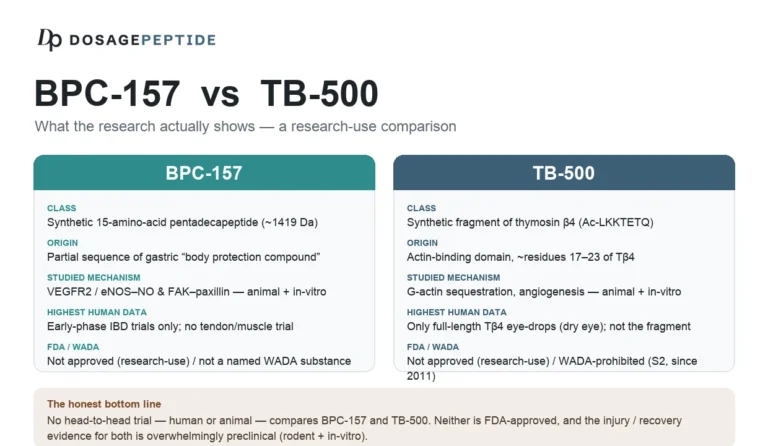
The one genuinely new development is recent. A randomised, double-blind, placebo-controlled Phase 2 trial (NCT07437547, sponsor Hudson Biotech) began recruiting in February 2026 to test subcutaneous BPC-157 versus placebo for 14 days in 120 participants with MRI-confirmed grade II hamstring strain, alongside standardised rehabilitation. Co-primary endpoints are time to unrestricted sport and change in MRI-assessed injury volume at Day 14; primary completion is scheduled for February 2027[13]. That is the first properly controlled musculoskeletal efficacy test of this peptide in humans. It is recruiting, not reporting — no results exist — and it is testing BPC-157, not pentadeca arginate. For how this compares with the evidence base of other repair-associated peptides, see our review of peptides studied for healing and recovery and our side-by-side of BPC-157 vs TB-500.
Where does the “more stable, better absorbed” claim come from?
Two claims dominate PDA marketing: that the arginate salt is dramatically more stable in acid than the acetate salt, and that it is therefore better absorbed. Tracing them leads somewhere more specific than “vendor copy” — and the destination is instructive.
The patent that started it
There is a granted US patent covering exactly this idea: Stable pentadecapeptide salts (US 9,850,282 B2), inventor Rudolf Rucman, assignee Diagen d.o.o., filed May 2013 and granted December 2017. It describes salts of the GEPPPGKPADDAGLV pentadecapeptide with basic amino acids — arginine, lysine, ornithine — and claims “significantly improved thermal stability and also stability in gastric juice” relative to earlier forms. It reports supporting figures: after 388 hours at 50 °C in water, the arginine salt retained 99.01 % of pentadecapeptide content versus 21.30 % for the acetate. It also specifies the conditions under which such a salt is defined — a 1:1 peptide-to-amino-acid molar ratio at pH 4.60 ± 0.05, or 1:2 at pH 7.40 ± 0.05[9].
So comparative data are not literally non-existent. But a patent is not a paper, and the difference is the whole point. The experiments are supplied by an applicant seeking exclusive rights, not by an independent laboratory; nothing in the filing has been peer-reviewed, refereed or replicated by anyone else; the measurement is accelerated thermal degradation in water, which is a formulation-shelf-life question rather than a pharmacokinetic or bioavailability one; and a patent describing how to make a salt is not evidence that any particular product on sale today is that salt, at that stoichiometry, at that pH. Between the 2013 filing and the vial in a shipping box lies a chain of manufacturing that nobody has published.
What the marketing adds on top
The most widely repeated assertion — that PDA is “1,000 times more stable” than BPC-157 acetate at pH 3.0 — appears in no peer-reviewed journal, and it does not appear in the patent either. The patent’s own numbers describe a different experiment at a different temperature in a different medium. Wherever the round figure came from, it is not a published measurement, and it is quoted without a source everywhere it appears.
The softer version of the claim is no better supported. A representative compounding-pharmacy page states that PDA is the same 15–amino–acid sequence “with the ‘Arginate’ referring to the salt form it’s bound to for enhanced stability and solubility,” and cites no study for the enhancement. That pattern — a specific physicochemical assertion with no reference attached — recurs across essentially every commercial PDA page we examined.
Note also the internal tension in the pitch. Acid stability is a meaningful selling point mainly for an oral product, since pH 3.0 is roughly gastric — and the patent’s framing, “stability in gastric juice,” is likewise an oral-dosing argument. Yet PDA is overwhelmingly sold as a lyophilised powder for reconstitution and subcutaneous injection, a route that bypasses the stomach entirely. If the acid-stability claim were true and material, it would argue for oral dosing — a route where BPC-157’s own human pharmacokinetics remain unpublished. We cover that specific question separately in BPC-157 oral vs injection.
What is the regulatory status of PDA and BPC-157 in August 2026?
FDA: not approved, and flagged for characterisation problems
Neither BPC-157 nor pentadeca arginate is FDA-approved for any indication, in any dosage form, for any population. BPC-157 “is not approved for human clinical use by the U.S. Food and Drug Administration (FDA) or any other global health authority”[15].
Beyond non-approval, FDA has published a specific safety assessment. BPC-157 appears on the agency’s page listing bulk drug substances for compounding that may present significant safety risks. Its exact placement matters and is often misreported: BPC-157 sits in the section headed “Bulk drug substances nominated but withdrawn”, which FDA describes as substances “previously in category 2 of the interim policies” whose nominations “were withdrawn by the nominators.” It is not currently an active category 2 listing with its own effective date. FDA’s stated concern is retained on the page regardless: compounded drugs containing BPC-157 “may pose risk for immunogenicity for certain routes of administration and may have complexities with regard to peptide-related impurities and active pharmaceutical ingredient (API) characterization,” with the agency identifying “no, or only limited, safety-related information for the proposed routes of administration”[10]. The word “arginate” does not appear anywhere on that page.
Read that rationale closely, because it is not a claim that BPC-157 has been shown to be dangerous. It is a claim that FDA does not know what the material is with sufficient precision, and lacks the data to judge harm. That criticism applies with more force, not less, to an arginate salt with no published characterisation of marketed material at all.
The July 2026 advisory committee vote — and what it did not cover
On 23–24 July 2026, FDA’s Pharmacy Compounding Advisory Committee met to discuss several peptides for possible inclusion on the 503A Bulks List. The FDA agenda names the substances precisely: “BPC-157-related bulk drug substances (BPC-157 (free base)/ BPC-157 acetate)”, with the single use evaluated listed as ulcerative colitis — alongside KPV, TB-500 and MOTS-c in their free-base and acetate forms[11]. The word “arginate” does not appear anywhere on FDA’s meeting page. Nor does any musculoskeletal indication for BPC-157.
The committee voted 8 to 6, with one abstention, to recommend BPC-157, over the objections of FDA’s own review scientists. Their objection is worth hearing in their words: one reviewer asked simply “What is BPC-157?”, noting disagreement over how the substance is even defined; another said the agency “cannot establish quality standards” without a clearer understanding; a third concluded the peptide is “not well-characterized”[12]. Three points must travel with that headline. First, FDA states plainly that advisory committees “make non-binding recommendations to the FDA, which generally follows the recommendations but is not legally bound to do so”[11]. Second, any change to the bulks list requires notice-and-comment rulemaking, a process measured in many months to years. Third — and most relevant here — the vote concerned the free base and acetate forms for ulcerative colitis. A recommendation about BPC-157 acetate is not a recommendation about pentadeca arginate, and a vote is not an approval. As of 17 August 2026, nothing has been approved.
WADA: prohibited at all times under S0
For anyone in tested sport the position is unambiguous. BPC-157 is prohibited under the S0 Non-Approved Substances category of the WADA Prohibited List — a category that applies at all times, in and out of competition — precisely because it is not approved for human therapeutic use by any government health authority[15]. USADA states that a therapeutic use exemption is unlikely to be approved, because permitted alternatives are available, while noting that each TUE application is considered case by case. S0 is a catch-all category rather than a named entry, which is why searching the List for “BPC-157” can mislead. Renaming the same sequence “pentadeca arginate” changes nothing: S0 captures the substance, not the label. Validated UHPLC–HRMS methods detect BPC-157 at 0.01 ng/mL and five of its metabolites at 0.03–0.11 ng/mL in human urine[8] — and those methods key on the peptide and its fragments, which are identical for PDA.
Is pentadeca arginate different from BPC-157 in any way that has been demonstrated?
To answer this cleanly, separate three questions that marketing tends to blur.
- Is the active moiety different? No. Same sequence, same mass, same fragments on mass spectrometry.
- Is the drug product different? Plausibly yes — a different counter-ion is a different material, and regulators sometimes treat a salt change as a distinct entity. But “different” is not “better”, and for marketed PDA the difference has never been characterised in public.
- Is in-vivo behaviour different? Unknown. This is the empirical question, and it is essentially unanswered. One unreplicated patent reports bench thermal stability; there is no comparative dissolution work, no independent accelerated-stability testing, no comparative pharmacokinetics, no comparative efficacy.
A fourth question is worth adding for anyone evaluating research material: is the product in the vial what the label says? Because “pentadeca arginate” has no pharmacopoeial identity, no compendial monograph and no reference standard, a certificate of analysis cannot verify it against an official specification the way it could for a listed substance. HPLC purity tells you what fraction of the peptide-related material is the main peak; mass spectrometry confirms the peptide mass — which will match BPC-157 either way. Neither routinely reports counter-ion identity or stoichiometry unless specifically requested, and stoichiometry is precisely what the patent uses to define the salt in the first place. In practice, a COA for PDA and a COA for BPC-157 acetate can look near-identical. Our guide to reading a peptide COA explains which assays actually answer which question, and our reconstitution reference covers handling of lyophilised material. Reference figures compiled for laboratory documentation are collected on our Pentadeca Arginate (PDA) 10 mg vial research reference page.
What would actually settle the PDA vs BPC-157 question?
The experiments are neither exotic nor expensive, which is itself informative — they simply have not been published in the open literature.
- Counter-ion characterisation of marketed lots. Ion chromatography or quantitative NMR on commercial PDA, reporting arginine-to-peptide stoichiometry and residual TFA/acetate. This alone would establish whether what is sold matches the salt the patent describes.
- An independent, peer-reviewed forced-degradation study. Arginate versus acetate, matched lots, across pH and temperature ranges including pH 3.0, with peptide remaining quantified by HPLC over time. The patent’s thermal data are a starting hypothesis, not a result — replication by a laboratory with no commercial stake is what would convert it into evidence.
- Comparative pharmacokinetics in a single species. Matched doses, both salt forms, same route, plasma concentration–time curves reporting Cmax, Tmax and AUC. The 2025 salt-form study on a different peptide shows exactly how this is done — and found no meaningful difference[6].
- A controlled human efficacy trial. One is currently underway for BPC-157 in hamstring strain, with no results yet[13]; nothing equivalent exists or is registered for PDA.
Until at least the first two exist, the correct evidence tier for pentadeca arginate is: a research chemical with no peer-reviewed data under its own name, whose entire efficacy narrative is borrowed from preclinical work on a differently-formulated compound, and whose one distinguishing claim rests on an unreplicated commercial patent. That framing is not hostile to PDA. It is simply what the record supports today, and it will change the moment somebody publishes. For a broader treatment of how safety questions are framed across this class, see our overview of peptide safety considerations.
Frequently Asked Questions
Is pentadeca arginate the same thing as BPC-157?
The peptide sequence is identical: GEPPPGKPADDAGLV, 15 amino acids, roughly 1,419 Da. What vendors say differs is the counter-ion — arginine for PDA, acetate for conventional BPC-157. The covalent molecule is the same, so mass spectrometry cannot distinguish them by peptide mass. Whether the salt difference produces any different behaviour in a biological system has never been published in a peer-reviewed journal for this compound, so “same peptide, unverified formulation difference” is the accurate summary.
How many published studies exist on pentadeca arginate specifically?
Zero. A PubMed search for the exact phrase “pentadeca arginate” returns no indexed records, and pairing “BPC 157” with “arginate” likewise returns none. ClinicalTrials.gov lists no studies under that name. By comparison, “pentadecapeptide BPC 157” retrieves 173 records as of August 2026, almost entirely animal and cell-culture work. Every efficacy statement made about PDA is therefore an extrapolation from BPC-157 research, not a finding about PDA.
Is PDA more stable than BPC-157, as vendors claim?
Not established. The only head-to-head data anywhere appear in a 2013 US patent on stable pentadecapeptide salts, which reports the arginine salt retaining 99.01 % of peptide content after 388 hours at 50 °C in water versus 21.30 % for the acetate. That is applicant-supplied, unreplicated, not peer-reviewed, and measures shelf-life thermal degradation rather than behaviour in the body. The widely circulated “1,000 times more stable at pH 3.0” figure appears neither in any journal nor in the patent.
Is pentadeca arginate FDA-approved?
No. Pentadeca arginate is not FDA-approved for any indication, and neither is BPC-157. FDA lists BPC-157 on its page of bulk drug substances that may present significant safety risks in compounding — in the section for nominations that were withdrawn — citing potential immunogenicity by certain routes and difficulty characterising peptide impurities and the active ingredient. Pentadeca arginate itself has never been formally nominated, evaluated or named by FDA in any compounding list or advisory-committee agenda.
Did the FDA approve BPC-157 in July 2026?
No. On 23–24 July 2026 an FDA advisory committee voted 8 to 6, with one abstention, to recommend BPC-157 free base and acetate for the 503A compounding bulks list, evaluated for ulcerative colitis. FDA states advisory committee recommendations are non-binding, and any change requires notice-and-comment rulemaking taking many months. A recommendation is not an approval, and the vote did not concern the arginate form or any musculoskeletal use.
Is pentadeca arginate banned by WADA?
Effectively yes. BPC-157 is prohibited at all times, in and out of competition, under category S0, Non-Approved Substances, because no government health authority has approved it for human therapeutic use. USADA says a therapeutic use exemption is unlikely to be granted since permitted alternatives exist, though applications are assessed case by case. S0 is a catch-all rather than a named listing, so the substance is captured regardless of what a label calls it, and validated urine methods detect the peptide down to 0.01 ng/mL.
Why do clinics market PDA rather than BPC-157?
Two reasons are commonly offered. The first is the stability and solubility narrative, which traces to an unreplicated commercial patent rather than to published science. The second is regulatory: because FDA’s listings name BPC-157 free base and acetate, some sellers argue an arginate salt falls outside those entries. That argument has not been validated by any FDA guidance, and FDA’s own stated concern — inadequate characterisation of the active ingredient — applies more strongly to an uncharacterised salt, not less.
What is the strongest evidence that exists for this peptide sequence?
Rodent and cell-culture work. Transected rat Achilles tendon showed improved load-to-failure and histology; cultured tendon fibroblasts showed increased migration and FAK/paxillin phosphorylation; rat hind-limb ischaemia showed faster blood-flow recovery with VEGFR2–Akt–eNOS activation. A 2025 narrative review concluded human data remain extremely limited and the compound should be considered investigational. One Phase 2 hamstring-strain trial began recruiting in February 2026, with primary completion scheduled for 2027 and no results posted.
Can a certificate of analysis confirm I have PDA and not BPC-157 acetate?
Not by the standard assays alone. HPLC reports purity of peptide-related material and mass spectrometry confirms peptide mass — and that mass is identical for both, since the sequence is the same. Counter-ion identity and stoichiometry require a separate test, typically ion chromatography or quantitative NMR, which routine COAs rarely include. Because “pentadeca arginate” has no compendial monograph or reference standard, there is also no official specification to test against.
References
- PubMed exact-phrase query, “pentadeca arginate”, National Library of Medicine, retrieved 17 August 2026 (zero indexed records). link
- Staresinic M, Sebecic B, Patrlj L, et al. Gastric pentadecapeptide BPC 157 accelerates healing of transected rat Achilles tendon and in vitro stimulates tendocytes growth. Journal of Orthopaedic Research. 2003;21(6):976–983. link
- Chang CH, Tsai WC, Lin MS, Hsu YH, Pang JS. The promoting effect of pentadecapeptide BPC 157 on tendon healing involves tendon outgrowth, cell survival, and cell migration. Journal of Applied Physiology. 2011;110(3):774–780. link
- Hsieh MJ, Liu HT, Wang CN, et al. Therapeutic potential of pro-angiogenic BPC157 is associated with VEGFR2 activation and up-regulation. Journal of Molecular Medicine (Berlin). 2017;95(3):323–333. link
- McGuire FP, Martinez R, Lenz A, Skinner L, Cushman DM. Regeneration or Risk? A Narrative Review of BPC-157 for Musculoskeletal Healing. Current Reviews in Musculoskeletal Medicine. 2025;18(12):611–619. link
- Moore JV, Cross ER, An Y, et al. Impact of counterion and salt form on the properties of long-acting injectable peptide hydrogels for drug delivery. Faraday Discussions. 2025;260:215–234. link
- Sahakijpijarn S, Moon C, Koleng JJ, Williams RO. Formulation Composition and Process Affect Counterion for CSP7 Peptide. Pharmaceutics. 2019;11(10):498. link
- Tian T, Jing J, Li Y, Wang Y, Deng X, Shan Y. Stable Isotope Labeling-Based Nontargeted Strategy for Characterization of the In Vitro Metabolic Profile of a Novel Doping BPC-157 in Doping Control by UHPLC-HRMS. Molecules. 2023;28(21):7345. link
- Rucman R (inventor); Diagen d.o.o. (assignee). Stable pentadecapeptide salts, a process for preparation thereof, a use thereof in the manufacture of pharmaceutical preparations and a use thereof in therapy. US Patent 9,850,282 B2. Filed 9 May 2013; granted 26 December 2017. link
- U.S. Food and Drug Administration. Certain Bulk Drug Substances for Use in Compounding that May Present Significant Safety Risks — BPC-157 entry, listed under “Bulk drug substances nominated but withdrawn”. Retrieved August 2026. link
- U.S. Food and Drug Administration. July 23–24, 2026: Meeting of the Pharmacy Compounding Advisory Committee — agenda and uses evaluated. link
- Regulatory Affairs Professionals Society. FDA advisory committee backs two controversial peptides. 23 July 2026. link
- ClinicalTrials.gov. NCT07437547 — A Randomized, Double-Blind, Placebo-Controlled Phase 2 Trial of Pentadecapeptide BPC 157 for Accelerated Repair of Acute Grade II Hamstring Strain Confirmed by MRI. Sponsor: Hudson Biotech. Recruiting, 2026. link
- ClinicalTrials.gov. NCT02637284 — Phase I Pilot Study in Healthy Volunteers to Assess the Safety and Pharmacokinetics of PCO-02 (BPC-157). Sponsor: PharmaCotherapia d.o.o. Status: Unknown; no results posted. link
- U.S. Anti-Doping Agency. BPC-157: Experimental Peptide Creates Risk for Athletes (S0 Non-Approved Substances). link
Research use only. This article is an independent literature and regulatory review published for educational and research-documentation purposes. Dosage Peptide does not sell peptides, does not provide medical advice, and does not endorse human use of any compound discussed here. Pentadeca arginate and BPC-157 are not approved by the FDA or any other regulatory authority for the treatment, cure or prevention of any disease, and nothing above should be read as a therapeutic recommendation or a human dosing protocol. Consult a qualified physician for any medical question.