ACE-031, also called ramatercept, is not a peptide. It is a recombinant, soluble homodimeric fusion protein — the extracellular ligand-binding region of the human activin receptor type IIB (ActRIIB) joined to the Fc portion of human IgG1, with each chain running to 343 amino acids[7]. It was developed by Acceleron Pharma as a decoy receptor, or “ligand trap,” intended to soak up myostatin and related growth factors before they can reach the muscle cell surface. It reached Phase 2 in Duchenne muscular dystrophy, was placed on hold in February 2011 after participants — both DMD boys and healthy adult volunteers — developed nosebleeds, gum bleeding and dilated skin capillaries, and was formally abandoned by Acceleron and Shire in May 2013[2][14]. It has never been approved anywhere, for any indication.
Why does it matter that ACE-031 is a protein, not a peptide?
The distinction is not pedantry, and it is worth making plainly because almost every commercial listing gets it wrong. A peptide is a short chain of amino acids — typically under about 50 residues, often far fewer. Semaglutide is 31 residues. Ipamorelin is 5. ACE-031 is a disulfide-linked dimer of two 343-residue glycosylated chains[7]. That is a biologic in the same structural class as a therapeutic antibody, roughly an order of magnitude larger than anything that could be made by solid-phase peptide synthesis.
Three practical consequences follow.
It cannot be chemically synthesised
ActRIIB-Fc fusion proteins are expressed in mammalian cell culture, because the molecule requires correct disulfide pairing, dimerisation through the IgG1 hinge, and N-linked glycosylation to fold and function[5]. A supplier equipped to make a 20-residue peptide has none of the infrastructure required. This is the single most important fact for anyone evaluating a vial labelled ACE-031, and it is the reason the counterfeiting problem documented below is as severe as it is.
Its analytical fingerprint is completely different
Purity for a peptide is conventionally assessed by reversed-phase HPLC with a mass-spectrometry identity check against an exact expected mass. Neither transfers cleanly to a large glycosylated dimer whose mass is heterogeneous by design. Establishing that a sample is genuinely ActRIIB-Fc requires methods such as SDS-PAGE, Western blotting, protease-cleavage tests for the Fc domain, and peptide-mapping mass spectrometry[7]. If you are used to reading a peptide certificate of analysis, the mental model does not carry over — our guide on how to read a peptide COA, including HPLC purity and mass-spec identity explains what those documents can and cannot establish, and why a peptide-style COA attached to a protein product is itself a red flag.
Its pharmacokinetics are Fc-driven
The Fc domain is not decoration. It confers FcRn-mediated recycling, which is why the measured mean terminal half-life in the first-in-human study was 10–15 days[1] — weeks, not the minutes-to-hours typical of unmodified peptides. That property is exactly what made a fortnightly or monthly subcutaneous schedule feasible in the clinical programme, and it also means any effect, wanted or unwanted, persists long after a dose. Every dose ever reported in the human literature is weight-based, in milligrams per kilogram. Our reference entry on the 1 mg vial format sold under the ACE-031 name documents how that grey-market presentation is labelled and how it differs from the weight-based dosing used in the clinical trials; it is a documentation page, not a protocol for use.
How does ACE-031 work mechanistically?
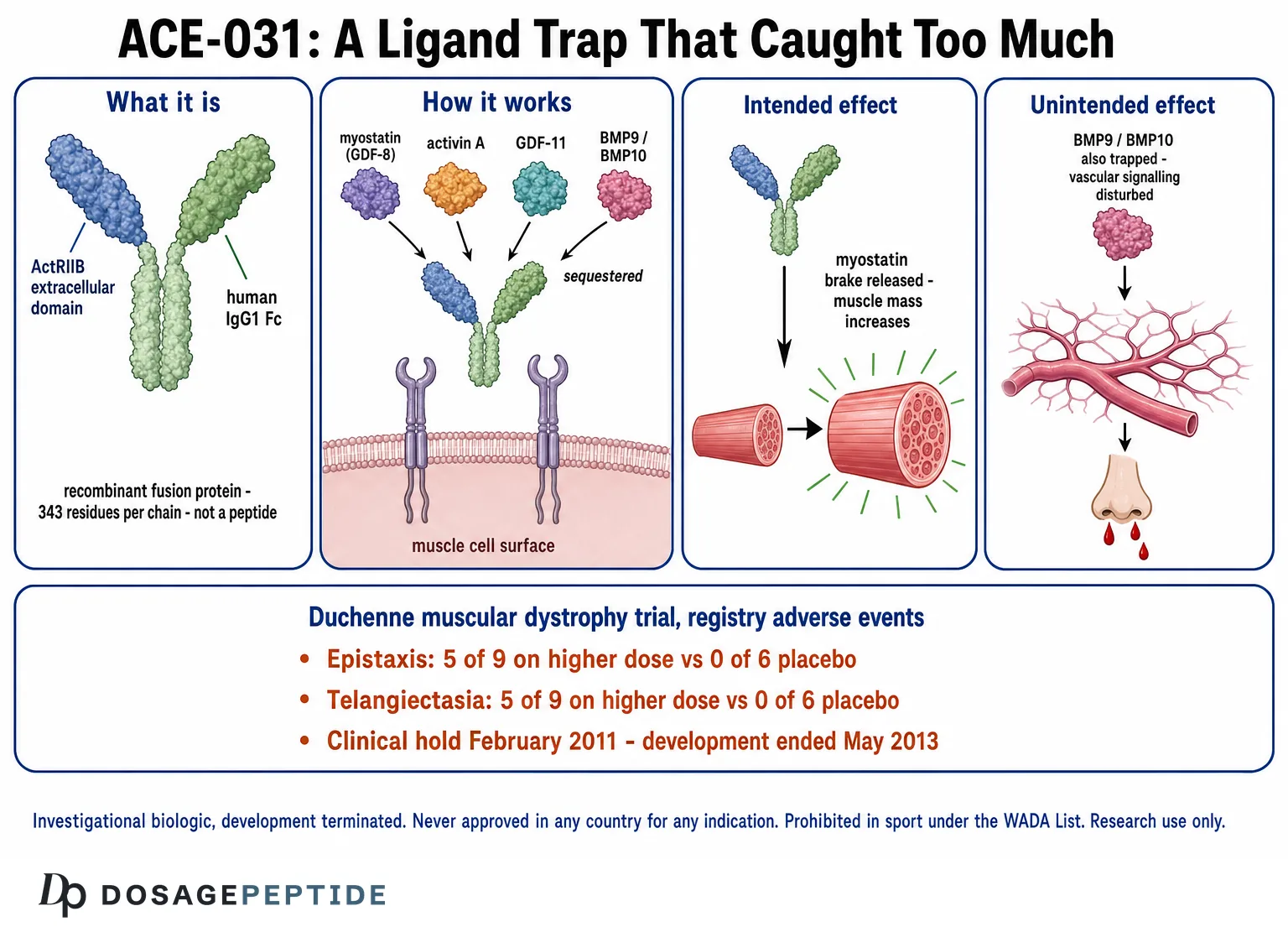
ACE-031 does not inhibit myostatin the way a small molecule inhibits an enzyme. It works by sequestration. Myostatin (GDF-8) and its relatives signal by binding a type II receptor at the cell surface, which recruits a type I receptor and phosphorylates the SMAD2/3 transcription factors, driving a programme that restrains muscle protein accretion and satellite cell activity[8]. ACE-031 presents the same binding surface as the real receptor, but in free solution and with no signalling machinery attached. Ligand that binds the decoy is simply removed from circulation.
The consequence is that ACE-031’s selectivity is the selectivity of ActRIIB itself — which is poor. ActRIIB is a promiscuous hub of the TGF-beta superfamily. Beyond myostatin it binds activin A, GDF-11, and members of the bone morphogenetic protein family including BMP9 and BMP10[8]. A trap built from the native receptor domain therefore traps all of them.
Two observations make this concrete. First, in mice, ACE-031 increased muscle mass independently of fibre type, whereas selective pharmacological myostatin blockade predominantly enlarges type II fibres — a difference the investigators explicitly attributed to ACE-031 acting on ligands beyond myostatin alone[5]. Second, the safety signal that ended the programme appeared in tissues that have nothing to do with muscle.
Compare the alternatives. A neutralising antibody targets one ligand and leaves the receptor free for everything else. A binding protein such as follistatin sequesters myostatin and activins but is not receptor-shaped — our explainer on what Follistatin-344 is and what myostatin-inhibition research actually shows covers that separate and equally over-marketed molecule. A receptor trap sits at the opposite end of the selectivity spectrum: maximum breadth, maximum off-target surface.
What did the preclinical work show?
The animal data were, on their own terms, striking. In 8-week-old C57BL/6 mice treated for 28 days, mean body weight in the ACE-031 group was 16% greater than control, and wet weights of the soleus, plantaris, gastrocnemius and extensor digitorum longus rose by 33%, 44%, 46% and 26% respectively. Mean fibre cross-sectional area increased by 22% in type I and 28% in type II soleus fibres, and by 57% in the predominantly type II plantaris[5].
A non-human primate study in common marmosets, run by the sponsor’s collaborators but published only in 2026, dosed 12 healthy animals — 8 on ACE-031 at 3.0 mg/kg weekly subcutaneously, 4 on vehicle — for 14 weeks. Lean body mass rose significantly from baseline in the ACE-031 animals and not in the controls; biceps brachii fibre cross-sectional area was 34% greater in type I and 20% greater in type II fibres; and ex vivo extensor digitorum longus preparations showed significantly greater specific twitch and tetanic force, although the corresponding absolute forces were not significantly different[6]. It is one of the few studies in this field to measure contractile force at all rather than mass alone. It is also very small: the authors themselves note that n = 4 in the control arm may have left the study underpowered to detect subtle effects, and that one vehicle-treated animal gained body weight and muscle unexpectedly, which affected the group comparisons. Absolute body weight showed no significant main effect of treatment (p = 0.6762) and no time-by-treatment interaction (p = 0.4406)[6].
Two honest caveats. Both studies used healthy animals, not disease models, so they demonstrate hypertrophic pharmacology rather than therapeutic benefit; and both were authored in part by the sponsor’s own scientists. Neither fact invalidates the findings, but both belong in an accurate reading of them — and preclinical hypertrophy of this magnitude is precisely what did not reproduce as clinical benefit in humans.
ACE-031 clinical trial dossier
Four registered human studies were conducted, all sponsored by Acceleron Pharma. Only two produced peer-reviewed publications; the others are reported here as registered.
| Study | Population | n | Design | Duration | Main reported outcome | Key adverse findings | Source |
|---|---|---|---|---|---|---|---|
| NCT00755638 (Attie et al.) | Healthy postmenopausal women, 45–75 y | 48 | Phase 1, randomised, double-blind, placebo-controlled, single ascending dose (0.02–3 mg/kg s.c.), 3:1 | Single dose; assessed to day 29 | At 3 mg/kg: total body lean mass +3.3% by DXA (p = 0.03); thigh muscle volume +5.1% by MRI (p = 0.03). Mean t½ 10–15 days | Generally well tolerated; injection-site erythema reported | [1][3] |
| NCT00952887 | Healthy postmenopausal women, 45–75 y | 70 | Phase 1, randomised, double-blind, placebo-controlled, multiple-dose escalation | Registered follow-up ~6.5 months | Listed as completed, with an actual completion date of February 2011 — the month the programme went on hold. No results posted on the registry and no dedicated peer-reviewed publication identified | Not posted | [3] |
| NCT01099761 (Campbell et al.) | Ambulatory boys with Duchenne muscular dystrophy, on stable corticosteroids | 24 (18 ACE-031, 6 placebo) | Phase 2, randomised, double-blind, placebo-controlled, multiple ascending dose: 0.5 mg/kg every 4 weeks or 1.0 mg/kg every 2 weeks, s.c. | 12 weeks of treatment; ~24-week follow-up | Primary objective was safety. Non-significant trends toward maintained 6-minute walk distance, increased lean mass and bone mineral density, reduced fat mass. Registry lean-mass change: +3.6% (0.5 mg/kg), +4.1% (1.0 mg/kg), +2.6% placebo | Study stopped after the second dosing regimen. Registry adverse-event data: epistaxis in 1/9 and 5/9 of the two ACE-031 arms vs 0/6 placebo; telangiectasia in 0/9 and 5/9 vs 0/6 placebo. No serious or severe adverse events attributed to the drug | [2][4] |
| NCT01239758 | Boys with DMD who completed the core study | 11 | Phase 2, open-label extension | Terminated May 2011 | Terminated before completion; no results posted | Registry states termination “based on preliminary safety data” | [4] |
What did the first-in-human study actually find?
The Phase 1 study by Attie and colleagues, published in Muscle & Nerve, randomised 48 healthy postmenopausal women 3:1 to a single subcutaneous dose of ACE-031 between 0.02 and 3 mg/kg or placebo. Exposure rose linearly with dose. At day 29, the 3 mg/kg group showed a statistically significant 3.3% increase in total body lean mass by DXA and a 5.1% increase in thigh muscle volume by MRI. Serum biomarker changes were interpreted by the authors as suggesting effects on bone and fat metabolism as well. The drug was described as generally well tolerated, with injection-site erythema among the adverse events reported[1].
Read that carefully. This was a single dose in healthy volunteers, with imaging endpoints at four weeks. The study measured neither strength nor physical function; it was not designed to, and the authors did not claim otherwise. A 3.3% change in whole-body lean mass one month after one injection is a clean pharmacodynamic signal that the molecule engages its target in humans. It is not evidence that anyone got stronger.
What happened in the Duchenne muscular dystrophy trial?
The Phase 2 study reported by Campbell and colleagues enrolled 24 ambulatory boys with DMD, all on stable corticosteroid therapy, randomising 18 to ACE-031 and 6 to placebo across two dosing regimens with a 12-week treatment period[2][4]. The primary objective was safety. Secondary objectives covered pharmacokinetics and pharmacodynamics, including the 6-minute walk test, hand-held myometry, DXA body composition and pulmonary function.
The efficacy result should be stated exactly as the authors stated it: there was a trend toward maintenance of 6-minute walk distance in the ACE-031 groups relative to a decline in placebo, and this was not statistically significant. Similar non-significant trends were seen for lean body mass, bone mineral density and fat mass. The paper’s own conclusion — that ACE-031 “demonstrated trends” on these measures — is the correct ceiling for any claim about this trial.
The study was stopped after the second dosing regimen because of the safety signal. ACE-031 was not associated with serious or severe adverse events, and the events that emerged were individually minor: nosebleeds, gum bleeding, and small dilated blood vessels visible in the skin[14]. The registry’s posted adverse-event table shows the dose relationship starkly — epistaxis in 5 of 9 boys and telangiectasia in 5 of 9 boys on the higher-intensity 1.0 mg/kg every-two-weeks regimen, against none of the 6 on placebo[4]. These events reportedly resolved fully after treatment was discontinued[14].
Why was ACE-031 development stopped?
The trials were placed on hold in February 2011. Acceleron and Shire then spent two years running additional non-clinical and toxicology work to determine whether the programme could be restarted safely. In a press release dated 2 May 2013 they announced they had concluded the collaboration on ACE-031 and would not resume development, stating that the findings from those studies did not support it[14]. The registry records for both DMD studies list the reason for termination as preliminary safety data[4].
The leading mechanistic interpretation
The prevailing explanation in the field — and it should be labelled as an interpretation, not a settled finding — is that the vascular events were a direct consequence of ACE-031’s lack of ligand selectivity. Epistaxis and cutaneous telangiectasia are the cardinal features of hereditary haemorrhagic telangiectasia, a genetic disease of impaired BMP9/BMP10 signalling through the endothelial ALK1 receptor. A native ActRIIB extracellular domain sits directly in that pathway: the crystal structure of BMP9 has been solved as a ternary complex with the extracellular domains of ALK1 and ActRIIB, and BMP9, BMP10 and the type II receptors ActRIIA, ActRIIB and BMPRII are all implicated in ALK1 signalling[8]. A trap built from that domain therefore plausibly reproduces a pharmacological version of the same lesion in endothelium[8].
The strongest circumstantial support for this reading comes from what happened to the rest of the class. Luspatercept’s ActRIIB domain was deliberately altered — its originators describe it as the ActRIIB extracellular domain “modified to reduce activin binding” — narrowing the ligand profile away from the native receptor’s[11]. Sotatercept, by contrast, is built from an unmodified ActRIIA extracellular domain fused to IgG1 Fc, and it reproduces the ACE-031 signal precisely: in its pivotal trial, epistaxis occurred in 22.1% of treated patients against 1.9% on placebo, and telangiectasia in 16.6% against 4.4%, with a dedicated telangiectasia subsection in the approved label[13]. The vascular effect is a property of the target class, not a manufacturing accident unique to ACE-031.
What can be said without hedging is narrower and still damning: the adverse effects appeared in tissues unrelated to skeletal muscle, they were dose-related, and they were sufficient to end development in a fatal childhood disease with high unmet need.
What happened to the ActRII field after ACE-031?
The receptor-trap concept did not die with ACE-031. Several successors advanced, and precision about what each one is matters, because approvals in unrelated indications are routinely borrowed to legitimise ACE-031 itself.
- Luspatercept (Reblozyl). A modified ActRIIB-Fc, engineered away from the native receptor’s ligand profile[11]. It is FDA-approved — initial US approval 2019, label revised May 2024 — as an erythroid maturation agent for anaemia in adults with beta thalassemia requiring regular red blood cell transfusions and for anaemia in certain very low- to intermediate-risk myelodysplastic syndromes[13]. It is a haematology drug. It is not approved for muscle growth, muscle wasting, or anything musculoskeletal.
- Sotatercept (Winrevair). An ActRIIA-Fc fusion protein built from the unmodified receptor domain, approved by the FDA in March 2024 for adults with pulmonary arterial hypertension (WHO Group 1) to increase exercise capacity, improve WHO functional class, and reduce the risk of clinical worsening events[13]. A different receptor, a different disease, a cardiopulmonary indication — and, as above, the same vascular adverse events.
- Bimagrumab. A monoclonal antibody against type II activin receptors rather than a trap. It remains investigational. A published randomised Phase 2 trial in 507 adults with obesity reported body-weight reductions with bimagrumab alone and in combination with semaglutide, with muscle spasms, diarrhoea and acne among common adverse events[10]. It is not approved.
None of this transfers to ACE-031, and one of these approvals argues actively against it. Sotatercept was licensed in a disease where an adult patient and a regulator will accept nosebleeds and skin telangiectasias in exchange for improved exercise capacity and a reduced risk of clinical worsening in pulmonary arterial hypertension. That trade is available because the underlying condition is life-limiting. It is not available to a healthy adult — and the fact that the same adverse events recur, at high rates, in an approved ActRII trap shows they were never going to be engineered away.
Why is “myostatin inhibition” oversold in physique contexts?
The myostatin story is compelling biology: myostatin-null cattle and the rare human loss-of-function cases are real. The inference drawn from them — that pharmacologically blocking myostatin in a normal adult produces proportionate, functional muscle — is where the argument breaks down, and the human trial record is unusually clear about it.
Mass was measured; strength and function largely were not
The Phase 1 study’s endpoints were DXA lean mass and MRI thigh volume[1]. DXA lean mass is not muscle; it is fat-free soft tissue, and it includes water. A short-term increase in that compartment is compatible with hypertrophy, with fluid shifts, or with both. No strength endpoint was reported. In the DMD study, where functional endpoints were collected — 6-minute walk, myometry, timed tests — the differences did not reach statistical significance[2].
This is a recurring pattern, not a one-off
The precedent was already established before ACE-031 entered the clinic. In a Phase 1/2 trial of the myostatin-neutralising antibody MYO-029 in 116 adults with muscular dystrophy, the authors reported no improvement in exploratory endpoints of muscle strength or function, alongside a trend toward increased muscle size on DXA and histology — while noting the study was not powered for efficacy[9]. Larger muscle and stronger muscle have repeatedly failed to move together in this drug class.
The stopping decision is itself a strong signal
This is the part most often left out. ACE-031 was halted in ambulatory boys with Duchenne muscular dystrophy — a progressive, fatal disease with, at the time, essentially no disease-modifying options. That is a population where regulators, investigators and families tolerate substantial risk. A safety signal severe enough to stop a programme there, over adverse events that were individually minor and fully reversible, tells you the sponsor and the reviewing authorities judged the underlying mechanism, not just the events, to be the problem. Applying the same molecule to a healthy adult seeking cosmetic hypertrophy inverts that risk–benefit calculation entirely.
And the events were not confined to the sick population. The reporting organisation’s account of the programme states plainly that they occurred in healthy adults as well as in DMD boys[14]; the multiple-dose Phase 1 study in healthy postmenopausal women has an actual completion date of February 2011, the same month the programme went on hold[3]. A healthy adult taking this compound is not extrapolating from a dystrophic population. They are in the population where it was already observed.
The same discipline applies across this category. Our overview of what the evidence actually shows for peptides marketed for muscle growth works through the tiers of evidence compound by compound, and the pattern in the ActRII class is repeated elsewhere: our explainers on the mechanism and research status of IGF-1 LR3 and on what mechano growth factor (MGF) is and what has been studied both describe compounds where preclinical anabolic signal vastly outruns controlled human evidence.
What is ACE-031’s status today?
ACE-031 has never received marketing authorisation from the FDA, the EMA, or any other regulator, for any indication. It is not in clinical development. Acceleron Pharma is now a subsidiary of Merck & Co., which is reflected in the sponsor field of the archived registry records[4]. Its only commercial existence is as a research chemical sold to laboratories and, in practice, to a grey market.
In sport, ACE-031 is prohibited at all times under the WADA Prohibited List, in section S4 (“Hormone and Metabolic Modulators”), subsection S4.3, “Agents Preventing Activin Receptor IIB Activation”. The List names the compound directly: S4.3 covers “Activin receptor IIB competitors such as: decoy activin receptors (e.g. ACE-031)”, alongside anti-activin receptor IIB antibodies such as bimagrumab and myostatin-binding proteins such as follistatin[12]. Substances in S4.3 are non-Specified Substances, which carries the higher default sanction. Anti-doping laboratories have published detection methods for ACE-031 in serum[7]. Prohibition applies in and out of competition. Separately, the legal position of research compounds varies substantially by jurisdiction and by what is claimed about them — our overview of the legal status of research peptides and how research-use-only labelling works sets out that framework.
What do vials sold as “ACE-031” actually contain?
This is the most consequential and least discussed finding in the recent literature, and it follows directly from the manufacturing point above.
In 2025, a doping-control laboratory analysed 14 black-market products sold as ACE-031 using gel electrophoresis, Western blotting and mass spectrometry. Only 12 of the 14 contained any ActRIIB-immunoreactive protein at all. Of those 12, mass spectrometry showed that every one contained full-length human activin receptor IIB — not ACE-031. The absence of an Fc-fusion was confirmed independently by treatment with IdeS protease, which cleaves IgG-derived Fc regions and was unable to cleave the black-market material. The products were also grossly impure, containing numerous additional proteins beyond the main compound. Among the remaining vials, one contained follistatin and one contained ipamorelin, an unrelated growth hormone secretagogue[7].
In other words: in a controlled analysis of the actual market, zero of fourteen products were the molecule on the label. Every published human finding about ACE-031 — the lean mass change, the half-life, the vascular events — was generated with clinical-grade ActRIIB-Fc manufactured to pharmaceutical standards. None of it can be assumed to describe a product that is a different protein entirely, expressed in an unspecified system, and contaminated with unidentified co-purified material.
Note also that a standard peptide HPLC purity figure would not distinguish full-length ActRIIB from ActRIIB-Fc, and would not detect a missing Fc domain. The methods that do so are protein methods, and they rarely appear on grey-market documentation.
Frequently Asked Questions
Is ACE-031 a peptide?
No. ACE-031 is a recombinant fusion protein: the extracellular domain of the human activin receptor type IIB joined to the Fc region of human IgG1, forming a glycosylated homodimer with 343 amino acids per chain. That places it in the same structural class as therapeutic antibodies, not peptides. It cannot be produced by chemical peptide synthesis and requires mammalian cell culture, which is why the label “ACE-031 peptide” is always incorrect.
Is ACE-031 FDA approved?
No. ACE-031 has never been approved by the FDA or any other regulator, for any indication or in any country. It received an FDA fast track designation on 4 August 2010 and an orphan drug designation for Duchenne muscular dystrophy later the same month[15], but those are development incentives granted before efficacy is established — they are not approvals. Clinical development was halted in 2011 and formally abandoned in 2013, and the compound is not in active development today.
Why was ACE-031 discontinued?
Trials were placed on hold in February 2011 after participants developed non-muscle adverse effects: epistaxis (nosebleeds), gum bleeding and telangiectasias (small dilated blood vessels in the skin). These occurred in healthy adult volunteers as well as in the DMD boys. The events were minor and reversed after treatment stopped, but they occurred in a dose-related way and were unrelated to muscle. After two years of additional non-clinical work, Acceleron and Shire announced on 2 May 2013 that the findings did not support restarting the programme.
What is the difference between ACE-031 and follistatin?
Both reduce myostatin signalling, but by different routes. ACE-031 is a decoy version of the receptor, so it captures whatever binds ActRIIB — myostatin, activin A, GDF-11 and certain BMPs. Follistatin is a naturally occurring binding protein with its own affinity profile, principally for activins and myostatin, and is not receptor-derived. Neither is approved, and neither has controlled human evidence of functional benefit in healthy adults.
Did ACE-031 increase muscle strength in humans?
There is no published human evidence that it did. The Phase 1 study measured lean mass and thigh muscle volume, not strength, and reported increases of 3.3% and 5.1% respectively at the highest single dose. The Duchenne Phase 2 study did collect functional and strength measures, and the differences versus placebo were reported as non-significant trends. Increased mass on imaging has repeatedly failed to translate into measured strength in this drug class.
What is ActRIIB-Fc, and how does it relate to luspatercept?
ActRIIB-Fc describes the general architecture: the ligand-binding part of activin receptor IIB fused to an antibody Fc domain to make a long-lived soluble trap. ACE-031 uses the native receptor sequence. Luspatercept is a modified ActRIIB-Fc whose ligand-binding domain was altered to narrow its ligand profile, and it is FDA-approved as an erythroid maturation agent for specific anaemias — a haematology indication, not a muscle one. The approval of the modified molecule says nothing favourable about the unmodified one.
Is ACE-031 banned in sport?
Yes. It is prohibited at all times under the WADA Prohibited List, section S4.3, “Agents Preventing Activin Receptor IIB Activation,” which names decoy activin receptors and gives ACE-031 as its example. Substances in S4.3 are non-Specified Substances, the category carrying the higher default sanction. Anti-doping laboratories have published detection work on this class, and a protocol originally developed for luspatercept was applied successfully to black-market ACE-031 material in a rat study, where it remained detectable in serum up to 48 hours after a high dose; the corresponding detection window in humans is not established. Athletes subject to anti-doping rules should treat it as a sanctionable substance.
Are research-chemical ACE-031 vials genuine?
The published evidence says usually not. In a 2025 analysis of 14 black-market products, only 12 contained any ActRIIB-related protein, and mass spectrometry showed all 12 contained full-length activin receptor IIB rather than the ActRIIB-Fc fusion — confirmed by the failure of an Fc-cleaving protease to act on them. All were substantially impure. One vial contained follistatin and one contained ipamorelin instead. No product in that sample matched its label.
What doses were used in ACE-031 clinical trials?
For documentation only, and never as guidance: every dose in the human literature is weight-based. The Phase 1 single-dose study in healthy postmenopausal women used subcutaneous doses from 0.02 to 3 mg/kg. The Phase 2 study in boys with Duchenne muscular dystrophy used 0.5 mg/kg every four weeks or 1.0 mg/kg every two weeks subcutaneously for 12 weeks. The higher-intensity regimen is the one in which epistaxis and telangiectasia occurred in 5 of 9 participants each. These figures describe historical, terminated research in supervised clinical settings.
References
- Attie KM, Borgstein NG, Yang Y, et al. A single ascending-dose study of muscle regulator ACE-031 in healthy volunteers. Muscle Nerve. 2013;47(3):416–423. PubMed 23169607
- Campbell C, McMillan HJ, Mah JK, et al. Myostatin inhibitor ACE-031 treatment of ambulatory boys with Duchenne muscular dystrophy: results of a randomized, placebo-controlled clinical trial. Muscle Nerve. 2017;55(4):458–464. PubMed 27462804
- ClinicalTrials.gov. ACE-031 Phase 1 programme in healthy postmenopausal women: NCT00755638 (single ascending dose) and NCT00952887 (multiple-dose escalation; actual completion February 2011). US National Library of Medicine.
- ClinicalTrials.gov. ACE-031 (ActRIIB-IgG1) in Duchenne muscular dystrophy: NCT01099761 (multiple ascending-dose core study; terminated, results posted) and NCT01239758 (open-label extension; terminated). US National Library of Medicine.
- Cadena SM, Tomkinson KN, Monnell TE, et al. Administration of a soluble activin type IIB receptor promotes skeletal muscle growth independent of fiber type. J Appl Physiol (1985). 2010;109(3):635–642. PubMed 20466801
- Cadena SM, Bogdanovich S, Khurana TS, et al. ACE-031, a soluble activin type IIB receptor, increases muscle mass and strength in the common marmoset (Callithrix jacchus). PLoS One. 2026;21(2):e0342666. PubMed 41686840
- Reichel C, Filip T, Gmeiner G, Thevis M. Gel electrophoretic detection of black market ACE-031. Drug Test Anal. 2025;17(10):1934–1946. PubMed 40312924
- Activin receptor pathway and BMP9/ALK1 structural biology: Lodberg A. Principles of the activin receptor signaling pathway and its inhibition. Cytokine Growth Factor Rev. 2021;60:1–17. PubMed 33933900. Townson SA, Martinez-Hackert E, Greppi C, et al. Specificity and structure of a high affinity activin receptor-like kinase 1 (ALK1) signaling complex. J Biol Chem. 2012;287(33):27313–27325. PubMed 22718755 (open access)
- Wagner KR, Fleckenstein JL, Amato AA, et al. A phase I/II trial of MYO-029 in adult subjects with muscular dystrophy. Ann Neurol. 2008;63(5):561–571. PubMed 18335515
- Heymsfield SB, Aronne LJ, Montgomery P, et al. Bimagrumab plus semaglutide alone or in combination for the treatment of obesity: a randomized phase 2 trial. Nat Med. 2026;32(3):869–882. PubMed 41772149
- Suragani RN, Cadena SM, Cawley SM, et al. Transforming growth factor-β superfamily ligand trap ACE-536 corrects anemia by promoting late-stage erythropoiesis. Nat Med. 2014;20(4):408–414. PubMed 24658078
- World Anti-Doping Agency. The Prohibited List 2026 (International Standard, effective 1 January 2026), S4.3 — Agents Preventing Activin Receptor IIB Activation. wada-ama.org
- US Food and Drug Administration. Prescribing information: WINREVAIR (sotatercept-csrk), initial US approval 2024; REBLOZYL (luspatercept-aamt), revised May 2024, initial US approval 2019.
- Muscular Dystrophy Association, Quest. UPDATE: ACE-031 clinical trials in Duchenne MD. 1 May 2013. Patient-organisation news article, not peer-reviewed; cited for the February 2011 clinical hold, the reported adverse events in healthy adults and DMD boys, and the 2 May 2013 Acceleron–Shire announcement. mda.org
- Acceleron Pharma. FDA designations for ACE-031 in Duchenne muscular dystrophy, August 2010. Company press releases (republished by trade press); cited only for the 2010 designations: fast track and orphan designation.
Research use only. This page is an independent scientific reference summarising published preclinical and clinical literature on a terminated investigational biologic. ACE-031 (ramatercept) is not approved for human use in any country and is not available as a medicine. Nothing here is medical advice, a recommendation, a protocol, or an endorsement of use in humans or animals, and no dose reported from a clinical trial should be interpreted as guidance. dosagepeptide.com does not sell peptides. Where this site links to a commercial supplier, that link may be a paid or affiliate placement; no such link appears in this article, and no vendor reviewed, funded or approved its contents.