Tesofensine is not a peptide. It is a small-molecule phenyltropane — a triple monoamine reuptake inhibitor that blocks the noradrenaline, dopamine and serotonin transporters — originally coded NS 2330 and developed as an oral tablet, dosed in milligrams. It was created for Parkinson’s disease and Alzheimer’s disease, failed both, and was repurposed for obesity after unintended weight loss showed up in those neurology trials; as of August 2026 it is not approved by the FDA and not approved by the EMA, and its only late-stage regulatory file — in Mexico — has no publicly verifiable approval.
Is tesofensine a peptide, and why does that matter?
Tesofensine appears constantly in peptide vendor catalogues, forum threads and “research compound” listings alongside genuine peptides such as tirzepatide, semaglutide or AOD-9604. That classification is simply wrong, and the error is not cosmetic.
A peptide is a chain of amino acids joined by peptide bonds. Tesofensine is a synthetic tropane derivative with the molecular formula C17H23Cl2NO — structurally a cousin of cocaine-like phenyltropanes and of the transporter-blocking compounds used as radioligands in dopamine imaging. It has no amino acids and no peptide bonds. Practical consequences follow directly:
- Route. Every published human trial administered tesofensine as an oral tablet. It is not an injectable, and it does not arrive as a lyophilised powder requiring the sterile-water workflow described in our peptide reconstitution reference.
- Units. Trial doses were expressed in milligrams (0.125–1.0 mg once daily), not in micrograms per kilogram or in “IU”. A vial-and-syringe mental model imported from peptide research does not transfer.
- Pharmacology. It acts on central monoamine transporters, not on a hormone receptor. Its adverse-event profile is that of a stimulant-class CNS drug — insomnia, dry mouth, raised heart rate, mood change — not that of an incretin analogue.
- Kinetics. Population pharmacokinetic modelling in Alzheimer’s patients reported a terminal half-life of roughly 234 hours (about 10 days) for the parent compound and about 374 hours for its N-desmethyl metabolite, with oral bioavailability estimated above 90%[14]. A drug with a ten-day half-life accumulates for weeks and clears for weeks. That behaviour is unlike almost anything in the peptide space.
If you are using this site to build a working vocabulary of research compounds, the peptide and research-compound glossary separates true peptides from the small molecules that have been marketed alongside them.
What is the tesofensine mechanism of action?
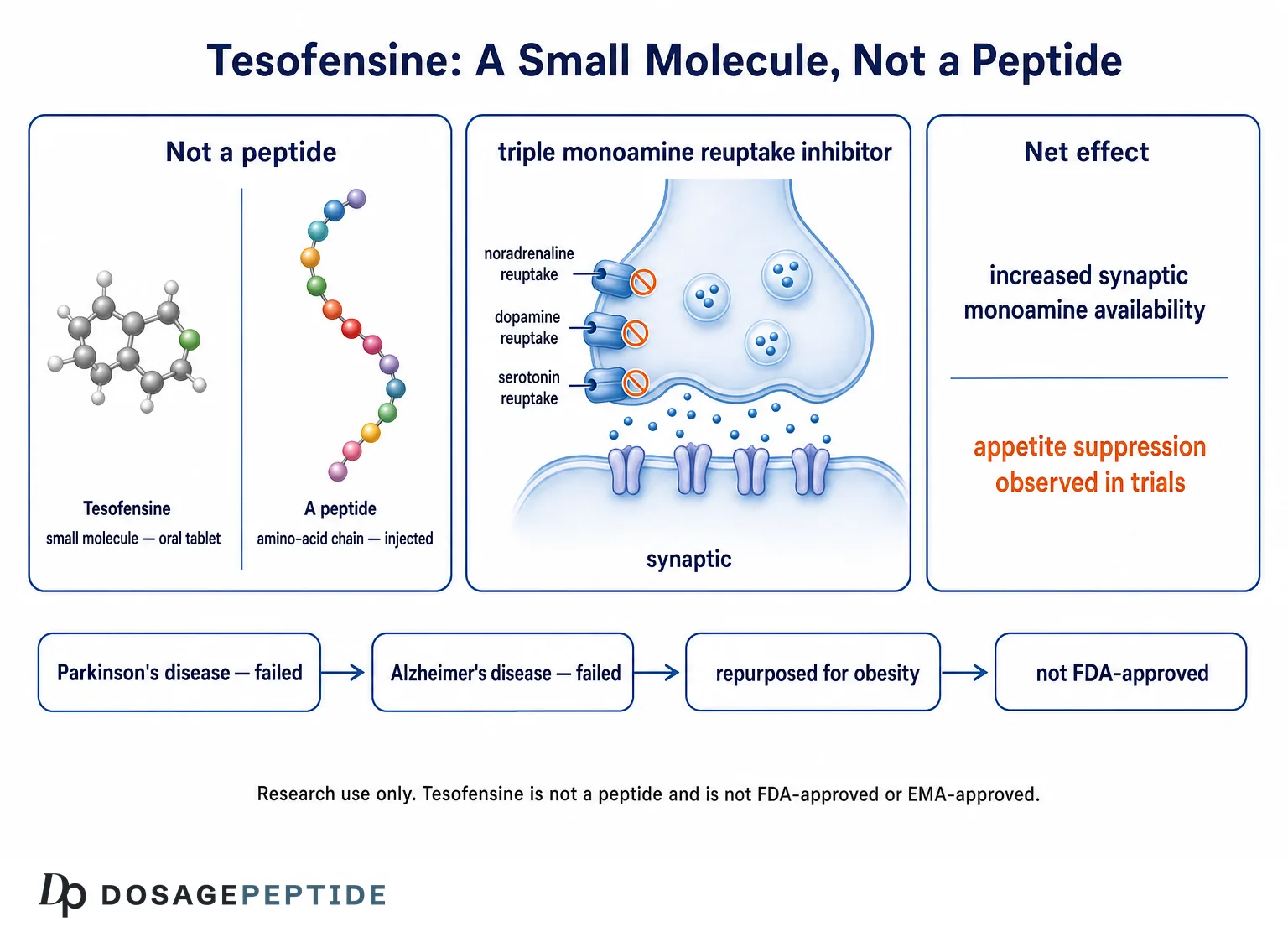
Tesofensine inhibits presynaptic reuptake of all three major monoamines — noradrenaline, dopamine and serotonin — by binding their respective transporters (NET, DAT and SERT). Blocking reuptake leaves more neurotransmitter in the synaptic cleft, amplifying signalling in circuits that regulate appetite, arousal and reward.
How much transporter blockade actually occurs in humans?
This has been measured directly. A positron emission tomography study using the DAT radioligand [11C]βCIT-FE in healthy volunteers given multiple oral doses of 0.125–1 mg found mean striatal dopamine transporter occupancy rising dose-dependently from 18% to 77%. Modelling put the maximum achievable occupancy at about 80%, with half of that effect reached at approximately 0.25 mg and a plasma concentration near 4 ng/mL[7]. That is a genuine, quantified human pharmacodynamic anchor — rare for compounds in this category, and it is the strongest single piece of mechanistic evidence in the tesofensine file.
What downstream receptors carry the appetite effect?
Transporter blockade is upstream; the anorectic effect depends on which receptors the extra monoamine reaches. In diet-induced obese rats, tesofensine-induced hypophagia was almost completely reversed by the α1-adrenoceptor antagonist prazosin and partially blocked by the dopamine D1 antagonist SCH23390, while α2, D2, D3 and 5-HT2A/C antagonists had no effect[8]. The working model is therefore indirect α1-adrenergic and D1-dopaminergic stimulation. This is animal-only evidence for the receptor mechanism; the human data establish transporter occupancy and weight change, not the receptor pathway.
Appetite suppression or increased energy expenditure?
A controlled respiration-chamber study in 32 overweight and moderately obese men treated for two weeks answered this reasonably cleanly. Tesofensine produced 1.8 kg more weight loss than placebo, raised ratings of satiety and fullness, lowered prospective food intake, and increased 24-hour fat oxidation by 18 g. Total 24-hour energy expenditure was not significantly different from placebo; only night-time expenditure rose, by 4.6% after adjustment for body composition[9]. In short: the weight effect is overwhelmingly an appetite effect, with a small metabolic contribution. Readers comparing this with substrate-oxidation compounds may find our review of L-carnitine and fatty-acid metabolism research a useful contrast in evidence quality.
Where did tesofensine come from? A Parkinson’s and Alzheimer’s failure
Tesofensine was developed by the Danish company NeuroSearch A/S, in collaboration with Boehringer Ingelheim, under the code NS 2330. The target indications were neurodegenerative: the rationale was that boosting dopaminergic and noradrenergic tone might improve motor function in Parkinson’s disease and cognition in Alzheimer’s disease. Four randomised, double-blind, placebo-controlled phase 2 trials were run — two in each disease — and the programme did not succeed. Three of the four appear in the ClinicalTrials.gov registry; the fourth is known only from the pooled publication.
| Trial | Population | n | Doses (as used in the published trials) | Duration | Reported outcome |
|---|---|---|---|---|---|
| SCEPTRE (NCT00148486), phase 2 | Early Parkinson’s disease | 261 | NS 2330, oral once daily | 14 weeks | Did not establish efficacy; programme not advanced |
| ADVANS (NCT00148512), phase 2 | Advanced Parkinson’s with motor fluctuations | 254 enrolled | 0.125, 0.25, 0.5, 1.0 mg | 14 weeks | UPDRS II+III −4.7 points at 0.5 mg (p = 0.005); “off” time −7.1% (−68 min) at 0.25 mg; no dose–response relationship established; GI and neuropsychiatric adverse events more frequent than placebo[5] |
| Alzheimer’s proof-of-concept (NCT00153010), phase 2 | Mild–moderate Alzheimer’s dementia | 430 | Three dose levels | 14 weeks | Negative proof-of-concept result; the compound was judged ineffective for neurodegenerative conditions[6] |
| Pooled weight analysis of all four neurology trials | Parkinson’s + Alzheimer’s | 968 (740 drug, 228 placebo) | 0.125–1.0 mg | 14 weeks | Weight change +0.5%, −0.5%, −0.9%, −1.8%, −2.8% (placebo → 1.0 mg), p = 0.015 for dose effect; heart rate +2.1 to +6.8 bpm; no blood-pressure effect at 14 weeks[4] |
The weight loss was an incidental observation, not a designed endpoint. Patients in these trials received no diet or lifestyle programme at all. In the obese subgroup, 32.1% of those on 1.0 mg achieved at least 5% weight loss versus 2.1% on placebo[4]. That signal is what redirected the entire programme. A 2009 industry review put it bluntly: the compound was ineffective for neurodegenerative conditions, and a notable occurrence of unintended weight loss was observed[6].
What did the tesofensine weight loss research actually show?
TIPO-1: the 24-week phase 2 obesity trial
The pivotal published human obesity result is TIPO-1 (NCT00394667), a phase 2, randomised, double-blind, placebo-controlled trial run at five Danish obesity management centres and published in The Lancet in 2008. After a two-week run-in, 203 patients with a BMI of 30–40 kg/m² were prescribed an energy-restricted diet and randomised to tesofensine 0.25 mg (n = 52), 0.5 mg (n = 50), 1.0 mg (n = 49) or placebo (n = 52) once daily for 24 weeks. 161 participants (79%) completed[1].
Mean weight loss at 24 weeks was 2.0% on diet plus placebo, versus 4.5%, 9.2% and 10.6% on 0.25, 0.5 and 1.0 mg respectively (p < 0.0001). The authors’ own conclusion was carefully hedged: tesofensine 0.5 mg might have the potential to produce twice the weight loss of then-approved drugs, and these findings of efficacy and safety need confirmation in phase 3 trials[1]. Our reference page documenting the 0.5 mg dose arm used in TIPO-1 records that trial arm and its reported parameters; it is a record of what was administered in a clinical study, not guidance for anyone.
The complete registered trial record
| Study | Phase / design | n | Doses used in the trial | Duration | Result as reported |
|---|---|---|---|---|---|
| TIPO-1 (NCT00394667)[1] | Phase 2, RCT, double-blind, placebo-controlled, 5 centres, Denmark | 203 | 0.25 / 0.5 / 1.0 mg once daily + energy-restricted diet | 24 weeks | Weight loss 4.5% / 9.2% / 10.6% vs 2.0% placebo (p < 0.0001). Heart rate +7.4 bpm at 0.5 mg (p = 0.0001). No significant BP rise at 0.25 or 0.5 mg. Common AEs: dry mouth, nausea, constipation, hard stools, diarrhoea, insomnia. Subject to a 2013 Lancet Expression of Concern. |
| Energy-balance study (NCT00428415)[9] | Phase 1/2, RCT, respiration chamber | 32 men | 2.0 mg/day ×7 days, then 1.0 mg/day ×7 days | 2 weeks | −1.8 kg vs placebo; increased satiety and fullness; 24-h fat oxidation +18 g; night-time energy expenditure +4.6%; no significant change in total 24-h energy expenditure |
| TIPO-4 (NCT00481104) | Phase 2, long-term safety extension for TIPO-1 completers | 140 | Tesofensine, open-label | Completed 2008 | No results posted to the registry and no peer-reviewed publication of this extension was located. Long-term controlled obesity data therefore remain unpublished (registry record) |
| Abuse-liability study[10] | Phase 1, randomised, double-blind, crossover | 52 recreational stimulant users | Tesofensine vs placebo, d-amphetamine 30 mg, bupropion, atomoxetine | Single dose, 48 h assessment | Tesofensine not significantly different from placebo on primary subjective measures and lower than d-amphetamine; abuse potential judged no greater than bupropion or atomoxetine |
| Tesomet in hypothalamic obesity (NCT03845075)[11] | Phase 2, RCT, single centre, + open-label extension | 21 adults | 0.5 mg tesofensine + 50 mg metoprolol | 24 weeks (48 with extension) | Placebo-subtracted weight change −6.3% (95% CI −11.3 to −1.3; p = 0.017); ≥5% weight loss in 8/13 vs 1/8; no significant difference in heart rate or blood pressure vs placebo; one drug-related SAE (exacerbation of pre-existing anxiety) |
| Tesomet in Prader-Willi syndrome (NCT03149445) | Phase 2, RCT + two open-label extensions | 18 | Tesofensine/metoprolol | 12 weeks + extensions | Completed 2019; small exploratory study |
| Tesomet in type 2 diabetes (NCT02737891) | Phase 2, RCT, two centres | 60 | Tesofensine/metoprolol | Completed Jan 2017 | Registered as completed |
| Phase 2b Tesomet programmes (NCT05147415, NCT05198362) | Phase 2b, planned dose-finding in hypothalamic obesity and Prader-Willi syndrome | 0 | — | — | Both withdrawn with zero enrolment |
| Mexican phase 3 obesity programme (Medix) | Phase 3, company-reported | Reported as 372 (three arms of 124) | 0.25 and 0.50 mg daily vs placebo | 24 weeks; reported as completed 2018 | Licensor reports primary and secondary endpoints met, mean weight loss about 10% at 24 weeks, and a safety database of roughly 1,600 patients. No corresponding record appears in the ClinicalTrials.gov registry, and no peer-reviewed publication of the results was located. The efficacy claim rests entirely on corporate disclosure |
The shape of that table is the honest summary of tesofensine trials: one well-conducted 24-week phase 2 obesity study with a striking result, and essentially nothing published beyond it. A search of the ClinicalTrials.gov registry for tesofensine as an intervention returns 13 studies, none of them registered as phase 3.
Why did The Lancet issue an expression of concern?
This is the part of the tesofensine story most often omitted, and it belongs in any honest account. In April 2013, The Lancet published a formal Expression of Concern regarding the TIPO-1 paper[2]. It followed a November 2011 inspection of the completed trial by the Danish Health and Medicines Authority, which raised three findings: informed consent had at one site been delegated to non-medical personnel; the integrity of the blinding procedure was questioned; and the recording and assessment of adverse events by the contract research organisation was incomplete, because recurrences of pre-existing events were not treated as noteworthy. The inspection report’s conclusion was that the published side-effect profile did not accord with the actual course of the trial, as documented by Retraction Watch.
The authors responded in a July 2013 letter titled “Under-reporting of adverse effects of tesofensine”[3]. Two things must be stated precisely. First, the paper was not retracted, and the concern centred on the completeness of adverse-event capture rather than on the weight-loss measurements. Second, the concern is nevertheless real and unresolved in the sense that matters: the safety side of the single most-cited tesofensine result should be read as probably understated, particularly for events such as headache, mood disturbance and stress that were plausibly under-recorded. Efficacy figures quoted from TIPO-1 without this caveat — which is how they usually circulate — present half the record.
How large are the cardiovascular and psychiatric signals?
Tesofensine is sympathomimetic by design. Blocking noradrenaline reuptake raises sympathetic tone, and the trial record shows this consistently and dose-dependently.
| Signal | What was measured | Source |
|---|---|---|
| Heart rate, obesity trial | +7.4 bpm at 0.5 mg vs placebo at 24 weeks (p = 0.0001) | TIPO-1[1] |
| Heart rate, neurology trials | +2.1, +4.2, +6.0, +6.8 bpm at 0.125, 0.25, 0.5, 1.0 mg at 14 weeks (p < 0.001 from 0.25 mg) | Pooled analysis[4] |
| Blood pressure | No significant systolic or diastolic increase at 0.25 or 0.5 mg in TIPO-1; significant increases reported at the highest dose tested (1.0 mg) in the development review | TIPO-1[1]; Bello & Zahner[6] |
| Neuropsychiatric | Insomnia the most common monoaminergic-drug adverse effect across this class; depressed mood and anxiety flagged for tesofensine specifically in the safety literature | Nathan et al.[13] |
| Neuropsychiatric, neurology trials | Gastrointestinal and neuropsychiatric adverse events more frequent than placebo, especially at higher doses | ADVANS[5] |
The timing matters. Sibutramine — a noradrenaline and serotonin reuptake inhibitor with a closely related profile — was withdrawn worldwide in 2010 after the SCOUT trial showed increased major adverse cardiovascular events. Tesofensine’s phase 3 programme was being contemplated in exactly that period, and a compound raising heart rate by 6–7 bpm in a population already at cardiovascular risk faced a regulatory environment that had just become extremely unforgiving. That is the single best explanation for why a drug with a headline 10.6% weight-loss figure never reached a registered phase 3 trial in the United States or Europe.
The developers took the cardiovascular signal seriously enough to engineer around it. In conscious telemetered rats, co-administration of the β1-blocker metoprolol fully prevented tesofensine’s rise in heart rate and blood pressure while leaving the food-intake suppression intact[12]. That preclinical finding is the origin of the fixed-dose combination Tesomet.
What is the regulatory status of tesofensine in 2026?
State this precisely, because vendor pages routinely do not.
- United States. Tesofensine is not FDA-approved for any indication. A DailyMed label search returns zero drug package labels for tesofensine, checked against the database release of August 2026. There is no approved US product, no prescribing information and no registered US phase 3 trial. A 2009 review noted that the FDA had at that time endorsed the design of a proposed phase 3 programme[6] — agreement on a trial design is not an approval, and that programme was never run.
- European Union. No EMA marketing authorisation exists for tesofensine.
- Mexico. This is the only late-stage regulatory file. Saniona, which acquired the asset from NeuroSearch, out-licensed Mexican and Argentine rights to Medix in 2016. Medix ran a phase 3 obesity programme in Mexico and filed a marketing application with COFEPRIS at the end of 2019. In February 2023 a COFEPRIS technical committee issued a favourable opinion — explicitly a non-binding technical step, not an authorisation, per the licensor’s own programme page. On 6 November 2024 the licensor announced that the application had not been approved and that Medix was entering a dialogue with the agency about the path forward, in an announcement titled “Mexican Application for Tesofensine Not Yet Approved”; a follow-up notice on 12 November 2024 added that COFEPRIS might not have reviewed the entire submitted package. On 20 February 2025 Medix resubmitted the complete dossier — approximately 20,000 pages — addressing the regulator’s questions, per a company announcement dated 20 February 2025. That resubmission is the most recent verifiable event; no decision has been published by either COFEPRIS or the licensor in the eighteen months since, and none had appeared as of August 2026.
Claims that tesofensine is already an approved, marketed obesity product in Mexico circulate widely on supplement and vendor sites, often with brand names attached. We could not verify any such approval from a regulatory or licensor source. The most recent verifiable disclosures from the rights holder describe a file under review after resubmission, not a granted authorisation. Until COFEPRIS or the licensor publishes a decision, the accurate statement is that the approval status of tesofensine outside clinical trials is unresolved. Anyone asserting otherwise should be asked for the authorisation number.
One further status point is well documented and often missed: tesofensine is classified under S6 stimulants on the World Anti-Doping Agency Prohibited List and is banned in competition. A 2026 anti-doping metabolism study noted that despite remaining under regulatory review, tesofensine is marketed online as a dietary supplement promoted for weight management, and mapped its urinary metabolites and elimination windows for exactly that reason — detection windows of up to 500 hours were reported[15]. That paper is, in effect, formal scientific acknowledgement that an unapproved investigational drug is being sold to consumers as a supplement.
What is Tesomet, and how did it perform?
Tesomet is a fixed-dose combination of tesofensine 0.5 mg with metoprolol 50 mg, designed to preserve the appetite effect while blunting the sympathetic cardiovascular response. Its most informative published trial enrolled 21 adults with hypothalamic obesity — a rare, treatment-refractory condition following hypothalamic injury — randomised to Tesomet or placebo for 24 weeks. Placebo-subtracted weight change was −6.3% (p = 0.017), 8 of 13 treated patients reached at least 5% weight loss versus 1 of 8 on placebo, and critically no significant difference in heart rate or blood pressure was seen between groups. Adverse events were mostly mild, led by sleep disturbance (50% vs 13%), dry mouth (43% vs 0%) and headache (36% vs 0%); one patient discontinued after a serious adverse event of exacerbated pre-existing anxiety[11].
That is a real and interesting result — and it is 21 people. The larger phase 2b dose-finding programmes intended to confirm it in hypothalamic obesity and Prader-Willi syndrome were both withdrawn with zero enrolment. Both registry entries (NCT05147415, NCT05198362) record an enrolment of zero. That is the correct evidence tier: promising, early, unconfirmed.
How does tesofensine compare with GLP-1 receptor agonists?
Comparisons between the TIPO-1 10.6% figure and modern incretin results are made constantly and are almost always methodologically invalid. Three reasons:
- Cross-trial comparison. TIPO-1 ran in 2006–2008 in 203 Danish patients over 24 weeks with a prescribed energy-restricted diet. Semaglutide and tirzepatide obesity trials ran a decade later, in thousands of patients, over 68–72 weeks, with different populations and different diet protocols. Placebo arms alone differ enough to invalidate a direct subtraction.
- Different evidence tiers. Semaglutide 2.4 mg and tirzepatide are FDA-approved for chronic weight management with published phase 3 programmes and, for semaglutide, a completed cardiovascular outcomes trial. Tesofensine has a single published phase 2 obesity trial carrying an unresolved Expression of Concern, and no published phase 3 anywhere. These are not comparable levels of certainty even where the percentages look similar.
- Opposite cardiovascular direction. The incretins lower heart-rate-independent cardiovascular risk markers and have outcome data; tesofensine raises heart rate dose-dependently and has none. Readers comparing metabolic compounds may find our overview of peptides studied for fat loss and our explainer on GLP-1 microdosing claims useful for seeing how differently these evidence bases are constructed.
What the tesofensine research still does not tell us
- No cardiovascular outcomes trial exists. For a sympathomimetic weight-loss drug, after the sibutramine withdrawal, this is the central unanswered question.
- No published controlled data beyond 24 weeks. The 140-patient TIPO-4 long-term safety extension completed in 2008 and has neither registry results nor a located publication.
- The phase 3 evidence is not in the public scientific record. The Mexican programme’s endpoints-met claim comes from corporate disclosure; there is no registry entry and no peer-reviewed paper to inspect.
- The Expression of Concern is unresolved. Adverse-event capture in the flagship trial was found to be incomplete by a national regulator.
- Nothing is known about material sold online. No published data exist on the identity, purity, dose accuracy or contamination profile of tesofensine sold as a “research chemical” or supplement — a concern amplified by a ten-day half-life, which means dosing errors accumulate over weeks rather than clearing overnight. Our discussion of what safety data does and does not cover for research compounds applies with additional force to an unapproved small molecule.
Frequently Asked Questions
Is tesofensine a peptide?
No. Tesofensine is a small-molecule phenyltropane with the formula C17H23Cl2NO, containing no amino acids and no peptide bonds. It is a triple monoamine reuptake inhibitor administered as an oral tablet in milligram doses in every published clinical trial. It is frequently listed in peptide vendor catalogues, but that classification is incorrect and misleads people about its route, its dosing units and its stimulant-class side-effect profile.
Is tesofensine FDA-approved?
No. Tesofensine has no FDA approval for any indication, no US prescribing information, and no drug package label in the DailyMed database. It also holds no EMA marketing authorisation. In 2009 the FDA was reported to have agreed the design of a proposed phase 3 programme, but that programme was never conducted, and agreement on a trial design carries no regulatory approval of the drug itself.
How much weight loss did tesofensine produce in trials?
In the 24-week phase 2 TIPO-1 trial, 203 patients with obesity on an energy-restricted diet lost a mean 4.5%, 9.2% and 10.6% of body weight on tesofensine 0.25, 0.5 and 1.0 mg respectively, versus 2.0% on diet plus placebo. These are doses used in a published clinical trial, not recommendations. The result has never been confirmed in a published phase 3 trial, and the paper carries a 2013 Lancet Expression of Concern regarding adverse-event reporting.
Why was tesofensine originally developed?
It was developed by NeuroSearch A/S with Boehringer Ingelheim under the code NS 2330 for Parkinson’s disease and Alzheimer’s disease, on the rationale that raising dopaminergic and noradrenergic tone might improve motor or cognitive function. Four phase 2 trials across the two diseases failed to establish efficacy. Dose-dependent weight loss observed incidentally in those trials, in patients receiving no diet programme, prompted the repurposing toward obesity.
Does tesofensine raise blood pressure and heart rate?
Heart rate rose dose-dependently in every dataset. TIPO-1 recorded +7.4 bpm at 0.5 mg versus placebo at 24 weeks, and the pooled neurology trials recorded +2.1 to +6.8 bpm across 0.125 to 1.0 mg. Blood pressure did not rise significantly at 0.25 or 0.5 mg in TIPO-1, but significant increases were reported at the highest dose tested. This sympathomimetic profile is the principal reason for regulatory caution.
What is Tesomet?
Tesomet is a fixed-dose combination of tesofensine 0.5 mg with the beta-blocker metoprolol 50 mg, designed after rat telemetry work showed metoprolol abolished tesofensine’s cardiovascular effects without reducing its appetite suppression. In a 21-patient randomised trial in hypothalamic obesity, Tesomet produced 6.3% placebo-subtracted weight loss over 24 weeks with no significant heart-rate or blood-pressure difference. The confirmatory phase 2b programmes were withdrawn before enrolling anyone.
Why did The Lancet issue an expression of concern about the tesofensine trial?
A 2011 inspection by the Danish Health and Medicines Authority found that informed consent had at one site been taken by non-medical personnel, questioned the integrity of the blinding procedure, and found adverse-event recording by the contract research organisation incomplete because recurrent events were not registered. The inspection concluded the published side-effect profile did not match the trial’s actual course. The paper was not retracted, and the concern relates to safety reporting rather than the weight measurements.
Is tesofensine banned in sport?
Yes. Tesofensine is classified under S6 stimulants on the World Anti-Doping Agency Prohibited List and is prohibited in competition. A 2026 anti-doping study characterised its urinary metabolites specifically because the compound is sold online as a weight-management supplement despite remaining under regulatory review, and reported detection windows extending to roughly 500 hours after a single ingestion.
Why does tesofensine have such a long half-life?
Population pharmacokinetic modelling in Alzheimer’s patients estimated a terminal half-life of about 234 hours — roughly ten days — for tesofensine, with its N-desmethyl metabolite at about 374 hours, alongside a large volume of distribution and oral bioavailability above 90%. Practically, plasma levels accumulate over several weeks before reaching steady state, and clearance after stopping is equally slow, which complicates the interpretation of both efficacy and adverse-event timing.
References
- Astrup A, Madsbad S, Breum L, Jensen TJ, Kroustrup JP, Larsen TM. Effect of tesofensine on bodyweight loss, body composition, and quality of life in obese patients: a randomised, double-blind, placebo-controlled trial. The Lancet. 2008;372(9653):1906–1913. PubMed 18950853
- The Editors of The Lancet. Expression of concern — Effect of tesofensine on bodyweight loss, body composition, and quality of life in obese patients. The Lancet. 2013;381(9873):1167. PubMed 23561987
- Astrup A, Madsbad S, Breum L, Jensen TJ, Kroustrup JP, Larsen TM. Under-reporting of adverse effects of tesofensine. The Lancet. 2013;382(9887):127. PubMed 23849924
- Astrup A, Meier DH, Mikkelsen BO, Villumsen JS, Larsen TM. Weight loss produced by tesofensine in patients with Parkinson’s or Alzheimer’s disease. Obesity (Silver Spring). 2008;16(6):1363–1369. PubMed 18356831
- Rascol O, Poewe W, Lees A, et al. Tesofensine (NS 2330), a monoamine reuptake inhibitor, in patients with advanced Parkinson disease and motor fluctuations: the ADVANS study. Archives of Neurology. 2008;65(5):577–583. PubMed 18474731
- Bello NT, Zahner MR. Tesofensine, a monoamine reuptake inhibitor for the treatment of obesity. Current Opinion in Investigational Drugs. 2009;10(10):1105–1116. PubMed 19777399
- Appel L, Bergström M, Buus Lassen J, Långström B. Tesofensine, a novel triple monoamine re-uptake inhibitor with anti-obesity effects: dopamine transporter occupancy as measured by PET. European Neuropsychopharmacology. 2014;24(2):251–261. PubMed 24239329
- Axel AMD, Mikkelsen JD, Hansen HH. Tesofensine, a novel triple monoamine reuptake inhibitor, induces appetite suppression by indirect stimulation of alpha1 adrenoceptor and dopamine D1 receptor pathways in the diet-induced obese rat. Neuropsychopharmacology. 2010;35(7):1464–1476. PubMed 20200509
- Sjödin A, Gasteyger C, Nielsen ALH, et al. The effect of the triple monoamine reuptake inhibitor tesofensine on energy metabolism and appetite in overweight and moderately obese men. International Journal of Obesity. 2010;34(11):1634–1643. PubMed 20479765
- Schoedel KA, Meier D, Chakraborty B, Manniche PM, Sellers EM. Subjective and objective effects of the novel triple reuptake inhibitor tesofensine in recreational stimulant users. Clinical Pharmacology & Therapeutics. 2010;88(1):69–78. PubMed 20520602
- Huynh K, Klose M, Krogsgaard K, et al. Randomized controlled trial of Tesomet for weight loss in hypothalamic obesity. European Journal of Endocrinology. 2022;186(6):687–700. PubMed 35294397
- Bentzen BH, Grunnet M, Hyveled-Nielsen L, Sundgreen C, Lassen JB, Hansen HH. Anti-hypertensive treatment preserves appetite suppression while preventing cardiovascular adverse effects of tesofensine in rats. Obesity (Silver Spring). 2013;21(5):985–992. PubMed 23784901
- Nathan PJ, O’Neill BV, Napolitano A, Bullmore ET. Neuropsychiatric adverse effects of centrally acting antiobesity drugs. CNS Neuroscience & Therapeutics. 2011;17(5):490–505. PubMed 21951371
- Lehr T, Staab A, Tillmann C, et al. Population pharmacokinetic modelling of NS2330 (tesofensine) and its major metabolite in patients with Alzheimer’s disease. British Journal of Clinical Pharmacology. 2007;64(1):36–48. PubMed 17324246
- Krug O, Thomas A, Thevis M. Investigations into the metabolism and elimination of tesofensine in human urine. Drug Testing and Analysis. 2026. PubMed 42320973
Research use only. This article is an independent scientific reference summarising published trial data and public regulatory records for tesofensine, an investigational compound that is not approved by the FDA or the EMA for any indication. Nothing here is medical advice, a treatment recommendation, or a dosing protocol for human use. All doses cited are those administered in published clinical trials under medical supervision and are reported for reference only. Dosage Peptide does not sell any compound and has no commercial interest in tesofensine.