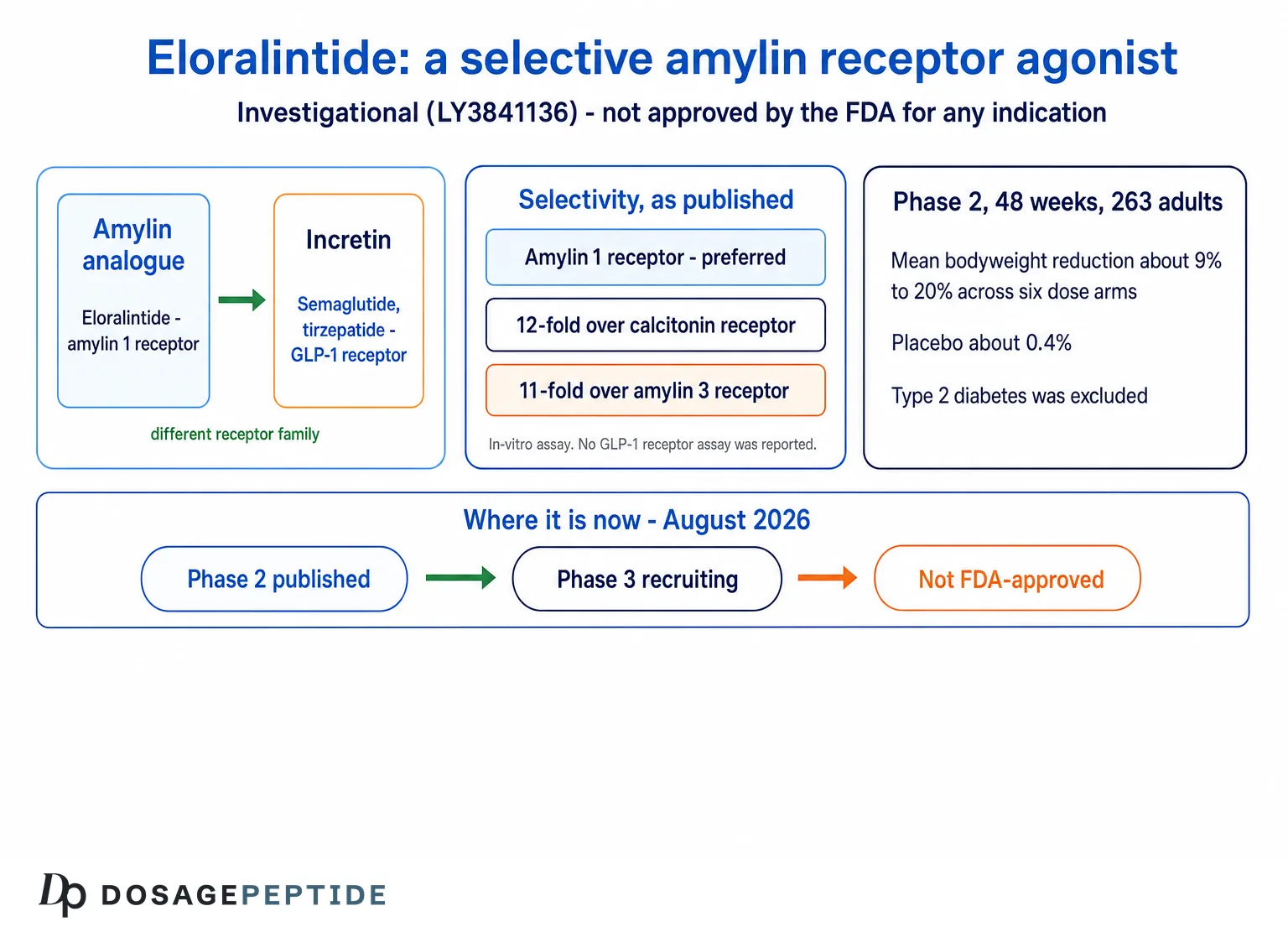
Eloralintide (development code LY3841136) is Eli Lilly’s investigational once-weekly selective amylin receptor agonist — a synthetic amylin analogue engineered to activate the amylin 1 receptor preferentially over the calcitonin receptor and the amylin 3 receptor, which is the only selectivity comparison the published in-vitro work actually ran. It is not an incretin, so it does not work through the GLP-1 receptor that every other well-known obesity drug depends on.[1] Its 48-week phase 2 trial in 263 adults was published in The Lancet in November 2025 and reported mean bodyweight reductions of roughly 9% to 20% across six dose arms versus 0.4% with placebo.[2] It is not approved by the FDA, or any other regulator, for any indication; as of August 2026 it is an investigational drug in phase 3, and any material sold under the name “eloralintide” outside a clinical trial is a research chemical, not the Lilly clinical product.
How does eloralintide compare with cagrilintide, tirzepatide and semaglutide?
The table below is the fastest way to place eloralintide against the compounds a reader is likely to already know. Read the last column carefully: these are separate trials in separate populations over different durations, with different statistical estimands. None of these compounds has been compared head-to-head against eloralintide. Cross-trial percentages are not a ranking.
| Compound | Primary receptor target | Molecule class | Dosing interval | Furthest completed phase | US regulatory status (Aug 2026) | Headline weight change — and where the number comes from |
|---|---|---|---|---|---|---|
| Eloralintide (LY3841136) | Amylin 1 receptor (AMY1R), preferentially over calcitonin receptor and AMY3R | Selective amylin analogue (peptide) | Once weekly, subcutaneous | Phase 2 completed (Aug 2025); phase 3 ongoing | Investigational. No FDA approval, no DailyMed label. | −9.5% to −20.1% vs −0.4% placebo at 48 weeks, efficacy estimand. Peer-reviewed in The Lancet; the one-decimal per-arm figures come from the sponsor’s press release.[2][3] |
| Cagrilintide | Amylin receptors and the calcitonin receptor (non-selective / dual agonist) | Long-acting amylin analogue (peptide) | Once weekly, subcutaneous | Phase 2 as monotherapy; phase 3 as part of the cagrilintide–semaglutide combination | Investigational. Not FDA-approved alone or in combination. | −6.0% to −10.8% vs −3.0% placebo at 26 weeks, trial product estimand. Peer-reviewed in The Lancet.[4] |
| Pramlintide (SymlinPen) | Amylin receptors (first-generation, non-selective) | Amylin analogue (peptide) | Before each major meal, subcutaneous | Approved product | FDA-approved — adjunct to mealtime insulin in type 1 or type 2 diabetes. Not approved for weight management. | No weight-loss indication; efficacy claims in the label are glycaemic. FDA-approved product label.[5] |
| Tirzepatide (Mounjaro, Zepbound) | GIP and GLP-1 receptors (dual incretin) | Incretin receptor co-agonist (peptide) | Once weekly, subcutaneous | Phase 3 and approved | FDA-approved — type 2 diabetes and chronic weight management, per its labelling. | −15.0% to −20.9% vs −3.1% placebo at 72 weeks, treatment-regimen estimand. Phase 3 SURMOUNT-1, peer-reviewed in NEJM.[6] |
| Semaglutide 2.4 mg (Wegovy) | GLP-1 receptor | Incretin receptor agonist (peptide) | Once weekly, subcutaneous | Phase 3 and approved | FDA-approved — chronic weight management, per its labelling. | −14.9% vs −2.4% placebo at 68 weeks. Phase 3 STEP 1, peer-reviewed in NEJM.[7] |
Two things should stand out. First, eloralintide’s headline number rests on a single phase 2 trial of 263 people — the smallest evidence base in the table. Cagrilintide’s monotherapy number is also phase 2, but from a dose-finding trial that randomised 906 participants across five doses, an active liraglutide arm and placebo; the tirzepatide and semaglutide numbers come from phase 3 trials of 2,539 and 1,961 participants.[4] Second, eloralintide and cagrilintide sit in the same pharmacological family but are not the same thing — the difference is receptor selectivity, and that difference is the entire reason this compound exists. For a fuller treatment of the underlying hormone, see our explainer on amylin as a satiety hormone, and for the trial-level record on eloralintide itself, our eloralintide research reference page.
What does “selective amylin receptor agonist” actually mean?
Amylin is a 37-amino-acid peptide co-secreted with insulin from pancreatic beta cells. It is not an incretin. Where GLP-1 and GIP are gut-derived hormones released in response to nutrient arrival, amylin is released alongside insulin from the pancreas itself, and its central actions are exerted principally in the circumventricular organs of the brain — the area postrema in particular — where the blood–brain barrier is permeable.[8]
The receptor architecture is what makes “selectivity” a meaningful engineering target. There is no single gene encoding an amylin receptor. Amylin receptors are formed when the calcitonin receptor (CTR) is co-expressed with one of three receptor activity-modifying proteins (RAMP1, RAMP2, RAMP3), producing the AMY1, AMY2 and AMY3 receptor subtypes.[8] A peptide that binds amylin receptors is therefore always at risk of also activating the bare calcitonin receptor, which is expressed in bone, kidney and elsewhere and does a different job entirely.
What the published selectivity data actually show
In cell lines expressing rat or human receptors, eloralintide preferentially activated the human AMY1 receptor — 12-fold over the calcitonin receptor and 11-fold over AMY3R. In rat cells, both AMY1R and AMY3R were activated more potently than CTR.[1] Cagrilintide, by contrast, is characterised in the literature as a dual amylin and calcitonin receptor agonist — that is, deliberately non-selective.[9]
An important precision point that most coverage skips: “selective” here means selective within the calcitonin receptor family, not selective against the incretin receptors. The published in-vitro characterisation of eloralintide was performed against AMY1R, AMY3R and CTR. It was not a GLP-1 receptor assay.[1] Eloralintide is an amylin analogue rather than an incretin analogue by design and by structural class, and no GLP-1 receptor agonism has been reported for it — but the sentence “it has been shown not to touch the GLP-1 receptor” is not one the published data supports. If you want the contrast on the incretin side, our guide to what a GLP-1 is lays out that mechanism separately.
What did the eloralintide phase 2 trial actually show?
The trial (ClinicalTrials.gov NCT06230523, registered as intervention-specific appendix W8M-MC-LAA1 under Lilly’s chronic weight management master protocol W8M-MC-CWMM, NCT06143956) was a 48-week, multicentre, double-blind, randomised, placebo-controlled study at 46 US research centres. It enrolled 263 adults aged 18–75 with a BMI of 30 kg/m² or higher, or 27 kg/m² or higher with at least one weight-related comorbidity, excluding people with type 2 diabetes. Participants were randomised 2:1:1:1:2:1:2 to placebo or once-weekly subcutaneous eloralintide at 1 mg, 3 mg, 6 mg or 9 mg, or to dose-escalation schedules of 6–9 mg or 3–9 mg. The primary endpoint was percent change in bodyweight from baseline at week 48. The study completed on 14 August 2025.[10][2]
Baseline characteristics matter for interpreting the result: mean age 49.0 years, mean bodyweight 109.1 kg, mean BMI 39.1 kg/m², 78% female and 78% White. This was a heavier-than-average, predominantly female, predominantly White, US-only cohort.[2]
The numbers, and which document each one came from
This is where the evidence tiers need to be kept apart. The Lancet paper reports the mean percent change in bodyweight at 48 weeks under the efficacy estimand as approximately −9% (1 mg, 95% CI −12.6 to −6.3), −12% (3 mg, −14.9 to −9.8), −18% (6 mg, −20.7 to −14.5), −20% (9 mg, −22.7 to −17.5), −20% (6–9 mg, −22.7 to −17.0) and −16% (3–9 mg, −18.6 to −14.1), against −0.4% (−2.2 to 1.4) for placebo.[2]
The widely quoted one-decimal figures — −9.5%, −12.4%, −17.6%, −20.1%, −19.9% and −16.4% — come from Lilly’s own press release of 6 November 2025, which also states plainly that these endpoints are assessed with the efficacy estimand and are not adjusted for multiplicity.[3] That caveat is the company’s own, and it is worth repeating: with six active arms and no multiplicity adjustment on the secondary comparisons, the precision implied by a decimal point is greater than the trial can really carry.
The efficacy estimand itself is defined in that release as the efficacy that would have been observed had all randomised participants remained on study intervention — with possible dose interruptions or dose modifications — for 48 weeks.[3] That is a different question from the one the SURMOUNT-1 treatment-regimen estimand answers, which counts everyone regardless of whether they stopped, and different again from the trial product estimand used for cagrilintide. Estimand choice alone moves a headline percentage, which is one more reason the table above is not a league table.
Tolerability in phase 2
The Lancet reports nausea at 11% (1 mg), 13% (3 mg), 64% (6 mg), 33% (9 mg), 54% (6–9 mg), 25% (3–9 mg) and 14% (placebo); fatigue at 0%, 13%, 29%, 43%, 46%, 21% and 12% respectively.[2] Two observations follow. Nausea in the 6 mg fixed-dose arm (64%) was roughly double that in the 9 mg arm (33%), which is the opposite of a clean dose–response, and the escalation arms do not sit tidily between the fixed arms either: 6–9 mg reported 54% but 3–9 mg reported 25%, below the fixed 9 mg arm. The only reading these numbers really support is the sponsor’s own — that adverse-event incidence was lower with slower escalation — and with 24 to 54 participants per arm the uncertainty around any single percentage is wide enough to absorb most of these differences.[3] Fatigue, notably, rose fairly monotonically with dose and is not a symptom that features prominently in incretin tolerability discussions. Readers coming from the amylin side may want to compare this against the documented cagrilintide adverse event profile, where gastrointestinal events dominated.
What did the earlier human studies show?
Two phase 1 datasets are published and both are worth separating from the phase 2 result.
The first, reported inside the discovery paper in Molecular Metabolism, was a single-ascending-dose study (NCT05295940) in 48 healthy participants with a mean BMI of 27.5 kg/m². After single doses of 4 mg or 12 mg, week-4 mean percent change in bodyweight was −2.5% (p<0.01) and −4.4% (p<0.001) versus +0.6% for placebo. Nine participants in eloralintide cohorts reported 16 adverse events, 15 of which were mild; two participants reported four gastrointestinal events in total.[1]
The second, published in Diabetes, Obesity and Metabolism, was a 12-week multiple-ascending-dose study in 100 participants with obesity or overweight (mean BMI 32.6 kg/m²), dosed once weekly without escalation. Least-squares mean percent bodyweight reduction at week 12 ranged from 2.6% to 11.3% across dose groups. The most common treatment-emergent adverse events were decreased appetite (19%), headache (12%), fatigue (11%) and COVID-19 (11%); diarrhoea 10%, nausea 8% and vomiting 4%. There were no deaths and one serious adverse event, judged unrelated to study drug.[11]
Both are small, sponsor-run, early-phase studies whose purpose was safety, tolerability and pharmacokinetics. Weight change in a phase 1 study is exploratory by construction. They support the once-weekly dosing interval and they suggested the gastrointestinal burden might be modest — a signal that the larger phase 2 trial then partly complicated, given 64% nausea in one arm.
What does selectivity buy, and what does it cost?
The stated rationale for building a selective molecule is tolerability. The preclinical evidence for that is a conditioned taste avoidance experiment: eloralintide induced significantly less conditioned taste avoidance in lean rats than cagrilintide (p<0.05).[1] That is a rodent behavioural assay, not a human tolerability endpoint, and conditioned taste avoidance in rats is a proxy for visceral malaise that does not translate one-for-one into human nausea rates. It is a reasonable hypothesis-generating result. It is not proof of better human tolerability, and the phase 2 nausea figures do not settle the question either, because there was no cagrilintide comparator arm.
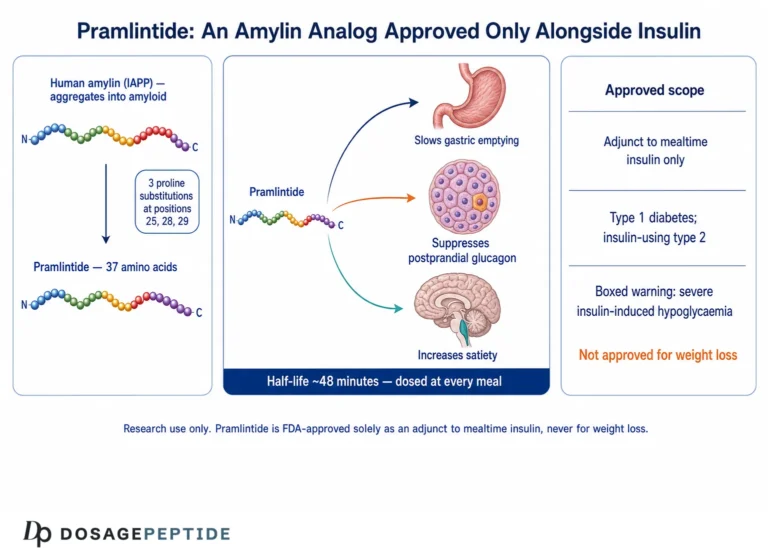
The cost of selectivity is more interesting. An incretin drug carries an intrinsic glucose-lowering mechanism: GLP-1 receptor agonism drives glucose-dependent insulin secretion and suppresses glucagon. A pure amylin receptor agonist does not have that lever. Amylin’s own glucoregulatory contribution operates by slowing gastric emptying and suppressing postprandial glucagon — which is precisely why the approved amylin analogue pramlintide is labelled as an adjunct to mealtime insulin, not a standalone glycaemic agent.[5][8]
Lilly reported that eloralintide treatment was associated with improvements in cardiometabolic risk factors including waist circumference, blood pressure, lipids, glycaemic control and inflammatory markers.[3] Read that carefully: the phase 2 trial excluded people with type 2 diabetes, so “improvements in glycaemic control” here means movement within a largely normoglycaemic-to-prediabetic range, and those improvements are not separable from the weight loss that produced them. Whether eloralintide does anything useful for glycaemia in people who actually have type 2 diabetes is an open question that a dedicated phase 3 trial is now testing.[12] The comparison our readers most often want — amylin versus incretin logic — is drawn out further in cagrilintide versus tirzepatide, and the same mechanistic split explains why oral incretins like orforglipron sit in a completely different pharmacological category despite chasing the same clinical outcome.
Where is eloralintide in the pipeline as of August 2026?
The brief that circulated after the phase 2 readout — “Lilly plans to start phase 3” — is now out of date. Phase 3 has started. The registered programme includes:
- ENLIGHTEN-1 (NCT07321886): phase 3, randomised, double-blind, placebo-controlled, in adults with obesity or overweight without type 2 diabetes. Planned enrolment 1,980; started 6 February 2026; primary endpoint is percent change in bodyweight at week 64; primary completion estimated March 2028.[13]
- ENLIGHTEN-2 (NCT07282600): phase 3 in adults with obesity or overweight and type 2 diabetes; planned enrolment 1,035; started 15 December 2025; primary completion estimated January 2028.[12]
- ENLIGHTEN-6 (NCT07392190): phase 3 in adults with persistent obesity or overweight already treated with a weekly incretin — the add-on question; planned enrolment 900; started 10 February 2026.[14]
Two further phase 3 master protocols are registered under the same sponsor — ENLIGHTEN-4 (NCT07353931) in obesity with osteoarthritis knee pain and ENLIGHTEN-3 (NCT07369011) in obesity with moderate-to-severe obstructive sleep apnoea — alongside combination studies with tirzepatide (phase 1 NCT06916065, phase 2 NCT06603571) and with macupatide. None of these has reported. The earliest primary completion dates cluster in 2028.[14] No phase 3 efficacy or safety data for eloralintide exist in the public record today, and the compound has no entry in Drugs@FDA and no structured product label in DailyMed — the expected state for an investigational drug, and the reason no therapeutic claim can be attached to it.
What is still unknown about eloralintide?
An honest list, because the gaps are larger than the published record:
- No phase 3 results. Every efficacy figure in circulation is phase 2 or earlier, from a single 263-person trial.
- No head-to-head trial against cagrilintide, semaglutide, tirzepatide or any other active comparator. The phase 2 trial was placebo-controlled only.[2]
- No long-term safety data. The longest published human exposure is 48 weeks. Amylin receptor agonism is a chronic-therapy proposition; 48 weeks does not characterise multi-year risk.
- No cardiovascular or other outcome trial. Nothing is published on hard endpoints.
- No published body-composition detail in humans. Fat-versus-lean-mass partitioning was demonstrated in diet-induced obese rats; the human phase 3 programme lists total body fat mass as a secondary endpoint, which means the human answer is not yet in.[1][13]
- No published data on what happens after discontinuation. Weight regain after stopping is a documented phenomenon across this therapeutic area and has not been characterised for eloralintide.
- Special populations are still being studied. Dedicated phase 1 trials in renal impairment (NCT07426380) and hepatic impairment (NCT07401862) are registered, meaning pharmacokinetic behaviour in those populations is not yet published.[14]
Independent syntheses have made the same point in more formal language: a 2026 network meta-analysis that ranked high-dose eloralintide second among novel amylin-based therapies explicitly described its own findings as preliminary, based on sparse, low-certainty data requiring confirmation in larger trials.[15] Indirect cross-trial rankings inherit every confound of the trials they pool.
Is research-grade “eloralintide” the same as the Lilly compound?
No, and this is the most consequential practical point on this page. Eloralintide as studied in NCT06230523 and the ENLIGHTEN phase 3 programme is a pharmaceutical-grade investigational product, manufactured under GMP, supplied to investigators under an IND, and administered under trial protocol. Material sold to laboratories under the name “eloralintide” is a research chemical: it is not manufactured to pharmaceutical standards, it is not the sponsor’s clinical supply, its identity and purity depend entirely on the vendor’s own third-party testing, and it carries no regulatory status of any kind. No published study has characterised the identity, purity or aggregation behaviour of any commercially available research-grade eloralintide.
Amylin analogues make this more than an abstraction. Native human amylin is amyloidogenic — that is the origin of the name “islet amyloid polypeptide” — and the second generation of long-acting amylin analogues, of which eloralintide is one, was designed around non-aggregating, long-acting structures.[9] Whether a given research-grade preparation reproduces those engineered properties is an empirical question that a certificate of analysis for a single lot does not fully answer. Our eloralintide reference page catalogues the doses used in the published trials for research documentation purposes only, and the equivalent pages for cagrilintide and tirzepatide do the same for those compounds. None of them is a human-use protocol.
Frequently Asked Questions
Is eloralintide FDA-approved?
No. As of August 2026 eloralintide is an investigational drug. It has no entry in Drugs@FDA and no structured product label in DailyMed, and it is not approved by the FDA or any other national regulator for any indication. Its phase 2 trial completed in August 2025 and phase 3 trials began enrolling in December 2025 and February 2026, with the earliest primary completion dates estimated for 2028.
What makes eloralintide different from cagrilintide?
Receptor selectivity. In published in-vitro work, eloralintide preferentially activated the human amylin 1 receptor — 12-fold over the calcitonin receptor and 11-fold over AMY3R. Cagrilintide is described in the literature as a dual amylin and calcitonin receptor agonist, meaning it deliberately activates both. The two have never been compared head-to-head in humans, so any statement that one is better tolerated in people is currently unsupported.
How much weight did people lose in the eloralintide phase 2 trial?
In the 48-week phase 2 trial of 263 adults, mean bodyweight reductions under the efficacy estimand ranged from about 9% in the 1 mg arm to about 20% in the 9 mg and 6–9 mg arms, versus 0.4% with placebo. The one-decimal figures often quoted (9.5% to 20.1%) come from Lilly’s press release, which states they are not adjusted for multiplicity. These are phase 2 results in a single US cohort, not phase 3 confirmation.
Does eloralintide activate the GLP-1 receptor?
Eloralintide is an amylin analogue, not an incretin analogue, and no GLP-1 receptor agonism has been reported for it. The published in-vitro characterisation, however, tested it against the amylin 1, amylin 3 and calcitonin receptors — not against the GLP-1 receptor. So the accurate statement is that it is selective within the calcitonin receptor family and is not designed as an incretin, rather than that a GLP-1 receptor assay has formally ruled activity out.
What were the most common side effects reported in the trials?
In the 48-week phase 2 trial the most common adverse events were nausea and fatigue, both more frequent at higher doses and reported by the sponsor as generally mild to moderate. Nausea ranged from 11% to 64% across active arms versus 14% on placebo, and fatigue from 0% to 46% versus 12%. In the 12-week phase 1 study the most common events were decreased appetite, headache, fatigue and COVID-19.
Is eloralintide being tested alongside tirzepatide?
Yes. Beyond monotherapy, Lilly has registered a phase 1 study of eloralintide given with tirzepatide, a phase 2 study of eloralintide with and without tirzepatide in adults with obesity and type 2 diabetes, and a phase 3 study in people with persistent obesity already on a weekly incretin. None of the combination studies has reported results, so nothing is currently known about combined efficacy or tolerability in humans.
Why does the trial-arm dose escalation matter?
The phase 2 trial deliberately included two escalation schedules (6–9 mg and 3–9 mg) alongside fixed doses. The escalation arms reached weight reductions comparable to or slightly below the fixed 9 mg arm, and the sponsor reported that adverse-event incidence was lower with slower escalation. With only 24 to 54 participants per arm, however, these comparisons are exploratory rather than definitive.
Is research-grade eloralintide equivalent to the clinical product?
No. The eloralintide studied in registered trials is a GMP investigational product supplied under an IND. Material sold to laboratories under that name is a research chemical of unverified provenance, with no regulatory status and no published characterisation of its identity, purity or aggregation behaviour. Because second-generation amylin analogues are specifically engineered to be non-aggregating, this is a substantive difference and not a formality.
How does eloralintide compare with pramlintide, the approved amylin drug?
Pramlintide (SymlinPen) is the only FDA-approved amylin analogue, indicated as an adjunctive treatment in patients with type 1 or type 2 diabetes who use mealtime insulin and have not achieved desired glucose control. It is dosed before each major meal and has no weight-management indication. Eloralintide is investigational, dosed once weekly, and has been studied for weight management in people without type 2 diabetes.
References
- Briere DA, Qu H, Lansu K, et al. Eloralintide (LY3841136), a novel amylin receptor agonist for the treatment of obesity: from discovery to clinical proof of concept. Molecular Metabolism. 2025;102:102271. PubMed 41109426
- Billings LK, Hsia S, Bays H, et al. Eloralintide, a selective amylin receptor agonist for the treatment of obesity: a 48-week phase 2, multicentre, double-blind, randomised, placebo-controlled trial. The Lancet. 2025;406(10520):2631–2643. PubMed 41207310
- Eli Lilly and Company. Lilly’s selective amylin agonist, eloralintide, demonstrated meaningful weight loss and favorable tolerability in a Phase 2 study of adults with obesity or overweight. Press release, 6 November 2025. investor.lilly.com
- Lau DCW, Erichsen L, Francisco AM, et al. Once-weekly cagrilintide for weight management in people with overweight and obesity: a multicentre, randomised, double-blind, placebo-controlled and active-controlled, dose-finding phase 2 trial. The Lancet. 2021;398(10317):2160–2172. PubMed 34798060
- AstraZeneca Pharmaceuticals LP. SYMLINPEN (pramlintide acetate) injection — US prescribing information. DailyMed, National Library of Medicine. DailyMed label
- Jastreboff AM, Aronne LJ, Ahmad NN, et al. Tirzepatide once weekly for the treatment of obesity. New England Journal of Medicine. 2022;387(3):205–216. PubMed 35658024
- Wilding JPH, Batterham RL, Calanna S, et al. Once-weekly semaglutide in adults with overweight or obesity. New England Journal of Medicine. 2021;384(11):989–1002. PubMed 33567185
- Hay DL, Chen S, Lutz TA, Parkes DG, Roth JD. Amylin: pharmacology, physiology, and clinical potential. Pharmacological Reviews. 2015;67(3):564–600. PubMed 26071095
- Bailey CJ, Flatt PR, Conlon JM. Long-acting amylin-related peptides as therapies for obesity and type 2 diabetes. Peptides. 2026;196:171480. PubMed 41747885
- Eli Lilly and Company. A study of LY3841136 compared with placebo in adult participants with obesity or overweight. ClinicalTrials.gov identifier NCT06230523. ClinicalTrials.gov NCT06230523
- Bhattachar S, Tham LS, Tidemann-Miller B, et al. Eloralintide, a selective, long-acting amylin receptor agonist for treatment of obesity: phase 1 proof of concept. Diabetes, Obesity and Metabolism. 2026;28(4):2651–2660. PubMed 41559929
- Eli Lilly and Company. A phase 3 study of once-weekly eloralintide in adult participants with obesity or overweight, and type 2 diabetes. ClinicalTrials.gov identifier NCT07282600. ClinicalTrials.gov NCT07282600
- Eli Lilly and Company. ENLIGHTEN-1: a study of eloralintide (LY3841136) in participants with obesity, or overweight without type 2 diabetes. ClinicalTrials.gov identifier NCT07321886. ClinicalTrials.gov NCT07321886
- Eli Lilly and Company. ENLIGHTEN-6 (NCT07392190) and the wider registered eloralintide programme — ENLIGHTEN-3 (NCT07369011), ENLIGHTEN-4 (NCT07353931), renal impairment (NCT07426380), hepatic impairment (NCT07401862) and the tirzepatide combination studies (NCT06916065, NCT06603571). ClinicalTrials.gov, records retrieved 12 August 2026. ClinicalTrials.gov NCT07392190 · full eloralintide study list
- Kamrul-Hasan ABM, Khalil I, Mahajan K, Dutta D, Banerjee M, Pappachan JM. Novel amylin-based therapies for weight management in adults with overweight or obesity without diabetes: a network meta-analysis. Endocrinology, Diabetes & Metabolism. 2026;9(3):e70247. PubMed 42175595
Research use only. This article is an educational review of published research and regulatory records. It is not medical advice, not a protocol, and not a recommendation for human use. Eloralintide (LY3841136) is an investigational compound in phase 3 clinical development and is not approved by the FDA or any other national regulator for any indication; research-grade material sold under this name is not an approved pharmaceutical product and is not the sponsor’s clinical trial supply. Nothing here should be used to diagnose, treat, cure or prevent any disease.