“Peptides” is not one thing, so “are peptides safe?” has no single honest answer. Insulin is a peptide and so is semaglutide; so is a vial of BPC-157 powder shipped from an anonymous website with “research use only” on the label — and those three sit at completely different levels of evidence. The useful question is not are peptides safe but which peptide, at what dose, in whom, for what purpose, and how much human evidence actually exists — and for a large share of the compounds people search for, the truthful answer is that nobody knows, because the studies have never been done in humans.
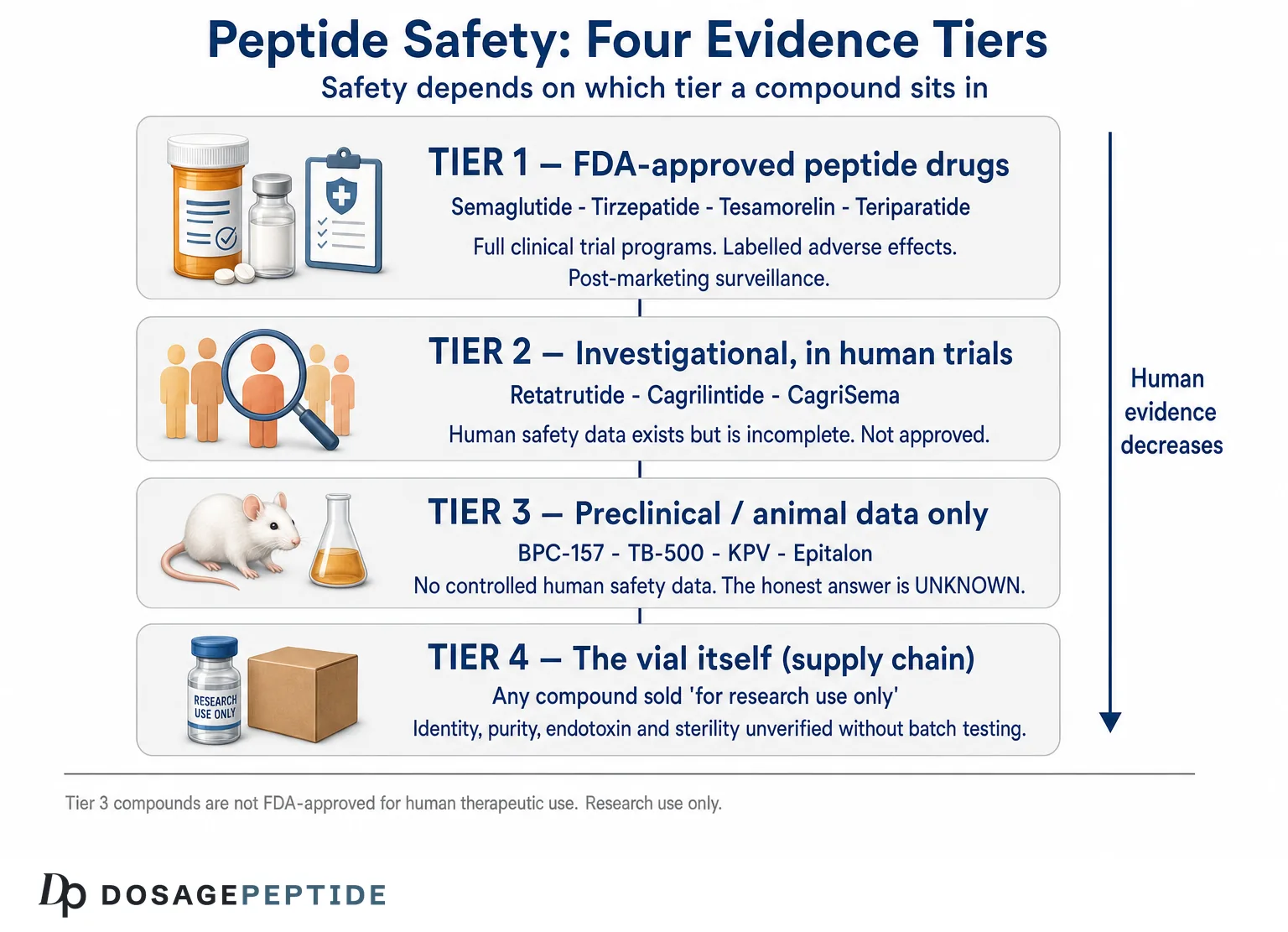
The four tiers of peptide safety evidence
Almost every argument about peptide safety collapses once you separate the category into evidence tiers. A compound’s tier tells you what kind of claim can legitimately be made about it.
| Tier | Examples | What safety data exists | What is genuinely unknown |
|---|---|---|---|
| Tier 1 — FDA-approved peptide drugs | Semaglutide, tirzepatide, liraglutide, insulin analogs, teriparatide, tesamorelin, bremelanotide, leuprolide, octreotide | Full clinical trial programmes, an approved label listing adverse reactions and contraindications, and ongoing post-marketing surveillance — but only for the specific approved indication and population | Long-term effects beyond trial duration; safety in populations excluded from trials; safety when used off-label at non-approved doses |
| Tier 2 — Investigational, in active human trials | Retatrutide, cagrilintide, CagriSema | Real and often substantial human safety data from Phase 1–3 trials, collected under medical supervision with monitoring | Rare adverse events, long-term risk, and the full risk–benefit balance — the questions approval exists to answer. Not approved for any indication |
| Tier 3 — Preclinical / animal / in-vitro only | BPC-157, TB-500, KPV, MOTS-c, epitalon, most Khavinson bioregulators | Animal and cell-culture data, sometimes extensive. Essentially no completed, published, controlled human safety trials | Nearly everything that matters in humans: effective dose, toxicity threshold, immunogenicity, drug interactions, long-term risk. “Unknown” — not “safe”, not “dangerous” |
| Tier 4 — The vial itself (supply chain) | Any compound sold “for research use only” | Whatever an independent, batch-specific third-party test shows — nothing more | Identity, purity, quantity, endotoxin load, sterility. A research-chemical vial is not a pharmaceutical product, whatever tier its molecule occupies |
Tier 4 is the one most safety discussions skip, and it is the one that matters most in practice. For the majority of people asking this question, the largest measurable risk is not the molecule’s pharmacology — it is the unregulated supply chain the molecule arrives through.
What does “safe” actually mean in pharmacology?
In regulatory science, no drug is “safe” in the abstract. Safety is a conditional judgement, always attached to four variables.
- Dose. Toxicity is dose-dependent for essentially every bioactive compound, which is precisely why dose-escalation trials exist.
- Indication. Approval is granted for a defined medical use, not for a molecule in general. A risk acceptable when treating serious disease is not automatically acceptable for cosmetic or performance purposes, because the benefit side of the equation has changed.
- Duration. Three weeks of exposure tells you little about three years. Effects on immune response, endocrine feedback and tissue growth may take far longer to appear than a short study can capture.
- Population. Trials enrol people meeting strict criteria. Pregnancy, kidney or liver impairment, cancer history, age extremes and concurrent medications are commonly excluded, so a label’s safety profile does not automatically transfer to people who would have been excluded.
This is why “peptides are safe” is not merely optimistic — it omits every variable that determines the answer.
Tier-by-tier: what the evidence actually supports
Tier 1 — FDA-approved peptide drugs
Several peptides are approved medicines with decades of cumulative human data. Crucially, each is approved for a narrowly defined use, and the label says so explicitly.
- Semaglutide (Wegovy) — a GLP-1 receptor agonist, available as an injection and as tablets, indicated alongside reduced-calorie diet and physical activity to reduce major adverse cardiovascular events in adults with established cardiovascular disease plus obesity or overweight, and for long-term weight reduction (the injection in adults and in patients aged 12 years and older with obesity, and in adults with overweight plus a weight-related comorbidity). The injection label carries a third indication, for noncirrhotic metabolic dysfunction-associated steatohepatitis (MASH) with moderate to advanced fibrosis (stages F2 to F3) in adults — granted under accelerated approval based on improvement of MASH and fibrosis, with continued approval potentially contingent on verification of clinical benefit in a confirmatory trial. That caveat is the label stating, in its own words, that the evidence is not yet final.[7]
- Tirzepatide (Zepbound) — a dual GIP/GLP-1 receptor agonist indicated for long-term weight reduction in adults with obesity or overweight plus a weight-related comorbidity, and for moderate-to-severe obstructive sleep apnoea in adults with obesity.[8]
- Tesamorelin (Egrifta SV) — a growth hormone-releasing factor analog indicated for reduction of excess abdominal fat in HIV-infected adults with lipodystrophy. The label states plainly that long-term cardiovascular safety has not been established and that it is not indicated for weight-loss management.[9]
- Bremelanotide (Vyleesi) — a melanocortin receptor agonist for premenopausal women with acquired, generalised hypoactive sexual desire disorder; explicitly not indicated in postmenopausal women or men, nor for enhancing sexual performance.[10]
- Teriparatide (Forteo) — a parathyroid hormone analog for osteoporosis in patients at high fracture risk.[11]
Tier 1 means the risks have been characterised, quantified, written down and are actively monitored after launch. It does not mean the risks are zero, and it does not extend to using the drug for a different purpose, in a different population, or at a dose the trials never tested.
Tier 2 — investigational peptides in human trials
Retatrutide is the clearest current example. It is a genuine late-stage clinical programme: the Phase 3 TRIUMPH-1 trial alone enrolled 2,335 participants across 134 sites.[14] Substantial human safety data therefore exists — collected under supervision, with monitoring and adverse-event reporting built in. That is a completely different evidence position from a Tier-3 compound, and it is the reason reported retatrutide side effects can be described as patterns observed in trial participants rather than extrapolations from rodents.
But investigational is not approved. As of July 2026, retatrutide has not been approved by the FDA for any indication. The FDA has stated directly that retatrutide and cagrilintide cannot be used in compounding under federal law, are not components of FDA-approved drugs, and have not been found safe and effective for any condition.[4] CagriSema (cagrilintide plus semaglutide) is likewise still under regulatory review rather than approved. The unknowns at this tier are exactly the ones approval is designed to resolve: rare events, long-term risk, and whether benefit outweighs harm across a whole population.
Tier 3 — preclinical only, where the honest answer is “unknown”
This is where most of the popular “research peptides” sit, and where the evidence gap is widest. Take BPC-157, probably the most-searched peptide in this category. Its animal literature is genuinely extensive. Its human literature is close to non-existent.
ClinicalTrials.gov lists only two registered interventional studies of BPC-157 in its entire history. The first, a Phase 1 pilot in 42 healthy volunteers in Tijuana, used oral tablets, ran in 2015–2016, has a record status of “unknown”, and never posted results.[12] The second, a Phase 2 trial in acute hamstring strain, began recruiting in February 2026 with 120 planned participants and primary completion scheduled for 2027.[13] That is a real development — but it is ongoing, and cannot retroactively supply evidence that does not yet exist. Anyone weighing what is actually documented about BPC-157 side effects is working almost entirely from animal models and uncontrolled self-report, and the regulatory picture is covered separately in our review of whether BPC-157 is FDA approved.
The FDA’s own assessment is the most precise statement available. Reviewing BPC-157 for compounding, the agency noted immunogenicity risk for certain routes of administration and complexity around peptide-related impurities and characterisation of the active ingredient, and concluded it had identified no, or only limited, safety-related information — and therefore lacked sufficient information to know whether the drug would cause harm when administered to humans. For KPV, MOTS-c and PEG-MGF, the same document goes further, stating the agency identified no human exposure data at all for drug products administered via any route of administration; for the thymosin beta-4 fragment sold as TB-500 it states, without the route qualifier, that it has not identified any human exposure data.[2]
TB-500 also illustrates a naming trap. Full-length thymosin beta-4 has been studied in registered human trials, including ophthalmic and cardiac programmes. TB-500 is not that molecule — it is a short fragment (LKKTETQ), which is why the FDA lists it separately. Trial data on the full-length protein is routinely cited as though it applied to the fragment in the vial; it does not, which is the core issue behind what can and cannot be said about TB-500 side effects. A first human trial of the fragment itself — a Phase 1/2 randomised, placebo-controlled dose-escalation study in 80 adults with stable atherosclerotic cardiovascular disease, run by the same sponsor as the BPC-157 hamstring trial — began recruiting in February 2026, with primary completion scheduled for 2027 and no results reported.[17] Until it reports, the fragment still has no completed controlled human safety data of its own.
Regulatory status here has been moving, and is widely misreported. These peptides previously sat in Category 2 of the FDA’s interim compounding policy — nominated with enough information to evaluate, but flagged for significant safety risks pending further evaluation.[1] On the FDA’s current page they appear under a heading for substances nominated but subsequently withdrawn by the nominators, with the agency’s safety assessments retained verbatim.[2] On 23–24 July 2026 the Pharmacy Compounding Advisory Committee met and voted on seven of these substances.[3] On 23 July it voted in favour of adding BPC-157, KPV and TB-500 to the 503A bulks list — 8–6 with one abstention in each case — and MOTS-c, 7–5 with two abstentions. On 24 July it voted in favour of epitalon and semax and against emideltide (DSIP). Six of seven were recommended, and reporting from the meeting records that the votes went against FDA’s own reviewers, who told the committee the substances were not characterised well enough to assess for safety and effectiveness.[16] Three points matter. Advisory committees issue non-binding recommendations the FDA may or may not follow. Any change would still have to be made through formal notice-and-comment rulemaking, which has not happened. And eligibility for pharmacy compounding is a different legal question from drug approval. Neither a committee vote nor a bulks-list placement is a finding that a compound is safe and effective, and none of these peptides is approved for human therapeutic use.
Tier 4 — the vial is not the molecule
A compound sold “for research use only” is not a pharmaceutical product, whatever tier its molecule occupies. Research-chemical supply operates outside pharmaceutical manufacturing standards, so identity, purity, stated quantity, endotoxin content and sterility are unverified unless a specific batch has been independently tested — and this is where the measurable harm concentrates.
The risks that have nothing to do with the peptide itself
Suppose a molecule were perfectly benign. Several serious risks would remain, and they are the ones best documented.
Purity, identity and dose accuracy
A published test purchase analysed semaglutide bought without prescription from illegal online pharmacies. It is small — six purchase attempts, of which three injection vials were actually delivered, the rest being non-delivery scams — so it establishes what can happen, not how often it happens. In those three vials, measured purity ranged from 7.7% to 14.37% against a claimed 99% on the label, while total semaglutide content exceeded the labelled amount by roughly 29% to 39%.[5] Both errors are dangerous, in opposite directions — the label bears no reliable relationship to the vial. The FDA has separately warned that some products sold as semaglutide are salt forms such as semaglutide sodium or acetate, which are different active ingredients from those in approved drugs.[4]
Endotoxin and sterility
In that same analysis, endotoxin was detected in all three samples, at 2.1645 to 8.9511 EU/mg, even though the lyophilised powder contained no viable microorganisms at the time of testing.[5] That distinction is widely misunderstood: endotoxin is a heat-stable bacterial cell-wall fragment, so a product can be sterile and still carry a meaningful endotoxin load capable of provoking fever and systemic inflammatory reactions when injected. No visual inspection detects it, and a sterility claim does not address it.
Dosing arithmetic
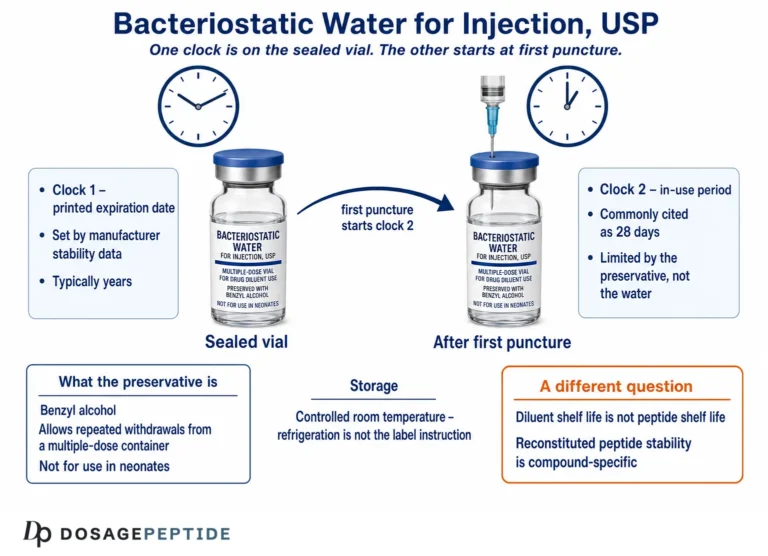
Reconstitution converts a powder into a solution whose concentration depends entirely on the diluent volume added, and unit confusion between milligrams, millilitres and syringe “units” is a recurring source of error. The FDA has received multiple reports of adverse events, some requiring hospitalisation, that it says may be related to dosing errors with compounded injectable semaglutide — arising both from patients self-administering incorrect doses and from health care professionals miscalculating them.[4] If professionals make this error, the arithmetic is not trivial; the mechanics are set out in our peptide reconstitution guide.
Handling, storage and administration
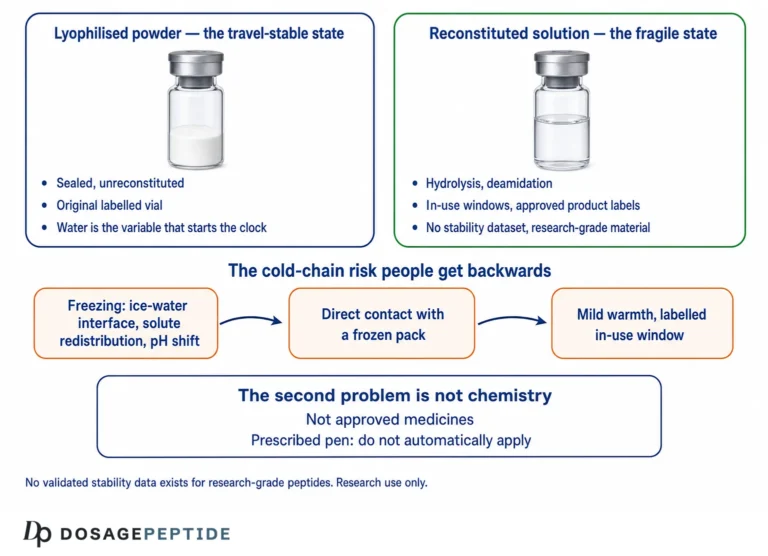
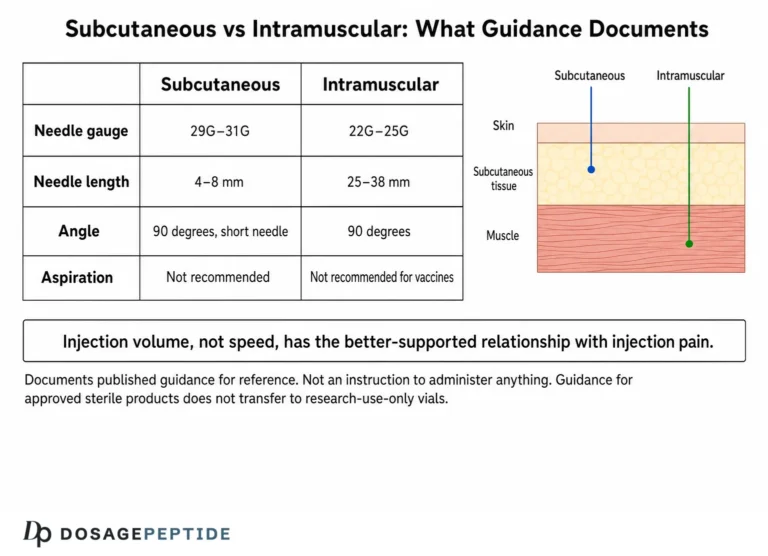
Peptides are physically fragile molecules, and degradation is invisible. The FDA has received complaints of compounded GLP-1 products arriving warm or with inadequate ice packs, and advises against using injectable GLP-1 drugs that arrive insufficiently refrigerated because this can affect quality.[4] Cold-chain questions are covered in our note on whether peptides need refrigeration. Separately, the mechanical risks of non-sterile technique — abscess, cellulitis, injection-site infection — are inherent to any self-administered injection.
Counterfeiting and drug interactions
The FDA has documented fraudulent compounded semaglutide and tirzepatide bearing false label information, including products naming compounding pharmacies that do not exist, or naming real licensed pharmacies that did not make the product.[4] Interaction risk is also uncharacterised for Tier-3 compounds: formal drug–drug interaction studies are part of a development programme, so a compound that never had one has never had them done.
What the approved peptide drugs’ adverse-effect profiles look like
Because Tier-1 drugs were studied properly, their harms are documented in detail. This is what real safety characterisation produces — and these are label and trial facts, not recommendations.
| Drug | Documented label findings |
|---|---|
| Semaglutide (Wegovy) | Boxed warning: in rodents, semaglutide causes thyroid C-cell tumours at clinically relevant exposures; whether it does so in humans is undetermined, and it is contraindicated with personal or family history of medullary thyroid carcinoma or MEN 2. Acute pancreatitis has been observed; acute gallbladder disease has occurred in trials. Adverse reactions at ≥5% include nausea, diarrhoea, vomiting, constipation, abdominal pain, headache, fatigue, dyspepsia, dizziness and hair loss.[7] |
| Tirzepatide (Zepbound) | Boxed warning: in rats, tirzepatide causes thyroid C-cell tumours; human relevance undetermined; same MTC/MEN 2 contraindication. Acute pancreatitis observed; acute gallbladder disease reported in trials. Adverse reactions at ≥5% include nausea, diarrhoea, vomiting, constipation, abdominal pain, dyspepsia, injection-site reactions, fatigue, hypersensitivity reactions and hair loss.[8] |
| Bremelanotide (Vyleesi) | Most common adverse reactions above 4%: nausea, flushing, injection-site reactions, headache and vomiting.[10] |
| Teriparatide (Forteo) | Osteosarcoma risk appears under Warnings and Precautions, advising against use in patients at increased osteosarcoma risk. Notably, this warning previously appeared as a boxed warning and was revised as evidence accumulated.[11] |
Two lessons follow. A rodent carcinogenicity signal is reported honestly as a rodent signal whose human relevance is undetermined — neither hidden nor inflated into a human cancer claim. And the teriparatide example shows labels change in both directions as data accumulates: a boxed warning can be downgraded, a new warning added. That is an active surveillance system, and it is exactly what Tier-3 compounds lack.
Why “no reported side effects” is a red flag, not a reassurance
For Tier-3 peptides you will often read that there are no known side effects. Treat that as a statement about the evidence base, not about the compound.
Adverse effects get “reported” through machinery: trial protocols with pre-specified monitoring, mandatory investigator reporting, pharmacovigilance databases, and post-marketing surveillance obligations attached to an approved product. A compound never marketed as a drug has none of that pointed at it — no sponsor obliged to collect signals, no label to update, no regulator monitoring outcomes. Absence of reports is therefore the expected result whether the compound is harmless or harmful, so the observation carries almost no information.
The point is not hypothetical. Melanotan II, another peptide long sold outside medical channels, accumulated published case reports of serious harm only because dermatologists began encountering patients — including reports of melanoma after injection.[15] The FDA’s summary for Melanotan II cites published case reports of melanoma, posterior reversible encephalopathy syndrome, sympathomimetic toxidrome and priapism.[2] Those signals emerged only after enough people had used it and enough clinicians wrote up what they saw — a slow, lossy and ethically poor substitute for a trial.
Absence of evidence is not evidence of absence. For Tier-3 compounds the correct statement is: no controlled human safety data exists, so the risk profile is unknown.
Are peptides legal?
This varies substantially by jurisdiction and is not legal advice. A few accurate general points hold in the United States.
- Approved peptide drugs are legal prescription medicines for their approved indications.
- Compounds sold as research chemicals are generally sold for laboratory research use only and are not approved for human therapeutic use. The FDA has acted against companies illegally selling unapproved drugs containing semaglutide, tirzepatide or retatrutide that were falsely labelled “for research purposes” or “not for human consumption” while being sold directly to consumers with dosing instructions.[4] The research-use label describes the intended use, and does not make consumer sale for human use lawful.
- Eligibility for pharmacy compounding is a separate regulatory question from drug approval, governed by the 503A bulks list process.[1]
- In competitive sport the rules are stricter and independent of national law. The WADA 2026 Prohibited List, effective 1 January 2026, names BPC-157 explicitly under S0 (non-approved substances), prohibited at all times; and lists thymosin-β4 and its derivatives, including TB-500, under S2 growth factors.[6] S0 captures substances not approved by any government health authority for human therapeutic use.
How to read the evidence yourself
The single most useful skill is checking claims at source. A few practical tests:
- Was it humans? Check the methods, not the abstract’s framing. “Rats”, “mice”, “in vitro” and “cell line” mean the finding has not been shown in people. Most BPC-157 and TB-500 literature is animal work.
- How many participants, and was there a control group? A study of 8 people generates a hypothesis, not a safety profile. Uncontrolled before-and-after studies cannot separate the compound from placebo, regression to the mean or natural healing — which matters enormously for injury-recovery claims.
- Does the citation resolve? A real citation has authors, a journal, a year and a working identifier. If a claim cites a PMID leading nowhere, or nothing at all, treat it as unsupported. Fabricated references are common in this niche.
- Did the trial report results? A registry entry proves a study was registered, not that it finished or found anything. Check the status field and whether results were posted — the 2015 BPC-157 Phase 1 record, for instance, never posted any.[12]
- Is the molecule the same molecule? Fragments, analogues and salt forms are different substances with different data. Thymosin beta-4 is not TB-500; semaglutide is not semaglutide sodium.
What a certificate of analysis does and does not prove
A COA is useful but frequently over-interpreted. At best it shows that one sample from one batch matched an expected mass and met a purity threshold by HPLC at the time of testing. It does not establish that your vial came from that batch, that the compound is safe in humans, that it survived shipping and storage, or that it is sterile. Unless endotoxin and sterility were specifically assayed, it says nothing about them. The semaglutide test purchase above shows that in the illegal online pharmacy market, product labelling can simply be false;[5] that study examined labels and packaging, not certificates of analysis, and no equivalent published test-purchase analysis of research-chemical COAs exists — which is itself the honest answer about how much weight one can carry. Terminology used across these documents is defined in our peptide research glossary.
Frequently Asked Questions
Are peptides safe to take?
There is no single answer, because the category spans FDA-approved medicines and compounds with no human data at all. Approved peptide drugs have characterised, labelled risk profiles for their approved indications. Research-only peptides such as BPC-157, TB-500 and KPV have essentially no controlled human safety data, so their risk profile is unknown. None of them is approved for human therapeutic use.
Is BPC-157 safe?
Unknown is the accurate word. The FDA concluded it lacked sufficient information to know whether BPC-157 would cause harm when administered to humans, noting immunogenicity risk for certain routes and impurity and characterisation complexities. Only two human trials have ever been registered: a 2015 oral Phase 1 study that never reported results, and a Phase 2 trial that began recruiting in 2026 and is not yet complete.
What are the most common side effects of peptide drugs?
For approved GLP-1 receptor agonists, labelled adverse reactions occurring in at least 5% of patients are predominantly gastrointestinal: nausea, diarrhoea, vomiting, constipation and abdominal pain, alongside fatigue, headache and injection-site reactions. Labels also carry warnings for acute pancreatitis and acute gallbladder disease. For research-only peptides, no comparable dataset exists, so no reliable side-effect frequency can be quoted.
Why do peptides carry a thyroid cancer boxed warning?
The boxed warnings on semaglutide and tirzepatide products stem from rodent carcinogenicity studies, though the two labels are worded differently. Wegovy’s states that in rodents, semaglutide causes thyroid C-cell tumours at clinically relevant exposures; Zepbound’s says more narrowly that in rats, tirzepatide causes thyroid C-cell tumours, with no exposure qualifier. Both labels state explicitly that whether this occurs in humans is undetermined, because the human relevance of the rodent finding has not been established. Both are contraindicated in people with a personal or family history of medullary thyroid carcinoma or MEN 2.
Are research peptides bought online safe?
The supply chain is the dominant documented risk. A peer-reviewed analysis of three vials of semaglutide purchased from illegal online pharmacies found measured purity of 7.7% to 14.37% against 99% claimed, total content 29% to 39% above the labelled amount, and detectable endotoxin in all three. Three delivered vials is a small sample, so it shows what can happen rather than how often it happens. Products sold for research use are not manufactured to pharmaceutical standards, and their identity, purity and endotoxin content are unverified.
Is retatrutide safe?
Retatrutide is investigational, not approved. Meaningful human safety data exists from a large Phase 3 programme, including a trial of over 2,300 participants, so it is far better characterised than preclinical-only peptides, and the reported retatrutide side effects come from monitored trial participants rather than animal models. However, it has not been found safe and effective for any condition by the FDA, and the agency has stated it cannot be used in compounding under federal law.
Are peptides banned in sport?
Several are. The WADA 2026 Prohibited List, in force since 1 January 2026, names BPC-157 under S0 non-approved substances, prohibited at all times, and covers thymosin-β4 and derivatives such as TB-500 under S2 growth factors. S0 applies to substances not approved by any government health authority for human therapeutic use, which sweeps in most research-only peptides regardless of whether they are named individually.
Does FDA advisory committee support mean a peptide is now approved?
No. On 23–24 July 2026 the Pharmacy Compounding Advisory Committee voted to recommend six of seven peptides for the 503A bulks list — BPC-157, KPV, TB-500, MOTS-c, epitalon and semax — and voted against emideltide. Those recommendations are non-binding, the FDA may or may not follow them, and any change would still require formal notice-and-comment rulemaking, which has not taken place. More fundamentally, eligibility for pharmacy compounding is a distinct legal question from drug approval, and neither constitutes a finding that a compound is safe and effective for a medical use.
References
- U.S. Food and Drug Administration. Bulk Drug Substances Used in Compounding Under Section 503A of the FD&C Act. fda.gov
- U.S. Food and Drug Administration. Certain Bulk Drug Substances for Use in Compounding That May Present Significant Safety Risks (substances nominated but withdrawn by the nominators; includes BPC-157, KPV, TB-500, epitalon, MOTS-c, Melanotan II). Content current as of 22 April 2026. fda.gov
- U.S. Food and Drug Administration. July 23–24, 2026: Meeting of the Pharmacy Compounding Advisory Committee. fda.gov
- U.S. Food and Drug Administration. FDA’s Concerns with Unapproved GLP-1 Drugs Used for Weight Loss. fda.gov
- Ashraf AR, Mackey TK, Vida RG, et al. Multifactor Quality and Safety Analysis of Semaglutide Products Sold by Online Sellers Without a Prescription. Journal of Medical Internet Research, 2024;26:e65440. PubMed 39509151 / PMC11582493
- World Anti-Doping Agency. World Anti-Doping Code International Standard: Prohibited List 2026 (effective 1 January 2026). wada-ama.org (PDF)
- Novo Nordisk. WEGOVY (semaglutide) prescribing information. DailyMed, U.S. National Library of Medicine. DailyMed
- Eli Lilly and Company. ZEPBOUND (tirzepatide) prescribing information. DailyMed, U.S. National Library of Medicine. DailyMed
- Theratechnologies Inc. EGRIFTA SV (tesamorelin) prescribing information. DailyMed, U.S. National Library of Medicine. DailyMed
- Cosette Pharmaceuticals, Inc. VYLEESI (bremelanotide) prescribing information. DailyMed, U.S. National Library of Medicine. DailyMed
- Eli Lilly and Company. FORTEO (teriparatide) prescribing information. DailyMed, U.S. National Library of Medicine. DailyMed
- PharmaCotherapia d.o.o. Phase I Pilot Study in Healthy Volunteers to Assess the Safety and Pharmacokinetics of PCO-02 (active ingredient BPC-157). ClinicalTrials.gov, NCT02637284 (2015–2016; no results posted). clinicaltrials.gov
- Hudson Biotech. A Randomized, Double-Blind, Placebo-Controlled Phase 2 Trial of Pentadecapeptide BPC 157 for Acute Grade II Hamstring Strain. ClinicalTrials.gov, NCT07437547 (recruiting, 2026). clinicaltrials.gov
- Eli Lilly and Company. TRIUMPH-1: Efficacy and Safety of Retatrutide Once Weekly in Participants Without Type 2 Diabetes Who Have Obesity or Overweight. ClinicalTrials.gov, NCT05929066 (Phase 3, n=2,335). clinicaltrials.gov
- Paurobally D, Jason F, Dezfoulian B, Nikkels AF. Melanotan-associated melanoma. British Journal of Dermatology, 2011;164(6):1403–5. PubMed 21564053
- Pharmaceutical Executive. FDA Panel Votes to Loosen Restrictions for Four Peptides (reporting the 23–24 July 2026 Pharmacy Compounding Advisory Committee votes and tallies), 24 July 2026. pharmexec.com
- Hudson Biotech. A Phase 1/2, Randomized, Double-Blind, Placebo-Controlled, Sequential Dose-Escalation Study of TB-500 (Thymosin Beta 4 17-23 Fragment) in Adults With Stable Atherosclerotic Cardiovascular Disease. ClinicalTrials.gov, NCT07487363 (recruiting, n=80; start February 2026, primary completion February 2027). clinicaltrials.gov
This article is an educational reference for research and informational purposes only. Dosage Peptide does not sell peptides. This site earns affiliate commission on some outbound links to third-party vendors; that revenue does not influence the evidence assessments on this page, and no vendor reviewed or approved this article. The peptides described here as research compounds are not approved for human therapeutic use and are sold for laboratory research use only. Nothing above is medical advice, a treatment recommendation, or a suggestion to self-administer any substance. Regulatory status changes; verify current status at the primary sources linked above.