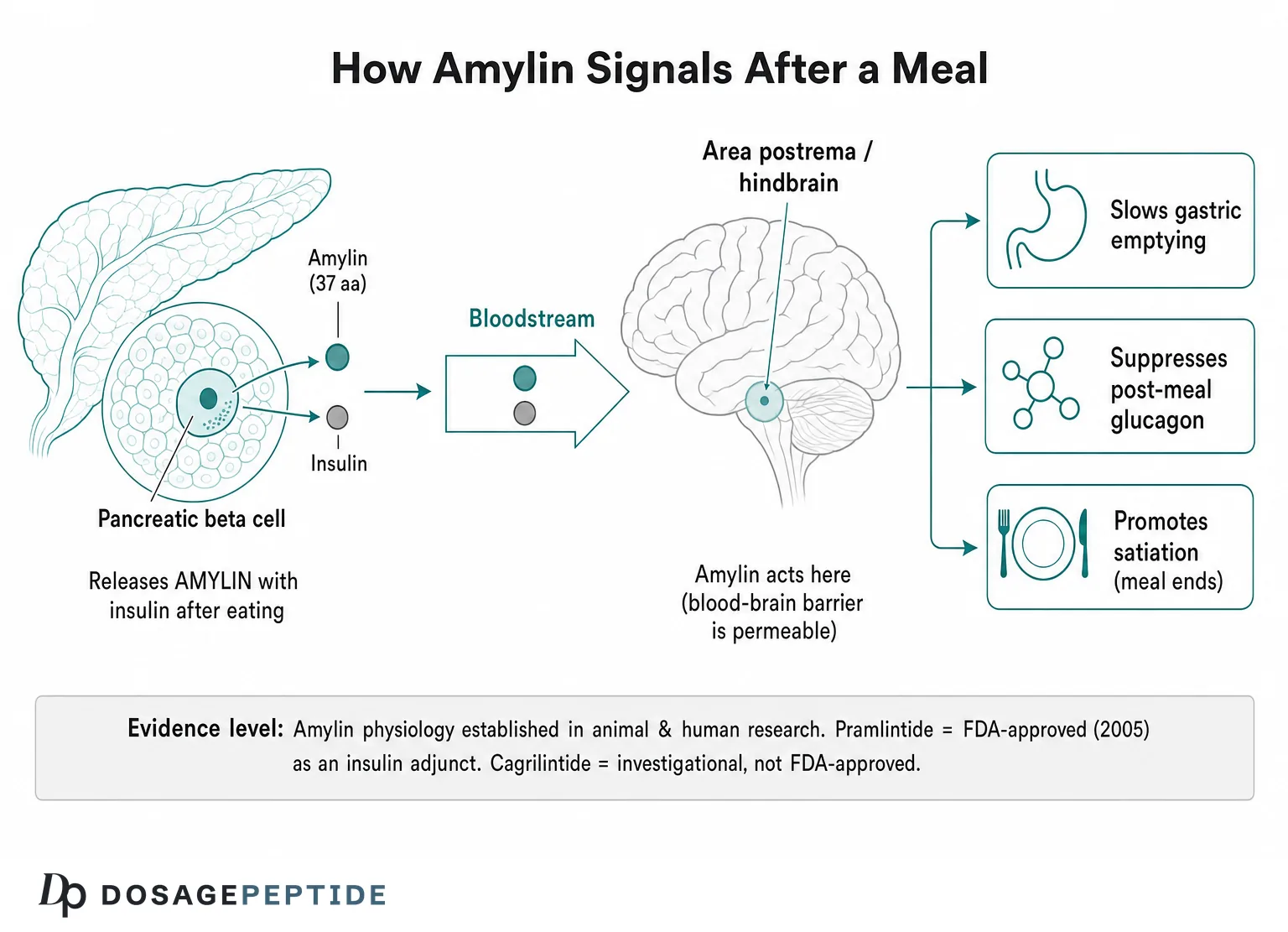
Amylin is a 37-amino-acid peptide hormone that pancreatic beta cells release into the bloodstream alongside insulin every time you eat. Its main job in research models is to help end a meal: it slows how fast the stomach empties, dampens the post-meal rise in glucagon, and signals the brainstem that enough food has arrived — the biology of satiation. Understanding amylin is the fastest way to understand why a whole class of investigational weight-management compounds, including cagrilintide, exists at all.
The short answer:
- Amylin (also called islet amyloid polypeptide, IAPP) is co-secreted with insulin from pancreatic beta cells after a meal.
- It acts mainly in the brainstem to promote satiation, slow gastric emptying, and suppress post-meal glucagon.
- Native amylin clumps into amyloid fibrils, which made it hard to turn into a drug — so chemists built more stable analogs.
- Pramlintide is the amylin-analog drug approved by the FDA (2005) as an adjunct to insulin. Cagrilintide is a newer, long-acting analog still in clinical development for obesity.
- Everything below is educational and research-focused — not medical advice or a dosing recommendation.
What Is Amylin? A Quick Definition
Amylin is a peptide hormone made of 37 amino acids, produced and stored in the same pancreatic beta cells that make insulin, and released into the circulation together with insulin in response to eating.[2] It was first isolated in 1987 by Garth Cooper and colleagues at Oxford, who purified it from the amyloid-rich pancreatic tissue of people with type 2 diabetes and initially called it “diabetes-associated peptide.” They noted it was roughly 46% identical to calcitonin gene-related peptide (CGRP), placing amylin in the calcitonin peptide family.[1]
The name “islet amyloid polypeptide” reflects a defining quirk: in humans, amylin has a strong tendency to aggregate into insoluble amyloid fibrils, and deposits of these fibrils are commonly found in the pancreatic islets of people with type 2 diabetes.[1] That same aggregation property, as we will see, is exactly what made native amylin an awkward starting point for drug development.
Where Does Amylin Come From and What Does It Do?
Because amylin is packaged and released with insulin, its blood levels rise and fall with meals in parallel with insulin. Where insulin’s central role is to move glucose into cells, amylin works as a complementary glucoregulatory and satiation signal. Research in both rodents and humans has mapped several consistent actions.[2][6]
| Amylin action | What happens in research models | Net effect studied |
|---|---|---|
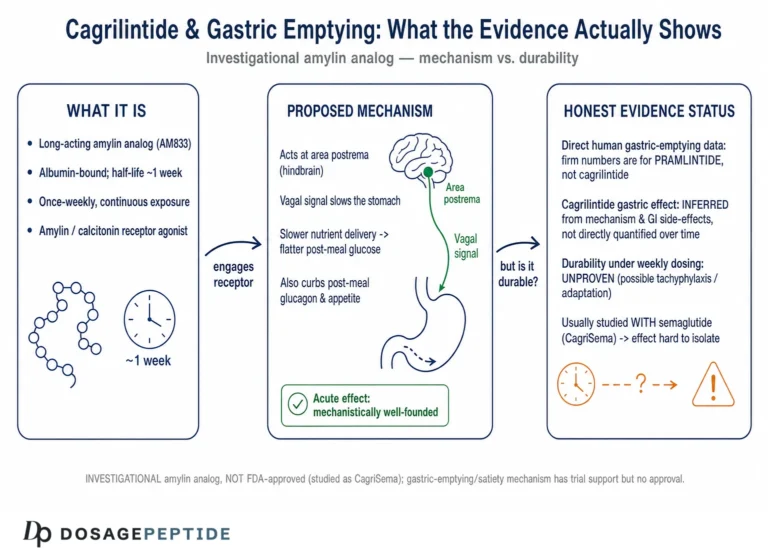
| Slows gastric emptying | Food leaves the stomach more gradually, blunting the speed of the post-meal glucose spike | Smoother post-prandial glucose curve |
| Suppresses glucagon | Dampens the meal-time rise in glucagon from pancreatic alpha cells | Less glucose released by the liver after eating |
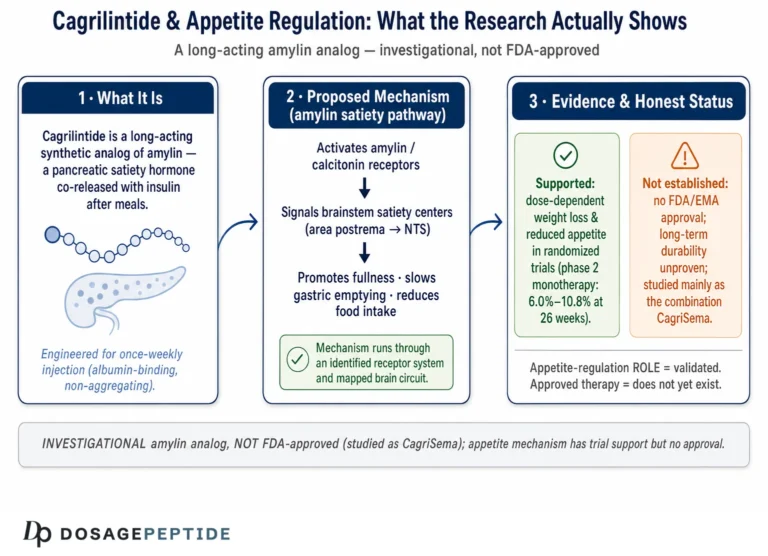
| Promotes satiation | Signals hindbrain circuits that a meal has arrived, helping bring eating to an end | Reduced meal size / food intake |
| Modulates food reward | Acts on midbrain reward pathways; in trials, amylin-receptor agonists reduced binge-eating episodes | Reduced reward-driven / high-fat intake |
A key point for the framing throughout this article: these are described effects in experimental and clinical research settings, characterizing how the hormone behaves. They are not a claim that any amylin product is a proven human treatment outside of the specific drug (pramlintide) that regulators have reviewed.[4]
How Does Amylin Signal? The Calcitonin-Receptor and RAMP System
Amylin does not have a single, dedicated receptor of its own. Instead, its receptors are built from two parts: the core calcitonin receptor combined with one of three receptor activity-modifying proteins (RAMP1, RAMP2, RAMP3). Pairing the calcitonin receptor with a RAMP creates the amylin-receptor subtypes known as AMY1, AMY2, and AMY3 — multi-subunit G-protein-coupled receptors that respond preferentially to amylin.[2] This modular design is why amylin, calcitonin, and CGRP signaling overlap, and why the salmon calcitonin peptide is often used as a research tool to probe amylin pathways.[5]
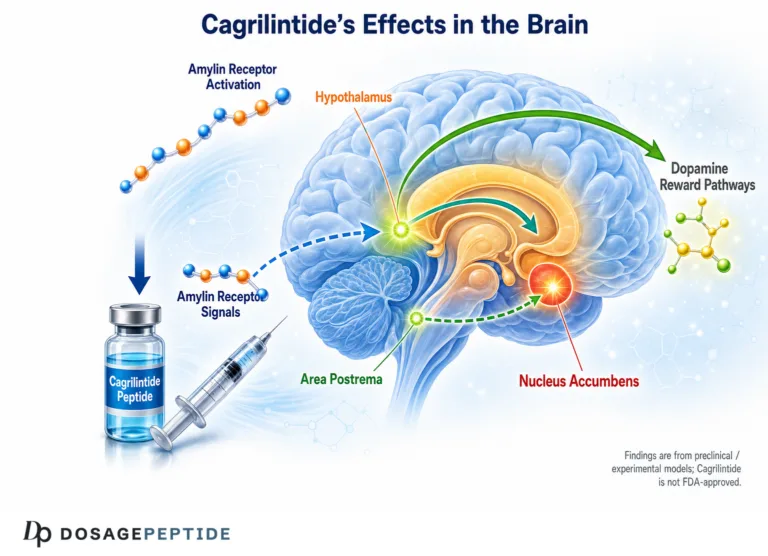
Anatomically, amylin acts largely from the circumventricular organs of the brain — regions such as the area postrema in the caudal hindbrain, where the blood-brain barrier is relatively permeable, so a circulating hormone can reach neurons directly.[3] From there, signals propagate to the nucleus tractus solitarius, the lateral parabrachial nucleus, and onward to hypothalamic and midbrain regions. Preclinical work shows amylin recruits genetically distinct neuron populations across the hindbrain, midbrain, and hypothalamus, which is thought to explain its combined effects on both how much is eaten (satiation) and food reward.[5]
Amylin vs Insulin vs GLP-1: How the Signals Differ
Amylin is frequently confused with the two hormones it is most often mentioned beside. They are distinct molecules with distinct receptors, even though all three influence glucose and appetite.
| Feature | Amylin (IAPP) | Insulin | GLP-1 |
|---|---|---|---|
| Source cell | Pancreatic beta cell | Pancreatic beta cell | Intestinal L-cell |
| Released with a meal? | Yes (with insulin) | Yes | Yes (gut-derived incretin) |
| Primary receptor | Calcitonin receptor + RAMP (AMY1/2/3) | Insulin receptor | GLP-1 receptor |
| Signature actions | Satiation, slowed gastric emptying, glucagon suppression | Glucose uptake into cells | Glucose-dependent insulin secretion, satiety, slowed emptying |
| Amino-acid length | 37 | 51 (two chains) | ~30 (active fragment) |
The overlap in appetite-related actions between amylin and GLP-1 is precisely why researchers are interested in combining them — the two hormones reduce food intake through partly separate circuits, so pairing them may produce complementary rather than redundant effects.[4] If you want the broader incretin picture, see our complete guide to GLP-1 biology.
Why Native Amylin Became a Drug-Design Problem
If amylin has such useful metabolic actions, why isn’t the natural hormone itself simply used as a therapeutic? The obstacle is chemistry. Human amylin is strongly amyloidogenic — it self-assembles into sticky, insoluble fibrils (the very “islet amyloid” it is named for).[1] A peptide that aggregates in solution is extremely difficult to formulate, store, and dose reliably, because it can clump before it ever reaches its target.[9]
The workaround was to engineer analogs: molecules that keep amylin’s receptor activity but resist aggregation. The first success substituted three amino acids (drawing on the more soluble rat amylin sequence) to create a non-aggregating peptide. Later work added a fatty-acid chain (lipidation) so the molecule would bind albumin in the blood and last far longer, dramatically extending its half-life.[9] Those two ideas — stabilize the sequence, then extend the duration — define the two generations of amylin-based compounds.
From Amylin to Pramlintide and Cagrilintide
Two named analogs matter most for anyone reading about amylin today.
Pramlintide — the approved amylin analog
Pramlintide was the first amylin-mimetic to reach the clinic. The FDA approved it in 2005 as an adjunct to mealtime insulin for type 1 and insulin-treated type 2 diabetes.[4] In practice it reproduces amylin’s core actions — suppressing post-meal glucagon, slowing gastric emptying, and enhancing satiety.[7] But because it has a short half-life, it requires multiple injections per day, and a systematic review found its effect on HbA1c was modest — roughly a 0.2%–0.4% between-group reduction versus placebo — accompanied by some weight loss but also more nausea and, in type 1 diabetes, more severe hypoglycemia.[8] Those real-world limitations (dosing burden, modest effect) are why the amylin field stalled for years.
Cagrilintide — the long-acting analog under investigation
Cagrilintide represents the second generation. It is a stable, lipidated, long-acting amylin analog designed for once-weekly dosing, developed specifically with obesity as the target indication.[9] In a phase 1b study, cagrilintide’s half-life was in the range of about 159–195 hours — long enough to support weekly administration — and it is being studied both on its own and in combination with the GLP-1 analog semaglutide.[10] It is important to be precise here: as an individual compound, cagrilintide remains investigational and is not an approved medicine. For readers researching the compound specifically, our reference pages cover what research says about cagrilintide and appetite regulation and how cagrilintide affects gastric emptying.
Where Does Cagrilintide Fit in Current Research?
The most discussed application of amylin biology is the combination of cagrilintide with semaglutide, studied under the name CagriSema. The rationale is the complementary-mechanism idea from earlier: an amylin-receptor agonist plus a GLP-1-receptor agonist engaging partly separate appetite circuits.[3]
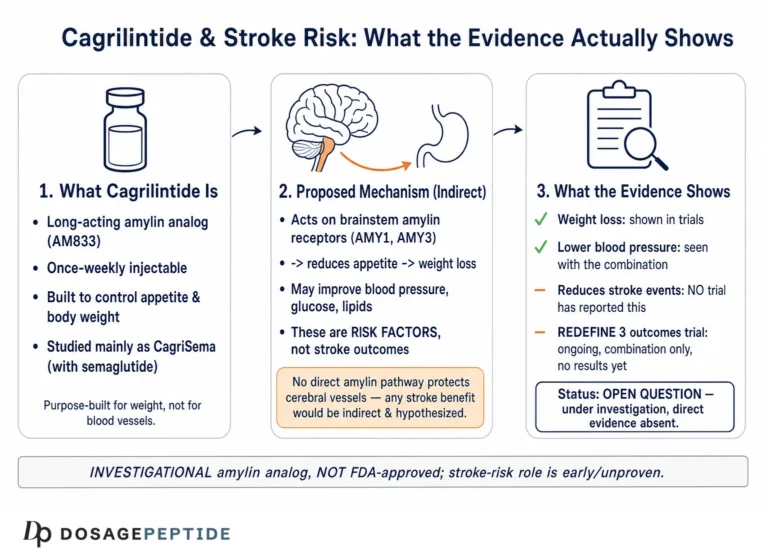
In the phase 3a REDEFINE 2 trial in adults with overweight or obesity and type 2 diabetes, once-weekly cagrilintide–semaglutide (2.4 mg of each) produced an estimated mean body-weight change of −13.7% versus −3.4% for placebo over 68 weeks; gastrointestinal adverse events were reported by about 72.5% of the combination group, most transient and mild-to-moderate.[11] A separate REDEFINE 1 analysis reported meaningful reductions in blood pressure with the combination.[12] These are trial findings for a combination product under regulatory evaluation — not evidence that any single research-grade peptide replicates those results. If you are comparing the two building blocks, see our side-by-side on cagrilintide vs semaglutide.
For structured reference material on the compound itself, our cagrilintide dosage protocol reference and the cagrilintide weekly dosage chart lay out how the peptide is described in the research literature — again, as reference information, not instructions for human use.
What Is the Evidence Level for Amylin and Its Analogs?
Because this is a young and fast-moving area, it helps to separate what is firmly established from what is still emerging:
- Amylin physiology (well established): the existence of amylin, its co-secretion with insulin, its receptor system, and its satiation/glucagon/gastric-emptying actions are supported by decades of rodent and human research.[2]
- Pramlintide (FDA-approved, 2005): a real, regulator-reviewed drug — but only as an adjunct to insulin, with modest glycemic benefit and known side effects.[8]
- Cagrilintide alone (investigational): promising phase 1–2 data, but not an approved medicine.[10]
- CagriSema combination (late-stage investigational): phase 3 trial results are published and the combination is under regulatory review, but readers should treat it as an investigational product, not an established standard of care.[11]
A recurring theme in the recent literature is caution around GLP-1-based weight loss and lean-mass preservation; part of the renewed interest in amylin agonists is the hypothesis that they may contribute to weight management with a different body-composition profile — a hypothesis still being tested rather than a settled fact.[4]
Frequently Asked Questions
Is amylin the same as insulin?
No. Amylin and insulin are two different hormones, but they are made by the same pancreatic beta cells and released together after a meal. Insulin’s main job is to move glucose into cells; amylin’s role is complementary — slowing gastric emptying, suppressing post-meal glucagon, and signaling satiation. They also act through completely different receptors.
What is the difference between amylin and cagrilintide?
Amylin is the natural 37-amino-acid hormone your pancreas makes. Cagrilintide is a laboratory-engineered analog of amylin — modified to resist the amyloid aggregation that plagues the natural peptide and lipidated so it lasts about a week in the body. In short, amylin is the biology; cagrilintide is an investigational molecule built to imitate that biology more durably.
Why is amylin called islet amyloid polypeptide (IAPP)?
Because human amylin readily clumps into insoluble amyloid fibrils, and these deposits accumulate in the pancreatic islets of many people with type 2 diabetes. It was actually first isolated in 1987 from amyloid-rich diabetic pancreatic tissue, which is where both the name and the abbreviation IAPP come from.
Does amylin cause weight loss?
In research settings, amylin and its analogs reduce food intake by promoting satiation and slowing gastric emptying, which is associated with reduced body weight in trials. However, this describes findings in studies of specific amylin-analog drugs. It is not a statement that amylin itself is an approved or proven weight-loss treatment, and nothing here is dosing guidance.
Is amylin FDA-approved?
The natural hormone is not a medication. The amylin analog pramlintide was FDA-approved in 2005 as an adjunct to mealtime insulin for diabetes. Newer analogs such as cagrilintide — and the cagrilintide–semaglutide combination — are investigational and under study or regulatory review rather than long-established approved products.
How does amylin work with GLP-1 drugs like semaglutide?
Amylin and GLP-1 both curb appetite, but through partly separate brain circuits — amylin acts strongly via the area postrema and hindbrain, GLP-1 through its own receptor pathways. Because the mechanisms are complementary rather than identical, researchers have paired a long-acting amylin analog (cagrilintide) with semaglutide to study whether the combination reduces food intake and body weight more than either alone.
Where does amylin act in the body?
Although it is a pancreatic hormone, amylin exerts most of its appetite effects in the brain — specifically the circumventricular organs such as the area postrema, where circulating hormones can reach neurons directly. From there the signal spreads to hindbrain, hypothalamic, and midbrain regions that govern meal termination and food reward.
References
- Cooper GJS, Willis AC, Clark A, Turner RC, Sim RB, Reid KBM. Purification and characterization of a peptide from amyloid-rich pancreases of type 2 diabetic patients. Proc Natl Acad Sci USA. 1987;84(23):8628–8632. https://doi.org/10.1073/pnas.84.23.8628
- Hay DL, Chen S, Lutz TA, Parkes DG, Roth JD. Amylin: Pharmacology, Physiology, and Clinical Potential. Pharmacol Rev. 2015;67(3):564–600. https://doi.org/10.1124/pr.115.010629
- Lutz TA. Role of amylin in feeding and satiation. Neuropharmacology. 2025;278:110587. https://doi.org/10.1016/j.neuropharm.2025.110587
- Walker CS, Aitken JF, Vazhoor Amarsingh G, Zhang S, Cooper GJS. Amylin: emergent therapeutic opportunities in overweight, obesity and diabetes mellitus. Nat Rev Endocrinol. 2025;21(8):482–494. https://doi.org/10.1038/s41574-025-01125-9
- Hankir MK, Le Foll C. Central nervous system pathways targeted by amylin in the regulation of food intake. Biochimie. 2024;229:95–104. https://doi.org/10.1016/j.biochi.2024.10.012
- Eržen S, Tonin G, Jurišić Eržen D, Klen J. Amylin, Another Important Neuroendocrine Hormone for the Treatment of Diabesity. Int J Mol Sci. 2024;25(3):1517. https://doi.org/10.3390/ijms25031517
- Kellmeyer TA, Kesty NC, Wang Y, Frias JP, Fineman MS. Pharmacokinetics of an oral drug (acetaminophen) administered at various times relative to subcutaneous injection of pramlintide in subjects with type 2 diabetes. J Clin Pharmacol. 2007;47(7):798–805. https://doi.org/10.1177/0091270007300949
- Lee NJ, Norris SL, Thakurta S. Efficacy and harms of the hypoglycemic agent pramlintide in diabetes mellitus. Ann Fam Med. 2010;8(6):542–549. https://doi.org/10.1370/afm.1174
- Kruse T, Hansen JL, Dahl K, et al. Development of Cagrilintide, a Long-Acting Amylin Analogue. J Med Chem. 2021;64(15):11183–11194. https://doi.org/10.1021/acs.jmedchem.1c00565
- Enebo LB, Berthelsen KK, Kankam M, et al. Safety, tolerability, pharmacokinetics, and pharmacodynamics of concomitant administration of multiple doses of cagrilintide with semaglutide 2.4 mg for weight management: a randomised, controlled, phase 1b trial. Lancet. 2021;397(10286):1736–1748. https://doi.org/10.1016/S0140-6736(21)00845-X
- Davies MJ, Bajaj HS, Broholm C, et al. Cagrilintide–Semaglutide in Adults with Overweight or Obesity and Type 2 Diabetes. N Engl J Med. 2025;393(7):648–659. https://doi.org/10.1056/NEJMoa2502082
- Verma S, Böttcher M, Brown P, et al. CagriSema Reduces Blood Pressure in Adults With Overweight or Obesity: REDEFINE 1. Hypertension. 2025;83(2):e26055. https://doi.org/10.1161/HYPERTENSIONAHA.125.26055
Research-use-only disclaimer: This article is provided for educational and informational purposes only and describes findings from experimental and clinical research. It is not medical advice, and nothing here is a recommendation to obtain, administer, or dose any peptide or drug in humans. Amylin itself is a naturally occurring hormone; among amylin-based compounds only pramlintide is an FDA-approved medication (as an adjunct to insulin), while cagrilintide and cagrilintide–semaglutide combinations are investigational. Research-grade peptides referenced anywhere on this site are intended strictly for laboratory research use only and are not for human consumption. Always consult a qualified healthcare professional for medical decisions.