In randomised human trials, the dominant documented adverse events with cagrilintide are gastrointestinal and closely tied to dose escalation. In the largest dataset — the 68-week phase 3a REDEFINE 1 trial, which included a dedicated cagrilintide 2.4 mg monotherapy arm of 302 people — gastrointestinal adverse events were reported by 54.0% of the cagrilintide group versus 39.9% of the placebo group, and injection-site reactions by 16.9% versus 3.0%.[1] Discontinuation because of adverse events in that monotherapy arm was 2.6%, slightly lower than the 3.5% seen on placebo.[1]
That headline carries an equally important caveat: every number below describes Novo Nordisk’s pharmaceutical-grade compound, administered on a fixed titration schedule under clinical monitoring, in a screened trial population — not research-grade powder purchased online and reconstituted at a kitchen counter. Only one of those two exposure scenarios has been studied.
What is cagrilintide’s regulatory status right now?
Cagrilintide is not approved by the FDA for any indication, either alone or in combination, as of August 2026. This is not a technicality — the FDA states the position explicitly on its own guidance page for unapproved GLP-1 products, naming the molecule directly: retatrutide and cagrilintide “cannot be used in compounding under federal law,” and are “not components of FDA-approved drugs and have not been found safe and effective for any condition.”[2]
The two development tracks sit at different stages, and conflating them is the most common error in consumer-facing writing about this molecule:
- CagriSema (cagrilintide 2.4 mg + semaglutide 2.4 mg). Novo Nordisk announced submission of a New Drug Application to the FDA on 18 December 2025 for weight management in adults with obesity, or overweight with at least one weight-related comorbid condition.[3] A filing is not an approval. No FDA decision has been announced as of August 2026, and no PDUFA date has been made public. No regulator anywhere has approved CagriSema.
- Cagrilintide as monotherapy. There is no regulatory submission at all. Dedicated phase 3 monotherapy trials in overweight or obesity only began enrolling in November 2025, with primary completion scheduled for May 2027.[4]
So the correct evidence tier for cagrilintide is: investigational, with substantial randomised human safety data, and no approval anywhere. That is a genuinely stronger position than most compounds sold as research peptides, and it is still not the same as an approved medicine. If you are comparing mechanisms, our explainer on amylin as a satiety hormone and how cagrilintide mimics it covers the pharmacology behind the adverse-event pattern described below.
What adverse events did the trials actually record?
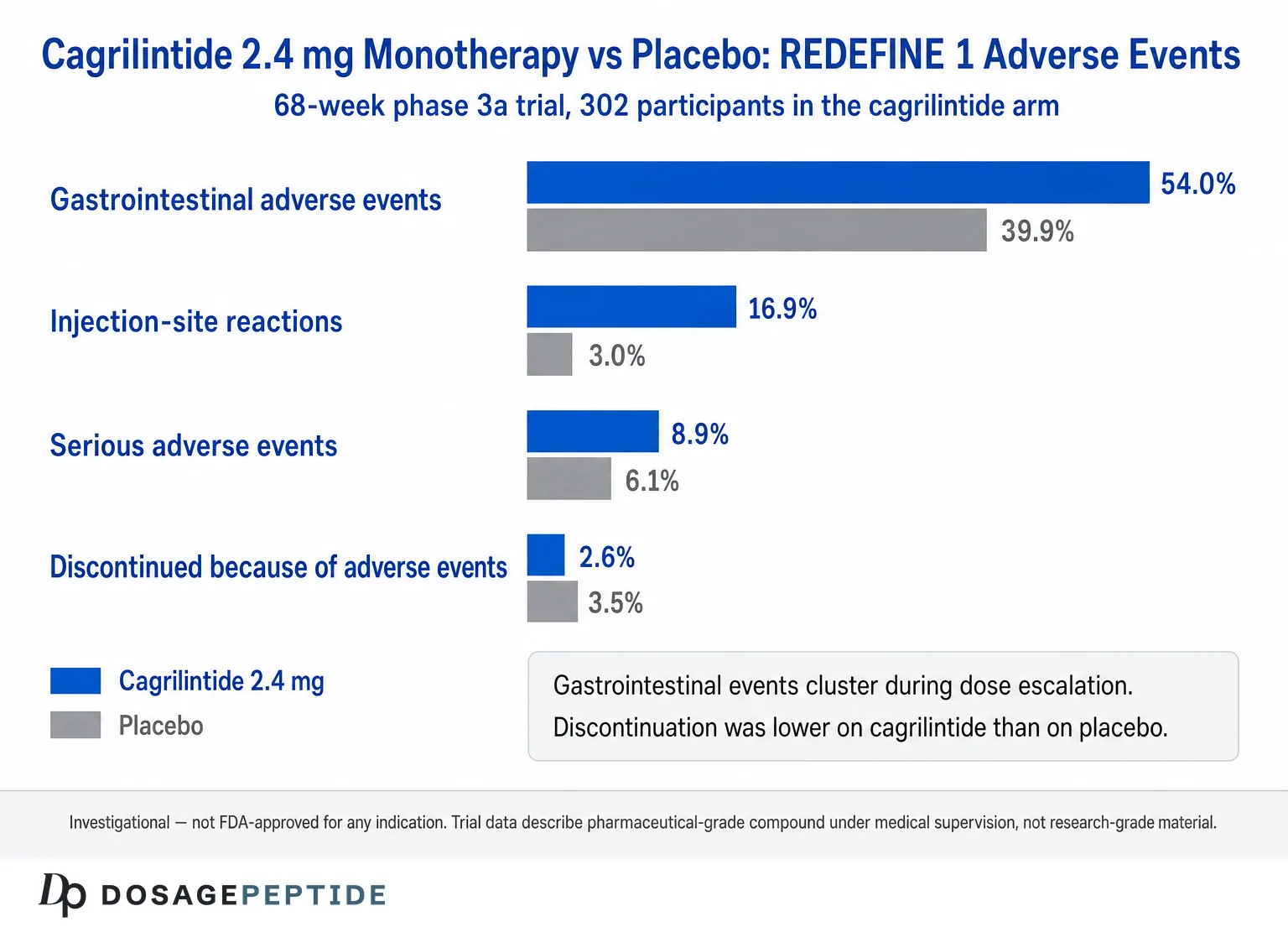
The table below reports rates only where a real publication states them, for the arm it states them for. Note that CagriSema rows describe the combination and cannot be attributed to cagrilintide alone — semaglutide independently produces gastrointestinal effects, as documented in our review of semaglutide’s adverse-event profile.
| Trial | Arm and dose | n | Duration | Key adverse-event rates |
|---|---|---|---|---|
| REDEFINE 1 (phase 3a)[1] | Cagrilintide 2.4 mg alone | 302 | 68 weeks | Any AE 84.1%; GI AE 54.0%; injection-site reactions 16.9%; serious AE 8.9%; discontinuation for AE 2.6%; gallbladder disorders 2.3%; pancreatitis 0 |
| REDEFINE 1 (phase 3a)[1] | Placebo | 705 | 68 weeks | Any AE 82.3%; GI AE 39.9%; injection-site reactions 3.0%; serious AE 6.1%; discontinuation for AE 3.5%; gallbladder disorders 1.0% |
| REDEFINE 1 (phase 3a)[1] | CagriSema 2.4/2.4 mg | 2106 | 68 weeks | Any AE 92.3%; GI AE 79.6%; serious AE 9.8%; discontinuation for AE 5.9%; GI-driven discontinuation 3.6%; injection-site reactions 12.2%; gallbladder disorders 4.1%; pancreatitis 0.2% |
| REDEFINE 1 (phase 3a)[1] | Semaglutide 2.4 mg alone | 302 | 68 weeks | Any AE 89.7%; GI AE 73.8%; serious AE 5.0%; discontinuation for AE 3.6%; injection-site reactions 2.6% |
| REDEFINE 1 — per-symptom[5] | CagriSema vs placebo | 2106 vs 705 | 68 weeks | Nausea 55% vs 12.6%; constipation 30.7% vs 11.6%; vomiting 26.1% vs 4.1% |
| Phase 2 dose-finding (Lau et al.)[6] | Cagrilintide 0.3, 0.6, 1.2, 2.4, 4.5 mg (5 dose groups) | ~506 on cagrilintide (100–102 per dose group); 99 liraglutide 3.0 mg; 101 placebo; 706 randomised in total | 26 weeks | GI AE 41–63% across dose groups vs 32% placebo; nausea 20–47% vs 18%; discontinuation for AE ~4% overall |
| REDEFINE 2 (phase 3a, type 2 diabetes)[7] | CagriSema 2.4/2.4 mg | 904 | 68 weeks | GI AE 72.5% vs 34.4% placebo; discontinuation for AE 8.4% vs 3% |
| Phase 1b co-administration (Enebo et al.)[8] | Cagrilintide 0.16–4.5 mg + semaglutide 2.4 mg, versus placebo-cagrilintide + semaglutide 2.4 mg | 95 exposed | 20 weeks | 566 AEs in 92 participants; 37% of events were GI disorders; ~97% of active and ~96% of placebo participants reported at least one AE |
| REDEFINE 4 (phase 3, open-label)[9] | CagriSema 2.4/2.4 mg vs tirzepatide 15 mg | 809 randomised | 84 weeks | Most common AEs with CagriSema gastrointestinal, described as mostly mild to moderate and diminishing over time; arm-level rates not published in the headline announcement |
Three observations cut against the usual framing.
First, the “any adverse event” rate on placebo was 82.3%.[1] In a 68-week trial, almost everyone reports something. Headline percentages of “84% had side effects” are close to meaningless without the placebo comparator; the honest signal is the difference between arms.
Second, in the phase 1b trial the proportion of participants reporting at least one adverse event was similar between participants receiving cagrilintide plus semaglutide 2.4 mg and those receiving placebo plus semaglutide 2.4 mg — every participant in that trial received semaglutide — and most events were mild to moderate.[8] That comparison measures cagrilintide’s marginal contribution on top of semaglutide, not cagrilintide against nothing. Severity, not just frequency, is part of the picture.
Third, two deaths occurred in the CagriSema group in REDEFINE 1, adjudicated as suicide and as cancer of unknown primary source; there were none in the other three arms.[1] Two events among 2,106 participants cannot establish causation in either direction, and mental-health scores measured by C-SSRS and PHQ-9 were similar across all four groups with no important changes over time.[1] We report the deaths because omitting them would be dishonest, not because the data support an inference.
Why do gastrointestinal events cluster during dose escalation?
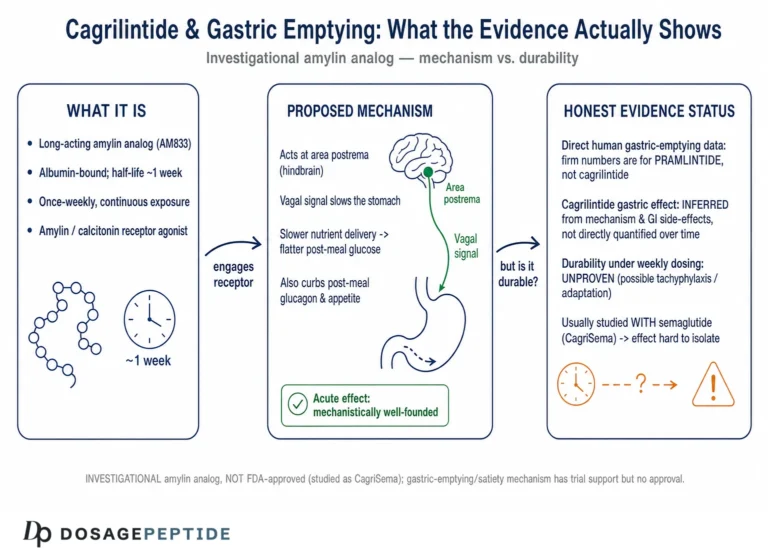
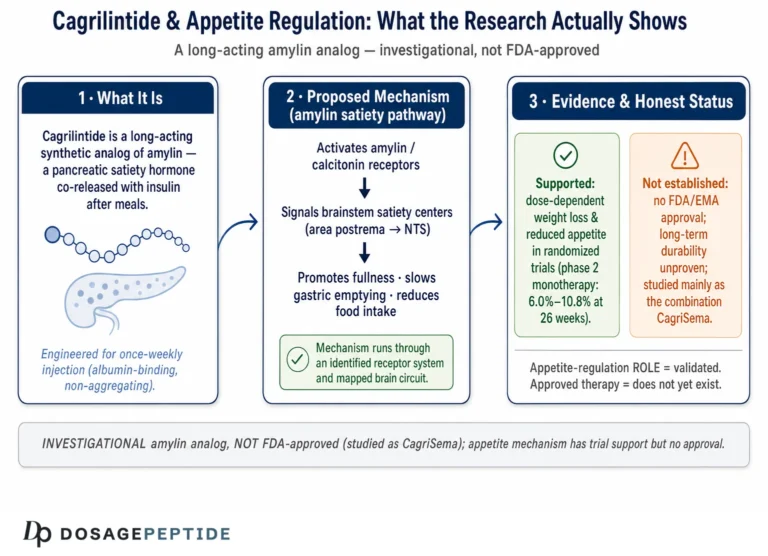
Amylin is co-secreted with insulin from pancreatic beta cells and acts to slow gastric emptying and promote satiety.[10] A long-acting analogue therefore produces its intended pharmacological effect and its principal side effect through overlapping mechanisms: the same delayed gastric emptying that reduces food intake also produces nausea, early fullness and constipation. This is why the adverse-event profile is dose- and titration-dependent rather than idiosyncratic.
The REDEFINE 1 investigators reported the time course directly, and it is the single most useful practical finding in the dataset: across the trial, the prevalence of nausea, diarrhoea and vomiting peaked during dose escalation and decreased thereafter, whereas constipation remained relatively constant after escalation was complete.[1] The publication reports this time course for the trial overall and does not break it out by treatment arm, so it should not be read as a cagrilintide-monotherapy finding. Most gastrointestinal events were mild to moderate in severity.
The dose-response relationship is visible in the phase 2 data, where gastrointestinal adverse events rose from 41% in the lowest dose groups to 63% in the highest across the 0.3–4.5 mg range, against 32% on placebo, with nausea ranging from 20% to 47% versus 18%.[6] That trial escalated over up to six weeks within a 26-week treatment period.[6][11] The escalation schedules used in the published literature are catalogued in our week-by-week record of cagrilintide dosing as reported in trials and the 10 mg vial reference sheet — both describe what investigators used, not what anyone should do.
One further finding is worth recording because it is counterintuitive and rarely mentioned. Mean heart rate change from baseline to week 68 was −3.31 beats per minute in the cagrilintide monotherapy arm, compared with +0.94 for CagriSema, +1.17 for semaglutide and −0.58 for placebo.[1] The modest heart-rate increase associated with GLP-1 receptor agonists was not observed with the amylin analogue alone in this trial.
What about injection-site reactions and immunogenicity?
This is where cagrilintide differs most clearly from a GLP-1 receptor agonist, and where the monotherapy arm is genuinely informative. Injection-site reactions occurred in 16.9% of the cagrilintide monotherapy group, versus 2.6% for semaglutide alone and 3.0% for placebo.[1] The CagriSema combination sat at 12.2%. In the phase 2 trial, administration-site reactions were named alongside gastrointestinal disorders as one of the two most frequent adverse-event categories, although no rate versus placebo was published.[6] The roughly five-fold excess over placebo measured in REDEFINE 1 is the finding most often omitted from summaries that focus only on nausea.
Allergic reactions were reported in 7.6% of the cagrilintide arm versus 5.5% on placebo, a small numerical excess.[1]
On immunogenicity, the honest answer is that the REDEFINE 1 primary publication does not report anti-drug antibody data, and we will not infer a rate that the paper does not state. This matters mechanistically: native human amylin is notoriously prone to forming amyloid fibrils, and the chemistry behind cagrilintide was explicitly a programme to engineer a stable, lipidated analogue resisting that behaviour while achieving a long half-life.[10] Measured half-life in the phase 1b trial was 159–195 hours, supporting once-weekly dosing.[8] Whether clinically meaningful anti-drug antibodies develop over multi-year exposure is an open question, not a settled one.
What does the amylin class tell us — and what does it not?
Only one amylin analogue has ever been FDA-approved: pramlintide (SYMLIN), first approved in 2005.[12] AstraZeneca has since ceased manufacture, and the FDA’s Drugs@FDA record for NDA 021332 now lists every SYMLIN presentation with a marketing status of Discontinued; it is no longer marketed in the United States as of August 2026, so the class comparison below is historical.[13] Pramlintide carries a boxed warning for severe hypoglycaemia. That warning is real, and it is also frequently misapplied to cagrilintide by writers reaching for class-level alarm. The specifics matter.
Pramlintide was approved as an adjunctive treatment in patients with type 1 or type 2 diabetes who use mealtime insulin and have not achieved glucose control on optimal insulin therapy alone.[12] The boxed warning states that SYMLIN used with insulin increases the risk of severe hypoglycaemia, particularly in patients with type 1 diabetes, and that when severe hypoglycaemia occurs it is seen within three hours following an injection; the label requires that mealtime insulin be reduced when pramlintide is initiated.[12] The label is explicit that pramlintide alone does not cause hypoglycaemia — the risk arises from the insulin co-administration the indication requires.
Cagrilintide is a different molecule, with a different structure (a lipidated long-acting analogue dosed once weekly, where pramlintide is injected before each major meal because of its short half-life[10][12]), studied in a different population (largely people without diabetes, not on mealtime insulin), for a different purpose. Pramlintide’s boxed warning does not transfer to cagrilintide, and nothing in this article should be read as attaching it. What the class context legitimately supplies is the observation that amylin-receptor agonism has a recognised interaction with glucose-lowering therapy, which is why the REDEFINE 2 trial in people with type 2 diabetes, who were required to have a glycated haemoglobin of 7–10% at entry, monitored glycaemic outcomes closely.[7]
What the trials did not establish
Naming the boundaries of the evidence is not hedging. These are findings in their own right.
Long-term safety beyond 68 weeks
The largest placebo-controlled REDEFINE trials ran 68 weeks.[1][7] The longest CagriSema exposure reported to date is 84 weeks, in REDEFINE 4 — an open-label head-to-head against tirzepatide 15 mg in 809 participants, which did not meet its primary endpoint of non-inferiority on weight loss (23.0% versus 25.5%, or 20.2% versus 23.6% on the treatment-regimen estimand) and whose arm-level adverse-event rates have not been published.[9] That trial tested the combination, so it adds nothing about cagrilintide alone. Obesity is chronic, and any real-world use would extend over years. The cardiovascular outcomes trial of CagriSema enrolled 7,101 participants with established cardiovascular disease and has a primary completion date in September 2027 — so long-term cardiovascular safety data are not yet available.[14] Rare adverse events, by definition, do not appear reliably in trials of a few thousand people.
Populations that were not enrolled
REDEFINE 1 enrolled adults without diabetes, with a BMI of 30 or higher, or 27 or higher with at least one obesity-related complication.[1] The rates above describe that population — not adolescents, pregnant or breastfeeding people, people with significant hepatic or renal impairment, or people of normal BMI. A phase 3 trial of cagrilintide and CagriSema in children and adolescents aged 8 to under 18 began enrolling in January 2026 and has not reported.[15]
The gap between trial product and research-grade material
This limitation is categorical rather than a matter of degree. Every rate in the table describes a compound manufactured to pharmaceutical standards, supplied in a controlled formulation, administered on a fixed titration schedule, with laboratory monitoring, adverse-event adjudication committees, and investigators able to intervene. None of it transfers to a vial of powder bought from a research-chemical vendor. The dataset does not speak to that scenario.
The risks that belong to the supply chain, not the molecule
These are frequently blurred together. The adverse events above are properties of cagrilintide. The risks below are properties of how unapproved material is manufactured, labelled, shipped and handled — and they would exist even if the molecule had a perfect safety record. One caveat applies to all of them: the FDA’s documented harms concern compounded semaglutide and tirzepatide, and the agency has not published equivalent reports for cagrilintide specifically — its cagrilintide statement is limited to the compounding prohibition.
- Identity and purity are unverified. Cagrilintide is not a component of any FDA-approved drug and cannot lawfully be used in compounding.[2] No regulatory pathway assesses a vendor-supplied vial for identity, potency or purity against a reference standard.
- Mislabelled and fraudulent product is documented. The FDA has reported fraudulent compounded semaglutide and tirzepatide bearing false label information, in some cases naming compounding pharmacies that do not exist, or that did not make the product.[2]
- Sterility and endotoxin. Non-sterile handling of a product intended for subcutaneous injection introduces infection risk entirely absent from the trials. The FDA has also received complaints of compounded injectable GLP-1 products arriving warm or with inadequate refrigeration, which can affect product quality.[2]
- Dosing error is a documented harm, not a theoretical one. The FDA has received multiple adverse-event reports, some requiring hospitalisation, related to dosing errors associated with compounded injectable semaglutide products, where individuals measured and self-administered incorrect doses.[2] Because the trial data show adverse events are dose- and escalation-dependent, a reconstitution or measurement error does not produce a random outcome — it moves someone predictably up the dose-response curve. Our reconstitution reference and our discussion of what “safe” can and cannot mean for research peptides cover why this arithmetic is where most error enters.
- Underreporting. The FDA notes that state-licensed pharmacies that are not outsourcing facilities are not required to submit adverse events, so events from compounded semaglutide and tirzepatide are likely underreported.[2] Absence of reported harm in this channel is not evidence of safety.
Because cagrilintide is most often discussed alongside incretin drugs, readers comparing the two mechanisms may find our side-by-side of cagrilintide and semaglutide useful for understanding why their adverse-event profiles overlap on gastrointestinal events but diverge sharply on injection-site reactions.
Where this leaves the evidence
The signal from the randomised data is coherent: predominantly gastrointestinal effects, front-loaded during titration, mostly mild to moderate, a measured excess of injection-site reactions, and a monotherapy discontinuation rate that did not exceed placebo — alongside a serious-adverse-event rate that was numerically higher on cagrilintide alone (8.9%) than on placebo (6.1%) or semaglutide alone (5.0%).[1] The longest reported exposure anywhere in the programme is 84 weeks, in a trial that missed its primary endpoint.[9] And every rate above is a property of the sponsor’s compound under monitored conditions — not a warranty that attaches to material bought elsewhere.
Frequently Asked Questions
Is cagrilintide FDA approved?
No. As of August 2026, cagrilintide is not approved by the FDA for any indication, alone or in combination. The FDA states directly that cagrilintide is not a component of any FDA-approved drug and has not been found safe and effective for any condition. Novo Nordisk submitted a New Drug Application for the CagriSema combination on 18 December 2025, but a submission is not an approval and no decision has been announced.
What is the most common cagrilintide side effect in trials?
Nausea, as part of a broader gastrointestinal pattern. In the phase 2 dose-finding trial, nausea occurred in 20–47% of cagrilintide participants across the 0.3–4.5 mg dose range, against 18% on placebo. In REDEFINE 1, gastrointestinal adverse events overall affected 54.0% of the cagrilintide monotherapy arm versus 39.9% of the placebo arm over 68 weeks.
Did gastrointestinal events decline over time in REDEFINE 1?
Yes, for most of them. Across the trial, the prevalence of nausea, vomiting and diarrhoea peaked during the dose-escalation period and declined afterwards, while constipation stayed relatively constant once escalation was complete. The publication reports this time course for the trial as a whole and does not break it out by treatment arm, so it is not specifically a cagrilintide-monotherapy finding. Most gastrointestinal events were mild to moderate, and this describes an average pattern in a monitored trial population on a fixed titration schedule, not any individual course.
How many people stopped taking cagrilintide because of side effects?
In REDEFINE 1, 2.6% of the cagrilintide monotherapy arm discontinued because of adverse events, compared with 3.5% on placebo, 3.6% on semaglutide alone and 5.9% on the CagriSema combination. In REDEFINE 2, in people with type 2 diabetes, discontinuation for adverse events on CagriSema was 8.4% versus about 3% on placebo.
Does cagrilintide cause injection-site reactions?
Yes, and this is its most distinctive signal. Injection-site reactions occurred in 16.9% of the cagrilintide monotherapy arm in REDEFINE 1, versus 3.0% on placebo and 2.6% on semaglutide alone. Administration-site reactions were also one of the two most frequent adverse-event categories in the phase 2 trial. This roughly five-fold excess over placebo was measured in REDEFINE 1; no other published cagrilintide trial reports a comparable placebo-controlled rate.
Does cagrilintide cause hypoglycaemia like pramlintide?
Pramlintide’s boxed warning for severe hypoglycaemia applies specifically to its approved use alongside mealtime insulin, mainly in type 1 diabetes, and its label states that pramlintide alone does not cause hypoglycaemia. Cagrilintide is a different molecule studied largely in people without diabetes and not on mealtime insulin. Pramlintide’s boxed warning should not be transferred to cagrilintide. Pramlintide itself has been discontinued and is no longer marketed in the United States.
Are there any deaths or serious events reported in cagrilintide trials?
Serious adverse events were reported in 8.9% of the cagrilintide monotherapy arm and 6.1% of placebo in REDEFINE 1, a numerical excess worth noting. Two deaths occurred, both in the CagriSema combination group, adjudicated as suicide and as cancer of unknown primary source, with none in the other three arms. Two events among 2,106 participants cannot establish causation, and mental-health scores were similar across all groups.
Is long-term cagrilintide safety known?
No. The largest placebo-controlled trials ran 68 weeks, and the longest reported exposure in the programme is 84 weeks in REDEFINE 4, which tested the CagriSema combination rather than cagrilintide alone. The cardiovascular outcomes trial of CagriSema, enrolling 7,101 participants with established cardiovascular disease, has a primary completion date in September 2027. Multi-year safety, cardiovascular outcomes, and rare adverse events have not been characterised, and dedicated phase 3 monotherapy trials only began enrolling in November 2025.
Do the trial safety numbers apply to cagrilintide bought online?
No. Every published rate describes a pharmaceutical-grade compound administered on a fixed schedule under clinical monitoring in a screened population. Research-grade material has no verified identity, potency, purity or sterility, cannot lawfully be compounded, and the FDA has documented fraudulent labelling, temperature-control failures and hospitalisations from self-measured dosing errors in the compounded semaglutide and tirzepatide supply channel.
References
- Garvey WT, Blüher M, Osorto Contreras CK, et al. Coadministered Cagrilintide and Semaglutide in Adults with Overweight or Obesity (REDEFINE 1). N Engl J Med. 2025;393(7):635–647. PubMed 40544433 (doi:10.1056/NEJMoa2502081)
- U.S. Food and Drug Administration. FDA’s Concerns with Unapproved GLP-1 Drugs Used for Weight Loss. fda.gov
- Novo Nordisk. Novo Nordisk files for FDA approval of CagriSema, the first once-weekly combination of GLP-1 and amylin analogues for weight management. 18 December 2025. Press release
- ClinicalTrials.gov. NCT07220642 — Efficacy and safety of cagrilintide for weight management in participants with overweight or obesity (phase 3 monotherapy). clinicaltrials.gov
- Novo Nordisk Canada. CagriSema 2.4 mg / 2.4 mg demonstrated 22.7% mean weight reduction in adults with overweight or obesity in REDEFINE 1, published in NEJM. 24 June 2025. Press release (PDF)
- Lau DCW, Erichsen L, Francisco AM, et al. Once-weekly cagrilintide for weight management in people with overweight and obesity: a multicentre, randomised, double-blind, placebo-controlled and active-controlled, dose-finding phase 2 trial. Lancet. 2021;398(10317):2160–2172. PubMed 34798060 (doi:10.1016/S0140-6736(21)01751-7)
- Davies MJ, Bajaj HS, Broholm C, et al. Cagrilintide–Semaglutide in Adults with Overweight or Obesity and Type 2 Diabetes (REDEFINE 2). N Engl J Med. 2025;393(7):648–659. PubMed 40544432 (doi:10.1056/NEJMoa2502082)
- Enebo LB, Berthelsen KK, Kankam M, et al. Safety, tolerability, pharmacokinetics, and pharmacodynamics of concomitant administration of multiple doses of cagrilintide with semaglutide 2.4 mg for weight management: a randomised, controlled, phase 1b trial. Lancet. 2021;397(10286):1736–1748. PubMed 33894838 (doi:10.1016/S0140-6736(21)00845-X)
- Novo Nordisk A/S. CagriSema demonstrated 23% weight loss in an open-label head-to-head REDEFINE 4 trial in people with obesity; the primary endpoint was not achieved. Company announcement, 23 February 2026. novonordisk.com (trial record: NCT06131437)
- Kruse T, Hansen JL, Dahl K, et al. Development of Cagrilintide, a Long-Acting Amylin Analogue. J Med Chem. 2021;64(15):11183–11194. PubMed 34288673 (doi:10.1021/acs.jmedchem.1c00565)
- ClinicalTrials.gov. NCT03856047 — Cagrilintide phase 2 dose-finding trial in overweight and obesity. clinicaltrials.gov
- U.S. Food and Drug Administration. SYMLIN (pramlintide acetate) injection — approved prescribing information, 2015 revision. accessdata.fda.gov
- U.S. Food and Drug Administration. Drugs@FDA record for NDA 021332 (SYMLIN, pramlintide acetate, AstraZeneca AB) — marketing status listed as Discontinued. accessdata.fda.gov
- ClinicalTrials.gov. NCT05669755 — Cardiovascular safety and efficacy of CagriSema in participants with established cardiovascular disease. clinicaltrials.gov
- ClinicalTrials.gov. NCT07253285 — Cagrilintide as monotherapy and CagriSema in children and adolescents aged 8 to under 18 with overweight or obesity (phase 3). clinicaltrials.gov
Research use only. Dosage Peptide is an independent reference library, not a seller, pharmacy or clinic. Cagrilintide is an investigational compound that is not approved by the FDA or any other regulator for any indication, and it cannot lawfully be used in compounding. Nothing on this page is a protocol, a dosing recommendation, medical advice, or an endorsement of human use. The adverse-event rates reported here are drawn from published clinical trials of the sponsor’s pharmaceutical-grade compound administered under medical supervision, and they do not describe research-grade material of unverified identity, purity or sterility.