- What the trials report: almost nothing. Controlled human studies of Selank were small (60–70 patients), short, mostly Russian-language, and built to measure anxiety relief — not to detect adverse events.
- What people report online — nasal stinging, headache, fatigue, irritability — is uncontrolled self-report with no denominator and no control group. This page keeps the two categories separate.
- No long-term safety data exist in any language.
- Selank is not FDA-approved. It is registered as a medicine in Russia only.
- The vial is its own variable: for a research-labelled product, identity and purity are not guaranteed by the label.
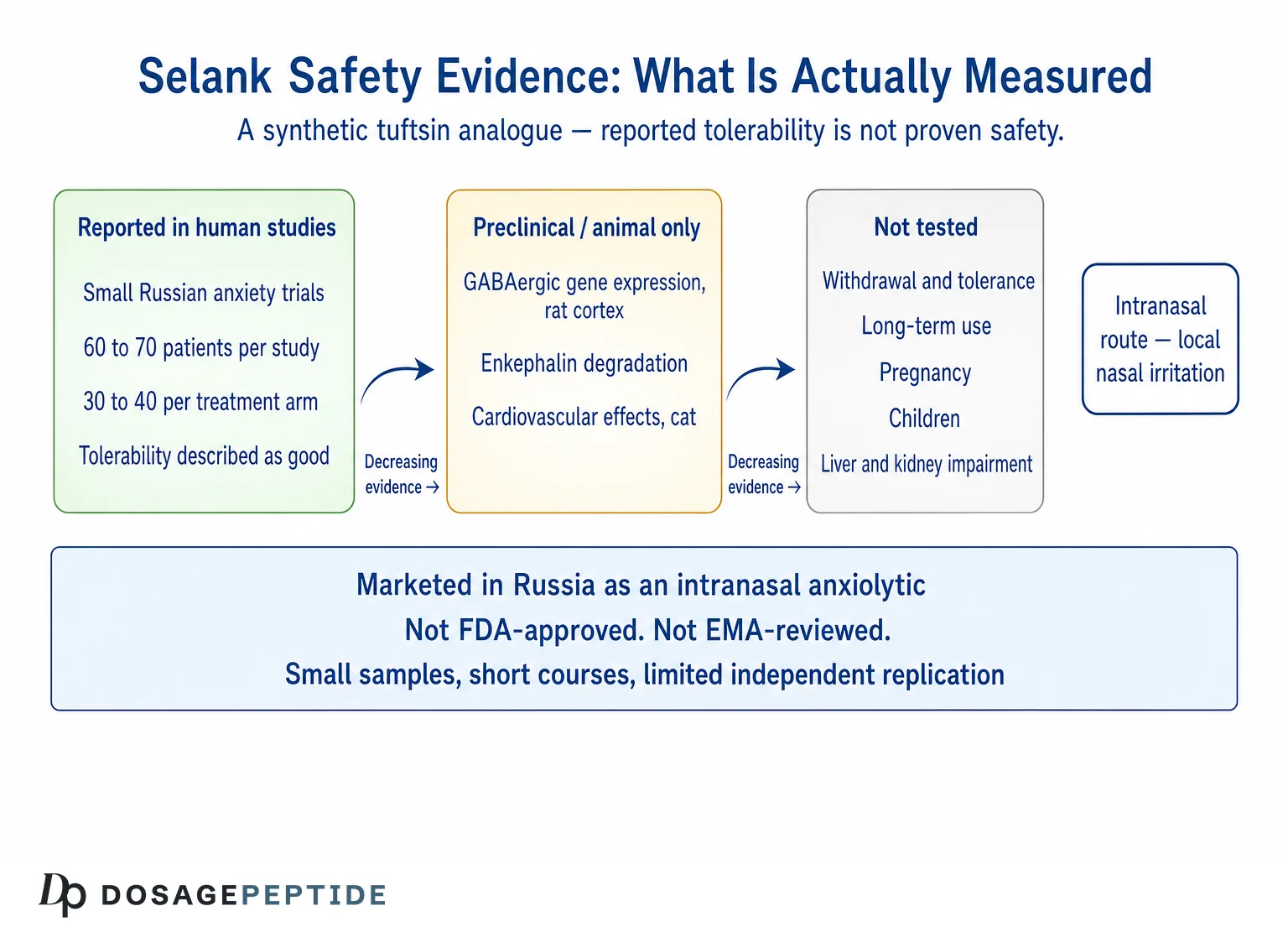
The honest answer to “what are Selank’s side effects” is that the published human literature reports very few of them — and that this fact is much weaker evidence than it first appears. The controlled trials that exist are small (60 to 70 patients per study, 30 to 40 per treatment arm), short-course, almost entirely Russian-language, and were designed to measure anxiolytic efficacy rather than to detect adverse events systematically.[1][2] Everything else circulating online — nasal stinging, headache, fatigue, irritability — is uncontrolled user report, not published data, and this page keeps those two categories strictly separate.
What side effects does the published research actually report?
Below is the evidence sorted by how well it is supported. The column an item sits in matters more than the item itself. A finding in the first column comes from a controlled human trial; a finding in the second comes from unstructured self-report with no denominator, no control group and no clinical assessment; a finding in the third is an inference from pharmacology or animal work that has never been tested for in humans at all.
| Reported effect | Evidence tier | What the underlying source actually is |
|---|---|---|
| Reduced benzodiazepine-type unwanted effects (attention and memory impairment, asthenia, sedation, sexual disturbance, emotional indifference, orthostatism) when Selank was added to phenazepam | Reported in a controlled human trial | An add-on study in 70 patients (30 on phenazepam alone, 40 on phenazepam plus Selank) that graded tolerability on the UKU side-effect scale. Note what this shows: the benzodiazepine’s side effects were reduced by adding Selank. It is not a direct measurement of Selank’s own adverse-event rate[3] |
| Anxiolytic effect comparable to a benzodiazepine, with additional antiasthenic and psychostimulant effects the comparator lacked | Reported in controlled human trials as an effect, not graded as an adverse event | Zozulya and colleagues described these as advantages over medazepam in 62 patients; whether the same activation is unwanted in some people was not assessed[1] |
| Withdrawal syndrome, tolerance or dependence | Not tested — commonly misreported as “not observed” | No published Selank trial reports a pre-specified withdrawal, tolerance or dependence endpoint. The add-on study discusses withdrawal of the benzodiazepine, not of Selank[3]. A 2021 US review argued that agents with GABAergic properties should be evaluated for abuse potential before public access, and described Selank as poorly studied[5] |
| Nasal or sinus irritation, stinging, dripping, altered taste after intranasal use | Anecdotal only — no controlled data | Widely repeated in user forums and vendor copy. No published trial reports structured nasal examination or graded local tolerability for Selank |
| Headache, drowsiness, irritability, “flat” mood in the first days | Anecdotal only — no controlled data | Self-report without denominator, blinding, or comparator. Cannot be distinguished from nocebo, from anxiety itself, or from impurities in an unregulated product |
| Injection-site reaction, redness, swelling | Anecdotal only — and route-specific | Subcutaneous use is not the route used in the Russian clinical studies; no clinical trial data exist for it |
| Immunogenicity (an unwanted immune response to the peptide or to aggregates and impurities in it) | Theoretical / regulatory concern | The FDA states that compounded drugs containing selank acetate “may pose risk for immunogenicity for certain routes of administration due to the potential for aggregation and peptide-related impurities”[4] |
| Effects on coagulation | Preclinical / ex-vivo only | Thromboelastography of glyproline-family peptides showed a shift toward hypocoagulation, with Selank showing the greatest anticoagulation potency of those tested — an experimental measurement never assessed for clinical relevance in humans[11] |
| Transient fall in arterial pressure | Animal only, intravenous route | In narcotised cats, intravenous selank produced a short-lived drop in arterial pressure in the first minutes after injection, with heart rate and respiratory rate unchanged. Different species, different route, not extrapolable[12] |
| Interaction with benzodiazepines and antipsychotics | Preclinical and in-vitro only | Radioligand-binding work reports that Selank blocks the modulatory activity of diazepam and olanzapine, and gene-expression work in a human neuroblastoma cell line reports Selank altering olanzapine’s effects; no human interaction study has been published[6][8] |
Read the table again with one question in mind: how many rows describe something that was actually measured in humans, versus something that was never looked for? Most of the reassurance attached to Selank online is built on the second kind — and an endpoint that was never assessed cannot come back negative.
What is Selank, chemically and historically?
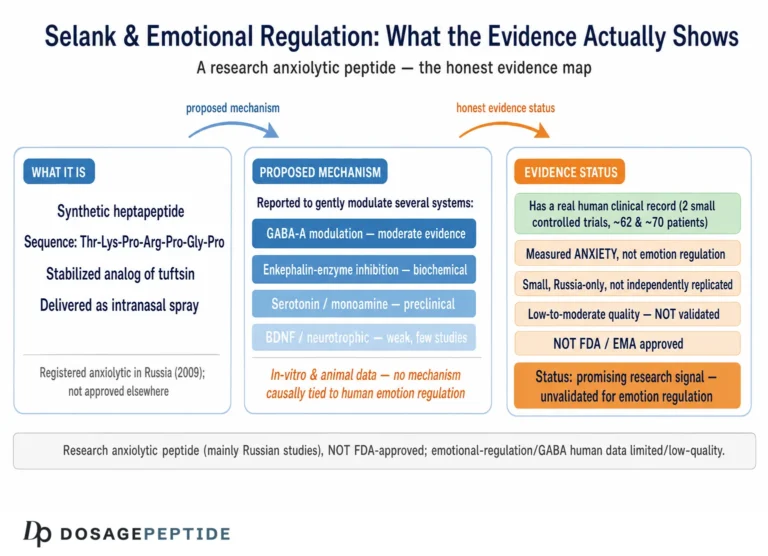
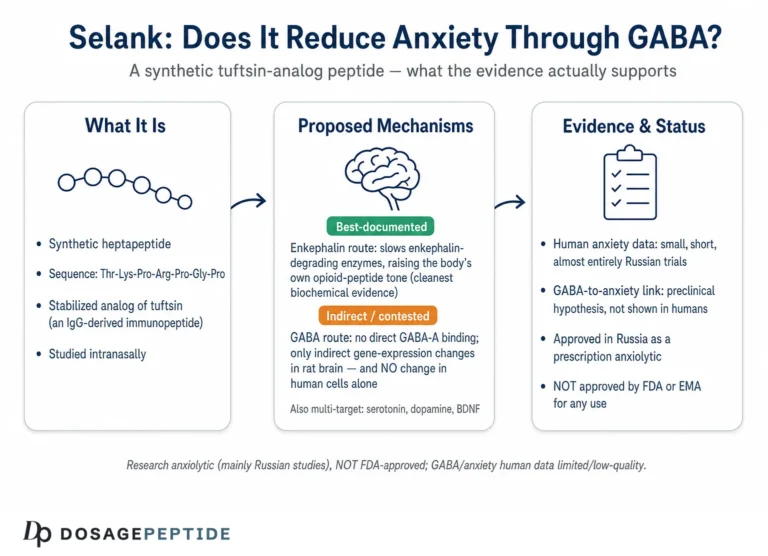
Selank is a synthetic heptapeptide with the sequence Thr-Lys-Pro-Arg-Pro-Gly-Pro. The first four residues correspond to tuftsin, an endogenous immunomodulatory tetrapeptide derived from the heavy chain of immunoglobulin G; the C-terminal Pro-Gly-Pro tripeptide was added to slow enzymatic degradation and extend the duration of action.[9][14] It was developed at the Institute of Molecular Genetics of the Russian Academy of Sciences, which remains the origin of most of the primary literature on the molecule.
That lineage matters for a safety article for two reasons. First, tuftsin’s native biology is immune rather than neurological — it is characterised as an immunomodulator that stimulates phagocytic activity[14] — so a tuftsin analogue is not a pharmacologically inert molecule that merely “calms the nervous system”. Second, almost every study of Selank traces back to one institutional network, which is the definition of limited independent replication. For a general orientation to the molecule itself, see our overview of what Selank is and how it is studied as a nootropic peptide.
Is Selank approved? The regulatory status, stated precisely
This is where most pages covering Selank tolerability go wrong, so it is worth stating without ambiguity:
- Russia: Selank was developed in Russia and is marketed there in intranasal form. A 2021 US review characterised it, alongside phenibut, as a “poorly studied Russian” drug with a GABAergic mechanism.[5]
- United States: Selank is not FDA-approved for any indication. It has not been through an FDA new drug application, and there is no FDA-reviewed label, no approved dosing, and no approved indication. The FDA has placed selank acetate (TP-7) in Category 2 of the bulk drug substances nominated for use in compounding — the category for substances that may present significant safety risks — stating that the agency “lacks important information regarding any safety issues raised by selank acetate administered to humans.”[4]
- European Union: Selank has not been assessed or authorised by the EMA.
- Everywhere else: material sold as Selank is a research chemical. It is not a supplement, not a medicine, and not quality-assured by any regulator.
The same 2021 review in the Journal of Clinical Pharmacology put the Western position bluntly, noting that Selank and phenibut are “inexplicably sold to US consumers as dietary supplements.”[5] Whatever status Selank holds in its country of origin, it is not FDA or EMA review, and it does not transfer.
Why “no side effects reported” is not the same as “proven safe”
This is the central point of the article, and it is a point about study design rather than about Selank specifically.
Small samples cannot detect uncommon harms
The comparative trials enrolled 62 and 60 patients respectively, split across two arms.[1][2] A trial of that size has essentially no power to detect an adverse event occurring in one person in several hundred. As a general statistical matter, observing zero events among 30 exposed patients is still compatible with a true event rate as high as roughly one in ten. “None observed” in a study this size is close to uninformative about rare risk.
Short courses are not a long-term safety window
The published English-language abstracts of the Selank trials do not state the treatment duration at all, which is itself a reporting limitation.[1][2][3] What is clear is that these were short treatment courses with follow-up measured in days — the phenazepam comparison tracked the anxiolytic effect for about a week after the last dose.[2] Tolerance, dependence, endocrine effects, immunological sensitisation, and cumulative mucosal changes are all phenomena that take longer than that to appear. Nothing in this literature speaks to exposure over months.
Efficacy trials are not pharmacovigilance
The Russian trials were designed to compare anxiolytic effect and were rated on scales such as Hamilton, Zung, CGI and Spielberger, with tolerability assessed alongside — on the UKU scale in the add-on study.[1][3] That is a legitimate design, but it is not the systematic, pre-specified, graded adverse-event collection that a modern safety database is built from. The absence of a structured safety endpoint is not the same as a structured finding of safety.
Single-network evidence and language barriers
Most human data on Selank originate from a small number of Russian centres, published in Russian-language journals, and have not been independently replicated by unaffiliated groups in other countries. A striking amount of Western commentary on Selank ultimately cites the same two or three abstracts. One notable exception is a resting-state functional MRI study in 52 healthy participants that compared Selank, Semax and placebo — useful evidence of human exposure, but it was a neuroimaging study reporting functional-connectivity differences, not a safety study, and it should not be cited as one.[13]
What the phrase should be replaced with
An accurate summary is: in the small, short, mostly Russian human studies published to date, Selank did not produce the sedation and psychomotor burden associated with the benzodiazepine comparators, and adding it to a benzodiazepine reduced that drug’s unwanted effects; the evidence base is too thin to characterise Selank’s own risk profile, and no regulator outside Russia has reviewed it. That sentence is longer and less satisfying than “Selank has no side effects” — and it is the only one the literature supports. The same reasoning applies across this class of compounds, which we cover in more depth in our general discussion of whether research peptides are safe.
What did the controlled human studies actually find?
Selank versus medazepam in generalised anxiety disorder and neurasthenia
Zozulya and colleagues studied 62 patients — 30 receiving Selank, 32 receiving the benzodiazepine medazepam. Anxiolytic effects were similar on the rating scales used, while Selank additionally showed antiasthenic and psychostimulant effects that the comparator lacked. The investigators also measured leu-enkephalin activity in serum, reporting that the reduced half-life seen in these patients increased during Selank treatment, mostly in those with generalised anxiety disorder.[1] This is the single most-cited human study on Selank, and it is a 62-patient, non-English publication whose abstract reports no structured adverse-event tally.
Selank versus phenazepam in anxiety and somatoform disorders
A comparative study in 60 patients with phobic-anxiety and somatoform disorders reported pronounced anxiolytic and mild nootropic effects, with the anxiolytic effect persisting for about a week after the last dose, and a positive impact on quality of life.[2] A later study from the same group compared phenazepam monotherapy (30 patients) with phenazepam plus Selank (40 patients) and reported that adding Selank decreased the benzodiazepine’s characteristic unwanted effects — attention and memory impairment, asthenia, sedation, increased sleep duration, sexual disturbance, emotional indifference and orthostatism — both during treatment and after tranquiliser withdrawal, with tolerability graded on the UKU side-effect scale.[3]
That last study is the closest thing in the literature to a structured tolerability assessment involving Selank in humans. It is still 70 patients, its abstract does not describe randomisation or blinding, and it remains unreplicated outside its originating network. Anyone weighing is Selank safe should hold those three studies in mind as the entire human corpus, not as a representative sample of a larger one.
How does Selank work, and what does the mechanism imply for safety?
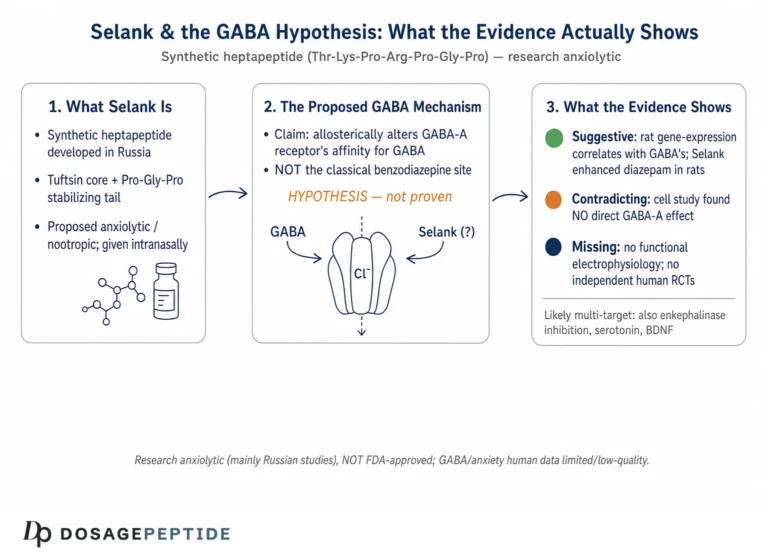
Keeping this deliberately brief, because the mechanism is covered in depth elsewhere on this site: radioligand-binding work reports that Selank affects GABA binding as a positive allosteric modulator and blocks the modulatory activity of diazepam and olanzapine, with binding sites the authors describe as potentially overlapping but not identical.[6] Administration in rats changed the expression of numerous genes involved in GABAergic neurotransmission in the frontal cortex,[7] although in the IMR-32 human neuroblastoma cell line Selank alone produced no change in the mRNA levels of the genes studied, acting instead on how GABA and olanzapine altered them.[8] Intranasal administration in rats was reported to regulate BDNF expression in the hippocampus,[10] and the medazepam trial linked Selank treatment to changes in enkephalin turnover.[1] All of that mechanistic work except the enkephalin measurement is preclinical.
The safety-relevant conclusion is narrow but important: a molecule reported to modulate GABAergic tone, gene expression in the brain, neurotrophin levels and opioid-peptide turnover is not pharmacologically trivial. Anything acting on those systems has, in principle, the capacity to interact with sedatives, anxiolytics, antipsychotics and antidepressants. That capacity has been observed in cells and animals[9] and has never been characterised in a human interaction study.
Does the route of administration change the risk profile?
Yes, and the distinction is routinely blurred. The human trials used the intranasal route. Intranasal delivery of a peptide raises a specific and largely unstudied set of local questions: mucosal tolerance on repeated dosing, effects on ciliary function, irritation from the excipients and preservatives in the vehicle rather than from the peptide, and the sterility of anything instilled into the nose over weeks. No published Selank trial reports structured nasal examination or a graded local-tolerability endpoint, so Selank nasal spray side effects are, in the strict sense, undocumented rather than absent.
Subcutaneous administration is common in research-chemical contexts and has no clinical trial base at all. It introduces a different risk category entirely: sterility of the reconstituted solution, injection technique, local reaction, and systemic exposure that bypasses nasal mucosal metabolism. Route is not a cosmetic detail — the one cardiovascular animal study on record used the intravenous route in cats and found a transient pressure drop that has no counterpart in the intranasal human literature.[12] Anyone reading a Selank dosage chart covering intranasal and subcutaneous approaches should note that the two columns rest on very different amounts of evidence — and that reference tables of that kind describe what has been used in laboratory settings, not what is recommended for a person.
Interactions, unstudied populations, and one bad argument
Interactions have not been studied in humans
The plausible interaction candidates follow directly from mechanism: benzodiazepines and Z-drugs, alcohol, antipsychotics, antidepressants, and anything else with sedative or GABAergic action. The evidence that Selank changes how those drugs behave is real, but it comes from radioligand binding, cell culture and rodent behaviour — not from humans.[6][9] The ex-vivo anticoagulant signal is a second, separate flag of the same type: interesting, unreplicated, of unknown clinical meaning.[11]
Whole populations have no data at all
There are no published human data on Selank in pregnancy or lactation, none in children or adolescents, none in people with hepatic or renal impairment, and none in the elderly as a defined subgroup. What exists instead is preclinical: a study using mouse embryonic stem cells and their derivatives concluded that the peptide compounds tested, Selank among them, did not produce a toxic effect in that model.[15] That is a cell-culture model. It is not reproductive safety data, and it must never be reported as such.
“Peptides are natural, so they are safe” is a fallacy
Selank is not tuftsin. It is a modified sequence deliberately engineered to resist the enzymes that would normally clear the natural peptide — that is the entire point of the Pro-Gly-Pro extension.[9] Longer persistence is a pharmacological property, not a reassurance. More generally, “natural” says nothing about safety: insulin, botulinum toxin and snake venom peptides are all natural. What determines risk is dose, route, duration, purity and the physiology of the person exposed. None of those five are established for Selank outside a narrow Russian clinical context.
Can the vial itself be the problem?
There is a distinction that safety discussions of research chemicals almost always miss: the risk from the molecule and the risk from the product are two different things, and for an unregulated compound the second is often larger.
Material sold as Selank is not subject to pharmacopoeial standards, batch release testing, or regulatory inspection. Realistic failure modes include under-dosing or over-dosing relative to the label, incomplete synthesis leaving truncated or deletion sequences, residual synthesis solvents, endotoxin from poor handling, incorrect peptide entirely, and degradation from bad storage or shipping. The FDA’s own stated concern for selank acetate names peptide-related impurities and aggregation explicitly[4] — aggregates are precisely the species most associated with unwanted immune responses to peptide and protein drugs.
This is why a third-party certificate of analysis is a safety document and not a marketing badge. An HPLC purity figure with a real chromatogram, plus mass-spectrometry confirmation that the mass matches the expected heptapeptide, is the minimum that distinguishes a characterised substance from an unknown powder. Our guide on how to read a peptide COA, including HPLC purity and mass-spec identity covers what a genuine one contains and the common ways they are faked. If a laboratory record does not specify the identity, purity and provenance of the exact vial used, no discussion of Selank side effects is meaningful — the observed effects cannot be attributed to Selank in the first place. The same principle applies to any handling reference, including our Selank 10 mg vial reconstitution and handling protocol, which documents laboratory practice for a characterised vial and is not a human-use instruction.
How does Selank compare with Semax on safety evidence?
The two are frequently discussed together, share a Russian origin, and share a regulatory position: the FDA lists semax (heptapeptide) in the same Category 2 grouping, stating that it “has no, or limited, safety-related information for proposed routes of administration.”[4] Structurally they are unrelated — Semax derives from an ACTH fragment, Selank from tuftsin — so mechanism does not transfer between them, and neither does any tolerability finding. If you are comparing the two, our side-by-side comparison of Semax and Selank and our overview of Semax in nootropic peptide research set out where each one’s evidence actually sits. The short version: both have thin evidence bases, and thinness in one is not offset by the other.
What is still unknown about Selank’s safety?
An honest inventory of the gaps is more useful than any list of reported effects:
- Long-term exposure. The published human studies are short courses with follow-up in days. Effects at three, six or twelve months are entirely unknown.
- Rare adverse events. Total published human exposure across the trials and the imaging study is on the order of a couple of hundred participants. Events rarer than roughly one in a hundred would very likely not have been detected.
- Immunogenicity in practice. Flagged as a potential risk by the FDA; never measured with anti-drug antibody assays in a published Selank trial.[4]
- Local nasal tolerance on repeated dosing. No structured mucosal endpoint in any published trial.
- Human drug–drug interactions. Predicted from mechanism, observed in animals and cells, never tested in people.
- Special populations. Pregnancy, lactation, paediatrics, hepatic impairment, renal impairment, cardiovascular disease — no data.
- Subcutaneous route. No clinical trial data whatsoever.
- Independent replication. The favourable tolerability picture rests almost entirely on one national research network.
- Abuse and dependence liability. A 2021 US review argued that agents with GABAergic properties should undergo evaluation for abuse potential before public access, and grouped Selank among poorly studied drugs of that class sold to consumers as supplements.[5]
None of this means Selank has been shown to be harmful. It means the question of whether it is harmful has not been answered, and the studies that exist were not built to answer it. That is a different, and more accurate, statement than either “Selank is safe” or “Selank is dangerous”.
Frequently Asked Questions
Is Selank FDA-approved?
No. Selank has never been approved by the FDA for any indication, and it has not been assessed by the EMA. In the United States the FDA has placed selank acetate in Category 2 of substances nominated for use in compounding — the group flagged as potentially presenting significant safety risks — citing immunogenicity potential from aggregation and peptide-related impurities, and a lack of information about safety issues raised by selank acetate administered to humans.
What are the most commonly reported Selank side effects?
The published controlled trials do not report a structured tally of Selank’s own adverse events. What they report is that Selank produced anxiolytic effects comparable to benzodiazepine comparators without those drugs’ sedative burden, and that adding Selank to phenazepam reduced the benzodiazepine’s unwanted effects. The effects most often described online — nasal stinging, headache, tiredness, irritability — come from uncontrolled user reports, not from published data, and should not be treated as an established side-effect profile.
Is Selank safe for long-term use?
There is no evidence either way, because the published human studies are short courses with follow-up measured in days. Tolerance, dependence, immunological sensitisation and cumulative mucosal effects all operate on longer timescales than the existing trials cover. Claims about long-term Selank safety, in either direction, are extrapolations rather than findings.
Does Selank cause withdrawal or dependence like benzodiazepines?
Nobody has tested this. No published Selank trial includes a pre-specified withdrawal, tolerance or dependence endpoint, so the widely repeated claim that “no withdrawal was observed” describes an endpoint that was never assessed rather than a negative result. A 2021 review in the Journal of Clinical Pharmacology grouped Selank among poorly studied GABAergic agents and argued that such agents should be evaluated for abuse potential before public access.
Why do so many sources say Selank has no side effects?
Because they convert “not measured” into “not present”, and they repeat trial conclusions without repeating the limits. As a general statistical matter, zero events observed among 30 exposed patients is still compatible with a true event rate approaching one in ten. The underlying studies are not false; they are simply far weaker than the confident phrasing built on top of them, and they are usually reproduced without the sample size or design attached.
Are there known drug interactions with Selank?
No human interaction studies have been published. Mechanistically, plausible candidates include benzodiazepines, alcohol, antipsychotics and other sedatives, and laboratory work has reported Selank blocking the modulatory activity of diazepam and olanzapine in binding experiments and altering olanzapine’s effects in a neuroblastoma cell line. That evidence is preclinical. The absence of documented human interactions reflects an absence of studies, not an absence of risk.
Is intranasal Selank safer than subcutaneous?
Intranasal is the route used in the published human trials, so it is the only route with any clinical evidence behind it. That does not make it demonstrably safer — no trial has assessed nasal mucosal tolerance with a structured endpoint. Subcutaneous use has no clinical trial base at all and adds sterility and injection-related risks on top of the pharmacological unknowns.
Can contaminated or mislabelled product cause what look like Selank side effects?
Yes, and this is a genuinely underrated variable. Unregulated material can contain truncated sequences, residual solvents, endotoxin, aggregates, the wrong peptide, or a different quantity than the label states. Any of these can produce effects wrongly attributed to Selank itself. Without third-party HPLC purity and mass-spectrometry identity confirmation for the specific batch, effects cannot be attributed to the molecule at all.
Is Selank a supplement?
No. Selank is a synthetic drug substance. It is not a vitamin, botanical, amino acid or other lawful dietary ingredient, and a 2021 US review specifically criticised its sale to consumers as a dietary supplement. Outside Russia it is handled as a research chemical, sold for laboratory use only, with no regulator verifying identity, purity, sterility or dose.
References
- Zozulya AA, Neznamov GG, Syunyakov TS, et al. Efficacy and possible mechanisms of action of a new peptide anxiolytic selank in the therapy of generalized anxiety disorders and neurasthenia. Zhurnal Nevrologii i Psikhiatrii imeni S.S. Korsakova. 2008;108(4):38–48. https://pubmed.ncbi.nlm.nih.gov/18454096/
- Medvedev VE, Tereshchenko ON, Israelyan AYu, et al. A comparison of the anxiolytic effect and tolerability of selank and phenazepam in the treatment of anxiety disorders. Zhurnal Nevrologii i Psikhiatrii imeni S.S. Korsakova. 2014;114(7):17–22. https://pubmed.ncbi.nlm.nih.gov/25176261/
- Medvedev VE, Tereshchenko ON, Kost NV, et al. Optimization of the treatment of anxiety disorders with selank. Zhurnal Nevrologii i Psikhiatrii imeni S.S. Korsakova. 2015;115(6):33–40. https://pubmed.ncbi.nlm.nih.gov/26356395/
- U.S. Food and Drug Administration. Certain Bulk Drug Substances for Use in Compounding that May Present Significant Safety Risks (Category 2 of the bulk substances nominated under sections 503A or 503B of the FD&C Act). https://www.fda.gov/drugs/human-drug-compounding/certain-bulk-drug-substances-use-compounding-may-present-significant-safety-risks
- Doyno CR, White CM. Sedative-Hypnotic Agents That Impact Gamma-Aminobutyric Acid Receptors: Focus on Flunitrazepam, Gamma-Hydroxybutyric Acid, Phenibut, and Selank. Journal of Clinical Pharmacology. 2021;61(Suppl 2):S114–S128. https://pubmed.ncbi.nlm.nih.gov/34396551/
- Vyunova TV, Andreeva L, Shevchenko K, Myasoedov N. Peptide-based Anxiolytics: The Molecular Aspects of Heptapeptide Selank Biological Activity. Protein and Peptide Letters. 2018;25(10):914–923. https://pubmed.ncbi.nlm.nih.gov/30255741/
- Volkova A, Shadrina M, Kolomin T, et al. Selank Administration Affects the Expression of Some Genes Involved in GABAergic Neurotransmission. Frontiers in Pharmacology. 2016;7:31. https://pmc.ncbi.nlm.nih.gov/articles/PMC4757669/
- Filatova E, Kasian A, Kolomin T, et al. GABA, Selank, and Olanzapine Affect the Expression of Genes Involved in GABAergic Neurotransmission in IMR-32 Cells. Frontiers in Pharmacology. 2017;8:89. https://pmc.ncbi.nlm.nih.gov/articles/PMC5328971/
- Kasian A, Kolomin T, Andreeva L, et al. Peptide Selank Enhances the Effect of Diazepam in Reducing Anxiety in Unpredictable Chronic Mild Stress Conditions in Rats. Behavioural Neurology. 2017;2017:5091027. https://pmc.ncbi.nlm.nih.gov/articles/PMC5322660/
- Inozemtseva LS, Karpenko EA, Dolotov OV, et al. Intranasal administration of the peptide Selank regulates BDNF expression in the rat hippocampus in vivo. Doklady Biological Sciences. 2008;421:241–243. https://pubmed.ncbi.nlm.nih.gov/18841804/
- Rogozinskaya EYa, Lyapina MG. Anticoagulant Effects of Arginine-Containing Peptides of the Glyproline Family (His-Phe-Arg-Trp-Pro-Gly-Pro and Thr-Lys-Pro-Arg-Pro-Gly-Pro) Revealed by Thromboelastography. Bulletin of Experimental Biology and Medicine. 2017;164(2):170–172. https://pubmed.ncbi.nlm.nih.gov/29181670/
- Gan’shina TS, Kozlovskii II. Effects of the new peptide anxiolytic drug selank on the cardiovascular system functioning and respiration in cats. Eksperimental’naia i Klinicheskaia Farmakologiia. 2005;68(4):33–35. https://pubmed.ncbi.nlm.nih.gov/16193654/
- Panikratova YaR, Lebedeva IS, Sokolov OYu, et al. Functional Connectomic Approach to Studying Selank and Semax Effects. Doklady Biological Sciences. 2020;490(1):9–11. https://pubmed.ncbi.nlm.nih.gov/32342318/
- Siebert A, Gensicka-Kowalewska M, Cholewinski G, Dzierzbicka K. Tuftsin – Properties and Analogs. Current Medicinal Chemistry. 2017;24(34):3711–3727. https://pubmed.ncbi.nlm.nih.gov/28745220/
- Kobylyanskii AG, Zolotarev YuA, Andreeva LA, Grivennikov IA, Myasoedov NF. Studying the Toxic Effects of Some Biologically Active Peptides on the Model of Mouse Embryonic Stem Cells. Bulletin of Experimental Biology and Medicine. 2017;163(6):731–736. https://pubmed.ncbi.nlm.nih.gov/29063333/
Research use only. DosagePeptide.com is an independent reference library and does not sell peptides. Selank is not approved by the FDA or the EMA for any use, and nothing on this page is medical advice, a treatment recommendation, a dosing instruction, or a suggestion that any person should administer this compound. The information here summarises published laboratory and clinical literature for qualified researchers working in appropriately controlled settings, and is intended for research and educational purposes only. Consult a licensed physician for any question concerning anxiety, mental health, or the use of any medicine.