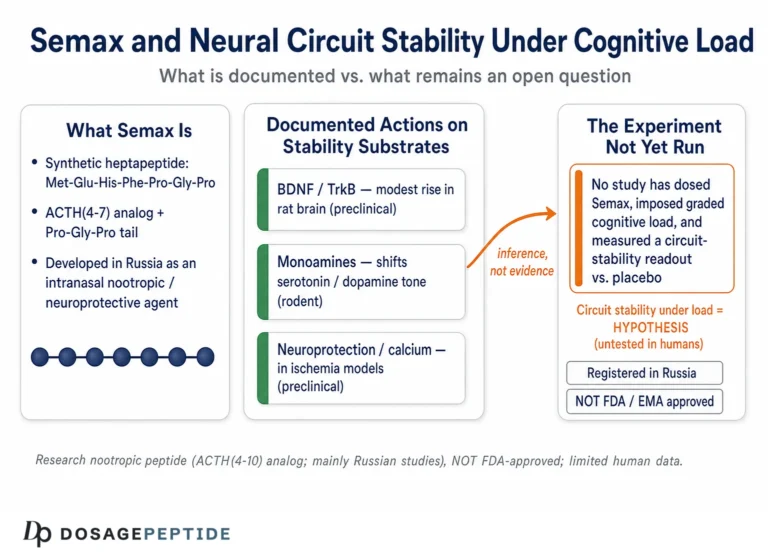
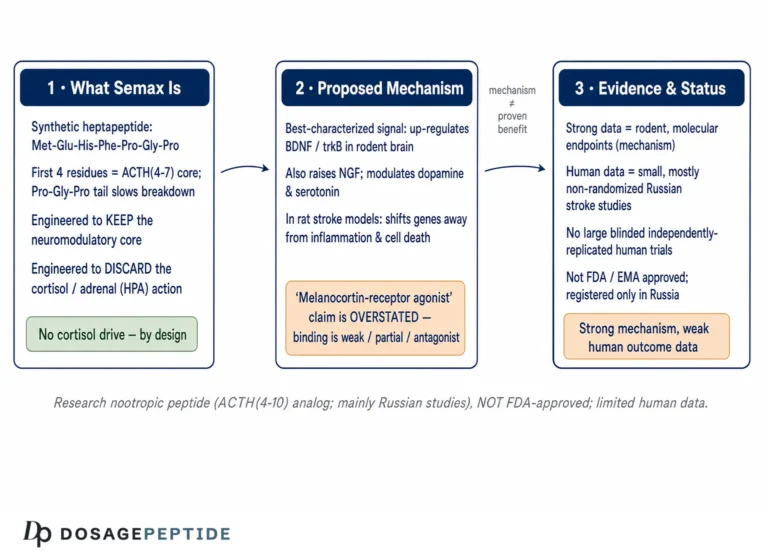
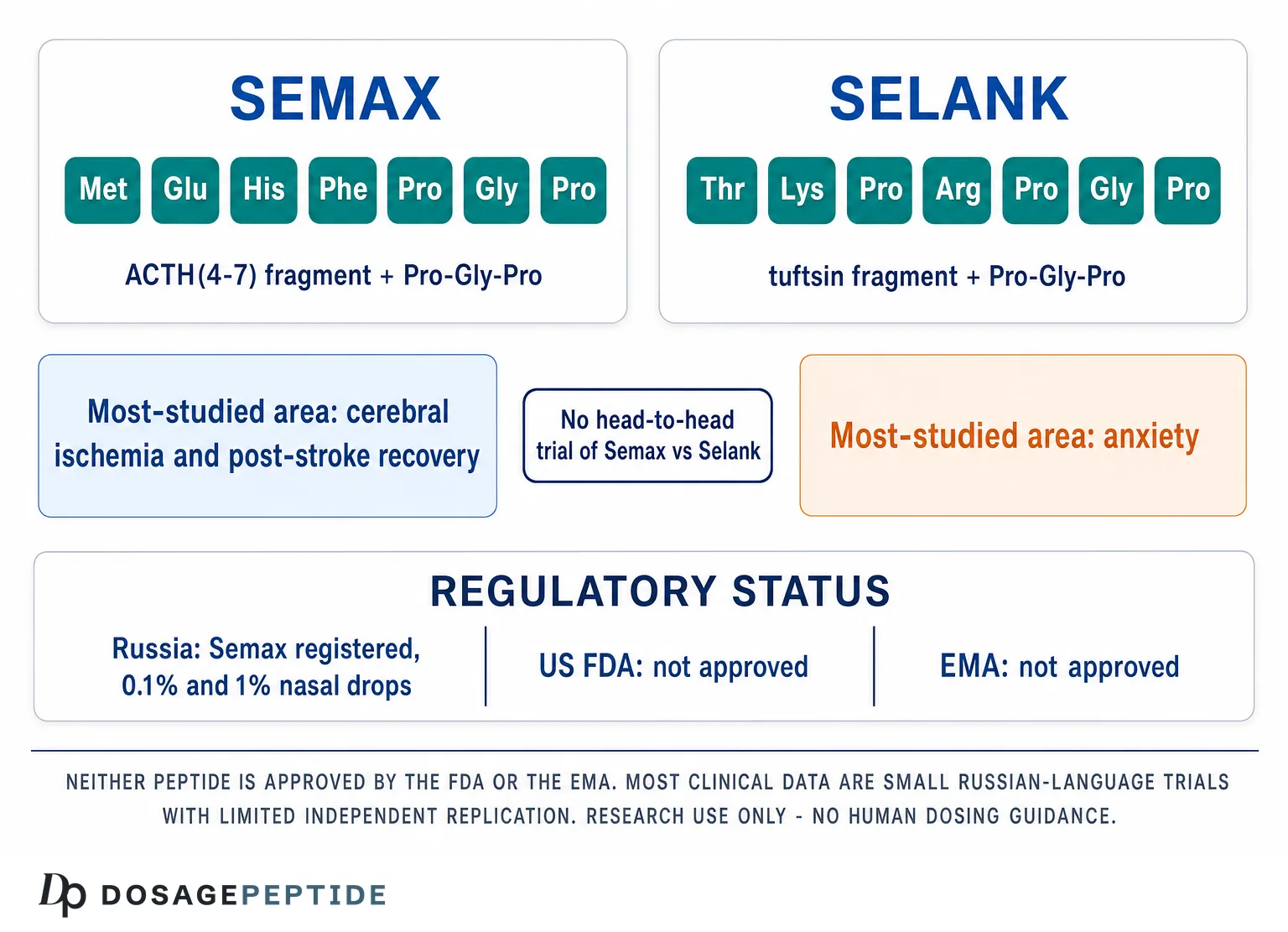
Semax and Selank are two synthetic heptapeptides developed at the same Russian institute, built on the same design trick — take a short bioactive fragment of a natural molecule and bolt a Pro-Gly-Pro tail onto it — but they start from completely different parent molecules and are studied for different things. Semax derives from adrenocorticotropic hormone (ACTH) and dominates the Russian cerebrovascular and cognitive literature; Selank derives from the immune tetrapeptide tuftsin and dominates the anxiolytic literature. Neither holds a marketing authorisation from the FDA or the EMA, neither appears as an intervention in any study registered on ClinicalTrials.gov, and — the part almost every comparison article omits — no randomised trial has ever measured one against the other for a clinical outcome.
Semax vs Selank at a glance
Everything below is drawn from primary sources cited at the end. Where the literature is thin or the evidence tier is weak, the table says so rather than filling the cell with a marketing claim. Where a figure has no traceable source, the table says that too.
| Attribute | Semax | Selank |
|---|---|---|
| Parent molecule | Adrenocorticotropic hormone (ACTH). Frequently described in the literature as an analogue of the ACTH(4–10) fragment, but the actual sequence it carries is ACTH(4–7)[1] | Tuftsin (Thr-Lys-Pro-Arg), an endogenous tetrapeptide released by enzymatic cleavage of immunoglobulin G[2] |
| Sequence | Met-Glu-His-Phe-Pro-Gly-Pro (MEHFPGP) — seven residues[3] | Thr-Lys-Pro-Arg-Pro-Gly-Pro (TKPRPGP) — seven residues[3] |
| Shared design element | Both append the same C-terminal Pro-Gly-Pro tripeptide to a shorter active fragment, intended to slow proteolysis of the parent sequence. The tail is not necessarily inert: in mouse spleen the short Gly-Pro fragment reproduced much of the gene-expression profile produced by intact Selank[2] | |
| Formula / MW / CAS | C37H51N9O10S; 813.9 g/mol; CAS 80714-61-0[4] | C33H57N11O9; 751.9 g/mol; CAS 129954-34-3 (also labelled TP-7)[4] |
| Primary studied domain | Cerebral ischemia and post-stroke recovery[5] | Anxiety and asthenic states[6]; immune and inflammatory gene regulation[2] |
| Proposed mechanism | Suppression of inflammatory and cell-death markers in rat ischemia–reperfusion brain tissue[7]; raised plasma BDNF in one non-randomised human stroke study[5]. Effects on monoamine systems are asserted in review articles, but we could not locate a primary study supporting them, so they are not listed here | Positive allosteric modulation of GABA binding in rat brain membrane preparations[8]; inhibition of enkephalin-degrading enzymes in human serum[3] |
| Shared mechanism | Both inhibit human serum enkephalin-degrading enzymes in vitro, Semax with roughly twice the potency of Selank in the same assay[3] | |
| Evidence base and its quality | Large rodent literature, mostly from one institutional network; human data limited to small Russian-language clinical reports and small imaging studies[9] | One published randomised comparative trial (n=62, Russian-language journal) plus preclinical work; a key cell-culture experiment returned a null result for Selank alone[10] |
| Regulatory status | No FDA or EMA marketing authorisation. A registered drug in Russia, available as 0.1% and 1% nasal drops[13]. Previously placed in Category 2 of FDA’s interim compounding policy, now listed among substances whose nominations were withdrawn[14]. Reviewed by FDA and its advisory committee in July 2026 for the 503A compounding list — a recommendation, not an approval[13] | No FDA or EMA marketing authorisation. Selank acetate (TP-7) was likewise placed in Category 2 of FDA’s interim compounding policy and now appears among substances whose nominations were withdrawn[14]. Not reviewed at the July 2026 advisory committee meeting |
| Trials on ClinicalTrials.gov | None. An intervention-field search of the ClinicalTrials.gov API returns zero records for Semax and, for Selank, two records that are unrelated brain-stimulation studies rather than studies of the peptide (checked 27 July 2026). That is a statement about the US registry only. Both compounds have a Russian clinical history that is not indexed alongside ClinicalTrials.gov[5][6], and we have not searched the Russian national register of trial authorisations | |
| Formats described in the literature | FDA’s own evaluation states that Semax is a registered drug in Russia available as 0.1% and 1% nasal drops[13]. The 1% intranasal solution is the form used in the published healthy-volunteer imaging study[9] | The Russian registered product is an intranasal solution. The strength usually quoted online is 0.15% (1.5 mg/mL), but that figure does not appear in the indexed record of the comparative trial[6] and we could not confirm it in any accessible primary source, so we treat it as unverified |
| Stability rationale | The Pro-Gly-Pro tail is intended to slow proteolysis of the parent fragment. We could not locate peer-reviewed human pharmacokinetic parameters — Cmax, Tmax or elimination half-life — for either peptide: a PubMed search for each peptide plus “pharmacokinetics” on 27 July 2026 returned single-digit numbers of records, and we found no human study among them. Russian-language regulatory dossiers may hold data we cannot access. On the indexed record, any specific half-life figure circulating online is unsourced | |
| What the literature does NOT show | No adequately powered, independently replicated, non-Russian randomised trial of stroke or cognitive outcomes; no demonstrated benefit in healthy cognition on validated neuropsychological endpoints | No independent replication outside Russia; no long-term safety dataset; the single comparative trial is small, and neither its abstract nor its PubMed record describes the blinding or allocation-concealment procedure in either direction |
What Semax actually is
Semax is the heptapeptide Met-Glu-His-Phe-Pro-Gly-Pro. The N-terminal four residues, Met-Glu-His-Phe, correspond to positions 4–7 of adrenocorticotropic hormone; the C-terminal Pro-Gly-Pro is synthetic[1]. This is worth stating precisely because two errors are widespread. The first is the claim that Semax is an ACTH(4–10) fragment: it is routinely described as an ACTH(4–10) analogue in the literature, but the residues it actually carries are 4–7, with Arg-Trp-Gly of the natural 8–10 positions replaced by Pro-Gly-Pro. The second is a sequence circulating on vendor pages that renders Semax as “Tyr-Val-Met-Glu-His-Phe”. That is not Semax. PubChem, and the primary literature that first characterised both peptides side by side, give MEHFPGP[4][3].
The free N-terminal amine matters. When researchers acetylated it, the peptide’s copper(II) coordination chemistry changed and its protection of a neuroblastoma cell line against copper toxicity was lost; the authors concluded the free terminus plays a crucial role[1]. That is the cleanest published warning against assuming a chemically modified Semax behaves like Semax.
The bulk of Semax research is preclinical cerebral ischemia. In rat transient middle cerebral artery occlusion models, Semax was associated with upregulation of active CREB in damaged subcortical tissue and downregulation of MMP-9, c-Fos and active JNK in adjacent cortex[7]. These are animal-model findings, not evidence that Semax treats stroke or dementia in humans. Our Semax 10 mg vial reconstitution page and our Semax intranasal and subcutaneous concentration reference set out reconstitution arithmetic and the route-specific concentrations reported in the literature. Those are reference figures for laboratory work. They are not a protocol for administering anything to a person, and no human dose has been established for this compound outside the labelling of the Russian registered product.
What Selank actually is
Selank is Thr-Lys-Pro-Arg-Pro-Gly-Pro: tuftsin (TKPR) with the same Pro-Gly-Pro extension[3]. Because tuftsin is an immune peptide, Selank carries an immunological dimension Semax does not. In mouse spleen, a single intraperitoneal dose altered mRNA levels of C3, Casp1, Il2rg and Xcr1, and the short Gly-Pro fragment reproduced much of that profile — suggesting the breakdown products, not only the intact heptapeptide, contribute to the effect[2].
On the anxiolytic side, the mechanistic anchor is a radioligand-binding study in rat brain plasma membranes reporting that Selank behaves as a positive allosteric modulator of GABA binding, with a joint action alongside benzodiazepines that is non-cumulative and differs from either agent alone[8]. That is a membrane-preparation result, and it is the only direct receptor-level study we were able to locate. We cover the receptor picture separately in how Selank interacts with GABA signalling; the point here is comparative, so we will not repeat it.
The same handling caveat applies on this side. Our Selank 10 mg vial reconstitution page and our Selank intranasal and subcutaneous concentration reference document reconstitution arithmetic and route-specific concentrations reported in the literature. They are reference figures for laboratory work, not an administration protocol, and rodent dose figures — which is most of what exists for Selank — do not translate into human exposures at all.
How good is the evidence, really?
This is where most Semax-versus-Selank comparisons quietly cheat, so it is worth doing properly.
The Selank anxiolytic trial, examined
The study everyone cites is Zozulya and colleagues, published in 2008 in Zhurnal nevrologii i psikhiatrii imeni S.S. Korsakova. Sixty-two patients with generalised anxiety disorder or neurasthenia were studied; 30 received Selank and 32 received the benzodiazepine medazepam. Outcomes were Hamilton, Zung and CGI scales plus serum enkephalin activity. The reported conclusion was that anxiolytic effects were similar between arms, with Selank additionally showing antiasthenic and psychostimulant effects[6].
Now the audit. Thirty patients per arm is small for a psychiatric efficacy trial — powered to detect large differences, not to establish equivalence, and “similar anxiolytic effects” between two small arms describes a failure to detect a difference, not proof that none exists. PubMed indexes the paper as a randomised controlled trial, but neither the abstract nor the PubMed record describes how allocation was concealed or whether anyone was blinded, and the full method is available only in Russian — so that indexing cannot be checked against the methods section by most readers. Comparing an intranasal peptide against an oral tablet also makes convincing double-blinding structurally difficult. The trial came from the same research network that developed the compound, and it has never been independently replicated outside Russia. One unreplicated 62-patient trial in a national-language journal justifies further research. It is not a body of evidence.
The null result nobody quotes
Filatova and colleagues, publishing in Frontiers in Pharmacology in 2017, tested Selank, GABA and olanzapine on GABAergic-system gene expression in IMR-32 human neuroblastoma cells. GABA alone altered 14 genes; olanzapine alone altered 25. Selank alone altered none. The authors’ own conclusion is hedged rather than flat: the absence of any change in the mRNA levels of the genes studied, they write, suggests that Selank is not able to directly affect the activity of the GABAergic system in this cell culture. Where changes did appear, they were combinatorial — and with GABA the combination produced nearly complete suppression of the changes GABA caused on its own, rather than reinforcing them[10].
Two honest readings follow. This is a cell-culture experiment in a neuroblastoma line — the weakest evidence tier there is — and a null result there does not refute in vivo findings. It is also directly inconsistent with the simplified story sold online, in which Selank “boosts GABA gene expression”. Both are true at once. That is what an unresolved mechanism looks like.
The Semax clinical literature, examined
Semax’s human evidence has the same structural problems. A representative example is a 2018 study of 110 post-ischemic-stroke patients reporting higher plasma BDNF and faster Barthel Index improvement in semax-treated subgroups[5]. It is indexed as a clinical trial in a Russian-language journal; patients were split into early and late rehabilitation groups then subdivided by semax exposure, and the published design does not describe randomised, blinded, placebo-controlled allocation. Concurrent rehabilitation is a large uncontrolled confounder here.
The strongest human Semax data are arguably imaging biomarkers rather than clinical outcomes. Twenty-four healthy volunteers received intranasal 1% Semax (14 subjects) or placebo (10 subjects) with resting-state fMRI before and after; the Semax group showed a larger rostral, medial-frontal subcomponent of the default mode network[9]. That demonstrates the molecule does something measurable to brain networks. It does not demonstrate that anyone thought or performed better.
Is there a head-to-head trial of Semax versus Selank?
No randomised clinical trial has compared Semax and Selank on any clinical endpoint. A PubMed search for both terms in the title field returns four papers (searched 27 July 2026, title field only), none of which is a clinical efficacy comparison; a title-field search will miss papers that name both peptides only in the abstract or body, and will miss non-indexed Russian-language work. An intervention-field search of ClinicalTrials.gov on the same date returns no registered interventional study of either peptide.
The closest published approach is a neuroimaging study by Panikratova and colleagues: 52 healthy participants received Semax, Selank or placebo, with resting-state fMRI before, 5 minutes after and 20 minutes after administration. Both general and compound-specific effects were reported on functional connectivity between the right amygdala and right temporal cortex[11]. This is a placebo-controlled parallel-group comparison — a genuine step above the vendor literature — but the outcome is a connectivity biomarker measured within 20 minutes, not anxiety, attention or memory performance, and 52 participants split three ways leaves small cells. It also carries the same independence problem as the rest of the corpus: it comes from the same Moscow group that produced the Semax default-mode-network study, sharing the authors Panikratova, Lebedeva and Sokolov[9], it has not been replicated by any independent laboratory, and it has not been repeated outside Russia. It is a better design than the vendor literature, not independent evidence.
There is also a preclinical near-comparison. In rats with 6-hydroxydopamine-induced parkinsonism, both peptides were tested in the same protocol: neither affected motor activity or passive defensive behaviour, and Selank — but not Semax — reduced anxiety in the elevated maze[12]. That is a rodent behavioural dissociation, and it is the most direct comparative datapoint we were able to locate.
The consequence is worth stating bluntly. Every “Semax is better for focus, Selank is better for anxiety” claim online is an inference assembled from non-comparable studies — different species, models, endpoints, laboratories, decades. It may be directionally right. It has never been measured.
Which is studied for focus, and which for anxiety?
Reframed as a question about the literature rather than outcomes, the split is clear. Semax’s programme is built around ischemia and neurotrophin signalling, and its human work sits in neurology and stroke rehabilitation[5][7]. Selank’s programme is built around anxiety, asthenia and immune modulation, with its one comparative clinical trial in generalised anxiety disorder and neurasthenia[6][2].
Note what that describes: where researchers have pointed their instruments. It does not certify that either compound produces the effect being investigated, in humans, reliably, at any exposure. A domain of study is a hypothesis under test, not a result.
Have they been studied together?
Combination use is the most frequently asked question and the most poorly evidenced. No published clinical trial has co-administered them. The two appear together in preclinical work — the same 6-OHDA rat protocol, for instance[12] — but studied in parallel arms, not in combination.
There is one mechanistic reason to be cautious about assuming additivity. Both peptides inhibit the same class of enkephalin-degrading enzymes in human serum, Semax with an IC50 around 10 µM and Selank around 20 µM in that assay[3]. Overlapping mechanisms are precisely the case where two agents can be less than additive, or interact unpredictably. Nobody has measured it.
Where the amidated analogs fit — and where they do not
N-Acetyl Semax Amidate and N-Acetyl Selank Amidate are vendor-modified derivatives, not the Russian registered products: they add an N-terminal acetyl group and a C-terminal amide to the parent sequence, making them chemically distinct compounds with distinct CAS identities.
A PubMed all-fields search for the vendor name “N-acetyl semax amidate” returns no indexed records (searched 27 July 2026). That is a statement about the trade name, not about the chemistry. Acetylated Semax itself has been studied: a search for “acetyl semax” on the same date returns two records — the copper-coordination and cell-protection study discussed above[1], and a Russian study of the proteolytic stability of Semax acetyl, which measures degradation kinetics rather than any behavioural or clinical outcome. What does not exist in the indexed literature is any study of the specific acetylated-and-amidated compound sold under the vendor name, in any species, on any behavioural or clinical endpoint.
So the frequently repeated claim that the amidated analog is “three to four times more potent per microgram” than Semax has no primary citation attached to it anywhere we can find; it originates from supplier copy. Meanwhile the most informative published experiment on N-terminal acetylation of Semax found the modification altered the peptide’s copper coordination and abolished its protection of neuroblastoma cells against copper toxicity[1]. The correct inference is not that the analog is worse — it is that data on the parent compound does not transfer to the modified one, in either direction, without being measured. If you are reading about the amidated forms, our N-Acetyl Semax Amidate reference page keeps them explicitly separate from Semax, and the reconstitution guide explains why percentage-strength and mg/mL labelling are not interchangeable across formats.
Where the regulators actually stand
Neither Semax nor Selank has a marketing authorisation from the FDA or the EMA. Searches of the Drugs@FDA approved-products database and of the EMA medicines database on 27 July 2026 return no authorised medicine containing either peptide. That much of the usual summary is right.
What is not right is the claim, repeated across peptide sites, that neither compound has ever been through a regulatory review. Both have. FDA placed Semax (heptapeptide) and Selank acetate (TP-7) in Category 2 of its interim compounding policy — bulk drug substances that may present significant safety risks — and both now appear on FDA’s list of Category 2 substances whose nominations were subsequently withdrawn by the nominators[14]. A withdrawn nomination is a procedural event, not a safety clearance: FDA’s recorded concern for both peptides was immunogenicity risk from aggregation and peptide-related impurities, together with a lack of human safety information[14].
Semax then went considerably further. For the Pharmacy Compounding Advisory Committee meeting of 23–24 July 2026, FDA published a 69-page briefing document evaluating semax (free base) and semax acetate for the section 503A Bulks List — the list of bulk substances that compounding pharmacies may lawfully use — against three proposed uses: cerebral ischemia, migraine and trigeminal neuralgia. FDA’s reviewers concluded that “there is insufficient evidence to support the effectiveness for semax (free base) or semax acetate for cerebral ischemia, migraine, or trigeminal neuralgia”, that semax free base is “not well-characterized from the physical and chemical characterization perspective”, and that “a balancing of the criteria weighs against” adding either form to the list[13]. The advisory committee heard that assessment on 24 July 2026 and went the other way: press coverage of the meeting reports an 8–5 vote in favour of recommending semax for the list[15]. FDA had not published its own minutes when this page was written.
Three distinctions follow, and vendor copy will collapse all three. An advisory-committee recommendation is advisory and non-binding; FDA can decide otherwise. Adding a substance to the 503A Bulks List would still require notice-and-comment rulemaking, which has not begun. And the list is not an approval in any case: it would permit a compounding pharmacy to use the bulk substance on a prescription, with no new drug application, no FDA finding of safety or efficacy, and no approved labelling. Selank was not on the July 2026 agenda at all. We cover that meeting and all seven peptides it considered in a separate piece on what the July 2026 compounding vote actually did.
Semax is a registered drug in Russia, available as 0.1% and 1% nasal drops — that is FDA’s own wording, verbatim[13]. Russian registration is a national authorisation granted under a different evidentiary standard, and it covers the indications listed there rather than everything the compound is marketed for. It also does not travel to a vendor vial. There is no United States Pharmacopeia or National Formulary monograph for semax, and none in the European, Japanese or International pharmacopoeias[13]. Research-grade material therefore carries no pharmacopoeial identity, purity or impurity specification, is not manufactured to the standard of the registered Russian product, and has not been shown to be the same substance. The same reasoning that stops Semax data transferring to its amidated analog stops the Russian clinical record transferring to research-chemical material.
What neither literature shows
Neither compound has a published human pharmacokinetic profile in the indexed literature, a long-term human safety dataset, or an independently replicated randomised controlled trial conducted outside the Russian research network that created them. For context on how ACTH-derived peptides are differentiated from one another in this space, see our note on Adamax versus Semax.
Research use only. Everything above describes published laboratory and clinical literature. Nothing here is a therapeutic claim, a treatment recommendation, or a human dosing protocol. Neither Semax nor Selank is an approved medicine in the United States or the European Union. US regulatory status is in flux: as of April 2026 neither substance sits in an FDA 503A category, and in July 2026 an FDA advisory committee recommended — but FDA has not adopted — adding Semax to the 503A compounding list. Nothing in that describes a lawful route to human use, and material sold online under either name is supplied for laboratory research only, not for human or veterinary use. Status verified 27 July 2026. Consult a qualified clinician for any health question.
Frequently Asked Questions
What is the actual amino acid sequence of Semax?
Semax is Met-Glu-His-Phe-Pro-Gly-Pro — seven residues. The first four correspond to positions 4–7 of adrenocorticotropic hormone; Pro-Gly-Pro is a synthetic C-terminal addition. It is often described as an ACTH(4–10) analogue, which is a statement about its lineage, not its sequence. Any source giving Semax as “Tyr-Val-Met-Glu-His-Phe” is wrong; PubChem lists CAS 80714-61-0 with the MEHFPGP sequence.
Is Semax or Selank approved by the FDA?
Neither. Neither appears in Drugs@FDA as an approved product, and neither is authorised by the European Medicines Agency. Both have nonetheless been through US regulatory review as compounding bulk substances: both were placed in FDA’s Category 2 and later listed as withdrawn nominations, and in July 2026 an FDA advisory committee voted narrowly to recommend adding Semax to the 503A compounding list — over FDA reviewers’ own written conclusion that the evidence was insufficient. A recommendation is not an approval, and rulemaking has not begun.
Which has better evidence, Semax or Selank?
Neither has strong evidence by international standards, and they are weak in different ways. Semax has a much larger preclinical literature and more human clinical reports, but those reports are mostly non-randomised and published in Russian-language journals. Selank has one published randomised comparative trial in 62 patients, which is a higher design tier but a single small unreplicated study. Neither has independent replication outside Russia.
Can Semax and Selank be combined?
No published clinical study has administered them together, and where they appear in the same preclinical papers they sit in parallel arms rather than in combination. Both inhibit the same class of enkephalin-degrading enzymes in serum, which is the kind of mechanistic overlap that makes simple additivity a poor assumption.
Has anyone run a head-to-head trial of the two?
Not on a clinical endpoint. The closest published work is a placebo-controlled resting-state fMRI study in 52 healthy participants that reported compound-specific effects on amygdala connectivity within 20 minutes — a neuroimaging biomarker, not a measure of anxiety, focus or memory performance.
Why are Russian formulations described as percentages?
Russian registered intranasal products are labelled by percentage solution rather than by milligrams per spray. A 0.1% solution is 1 mg/mL, 1% is 10 mg/mL, and 0.15% would be 1.5 mg/mL. FDA’s own evaluation records Semax as a Russian registered drug supplied as 0.1% and 1% nasal drops. The 0.15% figure usually quoted for Selank is one we could not confirm in an accessible primary source, so treat it as unverified. None of these figures translate to reconstituted research vials.
Is N-Acetyl Semax Amidate the same as Semax?
No. It is a chemically modified analog with an N-terminal acetyl group and a C-terminal amide, produced by suppliers rather than registered anywhere as a medicine, and a PubMed search returns no indexed studies under that vendor name. Acetylated Semax has been studied as a chemical entity: the most informative experiment found that acetylation changed the peptide’s copper coordination and removed its protective effect in a neuroblastoma cell assay, which argues against assuming data transfers between them.
Does Selank actually work through GABA receptors?
The direct evidence is a radioligand-binding study in rat brain membrane preparations describing Selank as a positive allosteric modulator of GABA binding. Against that, a cell-culture study in IMR-32 human neuroblastoma cells found Selank alone produced no change in the GABAergic genes examined, and in combination with GABA it largely suppressed the changes GABA produced alone. Both results are real and neither is decisive. The mechanism should be described as proposed, not established.
What is the shared Pro-Gly-Pro tail for?
Both peptides append the same C-terminal Pro-Gly-Pro tripeptide to a shorter bioactive fragment, intended to slow enzymatic degradation of the parent sequence. It is not necessarily inert: in mouse spleen, the short Gly-Pro fragment reproduced much of the gene-expression profile produced by intact Selank. That complicates attributing observed effects solely to the full heptapeptide, since breakdown fragments may carry part of the activity.
References
- Magrì A, Tabbì G, Giuffrida A, et al. Influence of the N-terminus acetylation of Semax, a synthetic analog of ACTH(4-10), on copper(II) and zinc(II) coordination and biological properties. J Inorg Biochem. 2016;164:59–69. PubMed 27586814
- Kolomin T, Morozova M, Volkova A, et al. The temporary dynamics of inflammation-related genes expression under tuftsin analog Selank action. Mol Immunol. 2014;58(1):50–55. PubMed 24291245
- Kost NV, Sokolov OYu, Gabaeva MV, et al. Semax and selank inhibit the enkephalin-degrading enzymes from human serum. Bioorg Khim. 2001;27(3):180–183. PubMed 11443939
- PubChem Compound Summaries, National Center for Biotechnology Information: Semax (CID 9811102) and Selank / TP-7 (CID 11765600)
- Gusev EI, Martynov MYu, Kostenko EV, et al. The efficacy of semax in the treatment of patients at different stages of ischemic stroke. Zh Nevrol Psikhiatr Im S S Korsakova. 2018;118(3 Pt 2):61–68. PubMed 29798983
- Zozulya AA, Neznamov GG, Syunyakov TS, et al. Efficacy and possible mechanisms of action of a new peptide anxiolytic selank in the therapy of generalized anxiety disorders and neurasthenia. Zh Nevrol Psikhiatr Im S S Korsakova. 2008;108(4):38–48. PubMed 18454096
- Sudarkina OYu, Filippenkov IB, Stavchansky VV, et al. Brain protein expression profile confirms the protective effect of the ACTH(4–7)PGP peptide (Semax) in a rat model of cerebral ischemia–reperfusion. Int J Mol Sci. 2021;22(12):6179. PMC8226508 (PMID 34201112)
- Vyunova TV, Andreeva L, Shevchenko K, Myasoedov N. Peptide-based anxiolytics: the molecular aspects of heptapeptide Selank biological activity. Protein Pept Lett. 2018;25(10):914–923. PubMed 30255741
- Lebedeva IS, Panikratova YaR, Sokolov OYu, et al. Effects of Semax on the default mode network of the brain. Bull Exp Biol Med. 2018;165(5):653–656. PubMed 30225715
- Filatova E, Kasian A, Kolomin T, et al. GABA, Selank, and olanzapine affect the expression of genes involved in GABAergic neurotransmission in IMR-32 cells. Front Pharmacol. 2017;8:89. PMC5328971
- Panikratova YaR, Lebedeva IS, Sokolov OYu, et al. Functional connectomic approach to studying Selank and Semax effects. Dokl Biol Sci. 2020;490(1):9–11. PubMed 32342318
- Slominsky PA, Shadrina MI, Kolomin TA, et al. Peptides semax and selank affect the behavior of rats with 6-OHDA induced PD-like parkinsonism. Dokl Biol Sci. 2017;474(1):106–109. PubMed 28702721
- U.S. Food and Drug Administration. FDA Briefing Document, Pharmacy Compounding Advisory Committee meeting, 23–24 July 2026: Semax-related bulk drug substances (semax free base and semax acetate). fda.gov/media/193348/download
- U.S. Food and Drug Administration. Certain bulk drug substances for use in compounding that may present significant safety risks (category 2 list, and substances nominated but withdrawn). fda.gov — category 2 bulk drug substances
- FDA committee recommends looser restrictions for several peptides. Healio, 24 July 2026. healio.com