A peptide Certificate of Analysis (COA) is a lot-specific test report: it records what a laboratory measured on one manufactured batch, on one date, using named methods. It proves nothing about any other batch, and nothing at all about the vial in front of you unless the lot number on the document matches the lot number on that vial. Reference guidance for active pharmaceutical ingredients treats the certificate as a batch document for exactly that reason — it should carry the batch number, each test with its acceptance limits and numerical result, a date, a quality-unit signature, and the name, address and telephone number of the original manufacturer.[1] The line most people misread is purity, and most of this page is about that.
What is a peptide Certificate of Analysis actually certifying?
A COA is not a quality badge or an endorsement. It is a snapshot of measurements taken against a specification — a defined list of tests, the analytical procedures used, and the acceptance criteria the batch must meet.[2] Three consequences follow.
It is lot-specific, not product-specific. Vendors commonly publish a single COA per product page, describing a batch that may predate your vial by years. The document becomes evidence only when its lot identifier matches the one on the vial. If your vial carries no lot number, no certificate can be attached to it, however impressive the report looks.
It reports only what was tested. A blank field is silence, not a passing result. In our reading of vendor documentation, research-grade certificates are frequently silent on more fields than they fill.
It is issued by someone traceable, or it is not much of a certificate. Reference guidance expects the name, address and telephone number of the original manufacturer, and where a repacker, broker or distributor reissues a certificate, the identity of the laboratory that performed the analysis plus a reference to the original batch certificate.[1] An anonymous PDF with a logo and a percentage fails that test.
COA decoding table: what each field measures and what it does not
| COA field | What the test measures | What it does NOT tell you |
|---|---|---|
| Product name / sequence | The identity the manufacturer claims | Nothing analytical — a claim is not a measurement |
| Lot / batch number | Which batch the results belong to | Anything about your vial unless the numbers match |
| Dates (manufacture, analysis, release) | When the batch was made and tested | How it was stored or shipped afterwards |
| Appearance | Visual check, usually white to off-white lyophilised cake | Identity or purity — colour is a weak, non-specific indicator |
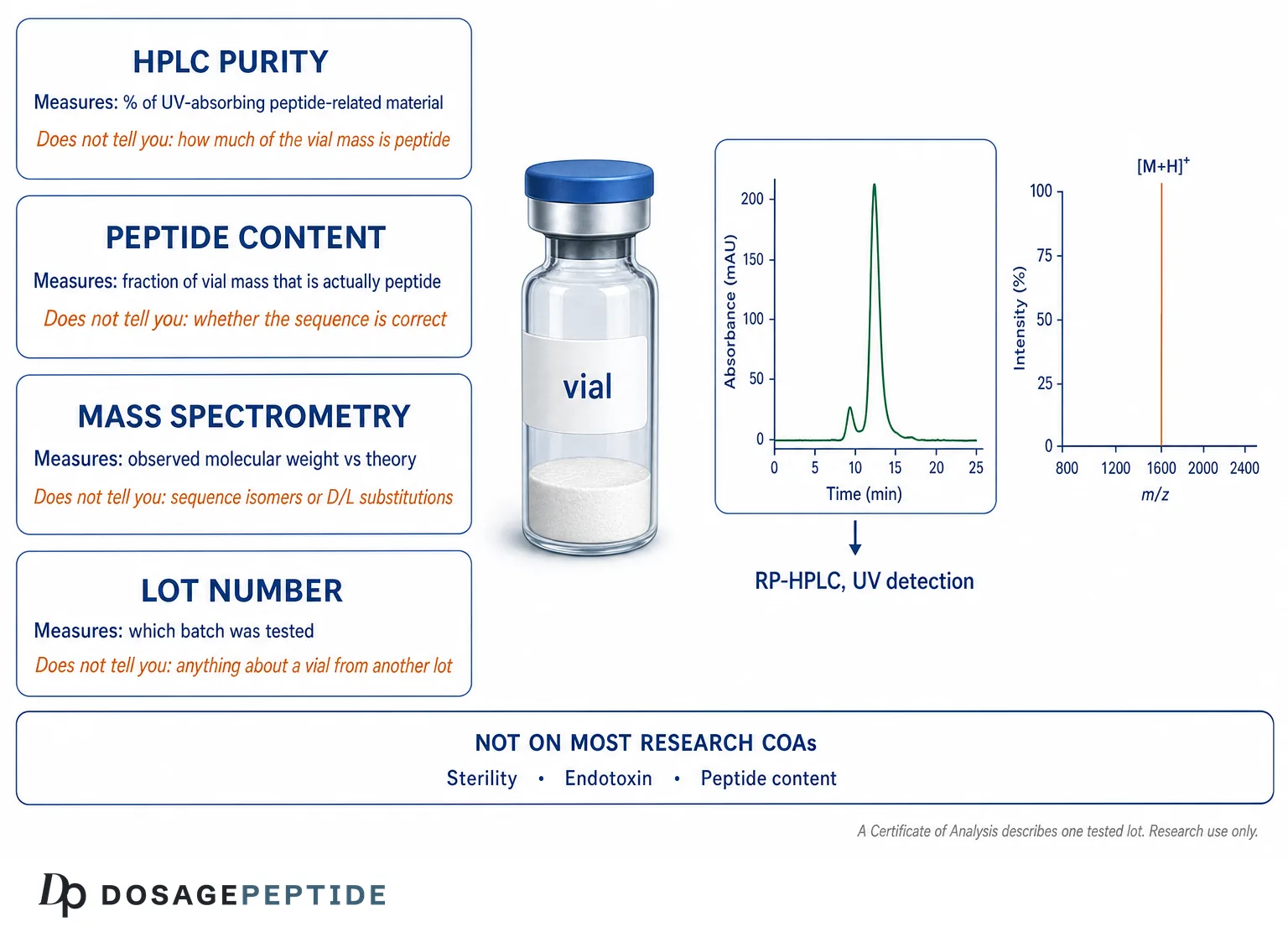
| Purity by HPLC (area %) | Main-peak share of total UV-absorbing peak area under one method | How much of the vial mass is peptide; excludes water, counterion and salts, and misses co-eluting species |
| Peptide content (net peptide content) | Mass fraction of the powder that is peptide, by amino acid analysis or nitrogen determination | Which peptide it is — content and identity are separate questions |
| Molecular weight, theoretical vs observed | Whether measured mass matches the mass calculated from the claimed sequence | Residue order, stereochemistry, or any isomer of identical mass |
| Mass spectrometry (ESI-MS / MALDI-TOF) | Mass-to-charge ratio of species present | Quantity — a spectrum is not a purity assay |
| Water content (Karl Fischer) | Water held by the lyophilised powder | Whether that water has already caused degradation |
| Counterion (trifluoroacetate or acetate) | Salt carried over from purification | Whether it will interfere in your specific assay |
| Residual solvents | Volatile solvent traces from synthesis and purification | Non-volatile process contaminants, which the method cannot see |
| Endotoxin | Bacterial endotoxin level in the sample tested | Sterility — a different test answering a different question |
| Sterility / bioburden | Whether viable organisms were recovered | Anything at all when the field is blank, which on research material it often is |
| Storage conditions / retest date | Stated handling conditions and the date for re-examination | That the material still meets specification today, after real-world shipping |
| Signature / issuing laboratory | Who takes responsibility and who can be contacted | Independence — a signature confirms authorship, not neutrality |
Why does “99% purity” not mean the vial is 99% peptide?
What HPLC purity actually measures
Research peptide purity is normally reported from reversed-phase HPLC with ultraviolet detection, the workhorse method for separating and characterising synthetic peptides for decades.[3] Detection sits low in the ultraviolet, commonly around 214 nm, because the peptide bond absorbs there — which is precisely why the method sees peptide-related material well and everything else poorly.
The output is an area percentage: main peak area divided by total integrated peak area. That definition hides three limitations:
- It is relative, not absolute. The denominator is other UV-absorbing peaks, not the mass in the vial. Water, inorganic salts and counterion contribute almost nothing to the chromatogram, so they are invisible to the calculation.
- It assumes equal UV response. Truncated and deletion sequences absorb differently from the full-length product, so area percent approximates composition rather than measuring it.
- It counts only what was separated. Anything co-eluting under the main peak is counted as main peak. Resolving impurities that sit almost on top of the target — amino acid substitutions, chain cleavages, and especially D-/L-isomers — is a recognised problem serious enough that pharmaceutical laboratories use two-dimensional liquid chromatography coupled to mass spectrometry to check whether a single-method peak is genuinely pure.[4] One RP-HPLC trace does not establish peak purity.
What peptide content measures
Peptide content (or net peptide content) is a different measurement entirely: what fraction of the dry mass is peptide rather than water, counterion and residual salt. It is determined by quantitative amino acid analysis after hydrolysis, or by nitrogen determination. Mass-balance thinking on therapeutic peptides treats assay, impurities, water and counterion as the components that should together account for the total mass. Hetrick and colleagues argue that mass balance is best demonstrated during method development and through well-designed forced degradation experiments rather than imposed as a release specification, precisely because analytical variability makes small gaps uninformative and turning them into acceptance criteria generates investigations and batch failures without adding quality assurance value.[5] Read that way, mass balance is a lens for understanding where the mass in a vial sits, not a pass/fail line on a certificate.
Peptides purified by reversed-phase HPLC are usually isolated as trifluoroacetate salts, because trifluoroacetic acid is the standard mobile-phase additive.[6] Trifluoroacetate is not light: each basic site can pair with a counterion adding roughly 114 daltons to the salt form — the figure used in the standard theoretical net peptide content calculation, MWpeptide / (MWpeptide + n × 114) — and lyophilised powders also retain water. Net peptide content in synthetic lots is therefore frequently and legitimately well below 100 % with nothing wrong.
A worked example (illustrative arithmetic, not data from a real lot)
A vial is labelled 10 mg; the COA reports HPLC purity 98.5 % and peptide content 80 %:
- Peptide mass: 10 mg × 0.80 = 8.0 mg
- Mass attributable to the intended sequence: 8.0 mg × 0.985 ≈ 7.9 mg
- Everything else: about 2.0 mg of water, trifluoroacetate and residual salt
So a “98.5 % pure 10 mg vial” can hold roughly 7.9 mg of the named molecule — about a fifth less than the label implies, if the label described peptide mass. Some vials are filled by gross powder weight, some corrected for peptide content, and the COA rarely says which. That ambiguity flows straight into every concentration calculation afterwards, which is why a peptide reconstitution guide belongs beside the certificate, and why any concentration calculator is only as good as the mass figure fed into it.
Most research COAs omit peptide content entirely
Purity is cheap to generate and impressive to print; amino acid analysis costs more and yields a smaller-looking number. Predictably, research-grade certificates commonly report HPLC purity and no peptide content at all. The honest reading when it is missing: the peptide fraction of this powder was not measured, and cannot be inferred from the purity line. No number of decimal places compensates.
How is identity confirmed, and what can a mass match not prove?
Identity usually rests on mass spectrometry — electrospray ionisation (ESI-MS) or MALDI-TOF. The certificate reports a theoretical molecular weight calculated from the claimed sequence and an observed value; agreement within tolerance is called confirmation.
What a mass match proves: the mass is right. That rules out gross substitution with an unrelated compound, most truncations, and many synthesis failures, because those change the mass.
What it does not prove: mass spectrometry cannot differentiate molecules sharing the same mass-to-charge ratio — a limitation explicit in the analytical literature, and the reason other techniques exist specifically to distinguish peptide enantiomers, diastereomers and isobaric structures that MS reports identically.[7] A mass match cannot exclude sequence isomers (same residues, different order, same mass), D/L substitutions (mass-identical to the correct L-form), or tell you how much of the vial the molecule represents.
This is why guidance on specifications states that identification should discriminate between compounds of closely related structure, that identity tests should be specific, and that identification by a single chromatographic retention time alone is not regarded as specific — while combinations such as HPLC with diode-array detection, HPLC/MS or GC/MS are generally acceptable.[2]
Why the chromatogram beats the number
“Purity: 99.1 %” in a table is an assertion; an attached chromatogram is evidence, and it is readable without a chromatography background. Is there a visible baseline, or has the trace been cropped so small peaks vanish? Is the main peak symmetrical or shouldered, the classic sign of something co-eluting? Are the axes labelled, with run time, column and detection wavelength stated? Does the mass spectrum show the observed mass or only the calculated one? Do integration marks match the peaks you can see? Attaching real instrument output costs the issuing lab nothing, so vendors who publish only the table have made a choice.
Analytical methods on a peptide COA, and their limits
| Analytical method | What it confirms | Typical limitation |
|---|---|---|
| RP-HPLC with UV detection (commonly near 214 nm) | Relative purity as area percent under one method | Blind to non-UV-absorbing mass; assumes equal response factors; counts co-eluting impurities as main peak |
| LC-MS / two-dimensional LC-MS | Purity plus mass identity of each resolved peak; can expose impurities hidden under the main peak | Costly and seldom seen on research certificates; still cannot separate species identical in both retention and mass |
| ESI-MS or MALDI-TOF | That observed mass matches the mass calculated for the claimed sequence | Cannot distinguish identical mass-to-charge species, including sequence isomers and D/L substitutions; not quantitative |
| Amino acid analysis | Net peptide content and amino acid composition ratio | Destroys the sample; gives composition, not residue order; some residues degrade during hydrolysis |
| Nitrogen determination | Peptide content estimated from total nitrogen | Any other nitrogen-containing contaminant inflates the result |
| Karl Fischer titration | Water content specifically, rather than general volatiles | Does not indicate whether hydration has already driven degradation |
| Ion chromatography (counterion) | Trifluoroacetate or acetate content | Often absent from research COAs; does not predict interference in a given assay |
| Headspace gas chromatography | Residual organic solvents | Volatiles only; non-volatile process contaminants are invisible |
| Bacterial endotoxins test | Endotoxin level in the sample tested | Not a sterility test; endotoxin can be present without viable organisms |
| Sterility testing | Whether viable organisms were recovered from tested units | Sample-based and destructive; rarely performed on research lyophilised powders |
| Chiral analysis / peptide sequencing | Stereochemistry and actual residue order | Specialist, expensive, rarely seen on a research peptide COA |
The fields most readers skip — and why they matter
Water content
Lyophilised peptides are hygroscopic, and guidance prefers a procedure specific for water, such as Karl Fischer titration, over a generic loss-on-drying figure.[2] High water does two things at once: it dilutes the peptide mass and raises the plausibility of hydrolytic degradation over time. What happens after the certificate was issued is a separate question, covered in our notes on storing peptides before and after reconstitution.
Counterion content
Trifluoroacetate carried over from purification is not inert in every system. In cell and tissue culture, trifluoroacetate has been reported to reduce cell numbers and thymidine incorporation in osteoblast and chondrocyte cultures, with the authors concluding that peptides should be converted to a hydrochloride or biologically equivalent salt before their biological effects are assessed.[6] That is one well-cited 1999 study in specific cell types, not a universal law — but it is a concrete reason a missing counterion line matters to in-vitro work.
Endotoxin and sterility — commonly absent, and that absence is informative
Bacterial endotoxin testing follows compendial procedures — the gel clot, photometric and kinetic methods described in USP <85> — each carrying its own testing recommendations and acceptance criteria.[8] Sterility testing is a separate discipline, with its own microbiological laboratory controls, sampling and incubation requirements, and its own investigation procedure when a positive appears; FDA’s aseptic processing guidance addresses endotoxin control and sterility testing in different sections for exactly that reason.[9] On research-grade certificates, both fields are commonly left blank. Material can be chemically excellent and microbiologically uncharacterised at the same time, because nobody looked.
The gap is not hypothetical. A 2024 market-surveillance and test-purchase study in the Journal of Medical Internet Research bought semaglutide products from illegal online pharmacies without prescription. Semaglutide is FDA-approved — as Ozempic for type 2 diabetes and Wegovy for chronic weight management — but these purchases came from outside the legitimate supply chain. The three delivered vials contained no viable microorganisms at testing, yet endotoxin was detected in all samples. Measured purity — determined by LC-MS against total sample mass, so a content-type figure rather than the RP-HPLC area percent used elsewhere on this page — ranged from 7.7 % to 14.37 % against the 99 % claimed on the labels, while the quantity of semaglutide present exceeded the labelled amount by 28.56 % to 38.69 %.[10] Purity and content moved in opposite directions in the same three vials — a textbook demonstration that they are different measurements and must not be read as one.
Three vials of one heavily counterfeited product should not be generalised to every research supplier. It does establish something narrower: a printed “99 %” with no traceable report behind it can be badly wrong in either direction, and a powder can be free of growing organisms while still carrying endotoxin — which is why what was and was not tested belongs in the laboratory record alongside how a working solution was prepared, a point covered in our notes on bacteriostatic water in peptide reconstitution.
Storage conditions and retest date
A retest or expiry date belongs on the certificate for material that carries one.[1] It is the date for re-examination under the stated conditions, and says nothing about a shipment that sat in a warehouse — which is why cold-chain questions such as whether peptides need refrigeration are answered by handling evidence, not by the certificate.
Red flags: what makes a peptide COA worthless
- No lot or batch number. The report cannot be attached to any physical material.
- Lot number does not match the vial. Equally fatal, and easy to miss when one showcase COA is reused across every shipment.
- No issuing laboratory named. Guidance expects the manufacturer’s name, address and telephone number, and where a broker reissues, the laboratory that performed the analysis plus a reference to the original batch certificate.[1] A logo is not a laboratory.
- No signature, approval date or report number. Certificates are expected to be dated and signed by authorised quality personnel;[1] without a report number nothing can be verified with the lab.
- An image with no chromatogram or spectrum. A flat JPEG of a table is the least falsifiable form a COA can take.
- Methods not stated. “HPLC 99 %” with no column, gradient, wavelength or run time cannot be evaluated.
- No acceptance limits. Each test is expected to appear with its acceptance limits alongside the numerical result;[1] a number with no criterion cannot pass or fail anything.
- Purity quoted to implausible precision. Area percent carries real integration and injection variability. A figure like 99.9873 % claims resolution the measurement does not have — that is a template, not an instrument.
- Identical reports across different lots. If retention times match to the second and peak areas are identical, one file has been relabelled.
- Identical reports across different compounds. The same chromatogram under two peptide names is conclusive.
- “Third-party tested” on the manufacturer’s own letterhead. If seller and issuer are the same entity, the claim is inaccurate regardless of the numbers.
- A report the named lab will not confirm. Unverified is unverified — not probably fine.
None of this requires a chemistry background. It requires reading the header and footer as carefully as the middle, and comparing more than one certificate from the same seller. Comparative write-ups such as our lab-tested supplier comparison are useful for seeing what documentation practice looks like across vendors — not as a substitute for checking the certificate attached to your own lot.
Manufacturer COA versus genuinely independent third-party testing
“Third party tested” is one of the least policed phrases in this market. Three situations are routinely conflated:
- Manufacturer COA — produced in-house by the entity that made and sells the material. Not automatically untrustworthy: supplier certificates have a legitimate role, but guidance contemplates relying on them only where the receiving party operates a supplier-evaluation system, with full analyses on multiple batches before in-house testing is reduced.[1] Retail buyers have no such system.
- Reissued or repackaged COA — a distributor prints its own document from someone else’s data. It should still name the analysing laboratory and reference the original batch certificate; when it does not, the trail breaks exactly where it matters.
- Genuinely independent testing — a laboratory with no commercial stake issues the report in its own name, with its own report number, methods and signature.
What you can verify yourself
- Match the lot. Vial label to certificate. If they disagree, stop.
- Contact the named laboratory with the report number and lot, and ask them to confirm they issued it. A laboratory that issued a report should be able to confirm it; a refusal or a dead contact address is information too. This is the highest-yield check available to a non-specialist.
- Check the dates are coherent. Analysis should follow manufacture and precede the retest date; out-of-sequence dates indicate a template.
- Check accreditation independently. Testing laboratories are commonly accredited to ISO/IEC 17025 for the competence of testing and calibration laboratories, and accreditation bodies publish searchable directories; the International Laboratory Accreditation Cooperation maintains a signatory list and search facility.[11] Accreditation is scope-limited — a lab may be accredited for tests other than the one on your report.
- Compare across lots. Two genuinely different batches produce two visibly different chromatograms.
One honest caveat: even a verified independent report covers only the sample sent to the laboratory. Nothing in the document prevents a good sample being submitted and a different batch being shipped. Independent testing raises the floor; it does not close the loop.
What no Certificate of Analysis can tell you
- Nothing about safety. Analytical purity and biological safety are different axes. FDA scientists reviewing therapeutic peptide products have described remaining gaps in understanding how specific impurities contribute to immunogenicity risk, noting that regulatory guidance on impurity qualification thresholds is sparse and that in-silico assessment methods have real limitations.[12] A high purity number does not resolve a question specialists describe as open.
- Nothing about efficacy. Whether a compound does anything useful is answered by controlled trials, not chromatography. A perfectly characterised batch of a preclinical-only or investigational compound remains preclinical-only or investigational.
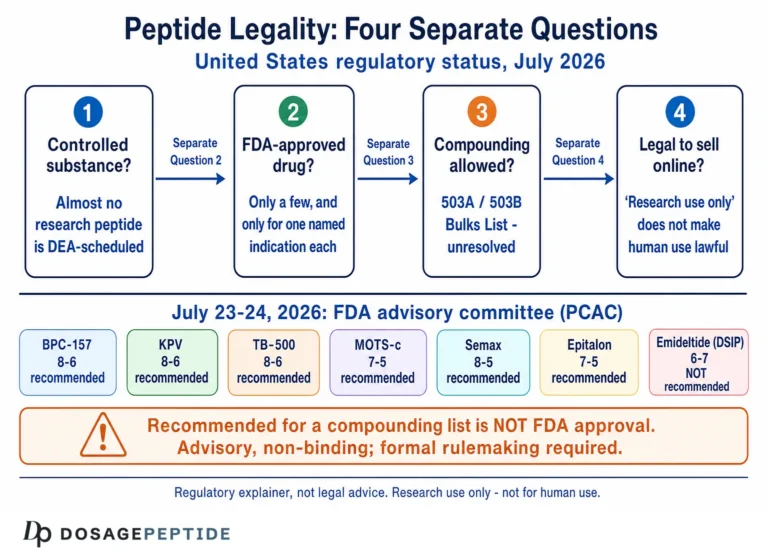
- Nothing about regulatory status. Several peptides sold as research chemicals have been evaluated by FDA in the compounding context and placed in the category of bulk drug substances that may present significant safety risks. For BPC-157 — which is not FDA-approved for any indication — FDA’s stated concerns include immunogenicity risk for certain routes of administration, complexities with peptide-related impurities and active pharmaceutical ingredient characterization, and no or only limited safety-related information for the proposed routes.[13] As of August 2026 BPC-157 remains in that category. At its meeting of 23–24 July 2026, FDA’s Pharmacy Compounding Advisory Committee took up BPC-157-related bulk drug substances and voted narrowly, 8 to 6, to recommend adding them to the 503A Bulks List, against the written recommendation of FDA’s own review staff.[14] That vote is non-binding, does not place the substance on the list, does not constitute FDA approval, and would require notice-and-comment rulemaking to take effect. A clean COA does not alter any of that either.
- Nothing beyond one lot at one moment. Not the product line, not the vendor, not the vial after shipping.
- “Research use only” is a labelling statement, not a quality grade. In the context where the phrase is most formally defined — in vitro diagnostic products — FDA guidance addresses distribution of products labelled research use only or investigational use only and when such labelling is inconsistent with how a product is actually promoted.[15] The principle carries: an RUO label describes intended use, not verified quality.
No Certificate of Analysis makes a research chemical suitable for human use. Purity, identity, water and counterion are manufacturing attributes; human suitability is established through toxicology, controlled clinical trials and regulatory review, which no analytical certificate substitutes for. If the vocabulary here is unfamiliar, our research peptide glossary defines these analytical terms without implying any use claim.
A five-minute reading order for any peptide COA
- Lot number first. Does it match the vial? If not, stop.
- Who issued it? Named lab, address, report number, signature, date.
- Is there instrument output? Chromatogram and spectrum with labelled axes, or only a typed table?
- Read purity as area percent. Note method, column and wavelength; treat it as relative composition of UV-absorbing peaks, nothing more.
- Look for peptide content. Present, use it to convert label mass into peptide mass. Absent, record the peptide fraction as unmeasured.
- Check identity evidence. Theoretical and observed mass both shown, and remember a mass match cannot exclude isomers or D/L substitutions.
- Scan the blank fields. Water, counterion, residual solvents, endotoxin, sterility. Blank means untested, not clean.
- Check dates and storage — then ask separately how the material was actually shipped.
- Ask for a second lot’s certificate. Different batches should not produce identical documents.
Frequently Asked Questions
Does 99% purity on a peptide COA mean the vial is 99% peptide?
No. HPLC purity is an area percentage: the main peak’s share of total UV-absorbing peak area under one chromatographic method. It excludes water, counterion and inorganic salts, which contribute almost nothing to the ultraviolet signal. The number describing how much of the vial mass is peptide is net peptide content, measured separately by amino acid analysis or nitrogen determination, and many research certificates omit it entirely.
What is the difference between purity and peptide content?
Purity answers “of the peptide-related material detected, what fraction is the target sequence?” Peptide content answers “of the total mass in this vial, what fraction is peptide at all?” They are independent, and they can move in opposite directions in the same sample. A lot can show 99 % purity and 75 % peptide content with no contradiction: the remaining 25 % is water, trifluoroacetate counterion and residual salts, none of which the purity assay counts.
Can mass spectrometry prove a peptide is the correct sequence?
Only partially. It confirms that observed molecular weight matches the mass calculated from the claimed sequence, ruling out gross substitutions and many truncations. It cannot differentiate molecules sharing the same mass-to-charge ratio, so it cannot exclude sequence isomers or D-amino acid substitutions, which are mass-identical to the correct L-form. Establishing those requires chiral analysis or sequencing, which research COAs rarely include.
Why does a peptide COA need a lot number?
Because a Certificate of Analysis reports results for one manufactured batch, not a product line. Reference guidance for active pharmaceutical ingredients expects the batch number on the certificate. Without a lot number, or with one that does not match the vial in hand, the document cannot be connected to any physical material. A single certificate reused across all shipments is a marketing asset, not batch evidence.
Are research peptides tested for sterility and endotoxin?
Often neither. Sterility testing and bacterial endotoxin testing are separate, separately validated procedures with their own acceptance criteria, and both fields are commonly left blank on research-grade certificates. A blank field means untested, not clean. The distinction matters because a powder can contain no viable organisms while still carrying endotoxin — the two tests answer different questions and neither substitutes for the other.
What does “third party tested” actually mean on a peptide vendor’s site?
Often less than it sounds. Genuinely independent testing means a laboratory with no commercial stake issued the report in its own name, with its own report number and methods. Check the letterhead: if the report is on the seller’s or manufacturer’s own paper, the claim is inaccurate. Then contact the named laboratory with the report number and lot, and ask them to confirm they issued it.
Does an advisory committee vote mean a peptide is FDA-approved?
No. An advisory committee makes non-binding recommendations to FDA. A vote to recommend a substance for the 503A bulk drug substances list does not place it on that list, does not approve it as a drug, and does not change its regulatory status until FDA acts through notice-and-comment rulemaking. Reading a committee vote as approval is the single most common misinterpretation of these meetings.
Does a good COA mean a peptide is safe?
No. A certificate describes manufacturing attributes — identity, purity, water, counterion — for one lot. Safety is established through toxicology and controlled clinical trials, and FDA scientists have explicitly described remaining gaps in understanding how peptide impurities contribute to immunogenicity risk. Analytical documentation and human safety are separate questions, and no Certificate of Analysis makes a research chemical suitable for human use.
References
- International Council for Harmonisation / U.S. Food and Drug Administration. Q7 Good Manufacturing Practice Guidance for Active Pharmaceutical Ingredients: Guidance for Industry. FDA, 2016. https://www.fda.gov/files/drugs/published/Q7-Good-Manufacturing-Practice-Guidance-for-Active-Pharmaceutical-Ingredients-Guidance-for-Industry.pdf
- International Council for Harmonisation / U.S. Food and Drug Administration. Q6A Specifications: Test Procedures and Acceptance Criteria for New Drug Substances and New Drug Products: Chemical Substances. FDA, 2000. https://www.fda.gov/regulatory-information/search-fda-guidance-documents/q6a-specifications-test-procedures-and-acceptance-criteria-new-drug-substances-and-new-drug-products
- Mant CT, Chen Y, Yan Z, Popa TV, Kovacs JM, Mills JB, Tripet BP, Hodges RS. HPLC analysis and purification of peptides. Methods in Molecular Biology, 2007;386:3-55. https://pmc.ncbi.nlm.nih.gov/articles/PMC7119934/
- Stoll DR, Sylvester M, Euerby MR, Buckenmaier SMC, Petersson P. A strategy for assessing peak purity of pharmaceutical peptides in reversed-phase chromatography methods using two-dimensional liquid chromatography coupled to mass spectrometry. Part II. Journal of Chromatography A, 2023;1693:463873. https://pubmed.ncbi.nlm.nih.gov/36871316/
- Hetrick EM, Pack BW, Wolfe CN, Zhao M. Mass balance analysis for therapeutic peptides: case studies, applications, and perspectives. Journal of Pharmaceutical and Biomedical Analysis, 2025;252:116501. https://pubmed.ncbi.nlm.nih.gov/39442464/
- Cornish J, Callon KE, Lin CQ, Xiao CL, Mulvey TB, Cooper GJ, Reid IR. Trifluoroacetate, a contaminant in purified proteins, inhibits proliferation of osteoblasts and chondrocytes. American Journal of Physiology, 1999;277(5):E779-83. https://pubmed.ncbi.nlm.nih.gov/10567002/
- Versloot RCA, Arias-Orozco P, Tadema MJ, Lucas FLR, Zhao X, Marrink SJ, Kuipers OP, Maglia G. Seeing the invisibles: detection of peptide enantiomers, diastereomers, and isobaric ring formation in lanthipeptides using nanopores. Journal of the American Chemical Society, 2023;145(33):18355-18365. https://pmc.ncbi.nlm.nih.gov/articles/PMC10450680/
- U.S. Food and Drug Administration. Pyrogen and Endotoxins Testing: Questions and Answers — Guidance for Industry. FDA, revised March 2026. https://www.fda.gov/regulatory-information/search-fda-guidance-documents/pyrogen-and-endotoxins-testing-questions-and-answers
- U.S. Food and Drug Administration. Sterile Drug Products Produced by Aseptic Processing — Current Good Manufacturing Practice: Guidance for Industry. FDA, 2004. See Section VII (Endotoxin Control) and Section XI (Sterility Testing). https://www.fda.gov/regulatory-information/search-fda-guidance-documents/sterile-drug-products-produced-aseptic-processing-current-good-manufacturing-practice
- Ashraf AR, Mackey TK, Vida RG, Kulcsar G, Schmidt J, Balazs O, Domian BM, Li J, Csako I, Fittler A. Multifactor quality and safety analysis of semaglutide products sold by online sellers without a prescription. Journal of Medical Internet Research, 2024;26:e65440. https://pmc.ncbi.nlm.nih.gov/articles/PMC11582493/
- International Laboratory Accreditation Cooperation. ILAC MRA and Signatories. ILAC. https://ilac.org/ilac-mra-and-signatories/
- Puig M, Shubow S. Immunogenicity of therapeutic peptide products: bridging the gaps regarding the role of product-related risk factors. Frontiers in Immunology, 2025;16:1608401. https://pmc.ncbi.nlm.nih.gov/articles/PMC12213570/
- U.S. Food and Drug Administration. Certain Bulk Drug Substances for Use in Compounding that May Present Significant Safety Risks. FDA. https://www.fda.gov/drugs/human-drug-compounding/certain-bulk-drug-substances-use-compounding-may-present-significant-safety-risks
- U.S. Food and Drug Administration. July 23-24, 2026: Meeting of the Pharmacy Compounding Advisory Committee. FDA Advisory Committee Calendar, 2026. https://www.fda.gov/advisory-committees/advisory-committee-calendar/july-23-24-2026-meeting-pharmacy-compounding-advisory-committee-07232026
- U.S. Food and Drug Administration. Distribution of In Vitro Diagnostic Products Labeled for Research Use Only or Investigational Use Only: Guidance for Industry and FDA Staff. FDA, 2013. https://www.fda.gov/regulatory-information/search-fda-guidance-documents/distribution-in-vitro-diagnostic-products-labeled-research-use-only-or-investigational-use-only
Research use only. This article explains how to read an analytical document and is not medical advice; no Certificate of Analysis qualifies a research chemical for human use. Regulatory status varies by jurisdiction and changes over time, so verify it independently.