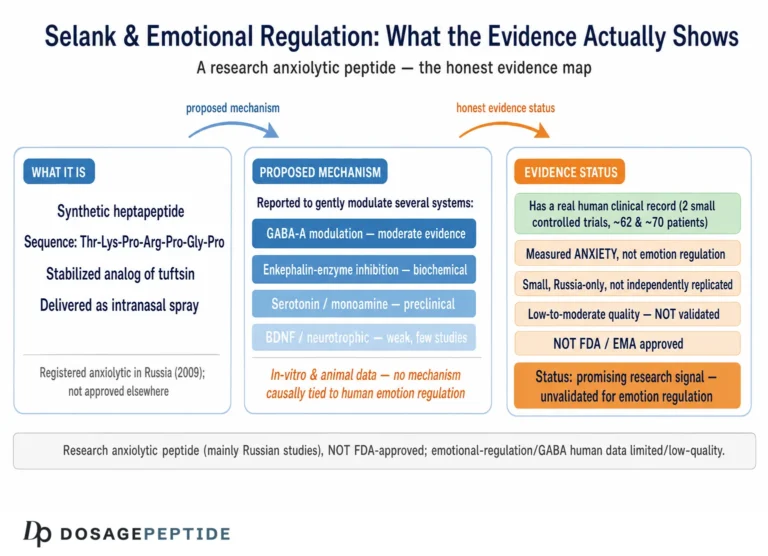
Selank probably does not work the way it is usually described. It is routinely sold as a GABA-system anxiolytic, but the direct evidence for that is thin: the GABA link rests mainly on gene-expression changes in rodent brain tissue, while Selank’s best-documented mechanism is its effect on enkephalins.1 On the anxiety question itself, the human evidence is small and geographically concentrated — a handful of Russian trials enrolling dozens of patients each, in which intranasal Selank matched benzodiazepines on anxiety scores while avoiding their sedation and cognitive dulling. Selank is a registered prescription anxiolytic in Russia; it is approved by neither the FDA nor the EMA for any indication.
The guiding principle throughout is restraint. Selank has not thrown up alarming safety signals in the limited populations studied, and it has a mechanistically plausible and unusually multi-pronged neuropharmacology. But plausibility is not proof, gene-expression changes in a rodent hippocampus are not the same as a demonstrated clinical mechanism, and a handful of small trials in one country do not constitute the kind of evidence base that supports strong causal claims. Readers interested in the broader behavioral pharmacology of this compound will find a companion treatment in our discussion of how Selank regulates behavior via central nervous system pathways; the present article narrows the lens specifically to the GABA question and the anxiety endpoint.
What Selank Is and Where It Came From
Selank is a synthetic heptapeptide with the sequence Thr-Lys-Pro-Arg-Pro-Gly-Pro. It was designed at the Institute of Molecular Genetics of the Russian Academy of Sciences, in collaboration with the V.V. Zakusov Institute of Pharmacology, as a stabilized analog of an endogenous molecule called tuftsin.2 Tuftsin itself is a tetrapeptide (Thr-Lys-Pro-Arg) — a naturally occurring fragment derived from the heavy chain of immunoglobulin G, historically known for its immunomodulatory activity, particularly its ability to stimulate phagocytosis. The problem with tuftsin as a drug candidate is that it is degraded almost instantly by peptidases in the body, giving it a vanishingly short half-life.
The engineering solution was to append three amino acids — Pro-Gly-Pro — to the C-terminal end of the tuftsin sequence. This addition does two things. It dramatically increases metabolic stability by protecting the peptide from rapid enzymatic breakdown, and the proline-rich tail is thought to contribute to the molecule’s ability to influence peptidase activity itself. The result is a compound that retains a measure of tuftsin’s immunological character while acquiring a pronounced profile of central nervous system effects — anxiolytic, mild psychostimulant, and nootropic — that the parent tetrapeptide does not meaningfully display.2
It is worth pausing on that origin story, because it sets up a recurring theme. Selank did not emerge from a program to build a GABA-receptor drug. It emerged from work on a small immunoregulatory peptide, and its anxiolytic properties were discovered and then rationalized after the fact. This matters for how we read the GABA claim: the connection to GABAergic signaling was not a design intention but an observation drawn from downstream studies, and much of what circulates online as confident mechanism is a later gloss on a genuinely exploratory body of Russian pharmacology. Terms like tuftsin, peptidase, and allosteric modulation recur throughout that literature; readers who want plain-language definitions of the vocabulary used here can consult the site’s peptide glossary.
Selank is best understood as one member of a small family of regulatory-peptide drugs developed by the same Russian institutions, the most prominent sibling being Semax, an ACTH(4–10)-derived heptapeptide positioned more as a neurotrophic and pro-cognitive agent than as an anxiolytic.2 The two share a design philosophy — take a short endogenous peptide, stabilize it with a proline-containing tail, and deliver it intranasally — and they share the enkephalin-enzyme mechanism discussed later, but their behavioral emphases differ. Keeping the family resemblance in mind helps explain why so much of Selank’s mechanistic literature reads as a search for the pathway that distinguishes its calming, anti-anxiety profile from Semax’s more activating one. It also explains why claims about one peptide are so often, and so carelessly, transposed onto the other in secondary sources.
| Property | Detail |
|---|---|
| Class | Synthetic heptapeptide, tuftsin analog |
| Sequence | Thr-Lys-Pro-Arg-Pro-Gly-Pro |
| Parent molecule | Tuftsin (Thr-Lys-Pro-Arg), an IgG-derived immunopeptide2 |
| Key modification | C-terminal Pro-Gly-Pro extension for metabolic stability2 |
| Proposed CNS actions | Anxiolytic, mild psychostimulant, nootropic, antiasthenic1 |
| Typical study route | Intranasal (nose-to-brain); some parenteral in animal work |
| Regulatory status | Prescription anxiolytic in Russia; not FDA/EMA approved |
What “GABAergic Activity” Means — and Why It Is the Default Suspect in Anxiety
Gamma-aminobutyric acid (GABA) is the principal inhibitory neurotransmitter in the mammalian central nervous system. Where glutamate excites neurons, GABA quiets them. It acts chiefly through two receptor families: the ionotropic GABA-A receptor, a chloride-channel complex that produces fast inhibition when GABA binds, and the metabotropic GABA-B receptor, a G-protein-coupled receptor that produces slower, more modulatory inhibition. The GABA-A receptor is the molecular home of the benzodiazepines, barbiturates, alcohol, and many general anesthetics, all of which enhance inhibitory chloride flux and thereby dampen neuronal excitability.
Because pathological anxiety is, in broad strokes, a state of excessive excitatory and stress-circuit activity — overactive amygdala output, heightened arousal, insufficient prefrontal and hippocampal braking — enhancing GABAergic inhibition is the single most validated pharmacological strategy for acute anxiety relief. Benzodiazepines work precisely because they bind an allosteric site on the GABA-A receptor and increase the receptor’s response to endogenous GABA, tilting the excitation-inhibition balance toward calm. This is why, whenever a new anxiolytic appears, the GABA system is the first mechanism investigators reach for. It is the default suspect.
That default, however, cuts both ways. A drug can reduce anxiety without acting directly on GABA at all — the serotonergic anxiolytics such as SSRIs and buspirone are proof of that. So the fact that Selank reduces anxiety-like behavior in animals and, apparently, anxiety symptoms in small human samples does not by itself implicate GABA. To make the GABA claim we need direct evidence that Selank changes something about GABAergic signaling, and then a further argument that this change is causally responsible for the anxiolytic effect. The next two sections take those in turn, and the honest answer is that the first is partly supported and the second is largely inferred.
It also helps to distinguish two very different ways a molecule could “modulate GABAergic activity.” One is pharmacodynamic and immediate: binding the receptor (as an agonist, or as a positive allosteric modulator like a benzodiazepine) and changing channel behavior within milliseconds. The other is transcriptional and delayed: changing the expression of the genes that encode GABA receptor subunits, transporters, and synthesizing enzymes over hours, thereby altering how much GABAergic machinery a cell builds. As we will see, essentially all of the direct evidence linking Selank to GABA is of the second kind — and even that is mixed. There is no persuasive evidence that Selank binds the GABA-A receptor the way a benzodiazepine does.
Does Selank Actually Touch the GABA System? The Gene-Expression Evidence
This is the heart of the matter, and it deserves to be reported carefully rather than summarized into a slogan. The primary evidence that Selank engages the GABA system comes from gene-expression studies performed by the same Russian molecular-genetics groups that developed the peptide, and the results are genuinely interesting but also more equivocal than popular accounts admit.
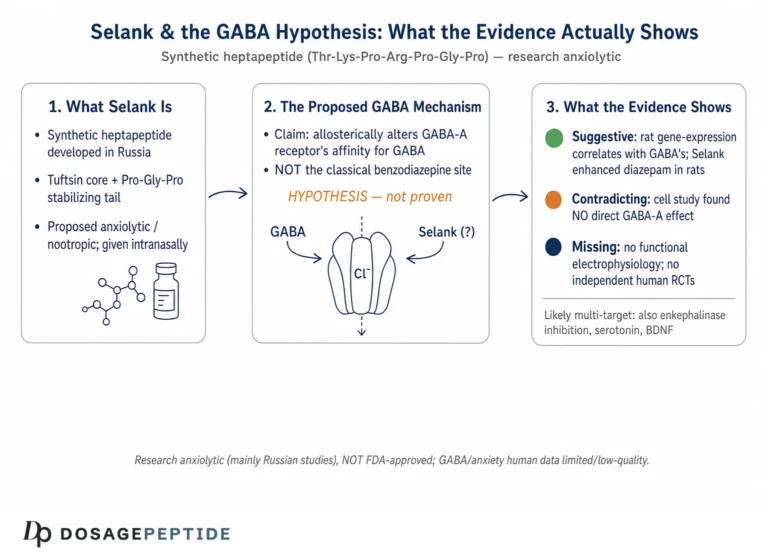
The most-cited animal study administered Selank to rats and measured the expression of a panel of genes involved in GABAergic neurotransmission in brain tissue.4 The findings were striking in magnitude but complicated in pattern. The panel comprised 84 genes involved in neurotransmission, including GABA-receptor subunits, transporters and related machinery. One hour after administration, a sizable fraction — on the order of 29 genes — showed altered expression, with the majority of changes being decreases, some of them large. By three hours, fewer genes were altered (around 17), and the direction had largely reversed, with the overwhelming majority (roughly 95 percent) of the still-changed genes now showing increased expression. Genes encoding GABA-A receptor subunits (for example, members of the Gabr family) were among those affected, alongside genes not classically part of the GABA system at all. The authors interpreted this dynamic, biphasic pattern as evidence that Selank exerts “complex effects on nerve cells,” and they proposed that one of its molecular mechanisms may be an allosteric modulation of the GABAergic system rather than direct receptor agonism.4
That word — allosteric — is doing a lot of work in the secondary literature, and it is important to see what it does and does not mean here. In the gene-expression context, it is a hypothesis offered to explain why a peptide that does not obviously bind the GABA-A receptor could nonetheless shift GABAergic tone: perhaps by changing receptor-subunit composition over time, or by acting on some upstream regulator. It is not a demonstration that Selank occupies the benzodiazepine site or any other allosteric pocket on the receptor protein. The distinction is frequently lost when vendor pages assert that Selank “acts as an allosteric modulator of GABA-A receptors” as though that were an established binding mechanism. It is a plausible interpretive frame for transcriptional data, not a characterized molecular interaction.
The most sobering data point comes from a cell-culture study by the same collaborative group, which tested GABA, Selank, and the antipsychotic olanzapine against a panel of 84 genes involved in GABAergic neurotransmission in human IMR-32 neuroblastoma cells.5 Here the result was, for the GABA hypothesis, distinctly underwhelming: Selank on its own produced no changes in the mRNA levels of the genes studied. GABA itself altered 14 genes and olanzapine 25, but the peptide alone moved none. Selank did show effects in combination — it suppressed the changes GABA produced when the two were applied together, and it amplified olanzapine’s effects — which the authors read as consistent with Selank modulating GABA-receptor interactions and possibly acting through BDNF-related pathways. But their explicit conclusion was that Selank “has no direct effect on the expression of genes of the GABAergic system” in that cell model.5
Holding these two studies side by side is instructive. In whole-brain rat tissue, Selank produced large, dynamic changes in GABA-related gene expression; in an isolated human neuroblastoma line, it produced none on its own. The most parsimonious reconciliation is that Selank’s influence on the GABA system is indirect — mediated by circuit-level, neuromodulatory, or intercellular signals that exist in an intact brain but are absent in a dish of tumor-derived cells — rather than a direct action on the GABAergic neurons themselves. That is a coherent story, and it is the one the investigators lean toward. But it is also a story that concedes the point most casual readers get wrong: Selank is not, on the available evidence, a direct GABA-receptor drug.
| Model | What was tested | GABA-related result |
|---|---|---|
| Rat brain, in vivo4 | Expression of 84 neurotransmission genes (incl. GABA subunits) after Selank | Large, biphasic changes (mostly down at 1 h, up at 3 h); GABA-A subunit genes affected; interpreted as allosteric/indirect modulation |
| Human IMR-32 cells5 | 84 GABAergic genes; Selank alone and in combination | Selank alone: NO change. In combination: suppressed GABA’s effect, enhanced olanzapine’s. Authors: no direct effect on GABAergic gene expression |
| Behavioral pharmacology10 | Selank added to diazepam in chronic-stress rats | Selank enhanced diazepam’s anxiety-reducing effect, consistent with functional interaction with GABAergic anxiolysis |
There is a further interpretive trap in the rat gene-expression data that deserves attention. A biphasic pattern — widespread downregulation at one hour, reversal to upregulation by three hours — is dramatic on a heatmap but genuinely hard to map onto a clean anxiolytic mechanism. Which phase is doing the therapeutic work? Do the transient decreases in GABA-A subunit transcripts reflect a homeostatic response to some upstream signal rather than the signal itself? And, critically, do any of these mRNA swings translate into changes in the actual number or function of GABA-A receptors at the synapse, on the timescale over which Selank reduces anxiety? The studies were not designed to answer these questions, and the authors are appropriately cautious in framing their data as evidence of “complex” and probably indirect modulation rather than a defined mechanism.4 A reader who takes away “Selank upregulates GABA-A receptors” has flattened a messy, time-dependent, bidirectional transcriptional signal into a tidy claim the primary data do not license.
The behavioral pharmacology adds a functional wrinkle that keeps the GABA hypothesis alive even as the molecular data undercut a direct-binding story. In a rat model of unpredictable chronic mild stress, Selank enhanced the anxiety-reducing effect of diazepam, a classic benzodiazepine that works squarely on the GABA-A receptor.10 A compound that potentiates a benzodiazepine’s behavioral effect is at least functionally interacting with GABAergic anxiolysis, even if the interaction is indirect. This is arguably the strongest single piece of evidence tying Selank’s anxiolytic action to the GABA system — and notably, it is a synergy study, not a demonstration that Selank alone acts through GABA.
The Enkephalin Route: Selank’s Best-Documented Mechanism
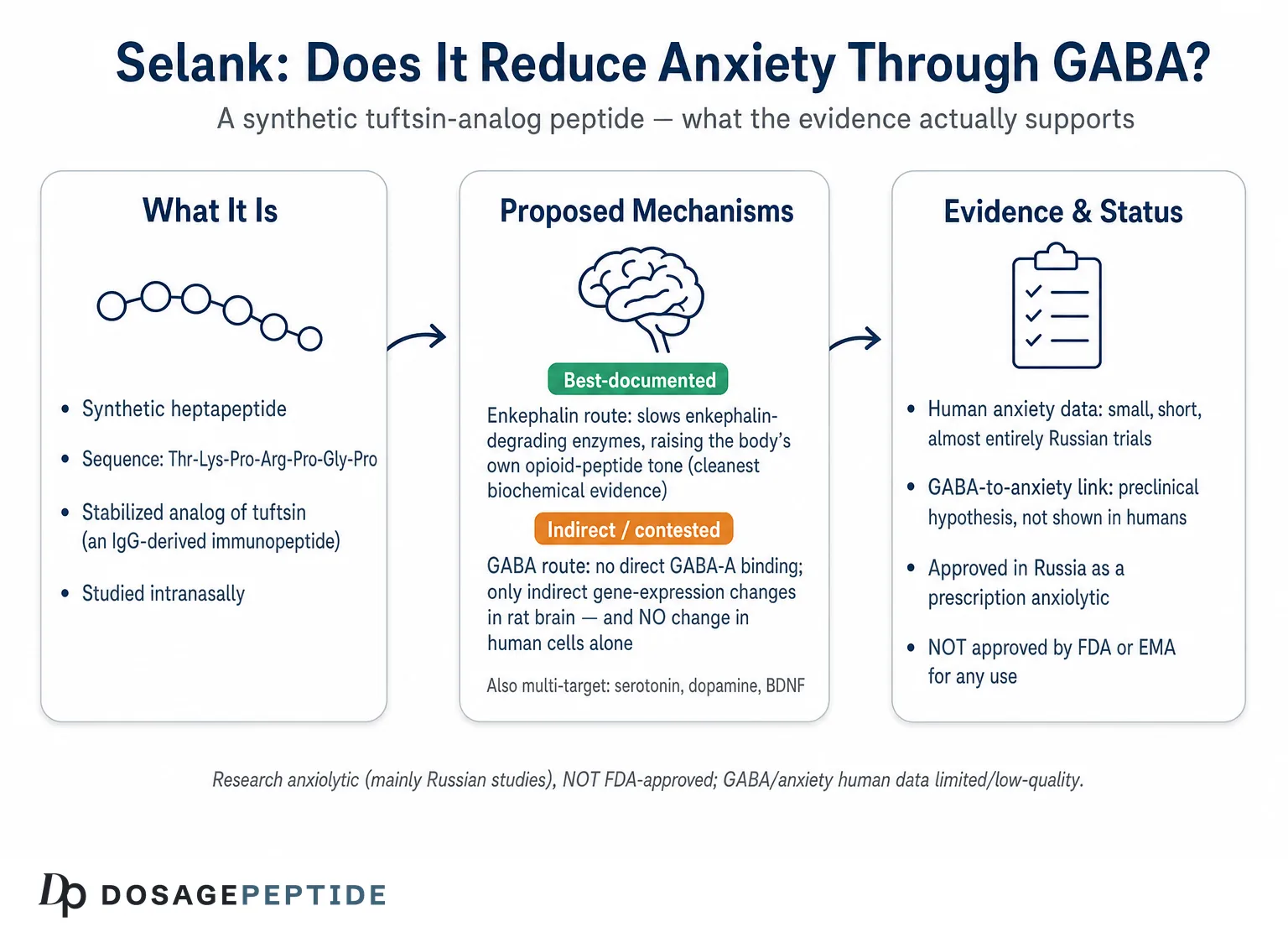
If the GABA story is inferential, the enkephalin story is comparatively concrete, and it is arguably the mechanism for which Selank has the cleanest biochemical evidence. Enkephalins are endogenous opioid peptides — the body’s own short-acting opioid signaling molecules — that are rapidly broken down by a group of enzymes collectively called enkephalin-degrading enzymes (including aminopeptidases and related peptidases). By slowing that breakdown, a compound can raise the effective tone of endogenous enkephalins without ever binding an opioid receptor itself.
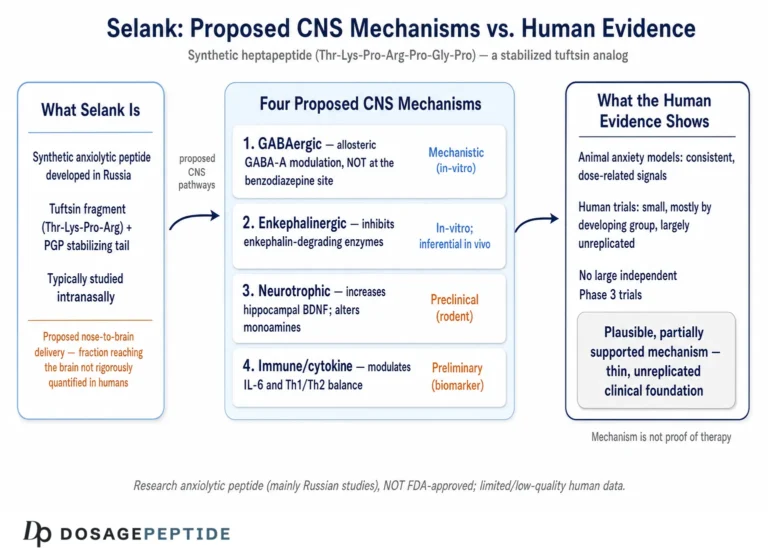
Selank does exactly this. In human serum, Selank (and its sibling peptide Semax) dose-dependently inhibited enkephalin-degrading enzymes, with Selank showing a half-maximal inhibitory concentration in the low-micromolar range and an effect more pronounced than reference inhibitors such as puromycin and bacitracin.3 A parallel line of work in rodents established the same principle in vivo and tied it directly to behavior: Selank extended the half-life of plasma leu-enkephalin and reduced anxiety-like behavior in the open field in anxious BALB/c mice, while producing neither effect in the low-anxiety C57Bl/6 strain.67 The strain-dependence is a meaningful detail: it suggests the enkephalin mechanism matters most in a baseline-anxious phenotype, which is precisely where an anxiolytic should act. The investigators concluded that “the anxiolytic activity of Selank is associated with inhibition of enkephalin-degrading enzymes.”7
There is also evidence that the enkephalin/opioid arm is functionally opioid-linked rather than incidental. In a study of Selank’s effect on dopamine-system behavior, the peptide’s action was blocked by naloxone, the classic opioid-receptor antagonist — implicating endogenous opioid signaling in at least some of Selank’s central effects.8 Related work has examined Selank in withdrawal-syndrome models — for example during alcohol withdrawal in rats with stable alcoholic motivation — where it has been reported to attenuate aversive withdrawal-associated behavior, again read as consistent with an enkephalinergic contribution. These are preclinical rodent findings, not human data.
Why would preserving enkephalins reduce anxiety? The endogenous opioid system is deeply woven into stress and emotional regulation. Enkephalins and their receptors are densely expressed in the amygdala, the periaqueductal gray, the hypothalamus, and other nodes of the fear and stress circuitry, where opioid signaling generally dampens stress reactivity and blunts the aversive, arousing components of threat responses. A compound that raises the ambient level of enkephalins — not by flooding the system with an exogenous opioid but by letting the body’s own, locally released peptides linger slightly longer — could plausibly nudge these circuits toward calm in a self-limiting, physiologically gated way. That framing is attractive precisely because it does not depend on a crude receptor flood: the effect would scale with wherever and whenever enkephalins are actually being released, which is a more elegant story than the blunt instrument of a benzodiazepine. It remains, however, a mechanistic rationale supported by biochemistry and rodent behavior rather than by direct human demonstration.
How does this connect to the GABA question in the title? Honestly, only indirectly and speculatively. The enkephalin and GABA systems are anatomically intertwined — enkephalinergic interneurons synapse onto and modulate GABAergic circuits in regions like the amygdala — so it is biologically conceivable that raising enkephalin tone shifts downstream GABAergic activity. But no study has traced that specific causal path for Selank. The cleaner reading is that Selank has two partially independent mechanistic stories: a well-supported enkephalin-preserving action, and a less well-supported, largely transcriptional and probably indirect association with the GABA system. The title’s framing — that anxiolysis flows through GABA modulation — picks the weaker of the two documented mechanisms as the headline.
Beyond GABA: Serotonin, Dopamine, and BDNF
One reason it is difficult to crown any single mechanism is that Selank, like many neuropeptides, appears to be a genuine multi-target agent. Rodent neurochemistry from the developing groups reported that Selank shifts monoamine metabolism — for example, increasing the ratio of the serotonin metabolite 5-HIAA to serotonin in regions such as the hypothalamus and striatum, a pattern read as accelerated serotonin turnover rather than a simple rise in serotonin levels. Given the central role of serotonergic signaling in both anxiety and mood, this monoaminergic action could contribute to the peptide’s behavioral profile independently of GABA.
The dopamine system is implicated as well. The naloxone-sensitive modulation of apomorphine-induced (dopaminergic) behavior noted above places Selank at the intersection of opioid and dopaminergic signaling, and Selank’s gene-expression footprint in the brain includes dopamine-receptor genes.48 This may relate to a clinically relevant feature of the human data: unlike sedating anxiolytics, Selank has been reported to carry a mild psychostimulant and antiasthenic (anti-fatigue) quality, which a dopaminergic contribution could help explain.1
Finally, there is brain-derived neurotrophic factor (BDNF), the neurotrophin most associated with neuroplasticity, learning, and the slower, adaptive dimension of mood and anxiety regulation. Intranasal Selank has been reported to regulate BDNF expression in the rat hippocampus, and in a chronic-ethanol memory-impairment model Selank normalized BDNF content in the hippocampus and frontal cortex while protecting against cognitive deficits.9 BDNF modulation is also the pathway the IMR-32 investigators invoked to explain Selank’s ability to amplify olanzapine’s effects.5 A neurotrophic action would sit comfortably with Selank’s reported nootropic character and with the observation that its benefits, in some accounts, build over repeated administration rather than appearing as an immediate, benzodiazepine-like calm.
The honest synthesis is that Selank’s anxiolytic effect — to whatever extent it is real — is unlikely to be a single-mechanism phenomenon. It looks like the sum of a well-documented enkephalin-preserving action, a probable serotonergic-turnover effect, a dopaminergic/opioid interaction, a neurotrophic BDNF signal, and an indirect and inconsistently demonstrated association with GABAergic gene expression. Any article, including this one, that isolates “GABA modulation” as the mechanism is imposing a tidiness the data do not support.
What the Human Anxiety Evidence Actually Shows
Everything above concerns mechanism. The separate, and for most readers more important, question is whether Selank actually reduces anxiety in people — and here the evidence base is small, geographically concentrated, and methodologically limited.
The single most-cited human study is a trial in patients with generalized anxiety disorder and neurasthenia, in which roughly 60 patients received either intranasal Selank (on the order of 1,350 micrograms per day) or the benzodiazepine medazepam over about two weeks, with symptoms tracked on standard instruments including the Hamilton Anxiety Rating Scale, the Zung self-rating scale, and clinical global impression measures.1 The reported result was that both treatments produced comparable reductions in anxiety scores, and that Selank additionally showed antiasthenic and mild psychostimulant benefits — less fatigue, more activation — that the benzodiazepine did not. The study also measured serum enkephalin activity and reported that patients with anxiety and asthenia had a shortened leu-enkephalin half-life that correlated with symptom severity, linking the clinical picture back to the enkephalin mechanism.1
A later comparison pitted Selank against phenazepam (a benzodiazepine widely used in the former Soviet sphere) in patients with anxiety disorders, again reporting broadly comparable anxiolytic efficacy but a more favorable tolerability profile for Selank — specifically, without the sedation, cognitive dulling, and dependence liability that characterize benzodiazepines.11 Taken together, these are the studies that underwrite the widely repeated claim that Selank offers “benzodiazepine-level anxiety relief without the side effects.”
That claim needs several honest qualifications, none of them minor:
- Small and regional. The human trials enrolled on the order of dozens, not hundreds or thousands, of patients, and they were conducted and published almost entirely within Russian research institutions, largely in Russian-language journals. Independent replication in Western, multicenter, regulator-grade trials is absent.
- Active-comparator, short-duration designs. The signature studies compared Selank to a benzodiazepine over roughly two weeks. Non-inferiority to an active drug in a small, short trial is a weaker claim than superiority to placebo in a large one, and it is vulnerable to the possibility that neither arm was strongly separated from what placebo would have produced.
- Investigator proximity. Much of both the mechanistic and clinical literature originates from the institutions that developed the compound. That is common early in a drug’s life, but it heightens the need for independent confirmation before strong conclusions are drawn.
- Publication and translation limits. A substantial portion of the evidence is difficult for non-Russian-reading reviewers to appraise in full, and key methodological details (randomization, blinding integrity, dropout handling) are not always transparent in the accessible summaries.
It is also worth being explicit about what a two-week, active-comparator design can and cannot establish, because this is the crux of how the human evidence is routinely oversold. When a small trial finds that Selank and a benzodiazepine produce similar improvements, the intuitive reading is “Selank is as good as a benzodiazepine.” But without a placebo arm, an equally valid reading is that both groups improved substantially through the natural course of the condition, expectancy effects, and the attention inherent in a clinical trial, with the drugs adding relatively little on top. Generalized anxiety and neurasthenia both show meaningful placebo responses in controlled research, so a design that omits placebo cannot separate genuine pharmacological benefit from these background effects. The reported differences between Selank and the benzodiazepine — less sedation, some activation, antiasthenic benefit — are more interpretable than the shared anxiolytic effect, because differences between two active arms are less confounded by placebo response than the absolute improvement in either arm.111 This is why the tolerability contrast is arguably the sturdiest thing the human trials tell us, and the efficacy claim the shakiest.
None of this means Selank does not work; the consistent direction of the human and animal findings, and the coherence with a plausible enkephalin mechanism, make a real anxiolytic effect entirely believable. But “believable and consistently suggestive in small regional trials” is a very different evidence tier from “established.” For the specific question in the title — whether Selank reduces human anxiety by modulating GABA — the human trials tell us about the anxiety endpoint, not the GABA mechanism: no human study has demonstrated that a GABAergic change mediates Selank’s clinical effect. That causal bridge remains entirely preclinical and, as we have seen, contested even there.
Selank Versus Benzodiazepines: A Mechanistic Contrast
Because Selank is almost always marketed and studied against benzodiazepines, laying the two side by side clarifies both what makes Selank interesting and why the GABA framing is misleading if taken literally.
| Feature | Benzodiazepines | Selank |
|---|---|---|
| GABA-A receptor binding | Direct positive allosteric modulator at a defined benzodiazepine site | No demonstrated direct binding; at most indirect/transcriptional influence on GABAergic genes45 |
| Primary documented mechanism | Enhanced GABA-A chloride flux | Inhibition of enkephalin-degrading enzymes; multi-target (serotonin, dopamine, BDNF)39 |
| Onset | Fast (minutes to hours) | Reported effects range from acute to cumulative |
| Sedation / cognitive impairment | Common, dose-dependent | Reported minimal; possible mild activation/psychostimulation1 |
| Tolerance / dependence | Well documented; withdrawal risk | Not reported in short trials; long-term data lacking11 |
| Human evidence base | Extensive, global, regulator-grade | Small, short, largely Russian; no FDA/EMA approval111 |
The contrast exposes the central irony of the title. Benzodiazepines are the archetype of GABAergic anxiolytics precisely because they bind the GABA-A receptor directly; Selank, which is often positioned as a gentler alternative, is the compound whose GABA engagement is least direct. If Selank works, its distinctiveness lies mostly in the mechanisms that are not GABAergic — the enkephalin preservation and neurotrophic effects that plausibly explain why it might calm without sedating or fostering dependence. The GABA link is real enough to keep investigating, but it is the supporting cast, not the lead.
How Selank Has Been Studied: Research Models and Methodology
Understanding the methodology behind these claims clarifies what the data can and cannot support. Selank’s evidence architecture spans three tiers, each with characteristic strengths and blind spots.
Molecular and cell-based work. The gene-expression studies used quantitative PCR and pathway-focused gene panels to profile transcriptional changes after Selank exposure, in both rat brain tissue and human neuroblastoma cells.45 These methods are powerful for detecting that expression changes occur, but they have well-known limitations: mRNA changes do not always translate into protein or functional change, transformed cell lines such as IMR-32 are imperfect proxies for mature neurons, and a peptide’s effect can look entirely different in a dish versus an intact circuit — which is exactly the discrepancy the two Selank studies displayed. The enkephalin-enzyme work, by contrast, used direct enzyme-activity assays in serum, a more mechanistically interpretable readout.3
Animal behavioral models. Selank’s anxiolytic reputation rests heavily on rodent paradigms — open-field tests, elevated-plus-maze-type assays, and chronic-stress models — often in anxiety-prone strains such as BALB/c mice.67 These are validated screens for anxiolytic activity, and the strain-dependent and diazepam-potentiating findings are genuinely informative.710 Their limitation is the usual one: behavioral anxiety in a mouse is a model of, not a substitute for, human anxiety disorders, and translation from rodent screens to clinical efficacy is notoriously unreliable across the whole field of anxiolytic development.
Human trials. The clinical studies used recognized psychometric instruments (Hamilton, Zung, CGI) and active benzodiazepine comparators, which is methodologically appropriate.111 The weaknesses lie in scale, duration, geographic concentration, and the frequent absence of a placebo arm. Crucially, no human study was designed to test the GABA mechanism itself — there is no human neuroimaging, receptor-occupancy, or biomarker study establishing that Selank changes GABAergic function in people. The mechanistic and clinical literatures run on parallel tracks that have never been formally joined.
The methodological bottom line is that Selank’s strongest data are its enkephalin-enzyme biochemistry and its consistent rodent behavioral signal; its GABA data are transcriptional, model-dependent, and unreplicated in humans; and its clinical data are suggestive but small. Anyone documenting the compound for research should treat the GABA-anxiety mechanism as a working hypothesis, and can find general reconstitution and handling references on the site’s peptide reconstitution guide.
Safety, Tolerability, and Handling in a Research Context
Within the limited populations and durations studied, Selank’s short-term tolerability has been reported as favorable — a point that must be stated carefully, because “well tolerated in small, short Russian trials” is not the same as “established as safe.”
The recurring observation across the human work is the absence of the problems that limit benzodiazepines: little to no sedation, no clear cognitive impairment, and no reported dependence or withdrawal over the study periods, alongside the mild activating quality already noted.111 As an intranasally administered peptide it avoids first-pass metabolism and, in principle, achieves some direct nose-to-brain delivery, which is part of why the intranasal route dominates both the clinical and research literature.
Several caveats temper this reassuring picture:
- Duration. The trials ran on the order of weeks. Anxiety disorders are frequently chronic; the long-term safety of repeated Selank administration has not been characterized.
- Population. Study populations were adults with anxiety or neurasthenia in Russian clinical settings. Data in older adults, in people with comorbid illness, and across diverse populations are lacking.
- Product quality. Because Selank is not an approved medicine outside a few jurisdictions, material sold as “research chemical” varies widely in purity, and impurities, endotoxin, or mislabeling are real risks that are independent of the molecule’s intrinsic profile.
- Immunological character. As a tuftsin derivative with retained immunomodulatory activity, Selank’s effects on immune signaling are part of its pharmacology; the long-term consequences of chronic immunomodulation in otherwise healthy users are unstudied.
On handling, a brief and strictly educational note is warranted, with the emphasis that this describes standard research-peptide practice and is not a usage recommendation: Selank is typically supplied as a lyophilized powder, reconstituted with sterile or bacteriostatic water directed gently against the vial wall rather than sprayed onto the powder, swirled rather than shaken to avoid shearing the peptide, and stored cold and protected from light, with repeated freeze-thaw cycles avoided. The arithmetic of reconstitution — a fixed mass of peptide in a chosen volume of diluent sets the concentration — is the same for any peptide and can be worked through with the site’s dosage calculator. Meticulous handling preserves whatever activity the molecule has; it does not create clinical certainty where the evidence base is thin.
Limitations and the GABA-Anxiety Evidence Gap
Pulling the threads together, the limitations bearing on the title’s question are substantial and, importantly, they compound rather than sit in isolation.
The GABA mechanism is indirect and contested. Selank shows no demonstrated direct binding to the GABA-A receptor. Its GABA link rests on transcriptional changes seen in rat brain but absent in a human cell line, plus a behavioral synergy with diazepam.4510 This is a hypothesis worth pursuing, not a mechanism established.
The causal bridge to anxiety is unbuilt. Even granting that Selank alters GABAergic gene expression in rodents and reduces anxiety in humans, no study connects the two — no experiment shows that blocking the GABAergic change abolishes the anxiolytic effect, and no human study measures GABAergic function at all. The title’s “modulate GABA to reduce anxiety” is an inference layered on two separately supported observations.
The better-supported mechanism is elsewhere. The enkephalin-enzyme inhibition has cleaner biochemistry and a direct behavioral tie-in, and Selank is multi-target across serotonin, dopamine, and BDNF.369 Attributing its anxiolysis primarily to GABA overweights the weakest link in the mechanistic chain.
The human evidence is small and regional. A handful of short, mostly non-placebo, Russian trials cannot bear the weight of strong efficacy or mechanism claims, and independent Western replication is absent.111
The responsible reading is therefore layered: Selank is a plausibly effective, unusually well-tolerated investigational anxiolytic whose GABAergic involvement is real enough to keep studying but almost certainly indirect, secondary, and not yet shown to mediate its clinical effect. Readers who want the broader neurobehavioral context beyond the GABA question specifically will find it in the companion piece on Selank and central nervous system pathways, and can browse related compound coverage through the site’s dosage index.
Regulatory Status
Selank’s regulatory picture is straightforward to state and frequently overstated in marketing.
Approved in Russia, not in the West. Selank is registered and marketed as a prescription anxiolytic (an intranasal formulation) in Russia, where it is used for generalized anxiety and neurasthenia-type presentations. It is not approved by the U.S. Food and Drug Administration or the European Medicines Agency for any indication.1 In the United States it is investigational and, in practice, sold and used on a research-only basis; it is not an approved drug, and it is not a dietary supplement ingredient with any recognized status for treating anxiety.
What Russian approval does and does not mean. Registration in one national system reflects that country’s regulatory judgment and evidence standards; it does not transfer to FDA or EMA recognition, nor does it substitute for the large, placebo-controlled, independently replicated trials those agencies require. A drug can be a legitimate prescription product in Russia and simultaneously investigational and unproven by Western regulatory standards — both statements are true of Selank at once.
Implications for the anxiety claim. Because no major Western regulator has evaluated Selank, there is no authoritative finding that it is safe and effective for anxiety in the populations most readers belong to, and certainly no regulatory endorsement of a GABAergic mechanism. Any legitimate exploration of Selank for anxiety, or of its GABA mechanism, belongs in properly authorized preclinical and clinical research under appropriate oversight — not in self-directed use.
Frequently Asked Questions
Does Selank work by directly binding GABA receptors like a benzodiazepine?
No. There is no evidence that Selank binds the GABA-A receptor the way benzodiazepines do. The GABA connection rests on gene-expression changes seen in rat brain tissue and on a behavioral synergy with diazepam, not on direct receptor binding.410 In a human neuroblastoma cell line, Selank on its own produced no change in GABAergic gene expression at all.5 The best current interpretation is that any GABAergic effect is indirect and probably secondary to Selank’s other mechanisms.
So what is Selank’s best-documented mechanism?
Inhibition of enkephalin-degrading enzymes. Selank slows the breakdown of the body’s endogenous enkephalins, raising their effective tone, and this action has been demonstrated biochemically in human serum and tied to reduced anxiety behavior in anxiety-prone mice.367 Its effects also involve serotonin turnover, dopamine/opioid interactions, and BDNF regulation, making it a genuinely multi-target peptide rather than a single-mechanism GABA drug.89
Is there good human evidence that Selank reduces anxiety?
There is suggestive but limited evidence. The main human studies are small (dozens of patients), short (about two weeks), and almost entirely Russian, comparing Selank to benzodiazepines like medazepam and phenazepam and reporting comparable anxiety reduction with fewer side effects.111 These are not the large, placebo-controlled, independently replicated trials needed to establish efficacy, and no Western regulator has evaluated the compound.
Why is the GABA mechanism emphasized so much online if the evidence is indirect?
Because GABA is the default suspect for any anxiolytic — it is the system benzodiazepines act on — and because a genuine rat study did report large changes in GABA-related gene expression after Selank.4 Popular accounts then compress “changed GABA gene expression in rats” and “interpreted as allosteric modulation” into the much stronger claim that Selank is a GABA-modulating anxiolytic. The primary literature is more cautious than the summaries.
Does Selank cause sedation, tolerance, or dependence like benzodiazepines?
In the short trials conducted, Selank was reported not to cause the sedation, cognitive impairment, or dependence typical of benzodiazepines, and it sometimes showed a mild activating effect instead.111 However, these observations come from brief studies; long-term safety and dependence liability have not been rigorously characterized, so the “no downsides” framing common in marketing is not fully supported.
How is Selank usually administered in research?
Intranasally. The nasal route is used in both the clinical trials and most research because it avoids first-pass metabolism and may allow some direct nose-to-brain delivery of the peptide. It is typically supplied as a lyophilized powder reconstituted with sterile or bacteriostatic water using gentle technique and cold, dark storage — standard research-peptide handling rather than a usage recommendation.
Is Selank approved or legal?
Selank is an approved prescription anxiolytic in Russia but is not approved by the FDA or EMA for any use. In the United States and much of the world it is investigational and sold on a research-only basis, with no recognized status as a treatment for anxiety.1 Russian approval does not equate to Western regulatory recognition.
Could the GABA mechanism eventually be confirmed?
It is possible. Confirming it would require experiments that are currently missing: demonstrating that Selank changes GABAergic function (not just gene expression), showing that blocking that change removes the anxiolytic effect, and ideally measuring GABAergic activity in humans given Selank.45 Until that work is done, the GABA-to-anxiety pathway remains a plausible hypothesis rather than an established mechanism.
References
- Zozulia AA, Neznamov GG, Siuniakov TS, et al. Efficacy and possible mechanisms of action of a new peptide anxiolytic selank in the therapy of generalized anxiety disorders and neurasthenia. Zh Nevrol Psikhiatr Im S S Korsakova. 2008;108(4):38-48. PMID: 18454096. https://pubmed.ncbi.nlm.nih.gov/18454096/
- Kolomin T, Shadrina M, Slominsky P, Limborska S, Myasoedov N. A new generation of drugs: synthetic peptides based on natural regulatory peptides. Neuroscience & Medicine. 2013;4(4):223-252. https://www.scirp.org/journal/paperinformation?paperid=40799
- Kost NV, Sokolov OYu, Gabaeva MV, et al. Semax and selank inhibit the enkephalin-degrading enzymes of human serum. Russian Journal of Bioorganic Chemistry. 2001;27(3):180-183. DOI: 10.1023/A:1011373002885. https://link.springer.com/article/10.1023/A:1011373002885
- Volkova A, Shadrina M, Kolomin T, et al. Selank administration affects the expression of some genes involved in GABAergic neurotransmission. Front Pharmacol. 2016;7:31. PMID: 26924987; PMCID: PMC4757669. DOI: 10.3389/fphar.2016.00031. https://pmc.ncbi.nlm.nih.gov/articles/PMC4757669/
- Filatova E, Kasian A, Kolomin T, et al. GABA, selank, and olanzapine affect the expression of genes involved in GABAergic neurotransmission in IMR-32 cells. Front Pharmacol. 2017;8:89. PMID: 28293190; PMCID: PMC5328971. DOI: 10.3389/fphar.2017.00089. https://pmc.ncbi.nlm.nih.gov/articles/PMC5328971/
- Zolotarev YuA, Dorokhova EM, Kost NV, et al. The inhibitory effect of selank on enkephalin-degrading enzymes as a possible mechanism of its anxiolytic activity. Bull Exp Biol Med. 2001;132(2):766-768. PMID: 11550013. https://pubmed.ncbi.nlm.nih.gov/11550013/
- Sokolov OYu, Meshavkin VK, Kost NV, Zozulya AA. Effects of selank on behavioral reactions and activities of plasma enkephalin-degrading enzymes in mice with different phenotypes of emotional and stress reactions. Bull Exp Biol Med. 2002;133(2):133-135. PMID: 12432865. https://pubmed.ncbi.nlm.nih.gov/12432865/
- Meshavkin VK, Kost NV, Sokolov OY, Zolotarev YA, Myasoedov NF, Zozulya AA. Naloxone-blocked depriming effect of anxiolytic selank on apomorphine-induced behavioral manifestations of hyperfunction of dopamine system. Bull Exp Biol Med. 2006;142(3):315-317. PMID: 17415472. https://pubmed.ncbi.nlm.nih.gov/17415472/
- Kolik LG, Nadorova AV, Antipova TA, et al. Selank, peptide analogue of tuftsin, protects against ethanol-induced memory impairment by regulating of BDNF content in the hippocampus and prefrontal cortex in rats. Bull Exp Biol Med. 2019;167(5):641-644. PMID: 31625062. DOI: 10.1007/s10517-019-04588-9. https://pubmed.ncbi.nlm.nih.gov/31625062/
- Kasian A, Kolomin T, Andreeva L, et al. Peptide selank enhances the effect of diazepam in reducing anxiety in unpredictable chronic mild stress conditions in rats. Behav Neurol. 2017;2017:5091027. DOI: 10.1155/2017/5091027. https://onlinelibrary.wiley.com/doi/10.1155/2017/5091027
- Medvedev VE, Tereshchenko ON, Israelian AIu, et al. Comparison of the anxiolytic effect and tolerability of selank and phenazepam in the treatment of anxiety disorders. Zh Nevrol Psikhiatr Im S S Korsakova. 2014;114(7):17-22. PMID: 25176261. https://pubmed.ncbi.nlm.nih.gov/25176261/
Educational and research-use disclaimer: This article is provided solely for scientific and educational purposes. Selank is not approved by the U.S. Food and Drug Administration, the European Medicines Agency, or comparable Western regulators for the treatment, cure, or prevention of anxiety or any other condition; where it is registered (notably Russia) that status does not constitute Western regulatory recognition of safety or efficacy. The proposed mechanism by which Selank modulates GABAergic activity to reduce anxiety is an open research question supported mainly by preclinical, largely rodent, gene-expression data and small regional human trials, not by established human mechanistic evidence. Nothing here is medical advice or a recommendation for human use. Any legitimate investigation of this compound should occur within properly authorized preclinical or clinical research under appropriate oversight. Readers should consult qualified professionals and applicable regulations before making any decisions.