Selank is a synthetic peptide developed in Russia as an anxiolytic intended to work without the sedation, cognitive dulling and dependence that follow benzodiazepines. The human evidence for that claim is real but very small: two controlled trials, enrolling 62 and 70 patients, reported anxiety relief broadly comparable to benzodiazepine comparators, with an activating rather than sedating profile. That is essentially the whole clinical record. Both studies come from Russian institutions connected to the compound’s development, most of the literature is published in Russian, and no independent international group has replicated the result. This article walks through what those trials measured, what the proposed mechanism looks like, and precisely where the distance sits between “promising” and “validated”.
This piece is written for researchers and scientifically literate readers who want an accurate map of the Selank evidence base rather than a promotional summary. Selank (sequence Thr-Lys-Pro-Arg-Pro-Gly-Pro) is a synthetic heptapeptide developed at the Institute of Molecular Genetics of the Russian Academy of Sciences as a stabilized analog of the immunomodulatory tetrapeptide tuftsin.11 It is registered as a prescription anxiolytic in the Russian Federation, where it has been marketed since 2009 as a low-concentration nasal spray for generalized anxiety disorder and neurasthenia.1 Outside Russia and a handful of neighboring countries it holds no regulatory approval, and it is not approved by the U.S. Food and Drug Administration or the European Medicines Agency for any indication.
Rather than treating the title as a claim to be defended, this article treats it as an open research question to be examined. We will look at what “emotional regulation” actually denotes and whether the Selank literature even measures it; at the compound’s structure and origin; at the four mechanisms most often invoked to explain its effects, and how much data each one actually rests on; at the human clinical studies in detail; at the methodological features that keep the evidence below the “validated” threshold; at how Selank compares with established anxiolytics; and at safety, handling, and regulatory status. The guiding principle throughout is calibration: neither dismissing a real and intriguing research signal nor inflating it into something it is not.
What “Emotional Regulation” Actually Means — and Whether the Studies Measure It
Before asking whether Selank influences emotional regulation, it helps to be precise about what that phrase denotes, because it is broader and more specific than the way it is often used in peptide marketing. In affective science, emotion regulation refers to the processes by which people influence which emotions they have, when they have them, and how they experience and express them. It encompasses strategies such as cognitive reappraisal (reinterpreting a situation to change its emotional impact), expressive suppression, attentional deployment, and the up- or down-regulation of arousal. It is measured with validated instruments — the Emotion Regulation Questionnaire, the Difficulties in Emotion Regulation Scale, reappraisal tasks under neuroimaging, physiological reactivity paradigms, and so on. Emotion regulation is not a synonym for “feeling calmer.”
This distinction matters enormously for reading the Selank literature honestly, because almost none of the human studies on Selank actually measured emotion regulation in that technical sense. What they measured was anxiety severity — typically via the Hamilton Anxiety Rating Scale, the Zung Self-Rating Anxiety Scale, and clinician-rated global impression scores — in populations with generalized anxiety disorder, neurasthenia, and related anxiety-spectrum diagnoses.1 Reducing a Hamilton anxiety score is a meaningful clinical outcome, but it is an anxiolytic outcome, not a demonstration that the compound improves a person’s capacity to regulate emotion. A drug can lower anxiety by dampening arousal without changing anything about the cognitive and behavioral machinery of emotion regulation; conversely, genuine improvements in reappraisal or distress tolerance can occur without a large drop in a symptom-severity score.
So the first honest observation is a framing one. When someone asks whether Selank has a validated role in “emotional regulation,” the most accurate response is that the human evidence speaks to anxiety reduction in clinical anxiety syndromes, not to emotion regulation as affective scientists define and measure it. The peptide may plausibly touch emotion-regulatory processes — its proposed mechanisms involve GABAergic tone, serotonergic signaling, and stress-related neurotrophins, all of which are relevant to affect — but that is a mechanistic inference, not a measured outcome. No study has administered Selank and then assessed reappraisal capacity, emotion-regulation questionnaire scores, or amygdala–prefrontal connectivity as a primary endpoint. That gap is the single most important thing to carry into everything that follows.
It is worth naming why the conflation is so easy to make. Anxiety and emotion dysregulation overlap heavily in clinical populations; someone with severe generalized anxiety often does have difficulty down-regulating fear and worry. So an anxiolytic effect can look, from the outside, like improved emotion regulation. But the two constructs are separable, and the tools that measure them are different. A compound earns the label “emotion-regulating” only when it is tested against emotion-regulation endpoints. Selank has not been, and readers should treat “emotional regulation” here as the broad, informal umbrella under which its anxiolytic data sit — not as a validated, separately measured effect.
What Selank Is: Tuftsin, Stability, and the Design Logic
Selank is a synthetic heptapeptide with the amino-acid sequence Thr-Lys-Pro-Arg-Pro-Gly-Pro. Its design begins with tuftsin, a naturally occurring tetrapeptide (Thr-Lys-Pro-Arg) that is cleaved from the heavy chain of immunoglobulin G and has long been studied for its immunomodulatory and, later, its neurotropic and behavioral effects. Tuftsin itself is biologically active but pharmacologically impractical: it is degraded almost immediately by peptidases, giving it a half-life far too short for any therapeutic use. The innovation behind Selank was to append a C-terminal Pro-Gly-Pro extension to the tuftsin core.11 Proline-rich terminal motifs are notoriously resistant to enzymatic cleavage, and this modification dramatically increased the molecule’s metabolic stability while preserving — and, according to its developers, reshaping — its central activity.
This design lineage explains several recurring themes in the Selank literature. First, because it derives from an immunopeptide, Selank retains measurable immunomodulatory and cytokine-regulating activity; studies have documented changes in the expression of genes for chemokines, cytokines, and their receptors in response to Selank and its fragments.10 This immune dimension is genuine but is not the focus of the emotional-regulation question, and it should not be over-read as evidence of a mood effect. Second, the proline-stabilized backbone allows intranasal delivery with meaningful central-nervous-system exposure, which is why the registered Russian product is a nasal spray rather than an injectable. Third, the tuftsin heritage links Selank to a broader Russian research program of “regulatory peptides” — short endogenous-peptide analogs, including the ACTH-derived nootropic Semax, developed by the same institute and often studied side by side.11
It is important to be candid about what the structure does and does not tell us. The sequence and its stability profile are well characterized; that is solid chemistry. But structure alone does not establish a mechanism of action in the brain, and it certainly does not establish clinical efficacy for emotion regulation. A stable, brain-penetrant peptide that engages several signaling systems is a promising research tool, not a validated therapeutic. The leap from “interesting, well-designed molecule” to “works for regulating emotion in humans” is precisely the leap the evidence has to earn, and the molecule’s elegant design does not pre-pay that debt. Readers interested in how Selank is positioned within the wider central-nervous-system peptide field can see the site’s discussion of how Selank is proposed to regulate behavior via central nervous system pathways, which surveys the same signaling systems examined here.
The Four Proposed Mechanisms — and How Much Data Each Rests On
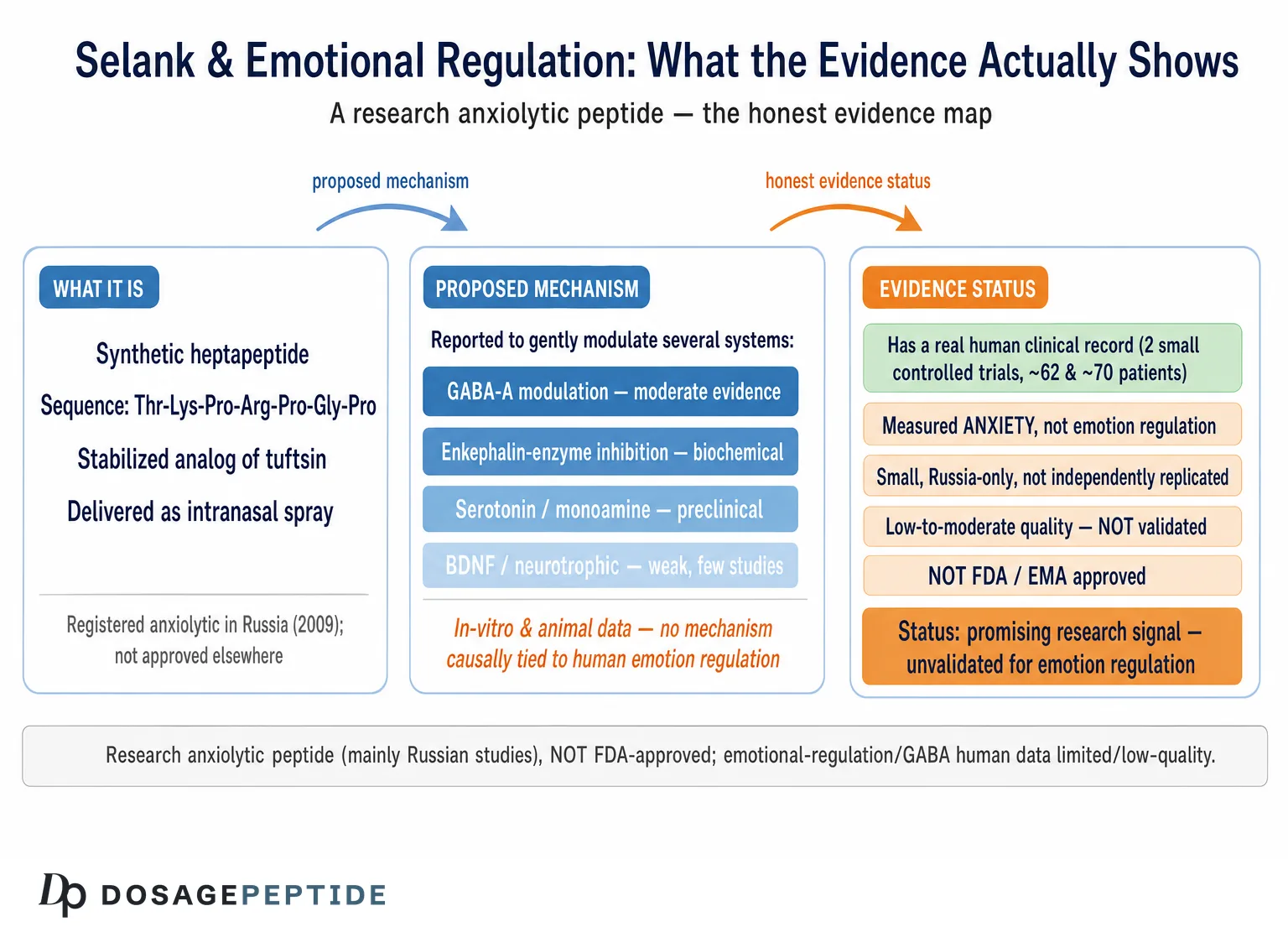
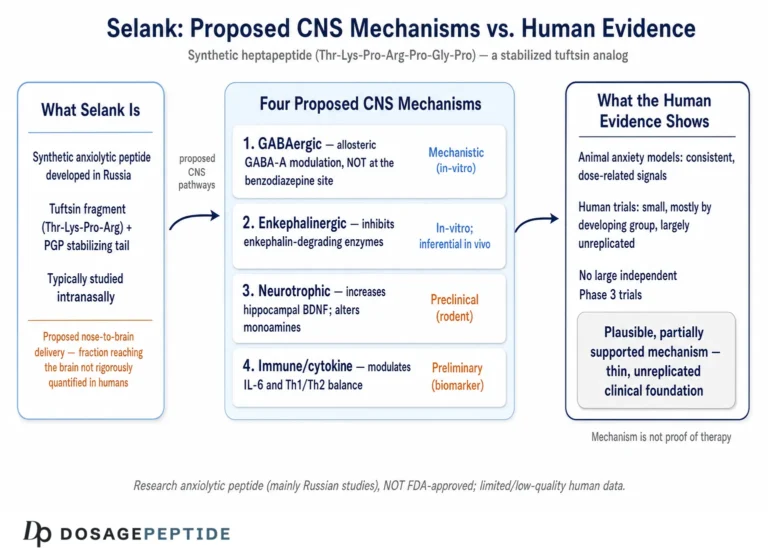
Popular writing about Selank tends to list its mechanisms as though each were established fact: “it modulates GABA, boosts BDNF, balances serotonin, and stabilizes enkephalins.” The reality is more textured. Each mechanism has some primary support, but the strength of that support varies from a handful of gene-expression studies to a single receptor-binding paper. Distinguishing well-supported from lightly supported mechanisms is essential to an honest read.
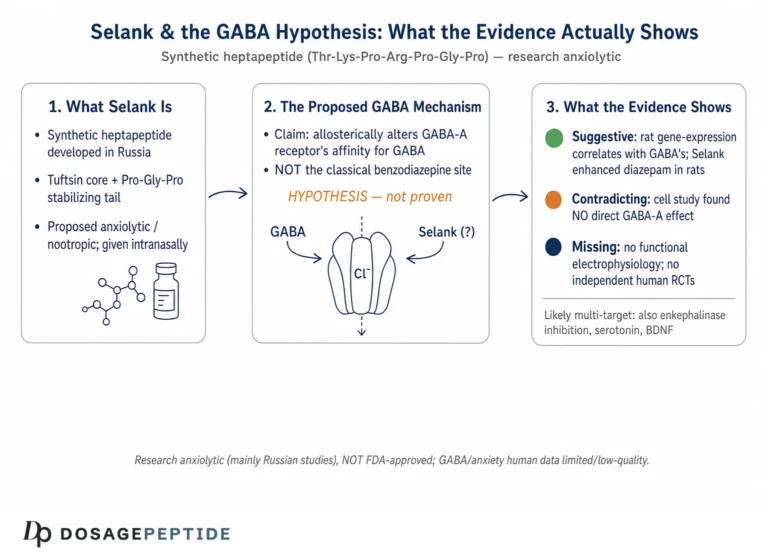
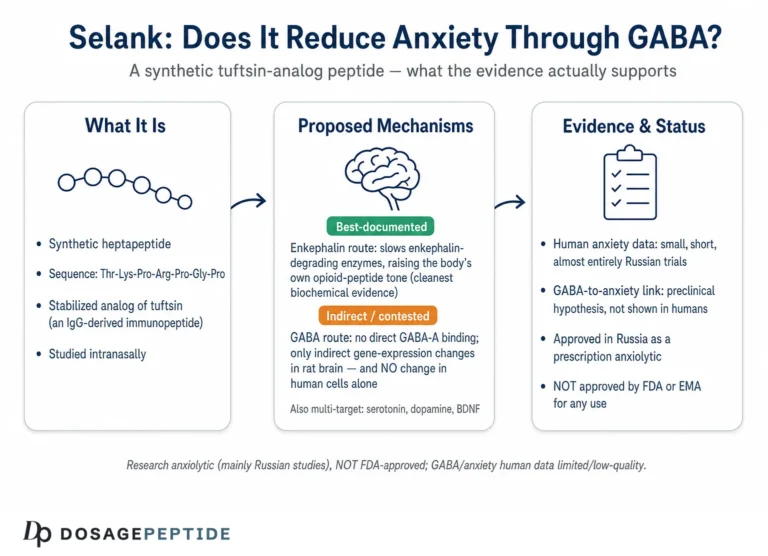
1. GABAergic modulation. This is the mechanism most directly relevant to anxiolysis, and it has the most interesting recent support. A 2016 study by Volkova and colleagues in Frontiers in Pharmacology examined the expression of 84 genes involved in GABAergic neurotransmission in rat brain after Selank administration and found significant changes in a large subset — notably, the pattern of Selank-induced expression changes at one hour positively correlated with the changes induced by GABA itself, a molecular correlate consistent with GABAergic activity.3 A companion line of work extended this to human neuroblastoma (IMR-32) cells, again showing Selank affecting genes involved in GABAergic neurotransmission alongside GABA and olanzapine.4 The most mechanistically specific claim — that Selank acts as a positive allosteric modulator of GABA-A receptors, enhancing endogenous GABA binding in a subtype-selective, concentration-dependent manner — comes from radioligand-binding work by Vyunova and colleagues.5 This is a coherent and genuinely intriguing body of evidence. It is also, importantly, mostly gene-expression and in-vitro receptor data, not electrophysiology in intact circuits, and it does not by itself prove that the modest GABAergic modulation translates into the clinical anxiolysis observed. It is suggestive, not conclusive.
2. Enkephalin stabilization. Selank inherits from tuftsin an ability to inhibit the enzymes that degrade enkephalins — endogenous opioid peptides involved in stress and mood. Kost and colleagues showed that Selank inhibits enkephalin-degrading enzymes in human serum, proposing this as a possible mechanism of its anxiolytic activity, and a later tritium-labeled-enkephalin method characterized Selank as relatively specific for carboxypeptidases and dipeptidylcarboxypeptidases.67 By slowing enkephalin breakdown, Selank could prolong endogenous opioid signaling. This is a well-documented biochemical effect. Whether it is the operative driver of any mood effect in humans, however, is unproven; it is one plausible contributor among several.
3. Serotonergic and monoaminergic effects. Selank has been reported to alter brain monoamine metabolism, including region-specific increases in serotonin turnover (5-HIAA). Semenova and colleagues compared Selank and tuftsin effects on serotonin metabolism in rats pretreated with the serotonin-synthesis inhibitor PCPA, documenting serotonergic modulation.8 Other work documented Selank-induced normalization of biogenic amine levels, including serotonin, in a model of antenatal hypoxia.9 This gives serotonergic involvement a real, if indirect, evidentiary footing, and it is biologically sensible given serotonin’s central role in mood and anxiety. Still, these are preclinical neurochemical findings, not human mechanistic demonstrations, and — like the rest of the mechanistic corpus — they originate largely from the compound’s developing institutions rather than from independent serotonin-pharmacology laboratories. No study has, for instance, measured cerebrospinal-fluid 5-HIAA or used serotonergic challenge paradigms in humans given Selank, so the serotonergic hypothesis remains an animal-level inference that has not been tested at the level where it would matter for a human emotion-regulation claim.
4. BDNF and neurotrophic signaling. Selank has been shown to influence brain-derived neurotrophic factor expression in the rat hippocampus, and — interestingly — to do so in a state-dependent way, for example preventing an ethanol-induced rise in hippocampal and cortical BDNF rather than simply elevating it, during modeled chronic ethanol exposure and withdrawal.13 This “normalizing” character is one of the more attractive features of the Selank story, but it is also one of the least developed, resting on a limited number of animal studies.
A methodological point is worth surfacing here, because it explains why the mechanistic picture stays “suggestive” rather than becoming “established.” Much of the receptor-level work on Selank relies on radiolabeled-ligand and tritium-labeling approaches that characterize binding and enzyme kinetics in isolated preparations.12 These are powerful tools for demonstrating that a peptide can interact with a target — that Selank enhances GABA binding, or slows enkephalin cleavage — but they operate at a level of abstraction well upstream of behavior. Showing that a molecule modulates a receptor in a test tube, or shifts gene expression in a slice of brain tissue, does not establish that the same event produces a meaningful change in a living, behaving organism, let alone in a human being trying to regulate an emotion. The gap between “engages the target” and “changes the outcome” is exactly where most candidate neuropsychiatric mechanisms fail to translate, and Selank has not yet been carried across that gap with the kind of integrated, target-to-behavior evidence chain that would justify calling any single mechanism its proven mode of action.
There is also a subtler issue of mechanistic pluralism. When a compound is reported to touch GABA, enkephalins, serotonin, and BDNF all at once, two interpretations are possible. The optimistic reading is that Selank is a multi-target “regulatory” peptide whose gentle, simultaneous nudging of several systems produces a balanced anxiolytic effect without the liabilities of hitting any one target hard — precisely the profile its developers describe. The skeptical reading is that a scatter of modest effects across many assays, each measured by a small number of related groups, can also reflect the diffuse, hard-to-replicate signals that short peptides often generate, and that without a clearly dominant, dose-dependent, independently confirmed primary mechanism it is difficult to know which effect, if any, actually drives the clinical observation. Both readings are legitimate on the current data, and an honest account holds them in tension rather than collapsing prematurely into the flattering one.
The table below grades these four mechanisms honestly. The pattern is that Selank has multiple plausible, partly documented mechanisms, none of which is individually nailed down at the level of intact human neurophysiology, and none of which has been tied causally to a measured emotion-regulation outcome.
| Proposed mechanism | Nature of the evidence | Honest strength rating |
|---|---|---|
| GABA-A positive allosteric modulation | Rat & human-cell gene-expression studies; radioligand binding345 | Moderate — coherent but mostly in-vitro/expression |
| Enkephalin-degrading enzyme inhibition | Human serum enzyme assays; tritium-labeled kinetics67 | Moderate biochemically; link to mood unproven |
| Serotonin / monoamine metabolism | Rat neurochemistry (PCPA depletion, antenatal-hypoxia models)89 | Preclinical only |
| BDNF / neurotrophic normalization | Limited rat hippocampus/cortex studies13 | Weak — few studies, state-dependent |
For a deeper treatment of the GABA arm specifically — the mechanism most often cited in support of an emotion-relevant effect — the site’s companion article on how Selank modulates GABAergic activity to reduce anxiety levels walks through the receptor-level data in more detail.
The Human Clinical Record: What Actually Exists
Unlike many research peptides sold online, Selank does have a human clinical record, and this is the strongest part of its case. It is worth setting out what that record contains — and, just as importantly, what it does not.
The foundational trial is the study by Zozulia, Neznamov, and colleagues, published in 2008, which enrolled 62 patients with generalized anxiety disorder and neurasthenia and compared Selank (30 patients) with the benzodiazepine medazepam (32 patients).1 Patients were assessed with the Hamilton Anxiety Rating Scale, the Zung self-rating scale, and clinical global impression, and the investigators additionally measured enkephalin-degrading enzyme activity in serum as a mechanistic correlate. The headline finding was that Selank produced anxiolytic effects broadly comparable to medazepam, and that it additionally showed antiasthenic and mild psychostimulant (activating) effects that the benzodiazepine did not — a profile of “calm without sedation” that has become the compound’s signature claim.
A second, frequently cited clinical study is the work by Medvedev and colleagues, published in 2015, which examined Selank as an adjunct rather than a standalone therapy. In 70 patients with anxiety-phobic, hypochondriac, and somatoform disorders, the investigators compared monotherapy with the benzodiazepine phenazepam (30 patients) against combined treatment with Selank plus phenazepam (40 patients).2 The combination reportedly achieved a positive effect earlier and, notably, reduced the undesirable side effects of the benzodiazepine — attention and memory impairment, sedation, excessive sleep, and sexual dysfunction. This positions Selank less as a primary anxiolytic and more as a benzodiazepine-sparing add-on, a genuinely interesting clinical role but one distinct from the “standalone emotion regulator” framing.
Beyond these, the developing institutions and associated Russian groups have reported additional clinical and observational data — on anxiety-asthenic disorders, on immunomodulatory effects in anxious patients, and on speed of response — and secondary summaries commonly state that the cumulative Russian clinical experience spans several hundred patients. That cumulative figure, however, aggregates studies of varying design and quality and should not be read as though it were a single large, rigorous trial. The table below summarizes the two best-documented controlled studies.
| Study | Design & population | Comparator | Principal finding |
|---|---|---|---|
| Zozulia et al., 20081 | 62 patients, GAD + neurasthenia | Medazepam (benzodiazepine) | Anxiolysis comparable to medazepam; added antiasthenic/activating effect |
| Medvedev et al., 20152 | 70 patients, anxiety-phobic/somatoform | Phenazepam monotherapy vs. phenazepam + Selank | Faster response; fewer benzodiazepine side effects with Selank added |
Two honest points frame this record. First, it is real: these are published clinical studies in diagnosed patient populations with standard psychometric endpoints, which already puts Selank ahead of the many peptides that have never touched a clinical trial. Second, it is thin and specific: two small controlled studies, plus a scatter of lower-tier reports, almost all from Russian groups connected to the compound’s development, measuring anxiety severity rather than emotion regulation per se. That is a foundation for continued investigation, not a validation.
Grading the Evidence: Why “Validated” Overstates the Case
If the human studies exist, why not simply call the emotional-regulation role “validated”? Because validation, in the sense the word carries in evidence-based medicine, requires the evidence to clear several bars that the Selank literature does not. Naming these limitations is not a dismissal; it is the difference between a fair reading and a promotional one.
Small sample sizes. The two best controlled studies enrolled 62 and 70 patients respectively. Trials of this size can detect large effects but are underpowered to characterize effect magnitude precisely, to detect uncommon adverse events, or to support subgroup conclusions. Modern anxiolytic registration programs enroll hundreds to thousands of patients across multiple trials.
Geographic and institutional concentration. Nearly all Selank clinical and mechanistic research originates from a small number of Russian institutions, several tied to the compound’s development at the Institute of Molecular Genetics.11 Independent replication by unaffiliated groups in other countries — a cornerstone of validation — is essentially absent. This is not an accusation of misconduct; it is a structural limitation on how confidently the findings can be generalized.
Publication and language accessibility. Much of the literature is published in Russian-language journals such as Zhurnal Nevrologii i Psikhiatrii imeni S.S. Korsakova, with limited peer-review transparency by international standards and reduced accessibility for independent scrutiny. Key methodological details — randomization procedures, blinding integrity, allocation concealment, pre-registration, handling of dropouts — are often sparsely reported.
Endpoint mismatch. As emphasized earlier, the studies measured anxiety severity, not emotion regulation. Even taken at full face value, they validate (at most) a modest anxiolytic effect in specific anxiety syndromes, not a demonstrated capacity to improve emotion-regulatory processes.
Comparator and blinding challenges. Comparing an intranasal peptide against oral benzodiazepines raises practical blinding difficulties, and several designs are open-label or use active comparators without placebo, which complicates interpretation of the true effect size against no treatment.
The synthesis is straightforward. The correct description of the Selank human evidence is “preliminary, positive, but low-to-moderate quality and not independently replicated,” which on any standard evidence hierarchy sits well below “validated.” A researcher should regard Selank as a compound with an encouraging early clinical signal that warrants larger, independent, placebo-controlled, pre-registered trials — ideally including genuine emotion-regulation endpoints — before any confident efficacy claim is appropriate. The site’s related discussion of how Selank influences GABA signaling to help lower anxiety similarly frames the clinical picture as promising rather than settled.
Selank Versus Established Anxiolytics: A Fair Comparison
One useful way to calibrate expectations is to place Selank beside the drug classes it is implicitly being compared to when people speak of “emotional regulation” — benzodiazepines and SSRIs. The comparison is illuminating precisely because it shows both where Selank’s appeal lies and how far its evidence trails.
Benzodiazepines are unambiguous positive allosteric modulators of the GABA-A receptor; their anxiolytic efficacy is beyond dispute, but so are their liabilities — sedation, cognitive and psychomotor impairment, tolerance, physical dependence, and a withdrawal syndrome. SSRIs are first-line pharmacotherapy for chronic anxiety disorders, with large randomized evidence, but they act slowly, carry their own side-effect burden, and do not help everyone. Against this backdrop, Selank’s reported profile — anxiolysis roughly comparable to a benzodiazepine in a small trial, but without sedation, without documented tolerance or dependence, and with a mild activating quality — is genuinely attractive if it holds up.12 The “if it holds up” is doing heavy lifting: the benzodiazepine and SSRI claims rest on decades of large multinational trials, whereas the Selank claims rest on two small single-region studies.
| Feature | Benzodiazepines | SSRIs | Selank (as reported) |
|---|---|---|---|
| Primary mechanism | GABA-A PAM (benzodiazepine site) | Serotonin reuptake inhibition | Proposed GABA/enkephalin/serotonin modulation368 |
| Onset | Rapid | Weeks | Reported relatively rapid2 |
| Sedation | Common | Variable | Reportedly minimal1 |
| Tolerance / dependence | Yes | Discontinuation effects | Not reported in available trials1 |
| Evidence base | Extensive, global, decades | Extensive, global, decades | Small, Russian, not independently replicated |
| Regulatory status | Approved worldwide | Approved worldwide | Approved only in Russia/neighbors |
The comparison yields a balanced conclusion. Selank’s theoretical selling point — a non-sedating, non-dependence-forming anxiolytic — addresses the exact weaknesses of the established options, which is why it attracts interest. But the evidence gap between it and those options is vast, and a favorable side-effect profile in small studies is not a substitute for demonstrated efficacy at scale. An honest reader should find Selank promising as a research direction and unproven as a therapy, holding both thoughts at once.
Preclinical Models: What They Can and Cannot Establish
Much of the confidence expressed about Selank in secondary sources actually rests on animal work, so it is worth understanding what those models show and where their limits lie. In rodents, Selank has produced anxiolytic-like effects in standard paradigms — the elevated plus maze, open-field, and social-interaction tests — with dose-response behavior in a broadly reproducible range, and it has attenuated anxiety and normalized behavior in stress and withdrawal models.813 It has been reported to improve learning and memory measures, to normalize monoamine balance after antenatal hypoxia,9 and to modulate serotonin turnover in a state-dependent fashion.8 This is a reasonably rich preclinical portfolio for a peptide of its class.
The strengths of this preclinical work are real: it is mechanistically probing (using tools such as PCPA depletion and receptor-binding assays), it spans multiple laboratories and models, and it converges on a consistent anxiolytic-plus-mildly-activating behavioral signature. But two caveats must temper any translational optimism. First, rodent anxiety models measure behavioral proxies — time in open arms, exploratory activity — that map imperfectly onto human anxiety and map even more loosely onto human emotion regulation as a cognitive construct. Countless compounds that looked anxiolytic in the elevated plus maze failed to translate. Second, the animal work, like the clinical work, largely emanates from the same research tradition, so cross-tradition replication is limited.
It is also worth being specific about the translational hazard, because it is not merely a generic caution. Rodent anxiety assays were largely developed and validated using benzodiazepines and other classical anxiolytics; their sensitivity is calibrated to compounds that act quickly and strongly on GABAergic arousal. A peptide that produces a gentler, multi-system, partly delayed effect can look weak or inconsistent in exactly the paradigms that reward benzodiazepine-like pharmacology, or, conversely, can produce open-arm entries and exploratory changes that are read as “anxiolytic” when they may partly reflect the peptide’s mild activating or locomotor effects rather than a true reduction in fear. Disentangling genuine anxiolysis from nonspecific activation is a known difficulty in this literature, and it is one reason a positive elevated-plus-maze result should be interpreted cautiously rather than treated as confirmation. For Selank specifically, the reported combination of reduced anxiety-like behavior and increased exploratory or cognitive activity is intriguing, but it also complicates the behavioral interpretation.
The measured conclusion is that preclinical data make the anxiolytic hypothesis biologically plausible and provide the mechanistic scaffolding discussed earlier, but they cannot validate a human emotional-regulation role. They are hypothesis-generating, not hypothesis-confirming. The appropriate posture is to treat the convergence of animal behavior, neurochemistry, and small human trials as a reason to invest in better human studies — not as a substitute for them. Researchers documenting how these behavioral paradigms are constructed can find related context in the site’s coverage of Selank and GABAergic activity and, for the related regulatory peptide developed alongside it, how Semax influences ACTH-related pathways.
Distinguishing Anxiolysis From Emotion Regulation — the Conceptual Crux
Because the entire premise of the title turns on this distinction, it deserves a dedicated section. There is a meaningful difference between a compound that reduces the intensity of an aversive emotional state and one that improves a person’s ability to regulate emotions, and conflating the two is the most common error in writing about anxiolytic peptides.
Anxiolysis is, in essence, turning down the volume on anxious arousal. If Selank enhances GABAergic inhibitory tone, prolongs enkephalin signaling, and nudges serotonergic balance, the net effect could plausibly be a dampening of the physiological and subjective intensity of anxiety.368 That is a real and potentially useful effect. But emotion regulation is a higher-order capacity: it includes the ability to notice an emotion, appraise its cause, choose a strategy, and modulate the response flexibly according to context. Someone can have low anxiety and poor emotion regulation, or high anxiety and excellent regulation. The constructs are dissociable, and they respond to different interventions — pharmacology can shift arousal, but reappraisal and distress tolerance are typically built through learning and therapy.
Where might Selank plausibly touch emotion regulation rather than mere arousal? There are hypotheses worth stating carefully. A non-sedating anxiolytic could, in principle, free up cognitive resources that acute anxiety otherwise consumes, indirectly supporting better regulation — but this is speculation, untested for Selank. Its reported BDNF and neuroplasticity effects could, over time, support the neural substrates of adaptive emotional learning — but the BDNF data are thin and preclinical.13 Its serotonergic modulation overlaps with systems implicated in mood flexibility — but again, this is mechanistic inference, not measured outcome. None of these pathways has been tested against an emotion-regulation endpoint in a human being.
So the conceptually honest verdict on the title’s exact question is this: clinical research provides preliminary support for a modest anxiolytic effect of Selank in specific anxiety disorders, and this can be loosely described as supporting emotional stability or calm. But it does not validate a distinct, measured role in emotion regulation as affective science defines it, because no study has measured that construct. The most defensible statement is that Selank is a plausible but unproven candidate whose relationship to genuine emotion regulation remains an open and, frankly, largely unexplored research question.
Safety, Tolerability, and the Limits of What We Know
Selank’s reported safety profile is one of its more reassuring features, but it too must be read within the constraints of the evidence. In the Russian clinical studies, Selank was generally described as well tolerated, without the sedation, cognitive impairment, tolerance, or dependence associated with benzodiazepines, and its adjunctive use actually reduced benzodiazepine-related side effects.12 The intranasal route avoids injection-related risks, and no major safety signals have surfaced in the published trials of the durations studied. For a peptide, this is a favorable early picture.
Several caveats are important, however:
- Short durations and small samples. The controlled trials ran on the order of weeks in populations of a few dozen patients. Rare adverse events, long-term safety, and effects of chronic use simply have not been characterized.
- Narrow populations. Safety was assessed in adults with anxiety-spectrum diagnoses, not in the elderly, in medically complex patients, in pregnancy, or in combination with the wide range of medications real-world users might take.
- Product-quality risk outside regulated channels. Because Selank is unapproved almost everywhere, material obtained outside the Russian pharmaceutical system is sold as “research chemical” of unverified purity, concentration, and sterility. Impurities, mislabeling, and endotoxin contamination are real hazards independent of the molecule’s intrinsic safety.
- Immunomodulatory activity. Given its tuftsin lineage and documented effects on cytokine and chemokine gene expression, Selank is not immunologically inert, and the long-term consequences of repeated immune modulation are not established.10
The reasonable reading is that Selank has not thrown up alarming safety signals in the limited, short-term, controlled settings studied, and that its non-sedating, non-dependence-forming profile is a legitimate point of interest. But “no signals in small short trials” is not the same as “established safe for ongoing use,” and it certainly does not substitute for demonstrated efficacy. Absence of demonstrated harm and absence of definitive efficacy coexist here, as they do for many research peptides.
Handling and Reconstitution in a Research Context
Because Selank is frequently encountered as a lyophilized (freeze-dried) powder in a sealed vial for laboratory purposes, a brief, strictly educational note on handling is warranted — with the emphasis that this describes standard research-peptide practice, not a usage recommendation, and that Selank is not an approved therapeutic outside a small number of jurisdictions.
Lyophilized peptides are generally reconstituted with sterile or bacteriostatic water. The diluent is directed slowly against the inside wall of the vial rather than sprayed onto the powder, and the vial is swirled gently rather than shaken, because vigorous agitation can shear peptide bonds and denature material. The chosen diluent volume simply sets the concentration: a fixed mass of peptide dissolved in a larger volume yields a lower concentration per unit volume, which is the arithmetic behind any reconstitution chart. General educational walkthroughs of this arithmetic appear on the site’s peptide reconstitution guide, and unfamiliar terms are defined in the peptide glossary.
Storage and stability considerations that recur across the research-peptide literature include keeping lyophilized material cool and dark (with freezing favored for long-term storage), refrigerating reconstituted solution and using it within a limited window, protecting the peptide from light and heat, avoiding repeated freeze-thaw cycles, and maintaining aseptic technique. It bears repeating that meticulous handling changes nothing about the evidence question. A perfectly reconstituted, high-purity vial of Selank is still a compound whose emotional-regulation role in humans remains unvalidated. Good technique preserves whatever activity the molecule has; it does not manufacture efficacy where the human data are preliminary.
Regulatory Status: A Tale of Two Jurisdictions
Selank’s regulatory position is unusual and frequently misrepresented, so precision matters. In the Russian Federation, Selank is a genuinely approved prescription medicine: it was registered with the Ministry of Health around 2009 and is marketed as a low-concentration intranasal spray for generalized anxiety disorder and, adjunctively, for neurasthenic conditions.1 This is a real approval within a real regulatory system, and it distinguishes Selank from the many peptides that hold no approval anywhere. Reports indicate availability in some neighboring countries as well.
Elsewhere, the picture is entirely different. Selank is not approved by the U.S. Food and Drug Administration, the European Medicines Agency, or comparable major regulators for any indication. It has not undergone the large multinational registration trials those agencies require, and the existing Russian evidence — small, single-region, not independently replicated — would not by itself meet Western approval standards. In the United States it exists only as an unapproved substance; in practice it is sold and shipped as a “research chemical” not intended for human use, and it is not a dietary supplement ingredient with any recognized status. Purchasers outside Russia are therefore obtaining an unapproved product of unverified quality with no regulatory oversight of manufacturing.
Two clarifications guard against common errors. First, Russian approval is not transferable evidence of efficacy by Western standards; regulatory systems differ in the quantity and design of evidence they require, and an approval in one system does not validate a compound in another. Second, the phrase “clinically studied” — true of Selank — is not the same as “clinically validated” or “approved where you live.” The honest regulatory summary is that Selank occupies a narrow, jurisdiction-specific niche: an approved anxiolytic in Russia, an unapproved research substance nearly everywhere else, with no regulator anywhere having evaluated or endorsed a distinct emotion-regulation indication. Any legitimate exploration of the compound for emotional regulation should proceed through formal, oversighted clinical research, not informal use. Until such research exists, the most accurate one-line characterization remains that Selank is a clinically studied Russian anxiolytic with an encouraging but unvalidated relationship to emotion regulation as that construct is properly defined and measured.
Frequently Asked Questions
Does clinical research prove Selank regulates emotions?
No, not in the strict sense. The human clinical studies measured anxiety severity in patients with generalized anxiety disorder and related conditions, and they suggest a modest anxiolytic effect comparable to a benzodiazepine in small trials.12 No study measured emotion regulation as affective scientists define it — reappraisal, distress tolerance, emotion-regulation questionnaire scores, or the underlying neural circuitry. So the research supports a preliminary anxiolytic effect that can be loosely described as promoting calm, but it does not validate a distinct, measured role in emotion regulation. That remains an open research question.
Is Selank FDA-approved?
No. Selank is not approved by the U.S. FDA, the European Medicines Agency, or other major Western regulators for any indication. It is an approved prescription anxiolytic only in Russia (registered around 2009) and reportedly some neighboring countries. Outside those jurisdictions it is an unapproved substance, typically sold as a research chemical of unverified quality.
How strong is the human evidence for Selank?
It is real but limited. The best-documented controlled studies enrolled 62 and 70 patients respectively, almost all research comes from Russian institutions connected to the compound’s development, much is published in Russian-language journals, and there is essentially no independent international replication.1211 On standard evidence hierarchies this is “preliminary and low-to-moderate quality,” which sits below “validated.”
How is Selank thought to work?
Four mechanisms are proposed, with differing support: positive allosteric modulation of GABA-A receptors (rat and human-cell gene expression plus receptor binding), inhibition of enkephalin-degrading enzymes (human serum biochemistry), modulation of serotonin and monoamine metabolism (rat neurochemistry), and effects on BDNF/neurotrophic signaling (limited rat studies).356813 None has been causally tied to a measured emotion-regulation outcome in humans.
Is Selank the same as a benzodiazepine?
No. Both are thought to enhance GABAergic signaling, but benzodiazepines are direct, potent positive allosteric modulators at a defined receptor site with proven efficacy and well-known liabilities (sedation, tolerance, dependence). Selank is reported to produce anxiolysis without those liabilities, but that favorable profile rests on small studies, whereas the benzodiazepine profile rests on decades of large global trials.1
Why is nearly all the research from Russia?
Selank was developed at the Institute of Molecular Genetics of the Russian Academy of Sciences and registered within the Russian pharmaceutical system, so its research ecosystem is concentrated there.11 The lack of independent replication by unaffiliated groups in other countries is a genuine limitation on how confidently the findings can be generalized, not evidence of wrongdoing.
Could Selank genuinely improve emotion regulation with more study?
It is plausible but unproven. Mechanistically, a non-sedating anxiolytic with neurotrophic and serotonergic effects could in principle support the substrates of adaptive emotional learning, and freeing cognitive resources from acute anxiety could indirectly aid regulation.813 But these are hypotheses. Confirming them would require larger, independent, placebo-controlled trials that use validated emotion-regulation endpoints — work that has not been done.
Is Selank safe?
In the small, short-term Russian trials it was generally well tolerated, without sedation, tolerance, or dependence, and it reduced benzodiazepine side effects when added to them.12 But long-term safety, safety in vulnerable populations, and the risks of unregulated research-grade material are not established, and its tuftsin-derived immunomodulatory activity is not fully characterized.10 Absence of signals in small trials is not proof of long-term safety.
What would it take to actually “validate” Selank for emotional regulation?
Large, adequately powered, randomized, double-blind, placebo-controlled trials, conducted by independent groups outside Russia, pre-registered, published in accessible peer-reviewed journals, and — critically — using validated emotion-regulation endpoints alongside anxiety scales. Until that exists, the accurate description is “clinically studied and approved in Russia as an anxiolytic; not validated for emotion regulation.”
References
- Zozulia AA, Neznamov GG, Siuniakov TS, et al. Efficacy and possible mechanisms of action of a new peptide anxiolytic selank in the therapy of generalized anxiety disorders and neurasthenia. Zh Nevrol Psikhiatr Im S S Korsakova. 2008;108(4):38-48. PMID 18454096. https://pubmed.ncbi.nlm.nih.gov/18454096/
- Medvedev VE, Tereshchenko ON, Kost NV, et al. Optimization of the treatment of anxiety disorders with selank. Zh Nevrol Psikhiatr Im S S Korsakova. 2015;115(8):34-39. PMID 26356395. https://pubmed.ncbi.nlm.nih.gov/26356395/
- Volkova A, Shadrina M, Kolomin T, Andreeva L, Limborska S, Myasoedov N, Slominsky P. Selank Administration Affects the Expression of Some Genes Involved in GABAergic Neurotransmission. Front Pharmacol. 2016;7:31. PMID 26924987; PMCID PMC4757669. https://www.ncbi.nlm.nih.gov/pmc/articles/PMC4757669/
- Kolomin T, Shadrina M, Andreeva L, et al. GABA, Selank, and Olanzapine Affect the Expression of Genes Involved in GABAergic Neurotransmission in IMR-32 Cells. Front Pharmacol. 2017;8:89. https://www.frontiersin.org/journals/pharmacology/articles/10.3389/fphar.2017.00089/full
- Vyunova TV, Andreeva LA, Shevchenko KV, Myasoedov NF. Peptide-based Anxiolytics: The Molecular Aspects of Heptapeptide Selank Biological Activity. Protein Pept Lett. 2018;25(10):914-923. PMID 30255741. https://pubmed.ncbi.nlm.nih.gov/30255741/
- Kost NV, Sokolov OIu, Gabaeva MV, et al. The inhibitory effect of Selank on enkephalin-degrading enzymes as a possible mechanism of its anxiolytic activity. Bull Exp Biol Med. 2001. PMID 11550013. https://pubmed.ncbi.nlm.nih.gov/11550013/
- Zolotarev YuA, Dorokhova EM, Nagaev IYu, et al. Leu-enkephalin generally labeled with tritium in studying the Selank inhibiting effect on the enkephalin-degrading enzymes of human blood plasma. Russ J Bioorg Chem. 2004;30(3):207-212. PMID 15344652. https://pubmed.ncbi.nlm.nih.gov/15344652/
- Semenova TP, Kozlovskaya MM, Zuikov AV, et al. Comparison of the effects of selank and tuftsin on the metabolism of serotonin in the brain of rats pretreated with PCPA. Eksp Klin Farmakol. 2009. PMID 19803361. https://pubmed.ncbi.nlm.nih.gov/19803361/
- Kozlovskaya MM, Kozlovskii II, Semenova TP. Selank-induced normalizing effects on integrative brain activity and biogenic amine levels due to antenatal hypoxia. Zh Nevrol Psikhiatr Im S S Korsakova. 2007. PMID 17385425. https://pubmed.ncbi.nlm.nih.gov/17385425/
- Kolomin TA, Shadrina MI, Agapova TYu, et al. Changes in expression of the genes for chemokines, cytokines, and their receptors in response to selank and its fragments. Mol Biol (Mosk). 2011. PMID 21786679. https://pubmed.ncbi.nlm.nih.gov/21786679/
- Andreeva LA, Nagaev IY, Mezentseva MV, et al. A New Generation of Drugs: Synthetic Peptides Based on Natural Regulatory Peptides (Semax and Selank). Neuroscience and Medicine / SCIRP. 2014. https://www.scirp.org/journal/paperinformation?paperid=40560
- Vyunova TV, Andreeva LA, Shevchenko KV, Myasoedov NF. An integrated approach to study the molecular aspects of regulatory peptides biological mechanism. J Labelled Comp Radiopharm. 2019;62(12):812-822. PMID 31325343. https://analyticalsciencejournals.onlinelibrary.wiley.com/doi/10.1002/jlcr.3785
- Kolik LG, Konstantinopolsky MA, Nadorova AV, et al. Selank, Peptide Analogue of Tuftsin, Protects Against Ethanol-Induced Memory Impairment by Regulating of BDNF Content in the Hippocampus and Prefrontal Cortex in Rats. Bull Exp Biol Med. 2019;167(5):641-644. https://link.springer.com/article/10.1007/s10517-019-04588-9
Educational and research-use disclaimer: This article is provided solely for scientific and educational purposes. Selank is not approved by the FDA, EMA, or comparable major regulators for the treatment, cure, or prevention of anxiety, emotion dysregulation, or any other condition; it is an approved prescription anxiolytic only in the Russian Federation and some neighboring countries, and no regulator anywhere has recognized a distinct “emotional regulation” indication. The available human evidence is preliminary, small, geographically concentrated, and not independently replicated, and no controlled study has measured emotion regulation as a validated endpoint. Nothing here is medical advice or a recommendation for human use. Material sold outside regulated channels is of unverified purity and quality. Any legitimate investigation of this compound should occur within properly authorized preclinical or clinical research under appropriate oversight, and readers should consult qualified professionals and applicable regulations before making any decisions.