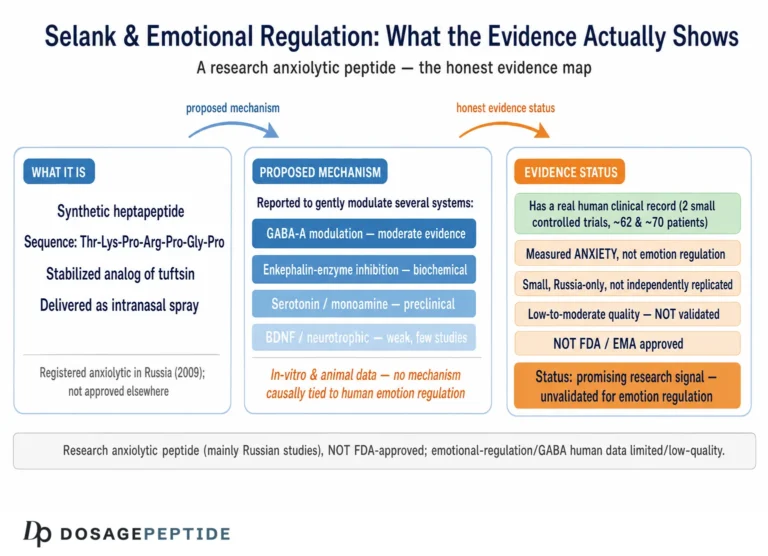
Selank is a synthetic seven-amino-acid peptide developed in Russia as a stabilized version of tuftsin, an immune peptide the body already makes. It is studied mainly for anxiety, and less firmly for attention and memory — but the honest summary is that the human evidence is thin: most trials are small, Russian, and methodologically limited, with the stronger mechanistic work coming from animal and cell studies. This guide covers what Selank is, what the research reports on anxiety and cognition, what is known about tolerability, and where the evidence simply runs out. It is educational and describes research findings, not medical advice.
What is Selank and where did it come from?
Selank (developmental designations include TP-7) is a synthetic peptide created at the Institute of Molecular Genetics of the Russian Academy of Sciences in collaboration with the Zakusov Institute of Pharmacology.[1] It belongs to a family of short “glyproline” regulatory peptides and was designed to reproduce the central and immune effects of tuftsin, a naturally occurring tetrapeptide, while surviving long enough in the body to be pharmacologically useful.
Tuftsin itself is a four-residue peptide (Thr-Lys-Pro-Arg) released by enzymatic cleavage of the heavy chain of immunoglobulin G. It has well-documented immunomodulatory and phagocytosis-stimulating properties, but it is degraded almost instantly by peptidases in plasma, which makes it useless as a stable drug. The design solution behind Selank was to extend tuftsin at its C-terminus with a short, protease-resistant Pro-Gly-Pro tail. This “capping” strategy shields the biologically active tuftsin core from rapid enzymatic breakdown and gives the molecule enough metabolic stability to exert measurable central-nervous-system effects.[1]
In the Russian Federation, Selank is registered and sold as a prescription drug—marketed as a 0.15% intranasal solution—for generalized anxiety disorder and as an adjunct for neurasthenic (anxiety-asthenic) conditions. It is important to be precise about the scope of that approval: registration in Russia does not equal FDA approval, and the Russian regulatory dossier rests largely on domestically conducted trials that have not been independently replicated in Western Phase 3 settings. Selank remains an investigational compound in the United States, European Union, and most other jurisdictions.
Why tuftsin biology matters for understanding Selank
To understand Selank, it helps to understand what its parent molecule does. Tuftsin was first described in the early 1970s and named after Tufts University, where it was characterized. It is a physiological immunostimulant: it enhances phagocytosis by macrophages and neutrophils, promotes antigen presentation, and generally amplifies innate immune responses. Because tuftsin is liberated from the Fc portion of immunoglobulin G by the sequential action of two enzymes (one in the spleen, one on the leukocyte surface), it functions as an endogenous bridge between antibody-mediated and cell-mediated immunity.
That immune ancestry is not incidental to Selank’s central-nervous-system profile—it is central to it. A growing body of neuroscience frames anxiety, chronic stress, and mood disturbance as conditions with an inflammatory component, in which elevated pro-inflammatory cytokines influence neurotransmitter metabolism and neural circuitry. A tuftsin-derived molecule that simultaneously tunes cytokine balance and modulates GABAergic and monoaminergic signaling is therefore mechanistically well-placed to act at the intersection of the immune and nervous systems. This dual identity—an immune peptide with neuroactive consequences—is the single most important concept for making sense of the otherwise sprawling Selank literature.
The design logic: engineering stability into a fragile peptide
Native tuftsin’s therapeutic potential was recognized decades ago, but its half-life measured in seconds-to-minutes made it impractical. The Russian design strategy was elegant in its simplicity: rather than radically redesign the molecule, the developers preserved the active Thr-Lys-Pro-Arg tetrapeptide and appended a Pro-Gly-Pro sequence to its C-terminus. Proline is the key. Its cyclic side chain forms a rigid kink in the peptide backbone that many peptidases cannot accommodate, so proline-rich termini act as natural “stop signs” for enzymatic degradation. The result is a molecule that retains tuftsin-like activity but survives long enough—particularly via the intranasal route, which partly bypasses first-pass degradation—to produce measurable CNS effects. This same glyproline design philosophy underlies a whole class of short Russian regulatory peptides.
Selank in the peptide landscape
Selank is frequently discussed alongside Semax, another Russian-developed research peptide, because the two share a developmental origin and are often studied together. But they are structurally and mechanistically distinct: Selank is a tuftsin analog acting primarily through GABAergic, monoaminergic, and neuroimmune pathways, whereas Semax is an ACTH(4–10) fragment analog acting through melanocortin signaling and neurotrophic upregulation. The comparison is developed in detail later in this article.
What is the molecular structure of Selank?
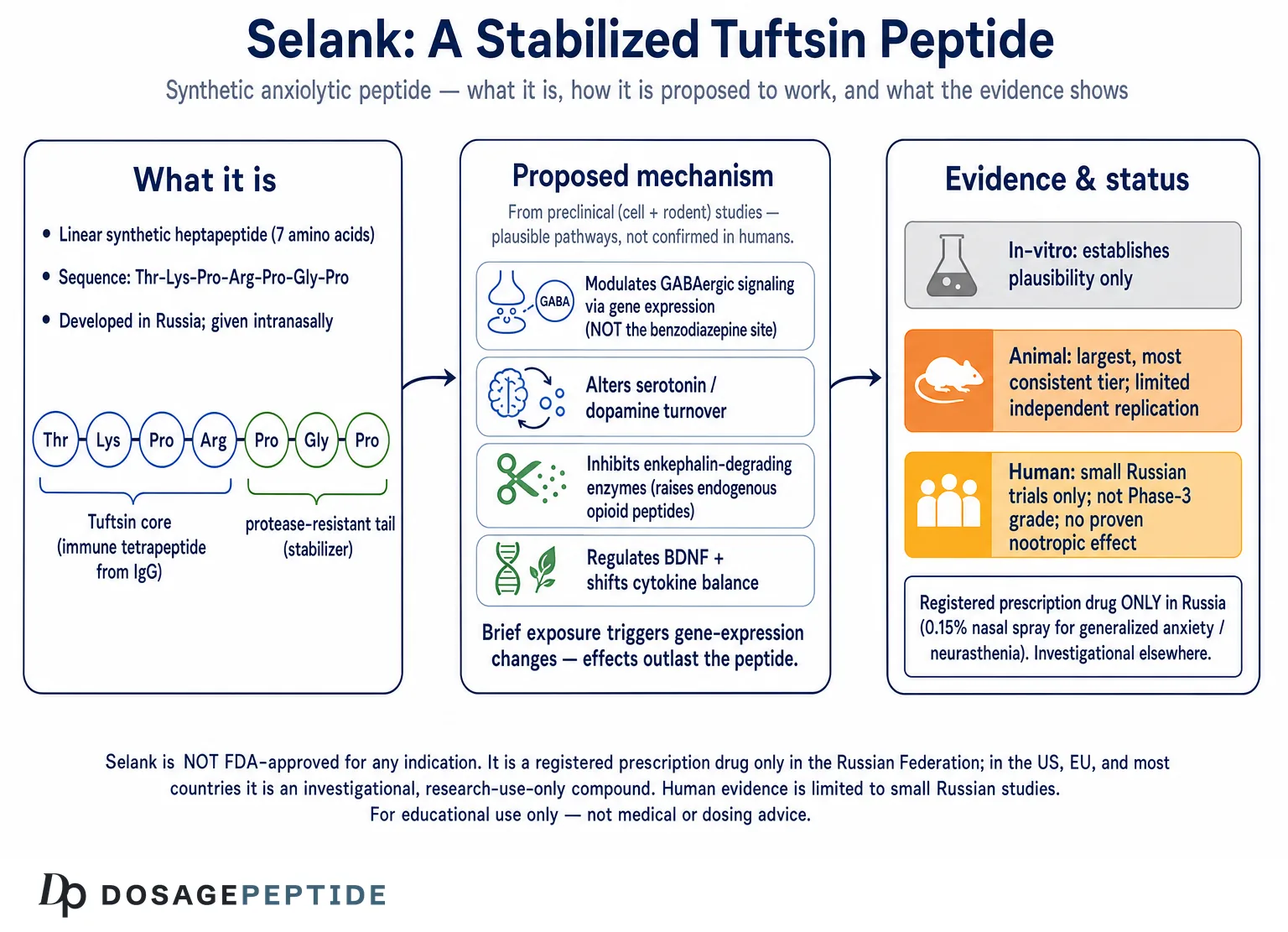
Selank is a linear heptapeptide—seven amino acid residues joined in a single unbranched chain. Its defining pharmacological features derive from combining the active tuftsin sequence with a stabilizing terminal extension.
| Property | Value / description |
|---|---|
| Compound class | Synthetic heptapeptide; stabilized tuftsin analog (glyproline family) |
| Amino acid sequence | Thr-Lys-Pro-Arg-Pro-Gly-Pro (single-letter: TKPRPGP) |
| Tuftsin core | Thr-Lys-Pro-Arg (first four residues) |
| Stabilizing extension | Pro-Gly-Pro (C-terminal tail, protease-resistant) |
| Molecular formula | C33H57N11O9 |
| Molecular weight | ~751.9 g/mol |
| Developer | Institute of Molecular Genetics, Russian Academy of Sciences |
| Typical research form | Lyophilized (freeze-dried) white powder; also formulated as 0.15% nasal solution in Russia |
| Regulatory status | Registered drug in Russia; investigational / not approved elsewhere |
The Pro-rich composition matters mechanistically as well as pharmacokinetically. Proline residues resist cleavage by most aminopeptidases and endopeptidases, so the Pro-Gly-Pro tail slows degradation of the whole molecule. Even so, Selank’s own plasma residence is brief—laboratory characterizations describe rapid clearance on the order of minutes—which raises an important interpretive point discussed under pharmacokinetics: the peptide’s downstream effects on gene expression and neurotransmitter systems appear to outlast the presence of the intact molecule itself.
Several features of the sequence are worth reading closely. The lysine and arginine residues in the tuftsin core carry positive charges at physiological pH, giving the peptide basic, cationic character that influences how it interacts with cell surfaces and receptors. The three proline residues (positions 3, 5, and 7) impose conformational rigidity—proline is the only proteinogenic amino acid whose side chain loops back to the backbone nitrogen, constraining the peptide into a defined shape rather than a floppy chain. This combination of a charged, bioactive head and a rigid, protease-resistant tail is precisely what a medicinal chemist would engineer to keep a small peptide both active and durable. It is a compact illustration of structure-driven design: nothing about Selank is arbitrary; each residue earns its place either by carrying tuftsin’s activity or by defending the molecule against enzymatic attack.
Researchers working with the lyophilized powder handle it much like other short peptides. General handling parameters are covered in our peptide reconstitution guide, and concentration math for a given vial size can be worked through with the reconstitution and dosage calculator. These resources are provided for laboratory handling context only.
How does Selank work? Mechanism of action
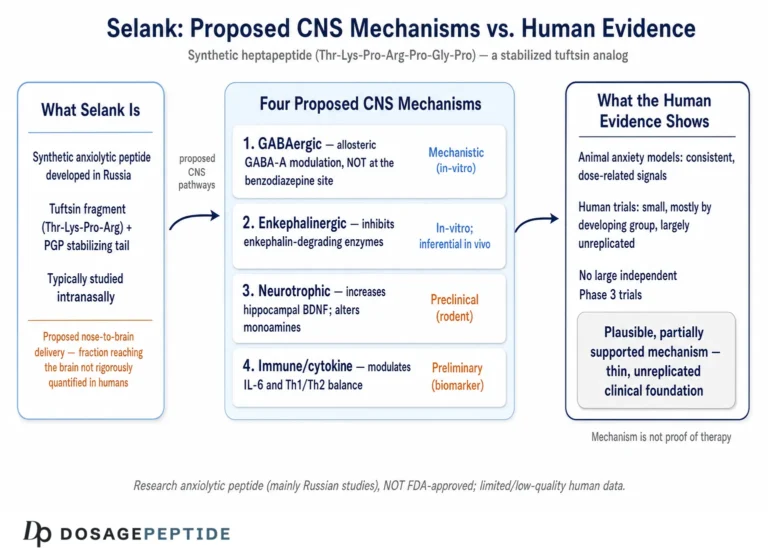
Selank does not have a single clean receptor target the way a classical drug does. Instead, the research literature describes a set of convergent, partly overlapping mechanisms—GABAergic modulation, changes in monoamine turnover, inhibition of enkephalin degradation, upregulation of BDNF, and neuroimmune (cytokine) modulation. Most of this mechanistic work is preclinical (cell-culture and rodent) and should be read as a description of plausible pathways rather than confirmed human physiology.
GABAergic modulation without benzodiazepine-site binding
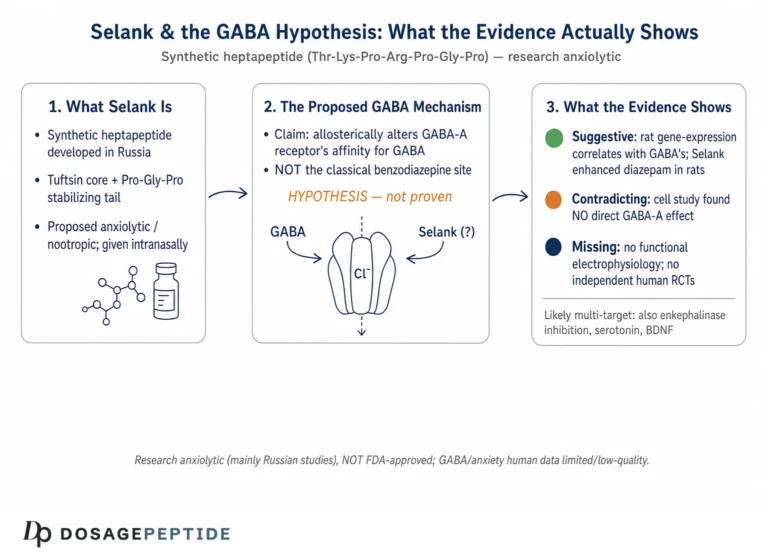
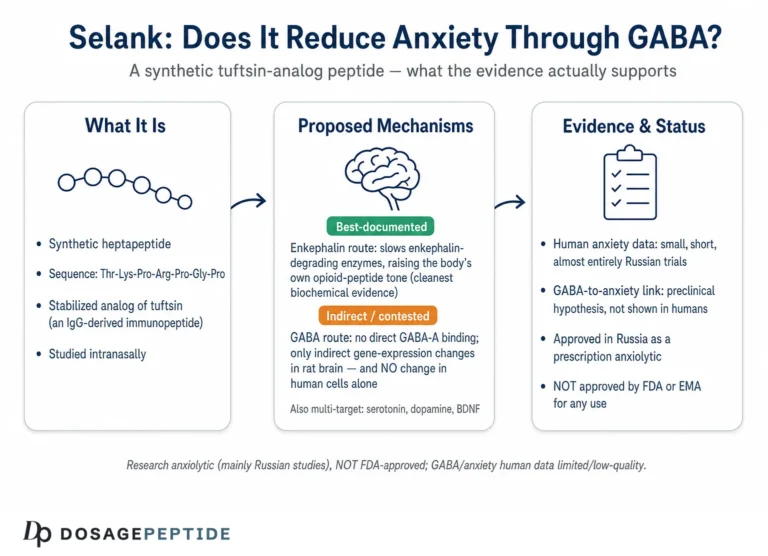
The most-cited proposed mechanism relevant to Selank’s anxiolytic profile is modulation of GABAergic neurotransmission—the brain’s primary inhibitory system. Crucially, Selank is not thought to bind the benzodiazepine site of the GABA-A receptor. Rather than acting as a direct positive allosteric modulator in the way diazepam does, the peptide appears to influence GABAergic tone at the level of gene expression.
In a controlled rodent study, intranasal administration of Selank altered the mRNA levels of a large panel of neurotransmission-related genes in the frontal cortex within one to three hours; of the genes analyzed, roughly 45 showed changed expression at the one-hour mark, including genes tied to GABAergic signaling.[2] This “genomic” style of action offers a mechanistic explanation for two clinically noted features: a comparatively gradual onset relative to benzodiazepines, and the reported absence of the sedation, motor impairment, and dependence liability associated with direct benzodiazepine-site agonism. It is worth stating plainly that a gene-expression signature in rat cortex is suggestive, not proof, of the mechanism operating in humans at therapeutic exposures.
The distinction from benzodiazepine pharmacology is worth developing because it is the crux of Selank’s proposed value proposition. A benzodiazepine binds an allosteric site on the GABA-A receptor and immediately increases the frequency of chloride-channel opening in response to GABA, producing fast, potent, dose-dependent inhibition—and, as a corollary, sedation, tolerance, and physical dependence with repeated use. Selank appears to work “upstream” of the receptor itself, nudging the expression of genes that build and regulate the GABAergic apparatus over hours. If that model is correct, it would explain why the peptide is described as calming rather than sedating, and why it does not carry the classic benzodiazepine withdrawal syndrome. The candidate genes affected in the cortical expression panels span GABA receptor subunits and enzymes involved in GABA synthesis and transport, painting a picture of system-level tuning rather than single-target agonism.[2] The caveat remains: this is a rodent transcriptomic story, and the human relevance is inferred, not demonstrated.
Effects on monoamines: serotonin and dopamine turnover
A second strand of preclinical work reports that Selank modifies monoamine metabolism in a region-specific way. Rodent neurochemistry studies from the originating Russian groups describe increased ratios of the serotonin metabolite 5-hydroxyindoleacetic acid (5-HIAA) to serotonin in regions such as the hypothalamus and striatum—a pattern interpreted as accelerated serotonin turnover rather than a simple rise in serotonin levels. Related reports describe normalization of dopamine metabolism under stress conditions, blunting stress-induced changes in prefrontal dopamine.
These monoaminergic effects are biologically plausible and internally consistent with an anxiolytic/antiasthenic profile, but the primary data are largely in Russian-language journals and animal models. They are best summarized as: Selank appears to modulate serotonergic and dopaminergic turnover in rodents, with the direction of change depending on brain region and baseline stress state. The magnitude and relevance in humans are not established.
The serotonergic angle is particularly relevant to the anxiety story because serotonin is the principal target of the most widely used anxiety medications (SSRIs). If Selank enhances serotonin turnover through a peptide-mediated route that does not involve reuptake inhibition, that would represent a mechanistically distinct way of engaging the same broad neurochemical system—potentially with a different onset and side-effect signature. This is an intriguing hypothesis, but it must be labeled as such: it is drawn from rodent turnover ratios, not from human serotonergic imaging or controlled human neurochemistry.
Inhibition of enkephalin degradation
Selank has been reported to inhibit enkephalin-degrading enzymes, thereby prolonging the activity of endogenous opioid peptides (the leu-enkephalin and met-enkephalin system). In the human generalized-anxiety trial discussed below, treatment with Selank was associated with an increase in serum leu-enkephalin activity that correlated with the reduction in anxiety symptoms—patients with anxiety-asthenic conditions started with decreased enkephalin levels, and Selank raised them.[3] This enkephalinase-inhibition pathway is also invoked to explain preclinical observations that Selank attenuates opioid-withdrawal signs (see the morphine-withdrawal model below).
The endogenous opioid system is relevant to anxiety in a way that is easy to overlook. Enkephalins are the body’s own short opioid peptides, and they participate in mood regulation, stress buffering, and the subjective sense of well-being—independently of the analgesic effects most associated with opioids. By slowing enkephalin breakdown rather than directly activating opioid receptors, Selank would raise the tone of an existing endogenous system rather than imposing exogenous agonism. Mechanistically, that is an important distinction: it is the difference between amplifying a physiological signal and overriding it, and it is consistent with the peptide’s reported lack of the reinforcing, dependence-forming properties of direct opioid agonists. The human correlation between rising leu-enkephalin and falling anxiety scores in the GAD trial is one of the more compelling threads connecting a proposed mechanism to a measured clinical endpoint, even within the constraints of that small study.
Upregulation of BDNF
Brain-derived neurotrophic factor (BDNF) is a key regulator of neuronal survival, synaptic plasticity, and mood-related circuitry. In vivo work found that intranasal Selank regulates BDNF expression in the rat hippocampus, with transcript-level changes appearing within hours of administration.[4] Importantly, the effect is not a crude, one-directional “more BDNF is better” story. In a rat model of chronic ethanol exposure—where hippocampal and frontal-cortex BDNF becomes pathologically elevated—Selank prevented that abnormal increase while improving object-recognition memory during alcohol withdrawal.[5] The picture that emerges is one of BDNF normalization toward a homeostatic set-point rather than blanket upregulation.
Immunomodulation and cytokine balance
Because Selank is a tuftsin analog, it retains immune-signaling activity, and a substantial fraction of the mechanistic literature concerns cytokines. Reported effects include modulation of interleukin-6 (IL-6), shifting of the T-helper-1/T-helper-2 (Th1/Th2) balance, and induction of interferon-alpha (IFN-α) gene expression. In an experimental influenza model, Selank showed antiviral activity linked to interferon-alpha modulation, with pre-exposure administration suppressing viral reproduction in cell culture.[6] A mouse study tracking the temporal dynamics of inflammation-related genes found that Selank altered expression of specific immune genes (including C3, Casp1, Il2rg, and Xcr1) after a single injection.[7] Under a rodent “social stress” paradigm, Selank reduced pro-inflammatory IL-1β and IL-6, restored IL-4, and suppressed TGF-β1 and TNF-α toward control levels.[8]
The neuroimmune angle is mechanistically interesting because stress, anxiety, and inflammation are increasingly understood as interlinked. But again the strongest data are preclinical, and the human immunomodulation reports come from small clinical cohorts.
How the mechanisms fit together
No single one of these pathways fully accounts for Selank’s reported profile; their interest lies in how they converge. A working synthesis of the preclinical literature runs like this: a brief intranasal exposure triggers changes in gene expression (GABAergic components, BDNF) and shifts cytokine balance toward an anti-inflammatory state, while the enkephalinase-inhibition effect raises endogenous opioid-peptide tone and the monoaminergic effects retune serotonin and dopamine turnover under stress. The net behavioral output described in animals—reduced anxiety-like behavior, preserved or improved cognition, and resilience to stress—is consistent with several of these levers being pulled at once. This convergence is part of what makes the peptide scientifically interesting, but it also complicates interpretation: with many partial mechanisms and no single dominant target, it is hard to attribute any observed effect to one pathway, and hard to predict human dose-response.
Why is Selank described as “anxiolysis without sedation,” and what is N-acetyl Selank?
Two features come up so often in discussions of Selank that they deserve their own treatment: the claim of anxiolysis without sedation or dependence, and the existence of a chemically modified variant, N-acetyl Selank.
Anxiolysis without sedation or dependence
The headline appeal of Selank in the research literature is a proposed dissociation between anxiety reduction and the classic downsides of anxiolytic drugs. Benzodiazepines are effective but sedating, impair psychomotor performance and memory, and produce tolerance and dependence. SSRIs avoid dependence but act slowly, carry a side-effect burden, and can transiently worsen anxiety on initiation. Selank is positioned—on the strength of its non-benzodiazepine mechanism and the human comparison with medazepam—as a compound that reduces anxiety with a gentler onset, an antiasthenic (energizing rather than sedating) quality, and no reported dependence.[3] This is a genuinely attractive pharmacological profile if it holds up. The honest qualification is that “no reported dependence” reflects a small and short-term human database, not decades of pharmacovigilance, and the antiasthenic claim rests largely on the developers’ own trials.
N-acetyl Selank (Selank amidate variants)
Research suppliers frequently offer an N-acetylated derivative, commonly labeled N-acetyl Selank or N-acetyl Selank amidate. Acetylation of the N-terminus and amidation of the C-terminus are standard peptide-chemistry modifications intended to further slow enzymatic degradation and, in principle, extend duration of action. The rationale is the same protease-resistance logic that produced Selank from tuftsin in the first place. It is important to be clear about the evidence status: the great majority of the published mechanistic and clinical Selank literature concerns the parent Thr-Lys-Pro-Arg-Pro-Gly-Pro sequence, not the acetylated variant. Claims that the N-acetyl form is meaningfully more potent or longer-lasting in humans are largely extrapolation from peptide-chemistry first principles rather than from head-to-head human data. Anyone treating the two as equivalent—or assuming the variant inherits all of the parent’s (already limited) clinical support—is overreaching the evidence.
What does the evidence actually show? An honest review by study type
This is the section that matters most for anyone evaluating Selank seriously. It is easy to find marketing copy that presents Selank as a proven anxiety cure and cognitive enhancer. The real evidence base is thinner and more preliminary than such copy implies. Below, findings are separated strictly by study type and labeled for what they are.
In-vitro (cell-culture) evidence
Cell-culture work supports several of the proposed molecular mechanisms. In neuronal-lineage cells, Selank has been shown to affect the expression of genes involved in GABAergic neurotransmission, alongside GABA itself and reference compounds. In peripheral blood mononuclear cell and cell-line systems, Selank has modulated cytokine gene expression, including suppression of IL-6 under certain conditions.[2] These experiments establish plausibility and identify candidate pathways. They cannot establish behavioral efficacy, dose-response in a whole organism, or safety.
The value of the in-vitro tier is that it lets researchers isolate a single mechanism under controlled conditions—for instance, exposing a defined cell line to a defined concentration of Selank and reading out exactly which genes change. That precision is also its limitation: a cortical cell in a dish has no blood-brain barrier to cross, no peptidase gauntlet to survive, no intact neural circuit to influence behavior, and no immune system to interact with. Effects that appear robust in a well can vanish, reverse, or become clinically irrelevant in a whole organism. This is why the in-vitro data are best treated as a mechanistic map rather than a promise of effect—useful for generating hypotheses that the animal and human tiers must then test.
Animal (preclinical) evidence
The animal literature is the largest and most internally consistent portion of the Selank evidence base. Rodent studies—predominantly from the originating Russian institutes—report anxiolytic-like behavior, effects on learning and memory, changes in monoamine turnover, BDNF regulation, and neuroimmune modulation. Foundational behavioral work characterized Selank and related tuftsin-family peptides in the regulation of adaptive behavior under stress.[9] Later work demonstrated protection against ethanol-induced memory impairment via BDNF normalization,[5] attenuation of morphine-withdrawal signs at an anxiolytic dose (with efficacy approaching diazepam),[10] and cytokine normalization under social stress.[8]
Several of these preclinical findings reward a closer look because they illustrate the quality of the mechanistic reasoning, not just the headline. The ethanol-memory study is a good example: rather than simply showing “Selank improved memory,” the investigators tied the behavioral rescue to a specific, direction-aware change in BDNF—preventing the pathological BDNF elevation that chronic ethanol produces—which is a more sophisticated and falsifiable claim than a generic neurotrophic boost.[5] Similarly, the morphine-withdrawal work quantified a total withdrawal-severity index and reported an anxiolytic-dose reduction on the order of about 40%, with efficacy approaching that of diazepam, which situates the enkephalinase-inhibition mechanism in a concrete behavioral outcome rather than leaving it as an abstract biochemical observation.[10] The social-stress cytokine study measured a panel of interleukins and demonstrated a coherent anti-inflammatory shift—lower IL-1β and IL-6, restored IL-4, suppressed TNF-α—linking the immune mechanism to a stress paradigm.[8]
This body of work is genuinely substantial for a peptide of this class. Its principal limitations are that it is concentrated within a small number of affiliated research groups, much of it is published in specialty or Russian-language venues, and independent Western replication is sparse. Preclinical consistency is encouraging but does not translate automatically into human efficacy—the history of neuropharmacology is full of compounds that performed impressively in rodents and failed in human trials. Selank’s animal record earns it serious scientific interest; it does not, by itself, earn it the status of a proven human therapeutic.
Human (clinical) evidence
Here candor is essential. Human data on Selank exist, but they consist of small Russian clinical studies of limited methodological quality—not large, multi-site, placebo-controlled, independently replicated trials of the sort required for FDA approval.
The most frequently cited human study is a 2008 comparative trial of Selank versus the benzodiazepine medazepam in generalized anxiety disorder and neurasthenia. It enrolled 62 patients (30 on Selank, 32 on medazepam) and used the Hamilton, Zung, and Clinical Global Impression scales alongside serum enkephalin measurement. Selank produced anxiolytic activity broadly comparable to medazepam, with additional antiasthenic/psychostimulant effects and an increase in leu-enkephalin activity that correlated with symptom improvement—without the early sedation seen with the benzodiazepine.[3] Related clinical reports describe immunomodulatory effects in patients with anxiety-asthenic disorders, including shifts in Th1/Th2 cytokine balance over a two-week course.
These results are interesting and directionally positive, but the sample sizes are far below Western Phase 3 standards, blinding and placebo control are inconsistent across the literature, and the trials originate largely from the compound’s developers. No high-quality independent trial has confirmed a nootropic (cognitive-enhancing) benefit in healthy humans. The correct summary is: preliminary human signal for anxiolysis, no robust independent confirmation, and no established cognitive-enhancement claim in humans.
A closer look at the methodological weaknesses
It is worth being specific about why the human evidence is graded as limited, because vague hedging is unhelpful. Several concrete issues recur across the clinical literature:
- Small samples. The flagship GAD trial randomized 62 patients across two arms. Modern regulatory anxiety trials enroll hundreds to thousands of participants to detect and confirm effects reliably. With small samples, both false positives and inflated effect sizes are more likely.
- Comparator, not placebo, design in key studies. The best-known trial compared Selank against an active drug (medazepam) rather than against placebo, which makes it difficult to quantify the absolute effect and to rule out expectation effects.
- Investigator independence. Much of the clinical and preclinical work comes from the institutes that developed Selank. That is common early in a compound’s life, but independent replication by unaffiliated groups is what converts a promising signal into an established finding, and that step is largely missing.
- Publication and language access. A substantial fraction of primary reports appear in Russian-language journals, which limits scrutiny by the broader scientific community and complicates systematic review and meta-analysis.
- Heterogeneous outcomes. Different studies use different scales, routes, durations, and patient populations, making it hard to pool results into a single confident estimate.
None of this means Selank “doesn’t work.” It means the evidence supports a cautious, provisional read—an anxiolytic with a plausible and distinctive mechanism and an encouraging but unconfirmed early clinical signal—rather than the settled, proven-therapy framing found in much consumer marketing.
How does Selank compare with conventional anxiety pharmacotherapy?
The table below places Selank alongside the two dominant classes of approved anxiety treatments, purely to clarify where it sits conceptually. This is a research comparison, not a treatment recommendation, and it does not imply Selank is a substitute for approved therapy.
| Attribute | Selank (investigational) | Benzodiazepines | SSRIs |
|---|---|---|---|
| Class | Synthetic tuftsin-analog peptide | GABA-A benzodiazepine-site modulators | Serotonin reuptake inhibitors |
| Onset | Reported gradual (hours) | Rapid (minutes to hours) | Slow (weeks) |
| Sedation | Reported minimal / antiasthenic | Common | Variable |
| Dependence liability | None reported (limited data) | Significant with chronic use | Low; discontinuation effects possible |
| Regulatory status | Approved only in Russia; investigational elsewhere | Widely approved | Widely approved |
| Evidence base | Small trials + extensive preclinical | Large, mature | Large, mature |
| Evidence tier | What exists for Selank | Strength / caveat |
|---|---|---|
| In-vitro | GABAergic and cytokine gene-expression effects in cells | Establishes plausibility only; no efficacy/safety inference |
| Animal | Anxiolytic-like behavior, BDNF regulation, monoamine turnover, opioid-withdrawal and cytokine effects | Largest, most consistent tier; concentrated in affiliated groups; limited independent replication |
| Human | Small Russian trials in GAD/neurasthenia; comparison to medazepam; immunomodulation in anxiety-asthenic patients | Limited quality; small n; not Phase-3-grade; no independent Western replication; no proven healthy-human nootropic effect |
Selank vs Semax: how do these two Russian peptides compare?
Because Selank and Semax are so often paired, a direct comparison helps clarify what Selank is and is not. Both are short synthetic peptides developed in the Russian scientific tradition, both are typically studied by intranasal delivery, and both are investigational outside Russia. But their structural origins and primary mechanisms differ.
| Feature | Selank | Semax |
|---|---|---|
| Parent molecule | Tuftsin (immune tetrapeptide from IgG) | ACTH(4–10) fragment of adrenocorticotropic hormone |
| Peptide family | Glyproline / tuftsin analog | Melanocortin (ACTH-derived) |
| Sequence | Thr-Lys-Pro-Arg-Pro-Gly-Pro | Met-Glu-His-Phe-Pro-Gly-Pro (heptapeptide analog) |
| Primary emphasis | Anxiolytic; neuroimmune modulation | Neuroprotective; attention/memory support |
| Proposed mechanisms | GABAergic gene expression, monoamine turnover, enkephalinase inhibition, BDNF, cytokines | Melanocortin signaling, BDNF/NGF neurotrophic upregulation |
| HPA / cortisol effect | Not a cortisol stimulant | Does not stimulate cortisol despite ACTH origin |
| Russian clinical use | Generalized anxiety disorder, neurasthenia | Ischemic stroke, cognitive disorders, optic nerve disease |
| Regulatory status (US) | Investigational; not FDA-approved | Investigational; not FDA-approved |
A convenient way to hold the distinction: Selank leans “calming/anxiolytic and immune-tuning,” while Semax leans “neuroprotective and pro-attentional.” Head-to-head preclinical studies have examined the two together—for example, in rodent models of Parkinsonism—underscoring that they are complementary research tools rather than interchangeable ones.[11] For dosing-protocol context on the two commonly researched Selank vial sizes, see the Selank 10 mg vial dosage protocol and the Selank 5 mg vial dosage protocol.
What research models are used to study Selank?
Understanding the methods behind the headline findings is part of reading the evidence honestly. Selank research draws on a fairly standard neuropharmacology toolkit.
In-vitro systems
- Neuronal-lineage cell lines (e.g., neuroblastoma-derived cells) used to measure gene-expression changes in GABAergic and neurotransmission-related pathways after peptide exposure.
- Peripheral blood mononuclear cells and immune cell cultures used to quantify cytokine production and gene expression, reflecting the tuftsin-derived immune activity.
- Viral-infection cell models used to assess antiviral/interferon effects.[6]
Animal models
- Rodent anxiety and stress paradigms (open field, elevated tests, social-confrontation stress) to assess anxiolytic-like behavior and cytokine responses.[8]
- Learning and memory tasks (object recognition, conditioned avoidance) to probe cognitive effects, including in ethanol-exposed rats.[5]
- Addiction/withdrawal models, such as morphine-dependent rats used to score withdrawal-syndrome severity.[10]
- Neurodegeneration models, including 6-OHDA-lesion Parkinsonism, often studied alongside Semax.[11]
Molecular assays
- Quantitative real-time PCR and gene-expression panels to track mRNA changes across neurotransmission and inflammation gene sets.[7]
- Neurochemical measurement (HPLC-based quantification of monoamines and their metabolites, e.g., 5-HIAA/5-HT ratios) to assess turnover.
- Immunoassays for BDNF protein and cytokine concentrations in brain tissue and serum.[4]
What are the pharmacology and handling characteristics of Selank?
Pharmacokinetics and the “short half-life, long effect” puzzle
One of the most-repeated facts about Selank is that the intact molecule is cleared from plasma within minutes, yet its behavioral and neurochemical effects reportedly persist far longer. This is not a contradiction once the gene-expression mechanism is taken seriously: if a brief exposure triggers changes in mRNA and downstream protein synthesis (for GABAergic genes, BDNF, cytokines), the functional consequences can outlast the peptide by many hours because they are mediated by molecules the peptide induced rather than by the peptide itself.[2] Intranasal delivery is the dominant route in both Russian clinical use and rodent studies, partly because it offers a practical way to expose the CNS to a rapidly degraded peptide.
Stability, storage, and reconstitution (research handling)
As a lyophilized peptide, Selank is generally supplied as a freeze-dried powder that is stable when kept cold and dry, and it is reconstituted with a suitable diluent for laboratory work. The Pro-Gly-Pro extension improves resistance to peptidase cleavage relative to native tuftsin, but the reconstituted peptide in solution is still a peptide and should be handled with standard cold-chain and light-protection precautions used for research peptides. General principles—diluent choice, target concentration, and avoiding repeated freeze-thaw—are covered in our reconstitution guide, and the arithmetic for a specific vial can be run through the dosage calculator. Terminology used throughout this article (heptapeptide, allosteric modulation, BDNF, Th1/Th2, and related terms) is defined in the site peptide glossary.
Two handling points specific to Selank deserve emphasis. First, the intranasal route—dominant in both the Russian formulation and rodent studies—is not merely a convenience; it is mechanistically load-bearing, because it provides a way to deliver a rapidly degraded peptide to the CNS with less systemic peptidase exposure than an oral route would allow. Research reproductions that change the route of administration are therefore not directly comparable to the intranasal literature. Second, because Selank’s downstream effects depend on triggering gene expression rather than on sustained receptor occupancy, the relationship between administered amount and effect is unlikely to be a simple linear dose-response, which is one more reason why extrapolating human dosing from animal data is unsound.
None of the above should be read as a human dosing recommendation. Selank is presented here strictly as a research compound, and no human dose is endorsed.
What research applications are being explored for Selank?
Beyond its registered Russian indication for anxiety and neurasthenia, Selank appears in the research literature across several exploratory directions. These are areas of investigation, not established uses, and are listed here to map the research landscape rather than to suggest efficacy.
- Anxiety and stress resilience. The core research theme, spanning rodent stress paradigms and the small human GAD/neurasthenia studies, with the recurring emphasis on anxiolysis without sedation.[3]
- Cognition and memory. Preclinical learning-and-memory tasks, including protection against ethanol-induced cognitive impairment, motivate interest in a possible pro-cognitive role—though, again, no healthy-human nootropic benefit is established.[5]
- Substance-withdrawal support. The morphine-withdrawal model raises the question of whether enkephalinase inhibition could ease withdrawal states, a hypothesis being explored preclinically.[10]
- Neuroimmune and antiviral effects. The tuftsin-derived immune activity has prompted investigation of cytokine modulation and interferon induction, including experimental antiviral work.[6]
- Neurodegeneration. Selank has been examined in models of Parkinsonism, frequently in tandem with Semax, as part of a broader interest in regulatory peptides and neuroprotection.[11]
The breadth of these directions reflects the peptide’s multi-pathway pharmacology, but breadth is not the same as depth. For most of these applications the evidence remains at the preclinical or small-clinical stage.
What are the limitations, open questions, and safety signals?
A trustworthy reference has to be as clear about what is unknown as about what is claimed.
- Evidence concentration. A large share of both preclinical and clinical Selank data originates from the compound’s developers and affiliated Russian institutes. Independent replication—especially in humans—is limited, which is a real constraint on confidence.
- Human trial quality. Existing human studies are small, variably controlled, and not designed to modern regulatory standards. The anxiolytic signal is real but preliminary; the cognitive-enhancement claim in healthy people is not established by high-quality human data.
- Mechanistic uncertainty. The GABAergic, monoaminergic, enkephalinergic, BDNF, and cytokine pathways are individually plausible and partly documented, but how they integrate—and which dominate at a given exposure in humans—is not resolved.
- Long-term safety. Reported short-term tolerability in Russian use appears favorable, with an absence of the sedation and dependence associated with benzodiazepines. However, there are no long-term, large-scale safety data of the kind generated by Western drug development. Absence of reported harm is not the same as demonstrated long-term safety.
- Product quality variability. Because Selank is sold in many markets as a “research chemical,” the identity, purity, and sterility of any given non-pharmaceutical supply cannot be assumed. This is a research-integrity and safety concern independent of the peptide’s intrinsic pharmacology.
Observed safety signals in the research literature are, on balance, mild—consistent with a peptide that lacks strong receptor agonism—but the honest framing is that the safety database is small and short-term.
What is the current regulatory status of Selank?
Selank’s legal and regulatory position differs sharply by country, and getting this right is essential for a YMYL reference.
- Russian Federation: Selank is a registered, approved prescription medicine, sold as a 0.15% intranasal solution for generalized anxiety disorder and neurasthenic conditions.[1]
- United States: As of mid-2026, Selank is not FDA-approved for any indication. It has been discussed within the FDA’s compounding-category review process for peptides; regulatory categorization of Selank and Semax has been subject to change during 2026, and their status under section 503A compounding has been actively reconsidered. Anyone relying on this must check the current FDA position directly, as it is in flux.
- European Union and most other jurisdictions: Selank is not an approved medicinal product and is treated as investigational / research-use-only.
A specific point of confusion in 2026 deserves clarification. Selank and Semax have been repeatedly discussed within the FDA’s framework for pharmacy compounding under section 503A, and their categorization—whether they may be compounded by patient-specific prescription through licensed pharmacies—has shifted during regulatory review this year. It is essential not to conflate two very different things: eligibility for compounding is not the same as FDA approval of a finished drug product with demonstrated safety and efficacy. A compound can be permitted for pharmacy compounding while still never having gone through the randomized-controlled-trial approval process. Because this categorization has been actively changing, any statement about Selank’s precise US status carries an expiration date and should be re-verified against current FDA guidance before it is relied upon.
The practical bottom line: outside Russia, Selank should be regarded as an investigational research compound, not an approved therapeutic. Marketing that presents it as an established treatment for anxiety or a proven cognitive enhancer overstates both the regulatory reality and the strength of the human evidence. A responsible reading treats Selank as a scientifically interesting peptide with a distinctive mechanism and a promising but immature evidence base—worthy of continued research, not of the confident therapeutic claims often attached to it.
For a mechanistically distinct mood-research peptide that blocks the TREK-1 potassium channel, see What Is PE-22-28?
Frequently Asked Questions
Is Selank FDA-approved?
No. Selank is not FDA-approved for any indication. It is a registered prescription drug only in the Russian Federation, where it is sold as a 0.15% nasal solution for generalized anxiety disorder and neurasthenia. In the United States, European Union, and most other countries it is treated as an investigational, research-use-only compound. Its US compounding categorization has been under active review in 2026, so the current status should be verified directly with the FDA.
What is Selank derived from?
Selank is a synthetic heptapeptide analog of tuftsin, a naturally occurring four-amino-acid immune peptide (Thr-Lys-Pro-Arg) released from immunoglobulin G. Because native tuftsin is degraded almost instantly, developers at the Institute of Molecular Genetics extended it with a protease-resistant Pro-Gly-Pro tail, producing the stable seven-residue sequence Thr-Lys-Pro-Arg-Pro-Gly-Pro that defines Selank.
How does Selank work in the brain?
Preclinical research suggests Selank acts through several convergent pathways rather than one receptor. It modulates GABAergic neurotransmission at the level of gene expression (without binding the benzodiazepine site), alters serotonin and dopamine turnover, inhibits enzymes that degrade endogenous enkephalins, regulates BDNF, and modulates cytokines. Most of this mechanistic detail comes from cell and rodent studies, so it describes plausible pathways rather than confirmed human physiology.
What is the difference between Selank and Semax?
Both are Russian-developed research peptides usually given intranasally, but they differ in origin and emphasis. Selank is a tuftsin analog studied mainly for anxiolytic and neuroimmune effects, acting via GABAergic, monoaminergic, and cytokine pathways. Semax is an ACTH(4–10) melanocortin-fragment analog studied mainly for neuroprotective and attention/memory effects via neurotrophic upregulation. They are complementary research tools, not interchangeable.
Does Selank actually improve cognition in humans?
The honest answer is that there is no robust, independently replicated human trial demonstrating cognitive enhancement in healthy people. Rodent studies show effects on learning and memory, and small Russian clinical studies in anxiety-asthenic patients report antiasthenic and mild psychostimulant effects. That is a preliminary signal, not proof of a nootropic benefit. Claims of reliable cognitive enhancement in humans go beyond the current evidence.
Why does Selank have such a short half-life but long-lasting effects?
The intact peptide is cleared from plasma within minutes, yet its effects reportedly persist for hours. The leading explanation is that a brief exposure triggers downstream changes in gene expression—such as shifts in GABAergic genes, BDNF, and cytokines—whose functional consequences outlast the peptide itself. In effect, Selank acts as a trigger for slower molecular processes rather than by remaining continuously present.
Is Selank a benzodiazepine or does it cause dependence?
Selank is not a benzodiazepine and is not thought to act at the benzodiazepine site of the GABA-A receptor. In the comparative Russian trial against medazepam, it produced comparable anxiety reduction but without the early sedation associated with the benzodiazepine, and it is generally described as lacking benzodiazepine-type dependence liability. However, long-term, large-scale human safety data are not available, so long-term safety should not be assumed.
What is the difference between Selank and N-acetyl Selank?
N-acetyl Selank is a chemically modified version of the parent peptide, typically with an acetylated N-terminus (and often an amidated C-terminus), intended to further resist enzymatic breakdown and potentially extend its duration of action. The important caveat is that nearly all of the published mechanistic and clinical research concerns the original Selank sequence, not the acetylated derivative. Claims that the N-acetyl form is stronger or longer-lasting in humans are extrapolations from peptide chemistry, not conclusions from head-to-head human studies.
Is there strong human evidence that Selank treats anxiety?
There is preliminary human evidence, not strong evidence. The main clinical support is a small Russian trial in generalized anxiety disorder and neurasthenia comparing Selank with the benzodiazepine medazepam, which reported comparable anxiety reduction without sedation. However, the study was small, compared against an active drug rather than placebo, and originated with the compound’s developers. No large, independent, placebo-controlled trial has confirmed the effect, so the anxiolytic signal should be viewed as promising but unproven.
How is Selank studied and handled in research settings?
Selank is typically supplied as a lyophilized powder, stored cold and dry, and reconstituted with a suitable diluent for laboratory use, most often via intranasal delivery in both Russian clinical practice and rodent studies. Research methods include cell-culture gene-expression assays, rodent anxiety, memory, withdrawal, and neurodegeneration models, and molecular techniques such as qPCR, HPLC monoamine measurement, and BDNF/cytokine immunoassays. No human dose is endorsed here; this is research context only.
References
- Selank. Wikipedia. https://en.wikipedia.org/wiki/Selank
- Volkova A, Shadrina M, Kolomin T, et al. Selank Administration Affects the Expression of Some Genes Involved in GABAergic Neurotransmission. Frontiers in Pharmacology. 2016. https://www.frontiersin.org/journals/pharmacology/articles/10.3389/fphar.2016.00031/full
- Zozulia AA, Neznamov GG, Siuniakov TS, et al. Efficacy and possible mechanisms of action of a new peptide anxiolytic selank in the therapy of generalized anxiety disorders and neurasthenia. Zh Nevrol Psikhiatr Im S S Korsakova. 2008. PMID: 18454096. https://pubmed.ncbi.nlm.nih.gov/18454096/
- Inozemtseva LS, Karpenko EA, Dolotov OV, et al. Intranasal administration of the peptide Selank regulates BDNF expression in the rat hippocampus in vivo. Doklady Biological Sciences. 2008. PMID: 18841804. https://pubmed.ncbi.nlm.nih.gov/18841804/
- Kolik LG, et al. Selank, Peptide Analogue of Tuftsin, Protects Against Ethanol-Induced Memory Impairment by Regulating BDNF Content in the Hippocampus and Prefrontal Cortex in Rats. Bulletin of Experimental Biology and Medicine. 2019. https://link.springer.com/article/10.1007/s10517-019-04588-9
- Ershov FI, Uchakin PN, Uchakina ON, et al. Antiviral activity of immunomodulator Selank in experimental influenza infection. Voprosy Virusologii. 2009. PMID: 19882898. https://pubmed.ncbi.nlm.nih.gov/19882898/
- Kolomin T, Morozova M, Volkova A, et al. The temporary dynamics of inflammation-related genes expression under tuftsin analog Selank action. Molecular Immunology. 2014. https://www.sciencedirect.com/science/article/abs/pii/S0161589013005440
- Yasenyavskaya AL, Samotrueva MA, Tsibizova AA, et al. The Influence of Selank on the Level of Cytokines Under the Conditions of “Social” Stress. Current Reviews in Clinical and Experimental Pharmacology. 2021. PMID: 32621722. https://pubmed.ncbi.nlm.nih.gov/32621722/
- Kozlovskaya MM, Kozlovskii II, Val’dman EA, Seredenin SB. Selank and short peptides of the tuftsin family in the regulation of adaptive behavior in stress. Neuroscience and Behavioral Physiology. 2003. PMID: 14969422. https://pubmed.ncbi.nlm.nih.gov/14969422/
- Konstantinopolsky MA, Chernyakova IV, Kolik LG. Selank, a Peptide Analog of Tuftsin, Attenuates Aversive Signs of Morphine Withdrawal in Rats. Bulletin of Experimental Biology and Medicine. 2022. PMID: 36322304. https://pubmed.ncbi.nlm.nih.gov/36322304/
- Peptides Semax and Selank affect the behavior of rats with 6-OHDA-induced PD-like parkinsonism. Doklady Biological Sciences. 2017. https://link.springer.com/article/10.1134/S0012496617030048