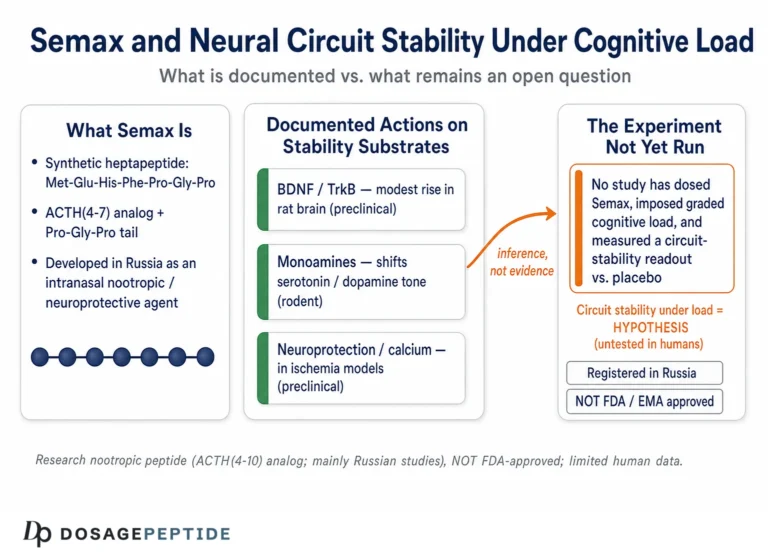
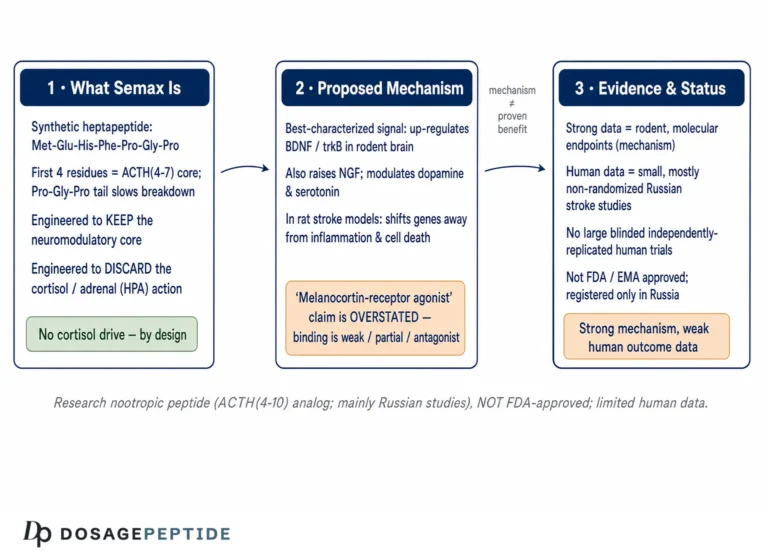
Semax is a synthetic seven-amino-acid peptide — Met-Glu-His-Phe-Pro-Gly-Pro — built from the ACTH(4–10) fragment of adrenocorticotropic hormone, with a Pro-Gly-Pro tail added to slow its enzymatic breakdown. It is a registered medicine in Russia, marketed there as 0.1% and 1% nasal drops, but it is not approved by the FDA, is not a component of any FDA-approved drug, and has no monograph in the European, Japanese or International Pharmacopoeias; in the United States and Europe it circulates as a research chemical.[1] Almost everything claimed for it rests on rodent experiments and on a Russian-language clinical literature that Western regulators have never been able to evaluate — the most important fact to hold in mind before reading any list of “Semax benefits”.
What exactly is Semax, chemically?
Adrenocorticotropic hormone (ACTH) is a 39-amino-acid pituitary hormone whose best-known job is telling the adrenal cortex to make cortisol. Researchers noticed decades ago that short fragments from the middle of the molecule produced behavioural effects in animals without the hormonal ones, and the 4–10 fragment (Met-Glu-His-Phe-Arg-Trp-Gly) became the template for a family of experimental peptides. Semax is one of them.
The sequence, and what was changed
Semax is Met-Glu-His-Phe-Pro-Gly-Pro: compared with native ACTH(4–10), the C-terminal residues Arg-Trp-Gly are replaced by Pro-Gly-Pro.[1] That substitution is the entire design idea — the C-terminal Pro-Gly-Pro is thought to increase the heptapeptide’s stability against hydrolysis by peptidases, which is what the unmodified fragment is vulnerable to.[1] The same motif appears in other Russian peptides, including Selank, and Pro-Gly-Pro is biologically active on its own, so some of what Semax does may be done by its metabolites.
Where it came from
Semax comes out of the Laboratory of Regulatory Peptides at the Institute of Molecular Genetics of the Russian Academy of Sciences in Moscow — the source, for example, of the semax used in one of the Russian clinical studies FDA reviewed.[1] A single-origin history is ordinary for a compound developed by one group, but it matters here: independent replication by unrelated laboratories is one of the main things missing from the Semax file.
Is Semax approved anywhere? The regulatory status, stated plainly
Russia: yes, as a registered drug
Semax is a registered medicine in the Russian Federation, available there as 0.1% and 1% nasal drops.[1] It is also routinely described in Russian sources as appearing on the country’s Vital and Essential Medicines list. Two cautions apply: a national registration reflects that country’s regulatory standard and its own dossier, much of which was never published in English, and inclusion on a vital-medicines list is a domestic pricing and availability designation rather than an independent verdict on efficacy. Russian registration is a real fact about Semax. It is not a Western regulator’s conclusion, and should never be read as one.
United States: not approved, and formally reviewed as a compounding ingredient
There is no FDA-approved Semax drug product, no Semax component in any approved drug, and no United States Pharmacopeia or National Formulary monograph for either semax free base or semax acetate.[1] In practice it is sold online and through wellness and “peptide therapy” clinics, often labelled for research purposes only, and marketed for a startling range of conditions — anxiety, depression, memory, stroke, diabetic neuropathy, ADHD, opioid withdrawal, ALS, Parkinson’s and Alzheimer’s disease among them. FDA documented that marketing landscape directly; none of those uses is supported by an approval.[1]
In 2026 Semax got its first formal Western regulatory read-out. FDA evaluated semax free base and semax acetate for possible inclusion on the section 503A bulk drug substances list — the raw ingredients compounding pharmacies may legally use — for cerebral ischemia, migraine and trigeminal neuralgia, and set out that evaluation in a briefing document prepared for the Pharmacy Compounding Advisory Committee meeting of 23–24 July 2026.[1] The agency’s written evaluation concluded that a balancing of the criteria weighs against placing either substance on that list, citing inadequate physicochemical characterisation, insufficient evidence of effectiveness for all three uses, and an uncharacterised safety profile.[1] The advisory committee nevertheless voted in favour of adding Semax, alongside five other peptides.[2]
That result is already being misreported. An advisory committee vote is a non-binding recommendation, FDA is not obliged to follow it, and adding a substance to the 503A list requires separate rulemaking. Even if Semax were listed, it would mean only that pharmacies may compound with it — not that FDA has approved Semax as a drug, and not that Semax works for anything.
Europe and elsewhere: no authorisation, no monograph
No Semax medicine appears in the European Medicines Agency’s public register of authorised medicines, and FDA’s review confirmed there is no Semax monograph in the European, Japanese or International Pharmacopoeias.[1] The two are different instruments, and both matter. A monograph is what tells a laboratory how to verify identity, purity and impurity limits; its absence means there is no agreed public standard against which a vial of Semax powder can be checked.
Why is the Semax evidence base so hard to read?
The clinical literature is overwhelmingly Russian-language. A PubMed search for “Semax” returns on the order of 230 indexed records at the time of writing, and a large share of the human studies appear in Russian journals — most prominently Zhurnal Nevrologii i Psikhiatrii imeni S.S. Korsakova — often available in English only as a short abstract. FDA’s reviewers hit exactly this wall: the references they found for cerebral ischemia were in Russian and, under the agency’s rules on foreign-language material, could not be considered.[1] That is a procedural exclusion, not proof the studies are worthless — but it means no Western regulator has read the primary evidence for Semax’s main indication.
The studies are small, and the design details are usually missing. Abstracts rarely describe randomisation, allocation concealment, blinding or pre-registration, and several of the human reports FDA located were conference abstracts with no full publication. Worse, a search of ClinicalTrials.gov for Semax as an intervention returns no registered studies at all.[3] Registration is what makes selective reporting visible; without it, a uniformly positive literature may simply be one in which negative results were never written up.
Independent replication is close to absent. The mechanistic, animal and clinical work largely traces back to a small network of Moscow institutions, and much of the non-Russian work that does exist has been chemistry rather than replication of the behavioural or clinical claims. If terms like preclinical, in vitro and investigational are doing unfamiliar work here, our peptide research glossary defines each tier.
What does Semax actually do, and at what evidence tier?
Neurotrophic signalling: real, but rodent
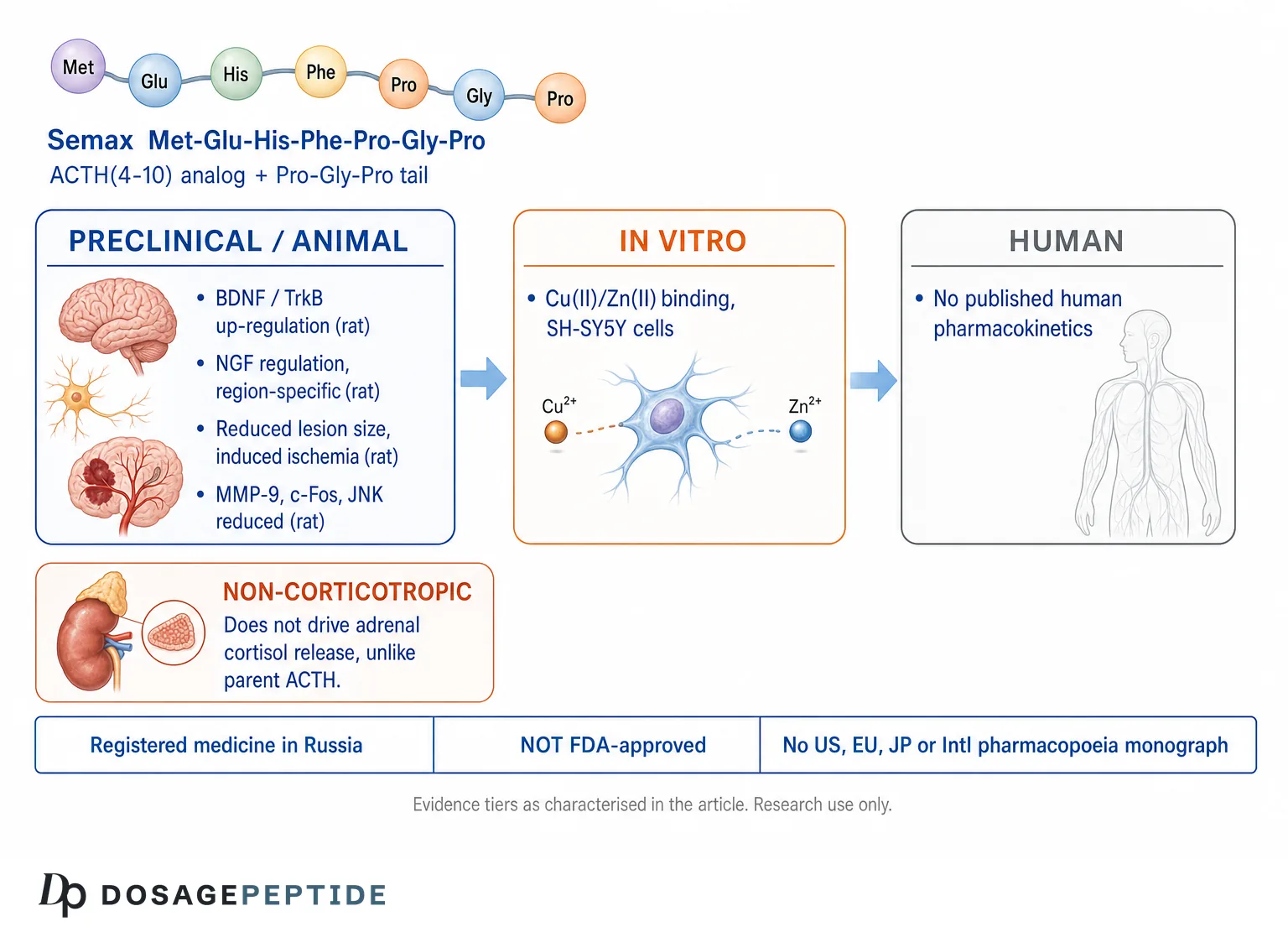
The most cited mechanism is that Semax changes expression of brain-derived neurotrophic factor (BDNF) and nerve growth factor (NGF). In rats, a single intranasal dose produced roughly a 1.4-fold rise in hippocampal BDNF protein, an approximately three-fold rise in BDNF mRNA and a two-fold rise in TrkB receptor mRNA, alongside increased TrkB phosphorylation.[4] A companion study showed the changes are region- and gene-specific rather than a blanket increase: an hour after dosing, both neurotrophin genes were up in hippocampus, Bdnf was up in brainstem and cerebellum, and Ngf was down in frontal cortex.[5] A third rat study followed both genes from 20 minutes to 24 hours and in retina as well as brain, and described the activation as multidirectional: expression of both neurotrophins fell in hippocampus and retina 20 minutes after dosing while rising in frontal cortex, with retinal BDNF significantly increased by 90 minutes.[6] Interesting biology — and entirely rodent biology. A 1.4-fold protein change in rat hippocampus is not a human cognitive outcome.
Monoamines: a modulator, not a stimulant
In rodents, Semax raised striatal levels of the serotonin metabolite 5-HIAA but on its own did not change dopamine or its metabolites; what it did was markedly amplify the dopamine release and locomotor response produced by amphetamine.[7] That is better described as permissive modulation than stimulation — and FDA flagged the amphetamine-potentiation finding as a reason the abuse potential of Semax remains uncharacterised.[1] Rodent work also reports reduced anxiety-like behaviour, improved learning and normalised brain biogenic amine levels in a developmental SSRI-exposure model,[8] and FDA’s review points to a further group of rodent studies reporting antidepressant- and anxiolytic-like effects.[1]
The non-corticotropic property: the most consistently reported thing about Semax
Semax is described as retaining the neurobehavioural properties associated with ACTH fragments while being devoid of the hormonal corticotropic and melanotropic activity of the parent hormone — that is, without the adrenal-cortex stimulation and the pigment-cell signalling those two terms denote.[1] This is one of the more consistently reported facts about the molecule’s pharmacology, and why Semax is discussed as a neuropeptide rather than a hormone — though it is worth noting that in FDA’s own review the point rests on a single secondary citation rather than on a body of primary data. The usual structural explanation is that the shortened, substituted sequence no longer carries what the melanocortin receptors need: Semax drops the C-terminal residues and, in doing so, also replaces the Arg and Trp of the His-Phe-Arg-Trp motif those receptors read. Treat that as the proposed rationale rather than a measured mechanism. And be precise about what the property does and does not mean: the absence of one hormonal effect is a safety-relevant structural claim, not evidence of benefit, and it does not make Semax inert with respect to stress-related systems.
Inflammation, vasculature and gene expression after ischemia
Genome-wide work in rats with induced focal cerebral ischemia found Semax predominantly altered immune-system genes — more than half the differentially expressed genes at 24 hours — plus a smaller set tied to vascular development.[9] A later ischemia-reperfusion study reported the same direction at protein level: lower MMP-9, c-Fos and active JNK, higher active CREB, 24 hours after occlusion.[10] Coherent animal work — and still animal work, in artificial lesions, from the originating research network. Separately, in a human neuroblastoma cell line Semax protected cells against copper-induced toxicity, an in-vitro result that underpins the antioxidant framing often applied to it.[11]
| Proposed mechanism | What was actually measured | Species / model | Evidence tier |
|---|---|---|---|
| BDNF / TrkB up-regulation | Hippocampal BDNF protein +1.4-fold, BDNF mRNA ~3-fold, TrkB mRNA ~2-fold after one intranasal dose | Healthy rat | Preclinical, animal only[4] |
| Region-specific neurotrophin regulation | NGF and BDNF mRNA up in hippocampus at 1 h; Bdnf up in brainstem and cerebellum; Ngf down in frontal cortex | Healthy rat | Preclinical, animal only[5] |
| Serotonergic modulation; permissive effect on dopamine | Striatal 5-HIAA raised; dopamine unchanged by Semax alone; amphetamine-induced dopamine release potentiated | Mouse / rodent | Preclinical, animal only[7] |
| Anxiolytic-like behaviour and monoamine normalisation | Behavioural test batteries plus brain biogenic amine levels in a developmental SSRI-exposure model | Rat | Preclinical, animal only[8] |
| Multidirectional neurotrophin regulation outside the brain | NGF and BDNF mRNA fell in retina 20 min after dosing; BDNF rose at 90 min; time course compared with hippocampus and frontal cortex | Rat, brain and retina | Preclinical, animal only[6] |
| Immunomodulation and vascular gene regulation | Genome-wide mRNA changes 3 h and 24 h after middle cerebral artery occlusion; immune genes dominant at 24 h | Rat, induced focal ischemia | Preclinical, animal disease model[9] |
| Suppression of cell-death and inflammatory proteins | MMP-9, c-Fos and active JNK reduced; active CREB increased at 24 h | Rat, ischemia-reperfusion | Preclinical, animal disease model[10] |
| Metal binding / protection against copper toxicity | Cu(II) and Zn(II) complex formation; viability of SH-SY5Y neuroblastoma cells | Human cell line | In vitro only[11] |
| No corticotropic or melanotropic activity | Absence of the adrenal-stimulating and pigmentary effects of full-length ACTH | Pharmacology of ACTH fragments | Reported pharmacological property (single secondary source), not an efficacy finding[1] |
| Anticoagulant / antithrombotic effect | Fibrinolytic activity, plasminogen activator, platelet aggregation, thrombus size | Rat | Preclinical, animal only; flagged by FDA as a bleeding-risk signal[1] |
Which research domains actually have studies?
Ischemic stroke: the largest literature, and the least accessible
Stroke is where the Russian clinical work is concentrated, from hospital studies in the late 1990s to recent rehabilitation research. A 2018 study in 110 patients recovering from ischemic stroke, with and without Semax given as two ten-day courses, reported higher plasma BDNF, faster improvement in Barthel index scores and better motor performance in the Semax arms.[12] A real dataset with a plausible biomarker link to the rodent work — published in Russian, with an English abstract that does not report randomisation, blinding or allocation concealment. Against it, FDA’s 2026 review concluded there is insufficient evidence of effectiveness for cerebral ischemia, noted that stroke treatment guidelines do not mention Semax, and pointed out that approved treatments already exist.[1] The skeptical conclusion: a suggestive national literature that has never cleared an independent evidentiary bar.
Cognition and attention in healthy adults: imaging, not outcomes
This is what most people mean by “Semax nootropic”, and it is the thinnest part of the file. The clearest English-language human data are two small resting-state fMRI studies from a Moscow group. In the first, 24 healthy volunteers were scanned before and 5 and 20 minutes after intranasal 1% Semax or placebo; the Semax group showed a larger rostral (medial frontal) subcomponent of the default mode network.[13] A related analysis in 52 healthy participants receiving Semax, Selank or placebo reported altered connectivity between the right amygdala and right temporal cortex, described by the authors as shown for the first time.[14] Note what these are: brain-imaging differences, in small samples, minutes after dosing, unreplicated. They show the molecule reaches a biological target. They do not show anyone remembered more, focused longer or worked better — those were not the endpoints.
Optic nerve and ophthalmic research
A small Russian ophthalmology literature exists, including a comparative study of Semax added to neuroprotective therapy in glaucoma patients whose intraocular pressure had already been normalised, described only as using electrophysiological and computerised examination endpoints.[15] The same caveats stack: Russian-language, small, single-centre, no accessible design detail, no replication outside Russia. Rodent data do show that Semax alters neurotrophin gene expression in retina as well as brain, which makes the hypothesis at least coherent — but, as above, the retinal change is multidirectional rather than a tidy increase, both neurotrophin genes falling 20 minutes after dosing before BDNF rose at 90 minutes.[6] Coherent is not demonstrated, and a biphasic gene-expression signal in rat retina is a long way from a preserved visual field in a human eye.
Anxiety, stress adaptation and pain
Anxiolytic- and antidepressant-like effects are reported in rodent studies,[1][8] and Semax is often discussed alongside Selank, the Russian tuftsin-derived anxiolytic peptide with which it shares the Pro-Gly-Pro motif. Readers comparing the two will find our side-by-side review of Semax and Selank research and the broader Selank explainer useful, with the same evidence-tier warnings attached. On pain, FDA reviewed the human data for migraine and trigeminal neuralgia and found it wanting: in the one small uncontrolled, unblinded study available, a minority of migraine subjects reported their headache resolving and subjects with typical trigeminal neuralgia showed no change in pain characteristics or evoked potentials, and the agency concluded the evidence of effectiveness was insufficient for both uses.[1] That is a genuinely negative finding, and it deserves the same weight as the positive ones.
Why is Semax studied intranasally?
Intranasal administration is the characteristic route in the Semax literature, and there is a defensible pharmacokinetic reason. In rats given radiolabelled Semax intravenously, peak brain concentration represented about 0.005% of the administered dose, with a peak brain-to-blood ratio of 0.24; given intranasally, peak brain levels represented about 0.072% of the dose and the ratio reached roughly 0.67.[1] More peptide reached brain relative to blood by the nasal route, consistent with proposed nose-to-brain pathways that bypass part of the systemic circulation — though how much is direct transport versus ordinary mucosal absorption is not settled.
Subcutaneous administration also appears in research settings, but FDA found no pharmacokinetic studies of Semax by that route in any species and no safety literature for it; the only route discussed in the human literature was intranasal.[1] Route is not cosmetic here: in rodent analgesia experiments, intraperitoneal Semax raised pain thresholds dose-dependently while the same doses given intranasally did not.[1] How the two routes appear in published work is documented in our intranasal and subcutaneous reference chart and the 10 mg Semax vial reference sheet — both describing what has been done in research, not what anyone should do.
The half-life puzzle
Semax is degraded quickly: rapid hydrolysis in rat blood and brain tissue in vitro, and in vivo the peptide is cut down from the N-terminus, with Pro-Gly-Pro the main metabolite recovered from blood and brain and aminopeptidases plus angiotensin-converting enzyme identified as the main degrading enzymes in rat serum.[1] Yet the literature routinely describes central effects lasting far longer than the parent molecule persists. Active metabolites, transcriptional changes outliving the peptide, or a brief receptor interaction triggering longer cascades are all plausible explanations; none is established. The rodent gene-expression work is at least consistent with the second of those: neurotrophin transcript levels in brain and retina were still moving hours after a single dose, long after the heptapeptide itself would have been cleared.[6] This remains an open question, made harder by a blunt fact — FDA reviewers were unable to find any human pharmacokinetic study of Semax by any route.[1] Nobody has published what the molecule does in a human body over time.
What about N-Acetyl Semax Amidate (NASA)?
NASA is Semax with two further modifications: an acetyl group on the N-terminus and an amide at the C-terminus, both classic medicinal-chemistry moves for blocking exopeptidase attack. It is widely sold and widely described as a more potent, longer-acting Semax.
Here is what can be supported. A PubMed search for N-Acetyl Semax Amidate returns nothing — no peer-reviewed work on that compound under that name, and so no published comparison of its potency, duration or safety against plain Semax. The nearest relevant evidence concerns N-terminal acetylation alone, and it does not point the way the marketing implies — acetylation changed the peptide’s copper coordination chemistry and abolished the protection unmodified Semax gave neuroblastoma cells against copper toxicity, because the free N-terminal amino group was doing that work.[11] One in-vitro endpoint in one cell line, and silent on the amidated C-terminus — but it demonstrates that stabilising a peptide can also remove some of what made it active. Anyone reading about NASA, including on our own N-Acetyl Semax Amidate nasal spray reference page, should treat “stronger than Semax” as an untested vendor claim rather than a finding.
What is known about safety, and what is not
The gaps are larger than most readers expect. FDA’s reviewers could not identify published acute toxicity studies, repeat-dose toxicity studies, developmental and reproductive toxicity studies, or an adequately designed carcinogenicity study for Semax, and found no clinical studies of immunogenicity or peptide aggregation.[1] The entire identifiable human exposure in the accessible literature amounted to a few dozen healthy adults, roughly 69 adults with medical conditions, and 451 children studied for depression or tics — and in most of those reports adverse events were simply not discussed.[1] “No adverse events reported” usually meant nobody reported on adverse events.
Two signals deserve naming. The anticoagulant and antithrombotic activity seen in rats raises a bleeding-risk question, particularly alongside other agents affecting coagulation, and research-grade material carries no labelling that would warn about it.[1] And a search of FDA’s adverse event reporting system through December 2025 retrieved a single consumer report: ocular pain and burning after use of Semax nasal drops purchased online, with hospitalisation reported and the eye pain unresolved a year later.[1] One report cannot establish causation; it also cannot be read as reassurance, because people using unapproved research chemicals almost never file adverse event reports.
Then there is the material itself. FDA noted the absence of public data on impurities, aggregates, endotoxins and microbial bioburden for semax substances, and inconsistent naming that leaves it unclear whether a given product is the free base or the acetate salt — different active ingredients sold under one name.[1] With no pharmacopoeial monograph, a certificate of analysis is only as good as the laboratory that issued it. Handling of lyophilised peptides in a laboratory setting is covered in our peptide reconstitution guide.
What a careful reader should conclude
Semax is neither vapourware nor a validated drug. What is solid: a well-defined synthetic heptapeptide with a rational design rationale; reported to be non-corticotropic, unlike its parent hormone; demonstrably alters neurotrophin and immune gene expression in rodent brain and reduces lesion size in animal models of induced ischemia; reaches brain tissue better by the nasal route than intravenously in rats; and registered as a medicine in one country with decades of clinical use behind it.
What is not: there is no adequate, independently replicated, English-accessible controlled trial showing clinical benefit for any condition; no human pharmacokinetic data; no standard toxicology package; no evidence at all for the specific modified variant most heavily marketed; and the one Western regulatory body that has formally reviewed the file concluded the evidence weighs against even permitting it as a compounding ingredient. Treating the Russian registration as Western validation is the most common error made about this molecule.
The reasonable position is neither dismissal nor enthusiasm: Semax is an interesting investigational neuropeptide whose supporting evidence has never been tested by the process that turns interesting into established — registered, controlled, replicated, independently reviewed trials. Until that happens, every confident claim about what Semax does in a human being is running ahead of the data.
Frequently Asked Questions
Is Semax FDA-approved?
No. There is no FDA-approved Semax drug product, Semax is not a component of any approved drug, and there is no USP or National Formulary monograph for it. In 2026 FDA evaluated semax free base and semax acetate as possible compounding ingredients and concluded the criteria weighed against listing them; an advisory committee voted the other way, but that vote is a non-binding recommendation, not an approval.
Is Semax the same thing as ACTH?
No. Semax is a seven-amino-acid analogue based on the ACTH(4–10) fragment, with the last three residues replaced by Pro-Gly-Pro. It is described in the pharmacology literature as lacking the corticotropic and melanotropic activity of full-length ACTH while retaining the neurobehavioural properties associated with ACTH fragments in animal studies. The usual structural explanation is that the shortened, substituted sequence no longer carries what melanocortin receptors need in order to be activated — a rationale rather than a directly measured mechanism.
Why is nearly all Semax research published in Russian?
Semax comes out of the Institute of Molecular Genetics of the Russian Academy of Sciences and was registered as a medicine in Russia, so its clinical development happened inside the Russian system and was published for that audience. The consequence is significant: when FDA reviewed Semax for cerebral ischemia, the relevant clinical references were in Russian and, under the agency’s foreign-language rules, could not be considered.
Does Semax raise cortisol or affect the stress axis?
Semax is described in the pharmacology literature as devoid of the corticotropic activity of full-length ACTH, meaning it is not reported to stimulate the adrenal cortex to release corticosteroids. That is a structural property and one of the more consistently reported facts about the molecule, though in FDA’s review it rests on a single secondary citation. It does not follow that Semax has no interaction with stress-related systems — rodent studies report effects on stress-linked behaviour — only that it is not described as acting as a corticotropin.
What is N-Acetyl Semax Amidate, and is it stronger?
NASA is Semax carrying an N-terminal acetyl group and a C-terminal amide, modifications intended to block enzymatic breakdown. No peer-reviewed literature indexed in PubMed studies that specific compound, so claims that it is more potent or longer-acting than plain Semax are untested. The one relevant chemistry study found that N-terminal acetylation removed a protective effect unmodified Semax showed in cell culture.
How long does Semax last in the body?
The parent molecule is short-lived: it is rapidly hydrolysed in blood and brain tissue, with Pro-Gly-Pro as the main metabolite and aminopeptidases and ACE among the enzymes responsible in rat serum. Reported central effects appear to outlast that, which is an unresolved question rather than a settled finding. No human pharmacokinetic study of Semax by any route has been published.
Has Semax been shown to improve cognition in healthy people?
Not in the accessible literature. The clearest English-language human studies are small resting-state fMRI experiments in healthy volunteers showing brain-network differences minutes after dosing. Those are imaging endpoints, not cognitive performance outcomes, and they have not been independently replicated. Claims that Semax is a proven nootropic in healthy adults outrun what has been measured.
What are the main unknowns about Semax safety?
Almost all of the standard package. FDA reviewers found no published acute or repeat-dose toxicity studies, no developmental or reproductive toxicity data, no adequate carcinogenicity study, no immunogenicity or aggregation data, and no human pharmacokinetics. Rodent anticoagulant activity raises a bleeding-risk question, and research-grade material has no pharmacopoeial standard governing its impurities, aggregates or endotoxin content.
References
- U.S. Food and Drug Administration. FDA Briefing Document, Pharmacy Compounding Advisory Committee Meeting, July 23–24, 2026 — Semax-Related Bulk Drug Substances (Semax (free base) and Semax acetate). FDA, 2026. https://www.fda.gov/media/193348/download
- National Community Pharmacists Association. FDA advisory committee nominates six peptides for pharmacies to compound. NCPA, 2026. https://ncpa.org/newsroom/qam/2026/07/31/fda-advisory-committee-nominates-six-peptides-pharmacies-compound
- U.S. National Library of Medicine. ClinicalTrials.gov search: intervention “Semax”. National Institutes of Health. https://clinicaltrials.gov/search?intr=Semax
- Dolotov OV, Karpenko EA, Inozemtseva LS, et al. Semax, an analog of ACTH(4-10) with cognitive effects, regulates BDNF and trkB expression in the rat hippocampus. Brain Research, 2006. https://pubmed.ncbi.nlm.nih.gov/16996037/
- Agapova TY, Agniullin YV, Shadrina MI, et al. Neurotrophin gene expression in rat brain under the action of Semax, an analogue of ACTH 4-10. Neuroscience Letters, 2007. https://pubmed.ncbi.nlm.nih.gov/17353092/
- Shadrina M, Kolomin T, Agapova T, et al. Comparison of the temporary dynamics of NGF and BDNF gene expression in rat hippocampus, frontal cortex, and retina under Semax action. Journal of Molecular Neuroscience, 2010; epub 2009. https://pubmed.ncbi.nlm.nih.gov/19662538/
- Eremin KO, Kudrin VS, Saransaari P, et al. Semax, an ACTH(4-10) analogue with nootropic properties, activates dopaminergic and serotoninergic brain systems in rodents. Neurochemical Research, 2005. https://pubmed.ncbi.nlm.nih.gov/16362768/
- Glazova NY, Manchenko DM, Volodina MA, et al. Semax, synthetic ACTH(4-10) analogue, attenuates behavioural and neurochemical alterations following early-life fluvoxamine exposure in white rats. Neuropeptides, 2021; epub 2020. https://pubmed.ncbi.nlm.nih.gov/33418449/
- Medvedeva EV, Dmitrieva VG, Povarova OV, et al. The peptide semax affects the expression of genes related to the immune and vascular systems in rat brain focal ischemia: genome-wide transcriptional analysis. BMC Genomics, 2014. https://pubmed.ncbi.nlm.nih.gov/24661604/
- Sudarkina OY, Filippenkov IB, Stavchansky VV, et al. Brain protein expression profile confirms the protective effect of the ACTH(4-7)PGP peptide (Semax) in a rat model of cerebral ischemia-reperfusion. International Journal of Molecular Sciences, 2021. https://pubmed.ncbi.nlm.nih.gov/34201112/
- Magrì A, Tabbì G, Giuffrida A, et al. Influence of the N-terminus acetylation of Semax, a synthetic analog of ACTH(4-10), on copper(II) and zinc(II) coordination and biological properties. Journal of Inorganic Biochemistry, 2016. https://pubmed.ncbi.nlm.nih.gov/27586814/
- Gusev EI, Martynov MY, Kostenko EV, et al. The efficacy of semax in the treatment of patients at different stages of ischemic stroke. Zhurnal Nevrologii i Psikhiatrii imeni S.S. Korsakova, 2018. https://pubmed.ncbi.nlm.nih.gov/29798983/
- Lebedeva IS, Panikratova YR, Sokolov OY, et al. Effects of Semax on the default mode network of the brain. Bulletin of Experimental Biology and Medicine, 2018. https://pubmed.ncbi.nlm.nih.gov/30225715/
- Panikratova YR, Lebedeva IS, Sokolov OY, et al. Functional connectomic approach to studying Selank and Semax effects. Doklady Biological Sciences, 2020. https://pubmed.ncbi.nlm.nih.gov/32342318/
- Kurysheva NI, Shpak AA, Ioileva EE, et al. Semax in the treatment of glaucomatous optic neuropathy in patients with normalized ophthalmic tone. Vestnik Oftalmologii, 2001. https://pubmed.ncbi.nlm.nih.gov/11569188/
Research use only. This page is a literature summary published by an independent peptide research reference library. It is not medical advice, not a treatment recommendation, and not a dosing protocol. Semax is not approved by the FDA or the EMA for any use, and material sold as a research chemical is not manufactured to pharmaceutical standards. Nothing here should be used to guide human administration; questions about any medical condition belong with a licensed clinician.