If you are holding a 5 mg or 10 mg Selank vial, two numbers matter: how much bacteriostatic water to add, and what amount published research and the registered foreign labelling actually describe. The first is exact arithmetic, and every row of it is shown below. The second is thinner than most charts admit — the only registered product is a 0.15% nasal solution (1.5 mg/mL), labelled as 2 drops per nostril three times daily for up to 14 days.[3]
So the nasal-versus-subcutaneous question is not really “which one works better”. It is that one route has a labelled product and a small published literature behind it, and the other has neither: no registered subcutaneous product, and no published human injection protocol this review could identify. Everything below describes what was studied or labelled, not what anyone should do. The vial-specific arithmetic also lives on the 5 mg vial protocol and 10 mg vial protocol pages.
Research Context: What Selank Is and Where It Sits
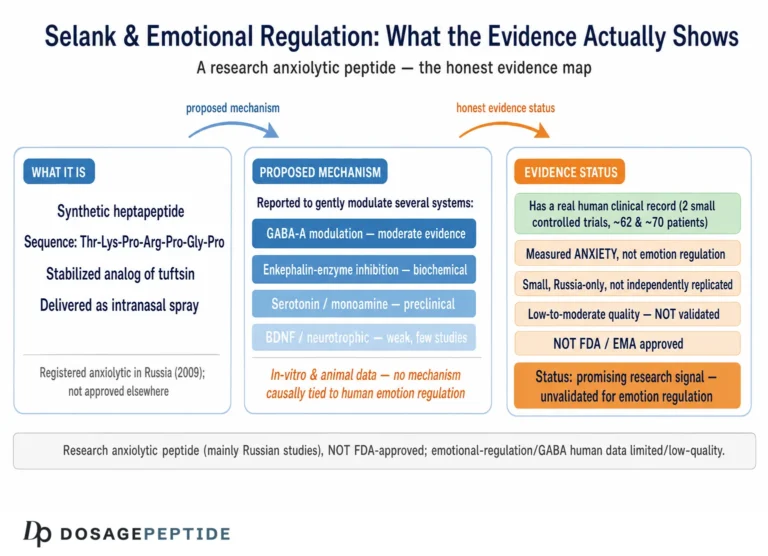
Selank is a synthetic heptapeptide with the sequence Thr-Lys-Pro-Arg-Pro-Gly-Pro (TKPRPGP). It was developed in the 1990s at the Institute of Molecular Genetics of the Russian Academy of Sciences. Structurally, it is a stabilised analogue of tuftsin — an endogenous tetrapeptide (Thr-Lys-Pro-Arg) that is enzymatically cleaved from the heavy chain of immunoglobulin G and that stimulates phagocytosis in macrophages and neutrophils[1]. Tuftsin signals at least in part through the receptor neuropilin-1[2]. Selank takes that tetrapeptide and appends the tripeptide Pro-Gly-Pro (PGP) at the C-terminus. The PGP tail is not decorative — it is a well-known stabilising motif in this family of Russian regulatory peptides, intended to slow peptidase cleavage of the parent sequence.
The regulatory position matters more than almost anything else on this page, and it is routinely misstated by vendors:
- Selank is not FDA-approved. There is no US-approved Selank drug product, no FDA-recognised indication, and no FDA-approved labelling that states a human amount, route or frequency.
- Selank is not EMA-approved. There is no European centrally authorised Selank medicine.
- Selank is registered in the Russian Federation as an anxiolytic, marketed as a 0.15% intranasal solution (nasal drops) under registration number ЛП-№(010951)-(РГ-RU), held by the Peptogen Innovative Scientific-Production Centre[3]. That registration is a real regulatory fact, but a Russian registration is not an FDA or EMA approval, and it does not import the same evidentiary standard.
- In US compounding terms, Selank has no permissive status. Selank acetate (TP-7) was nominated for the FDA’s Section 503A Bulks List and placed in Category 2 — substances that “may present significant safety risks” and that compounders are not permitted to use while under evaluation[4]. It was later removed from that Category 2 list following withdrawal of the nomination by the nominator — FDA now lists selank acetate under “bulk drug substances nominated but withdrawn”, a table of substances previously in Category 2[4] — a procedural removal, not an authorisation[5]. Removal from a “do not compound” list because nobody is still asking for it is the opposite of approval. Selank is not on the 503A Bulks List.
- The clinical evidence base is small and geographically concentrated. The controlled human work is largely Russian-language, conducted by or near the institutes that developed the compound, with limited independent replication. A ClinicalTrials.gov search for the intervention “Selank”, accessed 17 July 2026, returned no studies with Selank as an intervention — only unrelated records surfaced by fuzzy matching[6].
That is the honest tier. If you want the compound’s background before the numbers, the overview at what Selank is as a nootropic peptide studied for anxiety and cognition covers the discovery history in more depth. This page is the dosage and reconstitution reference. Unfamiliar terms used below — lyophilisation, bacteriostatic water, w/v percentage, dead volume — are defined in the peptide glossary.
A Russian registration and an FDA approval are not the same object
Because this distinction carries so much weight on this page, it is worth spelling out rather than gesturing at. A national registration means a national regulator reviewed a dossier submitted by a sponsor and permitted marketing in that country. It is a real administrative act with real requirements. What it does not automatically mean is that the underlying evidence would satisfy a different regulator applying a different standard.
The differences that matter most for a reader trying to calibrate confidence are these:
- Dossier transparency. The FDA publishes review documents — the medical, statistical, clinical pharmacology and chemistry reviews — through Drugs@FDA, and the EMA publishes a European Public Assessment Report. Those documents let an outsider read the regulator’s own reasoning, including the objections. There is no equivalent public assessment report for Selank that an English-reading outsider can audit. What is publicly available is the labelling and a small number of indexed abstracts.
- Evidence volume expectation. A US or EU approval for an anxiety indication would ordinarily rest on multiple adequate and well-controlled trials, typically placebo-controlled, typically with several hundred to several thousand participants across the programme, with a formal safety database and a defined exposure requirement. The publicly indexed Selank clinical literature is orders of magnitude smaller than that.
- Independence. Western approval processes assume the sponsor’s data will be re-analysed by a regulator with access to patient-level datasets. Where a compound’s clinical literature comes predominantly from the institutes that created it and has not been re-analysed independently, the ordinary error-correcting machinery has not run.
None of this is an accusation that the Russian registration is unfounded, and none of it demonstrates that Selank does not work. It is a statement about what a reader is entitled to conclude. “Registered in Russia” supports the sentence a national regulator permitted marketing of a 0.15% nasal solution. It does not support the sentence Selank is a proven anxiolytic, and vendors routinely make the second sentence do work the first sentence earns.
What a Selank dosage chart actually represents
A dosage chart for a compound like this is doing two jobs at once, and conflating them is where most online charts go wrong.
Job one is concentration arithmetic. If you dissolve X mg of powder in Y mL of liquid, the concentration is X/Y mg per mL. That is arithmetic. It is true regardless of what the compound is, whether it works, or whether anyone should use it. It can be verified with a calculator and it has no evidentiary tier at all. Every reconstitution table below falls into this category.
Job two is reporting what published work and registered labelling used. That is a claim about the literature, and it inherits the literature’s weaknesses. For Selank there is essentially one indexed human trial worth quoting, in 62 patients, plus the posology printed on the registered Russian label. Everything else circulating as a “Selank protocol” — 200 mcg twice daily, 300 mcg three times daily, 500 mcg subcutaneously, cycles of five days on and two days off — traces back to vendor pages and forum convention, not to a citable trial.
So the table below is a concentration map, not a prescription. It says what a given vial and volume produces. What anyone does with that number is not addressed here, and no human protocol is recommended anywhere on this page. The broader logic of reading any dosage table is set out in the peptide dosage chart guide.
Why the route question dominates everything else
Selank is unusual among peptides sold as research chemicals in that its canonical route is intranasal, not injection. The registered Russian product is a nasal drop solution[3]. The pivotal comparative clinical trial is reported to have used intranasal administration — although, as detailed below, the indexed English abstract does not itself state the route[7]. The rodent work on brain-derived neurotrophic factor used intranasal administration[8]. Subcutaneous Selank exists in vendor literature, but it has nothing resembling the same precedent in human research.
This is the reverse of the situation for most peptides discussed on this site, where injection is the studied route and everything else is speculative. With Selank, the vial you have — a lyophilised powder in a glass vial with a rubber stopper — is packaged like an injectable simply because that is how peptide manufacturers package everything. The packaging is not evidence about the route.
The unit convention you need first
A U-100 insulin syringe is graduated in units, where 100 units = 1 mL. Therefore:
- 1 unit = 0.01 mL
- 10 units = 0.1 mL
- 50 units = 0.5 mL (half a syringe on a 100-unit barrel)
- 100 units = 1.0 mL (a full 1 mL barrel)
The general relationship: for a vial of X mg reconstituted in Y mL, concentration = X/Y mg per mL. Per insulin unit, that is (X/Y) ÷ 100 mg, which — because 1 mg = 1,000 mcg — equals (X/Y) × 10 mcg per unit. That single formula generates every row in every table below, and you can re-derive any of them yourself. If you want it done interactively rather than by hand, the peptide dosage calculator runs the same arithmetic, and the insulin syringe units guide explains the unit-to-millilitre mapping in detail.
Selank Reconstitution Charts: 5 mg and 10 mg Vials
Selank is supplied as a white lyophilised (freeze-dried) powder, most commonly in 5 mg and 10 mg vials. Reconstitution means adding a diluent — usually bacteriostatic water, which is sterile water containing 0.9% benzyl alcohol as a preservative — to dissolve the powder into a liquid of known concentration. Neither table below is a recommendation. Each is a map from a diluent volume to the concentration it produces.
The 5 mg vial chart
For a 5 mg vial, applying concentration = 5 ÷ Y:
| Bacteriostatic water added | Arithmetic | Concentration | Per insulin unit (U-100) | Per 0.1 mL (typical nasal spray actuation) |
|---|---|---|---|---|
| 1.0 mL | 5 ÷ 1.0 | 5.0 mg/mL | 50 mcg | 500 mcg |
| 1.5 mL | 5 ÷ 1.5 | 3.33 mg/mL | 33.3 mcg | 333 mcg |
| 2.0 mL | 5 ÷ 2.0 | 2.5 mg/mL | 25 mcg | 250 mcg |
| 2.5 mL | 5 ÷ 2.5 | 2.0 mg/mL | 20 mcg | 200 mcg |
| 3.0 mL | 5 ÷ 3.0 | 1.67 mg/mL | 16.7 mcg | 167 mcg |
| 3.33 mL | 5 ÷ 3.33 | 1.5 mg/mL (= 0.15%) | 15 mcg | 150 mcg |
| 5.0 mL | 5 ÷ 5.0 | 1.0 mg/mL | 10 mcg | 100 mcg |
Check one row by hand: 5 mg ÷ 2 mL = 2.5 mg/mL. Per unit, 2.5 ÷ 100 = 0.025 mg = 25 mcg. Per 0.1 mL, 2.5 × 0.1 = 0.25 mg = 250 mcg. The row is consistent.
Note the 3.33 mL row. That is the volume that reproduces the concentration of the registered Russian 0.15% nasal solution from a 5 mg vial — the arithmetic behind it is worked through in the intranasal section below. A vial-specific walkthrough sits on the Selank 5 mg vial dosage protocol page.
The 10 mg vial chart
For a 10 mg vial, concentration = 10 ÷ Y. Every value is exactly double the 5 mg row at the same volume — that is the only difference, and it is worth internalising because it removes the need to memorise two tables.
| Bacteriostatic water added | Arithmetic | Concentration | Per insulin unit (U-100) | Per 0.1 mL actuation | Total units in vial |
|---|---|---|---|---|---|
| 1.0 mL | 10 ÷ 1.0 | 10.0 mg/mL | 100 mcg | 1,000 mcg | 100 |
| 2.0 mL | 10 ÷ 2.0 | 5.0 mg/mL | 50 mcg | 500 mcg | 200 |
| 2.5 mL | 10 ÷ 2.5 | 4.0 mg/mL | 40 mcg | 400 mcg | 250 |
| 3.0 mL | 10 ÷ 3.0 | 3.33 mg/mL | 33.3 mcg | 333 mcg | 300 |
| 4.0 mL | 10 ÷ 4.0 | 2.5 mg/mL | 25 mcg | 250 mcg | 400 |
| 5.0 mL | 10 ÷ 5.0 | 2.0 mg/mL | 20 mcg | 200 mcg | 500 |
| 6.67 mL | 10 ÷ 6.67 | 1.5 mg/mL (= 0.15%) | 15 mcg | 150 mcg | 667 |
| 10.0 mL | 10 ÷ 10.0 | 1.0 mg/mL | 10 mcg | 100 mcg | 1,000 |
Verify the 4 mL row: 10 ÷ 4 = 2.5 mg/mL. Per unit = 2.5 × 10 = 25 mcg. Total units = 4 mL × 100 units/mL = 400 units. Total peptide check: 400 units × 25 mcg = 10,000 mcg = 10 mg. The row closes.
That closure check — total units × mcg per unit should equal the vial’s stated mass — is the single most useful sanity test for any reconstitution table. If it does not close, a number is wrong. Run it on any chart you find online; a surprising number fail. The Selank 10 mg vial dosage protocol page carries the vial-specific version of this table with the same closure checks.
Worked example: targeting a specific per-actuation amount
Suppose the target is a solution where one 0.1 mL nasal actuation contains 250 mcg, starting from a 10 mg vial. Work backwards:
- 250 mcg per 0.1 mL means 2,500 mcg per mL = 2.5 mg/mL.
- Volume needed = mass ÷ concentration = 10 mg ÷ 2.5 mg/mL = 4 mL.
- Check against the table: the 4.0 mL row reads 2.5 mg/mL and 250 mcg per 0.1 mL. Confirmed.
- Check vial capacity: 4 mL requires at least a 5 mL vial, or a transfer to a larger container.
The same backwards method works for any target: volume = vial mass ÷ desired concentration. This is not a recommendation of 250 mcg — it is a demonstration of the arithmetic, and it would be equally valid for any target number.
Does the vial physically hold the water?
This is the step most charts skip and the one that causes the most failures at the bench. A standard 2 mL peptide vial does not hold 5 mL of diluent. Selank vials are commonly 2 mL or 3 mL glass; a 5 mg vial in a 2 mL vial cannot take 3.33 mL. Any chosen volume must be within the vial’s physical capacity, which is a property of the glass and not of the label. The guide to how much bacteriostatic water to use in reconstitution covers the capacity constraint in detail.
Selank makes this constraint unusually binding, and the reason is arithmetic rather than chemistry. Because the registered concentration is dilute — 1.5 mg/mL is low compared with most peptide working concentrations — reaching it from a 10 mg vial requires 6.67 mL of diluent. No standard 2 mL or 3 mL peptide vial holds that. The constraint is structural: the vial format was chosen by a manufacturer packaging an injectable powder, and the target concentration comes from a nasal product with a completely different container. They were never designed to meet.
That leaves three arithmetic responses, each with a cost:
- Accept a higher concentration. Reconstituting a 10 mg vial in 3 mL gives 3.33 mg/mL — roughly 2.2× the registered 0.15%. The mass in any given delivered volume scales with it. The concentration is fine as arithmetic; it simply is not the registered concentration, and any comparison to the labelled posology no longer holds without a corresponding volume adjustment.
- Split the vial. Reconstitute in a volume the vial holds, then draw a portion into a second container and dilute further. Every additional transfer step multiplies the opportunities for volumetric error and for contamination, and each partial withdrawal loses residual volume to the syringe hub and needle.
- Transfer to a larger container. Dissolve in a small volume, withdraw completely, and expel into a container sized for the final volume — adding the remaining diluent there. This reaches the target concentration in one step but moves the solution out of a stoppered, single-piercing-point vial into something with a different closure and a different microbiological profile.
The transfer route deserves a specific caution because it is the one most often glossed over. A lyophilised powder does not dissolve into a vacuum: displacing 6.67 mL of liquid into a 3 mL vial is not a technique problem, it is a physical impossibility. Any description of “reconstituting a 10 mg vial to 0.15%” that does not name a container larger than the vial has skipped a step. And transfer is not free: residual solution wets the interior of the source vial, the syringe barrel and the needle, so the mass that arrives in the destination container is always less than the mass on the label. For a small total mass like 5 or 10 mg, a residual of even 0.1–0.2 mL is a measurable fraction of the total.
Selank Intranasal Dosage: The 0.15% Solution Arithmetic
The registered Russian product is described as a 0.15% solution, and its labelling states the composition directly as 1.5 mg of Selank per 1 mL, with methylparaben as preservative in purified water, supplied as 3 mL in a dropper bottle[3]. The percentage and the mg/mL figure agree, and it is worth showing why, because the same conversion recurs constantly. Percentage concentrations in pharmacy are usually weight/volume: x% w/v means x grams per 100 mL. So:
- 0.15% = 0.15 g per 100 mL
- 0.15 g = 150 mg
- 150 mg per 100 mL = 1.5 mg per mL
- 1.5 mg/mL = 1,500 mcg per mL
That the label’s own stated composition (1.5 mg/mL) matches the percentage conversion is a genuine external check, and it is the one place on this page where a number can be tied to a regulatory document rather than reconstructed. It also tells us the total mass in a bottle: 3 mL × 1.5 mg/mL = 4.5 mg of Selank per 3 mL bottle. A 5 mg research vial contains slightly more peptide than one entire registered bottle.
From there, the per-delivery amounts depend entirely on the delivery device, which is where most confusion enters:
| Delivery volume | Device it corresponds to | Amount at 1.5 mg/mL (0.15%) |
|---|---|---|
| 0.05 mL | One drop from a nasal dropper (approx.) | 75 mcg |
| 0.1 mL | One actuation of a typical metered nasal pump | 150 mcg |
| 0.2 mL | Two actuations / one per nostril | 300 mcg |
| 1.0 mL | Full millilitre | 1,500 mcg |
Drop volume is an approximation, not a constant — it varies with dropper bore, viscosity, orientation and technique, typically landing somewhere near 0.05 mL. Any drop-based reconstruction is therefore approximate by construction, and this is one reason drop-counting is a poor basis for anything precise. Note also that the registered product is supplied as drops, not as a metered pump spray: a dropper does not meter, and the 0.1 mL actuation row above describes a different device entirely.
What the registered labelling states
The labelling for the registered Russian product describes a posology of 2 drops into each nostril, three times daily, for a course of 14 days, with repeat courses described as possible after an interval and on medical advice[3]. This is reproduced here as a description of what a foreign regulator permitted a manufacturer to print, in a country where the product is registered. It is not a protocol offered to any reader, it does not apply to a reconstituted research-chemical solution, and it carries no FDA or EMA standing whatsoever.
Expressed in drops, that labelled posology is 2 drops × 2 nostrils × 3 administrations = 12 drops per day. Converting drops to mass requires a drop-volume assumption, and the label does not supply one — so the mass per day cannot be derived from the label alone. At an assumed 0.05 mL per drop, 12 drops is 0.6 mL, which at 1.5 mg/mL is 900 mcg per day. That figure is a calculation performed here from a labelled drop count and an assumed drop volume; it is not printed on the label.
One further arithmetic consequence is worth noting for anyone comparing bottle sizes to vial sizes: at 0.6 mL per day, a 3 mL bottle covers five days, and a 14-day course at that rate consumes roughly 8.4 mL — close to three bottles. The 4.5 mg in one registered bottle is therefore not a 14-day supply under its own labelled drop count.
The one indexed human trial, and what it does and does not state
The most-cited human study is Zozulya and colleagues (2008), published in Zhurnal Nevrologii i Psikhiatrii imeni S.S. Korsakova. Sixty-two patients with generalized anxiety disorder and neurasthenia were studied: 30 received Selank and 32 received medazepam, a benzodiazepine, with assessment by the Hamilton anxiety scale, Zung self-rating scale and CGI. The reported conclusion was that the anxiolytic effects of the two were similar, with Selank additionally showing antiasthenic and psychostimulant effects[7].
Now the part that most pages omit. The indexed English abstract of that paper states no dose, no route and no treatment duration. The widely circulated figures — “1,350 mcg per day” and “14 days” — are not present in the indexed abstract and could not be verified against the primary text for this page. They appear on vendor and aggregator pages, which is precisely the tier this reference library exists to avoid laundering. The 14-day figure does have independent support, but from the registered labelling[3], not from the trial abstract; the two should not be silently merged. The 1,350 mcg/day figure has no primary support that this page was able to locate.
| Source | What it reports | Route | Duration | Evidence tier |
|---|---|---|---|---|
| Zozulya et al. 2008, n=62[7] | Anxiolytic effect similar to comparator medazepam; dose and route not stated in the indexed abstract | Reported as intranasal by secondary sources; not stated in the abstract | Not stated in the abstract | Small comparative clinical trial, Russian-language, not independently replicated |
| Registered Russian labelling[3] | 0.15% solution (= 1.5 mg/mL); 2 drops per nostril, 3× daily | Intranasal (drops) | 14-day course | National registration outside the US/EU; no FDA or EMA labelling exists |
| “1,350 mcg per day” | Circulated widely as the trial dose | — | — | Vendor/aggregator sources only; not verifiable from any primary source identified here |
| Inozemtseva et al. 2008[8] | BDNF expression change in rat hippocampus | Intranasal (rat) | Acute | Preclinical, animal only |
| Volkova et al. 2016[9] | 300 mcg/kg; 84-gene neurotransmission panel in rat frontal cortex at 1 h and 3 h | Intranasal (rat) | Acute | Preclinical, animal only |
| Kasian et al. 2017[10] | Selank 300 mcg/kg + diazepam in chronic mild stress, elevated plus maze | Intranasal (rat); diazepam oral | Chronic stress model | Preclinical, animal only |
| Filatova et al. 2017[11] | GABAergic gene expression in IMR-32 cells | n/a | n/a | In vitro, human cell line |
| Subcutaneous human protocol | None identified | SubQ | — | No published human standard exists |
Read the third and last rows carefully. They are the two most honest lines in the table.
Where “three drops per nostril” came from: a reconstruction, not a corroboration
A widely repeated convention holds that the trial regimen was three drops per nostril, three times daily, totalling 1,350 mcg. It is worth showing how that number is generated, explicitly labelled as a reconstruction from two unverified inputs — not as evidence, and not as confirmation of anything:
- Assume 1.5 mg/mL and assume a drop volume of ~0.05 mL. One drop ≈ 75 mcg.
- 1,350 mcg ÷ 75 mcg = 18 drops per day.
- 18 drops ÷ 3 administrations per day = 6 drops per administration.
- 6 drops ÷ 2 nostrils = 3 drops per nostril, three times daily.
The arithmetic closes. That closure means nothing. The 1,350 figure and the drop count were derived from each other using an assumed drop volume; demonstrating that two reconstructed numbers are mutually consistent is not independent confirmation of either. This is the exact failure mode the rest of this page objects to, and it is included here only so that a reader who encounters the “three drops” convention elsewhere can see where it comes from.
Worse for the convention: the registered labelling states two drops per nostril, not three[3]. Under the same 0.05 mL drop assumption, the labelled posology yields 900 mcg per day, not 1,350. The circulating figure and the only regulatory document available disagree by 50%. Either the drop-volume assumption is wrong (1,350 mcg over 12 labelled drops would require ~0.075 mL per drop), or the trial used a regimen different from the label, or the 1,350 figure is simply wrong. This page cannot resolve which, and says so rather than picking the answer that makes the table look tidy.
Nasal spray practicalities
If a solution is transferred to a metered nasal bottle, three device facts govern everything:
- Actuation volume. Most fine-mist nasal pumps deliver approximately 0.1 mL per press, but this varies by pump. The actual figure should come from the device specification, not assumption. A dropper — the format the registered product actually uses — does not meter at all.
- Priming loss. A new pump needs several actuations before it delivers a full metered volume. That peptide is lost.
- Dead volume. A nasal bottle cannot draw its last fraction of a millilitre. A 10 mg vial reconstituted into 5 mL nominally gives 50 actuations at 0.1 mL; in practice priming and dead volume reduce the usable count, so the real yield is lower than the arithmetic suggests. Any per-vial “supply” calculation that ignores this overstates.
Intranasal vs SubQ: What the Route Evidence Actually Shows
This is the question the search phrase “selank intranasal vs subq” is really asking, and the answer is asymmetric enough to state bluntly.
The case for intranasal being the studied route
Intranasal is where the precedent lives. The registered product is a nasal drop solution[3]. The BDNF work in rat hippocampus used intranasal delivery[8], as did the frontal-cortex gene-expression work at 300 mcg/kg[9] and the chronic-mild-stress behavioural work[10]. The comparative clinical trial is reported by secondary sources to have used the nasal route, which is consistent with everything else, though the abstract does not state it[7]. The pharmacological rationale usually offered is that intranasal delivery bypasses first-pass hepatic metabolism and may permit some nose-to-brain transfer via olfactory and trigeminal pathways — a proposed mechanism, and one that is contested in its magnitude across compounds generally, not a settled quantity for Selank specifically.
The case for subcutaneous being under-evidenced
There is no registered subcutaneous Selank product anywhere, no identified human trial using the subcutaneous route, and no published human protocol. Subcutaneous Selank appears in vendor and forum literature. That is a genuinely different tier from “the route used in the trial that everyone cites.”
Two consequences follow that are worth stating explicitly:
- Amounts do not transfer between routes. Bioavailability by the nasal route and by the subcutaneous route are different, unequal, and — for Selank in humans — not established with the precision that would let anyone convert one into the other. A number pulled from an intranasal source and re-labelled as a subcutaneous amount is not a conversion; it is a guess wearing a citation.
- Formulation is not interchangeable either. A solution prepared for nasal use and a solution prepared for parenteral use have different requirements for sterility, tonicity, pH, particulates and preservative. Note that the registered nasal product uses methylparaben as its preservative[3], not the benzyl alcohol found in bacteriostatic water. They are not the same product in a different bottle.
| Dimension | Intranasal | Subcutaneous |
|---|---|---|
| Registered product exists? | Yes — Russia, 0.15% nasal drops[3] | No, anywhere |
| Used in the cited human trial? | Reported by secondary sources; route not stated in the indexed abstract[7] | No |
| Route used in the cited rodent work? | Yes[9][10] | Not in the studies cited here |
| Published human amount? | Labelled posology exists (2 drops/nostril, 3× daily)[3] | None identified |
| FDA-recognised protocol? | No | No |
| Tolerability reported in a regulatory document | Labelling describes allergic reactions on individual intolerance, and an unpleasant taste when solution reaches the pharynx[3] | Not characterised — no registered product and no identified human trial |
That tolerability row deserves a caveat rather than reassurance. The listed adverse effects come from a national labelling document, not from a published safety dataset an outsider can inspect, and the indexed abstract of the one comparative trial reports no tolerability data at all[7]. A short adverse-effect list on a label is not evidence of a benign safety profile; it is evidence of what a manufacturer was permitted to print.
Mechanisms Studied
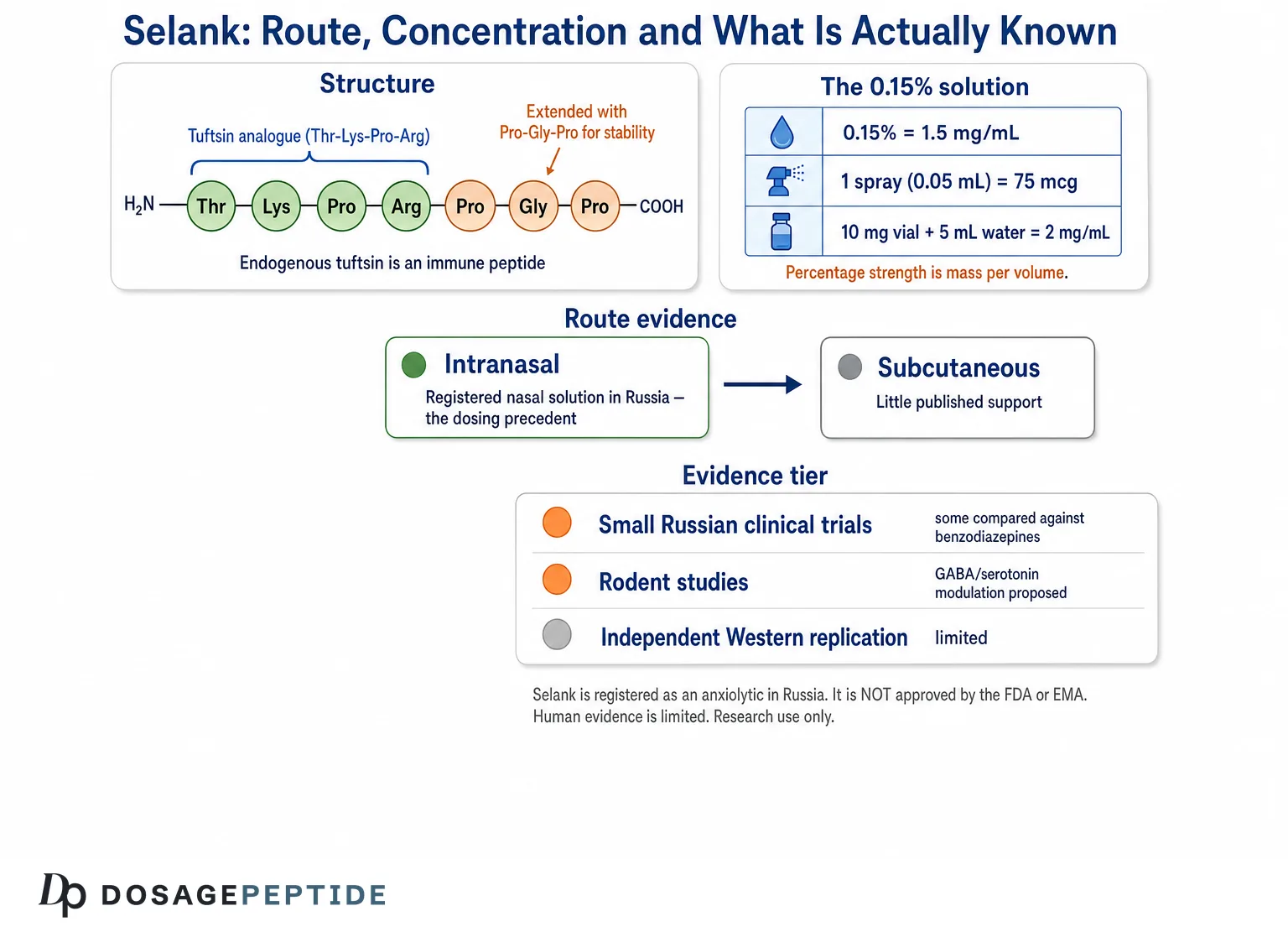
Selank’s proposed mechanism is genuinely interesting and genuinely unsettled. Several distinct lines of work exist, and they are at different tiers.
GABAergic modulation
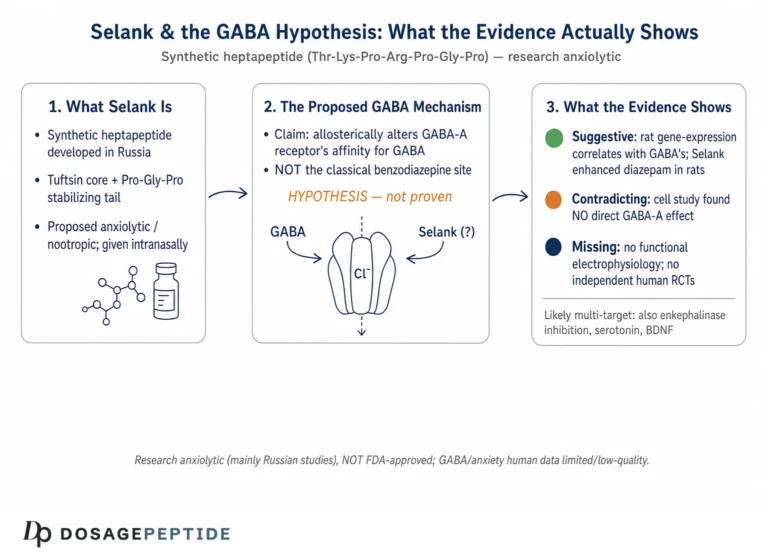
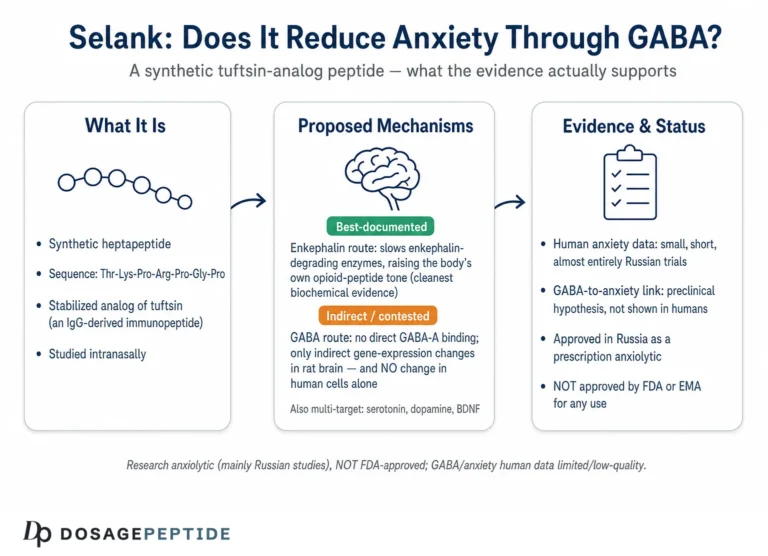
The most-developed hypothesis is that Selank acts on GABAergic neurotransmission. Volkova and colleagues administered Selank intranasally (300 mcg/kg, in a 6 µl volume) or GABA to rats and measured an 84-gene neurotransmission panel in the frontal cortex by real-time PCR, reporting significant expression changes in a large fraction of genes at 1 hour and fewer at 3 hours[9]. Filatova and colleagues extended this into a human neuroblastoma cell line (IMR-32), but found no direct effect: Selank on its own produced no change in the mRNA levels of the genes studied. Its only measured actions were combinatorial — it suppressed the expression changes GABA produced alone, and increased the number of genes altered by olanzapine — which the authors read as partial support for the idea that the peptide affects GABA’s interaction with its receptor rather than gene expression directly[11]. Note that the paper’s title is more affirmative than its result. Vyunova and colleagues reported that Selank affects GABA binding in a manner consistent with allosteric modulation, and that its joint action with benzodiazepines is not simply additive[12]. In the behavioural arm of this literature, Kasian and colleagues gave intranasal Selank at 300 mcg/kg alongside oral diazepam at 1 mg/kg in an unpredictable chronic mild stress model, assessing anxiety on the elevated plus maze[10] — note that the two agents were given by different routes, which limits what a direct comparison between them can mean.
What that body of work supports is a plausible and specific mechanistic hypothesis. What it does not support is the claim, common on vendor pages, that Selank “modulates GABA receptors like a benzodiazepine without the downsides” as an established fact in humans. Gene-expression changes in rat cortex and a neuroblastoma line are mechanistic evidence, not clinical evidence. The mechanism is unpacked further in the discussion of how Selank is proposed to modulate GABAergic activity.
Enkephalin-degrading enzyme inhibition
Kost and colleagues reported that both Semax and Selank dose-dependently inhibit the enkephalin-degrading enzymes from human serum, with a reported half-maximal inhibitory concentration of approximately 20 µM for Selank and 10 µM for Semax[13]. The proposed implication is that Selank could indirectly extend endogenous enkephalin signalling. This is an in vitro serum finding, and the micromolar potency is worth holding onto: micromolar is a relatively weak in vitro concentration, and whether it is reached in relevant tissue after a nasal dose in a human is not established. Whether the finding translates into a meaningful in vivo effect at the amounts described in the clinical literature is unknown.
Neurotrophin effects
Inozemtseva and colleagues reported that intranasal Selank regulates BDNF expression in the rat hippocampus in vivo[8]. Later rodent work reported effects on BDNF content in hippocampus and prefrontal cortex in an ethanol-induced memory impairment model[14]. Both are animal studies. “Raises BDNF” is a frequent marketing line; the accurate version is “alters BDNF expression in rodent brain regions in specific experimental models.”
Immunomodulation — the tuftsin inheritance
Because Selank is a tuftsin analogue, and tuftsin is a phagocytosis-stimulating immunopeptide acting via neuropilin-1[1][2], an immunomodulatory profile is frequently attributed to Selank by inheritance. Structural analogy is a reason to investigate, not a result. Sharing a sequence motif with tuftsin does not establish that Selank reproduces tuftsin’s activity at any particular amount, and the extended PGP tail changes the molecule’s enzymatic fate.
The mechanistic honesty problem
Note that these four mechanisms are not one mechanism. A compound described as simultaneously a GABAergic allosteric modulator, an enkephalinase inhibitor, a neurotrophin regulator and an immunomodulator is a compound whose mechanism is not resolved. That is a normal state for an early-stage molecule. It becomes a problem only when marketing presents the union of all four hypotheses as a settled description.
Current Evidence Level
Stated as precisely as the literature permits:
| Claim | Actual evidence tier |
|---|---|
| Selank is FDA-approved for anxiety | False. No FDA approval, no FDA indication, no FDA labelling |
| Selank is EMA-approved | False. No EU centrally authorised product |
| Selank is registered in Russia as an anxiolytic nasal solution | True — 0.15% (1.5 mg/mL) nasal drops, registration ЛП-№(010951)-(РГ-RU)[3] |
| Selank is legal to compound in the US | No. Not on the 503A Bulks List; was placed in Category 2 and later removed on nomination withdrawal[4][5] |
| Anxiolytic effect comparable to a benzodiazepine | Reported in one trial of 62 patients vs medazepam[7]. Not independently replicated at scale |
| The trial used 1,350 mcg/day for 14 days | Unverified. The indexed abstract states no dose, route or duration. The figure traces to vendor and aggregator pages only. The 14-day course is separately stated in the registered labelling[3] |
| Works through GABA receptors | Mechanistic hypothesis. Rodent gene expression + human cell line + binding work[9][11][12] |
| Raises BDNF | Preclinical, rodent only[8][14] |
| Inhibits enkephalin degradation | In vitro, human serum, IC50 ≈ 20 µM[13] |
| Non-sedating, non-dependence-forming | Asserted in national labelling[3], not established by an inspectable long-term dataset. No published multi-year human safety database identified |
| Established subcutaneous protocol | Does not exist |
Anyone who wants to see how the clinical case has been argued and where it thins out will find the extended treatment at whether clinical research validates Selank’s role in emotional regulation.
Frequency and Duration: What the Literature Reports
Frequency for Selank is not derived from plasma half-life, and understanding why clears up a common confusion.
Small linear peptides of this class are cleared from plasma extremely fast — on the order of minutes, not hours. If frequency were set by parent-compound plasma exposure, dosing would be continuous and pointless. The rationale offered in the literature instead invokes downstream effects that outlast the parent molecule: gene-expression changes measured at 1 and 3 hours post-administration[9], enzyme inhibition, and neurotrophin regulation. That is a coherent story. It is also a story, not a measured human duration-of-effect curve.
What can be said with citation:
- The registered labelling describes a 14-day course and three administrations per day[3]. Fourteen days is a short course for an anxiety indication, and it tells you very little about durability, tolerance or anything beyond two weeks.
- The labelling describes repeat courses as possible after an interval, on medical advice[3]. That is a labelling statement in one country, not evidence about long-term exposure.
- Rodent gene-expression work reports effects at 1 hour that are attenuated by 3 hours[9] — consistent with divided daily administration, but derived from rats and from mRNA, not from human symptom measurement.
What cannot be said with citation: the trial’s own duration and frequency, which the indexed abstract does not report[7]; and cycle lengths. The “5 days on, 2 days off” and “3 weeks on, 1 week off” schemes that dominate search results have no identified trial basis and no labelling basis. They are community convention. Presenting them as protocol is exactly the inflation this page exists to avoid.
Storage and Stability
Storage is one area where general peptide handling principles apply straightforwardly, because the physics does not care about the regulatory tier. For reference, the registered nasal product is labelled for storage at 2–8 °C[3] — refrigerated, which is consistent with a preserved aqueous peptide solution.
| State | General handling described in peptide literature | Notes |
|---|---|---|
| Lyophilised powder, unopened | Cold storage; freezer for long-term, refrigeration for shorter periods | The dry state is the stable state. Moisture is the enemy |
| Reconstituted solution | Refrigerated | Once in solution, chemical degradation pathways open up — hydrolysis, oxidation, aggregation |
| Diluent choice | Bacteriostatic water contains 0.9% benzyl alcohol as preservative; sterile water does not | Sterile water offers no preservative and no protection against microbial growth after the first entry |
| Registered nasal product | Labelled 2–8 °C; preserved with methylparaben[3] | A different preservative system from bacteriostatic water — the two are not equivalent formulations |
| Light and temperature cycling | Avoid both | Repeated freeze–thaw is a recognised degradation accelerant for peptides |
Three Selank-specific points are worth flagging. First, a nasal bottle is not a sealed vial: it is opened, actuated or squeezed, exposed to ambient air and to the nasal environment repeatedly. Its microbiological and stability profile is not the same as a stoppered vial pierced with a fresh needle each time — which is why the registered product carries a preservative in the first place. Second, the volume of diluent needed to reach nasal-range concentrations from a 5 mg or 10 mg vial is large relative to typical vial capacity, which pushes toward transfer, and every transfer is a contamination opportunity as well as a mass-loss opportunity. Third, a solution reconstituted with bacteriostatic water is dilute in a low-mass compound: at 1.5 mg/mL, the difference between a fresh solution and a degraded one is not visible, and there is no home method for detecting loss of peptide content. The general principles are covered in the guide to storing peptides before and after reconstitution, and the mechanics of reconstitution itself in the peptide reconstitution guide.
Selank vs Semax: Two Russian Peptides, Constantly Confused
Selank and Semax are frequently discussed together, sold together, and conflated. They share a developmental origin, a design philosophy and a route — and almost nothing else. In particular they have different parent molecules and different proposed targets: Selank is a tuftsin analogue framed as an anxiolytic; Semax is an ACTH(4-10) analogue framed as a nootropic and neuroprotective agent.
| Selank | Semax | |
|---|---|---|
| Parent molecule | Tuftsin, Thr-Lys-Pro-Arg (an immunopeptide from IgG) | ACTH(4-10), a fragment of adrenocorticotropic hormone |
| Sequence | Thr-Lys-Pro-Arg-Pro-Gly-Pro | Met-Glu-His-Phe-Pro-Gly-Pro |
| Shared design element | Both append the stabilising tripeptide Pro-Gly-Pro to a bioactive parent fragment | |
| Framing in the literature | Anxiolytic | Nootropic / neuroprotective; investigated in cerebral ischemia models[15] |
| Canonical route | Intranasal | Intranasal |
| FDA/EMA status | Neither | Neither |
| Shared finding | Both inhibit enkephalin-degrading enzymes from human serum in vitro (Selank IC50 ≈ 20 µM; Semax ≈ 10 µM)[13] | |
The practical consequence: do not transfer a Semax number to Selank or vice versa. Different parent molecules, different proposed targets, different registered concentrations. The Pro-Gly-Pro tail they share is a stability motif, not a functional equivalence. Interestingly, PGP has itself been examined in the ischemia transcription literature, where Dmitrieva and colleagues reported that its influence on neurotrophin and receptor gene transcription was largely non-specific, in contrast to Semax, which selectively affected transcription[15]. That finding cuts against, rather than for, the idea that the shared tail explains either compound’s activity — which is a useful reminder that the two molecules are related by construction technique, not by pharmacology. Anyone considering how compounds get combined should read the guide to stacking peptides, which is explicit about how little combination evidence exists for most of this category.
Limitations
The constraints on everything above, in order of how much they should change your confidence.
The clinical dataset is one small trial, and its key parameters are not public in English
Sixty-two patients, single-country, conducted in the research ecosystem that developed the compound, published in a Russian-language journal and indexed in English only in abstract translation[7]. The indexed abstract does not state the dose, the route or the treatment duration, which means the three numbers a dosage page most wants from it are the three numbers it does not supply. None of that makes the trial wrong. All of it means the finding has not survived the process — independent replication, larger n, longer follow-up, adversarial scrutiny — that normally converts a promising result into a reliable one.
Why a single-country, single-institute evidence base is structurally fragile
This is not a claim about any country’s science. It is a claim about how error correction works, and it applies identically to a US compound whose entire literature comes from one lab.
Replication is not a courtesy; it is the mechanism by which findings acquire reliability. When every study of a compound comes from one institute or one closely linked network, several correction mechanisms are simply absent:
- Shared methodological assumptions go unchallenged. If one group’s assay, rating-scale administration, blinding procedure or statistical convention has a systematic quirk, it does not average out across studies — it propagates through all of them, because they are all the same group’s studies.
- The file drawer is a single drawer. Publication bias is bad enough across a field. Within one network, a null result has one set of gatekeepers, and no rival group has an incentive to publish the disconfirmation.
- Language partition compounds it. A literature published predominantly in one language, indexed in another only as abstracts, is functionally unauditable by outsiders. Reviewers, meta-analysts and sceptics cannot check what they cannot read, and translation of an abstract is not access to a methods section.
- Commercial proximity. Where the institute that developed a compound is also the source of its clinical evidence and is connected to its marketing authorisation holder, the ordinary separation between the party making a claim and the party testing it is thin.
- Absence of replication is ambiguous, not exculpatory. No independent Western programme has tested the headline claim[6]. That could reflect commercial disinterest in an unpatentable old peptide, or regulatory friction, or scientific judgement that the claim is not worth chasing. The point is that we cannot tell which, and a reader should not resolve that ambiguity in whichever direction they prefer.
The correct posture is therefore neither dismissal nor endorsement. It is: this claim has not been through the process that would make it trustworthy, and it might be true anyway. Most claims in that position turn out to be smaller than advertised. Some do not.
Nobody has independently replicated the headline claim
The claim that Selank is anxiolytically comparable to a benzodiazepine without sedation or dependence liability is, if true, notable. Extraordinary claims of that kind normally attract replication attempts. The absence of a substantial independent Western replication programme[6] is itself information — though, as above, ambiguous information.
The mechanism is unresolved
Four separate mechanistic hypotheses, none converged, largely evidenced in rats and cell lines. Mechanistic plausibility is not efficacy. The in vitro enzyme finding sits at micromolar potency[13], which is not a concentration anyone has demonstrated is reached in a human brain region after a nasal dose.
Research-chemical supply is unverified
Vials sold for research use carry no regulatory guarantee of identity, purity, mass accuracy, endotoxin content or absence of process residues. A “10 mg vial” is a label claim. Every reconstitution table on this page assumes the label is accurate, and that assumption is the largest uncontrolled variable in the entire calculation. If the actual content is 8 mg, every concentration in every row is 20% lower than stated and no arithmetic on this page detects it. A third-party certificate of analysis reduces but does not eliminate this uncertainty, and a certificate supplied by the seller of the vial is a document about the seller as much as about the vial.
Drop-volume approximation
The 0.05 mL drop figure used in the reconstruction above is an approximation. Real drop volumes vary with the dropper, the liquid and the angle. Any drop-based number carries that error bar, and it compounds across a day’s administrations — which is precisely why the labelled 12 drops/day and the circulating 1,350 mcg/day cannot be reconciled without picking a drop volume, and picking one is an assumption rather than a finding.
Nasal-versus-injection bioavailability is not quantified
Without a human bioavailability figure for each route, there is no defensible conversion factor between them for Selank. Any chart offering one is inventing it.
What the evidence does not establish
Stated flatly, because vendor pages routinely state the opposite:
- It does not establish that Selank treats, cures or prevents generalized anxiety disorder, or any other condition, to any regulatory standard recognised by the FDA or EMA.
- It does not establish a safe human amount by any route. One small trial and one national label are not a safety dataset.
- It does not establish long-term safety. There is no inspectable multi-year human data. The absence of reported harm in short exposure is not evidence of long-term safety — it is absence of evidence.
- It does not establish a subcutaneous protocol. Not an under-studied one. A non-existent one.
- It does not establish that Selank is a benzodiazepine substitute. “Comparable Hamilton score reduction versus medazepam in 30 patients” and “substitutes for a benzodiazepine” are separated by an enormous evidentiary distance.
- It does not establish freedom from dependence or withdrawal. The registered label asserts it[3]; a label assertion is not a published controlled dataset, and no such dataset was identified here.
- It does not establish immunomodulatory activity in humans at the reported amounts. That is inherited from tuftsin by structural analogy.
- It does not establish that the widely quoted 1,350 mcg/day figure is correct. It could not be traced to any primary source.
- It does not establish that any of the circulating cycling schedules have a basis. They do not.
Frequently Asked Questions
What is the standard Selank dosage?
There is no standard in any FDA or EMA sense — no approved product, no approved labelling, no recognised human protocol. The registered Russian labelling for the 0.15% nasal drops describes 2 drops in each nostril three times daily for 14 days[3]. That is a description of a foreign product’s label, not a standard and not a recommendation. The widely quoted “1,350 mcg per day” has no primary source this page could verify.
How much bacteriostatic water does a 10 mg Selank vial require for a given concentration?
That depends entirely on the concentration being targeted, and the vial’s physical capacity. The arithmetic is fixed: 10 mg ÷ 1 mL = 10 mg/mL; ÷ 2 mL = 5 mg/mL; ÷ 5 mL = 2 mg/mL; ÷ 6.67 mL = 1.5 mg/mL, which matches the 0.15% concentration of the registered Russian nasal solution. Any chosen volume must be within the vial’s physical capacity — a 3 mL vial cannot hold 6.67 mL.
What does 0.15% Selank mean in mg per mL?
0.15% weight/volume means 0.15 grams per 100 mL. That is 150 mg per 100 mL, which reduces to 1.5 mg per mL, or 1,500 mcg per mL. The registered product’s own labelled composition states 1.5 mg per 1 mL, which agrees[3]. From a 10 mg vial, reaching 1.5 mg/mL requires 10 ÷ 1.5 = 6.67 mL of diluent. From a 5 mg vial, 5 ÷ 1.5 = 3.33 mL.
Is Selank better intranasal or subcutaneous?
The evidence is not symmetric enough for a “better.” Intranasal is the route of the registered Russian product and of the cited rodent work. Subcutaneous has no registered product and no identified published human protocol. That is a difference in evidence base, not a judgement about which produces a better outcome — no head-to-head route comparison in humans has been identified, and no human bioavailability figures exist to convert between them.
How many units on an insulin syringe is a Selank dose?
Only the arithmetic can be given. A U-100 syringe holds 100 units per mL, so one unit is 0.01 mL. For a vial of X mg in Y mL, each unit contains (X/Y) × 10 mcg. A 10 mg vial in 5 mL gives 2 mg/mL, so one unit is 20 mcg and ten units is 200 mcg. Note that insulin syringes are an injection instrument; the studied and registered Selank route is nasal.
Is Selank FDA-approved?
No. Selank has no FDA approval and no FDA-recognised indication. It is registered in the Russian Federation as an intranasal anxiolytic, which is a national registration outside the US and EU regulatory systems[3]. It is also not on the FDA’s Section 503A Bulks List for compounding: it was placed in Category 2 as a substance that may present significant safety risks, then removed following withdrawal of the nomination, and now listed by FDA among “bulk drug substances nominated but withdrawn”[4] — a procedural change, not an approval[5].
How long does Selank last, and why is it dosed multiple times a day?
Small peptides of this class clear from plasma within minutes, so frequency is not set by parent-compound exposure. The rationale offered in the literature is that downstream effects — gene-expression changes measured at 1 and 3 hours in rat frontal cortex[9], enzyme inhibition, neurotrophin regulation — outlast the molecule. That is a mechanistic rationale, not a measured human duration-of-effect curve.
What is the difference between Selank and Semax?
Different parent molecules with the same design trick, and they are frequently confused. Selank is tuftsin (Thr-Lys-Pro-Arg, an immunopeptide from IgG) extended with Pro-Gly-Pro, framed as anxiolytic. Semax is ACTH(4-10)-derived (Met-Glu-His-Phe) extended with the same Pro-Gly-Pro tail, framed as nootropic and neuroprotective. Different targets, both intranasal, both Russian-developed, neither FDA or EMA approved. Their numbers are not interchangeable.
Do Selank cycles like “5 days on, 2 days off” have research support?
No identified trial basis and no labelling basis. The registered Russian label describes a continuous 14-day course with repeat courses after an interval on medical advice[3]. Cycling schedules circulating online are community convention and vendor copy. They may be sensible caution or they may be arbitrary; the point is that they are not findings, and describing them as protocol misrepresents where they came from.
References
- Fridkin M, Gottlieb P. Tuftsin, Thr-Lys-Pro-Arg. Anatomy of an immunologically active peptide. Mol Cell Biochem. 1981. PubMed: 7035869
- Tuftsin signals through its receptor neuropilin-1 via the transforming growth factor beta pathway. J Neurochem. 2013. PubMed: 24033337
- Selank (Селанк), nasal drops 0.15% — registered product entry and labelling, registration no. ЛП-№(010951)-(РГ-RU), marketing authorisation holder Peptogen (Russian Federation). Register of Medicines of Russia (RLS), reproducing the State Register of Medicines entry; accessed 17 July 2026. rlsnet.ru — Селанк
- US Food and Drug Administration. Certain Bulk Drug Substances for Use in Compounding That May Present Significant Safety Risks (Category 2 list). FDA
- US Food and Drug Administration. Bulk Drug Substances Used in Compounding Under Section 503A of the FD&C Act. FDA
- ClinicalTrials.gov search for intervention “Selank”, accessed 17 July 2026 — returned no studies with Selank as an intervention. ClinicalTrials.gov
- Zozulia AA, Neznamov GG, Siuniakov TS, Kost NV, et al. Efficacy and possible mechanisms of action of a new peptide anxiolytic selank in the therapy of generalized anxiety disorders and neurasthenia. Zh Nevrol Psikhiatr Im S S Korsakova. 2008 (Russian). PubMed: 18454096
- Inozemtseva LS, Karpenko EA, Dolotov OV, et al. Intranasal administration of the peptide Selank regulates BDNF expression in the rat hippocampus in vivo. Dokl Biol Sci. 2008;421:241-3. PubMed: 18841804
- Volkova A, Shadrina M, Kolomin T, et al. Selank Administration Affects the Expression of Some Genes Involved in GABAergic Neurotransmission. Front Pharmacol. 2016;7:31. PMC4757669
- Kasian A, Kolomin T, Andreeva L, et al. Peptide Selank Enhances the Effect of Diazepam in Reducing Anxiety in Unpredictable Chronic Mild Stress Conditions in Rats. Behav Neurol. 2017;2017:5091027. doi:10.1155/2017/5091027
- Filatova E, Kasian A, Kolomin T, et al. GABA, Selank, and Olanzapine Affect the Expression of Genes Involved in GABAergic Neurotransmission in IMR-32 Cells. Front Pharmacol. 2017;8:89. PMC5328971
- Vyunova TV, Andreeva L, Shevchenko K, Myasoedov N. Peptide-based Anxiolytics: The Molecular Aspects of Heptapeptide Selank Biological Activity. Protein Pept Lett. 2018;25(10):914-923. Protein and Peptide Letters
- Kost NV, Sokolov OYu, Gabaeva MV, Grivennikov IA, Andreeva LA, Myasoedov NF, Zozulya AA. Semax and selank inhibit the enkephalin-degrading enzymes from human serum. Bioorg Khim. 2001;27(3):180-3. PubMed: 11443939
- Selank, Peptide Analogue of Tuftsin, Protects Against Ethanol-Induced Memory Impairment by Regulating of BDNF Content in the Hippocampus and Prefrontal Cortex in Rats. Bull Exp Biol Med. 2019. Bulletin of Experimental Biology and Medicine
- Dmitrieva VG, Povarova OV, Skvortsova VI, Limborska SA, Myasoedov NF, Dergunova LV. Semax and Pro-Gly-Pro Activate the Transcription of Neurotrophins and Their Receptor Genes after Cerebral Ischemia. Cell Mol Neurobiol. 2009. PMC11498467
Research-use-only disclaimer. This page is an educational reference describing what published research literature and foreign registered-product labelling report about Selank. Selank is not approved by the FDA or the EMA for any indication, and is not on the FDA’s Section 503A Bulks List for pharmacy compounding. Descriptions of the registered Russian labelling are reproduced as a factual account of a foreign regulatory document and are not offered as guidance to any reader. Nothing here is a recommendation, protocol, or endorsement for human use, and no statement on this page should be read as a suggestion that Selank treats, cures, prevents, or mitigates any disease or condition. The reconstitution mathematics is presented as verifiable arithmetic for laboratory and educational reference only. Dosage Peptide is an independent research reference library and does not sell peptides. Consult a qualified, licensed healthcare professional for any question about health, and comply with all applicable laws and institutional requirements governing the handling of research compounds.