The only SS-31 dose a regulator has ever reviewed is 40 mg subcutaneously, once daily. That is the label dose for FORZINITY (elamipretide), which the FDA approved on 19 September 2025 for Barth syndrome in patients weighing at least 30 kg.[1] The research protocols circulating for 10 mg and 30 mg vials reference something quite different: 5 mg daily for two weeks, then 10 mg daily — four to eight times smaller than the approved dose.
Both numbers are real, and the distance between them is the most useful thing on this page. What follows: the exact reconstitution math for a 10 mg or 30 mg lyophilised vial, how many insulin units each figure puts on the syringe, where the circulating protocol numbers came from, what the human trials actually measured, what safety signals appear in that data, and why a research vial and an approved 80 mg/mL solution are not the same product at a smaller dose.
What does “SS-31” actually refer to, and why does the name matter?
SS-31 is one of the most name-fragmented molecules in the peptide research space, and the fragmentation is not trivial — it is the reason so many pages about it are out of date.
The compound is a synthetic tetrapeptide with the sequence D-Arg-2’,6’-dimethylTyr-Lys-Phe-NH2 (commonly written D-Arg-Dmt-Lys-Phe-NH2).[2] Four amino acids, one amidated C-terminus, and a molecular architecture that has attracted more than two decades of mitochondrial research. It has carried at least five names across its lifetime:
| Name | Context in which it is used |
|---|---|
| SS-31 | The original laboratory designation — “SS” for Szeto–Schiller, the two investigators (Hazel Szeto and Peter Schiller) whose peptide series produced it. This is the name used in preclinical literature and on research-chemical vials. |
| Elamipretide | The INN (international non-proprietary name) — the name used in every clinical trial publication and in the FDA label. |
| MTP-131 | An early Stealth BioTherapeutics development code, seen in older cardiology trial records. |
| Bendavia | A historical trade name used during the cardiac ischaemia–reperfusion programme. |
| FORZINITY | The approved brand name of the finished pharmaceutical product (elamipretide hydrochloride injection), approved September 2025. |
Why this matters practically: if you search “SS-31” you land almost exclusively on research-chemical content, much of which was written before September 2025 and still describes the molecule as “investigational, not approved.” That statement is now partially false. If you search “elamipretide,” you land on a completely different corpus — failed phase 3 trials, an FDA advisory committee, a complete response letter, and eventually an approval. Both corpora describe the same tetrapeptide. Only together do they tell the truth.
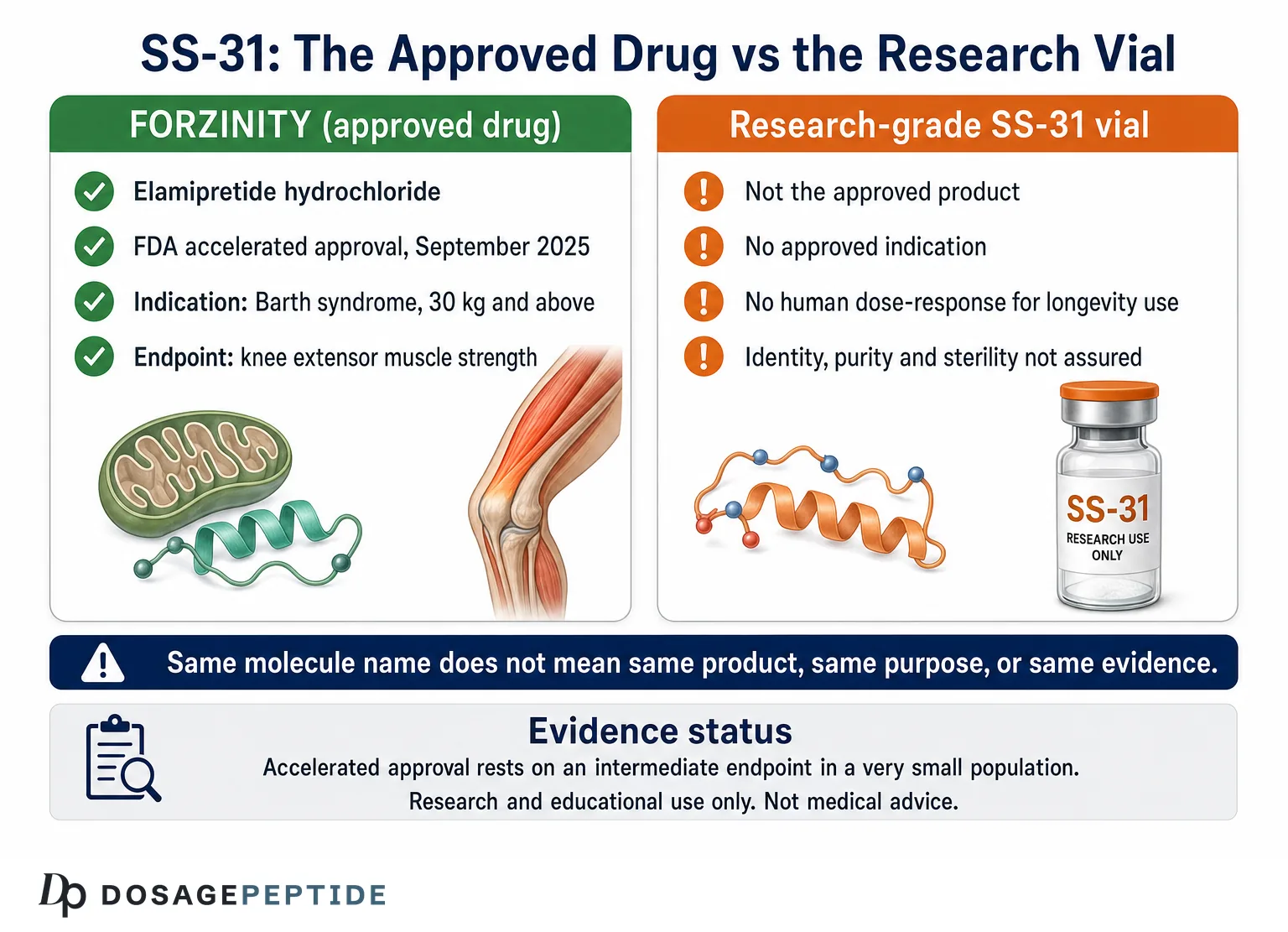
The second reason the naming matters is regulatory. A research-grade vial labelled “SS-31” is not FORZINITY. They may nominally contain the same peptide sequence, but they are not the same product: one is a manufactured pharmaceutical with an FDA-reviewed identity, purity, sterility, and stability dossier, a preservative system, and a defined concentration; the other is a lyophilised powder sold for laboratory use with no regulatory assurance of what is actually in the vial. That distinction is developed in detail below, and it is not a formality — it changes what any dose number actually means. For broader background on the molecule’s biology, see our overview of what SS-31 (elamipretide) is and how mitochondrial research uses it.
What is the approved dose of SS-31 (elamipretide)?
This is the single most useful number on this page, because it is the only SS-31 dose that has been reviewed by a regulator and printed on a label.
On 19 September 2025, the FDA granted accelerated approval to FORZINITY (elamipretide hydrochloride) injection, from Stealth BioTherapeutics, as the first treatment for Barth syndrome in patients weighing at least 30 kg.[1] The label states the indication precisely: FORZINITY “is indicated to improve muscle strength in adult and pediatric patients with Barth syndrome weighing at least 30 kg.”[3]
The label’s dosing statement is equally specific:[3]
| Label parameter | Documented value |
|---|---|
| Recommended dosage (≥30 kg) | 40 mg subcutaneously once daily |
| Volume per dose | 0.5 mL (contains 40 mg elamipretide, equivalent to 46.8 mg elamipretide hydrochloride) |
| Product concentration | 80 mg/mL — supplied as 280 mg / 3.5 mL |
| Presentation | Ready-to-use sterile aqueous solution, single-patient-use vial. Not a lyophilised powder — nothing is reconstituted. |
| Injection sites | Abdomen (at least two inches from the navel) or outer thigh, rotating sites daily |
| Severe renal impairment (eGFR <30 mL/min) | Halved to 20 mg once daily in adults not on dialysis. The label states there is insufficient information to recommend a regimen for adults with eGFR <30 mL/min who are on dialysis, or for paediatric patients weighing 30 kg or more with renal impairment. |
| Storage | 2°C–8°C, do not freeze; after opening, refrigerated or room temperature (20–25°C), discard 8 days after opening |
| Preservative | Benzyl alcohol, 20 mg per mL (10 mg per 0.5 mL dose) — carries a benzyl alcohol toxicity warning; not for neonates |
Four details of that table deserve to be flagged, because they are exactly the details that get lost when the number “40 mg” is repeated without context.
The approval is narrow — one disease, one endpoint, one country
The indication is Barth syndrome: an X-linked recessive, ultra-rare genetic disorder caused by pathogenic variants in the TAFAZZIN gene (formerly symbolised TAZ), with a worldwide incidence estimated around 1 in 300,000–400,000 live births.[4] The FDA’s own review puts the affected United States population at approximately 150 patients.[14] The approved claim is improvement in muscle strength — not survival, not cardiac outcomes, not fatigue, not longevity.
To be explicit, because the internet is already blurring this: elamipretide is not approved for anti-aging, longevity, general mitochondrial dysfunction, athletic performance, cognitive enhancement, heart failure, kidney disease, or eye disease. The approval of a drug for one ultra-rare monogenic condition is not regulatory validation of any of those uses. If anything, as the evidence section below shows, the trials that did test elamipretide in broader populations largely failed.
The approval is also United States only. The FDA is a US regulator; no other agency has approved elamipretide for any indication. In the European Union, elamipretide holds an orphan designation for Barth syndrome, granted in 2021 — but orphan designation is a development incentive, not a marketing authorisation, and no European marketing authorisation has been granted. Outside the United States, elamipretide remains an unapproved investigational drug in every indication.
“Accelerated approval” is a conditional status, not a full one
The FDA’s accelerated approval pathway allows earlier approval of drugs for serious conditions with unmet need on the basis of an endpoint that is reasonably likely to predict clinical benefit rather than one that measures the benefit directly.[1] For FORZINITY, that endpoint was muscle strength of the knee extensors measured by hand-held dynamometry (HHD) — explicitly characterised in the FDA review as an intermediate clinical endpoint for accelerated approval.[14] The label carries the corresponding statement: the indication is approved under accelerated approval based on an improvement in knee extensor muscle strength, an intermediate clinical endpoint, and continued approval may be contingent upon verification and description of clinical benefit in a confirmatory trial.[3]
In plain terms: the FDA accepted that leg-extension strength is probably a stand-in for meaningful benefit in Barth syndrome, and reserved the right to withdraw the approval if confirmatory data do not bear that out. This is a genuinely different epistemic status from, say, a statin approved on hard cardiovascular outcomes. The review is unusually blunt about the trade-off: the endpoint “assessed only a single muscle group and was not accompanied by compelling evidence of clinical benefit (i.e., an improvement in how patients feel, function, or survive).”[14]
The approved product is a solution, not a powder
This is the detail that most directly affects anyone comparing a research vial to the label. FORZINITY arrives as a ready-to-use liquid at 80 mg/mL. There is no reconstitution step, no bacteriostatic water, no dilution decision. The 40 mg dose is simply 0.5 mL drawn from a single-patient-use vial containing 3.5 mL, discarded 8 days after first opening.[3] A research “SS-31” vial, by contrast, is a lyophilised cake that must be reconstituted — and as shown below, at the concentration research protocols actually document, reproducing a 40 mg dose would be physically impossible from a 10 mg vial and would require an implausible injection volume even from larger ones.
How does a research-grade SS-31 vial differ from the approved product?
This comparison exists because a great deal of SS-31 content now leans on “FDA-approved” as though the status transfers to the vial in the reader’s freezer. It does not.
| Attribute | FORZINITY | Research-grade “SS-31” vial |
|---|---|---|
| Identity verified | Yes — FDA-reviewed manufacturing and specifications | No regulatory assurance; third-party COAs vary widely in scope and independence |
| Purity specification | Defined and enforced | Vendor-stated at best; impurity profile typically uncharacterised |
| Sterility | Manufactured sterile, preserved with benzyl alcohol at 20 mg/mL | Not assured |
| Concentration | Fixed at 80 mg/mL | Whatever you make it — typically 10 mg/mL |
| Stability data | Established; 8-day in-use limit after opening | Generally none for the reconstituted solution |
| Actual content | Matches label | Unverified — mass, sequence, and salt form may all differ |
| Legal status | Prescription medicine | Research use only — not for human use |
The mass-accuracy point is worth spelling out because it silently corrupts every dose calculation on this page. All the arithmetic below assumes the vial contains exactly 10 mg or 30 mg of the peptide. If a vial labelled 10 mg contains only 8 mg of peptide plus salt and residual water — i.e. reconstituting with 1.0 mL yields 8 mg/mL, not 10 mg/mL — then “50 units” is not 5 mg. It is 0.50 mL × 8 mg/mL = 4 mg, and the entire chart is wrong by 20% in a direction the user cannot detect.
Note too that the FDA label distinguishes 40 mg elamipretide from 46.8 mg elamipretide hydrochloride.[3] If a research vial’s labelled “10 mg” refers to salt mass rather than free base, the actual peptide content is about 8.5 mg (40 ÷ 46.8 = 85.5%) — a roughly 15% shortfall. Research vials frequently do not state which basis their labelled mass refers to, and research-grade SS-31 is commonly supplied as an acetate or trifluoroacetate salt, whose counter-ion fraction differs again from the hydrochloride. The correct framing is therefore: the FDA approval tells you the molecule can be manufactured to pharmaceutical standard and does something measurable in one rare disease at 40 mg/day. It tells you nothing whatsoever about the contents of any particular research vial. Storage handling for lyophilised and reconstituted peptides generally is a separate question, and the reconstituted-solution stability of a research vial is typically undocumented.
Research Context: how did an early-2000s peptide reach approval in 2025?
Understanding the dose gap requires understanding the arc of the molecule, which is unusually long and unusually bumpy.
Origins: a mitochondria-seeking peptide series
SS-31 emerged from the Szeto–Schiller peptide series — a family of small, cell-permeable peptides built on an alternating aromatic–cationic motif. The design problem they solved was counterintuitive. Molecules that carry net positive charge normally cross membranes poorly. Yet the SS peptides are highly cell-permeable and concentrate in the inner mitochondrial membrane without requiring the membrane potential to get there. The proposed explanation is that the aromatic rings (dimethyltyrosine, phenylalanine) shield the positive charges through their π-orbital electrons, producing an amphipathic molecule that is simultaneously at home in the lipid bilayer and in aqueous cytosol.[2]
Hazel Szeto’s 2014 review in the British Journal of Pharmacology framed SS-31 as the first-in-class cardiolipin-protective compound, and that framing has held up: the molecule’s identity is defined by what it binds, not by a receptor it activates.[5]
The clinical programme: broad ambitions, repeated misses
Stealth BioTherapeutics pursued elamipretide across an unusually wide front — cardiac, renal, ophthalmic, neuromuscular. The results, honestly summarised, are a long list of negative primary endpoints with recurring positive secondary signals. That pattern is discussed in the evidence section, but the timeline itself is instructive:
| Era | Programme | Outcome |
|---|---|---|
| ~2012–2016 | Cardiac ischaemia–reperfusion (MTP-131 / Bendavia; EMBRACE-STEMI, IV) | Did not reduce myocardial infarct size[2] |
| 2020 | PROGRESS-HF (heart failure with reduced ejection fraction) | Primary endpoint (LVESV) not met at either 4 mg or 40 mg[6] |
| ~2019–2024 | ReCLAIM-2 (geographic atrophy in dry AMD) | Co-primary endpoints not met; secondary ellipsoid zone signal[7] |
| 2023 | MMPOWER-3 (primary mitochondrial myopathy, phase 3) | Both primary endpoints missed[8] |
| 2020–2024 | TAZPOWER / SPIBA-201 (Barth syndrome), Part 1 randomised crossover + Part 2 open-label extension (up to 192 weeks per the label; 168-week results published) | Randomised crossover phase negative on every endpoint; OLE showed sustained functional improvement[14][9] |
| 10 Oct 2024 | FDA Cardiovascular and Renal Drug Advisory Committee (CRDAC) | Voted 10 “Yes” and 6 “No” on whether elamipretide is effective for the treatment of Barth syndrome[14] |
| May 2025 | Complete Response Letter issued despite the positive adcomm vote | FDA noted knee extensor strength by HHD could be reasonable as an intermediate clinical endpoint, and flagged manufacturing facility deficiencies[14] |
| Aug 2025 | NDA resubmitted 15 August 2025 seeking accelerated approval on knee extensor strength | Manufacturing deficiencies confirmed resolved; endpoint reframed as an intermediate clinical endpoint[14] |
| 19 Sep 2025 | Accelerated approval as FORZINITY | First therapy for Barth syndrome[1] |
Read that table again with the research-vial market in mind. The molecule that reached approval did so after failed programmes in cardiac reperfusion, heart failure, geographic atrophy and primary mitochondrial myopathy — and then only in the narrowest possible population, on an intermediate endpoint, after a rejection, and over its own review team’s objection. That is not the profile of a molecule with an established broad efficacy signature. It is the profile of a mechanistically interesting compound that has been very hard to demonstrate benefit with.
Mechanisms Studied: what does SS-31 do at the inner mitochondrial membrane?
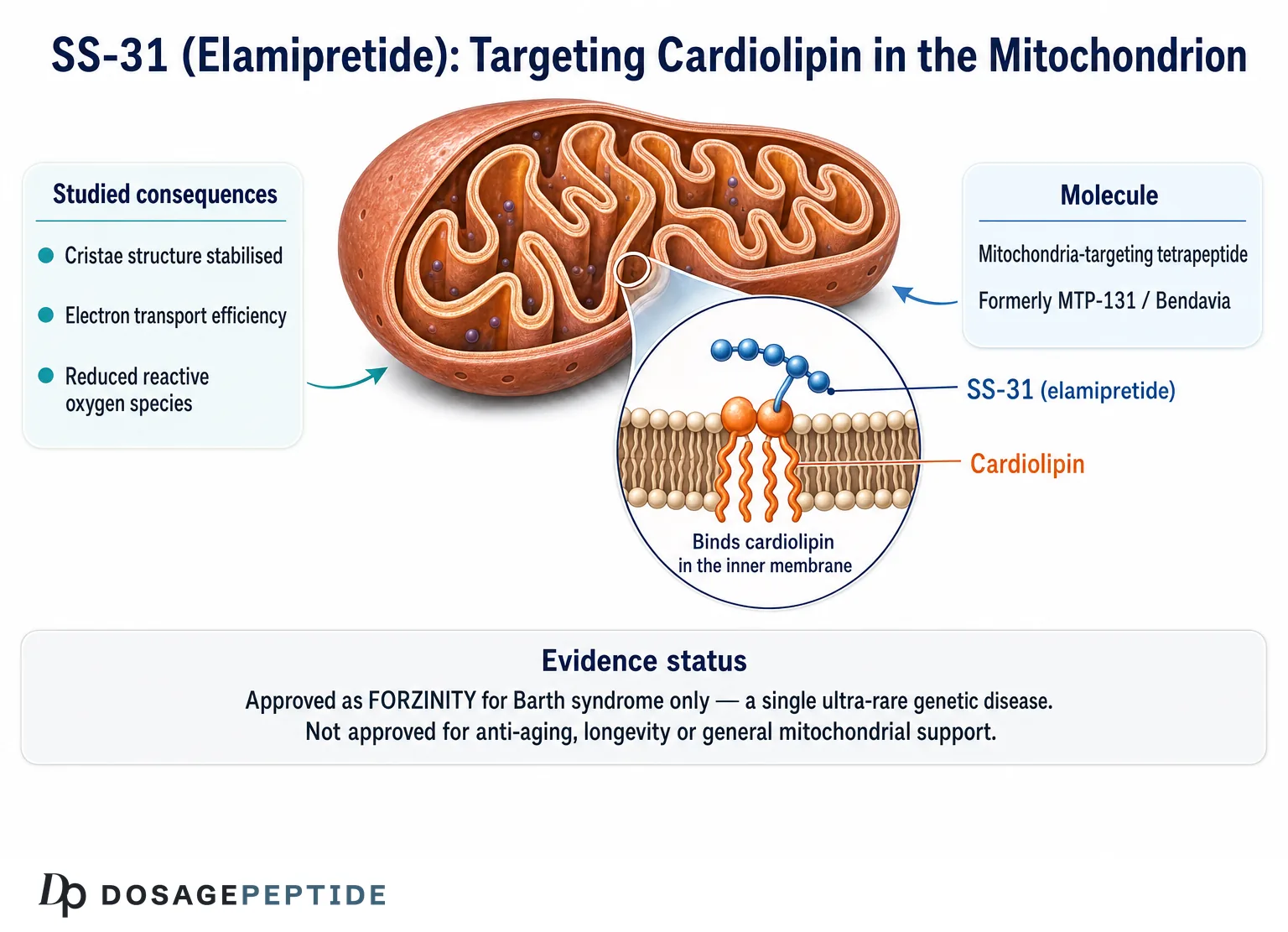
The mechanistic story is the strongest part of the SS-31 literature, and it is worth understanding properly, because it explains both the enthusiasm and the clinical disappointments.
Cardiolipin: the target
Cardiolipin is a distinctive phospholipid — it carries four acyl chains rather than the usual two, and in mammals it is found essentially exclusively in the inner mitochondrial membrane. It is not a passive structural lipid. It performs at least three jobs:
- Cristae architecture. Cardiolipin’s conical shape favours the tight membrane curvature that forms cristae — the folds that provide the surface area for oxidative phosphorylation.
- Respiratory supercomplex organisation. Cardiolipin acts as molecular glue holding electron transport chain complexes into higher-order supercomplexes, which improves the efficiency of electron transfer between them.
- Cytochrome c gatekeeping. This is the elegant part. Cytochrome c bound to intact cardiolipin behaves as an electron carrier. When cardiolipin is peroxidised, the cardiolipin–cytochrome c complex changes conformation and cytochrome c acquires peroxidase activity — it starts generating oxidative damage instead of carrying electrons, and the pathway tips toward cristae disorganisation and apoptosis.[5]
What SS-31 is proposed to do about it
SS-31 concentrates in the inner mitochondrial membrane and binds cardiolipin through combined electrostatic and hydrophobic interactions.[5] The downstream consequences reported across preclinical work are:
- Prevention of the cytochrome c peroxidase switch — SS-31 preserves cytochrome c’s electron-carrying role while blocking the peroxidase conversion.
- Reduced ROS generation at source — by improving electron transfer efficiency, less electron leak, so fewer reactive oxygen species. This is mechanistically distinct from a conventional antioxidant, which mops up ROS after they form.
- Cristae stabilisation and supercomplex assembly — improved organisation and stability of complexes I, III and IV.[2]
- Preserved membrane potential and mPTP resistance — reduced propensity for mitochondrial permeability transition pore opening.
More recent biophysical work has refined the picture, arguing that SS-31’s action is better described as modulating the surface electrostatics of the membrane rather than as classic lock-and-key binding to a single site — SS-31 interacts with anionic lipid bilayers generally and alters the surface charge environment in which membrane proteins operate.[11] That is a subtler and less tidy mechanism than “it protects cardiolipin,” and it may partly explain why effects have been hard to translate.
Why Barth syndrome is the one place the mechanism fits
Barth syndrome is, in essence, a cardiolipin disease. Pathogenic TAFAZZIN variants disable tafazzin, a transacylase that remodels immature cardiolipin into its mature acyl composition. A deficiency in tafazzin results in up to a 95% reduction in levels of structurally mature cardiolipin, with accumulation of the intermediate monolysocardiolipin (MLCL). The resulting elevated MLCL/CL ratio is diagnostic of the condition.[4]
So: a cardiolipin-binding drug, in a disease defined by defective cardiolipin, in the tissues with the highest mitochondrial density (heart, skeletal muscle). The mechanistic match looks about as clean as drug development gets. The TAZPOWER open-label extension reported that MLCL/CL values improved and correlated with clinical outcomes — apparently a rare instance of the biomarker moving in the direction the mechanism predicts.[9]
That report should be read alongside the regulator’s assessment of the same data, which points the other way. FDA reviewers noted that elamipretide “does not directly target the underlying genetic defect that causes BTHS, nor does it meaningfully impact the elevated cardiolipin ratio, the direct sequelae of the mutation in the Tafazzin gene.” And the agency’s Complete Response letter rested in part on its inability to conclude that effectiveness had been established for accelerated approval “based on left ventricular stroke volume (LVSV), the monolysocardiolipin (MLCL):tetralinoleoyl cardiolipin (CL) ratio, or acylcarnitines as surrogate endpoints reasonably likely to predict clinical benefit.”[14] In other words: the one biomarker that would most directly validate the cardiolipin mechanism was formally rejected by the FDA as a surrogate. The mechanism’s elegance did not survive contact with the regulatory record intact.
And this is precisely where the extrapolation to healthy-ageing use runs into trouble. Barth syndrome patients have a catastrophic, genetically-determined cardiolipin deficit. A healthy 45-year-old has, at most, the gradual age-associated shifts in cardiolipin content and composition described in the ageing literature. Whether a drug that helps in the former does anything measurable in the latter is an open question that no human trial has answered. The mechanism’s appeal in Barth syndrome is not transferable evidence.
How is SS-31 reconstituted, and what does a 10 mg or 30 mg vial give you?
Here is the concrete part. The figures below match our protocol pages for the SS-31 10 mg vial protocol and the SS-31 30 mg vial protocol, and they describe what documented research protocols reference — not a recommendation to anyone.
The reconstitution arithmetic
Concentration is simply mass divided by volume:
Concentration (mg/mL) = peptide mass (mg) ÷ diluent volume (mL)
| Vial | Bacteriostatic water added | Resulting concentration | Does the volume fit? |
|---|---|---|---|
| 10 mg | 1.0 mL | 10 mg ÷ 1.0 mL = 10 mg/mL | Yes — 1.0 mL fits a standard 10 mg vial with ample headroom |
| 30 mg | 3.0 mL | 30 mg ÷ 3.0 mL = 10 mg/mL | Only if the vial holds more than 3 mL — 3.0 mL fills a nominal 3 mL vial to capacity, leaving no headroom for mixing. Confirm the vial’s stated volume before adding 3.0 mL. |
Both fills land on the same working concentration: 10 mg/mL. This is deliberate and it is the useful part — whichever vial size is in front of you, the units-per-milligram maths is identical. The 30 mg vial simply lasts three times longer.
Converting to insulin syringe units
A U-100 insulin syringe is marked in “units” that refer to insulin, not to peptide mass. The only conversion that matters is volumetric:
1 unit = 0.01 mL. 100 units = 1.00 mL.
At 10 mg/mL, therefore:
- 1 unit = 0.01 mL × 10 mg/mL = 0.1 mg = 100 mcg
- 1 mg = 10 units
- 5 mg = 50 units = 0.50 mL
- 10 mg = 100 units = 1.00 mL
| Dose (mg) | Volume at 10 mg/mL | U-100 units | Doses from a 10 mg vial | Doses from a 30 mg vial |
|---|---|---|---|---|
| 1 mg | 0.10 mL | 10 units | 10 | 30 |
| 2.5 mg | 0.25 mL | 25 units | 4 | 12 |
| 5 mg | 0.50 mL | 50 units | 2 | 6 |
| 7.5 mg | 0.75 mL | 75 units | 1 (with 2.5 mg remaining) | 4 |
| 10 mg | 1.00 mL | 100 units | 1 | 3 |
| 40 mg (the approved label dose) | 4.00 mL | 400 units | Impossible — exceeds vial contents | Impossible — would consume 40 mg from a 30 mg vial |
That last row is the single most informative line on this page, and we will come back to it.
The practical volume problem at 10 mg
A 10 mg dose at 10 mg/mL is a full 1.00 mL subcutaneous injection. Subcutaneous volumes are conventionally kept at or below about 1 mL per site, so 1.00 mL sits at that ceiling rather than comfortably inside it. Larger single-site volumes are generally associated with more local discomfort and backflow, though no controlled data characterise this for SS-31 specifically.
Note the contrast with the approved product: FORZINITY delivers four times more peptide (40 mg) in half the volume (0.5 mL), because it is formulated at 80 mg/mL rather than 10 mg/mL. Formulation concentration, not peptide identity, is what makes the label dose physically deliverable.
A reader might reasonably ask: why not just reconstitute a 30 mg vial with 0.375 mL to hit 80 mg/mL (30 ÷ 0.375 = 80) and match the label? Several reasons. That volume is often insufficient to properly dissolve the lyophilised cake; measuring 0.375 mL accurately with a U-100 syringe — 37.5 units, between two markings — is unreliable; and concentrated peptide solutions raise solubility and stability questions that a research vial’s (typically absent) stability data cannot answer. The preservative point is worth stating precisely rather than dramatically: bacteriostatic water is 0.9% benzyl alcohol, about 9 mg/mL, so the resulting solution would carry benzyl alcohol at roughly half the commercial formulation’s 20 mg/mL — with no preservative-efficacy or stability testing behind it. The general principles are covered in our peptide reconstitution guide, and the arithmetic can be checked against our peptide dosage calculator. But the deeper point stands: matching a pharmaceutical concentration from a research powder is not simply an arithmetic exercise.
What dose per day do documented research protocols reference?
Our protocol pages document a titrated 8-week course: 5 mg once daily (50 units) for weeks 1–2, then 10 mg once daily (100 units) for weeks 3–8. This is a description of what circulating research protocols specify. It is not advice, it is not a recommendation, and — critically — it is not a dose validated by any human trial for the purposes people typically use it for.
Laid out plainly:
| Parameter | Documented research protocol | FORZINITY label |
|---|---|---|
| Dose per day | 5 mg (weeks 1–2), then 10 mg (weeks 3–8) | 40 mg |
| Frequency | Once daily | Once daily |
| Route | Subcutaneous | Subcutaneous |
| Duration | ~8 weeks | Chronic / ongoing |
| Concentration injected | 10 mg/mL (self-reconstituted) | 80 mg/mL (manufactured) |
| Volume per injection | 0.50–1.00 mL | 0.5 mL |
| Evidence for this dose | None in humans for the intended use | SPIBA-201 / TAZPOWER (Barth syndrome), n very small |
Consumption maths, for planning purposes. The titrated course is (14 days × 5 mg) + (42 days × 10 mg) = 70 mg + 420 mg = 490 mg total — forty-nine 10 mg vials, or roughly sixteen-and-a-third 30 mg vials. For comparison, 56 days at the 40 mg label dose would be 2,240 mg: about 75 of the 30 mg vials, or more than one full 30 mg vial every single day.
Why is there a four-to-eight-fold gap between research protocols and the trial dose?
This is the question the SS-31 search results almost never address, and it deserves a serious answer rather than a dismissal in either direction.
The gap is arithmetically stark. The only subcutaneous dose with a real human evidence base is 40 mg/day — used in MMPOWER-3 (n=218),[8] in PROGRESS-HF’s high-dose arm,[6] in ReCLAIM-2,[7] in TAZPOWER,[9] and now printed on the FDA label.[3] Research protocols reference 5–10 mg/day. That is 4× to 8× lower.
The candidate explanations, and what is wrong with each
“Lower doses suffice for maintenance rather than disease.” This is the most common rationalisation and it is unfalsifiable as stated. There is no human dose-response study for “mitochondrial support in healthy or ageing individuals” because there is no human trial of that indication at all. You cannot claim a dose is sufficient for an endpoint that has never been measured.
“Mitochondrial accumulation means plasma exposure understates the effect.” This one has genuine mechanistic support — SS-31 does concentrate in mitochondria far above plasma levels, and the label’s pharmacokinetics show rapid absorption (Cmax at 0.5–1 hour), high subcutaneous bioavailability (~92%), and essentially complete renal recovery of drug and metabolites by 48 hours with minimal accumulation.[3] The tissue-versus-plasma dissociation is real. But it cuts both ways: it does not tell you that 5 mg reaches a mitochondrial concentration that does anything. It tells you that plasma is a poor guide — which is an argument for uncertainty, not for a lower dose.
“The animal data used lower doses.” Superficially plausible and worth examining carefully. Siegel et al. (2013) used 3 mg/kg intraperitoneally in aged mice.[12] Chiao et al. (2020) used 3 µg/g body weight/day (i.e. 3 mg/kg/day) subcutaneously via osmotic minipump.[13] Those numbers look small next to 40 mg — until you notice they are per kilogram, and that naive mg/kg scaling from mouse to human is not a valid conversion. Interspecies dose translation requires body-surface-area normalisation and species-specific factors, and even properly executed it produces a starting point for a phase 1 trial, not a usable human dose. We will not manufacture a human number from these studies and present it as meaningful, and you should be sceptical of any page that does. The honest statement is: the mouse doses do not justify 5–10 mg/day in a human, and they do not refute it either. They are silent on the question.
The explanation nobody wants to print: cost and volume. At 10 mg/mL, a 40 mg dose is 4.0 mL — not deliverable subcutaneously at one site, and requiring more than a full 30 mg vial every single day. An 8-week course at label dose would need roughly 75 of the 30 mg vials. The 5–10 mg figure is compatible with what a research vial can physically and economically deliver. That is an argument about logistics, not about pharmacology — and a dose derived from what fits in the vial is not a dose derived from evidence.
The uncomfortable conclusion
There are only two coherent possibilities, and both are unfavourable:
- The 40 mg dose is roughly the right dose — in which case 5–10 mg/day is likely sub-therapeutic, and the research protocol is a homeopathic gesture at a drug that mostly failed at its full dose anyway.
- 5–10 mg/day is meaningfully active for some other endpoint — in which case this is an entirely unstudied dose, for an entirely unstudied indication, with no human data of any kind, and the fact that the same molecule was approved at four to eight times the dose for a different disease tells you precisely nothing about it.
In neither case does the FDA approval of FORZINITY provide support for a 5–10 mg/day research protocol. If anything, the approval sharpens the problem by establishing, on the record, what dose the developers actually thought was necessary.
Current Evidence Level: what has SS-31 actually been shown to do in humans?
Evidence tiers, stated precisely, because this is where most SS-31 content collapses into vagueness.
Tier 1: FDA-approved — one disease, one endpoint, conditionally, in one country
Barth syndrome, muscle strength, elamipretide 40 mg SC daily, accelerated approval, September 2025.[1] This is real and it is a genuine milestone — the first approved treatment for the disease, in a population the FDA estimates at roughly 150 US patients.[14]
But the supporting dataset is small enough to state in one sentence. TAZPOWER — the trial the FDA calls SPIBA-201 — randomised 12 patients in Part 1, a double-blind placebo-controlled crossover with two 12-week treatment periods separated by a four-week washout, in which neither primary endpoint was met.[10] Part 2, an open-label single-arm extension, enrolled 10 of the 12 subjects who completed Part 1 and administered elamipretide for up to 192 weeks;[14] eight reached the week-168 visit in the published analysis.[9] Eight patients at the final published visit. A third study, SPIBA-001, compared those same treated subjects to an external natural-history cohort.[14] In an ultra-rare disease this is arguably the best dataset obtainable — but it has essentially no statistical power against chance, regression to the mean, or the placebo and expectation effects that plague open-label extensions.
And this is the fact that responsible coverage cannot omit: the randomised, blinded portion did not show the knee extensor strength improvement. The FDA states it flatly — “Elamipretide was not superior to placebo on any of these endpoints after 12 weeks of treatment in SPIBA-201, Part 1” — the endpoint list explicitly including muscle strength of the knee extensors by HHD, the 6MWT, fatigue, 5-times sit-to-stand, balance, echocardiography and MLCL:CL ratios. The review adds that all controlled results prespecified as primary and key secondary endpoints “failed to show any benefit when compared to placebo over 12 weeks of treatment, with some trends even favoring placebo.”[14]
The improvement emerged during the open-label extension — the unblinded phase, in which every participant knew they were receiving drug. The 168-week OLE reported a cumulative 96.1 m improvement on the 6-minute walk test (p=0.003), improved fatigue scores, improved 3D left ventricular volumes, and improved MLCL/CL ratios.[9] Those are encouraging numbers. They are also uncontrolled numbers in eight people over three years, in a disease where patients grow and gain function with age.
The regulatory record reflects this tension rather than hiding it, and it is worth reading the actual logic of the approval. The signatory authority’s stated rationale was that in the context of a very rare, serious disease with no approved therapies, the extension was sufficiently well-controlled with respect to the HHD findings, “which showed negligible responses to placebo for the same subjects during the randomized, double-blind treatment period in SPIBA-201, Part 1 and then sizeable increases in HHD in SPIBA-201, Part 2 that persisted over more than 3 years of follow-up.” The same document records that the signatory “agrees that there is more uncertainty than we would accept for more common diseases.”[14]
The dissent is on the record too. The FDA’s advisory committee split 10 “Yes” to 6 “No” on the question of whether elamipretide is effective for the treatment of Barth syndrome. A complete response letter was issued despite that positive vote. And the FDA’s integrated review records that the clinical and biostatistical reviewers and the Cross-Discipline Team Leader concluded there was not substantial evidence of effectiveness on knee muscle strength for accelerated approval and recommended a Complete Response action — with the signatory authority reaching the opposite conclusion.[14] An approval over the objection of the review team is not disqualifying — the ultra-rare disease context and the absence of alternatives are legitimate considerations, and the patient community advocated strongly for it — but it is a materially different thing from a clean, uncontested approval, and anyone citing “FDA-approved” as a quality signal for SS-31 should know exactly what that signal contains.
Tier 2: Investigational, tested, and largely negative
This tier is the reason to be cautious, and it is systematically under-reported on pages selling the molecule’s promise.
MMPOWER-3 (Karaa et al., Neurology, 2023) is the most important negative result. It is the largest elamipretide trial and the closest thing to a test of the “mitochondrial support” thesis in humans: 218 participants with genetically confirmed primary mitochondrial myopathy, randomised 1:1 to elamipretide 40 mg/day subcutaneously or placebo for 24 weeks. Both primary endpoints missed. The difference in least-squares mean change on the 6-minute walk test was −3.2 metres (95% CI −18.7 to 12.3; p=0.69) — numerically favouring placebo. The PMMSA total fatigue score was likewise not significant (p=0.37). The authors’ conclusion is unambiguous, and the paper carries a Class I evidence designation: subcutaneous elamipretide did not improve the 6MWT or fatigue at 24 weeks in patients with primary mitochondrial myopathy.[8]
Sit with that. In 218 people with documented, genetically confirmed mitochondrial disease, at four to eight times the dose research protocols reference, for three times the duration of a typical 8-week course, elamipretide did not improve walking distance or fatigue.
The subgroup story is worth telling accurately, because it is routinely mangled in both directions. A prespecified subgroup of participants with disease-causing nuclear DNA (nDNA) pathogenic variants did show an improvement on the 6MWT, while the mitochondrial-DNA cohort showed no difference versus placebo. Those published findings then prompted post hoc genotype-specific analyses: the mtDNA-replisome cohort improved by 25.2 ± 8.7 m versus 2.0 ± 8.6 m for placebo (p=0.06 — trending, not significant), and within that group the subjects with chronic progressive external ophthalmoplegia improved by 37.3 ± 9.5 m versus −8.0 ± 10.7 m (p=0.0024).[15] These are subgroup findings from a trial that missed both primary endpoints. They are the stated design basis for a follow-up phase 3 (NuPOWER) — which is exactly what a hypothesis-generating result is for. They are not a result. Our discussion of NAD homeostasis in mitochondrial myopathies covers why this patient population has proven so resistant to interventions that look convincing in cells.
PROGRESS-HF (2020) randomised 71 patients with heart failure with reduced ejection fraction 1:1:1 to placebo, elamipretide 4 mg, or 40 mg once daily for 28 days. Change in left ventricular end-systolic volume at week 4 did not differ significantly for either dose versus placebo (40 mg vs placebo: difference of means 2.3; 95% CI −1.9 to 6.5; p=0.28). No significant differences in LVESV or LVEF. Well tolerated; ineffective on the endpoint.[6] Note that this trial did include a low-dose arm — 4 mg — and it performed no better. That is the closest thing in the human record to a test of whether a small fraction of the 40 mg dose does something, and the answer was no, on that endpoint, in that disease.
ReCLAIM-2 (Ehlers et al., Ophthalmology Science, 2024) tested subcutaneous elamipretide 40 mg daily for 48 weeks in geographic atrophy secondary to dry AMD. It missed its co-primary endpoints of geographic atrophy lesion progression and mean change in low-luminance visual acuity. A secondary analysis reported a 43% reduction in ellipsoid zone total attenuation at 48 weeks (p=0.003) versus placebo.[7] Interesting; not a positive trial.
EMBRACE-STEMI, the intravenous cardiac reperfusion programme, did not reduce myocardial infarct size.[2] It is worth noting that this one was intravenous — it says nothing about any subcutaneous dose, and should never be cited as if it did.
The recurring shape here is worth naming: primary endpoint missed, secondary or post hoc signal reported, programme continues. That pattern is common in drug development and it is not evidence of bad faith. But four independent programmes producing it is a meaningful signal about how difficult it has been to demonstrate that this mechanism translates into outcomes people can feel.
Tier 3: Preclinical — strong, consistent, and animal-only
The animal ageing literature is genuinely striking, which is why the longevity interest exists at all. Two studies anchor it:
Siegel et al., Aging Cell, 2013. Young (5-month) and old (27-month) mice received saline or 3 mg/kg SS-31 intraperitoneally. In vivo P/O ratio and mitochondrial phosphorylation capacity (ATPmax) were significantly depressed in old versus young mice. One hour after a single SS-31 injection, both measures returned to young levels.[12] A single dose, one hour, aged mitochondrial energetics restored to young values. It is a remarkable result.
Chiao et al., eLife, 2020. 24-month-old C57BL/6 mice received 3 µg/g body weight/day subcutaneously via osmotic minipump for 8 weeks. Reported outcomes: improved diastolic function (increased Ea/Aa, decreased myocardial performance index), improved treadmill running time, reduced cardiac hypertrophy, normalised proton leak, reduced ROS production, decreased protein glutathionylation and carbonylation.[13] Late-life restoration of cardiac function in old mice — a well-executed study from a serious lab.
Two honest caveats. First, the Chiao study reported that the improvement in Ea/Aa was maintained at 2 weeks after treatment stopped but had dropped by approximately half by 4 weeks.[13] The effect is not a durable reset; it decays. Any “8-week course confers lasting benefit” framing is not supported even by the mouse data. Second — and this is the whole ballgame — these are mice. The mouse ageing evidence for SS-31 is arguably as good as it gets for a longevity candidate. And it has never been tested in a human ageing trial. Not once. There is no phase 1 in healthy older adults with functional endpoints, no dose-ranging study, nothing.
So the accurate summary of the longevity thesis is: compelling mechanism, strong mouse data, decaying effect on washout, zero human evidence, and the one human population where mitochondrial dysfunction was objectively documented (MMPOWER-3) showed no benefit at four to eight times the dose. That is not a reason to dismiss the molecule. It is a reason to be honest that the longevity application is a hypothesis, not a finding.
How does the SS-31 evidence base compare with other mitochondrial peptides?
SS-31 is usually encountered alongside MOTS-c, and the two are frequently discussed as though interchangeable. They are not remotely alike.
| SS-31 / elamipretide | MOTS-c | |
|---|---|---|
| Origin | Synthetic, designed in a peptide-chemistry programme | Endogenous — encoded in the mitochondrial genome (12S rRNA region) |
| Class | Mitochondria-targeted tetrapeptide | Mitochondrial-derived peptide (MDP) |
| Length | 4 amino acids | 16 amino acids |
| Target | Cardiolipin / inner mitochondrial membrane — a lipid | Signalling — folate–methionine cycle, AMPK activation, nuclear translocation |
| Mode | Structural / biophysical: protects and stabilises | Signalling / transcriptional: instructs |
| Human trial data | Extensive — and mostly negative outside Barth syndrome | Very limited |
| Regulatory status | FDA-approved for Barth syndrome (accelerated, Sept 2025, US only); not approved for anything else, anywhere | Not approved for any indication |
The key conceptual distinction: SS-31 is a structural intervention — it sits in the membrane and changes its biophysics. MOTS-c is a signalling intervention — it carries information to the nucleus and changes gene expression. Grouping them as “mitochondrial peptides” is like grouping a structural engineer and a policy memo because both affect a building. Our explainer on how MOTS-c is classified within mitochondrial-derived peptides develops this taxonomy, and the MOTS-c dosage chart and per-day protocol documents its distinct reconstitution figures.
One asymmetry worth noting: SS-31 has vastly more human trial data than MOTS-c — and that is precisely why we can be more confident that SS-31 has repeatedly failed to hit its endpoints. MOTS-c is not better supported; it is less tested. Absence of failed trials is not evidence of efficacy. The molecule with 218-patient Class I negative data is, epistemically, better characterised than the one with none.
What safety signals appear in the human data?
Reported honestly, the tolerability profile is one of the better parts of the elamipretide record — the trials consistently found it well tolerated even where they found it ineffective. MMPOWER-3 described most adverse events as mild to moderate;[8] PROGRESS-HF found similar rates of drug-related adverse events across all three arms;[6] the 168-week TAZPOWER extension reported sustained tolerability, with injection-site reactions the most common adverse events.[9] The FDA review summarised the drug as having “no notable safety concerns other than injection site reactions and hypersensitivity reactions.”[14]
The FORZINITY label documents the specifics:[3]
- Injection site reactions dominate — in the label’s adverse-reaction table, drawn from the same 12-patient TAZPOWER crossover, reactions were reported in 100% of elamipretide-treated participants versus 67% on placebo. Erythema 100% vs 25%; pain 75% vs 42%; induration 67% vs 17%; pruritus 67% vs 17%. With twelve patients, each percentage point is a fraction of one person — “67%” means 8 of 12 — so the rates are indicative rather than precise. The direction, however, is unambiguous: site reactions are essentially universal.
- Hypersensitivity reactions, including serious allergic reactions requiring emergency medical intervention. A hypersensitivity contraindication was added to the label during review.[14]
- Eosinophilia — mean increase from baseline of approximately 0.5–0.6 × 10³/µL, peaking around 90 days.
- Benzyl alcohol toxicity warning — the preservative in the commercial formulation, present at 20 mg/mL; not approved for neonates because of the risk of gasping syndrome and metabolic acidosis. (This warning attaches to the formulation, not the peptide.)
- Renal impairment — dose halved to 20 mg once daily in adults with eGFR <30 mL/min who are not on dialysis, consistent with the drug’s predominantly renal elimination; the label declines to recommend a regimen for adults on dialysis or for paediatric patients with renal impairment.
Two things follow. First, the near-universal injection-site reaction rate is directly relevant to anyone contemplating a 1.00 mL subcutaneous volume, since injection volume is itself a driver of local reactions — and the approved product achieves four times the dose in half that volume. Second, and more importantly: this safety profile was generated with a pharmaceutical-grade, characterised, sterile product. It does not transfer to an uncharacterised research powder, whose impurity profile is the very thing most likely to drive hypersensitivity and local reactions. A clean trial safety record for FORZINITY is not a safety record for anything else.
Limitations: what this article cannot tell you
A candid inventory of what remains unknown, because the gaps are larger than the knowledge.
There is no validated dose for the use most readers have in mind
This is the central limitation and it cannot be softened. If the intended purpose is mitochondrial support, healthy ageing, energy, recovery, or performance, then no dose has been established, because no human trial of that indication exists at any dose. The 5–10 mg/day figure is a convention that circulates within research-vial protocols; the 40 mg figure is validated for a different disease and a different endpoint entirely. Neither number answers “how much per day” for the question most people are actually asking. Anyone giving you a confident number for that use is inventing it.
The approval’s evidentiary base is very small and internally contested
Twelve patients randomised, none of whom showed benefit on any endpoint in the blinded phase;[14] eight patients at the published week-168 visit of the open-label extension;[9] a 10–6 advisory vote; a prior complete response letter; a review team that recommended rejection; and a biomarker the agency explicitly declined to accept as a surrogate.[14] Accelerated approvals can be, and have been, withdrawn when confirmatory trials fail.
The mouse-to-human translation has repeatedly not held
SS-31’s preclinical record is excellent and its clinical record is poor. This is the most common failure mode in translational medicine, and mitochondrial function may be particularly prone to it: cells and mice are homogeneous, young-adult-versus-old comparisons are stark, and endpoints like ATPmax are proximal to the mechanism. Humans are heterogeneous, and endpoints like “can you walk further” are many causal steps away from cristae architecture. MMPOWER-3 is the cleanest available test of whether fixing the proximal endpoint moves the distal one, and it says no.
Chronic-use safety in healthy people is entirely unstudied
The safety data come from people with serious disease, over defined trial durations, under monitoring. Nothing characterises repeated 8-week courses in healthy individuals over years. And a mechanistic caution deserves mention: mitochondrial ROS are not purely damage — they function as signals, including in the hormetic adaptations that drive exercise benefit. Whether chronically suppressing ROS generation at source in a person without mitochondrial pathology is beneficial, neutral, or counterproductive is genuinely unknown, and there is a plausible mechanistic argument in each direction.
Product identity is unverifiable at the point of use
Every number in this article assumes the vial contains what the label says. That assumption is untestable by the person holding it, and the free-base versus salt ambiguity means even an honest vendor’s label can be read two ways with roughly a 15% spread — before any question of purity, residual solvent, or water content.
The 8-week course framing has no basis
The approved product is dosed chronically, indefinitely. The trials ran 24 weeks, 28 days, 48 weeks, or up to 192 weeks. The mouse data show effects decaying within 2–4 weeks of stopping.[13] Where the ~8-week research convention originates is unclear, and no dataset supports it as a meaningful unit of administration.
Frequently Asked Questions
What is the SS-31 dose per day?
Two different answers exist. The only regulator-reviewed dose is 40 mg subcutaneously once daily — the FORZINITY label dose for Barth syndrome in patients weighing at least 30 kg. Documented research protocols circulating with 10 mg and 30 mg vials reference a titrated 8-week course: 5 mg once daily for weeks 1–2, then 10 mg once daily for weeks 3–8. That is four to eight times lower than the label dose and has no human evidence base for any indication. No validated dose exists for mitochondrial support or longevity purposes.
Is SS-31 FDA approved?
Partially, and the precision matters. Elamipretide (SS-31) received FDA accelerated approval on 19 September 2025 as FORZINITY, to improve muscle strength in adult and pediatric patients with Barth syndrome weighing at least 30 kg. That approval is US-only — elamipretide holds an EU orphan designation but no European marketing authorisation. It is one ultra-rare genetic disease and one endpoint. It is not approved for anti-aging, longevity, general mitochondrial dysfunction, athletic performance, heart failure, or eye disease. A research-grade SS-31 vial is not the approved product.
How much bacteriostatic water do I add to a 10 mg SS-31 vial?
Documented research protocols reference 1.0 mL of bacteriostatic water for a 10 mg vial, producing 10 mg/mL. A 30 mg vial takes 3.0 mL for the same 10 mg/mL concentration — check that the vial actually holds more than 3 mL first, since 3.0 mL fills a nominal 3 mL vial to capacity. At 10 mg/mL, one U-100 unit (0.01 mL) delivers 0.1 mg (100 mcg), so 1 mg equals 10 units and 5 mg equals 50 units or 0.50 mL.
How many units of SS-31 is 5 mg?
At the standard 10 mg/mL research concentration, 5 mg is 50 units on a U-100 insulin syringe, equal to 0.50 mL. The arithmetic: 5 mg ÷ 10 mg/mL = 0.50 mL; 0.50 mL ÷ 0.01 mL per unit = 50 units. A 10 mg dose would be 100 units or a full 1.00 mL — at the conventional ceiling for a single subcutaneous site. This assumes the vial contains exactly the labelled mass, which research vials do not guarantee.
Why is the research dose so much lower than the approved 40 mg dose?
No good pharmacological reason has been established. At 10 mg/mL, a 40 mg dose would require 4.0 mL — not deliverable subcutaneously and consuming more than a full 30 mg vial daily. The 5–10 mg convention fits what a research vial can physically and economically deliver, which is a logistics argument rather than an evidence-based one. Either 5–10 mg is sub-therapeutic, or it is an entirely unstudied dose for an unstudied indication.
Did SS-31 work in mitochondrial disease trials?
Largely no. MMPOWER-3, the largest trial, randomised 218 patients with genetically confirmed primary mitochondrial myopathy to 40 mg/day or placebo for 24 weeks and missed both primary endpoints — the 6-minute walk test difference was −3.2 m (95% CI −18.7 to 12.3; p=0.69), numerically favouring placebo. It carries a Class I evidence designation for the negative result. PROGRESS-HF in heart failure and ReCLAIM-2 in geographic atrophy also missed their primary endpoints.
Does SS-31 have human evidence for longevity or anti-aging?
None. There has never been a human trial of SS-31 for ageing, longevity, or healthy mitochondrial function — no phase 1 in healthy older adults, no dose-ranging study, nothing. The interest derives from mouse work: Siegel et al. (2013) restored aged mitochondrial energetics to young levels one hour after a single 3 mg/kg dose, and Chiao et al. (2020) improved diastolic function in 24-month-old mice. Mouse-to-human dose scaling is not valid, and those effects decayed within weeks of stopping.
Is SS-31 the same as MOTS-c?
No — they are fundamentally different. SS-31 is a synthetic 4-amino-acid peptide that binds cardiolipin, a lipid in the inner mitochondrial membrane, acting structurally. MOTS-c is a 16-amino-acid peptide encoded in the mitochondrial genome that acts as a signalling molecule via AMPK and nuclear gene expression. SS-31 is FDA-approved for Barth syndrome; MOTS-c is not approved for anything. SS-31 also has far more human trial data — most of it negative.
How long does SS-31 stay in the body?
Plasma exposure is brief but tissue behaviour differs. The FORZINITY label documents rapid subcutaneous absorption with peak plasma concentrations at 0.5–1 hour, absolute bioavailability around 92%, predominantly renal elimination, and approximately 100% of the dose recovered in urine as parent drug or metabolites by 48 hours, with minimal accumulation on once-daily dosing. The peptide concentrates in mitochondria well above plasma levels, so plasma kinetics understate tissue residence.
References
- U.S. Food and Drug Administration. FDA Grants Accelerated Approval to First Treatment for Barth Syndrome (19 September 2025).
- Tung C, Varzideh F, Farroni E, Mone P, Kansakar U, Jankauskas SS, Santulli G. Elamipretide: A Review of Its Structure, Mechanism of Action, and Therapeutic Potential. International Journal of Molecular Sciences, 2025;26(3):944. DOI 10.3390/ijms26030944.
- DailyMed. FORZINITY (elamipretide hydrochloride) injection — full prescribing information. Stealth BioTherapeutics Inc.
- Sabbah HN. Barth syndrome cardiomyopathy: targeting the mitochondria with elamipretide. Heart Failure Reviews, 2021;26(2):237–253. PMID 33001359. DOI 10.1007/s10741-020-10031-3.
- Szeto HH. First-in-class cardiolipin-protective compound as a therapeutic agent to restore mitochondrial bioenergetics. British Journal of Pharmacology, 2014;171(8):2029–50. PMID 24117165.
- Butler J, Khan MS, Anker SD, et al. Effects of Elamipretide on Left Ventricular Function in Patients With Heart Failure With Reduced Ejection Fraction: The PROGRESS-HF Phase 2 Trial. Journal of Cardiac Failure, 2020;26(5):429–437. PMID 32068002. DOI 10.1016/j.cardfail.2020.02.001.
- Ehlers JP, Hu A, Boyer D, et al. ReCLAIM-2: A Randomized Phase II Clinical Trial Evaluating Elamipretide in Age-related Macular Degeneration, Geographic Atrophy Growth, Visual Function, and Ellipsoid Zone Preservation. Ophthalmology Science, 2024. PMID 39605874. DOI 10.1016/j.xops.2024.100628.
- Karaa A, Bertini E, Carelli V, et al. Efficacy and Safety of Elamipretide in Individuals With Primary Mitochondrial Myopathy: The MMPOWER-3 Randomized Clinical Trial. Neurology, 2023;101(3):e238–e252. PMID 37268435. DOI 10.1212/WNL.0000000000207402.
- Thompson WR, Manuel R, Abbruscato A, Carr J, Campbell J, Hornby B, et al. Long-term efficacy and safety of elamipretide in patients with Barth syndrome: 168-week open-label extension results of TAZPOWER. Genetics in Medicine, 2024;26(7):101138. PMID 38602181. DOI 10.1016/j.gim.2024.101138.
- Reid Thompson W, Hornby B, Manuel R, Bradley E, Laux J, Carr J, Vernon HJ. A phase 2/3 randomized clinical trial followed by an open-label extension to evaluate the effectiveness of elamipretide in Barth syndrome, a genetic disorder of mitochondrial cardiolipin metabolism (TAZPOWER). Genetics in Medicine, 2021;23(3):471–478. PMID 33077895. DOI 10.1038/s41436-020-01006-8.
- Mitchell W, Ng EA, Tamucci JD, Boyd KJ, Sathappa M, Coscia A, Pan M, Han X, Eddy NA, May ER, Szeto HH, Alder NN. The mitochondria-targeted peptide SS-31 binds lipid bilayers and modulates surface electrostatics as a key component of its mechanism of action. Journal of Biological Chemistry, 2020;295(21):7452–7469. DOI 10.1074/jbc.RA119.012094.
- Siegel MP, Kruse SE, Percival JM, Goh J, White CC, Hopkins HC, Kavanagh TJ, Szeto HH, Rabinovitch PS, Marcinek DJ. Mitochondrial-targeted peptide rapidly improves mitochondrial energetics and skeletal muscle performance in aged mice. Aging Cell, 2013;12(5):763–71. PMID 23692570.
- Chiao YA, Zhang H, Sweetwyne M, Whitson J, Ting YS, Basisty N, Pino LK, Quarles E, Nguyen NH, Campbell MD, Zhang T, Gaffrey MJ, Merrihew G, Wang L, Yue Y, Duan D, Granzier HL, Szeto HH, Qian WJ, Marcinek D, MacCoss MJ, Rabinovitch P. Late-life restoration of mitochondrial function reverses cardiac dysfunction in old mice. eLife, 2020;9:e55513. DOI 10.7554/eLife.55513.
- U.S. Food and Drug Administration. NDA 215244Orig1s000 Integrated Review — Forzinity (elamipretide). Center for Drug Evaluation and Research, 2025.
- Karaa A, Bertini E, Carelli V, et al. Genotype-specific effects of elamipretide in patients with primary mitochondrial myopathy: a post hoc analysis of the MMPOWER-3 trial. Orphanet Journal of Rare Diseases, 2024;19(1):431. PMID 39574155. DOI 10.1186/s13023-024-03421-5.
Research use only. This article is an educational summary of published literature and regulatory documents. dosagepeptide.com is an independent reference library and does not sell peptides. Nothing here is medical advice, a treatment recommendation, or a dosing instruction. Doses described are reported as documented in the cited literature and protocol references, not as guidance for any person to follow. SS-31 sold as a research chemical is not FORZINITY and is not approved for human therapeutic use; FORZINITY itself is a prescription medicine approved in the United States under accelerated approval for Barth syndrome only, and is not approved for anti-aging, longevity, athletic, or general mitochondrial-support use. Consult a qualified physician regarding any health condition.