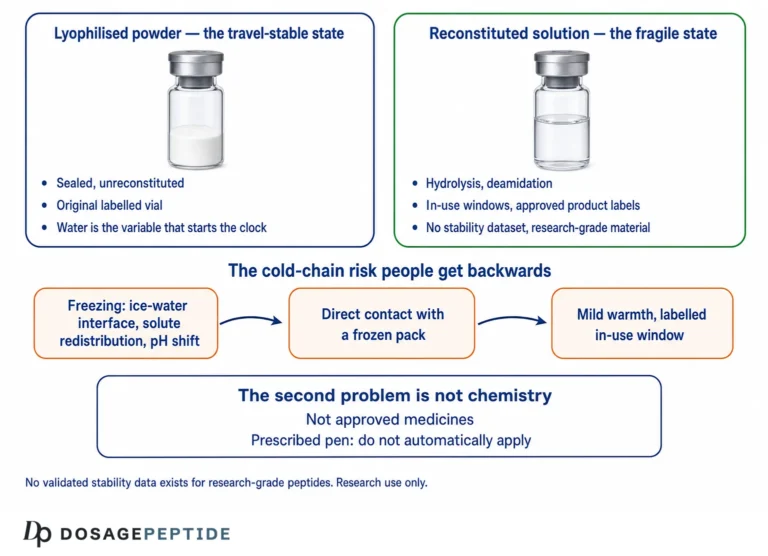
The honest answer is that it depends entirely on the physical state of the peptide, not the peptide itself. A sealed, lyophilized (freeze-dried) peptide powder is comparatively stable and tolerates ordinary shipping temperatures for days — which is the usual justification given for research vials arriving without a cold chain — while cold or frozen storage is used to extend that window over months. Once that powder is reconstituted into water, the situation reverses: refrigeration at 2–8 °C becomes the working norm, and the conventional working window contracts from months or years to a few weeks — a borrowed convention, as the next paragraph explains, not a measured shelf life.
One thing governs every number below: research-use-only peptide vials have no regulatory stability program behind them. Every duration in the table that follows is a convention borrowed from analogous pharmaceutical products — not a validated expiry, not a potency guarantee, and not a sterility guarantee.
Quick answer: peptide storage at a glance
| State | Typical storage temperature | Conventional working shelf life | Key caveat |
|---|---|---|---|
| Lyophilized, sealed, in transit / short-term | Ambient (roughly 15–25 °C), out of direct light | Convention: days to a few weeks | Why vials ship without ice packs. Heat and humidity both shorten this; a soft or collapsed cake is a red flag. |
| Lyophilized, refrigerated | 2–8 °C | Convention: many months | Not a validated expiry for research-grade material. Condensation on a cold vial is a real risk — let it reach room temperature sealed before opening. |
| Lyophilized, frozen (long-term) | −20 °C or colder | Convention: a year or more | Only meaningful if the vial is never repeatedly thawed and refrozen. Freeze–thaw cycling is a documented degradation driver. |
| Reconstituted with bacteriostatic water | 2–8 °C, protected from light | Convention: up to 28 days after first puncture | The 28 days is a preserved multi-dose container convention, not a peptide potency figure. Chemical degradation continues regardless of the preservative. |
| Reconstituted with sterile (preservative-free) water | 2–8 °C, protected from light | Convention: single-use; hours, not weeks | No antimicrobial preservative at all. Repeated withdrawal from a preservative-free container is outside every conventional standard. |
If you want the mechanics of getting from powder to solution in the first place, our peptide reconstitution guide walks through the full sequence, and the companion piece on how much bacteriostatic water to use for reconstitution covers the volume arithmetic that determines final concentration.
Why does adding water change the shelf life so dramatically?
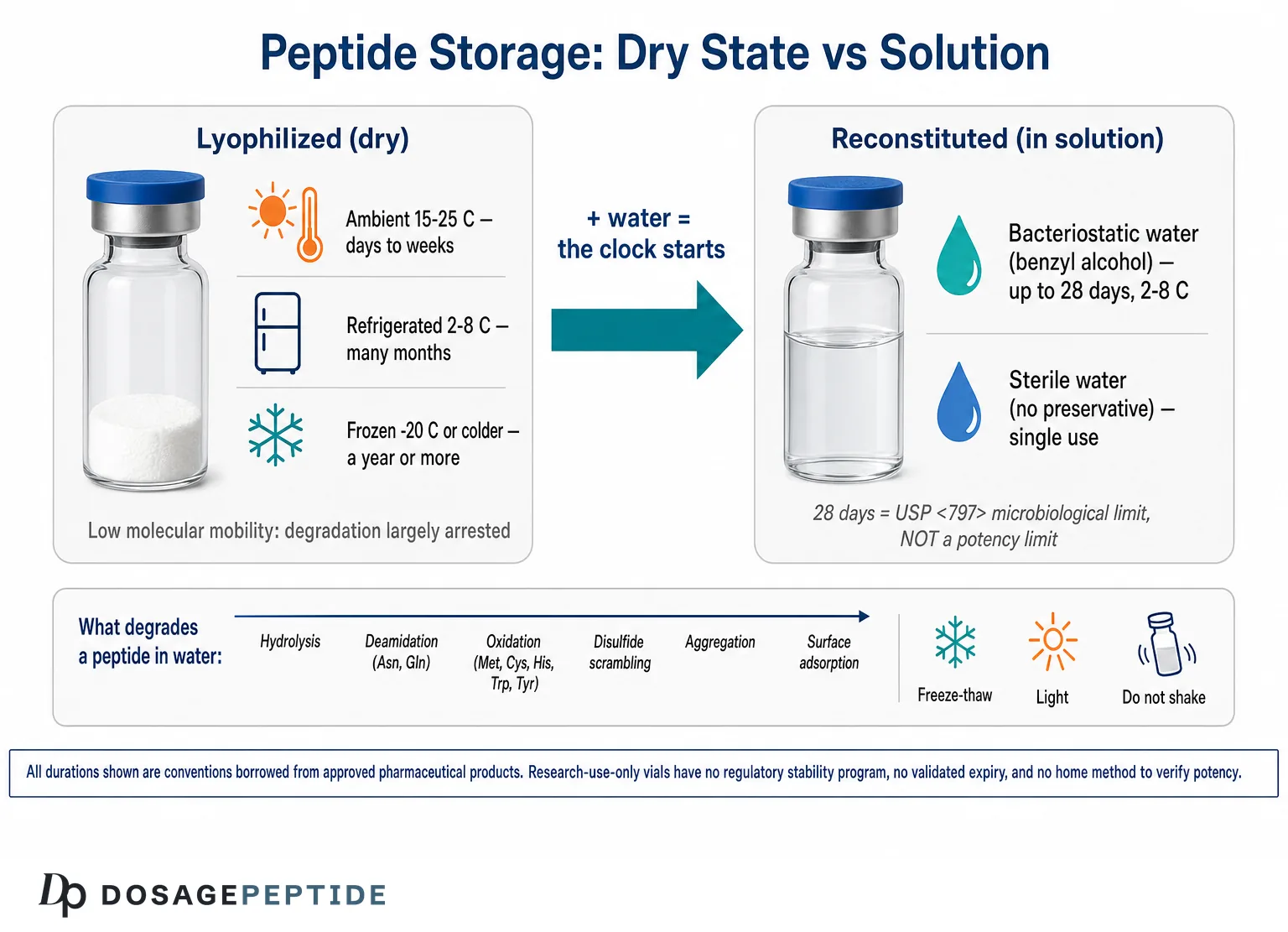
Peptides are not inert. In the dry, amorphous solid state molecular mobility is very low and the reactions that destroy a peptide are largely frozen out — this is the entire rationale for lyophilizing peptide drugs.[9] Add water and you restore mobility, and with it a family of degradation pathways the classical stability literature catalogues in detail.[1][2]
Hydrolysis and deamidation
Peptide bonds are hydrolysable, and some side chains are far more labile than the backbone. Asparagine and, more slowly, glutamine residues lose their amide group in aqueous solution — deamidation — converting to aspartate/isoaspartate and glutamate. A systematic study of 306 asparaginyl sequences in model peptides at pH 7.4 and 37 °C found deamidation rates spanning orders of magnitude with sequence context alone, at fixed pH and temperature — and rate also varies with pH, temperature and higher-order structure.[5] The implication is practical: two peptides in the same fridge, in the same diluent, can degrade at very different rates, and no label tells you which is which.
Oxidation
Methionine, cysteine, histidine, tryptophan and tyrosine are the residues most vulnerable to oxidation, driven by contaminating oxidants, trace transition-metal contamination and light. Oxidation may be non-site-specific (contaminating oxidants) or metal-catalysed and site-specific — and the two respond to opposite mitigations, which is why there is no universal “antioxidant fix.”[4] A research vial has no formulation excipients, no chelator and no inert-gas overlay, so none of those protections are present.
Disulfide scrambling, aggregation and adsorption
Peptides carrying two or more disulfide bonds can rearrange them in solution, producing mispaired isomers; peptides with a single disulfide, or with free thiols, can instead form covalent dimers and higher oligomers. Separately, partially unfolded species associate into soluble oligomers and eventually visible particles; aggregation is the most common physical failure mode described for aqueous protein pharmaceuticals, and is sensitive to pH, ionic strength, temperature and interface exposure.[3] Short peptides are generally less aggregation-prone than proteins, but the same variables apply. Peptides also simply stick to things: at the low concentrations typical of reconstituted vials, a non-trivial fraction can adsorb to container and processing surfaces, and controlled work on a monoclonal antibody found adsorption to glass, silica, cellulose and stainless-steel surfaces to be rapid, material-dependent and sometimes irreversible.[8] That mechanism applies to surface-active peptides too, though it has not been quantified for research-grade peptide vials. All of this is silent loss — a solution can be substantially degraded while still looking perfectly clear.
Bacteriostatic water vs sterile water: which one sets the clock?
This is the most consequential fork in the whole topic, and it is frequently blurred. The two diluents are not interchangeable.
| Property | Bacteriostatic Water for Injection, USP | Sterile Water for Injection, USP |
|---|---|---|
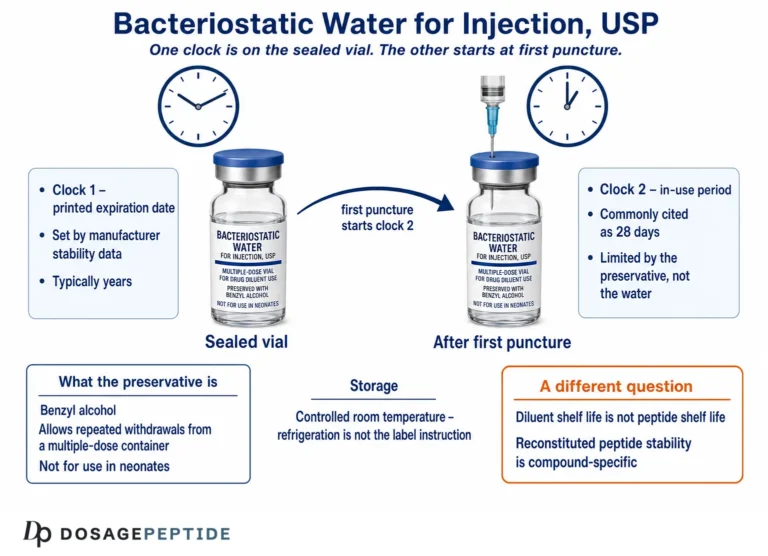
| Preservative | Benzyl alcohol, added as a bacteriostatic preservative — the Hospira label describes 0.9% (9 mg/mL) or 1.1% (11 mg/mL) depending on presentation[11] | None |
| Mode of action | Bacteriostatic — formulated to inhibit bacterial growth rather than to sterilize. It will not render a contaminated solution sterile, and it offers no protection at all against chemical degradation of the peptide. | Not applicable |
| Container type | Labeled as a multiple-dose container “from which repeated withdrawals may be made”[11] | Conventionally single-use |
| Conventional in-use limit once punctured | Convention: 28 days, borrowed by analogy from the USP <797> beyond-use date for preserved multiple-dose containers[10] | Convention: discard after a single use |
| Storage of the diluent itself | “Store at 20 to 25 °C (68 to 77 °F)” per the label[11] | Controlled room temperature |
| Known restriction | Benzyl alcohol–containing solutions are contraindicated in neonates and are not used for epidural or spinal routes[11] | Hypotonic; not for direct injection undiluted |
Where the 28-day figure actually comes from — and what it does not mean
Precision matters here, because this number is repeated everywhere without attribution. The Hospira Bacteriostatic Water for Injection label itself does not print a 28-day discard statement. The 28 days is a compounding standard: USP General Chapter <797> assigns a beyond-use date of 28 days after initially entering or puncturing a preserved multiple-dose container, cross-referencing the antimicrobial effectiveness criteria of USP <51>, unless the manufacturer specifies otherwise.[10] Note the scope: that allowance is written for commercially manufactured multiple-dose containers and for compounded multiple-dose preparations whose own formulation has passed <51> testing. A research peptide reconstituted at a bench has no such testing behind it, so the 28 days is an analogy applied to it, not a standard that reaches it.
Two consequences follow, and both are routinely missed. First, 28 days is a microbiological limit, not a potency limit — it describes the preservative’s ability to suppress bacterial growth and says nothing about how much intact peptide remains. Second, the peptide’s own chemical clock runs independently: deamidation, oxidation and aggregation proceed on their own schedule regardless of benzyl alcohol, and for any given research peptide that schedule is simply unknown.
What do FDA-approved peptide products actually say?
Approved products are the only place hard numbers are defensible, because they rest on real stability data filed with a regulator. Three worked examples from current US labeling:
- Semaglutide (Ozempic), FDA-approved for type 2 diabetes. Prior to first use the pen is refrigerated at 2–8 °C, kept in the original carton until administration, and the label states in that same section: “Do not freeze OZEMPIC and do not use OZEMPIC if it has been frozen.” After first use the pen “can be stored for 56 days at controlled room temperature 15 °C to 30 °C (59 °F to 86 °F) or in a refrigerator,” still protected from excessive heat and sunlight.[12]
- Tirzepatide (Mounjaro), FDA-approved for type 2 diabetes. Single-dose pens and vials are stored at 2–8 °C and “can be stored unrefrigerated at temperatures not to exceed 30 °C (86 °F) for up to a total of 21 days.” The label also says to “Protect MOUNJARO from heat and light” and to use the original carton.[13]
- Somatropin (Genotropin), FDA-approved for growth hormone deficiency and several other pediatric growth indications. The cleanest illustration of the preservative principle. The lyophilized powder is stored at 2–8 °C, protected from light, not frozen — although the MINIQUICK presentation may additionally be held for up to 3 months at or below 25 °C (77 °F) before reconstitution. After reconstitution, the 5 mg and 12 mg cartridges — which use a preserved diluent — may be refrigerated “for up to 28 days,” while the preservative-free MINIQUICK “may be stored under refrigeration at 36 °F to 46 °F (2 °C to 8 °C) for up to 24 hours before use.” Both carry the instruction “Do not shake.”[14]
Twenty-eight days versus twenty-four hours, for the same active molecule in the same fridge. The two presentations differ in more than one respect — MINIQUICK is a single-dose device with its own fill and reconstituted volume — but the preservative in the cartridge diluent is the difference the labels themselves turn on, and it is the clearest published illustration of the bacteriostatic-versus-sterile-water distinction.
Does gonadorelin need to be refrigerated?
Gonadorelin is a decapeptide — sequence 5-oxo-Pro-His-Trp-Ser-Tyr-Gly-Leu-Arg-Pro-Gly-NH2 — and it deserves a straight answer, including the uncomfortable part. The human gonadorelin products formerly marketed in the United States are no longer available. The FACTREL label currently listed on DailyMed is a veterinary product from Zoetis, indicated in cattle for ovarian follicular cysts and, with a prostaglandin, for estrous-cycle synchronisation ahead of fixed-time insemination in lactating dairy cows. It is supplied as a ready-to-use 50 mcg/mL solution, not a lyophilized powder, and its storage instruction is: “Store at refrigerator temperature 2° to 8°C (36° to 46°F), with excursions permitted to 25°C (77°F). Use contents within 1 month of first vial puncture.”[15] That is an animal-drug label, and it should be read as such.
For research material the honest answer is thinner: gonadorelin sold as a research chemical is typically a lyophilized powder with no regulatory stability data of any kind. The vial is stored per the supplier’s stated conditions and reconstituted solution is refrigerated by convention. Note what the sequence contains, though — tryptophan and tyrosine, both prime targets for photo-oxidation.[6] Light protection is not optional for this one, and any shelf-life number you are quoted is borrowed, not validated.
Does freezing help — and what about freeze–thaw cycles?
Freezing lyophilized powder for long-term storage is a reasonable extension of cold-storage logic. Freezing a reconstituted solution is a different proposition, because freeze–thawing is itself a stress. Controlled work on a monoclonal antibody found freeze–thaw-induced aggregation varying strongly with solution pH, cooling and warming rates, and — strikingly — with the container material, some materials producing significantly higher aggregate levels than glass or plastic.[7] Ice-front formation concentrates solutes, shifts local pH as buffer components crystallize selectively, and creates fresh interfaces at which molecules unfold.
The operational rule is simple: if you freeze at all, freeze in single-use aliquots. Never repeatedly thaw and refreeze one vial. Each cycle is another full dose of the same stress, and the damage is cumulative and invisible.
Do light and shaking really matter?
Light. Tryptophan, tyrosine, phenylalanine and cysteine/cystine undergo primary photo-oxidation, and the resulting changes can propagate to secondary and tertiary structure.[6] This is exactly why approved peptide products carry “store in the original carton to protect from light” instructions.[13] Keep the vial in its box; a clear vial under a bench lamp is a slow-motion experiment you did not intend to run.
Agitation. Vigorous shaking generates air–liquid interface, and interface exposure is a recognized cause of aggregation in its own right, separate from the other stresses a solution is under.[8] Agitation itself is catalogued among the classic physical stresses on protein and peptide solutions.[2][3] Peptides are surface-active: they adsorb at the air–water boundary, partially unfold there, and desorb as aggregation-competent species. Direct the diluent stream down the vial wall rather than onto the powder, then swirl gently. The approved-product instruction “Do not shake” is not a formality.[14]
What storage numbers cannot tell you about a research-grade vial
This section is the one that matters most, and it is the one most storage articles omit.
- There is no stability program. An approved product’s 21-day or 56-day figure exists because a manufacturer ran real-time and accelerated stability studies and a regulator reviewed them. A research-use-only vial has nothing equivalent; its actual degradation rate is unmeasured.
- There is no validated expiry. A date printed on a research vial is a supplier’s assertion, not a regulatory expiry, and it is not backed by the assay data that would make it meaningful.
- There is no home method to verify potency. Clarity, color and absence of visible particles tell you almost nothing — substantial deamidation, oxidation or soluble aggregation leaves a solution looking entirely normal. Confirming intact peptide content requires HPLC and mass spectrometry.
- Purity and identity are separate unknowns. Storage guidance assumes the vial contains what the label says, in the stated amount. For research-grade material that assumption rests on a certificate of analysis whose independence is often unverifiable.
Everything in the first table is therefore a convention derived by analogy from products with real data behind them. None of it is a safety guarantee, and none of it constitutes a human-use instruction. Our compound reference pages — for example the semaglutide 5 mg vial reference and the BPC-157 10 mg vial reference — apply the same framing, and the storage guidance for reconstituted tesamorelin works through one compound in detail.
“I left my peptide out of the fridge” — what now?
This is the question people actually arrive with, and it deserves a direct answer rather than a shrug. There is no published stability study for a research-grade vial left on a counter, so nothing below is a potency guarantee. What can be said is which variables matter and in what order.
The first question is always: was it powder or solution?
- Sealed lyophilized powder, out for hours or a few days at room temperature. This is the scenario the entire research-vial shipping model is built on — vials routinely spend days in transit without ice. By convention this is tolerated. Heat and humidity are what change the answer: a vial left in a hot car or a steamy bathroom is a different case from one left on a desk.
- Reconstituted solution, out overnight or longer. This is the case with real consequences. Room temperature accelerates chemical degradation (hydrolysis, oxidation, deamidation) and, more importantly, removes the temperature constraint on microbial growth. Bacteriostatic water’s benzyl alcohol inhibits growth; it does not sterilise, and its conventional 28-day window assumes refrigeration throughout.
- Frozen powder that thawed and refroze. The number of freeze–thaw cycles matters more than the total time. Repeated cycling is a documented degradation driver, which is why long-term frozen storage is only meaningful if the vial is aliquoted or left undisturbed.
What to look at. A lyophilized cake that has softened, collapsed, discoloured or turned gummy indicates moisture ingress. In solution, cloudiness, visible particles, a colour change or any film are all disqualifying. But the reverse does not hold: a solution that looks perfectly clear can still have lost potency or become contaminated. Degradation is a chemical event, and it is invisible. Visual inspection can only condemn a vial, never clear one.
What cannot be recovered. Nothing about re-refrigerating an excursion undoes it. Degradation is cumulative and irreversible; putting a vial back in the fridge stops the clock running faster, it does not rewind it. And no home method — not re-freezing, not filtering, not adding fresh bacteriostatic water — restores either potency or sterility.
The practical consequence for research documentation is that the excursion itself should be recorded: date, duration, approximate temperature, and physical state at the time. A vial with an undocumented thermal history is a vial with an unknown content, and any measurement taken from it inherits that uncertainty.
A practical storage checklist for research settings
- Keep it lyophilized until solution is actually needed. The dry state is the stable state; reconstitution starts the clock.[9]
- Let cold vials equilibrate sealed — opening straight from the fridge invites condensation onto the powder.
- Match diluent to protocol: a preserved diluent is what the compounding convention assumes for a container entered more than once; preservative-free diluent carries a single-entry convention. Neither choice is a human-use instruction.
- Record the date of first entry into the container, not the date of receipt. The 28-day compounding convention runs from first entry, not from arrival.[10]
- Carton on, light off; swirl, never shake. Aim the diluent stream at the glass wall.
- Aliquot before freezing, if freezing at all. One thaw per aliquot, no exceptions.[7]
- Log everything: reconstitution date, diluent lot, volume, resulting concentration, storage location. Concentration arithmetic can be checked with our peptide dosage calculator, and unfamiliar terms are defined in the peptide glossary.
Frequently Asked Questions
I left my reconstituted peptide out overnight — is it ruined?
There is no stability study that answers this for a research-grade vial, so no one can tell you it is fine. What is known: room temperature accelerates chemical degradation and removes the temperature constraint on microbial growth, and bacteriostatic water inhibits growth rather than sterilising. Re-refrigerating does not reverse anything that has already happened. If the vial looks cloudy or has particles it is definitively compromised; if it looks clear, that proves nothing either way.
How long do lyophilized peptides last at room temperature?
By convention, days to a few weeks for a sealed vial kept out of direct light — which is why research vials ship without a cold chain. That is a shipping-tolerance convention borrowed from analogous products, not a validated shelf life, and heat and humidity both shorten it.
Can I tell by looking whether a peptide has degraded?
Only in one direction. A collapsed or discoloured cake, or a cloudy solution with particles, tells you the vial is compromised. A normal appearance tells you nothing — chemical degradation does not change how a clear solution looks.
Do peptides need to be refrigerated before reconstitution?
Not necessarily for short periods. Sealed lyophilized powder is comparatively stable in the dry state and tolerates ambient temperature for days, which is why research vials ship without cold packs. Refrigeration at 2–8 °C is the conventional choice for storage beyond that, and freezing for long-term holding. These are conventions borrowed from pharmaceutical practice, not validated expiries for research-grade material.
How long do peptides last in the fridge after mixing?
For a container reconstituted with preserved (bacteriostatic) diluent, the conventional working figure is up to 28 days refrigerated. That number is borrowed by analogy from the USP <797> beyond-use date for preserved multiple-dose containers — a standard written for products with antimicrobial effectiveness data behind them, which a bench-reconstituted research vial does not have. It is a microbiological limit rather than a statement about how much intact peptide remains. Chemical degradation continues independently, at a rate that is unknown for research-grade material.
What is the difference between bacteriostatic water and sterile water?
Bacteriostatic Water for Injection contains benzyl alcohol as a preservative — the Hospira label describes 0.9% or 1.1% depending on presentation — and is supplied in a multiple-dose container from which repeated withdrawals may be made. Sterile Water for Injection contains no preservative and is conventionally single-use. The preservative is formulated to suppress bacterial growth; it will not render a contaminated solution sterile, and it does not protect the peptide chemically.
Can peptides be left out of the fridge?
Lyophilized powder tolerates ambient temperature for limited periods; that is the basis of ambient shipping. Reconstituted solution is a different case, and there is no validated room-temperature allowance for research-grade material. By comparison, approved products publish specific limits from real stability data — 56 days at 15–30 °C for an in-use Ozempic pen, up to 21 days not exceeding 30 °C for Mounjaro — and those figures apply only to those products.
Can you freeze reconstituted peptides?
Freezing solution is generally avoided because freeze–thawing is itself a degradation stress. Published work — on a monoclonal antibody rather than a small peptide — shows freeze–thaw-induced aggregation varying with pH, cooling and warming rates, and container material. If a solution is frozen at all, it should be divided into single-use aliquots so that no vial is ever thawed and refrozen. Repeated cycling is cumulative and leaves no visible trace.
Does gonadorelin need to be refrigerated?
Human gonadorelin products are no longer marketed in the United States; the FACTREL label currently on DailyMed is a veterinary cattle product, a ready-to-use solution stored at 2–8 °C with excursions to 25 °C and contents used within one month of first puncture. For research-grade lyophilized gonadorelin there is no regulatory stability data at all. Reconstituted solution is refrigerated by convention, and light protection matters because the sequence contains tryptophan and tyrosine.
How can you tell if a peptide has degraded?
Reliably, you cannot — not by inspection. Deamidation, oxidation, disulfide scrambling and soluble aggregation can all proceed substantially while a solution remains clear and colorless. Visible haze, particulates, discoloration or a collapsed lyophilized cake are late-stage signals worth acting on, but their absence proves nothing. Confirming intact peptide content requires analytical chemistry such as HPLC and mass spectrometry.
Why do peptide vials ship without ice packs if they need refrigeration?
The usual justification is that the shipped form is lyophilized powder, not solution. Freeze-drying removes the water that enables hydrolysis, deamidation and aggregation, leaving a low-mobility solid in which those reactions are largely arrested. The refrigeration convention attaches to the reconstituted state and to long-term storage of the powder — not to the few days a sealed dry vial spends in transit. Note that ambient shipping is a supplier logistics choice, not a validated stability finding for any specific research vial.
References
- Manning MC, Patel K, Borchardt RT. Stability of protein pharmaceuticals. Pharm Res. 1989;6(11):903-18. PubMed
- Manning MC, Chou DK, Murphy BM, Payne RW, Katayama DS. Stability of protein pharmaceuticals: an update. Pharm Res. 2010;27(4):544-75. PubMed
- Wang W. Instability, stabilization, and formulation of liquid protein pharmaceuticals. Int J Pharm. 1999;185(2):129-88. PubMed
- Li S, Schöneich C, Borchardt RT. Chemical instability of protein pharmaceuticals: mechanisms of oxidation and strategies for stabilization. Biotechnol Bioeng. 1995;48(5):490-500. PubMed
- Robinson NE, Robinson AB. Molecular clocks. Proc Natl Acad Sci U S A. 2001;98(3):944-9. PubMed
- Kerwin BA, Remmele RL Jr. Protect from light: photodegradation and protein biologics. J Pharm Sci. 2007;96(6):1468-79. PubMed
- Kueltzo LA, Wang W, Randolph TW, Carpenter JF. Effects of solution conditions, processing parameters, and container materials on aggregation of a monoclonal antibody during freeze-thawing. J Pharm Sci. 2008;97(5):1801-12. PubMed
- Bee JS, Chiu D, Sawicki S, Stevenson JL, Chatterjee K, Freund E, Carpenter JF, Randolph TW. Monoclonal antibody interactions with micro- and nanoparticles: adsorption, aggregation, and accelerated stress studies. J Pharm Sci. 2009;98(9):3218-38. PubMed
- Carpenter JF, Pikal MJ, Chang BS, Randolph TW. Rational design of stable lyophilized protein formulations: some practical advice. Pharm Res. 1997;14(8):969-75. PubMed
- United States Pharmacopeia. General Chapter <797> Pharmaceutical Compounding — Sterile Preparations, Revision Bulletin, official May 1, 2020 — “The BUD after initially entering or opening (e.g., needle-punctured) multiple-dose containers is 28 days (see Antimicrobial Effectiveness Testing <51>) unless otherwise specified by the manufacturer.” USP–NF. uspnf.com (PDF)
- Bacteriostatic Water for Injection, USP (Hospira, Inc.). US prescribing information. DailyMed, National Library of Medicine. DailyMed
- OZEMPIC (semaglutide) injection, for subcutaneous use. US prescribing information, Novo Nordisk. DailyMed, National Library of Medicine. DailyMed
- MOUNJARO (tirzepatide) injection, for subcutaneous use. US prescribing information, Eli Lilly and Company. DailyMed, National Library of Medicine. DailyMed
- GENOTROPIN (somatropin) for injection, for subcutaneous use. US prescribing information, Pfizer. DailyMed, National Library of Medicine. DailyMed
- FACTREL (gonadorelin injection) — veterinary label, Zoetis Inc. DailyMed, National Library of Medicine. DailyMed
This article is provided for research and educational reference only. Dosage Peptide is an independent reference library; it is not a seller, a pharmacy, or a clinical service, and it does not provide medical advice. The peptides discussed here, other than the specific FDA-approved products named and identified as such, are research chemicals intended for use in laboratory settings only — they are not approved for human use, and nothing above should be read as a recommendation, protocol, or instruction for administration to humans or animals. Storage durations described in this article are conventions derived from analogous pharmaceutical products; they are not validated expiry dates and do not guarantee potency, purity, or sterility. Consult a qualified healthcare professional for any question relating to health, and follow all applicable institutional, local, and national regulations governing the handling of research materials.