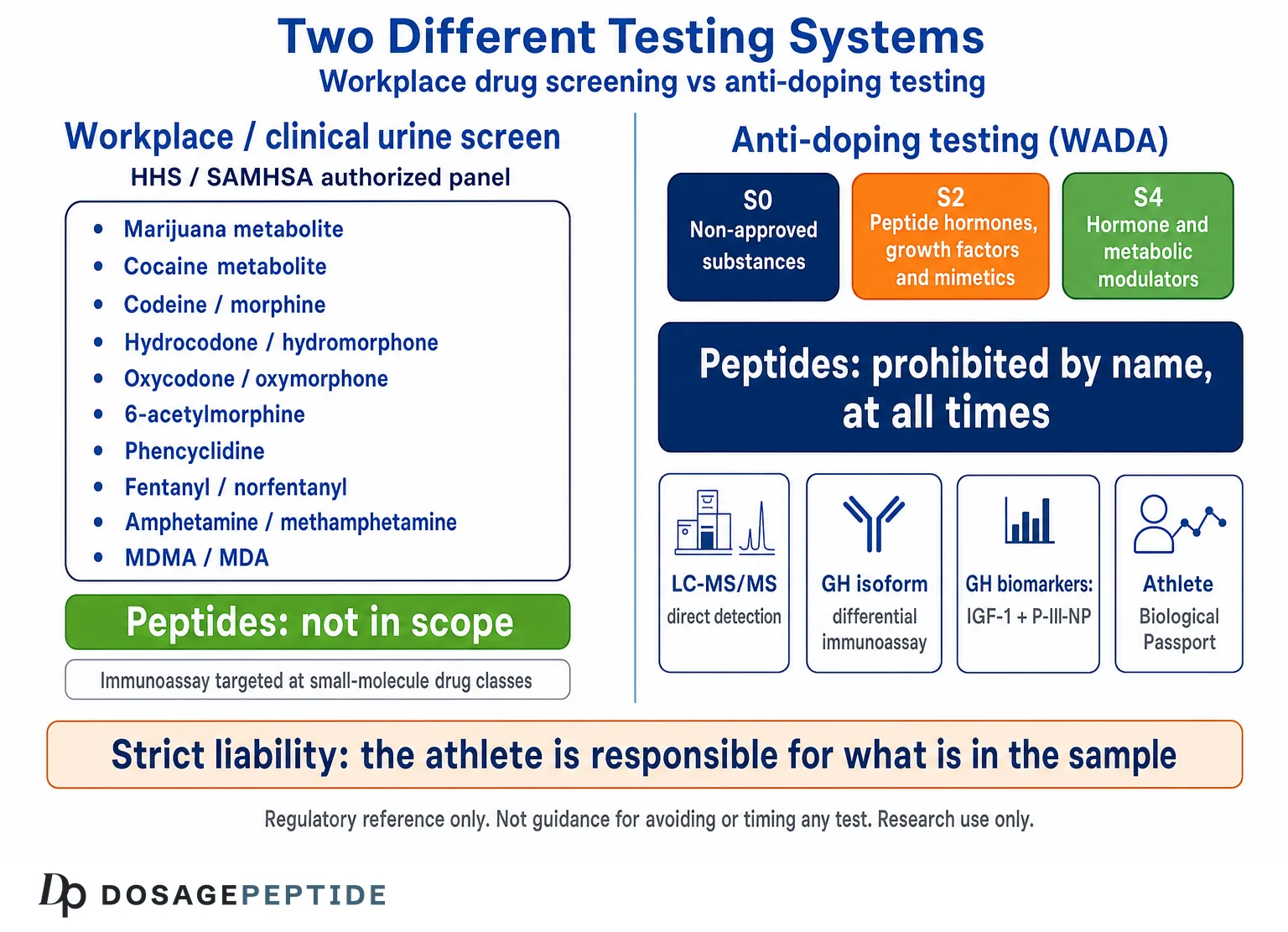
For an ordinary employment, clinical or pre-employment urine drug screen, the answer is no: peptides are not on those panels and are not detected by them. For anti-doping testing under the World Anti-Doping Agency (WADA), the answer is the opposite — dozens of peptides are prohibited by name, laboratories run dedicated assays for them, and some methods do not look for the peptide at all. These are two separate systems with different legal bases, different analytical chemistry and different target lists, and conflating them is the most common error in this topic.
What does a standard workplace drug test actually screen for?
In the United States, the reference specification for regulated urine drug testing is the HHS/SAMHSA panel issued under the Mandatory Guidelines for Federal Workplace Drug Testing Programs. The authorized urine panel, effective 7 July 2025, consists of exactly these analyte groups: marijuana metabolite (Δ9-THCC), cocaine metabolite (benzoylecgonine), codeine/morphine, hydrocodone/hydromorphone, oxycodone/oxymorphone, 6-acetylmorphine, phencyclidine, fentanyl/norfentanyl, amphetamine/methamphetamine, and MDMA/MDA[1]. A subsequent HHS notification published 13 March 2026 confirmed that no revisions were made to those analytes or cutoffs[2].
The commercially marketed “5-panel”, “10-panel” and “12-panel” tests follow the same logic, extending the list with further drugs of abuse — benzodiazepines, barbiturates, methadone, propoxyphene — while remaining panels of controlled small-molecule drugs. No peptide hormone, growth factor, growth hormone secretagogue or metabolic modulator appears anywhere in that framework.
Why peptides are invisible to these panels — it is chemistry, not a loophole
This is routinely misrepresented as a gap that peptides “slip through”. A regulated urine screen begins with an immunoassay: an antibody-based initial test calibrated against a specific target analyte, with defined cross-reactivity requirements for other analytes in the same group[1]. An antibody raised against benzoylecgonine does not bind a 15-amino-acid peptide. A presumptive positive then goes to confirmatory mass spectrometry, but only for the analytes the laboratory is certified to confirm.
Detecting peptides requires a different analytical stack: enrichment and clean-up by solid-phase extraction, then liquid chromatography coupled to tandem or high-resolution mass spectrometry[6], frequently targeting characteristic metabolites alongside the intact molecule[5]. That instrumentation sits in accredited anti-doping and specialist laboratories, not in commercial occupational-health labs. A test finds what it is designed to find.
Do peptides show up on a military drug test?
The US Department of Defense operates its own urinalysis program — the Military Personnel Drug Abuse Testing Program, established under DoD Instruction 1010.01, with laboratory technical procedures set by DoD Instruction 1010.16 — and it is likewise a controlled-substance abuse program, not a performance-enhancement program. Its panel has been expanded to track changing misuse patterns: fentanyl and its metabolite norfentanyl were added to the panel in 2019, and the Armed Forces Medical Examiner System’s forensic toxicology laboratory also performs confirmation testing for synthetic cannabinoids[3]. The analytes remain drugs of abuse: cannabinoids, cocaine, amphetamines, opioids and related classes. Peptide hormones are not target analytes of that program.
That is a statement about analytical scope only. It says nothing about whether possession or use is permitted under service regulations or supplement policies, or about the underlying legal status of the compound, which we cover separately in our overview of the legal status of research peptides.
Anti-doping testing works on completely different rules
The WADA Prohibited List is an International Standard revised annually; the 2026 edition came into effect on 1 January 2026[4]. Any athlete inside a WADA-signatory testing pool — Olympic sports, most international federations, national anti-doping organisations, and many domestic competitions by adoption — is bound by it. Three sections are where peptides live.
S0 — Non-Approved Substances
S0 is the catch-all. It prohibits, at all times, “any pharmacological substance which is not addressed by any of the subsequent sections of the List and with no current approval by any governmental regulatory health authority for human therapeutic use”, giving drugs in pre-clinical or clinical development, discontinued drugs, designer drugs and veterinary-only substances as examples. The 2026 text names BPC-157 explicitly[4] — a direct consequence of its having no marketing authorisation from any national regulator for any human indication, a status we examine in our analysis of BPC-157 and FDA approval. S0 substances are classified as Specified Substances.
S2 — Peptide Hormones, Growth Factors, Related Substances and Mimetics
This is the largest peptide-relevant class, and all of it is non-Specified and prohibited at all times[4]. Verbatim from the 2026 List:
- S2.1 covers erythropoietins and agents affecting erythropoiesis, including EPO-mimetics, hypoxia-inducible factor (HIF) activating agents such as roxadustat and molidustat, GATA inhibitors, TGF-β signalling inhibitors and innate repair receptor agonists.
- S2.2.1 covers testosterone-stimulating peptides in males: chorionic gonadotrophin (CG), luteinizing hormone (LH), GnRH and its agonist analogues, and kisspeptin and its agonist analogues.
- S2.2.3 covers growth hormone, its analogues and its fragments — naming AOD-9604 and hGH 176-191 as fragment examples.
- S2.2.4 covers growth hormone releasing factors, and names GHRH analogues (CJC-1293, CJC-1295, sermorelin, tesamorelin), growth hormone secretagogues and mimetics (anamorelin, capromorelin, ibutamoren/MK-677, ipamorelin, lenomorelin/ghrelin, macimorelin, tabimorelin), and the GHRPs (alexamorelin, examorelin/hexarelin, GHRP-1 through GHRP-6).
- S2.3 covers growth factors and growth factor modulators: FGFs, HGF, IGF-1 and its analogues, mechano growth factors, PDGF, VEGF, and “Thymosin-ß4 and its derivatives e.g. TB-500”.
Two entries deserve emphasis because they are commonly assumed to be exempt. MK-677 (ibutamoren) is not a peptide — it is an orally active non-peptide ghrelin receptor agonist — yet it is named in S2.2.4[4]. See our reference page on MK-677 as a growth hormone secretagogue. Likewise TB-500 is named explicitly as a thymosin-β4 derivative, so the frequent claim that it occupies a grey area is incorrect under the 2026 List.
S4 — Hormone and Metabolic Modulators
Two S4 subsections matter here, both non-Specified and prohibited at all times[4]. S4.3 prohibits agents preventing activin receptor IIB activation, which includes myostatin inhibitors, myostatin-binding proteins such as follistatin and myostatin propeptide, decoy activin receptors, and myostatin-neutralising antibodies. S4.4.1 prohibits metabolic modulators: AMPK activators, naming BAM15, AICAR, and MOTS-c (the mitochondrial open reading frame of the 12S rRNA-c); PPARδ agonists, naming GW1516/GW501516; and Rev-erbα agonists SR9009 and SR9011. S4.4.2 adds insulins and insulin-mimetics.
The inclusion of MOTS-c is notable because it is an endogenous mitochondrial-derived peptide, discussed in our background page on how MOTS-c is classified among mitochondrial-derived peptides. AICAR, covered in our AICAR 50 mg protocol reference, has been incorporated as a target analyte into published high-throughput ‘dilute-and-shoot’ multi-target LC-MS/MS screening procedures for doping control[5].
“Prohibited at all times” means there is no off-season
S0, S2 and S4 all sit under the 2026 List heading “Substances and Methods Prohibited at All Times (In- and Out-of-Competition)”[4]. Only S6 to S9 — stimulants, narcotics, cannabinoids, glucocorticoids — are limited to in-competition, with beta-blockers (P1) restricted in particular sports. Athletes in a registered testing pool are subject to out-of-competition testing, including during rehabilitation from injury.
How do anti-doping laboratories actually detect peptides?
Three distinct approaches are in use, and they explain why the “peptides are undetectable” claim persists and why it is wrong.
Direct detection by mass spectrometry
For synthetic peptides not naturally present in humans, laboratories detect the compound or its degradation products directly, typically combining solid-phase extraction with LC-MS/MS or high-resolution mass spectrometry. Because small peptides are extensively metabolised after administration, assays frequently target characteristic metabolites as well as the parent compound: a metabolite of GHRP-2 is among the analytes carried in published routine screening procedures[5]. Sensitivity is high: a validated ghrelin and desacyl-ghrelin assay achieved limits of detection in the 30–50 pg/mL range, against a WADA minimum required performance level of 2 ng/mL in urine[6]. Newly listed substances get new methods: after kisspeptins were added to the List in 2024, LC-HRMS methods for kisspeptin and its analogues in serum and urine were developed and characterised[7].
The growth hormone problem, and the two indirect tests built for it
Growth hormone and IGF-1 are both produced by the body, which is precisely what makes direct detection of an exogenous dose difficult. Anti-doping responded with two methods that do not rely on finding a foreign molecule. The hGH Isoform Differential Immunoassay exploits the fact that endogenous secretion involves multiple GH isoforms while recombinant preparations contain only the 22 kDa isoform, so administration shifts the ratio measured by two differently specific antibodies[8]. The hGH Biomarkers Test measures two GH-sensitive downstream markers, IGF-1 and the N-terminal propeptide of type III collagen (P-III-NP), which rise dose-dependently after GH administration, and combines them into a score[8]. Both operate against population-derived decision limits[9]. The science behind recombinant GH is covered in our page on HGH 191aa and somatropin research.
The Athlete Biological Passport: longitudinal profiling instead of detection
The Athlete Biological Passport (ABP) does not look for a substance at all. It monitors an individual athlete’s own biomarkers over time using an Adaptive Model that predicts, for that individual, the range within which marker values should fall under normal physiology, and flags values falling outside a 99% range; confounders such as altitude exposure and recent competition are recorded on the doping control form for expert review. It runs three modules, not two: haematological, steroidal, and — added to WADA’s ABP Operating Guidelines in 2023 — an Endocrine Module, whose primary marker is a GH-2000 score calculated from serum IGF-1 and P-III-NP, explicitly aimed at growth hormone doping and of potential utility against GH secretagogues and IGF-1 abuse[10]. For erythropoietic agents the haematological module is used to direct targeted testing for agents affecting erythropoiesis[10]. The approach has been tested against known administration: in an open-label, placebo-controlled administration study in 35 recreational athletes, an ABP approach using IGF-1 and P-III-NP priors drawn from seven years of anti-doping data in 11,455 elite athletes, set at 99% specificity, flagged 20 of 27 individuals receiving recombinant hGH, including 17 of 27 after treatment had ceased[9]. Indirect methods exist precisely because direct detection of endogenous-identical and rapidly cleared compounds is hard.
Which test looks at what?
| Test type | Who administers it | What it screens for | Peptides in scope? |
|---|---|---|---|
| HHS/SAMHSA regulated urine panel | Federal agencies and DOT-regulated employers, via HHS-certified laboratories | Cannabinoids, cocaine metabolite, opiates and semi-synthetic opioids, 6-AM, PCP, fentanyl/norfentanyl, amphetamines, MDMA/MDA[1] | No |
| Commercial 5/10/12-panel screen | Private employers, occupational health providers | Same drug-of-abuse classes plus benzodiazepines, barbiturates, methadone, propoxyphene | No |
| DoD military urinalysis | Service drug testing programs under DoDI 1010.01, with laboratory procedures under DoDI 1010.16 | Controlled substances of abuse, including cannabinoids, cocaine, amphetamines, opioids, fentanyl and synthetic cannabinoids[3] | No |
| Clinical toxicology screen | Hospitals, emergency departments | Drug classes relevant to acute poisoning and overdose | No |
| WADA-accredited anti-doping analysis | WADA-accredited laboratories for NADOs, IFs, USADA and equivalents | All classes on the current Prohibited List, including S0, S2 and S4[4] | Yes — extensively |
| NCAA drug testing | NCAA, via its contracted provider | Eight banned drug classes on the NCAA list, which is not identical to WADA’s[11] | Yes |
Sport bodies keep their own lists, and they differ
Assuming that every sports organisation mirrors WADA is a mistake. The NCAA maintains its own list, with eight banned drug classes for 2026–27. Its “peptide hormones, growth factors, related substances and mimetics” class gives BPC-157, erythropoietin, growth hormone, hCG, ibutamoren (MK-677), IGF-1 (including colostrum and deer antler velvet) and TB-500 as examples — but states that insulin, Synthroid and Forteo are not banned[11]. That diverges directly from WADA, where insulins and insulin-mimetics are prohibited under S4.4.2[4]. The NCAA list also warns in its own text that it is neither complete nor exhaustive and that any chemically or pharmacologically related substance is banned regardless of whether it is named[11].
What is not on the 2026 WADA List
Several compounds frequently discussed in research contexts are not named anywhere in the 2026 Prohibited List: NAD+ and its precursors, and glutathione[4]. Semaglutide and tirzepatide are also not prohibited — but markers of both were placed on the 2026 Monitoring Program, in and out of competition, the mechanism WADA uses to watch for misuse patterns in substances that are not banned[12]. Absence from the List is not permanent status: S0 is a catch-all, the List is revised annually, and only an athlete’s own anti-doping organisation can give a binding answer for a specific product.
Contamination, mislabelling and strict liability
This is the practically decisive issue for anyone in a tested population, and it has nothing to do with what a person intended to take. Article 2.1.1 of the World Anti-Doping Code — the 2021 Code, which governs through 2026 and whose wording on this point is carried over unchanged into the 2027 Code — states that it is the athlete’s personal duty to ensure that no prohibited substance enters their body, that athletes are responsible for any prohibited substance found in their samples, and that “it is not necessary that intent, Fault, Negligence or knowing Use on the Athlete’s part be demonstrated in order to establish an anti-doping rule violation”. The Code’s own commentary identifies this as the strict liability principle, consistently upheld by the Court of Arbitration for Sport[13].
The empirical risk is documented. In a JAMA chemical analysis of 44 products sold online as selective androgen receptor modulators, only 23 (52%) contained one or more SARMs at all (ostarine, LGD-4033 or andarine). A further 17 (39%) contained a different unapproved drug — the growth hormone secretagogue ibutamoren, the PPARδ agonist GW501516 or the Rev-erbα agonist SR9009, all WADA-prohibited. Four (9%) contained no active compound and 11 (25%) contained substances not listed on the label. In only 18 of the 44 products (41%) did the amount of active compound match the label; in 26 of 44 (59%) it differed substantially[14]. Separately, forensic analysis of a seized injection vial identified a previously undescribed heptapeptide — a glycine analogue of GHRP-2 — which the authors suggested may represent an attempt to circumvent detection[15]. The NCAA states the same risk in its own guidance: supplements may be contaminated with banned substances not listed on the label, and complete elimination of risk is impossible[11].
Put together: an athlete can face an anti-doping rule violation from a product whose label was wrong, and intent is not a defence to the finding itself. Purity and identity are also central to the broader discussion in our page on what is known about peptide safety; the terminology used throughout this field is defined in our peptide research glossary.
Interfering with a doping control is itself a violation
Under the World Anti-Doping Code, evading sample collection, or refusing or failing to submit to sample collection without compelling justification after notification, is an anti-doping rule violation in its own right under Article 2.3. Tampering or attempted tampering with any part of doping control is a separate violation under Article 2.5[13]. The Prohibited List reinforces this analytically: M2.1 prohibits tampering with the integrity and validity of samples, giving sample substitution and adulteration — including addition of proteases to a sample — as examples, and the entire S5 class covers diuretics and masking agents[4]. These provisions are enforceable whether or not any prohibited substance is ever found.
Frequently Asked Questions
Will BPC-157 show up on a standard employment drug test?
No. BPC-157 is not an analyte on the HHS/SAMHSA regulated urine panel or on commercial 5-, 10- or 12-panel drug screens, which target controlled small-molecule drugs of abuse. It is, however, explicitly named under S0 (Non-Approved Substances) of the 2026 WADA Prohibited List and appears on the NCAA banned-substance list, so it is fully in scope for athletes subject to anti-doping testing.
Is TB-500 detectable in anti-doping testing?
TB-500 is named directly in the 2026 WADA Prohibited List under S2.3, as a derivative of thymosin-β4, and is prohibited at all times. It also appears as an example under the NCAA’s peptide hormones class. The frequently repeated claim that TB-500 sits in a regulatory grey area is not supported by the current List text.
Is MK-677 banned even though it is not a peptide?
Yes. MK-677 (ibutamoren) is an orally active non-peptide ghrelin receptor agonist, but the WADA classification is based on pharmacological effect rather than molecular class. It is named explicitly under S2.2.4 as a growth hormone secretagogue and is prohibited in and out of competition. The NCAA also lists ibutamoren by name.
Is NAD+ on the WADA Prohibited List?
NAD+ and its precursors are not named in the 2026 WADA Prohibited List or the 2026 Monitoring Program. That describes the current text, not a permanent clearance: the List is revised annually and S0 functions as a catch-all for substances without regulatory approval for human therapeutic use. Athletes in tested pools should confirm status with their own anti-doping organisation.
Why can anti-doping laboratories detect peptides when workplace labs cannot?
Because they are asked to, and are equipped for it. Regulated workplace screens start with antibody-based immunoassays calibrated to specific small-molecule targets. Peptide analysis requires enrichment and clean-up, typically by solid-phase extraction, followed by LC-MS/MS or high-resolution mass spectrometry, plus, for endogenous compounds, indirect isoform and biomarker approaches. That capability sits in accredited anti-doping laboratories, not general occupational-health labs.
Does the Athlete Biological Passport detect peptides directly?
No, and that is the point of it. The ABP tracks an individual athlete’s own biomarkers longitudinally across three modules — haematological, steroidal and, since 2023, endocrine — and uses an Adaptive Model to flag variation that is not physiologically plausible for that person. The endocrine module targets growth hormone doping through a GH-2000 score built from serum IGF-1 and P-III-NP, rather than by detecting hGH itself.
Are AICAR and MOTS-c prohibited in sport?
Both are named in section S4.4.1 of the 2026 WADA Prohibited List as activators of AMP-activated protein kinase, within the Hormone and Metabolic Modulators class, prohibited at all times and classified as non-Specified Substances. AICAR is carried as a target analyte in published high-throughput multi-target LC-MS/MS screening procedures for doping control.
Do the NCAA and WADA lists say the same thing?
No. They overlap heavily but diverge in specifics. The clearest example is insulin: WADA prohibits insulins and insulin-mimetics under S4.4.2, while the NCAA’s 2026–27 list explicitly states insulin is not banned. The NCAA list also declares itself non-exhaustive and bans any chemically or pharmacologically related substance whether or not it is named. Athletes should work from the list that governs their own competition.
Can a mislabelled product cause a positive anti-doping test?
Yes. Published chemical analysis of performance products sold online has found undeclared prohibited substances, missing active ingredients and inaccurate quantities. Under Article 2.1.1 of the World Anti-Doping Code, athletes are responsible for whatever is found in their sample; intent or fault need not be shown to establish the violation, although fault is considered when determining consequences.
References
- Department of Health and Human Services (SAMHSA). Mandatory Guidelines for Federal Workplace Drug Testing Programs—Authorized Testing Panels. 90 FR 4662, 16 January 2025. govinfo.gov
- Department of Health and Human Services (SAMHSA). Mandatory Guidelines for Federal Workplace Drug Testing Programs—Authorized Testing Panels. 91 FR 12308, 13 March 2026. govinfo.gov
- Defense Visual Information Distribution Service. DoD adds fentanyl to drug testing panel. 21 November 2019. dvidshub.net
- World Anti-Doping Agency. World Anti-Doping Code International Standard: Prohibited List 2026. In effect 1 January 2026. wada-ama.org (PDF)
- Guddat S, Solymos E, Orlovius A, Thomas A, Sigmund G, Geyer H, Thevis M, Schänzer W. High-throughput screening for various classes of doping agents using a new ‘dilute-and-shoot’ liquid chromatography-tandem mass spectrometry multi-target approach. Drug Test Anal. 2011;3(11-12):836–50. PubMed
- Thomas A, Krombholz S, Wolf C, Thevis M. Determination of ghrelin and desacyl ghrelin in human plasma and urine by means of LC-MS/MS for doping controls. Drug Test Anal. 2021;13(11-12):1862–70. PubMed
- Krombholz S, Korsmeier L, Thomas A, Thevis M. Analysis and characterization of kisspeptin and its analogues in serum and urine samples by liquid chromatography-high-resolution mass spectrometry for doping control purposes. Drug Test Anal. 2026;18(7):862–76. PMID 42057309. PMC
- Holt RIG, Ho KKY. The use and abuse of growth hormone in sports. Endocr Rev. 2019;40(4):1163–85. PubMed
- Equey T, Pastor A, de la Torre Fornell R, Thomas A, Giraud S, Thevis M, Kuuranne T, Baume N, Barroso O, Aikin R. Application of the Athlete Biological Passport approach to the detection of growth hormone doping. J Clin Endocrinol Metab. 2022;107(3):649–59. PubMed
- World Anti-Doping Agency. Athlete Biological Passport Operating Guidelines, Version 9.0, July 2023 (Hematological, Steroidal and Endocrine Modules; Adaptive Model). wada-ama.org (PDF)
- National Collegiate Athletic Association. 2026–27 NCAA Banned Substances. ncaa.org (PDF)
- World Anti-Doping Agency. The 2026 Monitoring Program. wada-ama.org (PDF)
- World Anti-Doping Agency. World Anti-Doping Code 2021, Articles 2.1, 2.3 and 2.5. In force through 31 December 2026; succeeded by the 2027 Code on 1 January 2027, which retains the Article 2.1.1 wording. wada-ama.org (PDF)
- Van Wagoner RM, Eichner A, Bhasin S, Deuster PA, Eichner D. Chemical composition and labeling of substances marketed as selective androgen receptor modulators and sold via the internet. JAMA. 2017;318(20):2004–10. PMC
- Popławska M, Błażewicz A. Identification of a novel growth hormone releasing peptide (a glycine analogue of GHRP-2) in a seized injection vial. Drug Test Anal. 2019;11(1):162–7. PubMed
This article is provided for research and educational purposes only. It describes the composition and analytical scope of drug testing panels and the current regulatory status of listed substances; it is not medical, legal or athletic-eligibility advice, and it is not a recommendation to use any compound in humans. Regulatory lists change annually. Athletes subject to testing must verify the status of any substance with the anti-doping organisation that governs them. Compounds described here as research chemicals or non-approved substances have no marketing authorisation for human therapeutic use.