No — BPC-157 has not been approved by the FDA, and nothing that happened in July 2026 changed that. What actually occurred on 23 and 24 July 2026 was a two-day meeting of the FDA’s Pharmacy Compounding Advisory Committee (PCAC), which voted on whether seven peptides should be recommended for the 503A Bulks List — the roster of bulk substances that state-licensed compounding pharmacies may use when filling a prescription.[1] Six of the seven, including BPC-157, received a favorable recommendation. That recommendation is advisory, non-binding, and is not a drug approval of any kind.
Status as of 25 August 2026: unchanged. One month after the vote, the FDA has issued no proposed rule and has made no final decision; BPC-157 remains an unapproved drug substance, and compounding it remains outside the rules until notice-and-comment rulemaking is proposed, opened for comment, and finalised — a process measured in many months to years, not weeks. Anyone telling you the status changed in August is describing the July advisory vote a second time.
Last verified 25 August 2026. This is a developing regulatory story. Vote tallies and dates below were checked against the FDA’s own meeting materials and against multiple independent outlets.
| What the July 2026 vote DID | What the vote did NOT do |
|---|---|
| Produced a non-binding recommendation from an FDA advisory committee | Approve BPC-157, or any of the seven peptides, as a drug |
| Recommended six of seven peptides for possible inclusion on the 503A Bulks List | Place anything on the 503A Bulks List — that requires FDA rulemaking |
| Concerned bulk substances used by state-licensed compounding pharmacies under a prescription | Create an approved indication, approved labeling, or an approved finished drug product |
| Signaled a possible loosening of restrictions that have applied since 2023 | Establish that any of these peptides is safe or effective for any condition |
| Went against the written recommendation of FDA review staff | Legalize, validate, or regulate research-use-only vials sold online |
| Started a clock on a formal, public rulemaking process | Bind the FDA, which has overruled advisory committees before |
What actually happened on 23–24 July 2026?
The PCAC is a standing federal advisory committee that advises the FDA on compounding questions, including which bulk drug substances belong on the 503A Bulks List. Over two days at FDA headquarters in Silver Spring, Maryland, it took up seven peptides, each considered in both free-base and acetate salt forms.[1]
Six received favorable votes. One, emideltide, was rejected. Every vote was close; none reached anything resembling consensus. The table below records the tallies as reported by the Regulatory Affairs Professionals Society, STAT and Bloomberg Law; NPR’s 23 July report covers the first day’s votes only.[4][5][8][9][11][6]
Two mechanical points are needed to read the table correctly. First, the committee cast fourteen votes, not seven: the free base and the acetate salt of each substance were voted on separately, and the single tally shown per row is the per-substance result as reported by the press.[2] Second, the conditions listed are the uses named by the parties who nominated each substance. The committee did not evaluate whether the peptide works for that condition, and a “Recommended” outcome carries no endorsement of the listed use.
| Peptide | Vote | Outcome | Condition named in the nomination (not an approved or endorsed use) | Background reference (research-use literature, no clinical use guidance) |
|---|---|---|---|---|
| BPC-157 (23 July) |
8–6, 1 abstention | Recommended | Ulcerative colitis | BPC-157 laboratory reference page |
| KPV (23 July) |
8–6, 1 abstention | Recommended | Wound healing and inflammatory conditions | KPV laboratory reference page |
| TB-500 (23 July) |
8–6, 1 abstention | Recommended | Wound healing | TB-500 laboratory reference page |
| MOTS-c (23 July) |
7–5, 2 abstentions | Recommended | Obesity and osteoporosis | MOTS-c laboratory reference page |
| Epitalon (Epithalon) (24 July) |
7–5, 1 abstention | Recommended | Insomnia | Epithalon laboratory reference page |
| Semax (24 July) |
8–5 | Recommended | Cerebral ischemia, migraine, trigeminal neuralgia | Semax laboratory reference page |
| Emideltide (DSIP) (24 July) |
6–7, 1 abstention | Rejected | Opioid withdrawal, chronic insomnia, and narcolepsy | DSIP laboratory reference page |
One identity is worth spelling out, because most coverage does not: emideltide — the only substance the committee rejected — is the peptide more commonly known as DSIP, delta sleep-inducing peptide. The FDA’s own agenda lists it as “Emideltide (also referred to as delta sleeping inducing peptide (DSIP)).”[1] Anyone following this story under the more familiar name would otherwise miss that it was the one nomination to fail. Our DSIP laboratory reference page covers what the research literature does and does not establish.
BPC-157 and TB-500 are frequently discussed together, and the neutral side-by-side is on our BPC-157 versus TB-500 comparison page. Nothing on that page is affected by this vote: that page describes research literature, not an approved medicine.
How did BPC-157 get to this point?
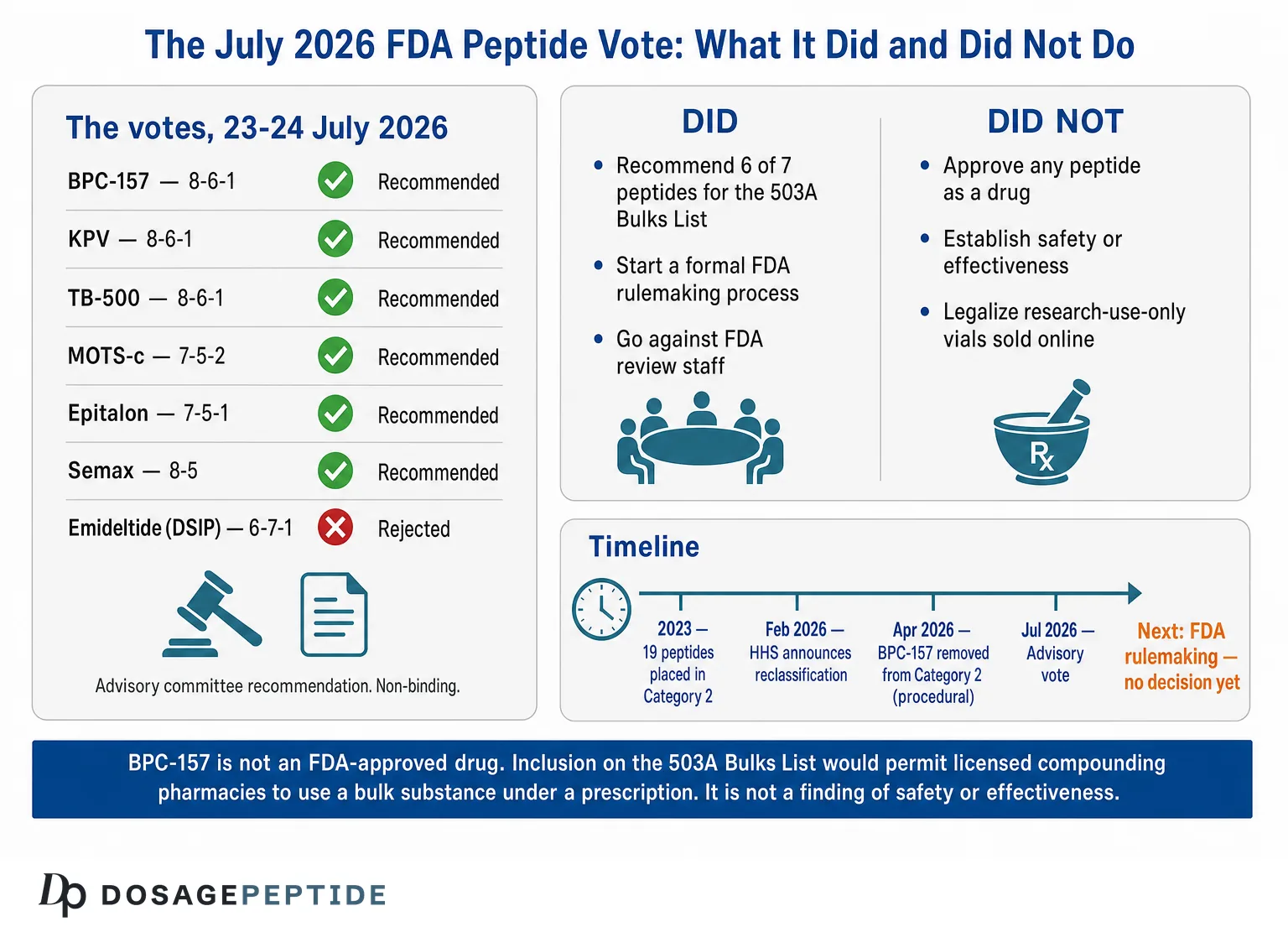
The July meeting is the third act in a sequence that began in 2023, and the earlier acts explain why so many people misread the headlines.
2023: Category 2
The FDA placed nineteen peptides — BPC-157 among them — into “Category 2,” a designation for nominated bulk substances that the agency judged to raise significant safety risks. In practice, that made compounding them a non-starter for licensed pharmacies, and it pushed demand toward the unregulated research-chemical market.
February 2026: the reclassification announcement
On 27 February 2026, Health and Human Services Secretary Robert F. Kennedy Jr. said that a majority of the nineteen Category 2 peptides would be moved back to Category 1; contemporaneous legal and pharmacy analyses put the figure at roughly twelve to fourteen.[14][15] At the time of the announcement, the FDA had not published a formal updated list, and an announcement by a cabinet secretary is not itself a regulatory action.
April 2026: removal from Category 2
The FDA gave notice on 15 April 2026 that it would remove BPC-157 — both the free base and the acetate — from Category 2 within seven calendar days. The trigger was procedural rather than scientific: the parties who had originally nominated the substance formally withdrew their nominations, which removed the basis for the Category 2 listing.[15] No new safety or efficacy finding accompanied the change, and the same analysis notes that removal from Category 2 does not by itself make a substance eligible for compounding under section 503A. The practical result was a gray zone, and an absence of prohibition is not a permission — BPC-157 was not on the positive 503A Bulks List, so compounders still had no listed basis to use it.
July 2026: the advisory vote
That gray zone is what the PCAC was convened to resolve. Its recommendation is an input to the FDA’s decision, not the decision. This is the furthest these substances have moved toward a lawful compounding pathway since the 2023 restrictions, and the outcome will materially affect what licensed pharmacies may prepare. That is a regulatory question about supply, not a verdict on whether the peptides work.
What is the 503A Bulks List, and why is inclusion not approval?
Section 503A of the Federal Food, Drug, and Cosmetic Act governs traditional pharmacy compounding: a state-licensed pharmacist preparing a customized preparation for an identified patient pursuant to a valid prescription. When a compounder wants to work from a bulk drug substance that is not a component of an FDA-approved drug and has no applicable USP monograph, that substance must appear on the 503A Bulks List.
Inclusion on that list answers exactly one question: may a compounding pharmacy use this raw material at all? It does not answer whether the substance works, whether it is safe at any particular exposure, what it should be labeled to treat, or how a finished preparation should be manufactured and tested. There is no New Drug Application, no Biologics License Application, no FDA review of a finished product, and no FDA-approved labeling. A physician who prescribes a compounded preparation is prescribing an unapproved drug, and the responsibility for that judgment sits with the prescriber.
503A versus 503B
The distinction matters for reading coverage of this story. A 503A pharmacy compounds patient-specific preparations under state board oversight and is not required to meet current Good Manufacturing Practice (cGMP) standards; sterile compounding practice is instead governed largely by standards such as USP General Chapter <797>. A 503B outsourcing facility registers with the FDA, may produce in batches without patient-specific prescriptions, and must comply with cGMP. The July votes concerned the 503A list. Neither category produces an FDA-approved drug.
A favorable vote is not evidence
This is the point most easily lost. The committee’s task was a multi-factor eligibility judgment — physicochemical characterization, safety, effectiveness, and historical use — and a majority of members concluded the balance favored inclusion. That is a regulatory determination made by a divided panel whose voting pool varied by substance, because several members were seated for named substances only: between 13 and 15 votes were cast in each session.[2] It is not a clinical trial, a systematic review, or a finding of efficacy, and it does not change the underlying evidence base by a single study.
What did the FDA’s own scientists say?
This is the part of the story that most coverage led with, and it deserves to be stated plainly: the committee voted against the recommendation of the agency’s career review staff, who had assessed each nomination and recommended against adding these substances to the list.[6]
On BPC-157, FDA staff wrote that the evaluation criteria “weigh against” inclusion, citing limited evidence of effectiveness for the proposed use (ulcerative colitis) and the availability of approved treatments for that condition.[4] The only effectiveness study staff located was reported in a meeting abstract of a trial that randomized 53 subjects, of whom 46 completed, in which the peptide was administered as an enema — not by injection, which is the route the compounding and gray markets actually use.[3][10] Staff also flagged that the substance is not well characterized, which makes it difficult to set quality standards, and noted adverse event reports following injection including injection-site reactions and one case of shortness of breath requiring emergency care, with causation unestablished.[3]
On KPV, staff reported that the nominator supplied no clinical evidence for wound healing or inflammatory conditions, and that the agency could not find a published study in which a KPV drug product had been administered to humans at all.[10] Readers who want the neutral literature summary can see our overview of what KPV is and what has actually been studied — which is, at present, overwhelmingly preclinical.
Across all seven nominations, the recurring FDA objections were consistent: inadequate physicochemical characterization, little or no human effectiveness data for the proposed routes, insufficient human safety data, unassessed immunogenicity risk, and the possibility of peptide-related impurities.[5] None of that changed on 24 July. A vote does not generate data.
What was reported about the committee itself?
Several outlets raised questions about the composition of the panel. NBC News reported that eight of the voting members had joined the committee through appointments made under Secretary Kennedy, that six of those eight run practices where peptides are administered, and that all eight voted in favor of BPC-157, KPV and TB-500.[7] Ahead of the meeting, the Associated Press reported that the panel included “more than a half-dozen panelists who run clinics, online businesses or pharmacies specializing in peptides,” and named individual members; Bloomberg Law and other outlets reported similar commercial ties.[12][11] A Department of Health and Human Services spokesperson disputed the criticism and said all members completed the standard ethics and vetting process.[7]
We report this because it was widely reported and because it is material to how much weight a reader should place on the vote as a scientific signal. We take no position on the motives of any individual. The relevant, verifiable fact for a reference library is narrower and harder to argue with: the votes were close, and they went against the agency’s own reviewers.
The majority’s stated reasoning deserves the same airing. According to meeting coverage, members who voted in favor argued that these compounds are already being bought in volume from an unregulated online market that labels them “research use only,” often from overseas sellers, with no prescriber involved and no assurance of what is in the vial — and that a lawful compounding route would at least put a licensed pharmacy and a quality standard between the patient and the substance.[6][8] Members who voted no contested that logic on the record — one argued the harm-reduction framing conflicts with a clinician’s obligation not to do harm, another that listing a substance risks creating confidence the data does not support.[6] Either way, the argument that carried the day was about access and eligibility, not about clinical proof of benefit.
Does any of this apply to research-use-only vials sold online?
No. This is the misreading most likely to cause harm, so it is worth being blunt about it.
A compounded preparation and a research-use-only (RUO) vial are two entirely separate supply chains that happen to share a molecule name. A compounded preparation would be made by a state-licensed pharmacy, from a bulk substance meeting defined criteria, under a prescription written for an identified patient, with the pharmacy accountable to its state board. An RUO vial is a laboratory reagent sold for in-vitro and preclinical research, with no prescription, no pharmacy oversight, no dispensing record, no requirement for sterility or endotoxin testing appropriate to human administration, and no verified identity or purity beyond whatever the seller chooses to publish.
If the FDA eventually adds BPC-157 to the 503A Bulks List, the only thing that becomes lawful is a licensed pharmacy using the bulk substance to fill an individual prescription written by a prescriber. It would not retroactively make an online research vial into a medicine, would not make it prescription-legitimate, and would not tell you anything about what is in it. The same holds for every peptide in the table above. Documented uncertainty about identity, purity and immunogenicity was central to the FDA’s own objections — and those objections apply with far more force to material that has never been near a pharmacy.
For the same reason, this article contains no dosing information and no protocol guidance. Our summary of reported BPC-157 adverse effects and evidence gaps exists to document what the literature says and what it does not, not to recommend use.
What happens next?
The FDA now reviews the committee’s recommendations and decides whether to initiate rulemaking. Adding a substance to the 503A Bulks List requires a proposed rule, a public comment period, and a final rule published in the Federal Register — a process that one regulatory attorney quoted after the meeting estimated at roughly eight to twelve months, and which can run longer.[13] The agency is not obliged to follow the committee, and it has declined to follow advisory committees before.
Between now and a final rule, the accurate description of BPC-157’s status in the United States is: not an FDA-approved drug; no longer on the Category 2 do-not-compound list; not on the 503A Bulks List; the subject of a favorable but non-binding advisory recommendation issued over the objection of FDA review staff. Anything stated more confidently than that — in either direction — is running ahead of the record.
Frequently Asked Questions
Has anything changed since the July 2026 vote?
No. As of 25 August 2026 the FDA has not published a proposed rule, opened a comment period, or issued any decision. The advisory committee’s recommendation was the last step to occur, and it was non-binding.
How long until the FDA actually decides?
There is no deadline. Adding a substance to the 503A Bulks List requires formal notice-and-comment rulemaking: a proposed rule, a public comment period, then a final rule. Comparable rulemakings have taken well over a year, and the FDA is not obliged to follow an advisory committee at all — it has overruled them before.
What would count as actual FDA approval?
A new drug application or biologics licence application, reviewed and approved for a specific indication with approved labelling. Nothing on the 503A pathway produces that. Bulks List inclusion, if it ever happens, would only permit a licensed compounding pharmacy to use the substance under a prescription — a different thing entirely.
Is BPC-157 FDA-approved?
No. BPC-157 has never been approved by the FDA for any indication, and the July 2026 advisory committee vote did not approve it. Approval requires a New Drug Application supported by adequate and well-controlled clinical trials, followed by FDA review of safety, effectiveness, manufacturing and labeling. None of that has occurred. The vote concerned eligibility for pharmacy compounding, which is a different regulatory question entirely.
Did the FDA approve BPC-157 for compounding in July 2026?
No. An advisory committee recommended it for possible inclusion on the 503A Bulks List by an 8–6 vote with one abstention. Advisory committee recommendations are non-binding. The FDA must still decide whether to proceed, and adding a substance to the list requires formal notice-and-comment rulemaking. Until a final rule is published, nothing about a compounding pharmacy’s legal position has changed.
Is BPC-157 banned?
It is not an FDA-approved drug, and it is not authorized for sale for human use. What changed is narrower: the FDA removed BPC-157 from the Category 2 “do not compound” list in April 2026 after the original nominating parties withdrew their nominations — a procedural change, not a safety finding. Removal from a restricted list is not the same as appearing on a permitted list. BPC-157 sits in between: not prohibited by that listing, not authorized by the 503A Bulks List.
Which peptides did the committee recommend, and which did it reject?
Six were recommended: BPC-157, KPV, TB-500 and MOTS-c on 23 July, then epitalon and semax on 24 July. One, emideltide — better known as DSIP, delta sleep-inducing peptide, and evaluated for opioid withdrawal, chronic insomnia and narcolepsy — was rejected by a 6–7 vote with one abstention. Every vote was narrow, and none of the six favorable votes reflected agreement from the FDA’s own scientific reviewers.
Why did FDA scientists oppose the recommendations?
Agency reviewers cited inadequate physicochemical characterization, little or no human effectiveness data for the proposed routes of administration, insufficient human safety data, unassessed immunogenicity risk and possible peptide-related impurities. For BPC-157 specifically, the only effectiveness evidence staff located was a meeting abstract of a trial that randomized 53 subjects (46 completed) using enema administration, not injection. For KPV, staff found no published study of administration to humans.
Does a favorable vote mean these peptides work?
No. The committee was weighing an eligibility standard for compounding, not adjudicating clinical efficacy, and it reached its conclusions over its own agency’s evidentiary objections. Nothing about the underlying research base changed on 23 or 24 July 2026. Any claim that the vote demonstrates a peptide is safe or effective for a condition misstates both what was voted on and what the evidence shows.
Does this legalize buying peptides online?
No. Research-use-only material sold online is a laboratory reagent supply chain with no pharmacy oversight, no prescription, and no requirement to meet standards for human administration. A 503A listing, if it ever happens, would apply to bulk substances used by licensed pharmacies filling prescriptions. The two are not connected, and one does not confer legitimacy on the other.
What does 503A actually mean?
Section 503A of the Federal Food, Drug, and Cosmetic Act covers traditional compounding: a state-licensed pharmacy preparing a customized medication for an individual patient under a valid prescription. Bulk substances used this way must appear on the 503A Bulks List when no approved-drug component or USP monograph applies. It is a permission to use a raw material — not an approval of a finished product.
When will the FDA make a final decision?
There is no announced date. The agency must complete its own review and, if it proceeds, publish a proposed rule, take public comment and issue a final rule. A regulatory attorney quoted after the meeting estimated roughly eight to twelve months as a realistic minimum. The FDA may also decline to follow the committee. This page will be updated when a formal FDA action is published.
References
- U.S. Food and Drug Administration. “July 23–24, 2026: Meeting of the Pharmacy Compounding Advisory Committee.”
- U.S. Food and Drug Administration. “2026 Meeting Materials, Pharmacy Compounding Advisory Committee.”
- U.S. Food and Drug Administration. FDA Briefing Document, Pharmacy Compounding Advisory Committee — BPC-157 (PDF).
- Regulatory Affairs Professionals Society (RAPS). “FDA advisory committee backs two controversial peptides.”
- Regulatory Affairs Professionals Society (RAPS). “FDA advisory committee backs two more peptides, rejects one for compounding list.”
- NPR. “FDA panel supports broadening access to peptides popular on the gray market,” 23 July 2026.
- NBC News. “FDA panel, with ties to the peptide industry, recommends easing restrictions on four of the compounds.”
- STAT News. “FDA advisory panel narrowly votes to allow compounding of unapproved peptides,” 23 July 2026.
- STAT News. “FDA advisory panel narrowly rejects compounding of one peptide, backs two others,” 24 July 2026.
- TIME. “An FDA Committee Just Voted in Favor of Peptides — Despite the Agency’s Opposition,” 23 July 2026.
- Bloomberg Law. “FDA Advisers Back Looser Rules For Six Peptides, Reject One (1).”
- Perrone M. (Associated Press, via PBS NewsHour). “FDA panel on peptides will include experts who promote the unproven chemicals favored by RFK Jr.,” 29 June 2026.
- Pharmaceutical Executive. “FDA Panel Votes to Loosen Restrictions for Four Peptides.”
- Pharmacy Times. “The Peptide Reclassification Everyone’s Talking About: A Pharmacist’s Take on What RFK Jr’s Announcement Actually Means.”
- Frier Levitt. “FDA to Remove 12 Popular Peptides from the Category 2 ‘Do Not Compound’ List.”
Research use only. Dosage Peptide is an independent reference library. It does not sell peptides, does not provide medical advice, and is not affiliated with the FDA, HHS, any compounding pharmacy or any supplier. BPC-157, TB-500, KPV, MOTS-c, epitalon, semax and emideltide are not approved by the FDA for the treatment, prevention or cure of any disease, and the July 2026 advisory committee vote did not change that status. Nothing on this page is a recommendation to obtain, administer or dose any compound in humans or animals. Material sold as “research use only” is intended for in-vitro and laboratory research by qualified personnel and is not a medicine. Regulatory status is subject to change; verify current status against primary FDA sources before relying on any statement here.