Bacteriostatic Water for Injection, USP carries two separate clocks, and they answer two different questions. The printed expiration date on a sealed vial is the manufacturer’s stability date and is typically years out. Once the stopper has been punctured, a second and much shorter in-use clock starts — the widely repeated 28 days — and it exists because of the benzyl alcohol preservative’s antimicrobial staying power, not because the water itself degrades. The surprise for most readers is that the 28-day figure does not appear on the Hospira package insert at all; it comes from the USP compounding framework and appears explicitly on certain drug labels that ship bacteriostatic water as a co-packaged diluent.[1][2]
This page reports what the FDA-approved labeling and the pharmacopoeial standards actually document about the diluent. It is not a preparation procedure. Bacteriostatic Water for Injection, USP is not an excipient or a supplement: it is an FDA-approved prescription drug product, approved under NDA 018802 on 27 October 1982, and its labeled indication is narrow — it is “indicated only for diluting or dissolving drugs for intravenous, intramuscular or subcutaneous injection,” following the instructions of the manufacturer of the drug being dissolved.[1][14]
| Situation | What the label or USP framework says | What the limiting factor actually is |
|---|---|---|
| Sealed vial, before the printed date | Usable to the manufacturer’s expiration date printed on the vial and carton | Container-closure integrity and the manufacturer’s own stability data. Water does not “spoil”; the date certifies the sealed system. |
| Sealed vial, past the printed date | No FDA-approved US label authorizes use past the printed expiration date | Nothing has been tested past that point. Absence of data, not proven failure. |
| After the first needle puncture | CDC injection-safety guidance, citing USP <797>, says a punctured multiple-dose vial should be dated and discarded within 28 days unless the manufacturer specifies a different date[5][7]; EGRIFTA WR patient labeling says to discard leftover bacteriostatic water 28 days after first use[2] | How long the benzyl alcohol can keep suppressing organisms introduced at each entry — the same 28-day window USP <51> uses to challenge a preservative.[3] |
| Kept in a refrigerator | The label directs storage at 20 to 25 °C (USP Controlled Room Temperature). No FDA-approved US label offers a longer in-use period for a refrigerated vial.[1] | Cold does not extend a documented in-use limit that was never set on temperature in the first place. |
| Seal broken, solution cloudy or particulate | “Do not use unless the solution is clear and seal intact.”[1] | Visible failure overrides every date on the vial. Multi-dose containers are a documented contamination route.[4] |
What are the two dates on a bacteriostatic water vial?
The expiration date is printed by the manufacturer on the vial and the carton. It applies to the unopened, unpunctured container and reflects stability testing the manufacturer performed on that sealed configuration. For a simple aqueous diluent this is normally measured in years.
The beyond-use date is a different animal. It is the date after which an opened multiple-dose container should no longer be used, and it is assigned by the user, not the printer. The distinction is spelled out in US injection-safety guidance: the expiration date governs the unopened vial; the beyond-use date governs the opened one; and the beyond-use date can never run past the printed expiration date.[5] Almost every argument you will read online about “how long is bac water good for” is really two people answering two different questions.
If you are working through the arithmetic of how much diluent a given vial needs before you get to the storage question, that belongs in the peptide reconstitution guide and in the companion piece on how much bacteriostatic water a reconstitution actually calls for.
Where does the 28-day rule come from?
Three sources converge on the number, and it is worth being precise about which is which.
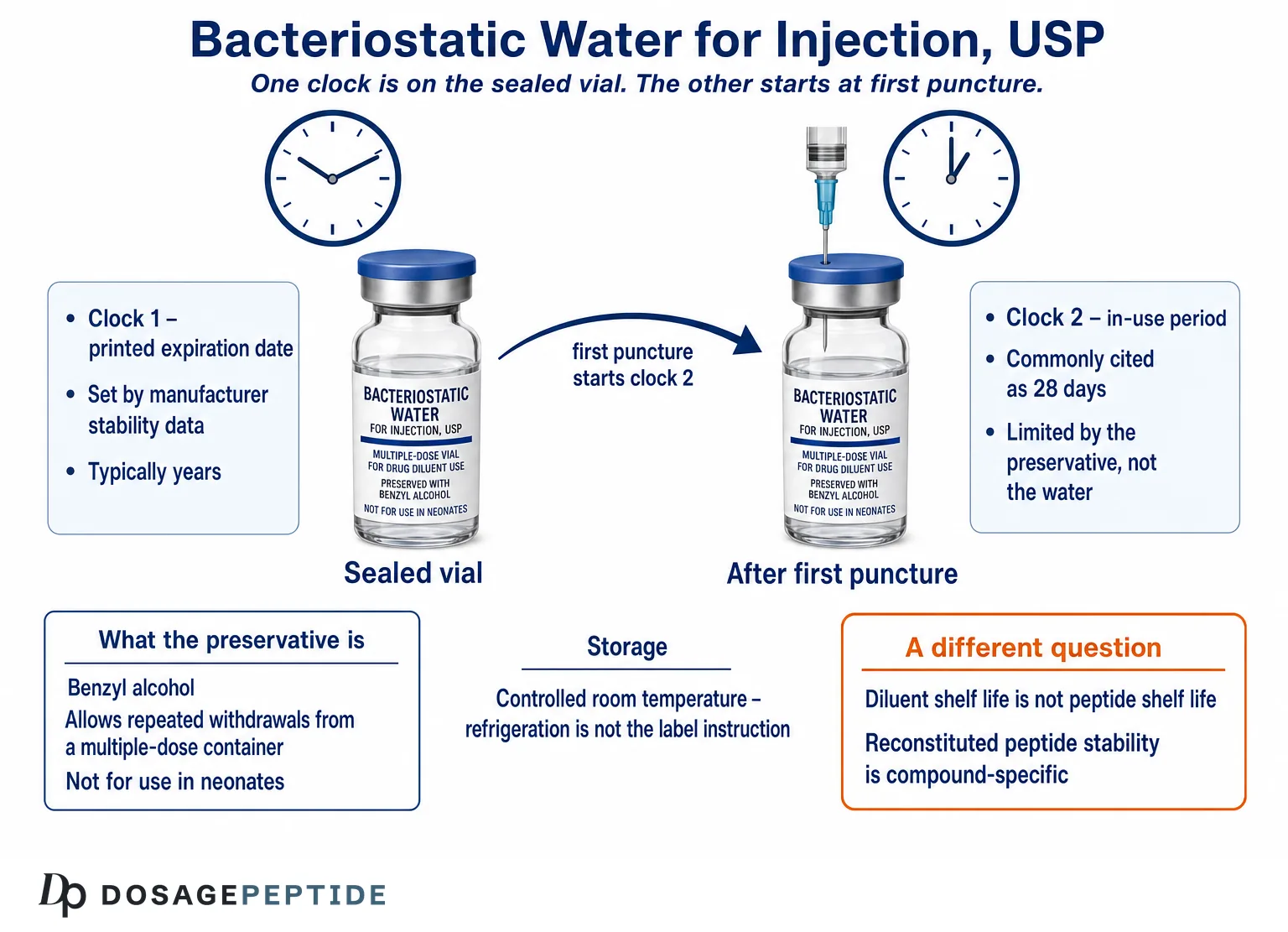
USP <51> Antimicrobial Effectiveness Testing is the compendial test that qualifies a preservative system. The chapter states plainly that in sterile articles packaged in multiple-dose containers, “antimicrobial preservatives are added to inhibit the growth of microorganisms that may be introduced from repeatedly withdrawing individual doses,” and that one or more preservatives are expected in all sterile multidose units.[3] The challenge itself is a 28-day exercise: in a 2025 preservative-effectiveness study of compounded clozapine oral suspensions that followed the ⟨51⟩ protocol, the preparations were inoculated with three bacterial and two fungal strains, incubated for 28 days, and read for colony counts at days 7, 14 and 28.[6] That study is cited here only to show the shape and duration of the test, not as evidence about this diluent: no published ⟨51⟩ challenge study of bacteriostatic water itself was located for this article, and the manufacturer’s own preservative-effectiveness data are not public. Twenty-eight days is therefore where the testing horizon stops, not a day on which benzyl alcohol has been shown to fail.
USP <797> Pharmaceutical Compounding — Sterile Preparations converts that testing horizon into a practical ceiling. Injection-safety guidance summarizing the chapter states that a punctured multi-dose vial “should be dated and discarded within 28 days unless the manufacturer specifies a different (shorter or longer) date for that opened vial.”[5][7]
Individual FDA-approved labels are the third source, and this is where the wording genuinely differs from product to product.
| Label | What it says about the bacteriostatic water itself |
|---|---|
| Bacteriostatic Water for Injection, USP — Hospira/Pfizer insert (NDA 018802) | No in-use limit and no 28-day statement anywhere. Describes a “multiple-dose container from which repeated withdrawals may be made,” directs storage at 20 to 25 °C, calls for aseptic technique on single or multiple entry, and states that the product is not to be used unless the solution is clear and the seal intact.[1] |
| Repackager and distributor listings of the same product (HealthFirst, ProPharma, Medical Purchasing Solutions), all under NDA 018802 | Reproduce the Hospira text. Same silence on an in-use period; same room-temperature storage statement.[14] |
| EGRIFTA WR (tesamorelin), FDA-approved patient labeling | Explicit: “Throw away (discard) any Bacteriostatic Water for Injection left in the bottle 28 days after first use.” The 30 mL bottle is supplied as a 28-day diluent supply.[2] |
So the honest formulation is this: 28 days is a real, regulator-recognized figure, and at least one FDA-approved label puts it on the diluent bottle in so many words. But it is a framework default, not a chemical expiry printed on every carton — and the diluent’s own approved insert does not state it.
What is benzyl alcohol actually doing in bacteriostatic water?
Benzyl alcohol is the whole reason repeat entry is contemplated at all. The Hospira product approved under NDA 018802 is water for injection with 0.9% (9 mg/mL) or 1.1% (11 mg/mL) benzyl alcohol added as a bacteriostatic preservative, at pH 5.7 (range 4.5 to 7.0) — 9 mg/mL in the 30 mL plastic vials, 11 mg/mL in the 20 mL glass vials.[1] Those figures are specific to that application, not to the name on the bottle: the bacteriostatic water co-packaged as a diluent with OMNITROPE, for instance, is preserved with 1.5% benzyl alcohol.[11] Sterile Water for Injection, USP, by contrast, “contains no bacteriostat, antimicrobial agent or added buffer and is supplied only in single-dose containers.”[8] That single sentence is the entire difference in shelf-life behaviour between the two, and it is unpacked further in the comparison of bacteriostatic water versus sterile water.
The word is bacteriostatic, not sterilizing. The preservative is designed to suppress organisms introduced during withdrawal; it does not sterilize, and it does not rescue an already-contaminated vial. A single-centre prevalence survey illustrates the point: over four months at a teaching hospital in Shiraz, Iran, 36 of 637 in-use multi-dose vials (5.6%) grew aerobic bacteria, 88.9% of isolates Gram-positive and Staphylococcus epidermidis the most frequent at 44.4%.[4] That is one hospital in one country in 2006, and the authors stated the clinical significance was not resolved — it is a prevalence observation, not evidence that preserved vials cause infection. What it does establish is that a preserved multi-dose container is not a self-sterilizing one.
The neonatal contraindication is on the label for a reason
The vial and tray labels for the approved US product carry the statement “WARNING: NOT FOR USE IN NEONATES.” — a labeling warning, not a formal FDA Boxed Warning. The contraindications section reads: “Due to the potential toxicity of benzyl alcohol in neonates, solutions containing benzyl alcohol must not be used in this patient population.” The same section bars use for fluid replacement and in epidural or spinal anesthesia, and the warnings note that intravenous administration without a solute may cause hemolysis.[1] The concern dates to a 1982 New England Journal of Medicine report titled “The gasping syndrome and benzyl alcohol poisoning,” describing the syndrome in newborn intensive-care patients; the NOVAREL label still cites the association of benzyl alcohol with a fatal gasping syndrome in premature infants.[9][12] It is a genuine label restriction, not boilerplate.
Does bacteriostatic water need to be refrigerated?
No — and the label answer differs from what most people assume. The Hospira insert and the HealthFirst, ProPharma and Medical Purchasing Solutions listings of the same NDA 018802 product all carry the identical storage line: “Store at 20 to 25 °C (68 to 77 °F). [See USP Controlled Room Temperature.]”[1] Room temperature is the specified condition, not a fallback.
Refrigeration is widely assumed to buy extra in-use time, and no FDA-approved US bacteriostatic water label states a refrigerated in-use extension — the assumption has no basis in the diluent’s own labeling. Where refrigeration is specified, and it frequently is, the instruction sits on the drug label and applies after reconstitution: a different question, covered in the discussion of whether peptides need refrigeration.
Why the diluent’s shelf life is not the reconstituted peptide’s shelf life
This is the single most consequential confusion on this topic, and the FDA-approved labels settle it decisively. Four approved products are reconstituted with the same Bacteriostatic Water for Injection, and each assigns a completely different post-reconstitution window:
| Product (FDA-approved) | Diluent | Documented period after reconstitution |
|---|---|---|
| EGRIFTA WR (tesamorelin) — approved for reduction of excess abdominal fat in HIV-infected adults with lipodystrophy | Bacteriostatic Water for Injection, USP | Store reconstituted product at 20 to 25 °C; discard unused solution 7 days after mixing; do not freeze[2] |
| SEROSTIM (somatropin) 4 mg — approved for the treatment of adults with HIV and wasting or cachexia, to increase lean body mass and body weight and improve physical endurance | Bacteriostatic Water for Injection with 0.9% benzyl alcohol | Refrigerated 2 to 8 °C for up to 14 days; do not freeze[10] |
| OMNITROPE (somatropin) 5.8 mg vial | Bacteriostatic Water for Injection with 1.5% benzyl alcohol | Refrigerated 2 to 8 °C; use within 21 days, discard unused portions after 21 days[11] |
| NOVAREL (chorionic gonadotropin) | Bacteriostatic Water for Injection preserved with 0.9% benzyl alcohol | “The solution should be refrigerated and used within 30 days”[12] |
Seven days, fourteen, twenty-one, thirty — one diluent, four answers. The window is set by the solute: its own chemical and physical stability data, generated by the sponsor for that specific formulation at that specific concentration. The diluent’s 28-day preservative window is a ceiling on microbial protection, not a stability claim for whatever is dissolved in it. The Hospira insert says as much: “Do not store reconstituted solutions of drugs for injection unless otherwise directed by the manufacturer of the solute.”[1]
Peptides in aqueous solution are not inert. A forced-degradation study of synthetic liraglutide published in the Journal of Peptide Science separated and characterized 19 degradation products under deliberately harsh acidic, basic and oxidative stress, concluding that the peptide is highly susceptible to hydrolytic and oxidative degradation.[13] That is analytical bench chemistry on one peptide, deliberately stressed — not a shelf-life measurement, not a study of any product in a vial, and not transferable to other peptides. It shows the degradation chemistry exists, which is why sponsors run real-time stability programs instead of assuming a peptide keeps as long as its diluent.
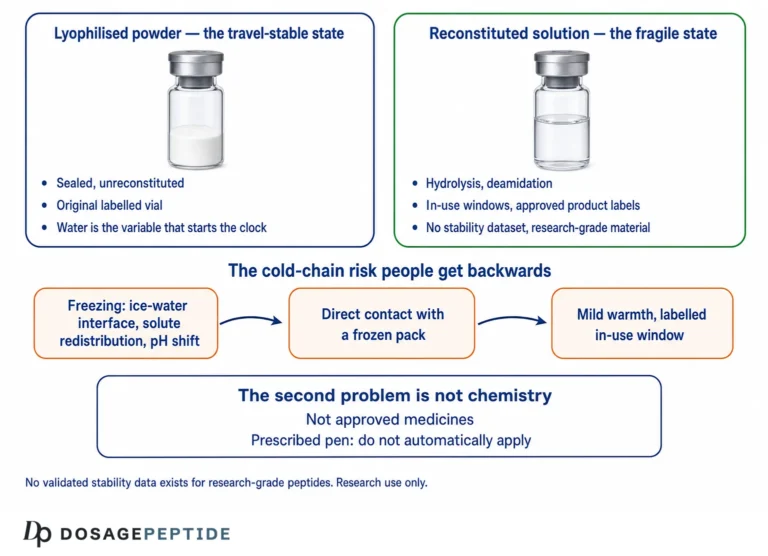
For research-grade peptides the picture is bleaker still: there is usually no published stability program at all, no assigned in-use period, and no regulatory record to consult. That is a genuine evidence gap, and it is worth stating rather than papering over. What is documented about handling and temperature is collected in the reference on storing peptides before and after reconstitution. Product-specific labeling records, where they exist, are summarized on pages such as the tesamorelin 10 mg vial reference and the KLOW 80 mg blend reference, and the mechanics of dilution are covered in the peptide reconstitution guide.
Is everything sold as “bacteriostatic water” the same product?
No, and the FDA’s own listing data show it. Bacteriostatic Water for Injection, USP from Hospira — and the repackager listings that carry the identical insert — are marketed under NDA 018802, an approved application held by Hospira.[14] At least one other product listed in the National Drug Code directory under the name “Bacteriostatic Water” carries the marketing category UNAPPROVED DRUG OTHER and no application number. Its entire structured product label runs to three sections — a “description” whose text is a single how-supplied sentence (30 mL multiple-dose vials, 25 per carton), plus a carton image and a vial image. There is no indication, no contraindication, no warning, no storage statement, and no stated benzyl alcohol concentration.[15]
The consequence matters: everything on this page rests on the approved insert. A product marketed without an approved application carries no such insert, so nothing about its expiration dating or preservative content can be inferred from Hospira’s document. The NDC and marketing category settle which one is in front of you.
Frequently Asked Questions
How long is bacteriostatic water good for after opening?
The convention is 28 days from the first needle puncture. That figure comes from the USP <797> default for punctured multiple-dose containers and matches the 28-day duration of the USP <51> preservative challenge test. It also appears verbatim on EGRIFTA WR’s FDA-approved patient labeling, which directs discarding leftover bacteriostatic water 28 days after first use. The Hospira insert for the diluent itself states no in-use limit.
Does bacteriostatic water expire if unopened?
Yes. Every vial and carton carries a manufacturer’s expiration date covering the sealed, unpunctured container. No FDA-approved US label authorizes use beyond it. That does not mean the contents fail on that date — it means nothing has been tested past it, and the labeling makes no representation about the product afterwards. Absence of data is the honest description, not proven degradation.
Does bacteriostatic water need to be refrigerated?
No. Every FDA-approved US Bacteriostatic Water for Injection label specifies storage at 20 to 25 °C, USP Controlled Room Temperature. Refrigeration is not directed and no label offers a longer in-use period for a refrigerated vial. Refrigeration instructions that people associate with this diluent generally come from the drug label after reconstitution, which is a separate question with a product-specific answer.
What is the difference between bacteriostatic water and sterile water?
The FDA-approved Hospira Bacteriostatic Water for Injection contains 0.9% or 1.1% benzyl alcohol as a preservative and is supplied in multiple-dose containers permitting repeated withdrawals; co-packaged diluents sold with other drugs may use a different strength, such as the 1.5% supplied with OMNITROPE. Sterile Water for Injection contains no bacteriostat, no antimicrobial agent and no buffer, and is supplied only in single-dose containers with instructions to discard the unused portion. The preservative is the entire reason one has an in-use period and the other does not.
Why is benzyl alcohol in bacteriostatic water?
It is the antimicrobial preservative that allows a sealed vial to be entered more than once. USP <51> states that preservatives are added to sterile multiple-dose containers specifically to inhibit growth of organisms introduced during repeated withdrawal, and that one or more preservatives are expected in all sterile multidose units. Benzyl alcohol also drives the label’s neonatal contraindication and its exclusions for fluid replacement and epidural or spinal use.
What does the label say about neonates, children and pregnancy?
The contraindications section rules it out in neonates outright, on the grounds of benzyl alcohol toxicity, and the warnings direct that only preservative-free Sterile Water for Injection be used where water is required for preparing or diluting medications for neonates. The label further records that safety and effectiveness have not been established in pediatric patients, that animal reproduction studies have not been conducted, and that the product should be given to a pregnant woman only if clearly needed.
Does refrigerating a punctured vial extend the 28 days?
There is no labeling support for that. The 28-day figure is anchored to a 28-day preservative challenge and to the USP <797> default for punctured multiple-dose containers, and no FDA-approved US bacteriostatic water label offers a temperature-dependent alternative to it. Extending a documented limit on the basis of an untested storage condition means substituting assumption for data, which is the opposite of what a beyond-use date is for.
How long does a peptide last once reconstituted with bacteriostatic water?
That depends entirely on the peptide, not on the water. Four FDA-approved products reconstituted with the same bacteriostatic water carry post-reconstitution windows of 7, 14, 21 and 30 days respectively. For research-grade peptides no such stability program generally exists, so no in-use period can be stated with confidence. The diluent’s preservative window is a microbial ceiling, never a chemical stability claim for the solute.
References
- Hospira, Inc. (Pfizer). Bacteriostatic Water for Injection, USP — full prescribing information (NDA 018802), revised 08/2019. DailyMed, U.S. National Library of Medicine. DailyMed SPL 87d6e9dc
- Theratechnologies Inc. EGRIFTA WR (tesamorelin) for injection — full prescribing information and FDA-approved patient labeling, revised 03/2025. DailyMed. DailyMed SPL 839334d3
- United States Pharmacopeia. General Chapter ⟨51⟩ Antimicrobial Effectiveness Testing. USP-NF. Rockville, MD: United States Pharmacopeia; 2017. DOI 10.31003/USPNF_M98790_03_01
- Motamedifar M, Askarian M. The prevalence of multidose vial contamination by aerobic bacteria in a major teaching hospital, Shiraz, Iran, 2006. Am J Infect Control. 2009;37(9):773-7. PubMed 19362388
- Indiana Department of Health. Frequently Asked Questions Regarding Safe Practices for Medical Injections (reproducing U.S. Centers for Disease Control and Prevention injection-safety FAQs). in.gov PDF
- Berzy J, Sachedina H, Virji A, Gross JA, Cull E, Walker SE. Microbial challenge of stable compounded clozapine suspensions in plastic bottles. Int J Pharm Compd. 2025;29(3):194-201. PubMed 40582004
- United States Pharmacopeia. General Chapter ⟨797⟩ Pharmaceutical Compounding — Sterile Preparations. USP-NF. Rockville, MD: United States Pharmacopeia; 2023. DOI 10.31003/USPNF_M99925_07_01
- Medefil, Inc. Sterile Water for Injection, USP — structured product label. DailyMed. DailyMed SPL 99e99a50
- Gershanik J, Boecler B, Ensley H, McCloskey S, George W. The gasping syndrome and benzyl alcohol poisoning. N Engl J Med. 1982;307(22):1384-8. PubMed 7133084
- EMD Serono, Inc. SEROSTIM (somatropin) for injection — full prescribing information. DailyMed. DailyMed SPL 62b01d29
- Sandoz Inc. OMNITROPE (somatropin) injection and for injection — full prescribing information, revised 07/2025. DailyMed. DailyMed SPL 58d84ffa
- Ferring Pharmaceuticals Inc. NOVAREL (chorionic gonadotropin) for injection — full prescribing information, revised 05/2023. DailyMed. DailyMed SPL ac6918ff
- Badgujar D, Bawake S, Sharma N. A comprehensive study on the identification and characterization of major degradation products of synthetic liraglutide using liquid chromatography-high resolution mass spectrometry. J Pept Sci. 2025;31(1):e3652. PubMed 39162000
- U.S. Food and Drug Administration. Drugs@FDA application overview, NDA 018802 — Bacteriostatic Water for Injection in Plastic Container (Hospira). Drugs@FDA NDA 018802
- Fujian Genohope Biotech Ltd. Bacteriostatic Water injection, solution — structured product label (marketing category: unapproved drug other). DailyMed. DailyMed SPL 54f66b82
Research use only. This article is an educational review of FDA-approved labeling and pharmacopoeial records concerning a diluent; it is not medical advice, not a preparation procedure, and not a recommendation for human use. Bacteriostatic Water for Injection, USP is an FDA-approved prescription product (NDA 018802) indicated solely for diluting or dissolving drugs for injection according to the instructions of the manufacturer of the drug to be administered, and is contraindicated in neonates. The research peptides referenced on this site are not approved by the FDA or any other national regulator for any indication, and research-grade material is not an approved pharmaceutical product. Nothing here should be used to diagnose, treat, cure or prevent any disease.