Short answer: in the United States, peptides are not a single legal category, and “are peptides legal?” has no single answer. Almost no research peptide is a controlled substance, a handful are FDA-approved drugs for narrowly defined indications, several are stuck in a compounding-law limbo that moved — but did not resolve — on 23–24 July 2026, and selling them online under a “research use only” label does not make human use lawful. This page separates the four legal questions that get blurred together, states the current status of each, and flags exactly where vendors overstate things.
This is a regulatory explainer written for researchers and informed readers. It is not legal advice, it is US-focused, and nothing here tells you what you may personally do.
Why “legal” splits into four separate questions
\n
\n
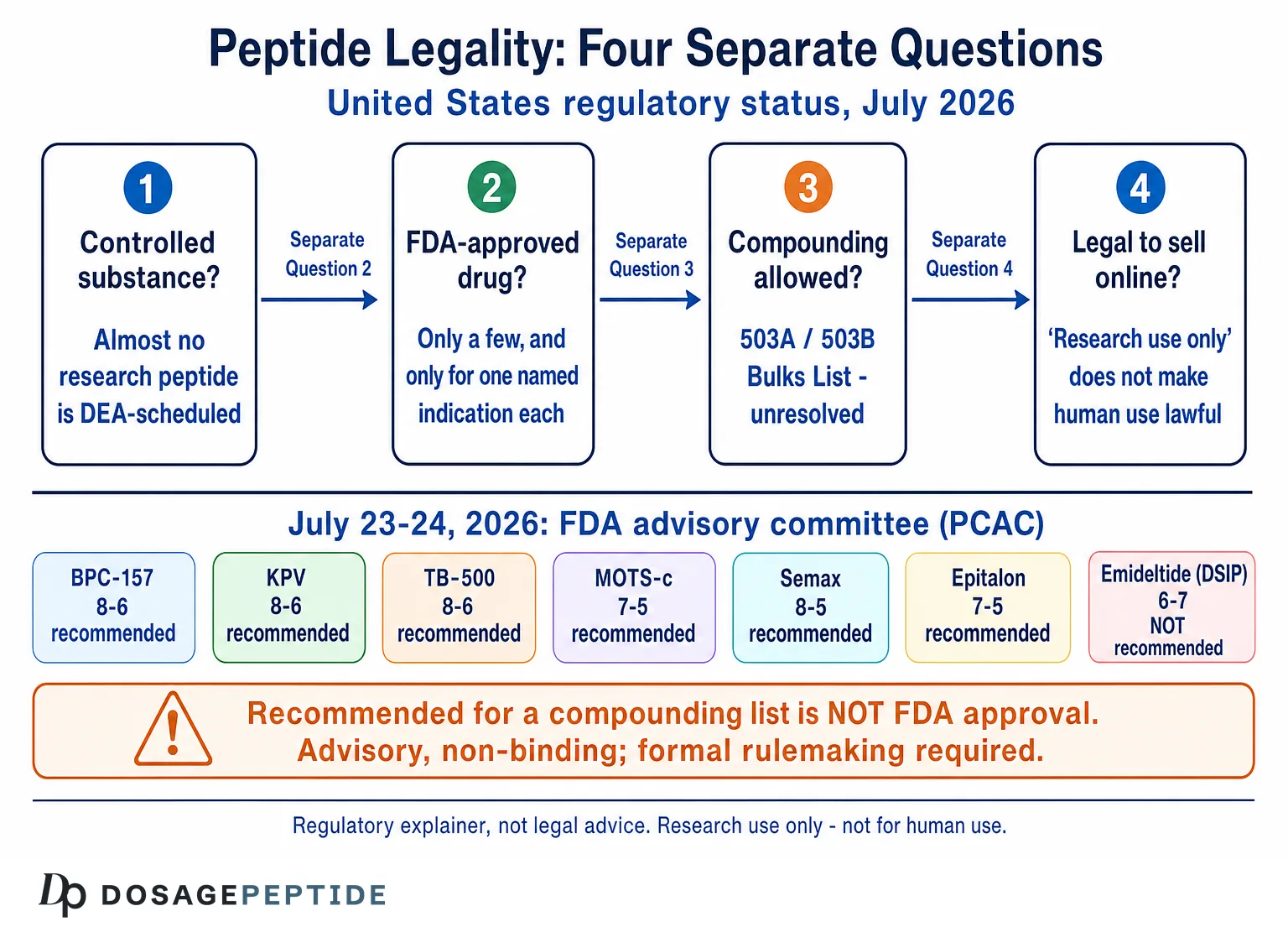
Most confusion about peptide legality comes from collapsing four independent legal axes into one word. A compound can be perfectly legal on one axis and clearly unlawful on another. The four axes are:
- Controlled-substance status. Is the molecule on a DEA schedule under the Controlled Substances Act? For nearly every peptide, the answer is no.
- Drug-approval status. Has FDA approved a drug product containing it — and for which indication? Approval is always per product and per indication.
- Compounding status. May a licensed pharmacy legally use the bulk substance to compound a prescription drug under section 503A or 503B of the Federal Food, Drug, and Cosmetic Act (FD&C Act)?
- Commercial status. Is selling or importing it — typically labeled “research use only” — lawful under the FD&C Act’s unapproved-new-drug and misbranding provisions?
Two more layers sit outside US federal drug law entirely: anti-doping rules in sport (a contractual regime, not a statute), and state or non-US national law.
Status table: representative compounds, July 2026
| Compound | US regulatory status | What that actually permits |
|---|---|---|
| Tesamorelin (Egrifta SV) | FDA-approved drug, initial US approval 2010[13] | Lawful prescription use for the approved indication only: reduction of excess abdominal fat in HIV-infected adult patients with lipodystrophy. Any other use is off-label prescribing by a licensed clinician, not an approved use. |
| Bremelanotide (Vyleesi) | FDA-approved drug, initial US approval 2019[13] | Lawful prescription use for acquired, generalized hypoactive sexual desire disorder in premenopausal women. Nothing broader. |
| Tirzepatide (Mounjaro / Zepbound) | FDA-approved drug; Zepbound approved for chronic weight management in 2023[13] | Lawful prescription use for the specific approved indications. An identical molecule sold by a research-chemical vendor is not covered by that approval. |
| Sermorelin | Previously approved as Geref; NDAs withdrawn effective 2009, and FDA determined in 2013 that the withdrawal was not for reasons of safety or effectiveness[7] | Historical approval does not confer current legal status. No FDA-approved sermorelin product is marketed in the US today. |
| BPC-157 | Not FDA-approved. Not a controlled substance. Nomination withdrawn from Category 2 in April 2026[4]; PCAC voted 8–6, one abstention, to recommend inclusion on the 503A Bulks List for ulcerative colitis, 23 July 2026[3] | Nothing yet. An advisory vote is not a rule and is not an approval. No approved labeling, no safety/efficacy determination, no lawful human-use indication. |
| Semax | Not FDA-approved. No USP or NF drug substance monograph exists, and it is not a component of any FDA-approved drug[2]. PCAC voted 8–5 to recommend inclusion, 24 July 2026[3]. | Same as BPC-157: recommended, not approved. The absence of a pharmacopoeial monograph also means research-grade material has no official identity or purity standard to be tested against. |
| Emideltide (DSIP) | Not FDA-approved. PCAC voted against inclusion, 6–7 with one abstention, 24 July 2026[3]. | No compounding pathway recommended. Status unchanged. |
| MK-677 / ibutamoren mesylate | Not a peptide (an orally active non-peptide secretagogue). Not federally scheduled. Remains in Category 2 for both 503A and 503B[4]. | FDA does not intend to permit its use in compounding pending further evaluation, citing a trial terminated early for a potential congestive heart failure signal. |
| Somatropin (hGH) | FDA-approved for defined indications. Not on any DEA schedule[9], but subject to a dedicated criminal provision. | Distribution for non-approved human uses is a federal felony under 21 U.S.C. § 333(e)[8]. This is the sharpest exception to “peptides aren’t controlled.” |
Axis 1: Are research peptides controlled substances?
For the overwhelming majority: no. A search of the DEA’s alphabetical list of controlled substances returns no entries for BPC-157, TB-500, semax, epitalon, KPV, MOTS-c, sermorelin, tesamorelin, ipamorelin or somatropin[9]. Anabolic steroids are Schedule III; peptides are structurally unrelated and were never swept into that definition.
This is the single most misused fact in peptide marketing. “Not scheduled” is a statement about the Controlled Substances Act only. It says nothing about whether a product is an unapproved new drug, whether it is misbranded, or whether importing it is lawful — all of which are governed by an entirely different statute.
The growth hormone exception
Human growth hormone is the exception worth knowing. It is not scheduled, but 21 U.S.C. § 333(e) makes it a criminal offense to knowingly distribute, or possess with intent to distribute, hGH for any use in humans other than a disease or recognized medical condition authorized by the Secretary under section 355 and pursuant to a physician’s order[8]. The provision carries up to five years’ imprisonment, and up to ten where a minor is involved. Congress built a bespoke criminal regime for hGH instead of scheduling it.
MK-677 and SARMs are a different category
Ibutamoren (MK-677) is routinely sold alongside peptides but is not one — it is a small-molecule ghrelin receptor agonist. It is not federally scheduled, but it does sit in Category 2 on FDA’s interim compounding lists for both 503A and 503B[4]. SARMs are a separate class again, with their own repeatedly introduced — and, as of this writing, not enacted — scheduling legislation. If you are trying to place MK-677 in the regulatory picture, our explainer on what MK-677 (ibutamoren) is and how it acts as a growth hormone secretagogue covers the pharmacology that drives its distinct treatment in law.
Axis 2: Is it an FDA-approved drug — and for what?
FDA approval is not a property of a molecule. It is a property of a specific product, made by a specific manufacturer, for a specific indication, with specific approved labeling. Tesamorelin is an approved drug — for reduction of excess abdominal fat in HIV-infected adults with lipodystrophy, and that is the whole of the approval[13]. Bremelanotide is approved for one sexual-desire indication in premenopausal women. Tirzepatide is approved for type 2 diabetes and, separately, for chronic weight management[13].
Two consequences follow, and both get flattened in marketing copy:
- An approved indication does not transfer. “Tesamorelin is FDA-approved” is true and tells you nothing about growth-hormone-axis peptides generally, or about a vendor’s vial of a GHRH analogue.
- Approval attaches to the manufacturer’s product. An unapproved copy of an approved molecule is still an unapproved new drug. FDA said exactly this in a March 2026 warning letter to a peptide seller offering tirzepatide and retatrutide[12].
Withdrawn approvals do not persist
Sermorelin is the clearest case. Geref held US approvals (NDA 19-863 and NDA 20-443); the manufacturer discontinued the product and the applications were withdrawn. FDA determined in a 4 March 2013 Federal Register notice that the withdrawal was not for reasons of safety or effectiveness — a technical finding that permits abbreviated applications to reference the listed drug, not a statement that the product is currently approved[7]. Vendors sometimes present the historical approval as a live one. It is not.
Where peptides stop and biologics begin
One quiet legal line matters for how a molecule is regulated at all: under 21 CFR 600.3(h)(6), a “protein” is any alpha amino acid polymer with a specific, defined sequence that is greater than 40 amino acids in size[11]. Above that threshold a product is generally a biologic requiring a BLA; at or below it, it is regulated as a drug. Most research peptides are far below 40 residues — BPC-157 has 15, semax has 7 — so they sit squarely in drug law. Definitions like this are collected in our peptide research glossary; handling and reconstitution references such as the BPC-157 10 mg vial reconstitution reference and the wider research protocol library document what appears in the published literature and in laboratory practice, and are not authorisation for human administration.
Axis 3: Can a compounding pharmacy legally use it?
This is the axis that actually moved in 2026, and the one most misreported.
Under section 503A of the FD&C Act[8], a state-licensed pharmacist or physician may compound with a bulk drug substance only under a conditional cascade, taken in order: the substance must comply with an applicable USP or NF monograph if one exists; if no monograph exists, it must be a component of an FDA-approved drug product; and only if neither applies may it qualify by appearing on FDA’s 503A Bulks List. It must also be manufactured by an FDA-registered establishment and be accompanied by a valid certificate of analysis[5]. Substances like BPC-157 and semax fail the first two conditions outright — neither has a USP/NF drug substance monograph and neither is a component of an approved drug[2]. The Bulks List is the only remaining route, and it is populated by formal notice-and-comment rulemaking[5].
The timeline, in order
- September 2023. FDA placed a large group of peptide bulk substances into Category 2 of its interim compounding policy — substances it considered to raise significant safety risks. Most peptide entries on FDA’s list carry the date 29 September 2023; ibutamoren mesylate, a non-peptide secretagogue nominated alongside the peptides, had already entered Category 2 for 503B on 29 December 2022[4]. HHS later characterised the 2023 action as covering nineteen peptides[6]. In practice it removed the enforcement-discretion cover compounders had relied on for the listed substances, and mainstream compounding of those substances largely stopped.
- 27 February 2026. HHS leadership publicly stated an intent to move roughly fourteen of those nineteen substances back to Category 1, which is what generated the first wave of “peptides are legal again” headlines[6].
- April 2026. Twelve substances came off Category 2 — but the mechanism was procedural, not scientific: FDA announced the removals on the basis that the nominations had been withdrawn by the nominators[6]. FDA’s page now files them under bulk drug substances nominated but withdrawn — BPC-157, KPV, TB-500, MOTs-C, semax, epitalon, emideltide, selank acetate, thymosin-alpha 1, AOD-9604, CJC-1295, melanotan II, cathelicidin LL-37, dihexa acetate, PEG-MGF, injectable GHK-Cu and ipamorelin acetate — each still carrying its published safety-risk description, because FDA did not retract its safety concerns. GHRP-2, GHRP-6, kisspeptin-10, tranilast and ibutamoren mesylate remain in Category 2[4]. The withdrawals did not end the evaluation: FDA continued on its own initiative, which is why the same substances reached the July advisory committee[2].
- 23–24 July 2026. The Pharmacy Compounding Advisory Committee met at FDA’s White Oak campus under docket FDA-2025-N-6895 to consider seven peptides for the 503A Bulks List[1].
What the July 2026 PCAC actually voted on
FDA evaluated each substance against a named use, not in the abstract. The indications below are FDA’s own, taken from the published meeting materials[1]; the tallies are as reported from the two sessions[3].
| Substance | Use FDA evaluated | Vote (yes–no) | Abstentions | Outcome |
|---|---|---|---|---|
| BPC-157 | Ulcerative colitis | 8–6 | 1 | Recommended for inclusion |
| KPV | Wound healing and inflammatory conditions | 8–6 | 1 | Recommended for inclusion |
| TB-500 | Wound healing | 8–6 | 1 | Recommended for inclusion |
| MOTS-c | Obesity and osteoporosis | 7–5 | 2 | Recommended for inclusion |
| Semax | Cerebral ischemia, migraine, trigeminal neuralgia | 8–5 | not reported | Recommended for inclusion |
| Epitalon | Insomnia | 7–5 | 1 | Recommended for inclusion |
| Emideltide (DSIP) | Opioid withdrawal, chronic insomnia, narcolepsy | 6–7 | 1 | Not recommended |
Two caveats about that table. First, every vote was close, and every one for which abstentions were reported recorded at least one. Second, FDA did not put seven questions to the committee but fourteen: its published voting questions asked separately about the free base and the acetate salt of each substance[1]. The tallies reported publicly, and reproduced above, are the per-substance outcomes; the underlying record is per form.
Why “FDA approved BPC-157” is false
This is the most important sentence on this page. A PCAC vote is advisory and non-binding. FDA is not legally bound by it. To change anything, FDA must run formal rulemaking — proposed rule, public comment period, final rule — a process that realistically takes many months at minimum. Until a final rule issues, nothing about lawful compounding has changed.
And even a successful final rule would not be an approval. Placement on the 503A Bulks List means only that a compounding pharmacy may use that bulk substance to prepare a drug pursuant to a valid prescription. It is not an NDA or BLA. It involves no FDA determination that the substance is safe or effective. It produces no approved labeling, no approved indication, no required prescribing information, and no manufacturing standards of the kind that attach to approved products. Anyone writing “FDA-approved” on the strength of the July 2026 vote is wrong. We track this specific claim in detail on whether BPC-157 is FDA-approved.
What FDA’s own scientific staff wrote
In six of the seven votes the committee recommended inclusion even though FDA’s own written evaluation concluded that a balancing of the criteria weighed against it[2][3]. That is unusual and worth reading directly, because the briefing documents are the most detailed public evidence reviews of these compounds FDA has published.
On BPC-157, FDA concluded that “a balancing of the criteria weighs against” inclusion, that BPC-157 is “not well characterized from a physiochemical perspective,” and that it identified a single meeting abstract as the entire efficacy base for the nominated use — a randomised, double-blind, placebo-controlled study in ulcerative colitis with 53 subjects randomised and 46 completing, using an 80 mg rectal enema, not an injection. The between-group difference in Disease Activity Index did not exclude no effect. Three FAERS reports were retrieved, all involving injectable BPC-157: an injection-site reaction, shortness of breath resulting in an emergency room visit, and diffuse hyperpigmentation with gingival darkening. All three were confounded; in the one case with a positive rechallenge FDA judged the reaction likely attributable to the product, but could not separate BPC-157 from the second peptide it was combined with[2]. Notably, that report involved a product labeled “research purposes only.”
On KPV, FDA was blunter: the nomination did not include, and FDA did not identify, any information on these substances administered in humans, by any route[2]. The evidence base for a peptide recommended 8–6 for wound healing contains zero human administration studies.
On Semax, FDA found “insufficient evidence to support the effectiveness for semax (free base) or semax acetate for cerebral ischemia, migraine, or trigeminal neuralgia,” noted that it is “not well-characterized from the physical and chemical characterization perspective,” and recorded that no monograph exists in the USP-NF, the European Pharmacopoeia, the Japanese Pharmacopoeia or the International Pharmacopoeia[2]. Selank, frequently discussed alongside it, was not on the July agenda at all — it sits in the same nominated-but-withdrawn bucket[4]. Our Semax vs Selank comparison sets out what the underlying research does and does not show.
The independent literature agrees on the tier. A 2025 review in Current Reviews in Musculoskeletal Medicine found only three human pilot studies of BPC-157 in total and concluded it “should be considered investigational”[15]. Preclinical breadth is real; clinical evidence is thin. We keep the safety literature separate from the legal question on what the evidence says about peptide safety.
Axis 4: Is selling or buying “research use only” peptides legal?
Start with a fact almost nobody states plainly: there is no FDA “research use only” category for injectable drugs. The RUO labeling statement people copy — “For Research Use Only. Not for use in diagnostic procedures.” — comes from 21 CFR 809.10(c)(2)(i), a narrow labeling exemption for in vitro diagnostic products in the laboratory research phase of development[10]. It was never a route to market unapproved injectables to consumers.
What actually governs is intended use. Under section 201(g)(1) of the FD&C Act, an article becomes a drug if it is intended for the diagnosis, cure, mitigation, treatment or prevention of disease, or intended to affect the structure or any function of the body. Intent is inferred from the whole context: claims, labeling, website copy, what is sold alongside it.
FDA applied precisely that reasoning in a March 2026 warning letter, writing that “[d]espite statements on your product labeling marketing your products for ‘Research Use Only,’ and ‘not intended for human consumption, medical use, or veterinary use,’ evidence obtained from your website establishes that your products are intended to be drugs for human use.” The site’s own copy — appetite suppression, glucose handling, weight reduction — supplied the intent. The products were held to be unapproved new drugs, and their introduction into interstate commerce a violation of sections 301(d) and 505(a). FDA also treated the bacteriostatic water sold alongside them as a drug, because selling it with injectables requiring reconstitution demonstrated the intended use[12]. That letter was one of several carrying the same 31 March 2026 date issued to online peptide sellers.
Imports
The border is a separate chokepoint. Import Alert 66-41, “Detention Without Physical Examination of Unapproved New Drugs Promoted In The U.S.,” lets FDA divisions detain listed products without testing the individual shipment[12]. The alert expressly notes that commercial or promotional shipments, and products subject to detention without physical examination, are generally not amenable to enforcement discretion — the informal latitude sometimes extended to genuine personal importation. An RUO sticker does not create an import exemption.
The honest summary of axis 4
Possessing a research chemical is generally not itself a federal crime where the substance is unscheduled — with the hGH carve-out above, where § 333(e) reaches possession with intent to distribute[8]. Selling unapproved peptides to the public with structure/function or disease claims is a different matter: it sits squarely within FD&C Act enforcement, and the RUO label does not cure it — it is evidence FDA reads past, not a shield.
Sport: WADA rules are not law, but they end careers
Anti-doping rules are contractual, enforced by sporting bodies rather than governments — and they are stricter than drug law, not looser. Under the 2026 WADA Prohibited List, category S0 covers any pharmacological substance that is not addressed by any other section of the List and has no current approval by any governmental regulatory health authority for human therapeutic use, prohibited at all times, and it names BPC-157 explicitly. TB-500 appears under S2.3 as “Thymosin-β4 and its derivatives e.g. TB-500.” S2.2.4 captures GHRH analogues (CJC-1293, CJC-1295, sermorelin, tesamorelin), growth hormone secretagogues and their mimetics (including ibutamoren/MK-677 and ipamorelin), and the GHRPs[14]. All are prohibited in and out of competition.
The logic of S0 is worth absorbing: the very thing that keeps a peptide off the DEA schedules — the absence of regulatory approval — is what places it on the WADA list. “Unscheduled” and “permitted in sport” are close to opposites here.
State law and non-US readers
Everything above is federal US law. States maintain their own controlled-substance schedules, pharmacy practice acts, telehealth rules and consumer-protection statutes, and they do not always mirror the federal position — a substance unscheduled federally can still be restricted at state level. Outside the United States the picture changes entirely: national medicines agencies, customs regimes and personal-import rules differ substantially, and a compound freely sold in one jurisdiction can be a prescription-only or prohibited medicine in another. If you are not in the US, the analysis on this page does not describe your legal position. Check your own regulator.
How to read a vendor’s legality claim
- “FDA approved” — ask which product, which NDA or BLA, and which indication. If the answer is a PCAC vote or a Bulks List placement, it is not an approval.
- “Legal because it’s not a controlled substance” — true and irrelevant. That is axis 1 answering a question asked on axis 4.
- “Pharmaceutical grade” — for compounds with no USP/NF monograph, such as semax or BPC-157, there is no pharmacopoeial standard the phrase could refer to.
- “Clinically proven” — check whether the underlying studies were in humans at all. For KPV, FDA found none.
The compounds discussed here are, with the specific FDA-approved exceptions named in the status table, unapproved investigational or research substances, and everything on this page is provided for research, educational and regulatory-literacy purposes only. Nothing here is medical or legal advice, a recommendation for human use, or a dosing protocol, and nothing here claims that any unapproved peptide treats, cures, prevents or mitigates any disease; regulatory status changes, so verify against the primary sources listed below.
Frequently Asked Questions
Are peptides legal in the US?
It depends which legal question you mean. Almost no research peptide is a DEA-controlled substance, so possession is generally not a federal drug-schedule offence. But most are unapproved new drugs, which makes selling them with human-use or structure/function claims unlawful under the FD&C Act regardless of an RUO label, and importing them can trigger detention without physical examination. A handful of peptide drugs are FDA-approved for narrow, specific indications.
Is BPC-157 legal?
BPC-157 is not a controlled substance and is not FDA-approved for any indication. On 23 July 2026 an FDA advisory committee voted 8–6, with one abstention, to recommend adding it to the 503A Bulks List for ulcerative colitis, but that vote is advisory and non-binding. FDA must complete formal notice-and-comment rulemaking before anything changes, and even then, Bulks List placement permits compounding — it is not a drug approval.
Did the FDA approve BPC-157 in July 2026?
No. This is the most common current misstatement. The Pharmacy Compounding Advisory Committee recommended inclusion on a bulk substances list for compounding. There was no NDA, no BLA, no safety or efficacy determination, and no approved labeling. FDA’s own briefing document had concluded the evaluation criteria weigh against inclusion. Any vendor writing “FDA approved” is misrepresenting what happened.
What does “research use only” actually mean?
As a regulatory term it comes from 21 CFR 809.10(c)(2)(i), a labeling exemption for in vitro diagnostic products in the laboratory research phase. It is not a category for injectable drugs and it does not legalise human use. FDA determines a product’s intended use from all available evidence, including website claims, and has explicitly stated in warning letters that RUO disclaimers do not override that evidence.
Which peptides are FDA-approved?
Several peptide drugs hold approvals, each for defined indications: tesamorelin for reduction of excess abdominal fat in HIV-infected adults with lipodystrophy, bremelanotide for acquired generalized hypoactive sexual desire disorder in premenopausal women, and tirzepatide for type 2 diabetes under one trade name and, in a separate product, chronic weight management. Approval is always product-specific and indication-specific, and it never transfers to a research-chemical version of the same molecule.
Can a compounding pharmacy legally make BPC-157 or semax?
Not currently. Section 503A requires a bulk substance to meet a USP or NF monograph if one exists; failing that, to be a component of an FDA-approved drug; and failing both, to appear on the 503A Bulks List. BPC-157 and semax meet neither of the first two — FDA confirmed neither has a monograph nor is a component of an approved drug — and neither is on the Bulks List, because the July 2026 recommendation has not been converted into a final rule.
Is it illegal to buy peptides online?
Federal enforcement in this area has focused on sellers rather than individual purchasers, and unscheduled substances are not covered by drug-possession statutes. That said, imported shipments of unapproved new drugs can be detained without physical examination, sellers face unapproved-new-drug and misbranding exposure, and state law adds a further layer. Nothing here should be read as advice about what any individual may lawfully do.
Are peptides banned in sport?
Broadly yes, and more strictly than under drug law. The 2026 WADA Prohibited List names BPC-157 under S0 (non-approved substances, prohibited at all times), TB-500 under S2.3 as a thymosin-β4 derivative, and covers GHRH analogues, growth hormone secretagogues including MK-677 and ipamorelin, and the GHRPs under S2.2.4. Tested athletes should assume any research peptide is prohibited unless verified otherwise.
Is MK-677 a peptide, and is it legal?
MK-677 (ibutamoren) is not a peptide — it is an orally active small-molecule growth hormone secretagogue. It is not federally scheduled, but ibutamoren mesylate remains in Category 2 on FDA’s interim compounding lists for both 503A and 503B, citing a trial terminated early over a potential congestive heart failure signal, and it is prohibited in sport under WADA S2.2.4.
References
- US Food and Drug Administration. July 23–24, 2026: Meeting of the Pharmacy Compounding Advisory Committee — agenda, substances and uses evaluated, docket FDA-2025-N-6895; and the meeting’s voting questions (separate free base and acetate questions for each substance).
- US Food and Drug Administration, PCAC briefing documents, July 2026: BPC-157-Related Bulk Drug Substances; KPV-Related Bulk Drug Substances; Semax-Related Bulk Drug Substances.
- Reported vote outcomes: Pharmaceutical Executive, 23 July 2026 session (BPC-157, KPV, TB-500, MOTS-c); Regulatory Affairs Professionals Society, 24 July 2026 session (semax, epitalon, emideltide).
- US Food and Drug Administration. Certain Bulk Drug Substances for Use in Compounding That May Present Significant Safety Risks — Category 2 table (with dates added) and the “nominated but withdrawn” table.
- US Food and Drug Administration. Bulk Drug Substances Used in Compounding Under Section 503A of the FD&C Act.
- Orrick, Herrington & Sutcliffe. FDA Announces Removal of 12 Peptides from Category 2 and Schedules PCAC Meetings to Consider Adding Peptides to the 503A Bulk Drug Substances List, April 2026.
- Federal Register, 4 March 2013 (78 FR 14095; doc. 2013-04827). Determination That GEREF (Sermorelin Acetate) Injection … Were Not Withdrawn From Sale for Reasons of Safety or Effectiveness.
- Legal Information Institute, Cornell Law School: 21 U.S.C. § 353a (pharmacy compounding, section 503A) and 21 U.S.C. § 333 (penalties, including § 333(e) on human growth hormone).
- US Drug Enforcement Administration, Diversion Control Division. Controlled Substances — Alphabetical Order.
- 21 CFR § 809.10 — Labeling for in vitro diagnostic products (source of the “For Research Use Only” statement), eCFR.
- 21 CFR § 600.3(h)(6) — definition of “protein” (greater than 40 amino acids), eCFR.
- US Food and Drug Administration enforcement: Warning Letter, Gram Peptides, MARCS-CMS 721806, 31 March 2026; Import Alert 66-41: Detention Without Physical Examination of Unapproved New Drugs Promoted In The U.S.
- FDA-approved product information: EGRIFTA SV (tesamorelin) prescribing information; VYLEESI (bremelanotide) prescribing information; FDA Approves New Medication for Chronic Weight Management (Zepbound / tirzepatide), 8 November 2023.
- World Anti-Doping Agency. World Anti-Doping Code International Standard: Prohibited List 2026 (effective 1 January 2026).
- McGuire FP, Martinez R, Lenz A, Skinner L, Cushman DM. Regeneration or Risk? A Narrative Review of BPC-157 for Musculoskeletal Healing. Curr Rev Musculoskelet Med. 2025;18(12):611–619. doi:10.1007/s12178-025-09990-7