- Needle: 25G–31G for subcutaneous administration in standard nursing references; 4 mm pen needles or 6 mm syringe needles are documented as safe first-line choices in diabetes injection-technique consensus.
- Angle: 90° for adults of normal or larger body size, 45° where subcutaneous tissue is thinner. A lifted skin fold is documented where the needle may exceed subcutaneous depth, not as a universal step.
- Aspiration: not documented as necessary. The CDC states there are no large blood vessels at recommended sites and that aspiration may increase pain.
- Volume: no more than 1 mL per subcutaneous site in adults. Volume, unlike injection speed, does measurably increase pain.
- The gap that matters: all of that guidance describes approved, sterile, prescriber-supervised products. A vial labelled “research use only” does not meet those conditions, and the FDA has issued warning letters to online peptide vendors on exactly that point. This page documents the sources; it is not administration instructions.
Search interest in “how to inject peptides” is overwhelmingly practical: someone has a vial, a syringe, and a question about angle, depth, and whether to pull back on the plunger. This page does not answer that question as a procedure, and the reason is not squeamishness about the topic. It is that the administration guidance people are reaching for was written for approved, sterile, prescriber-supervised products, and the compounds most often bought as “research use only” peptides fail the conditions that guidance assumes. Documenting the technique without documenting that gap would be the misleading part.
What follows is a reference on what published administration guidance actually specifies, where the evidence behind common claims is weaker than it is usually presented, what injection-site complications are documented in the literature, and what the current regulatory position on research-labelled peptides is. It is written as documentation of published sources, not as instructions for a reader to follow.
Why the source of the vial comes first
The “research use only” (RUO) label is frequently read as a technicality — a formality on a product that is otherwise equivalent to a pharmacy item. Current U.S. enforcement does not treat it that way.
The FDA has issued warning letters to online peptide vendors — among them Prime Peptides, Summit Research Peptides, SwissChems, and Xcel Research — for distributing unapproved semaglutide, tirzepatide, and retatrutide products. The agency’s stated basis is instructive: in each letter, the FDA noted that the products carried “research use only” marketing while the companies’ own websites and social media demonstrated that the products were intended for human use.[1] The label did not settle the question; the surrounding evidence of intended use did.
That distinction matters for how any technique content is read. A page that pairs an RUO product with a complete administration procedure is itself part of the evidence of intended use. This is a documented enforcement pattern, not a hypothetical.
The FDA has separately documented concrete harms in this supply category: reports of adverse events requiring hospitalization associated with dosing errors in compounded semaglutide, products arriving warm or with inadequate cold-chain packaging, salt forms such as semaglutide sodium and semaglutide acetate that are different active ingredients from those in approved drugs, and fraudulent labelling naming compounding pharmacies that do not exist.[1][2] None of these failure modes are addressed by injection technique. A correctly performed injection of a mislabelled, non-sterile, or wrongly concentrated solution is still a mislabelled, non-sterile, wrongly concentrated solution.
Regulatory posture on compounded GLP-1 products has also tightened rather than relaxed: the FDA has moved to exclude semaglutide, tirzepatide, and liraglutide from the 503B bulk drug substances list, which would close the route by which outsourcing facilities compounded them at scale.[3] Readers encountering older articles describing compounded GLP-1s as broadly available should treat that framing as out of date.
Needle, angle and depth: what published guidance specifies
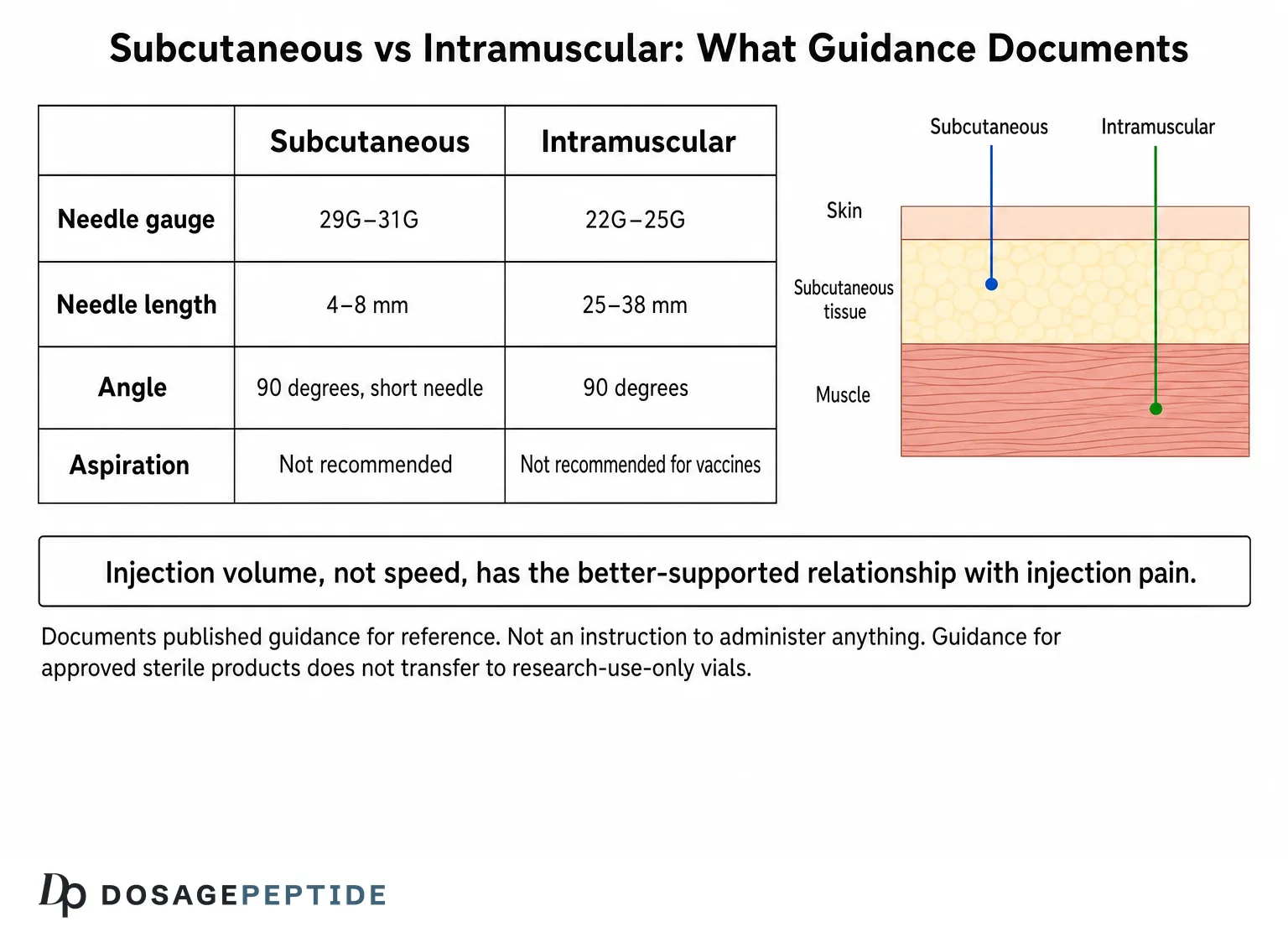
The table below summarises parameters as they appear in diabetes injection-technique consensus, CDC immunization guidance, the WHO injection safety toolkit, and standard nursing and StatPearls references. These are clinical documents describing administration of approved products by or under the supervision of trained personnel.
| Parameter | Subcutaneous (SC) | Intramuscular (IM) | What the source documents |
|---|---|---|---|
| Needle gauge | 25G–31G | 22G–25G | Nursing references document 25–31G for SC administration; larger bore is documented for viscous or oil-based IM products[4] |
| Needle length | Approximately 12–16 mm (½–⅝ inch) in general nursing references; 4 mm pen needles in diabetes guidance | 25–38 mm, weight- and site-dependent | The FITTER consensus documents the 4 mm pen needle and 6 mm syringe needle as safe and effective first-line choices across patient categories[5] |
| Angle | 45° or 90°, selected by subcutaneous tissue depth | 90°, needle perpendicular to the skin | 90° is documented for adults of normal or larger body size, 45° where adipose tissue is thinner; CDC documents 90° for IM[4][6] |
| Skin pinch (lifted fold) | Documented where the needle may exceed subcutaneous depth, or in lean subjects | Generally not used | Described as a method of lifting subcutaneous tissue away from muscle, not as a universal step[5] |
| Aspiration | Not documented as necessary | Not recommended for vaccines at recommended sites | CDC states aspiration is not necessary because no large blood vessels are present at recommended sites, and that it may increase pain[6][7] |
| Injection speed | Evidence is mixed; see the section below | A randomised trial found no effect of speed on pain; a Cochrane review found only low-quality evidence of reduced pain at 48 hours[8][9] | |
| Documented volume per site | No more than 1 mL in adults; 0.5 mL in children | Commonly up to 2–5 mL depending on muscle mass and site | Larger SC volumes are documented as poorly absorbed and more uncomfortable; injection volume, unlike speed, does measurably increase pain[4][8] |
| Documented sites | Abdomen, lateral thigh, upper outer arm | Deltoid, vastus lateralis, ventrogluteal | Site selection is documented by tissue depth and distance from major vessels and nerves[10] |
| Rotation | Documented as a measure against lipohypertrophy | Alternating sides documented for repeated dosing | Incorrect site rotation carries one of the strongest associations with lipohypertrophy in surveyed populations[11] |
| Needle reuse | Prohibited in WHO guidance | WHO states a new single-use device is required for each procedure, including for reconstitution, and that a syringe must not be reused even if the needle is changed[12] | |
| Sharps disposal | Immediate disposal at point of use | WHO documents disposal into a leak- and puncture-resistant sharps container in the location where the device was used[12] | |
Aspiration: what actually changed
Aspiration — drawing back on the plunger to check for blood return before injecting — is the single most persistent piece of injection folklore, and the guidance genuinely has moved.
CDC immunization guidance states that aspiration before injecting a vaccine is not necessary, on two grounds: no large blood vessels are present at the recommended injection sites, and aspiration may increase pain through longer needle dwell time in tissue and movement of the needle.[6][7]
Two qualifications are worth stating precisely, because this recommendation is routinely over-generalised online. First, it is framed around recommended sites — the anatomical basis for the advice is the absence of large vessels at those specific landmarks, not a general finding that intravascular injection is unimportant. Second, the CDC guidance addresses vaccine administration. Extending “aspiration is never needed for anything, anywhere” beyond that context is an inference, not a citation. Contrary to a common claim, the WHO injection safety toolkit does not address aspiration technique at all,[12] so it cannot be cited in support of the point.
Does injecting slowly reduce pain?
“Inject slowly to reduce pain” appears in a great deal of peptide-adjacent writing, usually stated as settled. It is not.
A double-blinded randomised controlled trial in 82 adults with diabetes tested subcutaneous injections at 150, 300, and 450 µL/s across volumes from 400 to 1600 µL. Injection speed had no measurable impact on pain (p = 0.833). Injection volume did: larger volumes produced significantly more pain, and the thigh was significantly more painful than the abdomen.[8]
A Cochrane systematic review of subcutaneous heparin injections found no clear difference in pain immediately after injection, and no clear difference in bruise size. It did find lower pain intensity at 48 hours with slower injection, but rated that evidence low-quality on grounds of imprecision and inconsistency, from a pooled sample of 59 participants.[9]
The honest summary is that volume has a better-supported relationship with injection pain than speed does. Articles presenting slow injection as an established pain-reduction technique are inflating a low-quality, mixed evidence base.
What can go wrong at the injection site
Lipohypertrophy is the best-quantified complication of repeated subcutaneous injection. A meta-analysis pooling 26,865 participants across 45 studies estimated prevalence at 41.8% (95% CI 35.9–47.6%) among people with diabetes on insulin therapy, with longer duration of therapy significantly associated with higher prevalence.[13] A survey of 401 patients found 53.1% prevalence, and — importantly for anyone assessing risk factors — incorrect site rotation carried an odds ratio near 8.4, with weight-adjusted dose near 7; needle reuse frequency was also independently associated.[11]
Lipohypertrophy is not merely cosmetic. The FITTER consensus documents that it distorts absorption, and that injecting into these lesions produces unpredictable uptake — in the insulin context, a documented cause of erratic glycaemic control.[5] In the Chinese cohort, patients with lipohypertrophy used roughly 31.7% more insulin and had higher HbA1c.[11] An absorption-altering lesion is a dose-accuracy problem, and it compounds any pre-existing uncertainty about what a vial actually contains.
Bloodborne pathogen transmission and infection are the harms the WHO toolkit is principally built around. Its recommendations centre on single-use devices, skin preparation with 60–70% alcohol allowed to dry completely, and immediate point-of-use sharps disposal.[12]
Nerve and vascular injury drive the anatomical specificity of IM site selection. The StatPearls reference on intramuscular injection documents landmark identification for the ventrogluteal, dorsogluteal, deltoid, and vastus lateralis sites precisely because misplacement risks structures including the sciatic nerve and radial nerve.[10] It also notes that inadvertent subcutaneous delivery when intramuscular was intended alters the drug’s onset.
The FDA has additionally documented at least one adverse event report associated with a product labelled as compounded tirzepatide involving injection-site redness, swelling, pain, and a red lump.[1]
Why that guidance does not transfer to a research vial
Every parameter in the table above sits inside a chain that begins long before the needle. An approved injectable arrives with an identity and potency verified against a specification, sterility and endotoxin testing, a validated container closure, a cold chain, a concentration printed on a label that regulators can hold someone accountable for, and a prescriber who selected it. Technique is the final step in that chain, and it is documented on the assumption that everything upstream held.
A vial sold as research-use-only breaks that assumption at several points at once. A certificate of analysis, where one is supplied at all, typically speaks to the identity and purity of a powder at some point in its history — it is not a release specification for a sterile injectable, and it does not establish sterility, endotoxin limits, or that the vial in hand corresponds to the document. The FDA’s documented findings of wrong salt forms, absent cold chain, and fabricated pharmacy names on labels are all upstream failures.[1] Perfect angle and perfect rotation do not reach any of them.
This is why this page documents the guidance and its limits rather than supplying a procedure. For related background on what these compounds are and how the evidence around them is graded, see our overviews of what the safety literature does and does not establish, tirzepatide’s approved indications and mechanism, and the adverse effects documented in its trial programme. Reference material on anatomical site documentation, insulin syringe unit markings, and stability and storage conditions is maintained separately.
Frequently Asked Questions
Is aspiration recommended before injection?
CDC guidance states that aspiration is not necessary before administering vaccines, because no large blood vessels are present at the recommended injection sites and aspiration may increase pain.[6] That guidance is specific to vaccine administration at recommended sites and should not be read as a universal statement about all injections at all locations.
What needle length does diabetes guidance document?
The FITTER consensus, developed by 183 experts from 54 countries, documents that the shortest needles — 4 mm pen needles and 6 mm syringe needles — are safe, effective, and less painful, and states they should be the first-line choice across patient categories.[5] This applies to insulin therapy in diagnosed patients.
Does injecting slowly reduce pain?
The evidence is weaker than commonly claimed. A randomised controlled trial found injection speed had no effect on pain, while larger volumes significantly increased it.[8] A Cochrane review found no clear difference immediately post-injection and rated the 48-hour finding low-quality.[9]
What subcutaneous volume do nursing references document per site?
Standard nursing references document no more than 1 mL for adults and 0.5 mL for children, noting that larger amounts may be poorly absorbed and cause increased discomfort.[4]
How common is lipohypertrophy?
A meta-analysis of 45 studies covering 26,865 participants with diabetes on insulin therapy estimated pooled prevalence at 41.8%, rising with duration of therapy.[13] Incorrect site rotation and needle reuse are documented risk factors.[11]
Does a certificate of analysis mean a vial is safe to inject?
No. A certificate of analysis typically documents identity and purity of material at a point in its history. It is not a sterility release, does not establish endotoxin limits, and does not verify that the vial supplied matches the document. The FDA has documented labelling on products in this category that named compounding pharmacies which do not exist.[1]
Does a “research use only” label change a product’s legal status?
Not on its own. In warning letters to peptide vendors including Prime Peptides, Summit Research Peptides, SwissChems, and Xcel Research, the FDA observed RUO marketing alongside website and social media content demonstrating intent for human use, and treated the products as unapproved drugs.[1]
What does WHO guidance say about reusing a syringe if the needle is changed?
The WHO injection safety toolkit states that a syringe must not be reused even if the needle is changed, and that a new single-use device is required for each procedure, including reconstitution.[12]
Are compounded GLP-1 products still widely available?
The regulatory position has tightened. The FDA has moved to exclude semaglutide, tirzepatide, and liraglutide from the 503B bulk drug substances list and has issued warning letters to telehealth companies and online vendors.[3] Articles describing broad availability during the earlier shortage period are out of date.
References
- FDA’s Concerns with Unapproved GLP-1 Drugs Used for Weight Loss. U.S. Food and Drug Administration.
- FDA alerts health care providers, compounders and patients of dosing errors associated with compounded injectable semaglutide products. U.S. Food and Drug Administration.
- Understanding the Risks of Compounded Drugs. U.S. Food and Drug Administration.
- Chapter 18: Administration of Parenteral Medications. In: Nursing Skills, 2nd ed. Open Resources for Nursing (Open RN), Chippewa Valley Technical College, 2023. NCBI Bookshelf NBK596739.
- Frid AH, Kreugel G, Grassi G, Halimi S, Hicks D, Hirsch LJ, et al. New Insulin Delivery Recommendations. Mayo Clin Proc. 2016;91(9):1231–55. PMID 27594187. DOI.
- Vaccine Administration. General Best Practice Guidelines for Immunization, U.S. Centers for Disease Control and Prevention.
- Chapter 6: Vaccine Administration. Epidemiology and Prevention of Vaccine-Preventable Diseases (Pink Book), U.S. Centers for Disease Control and Prevention.
- Heise T, Nosek L, Dellweg S, Zijlstra E, Præstmark KA, Kildegaard J, et al. Impact of injection speed and volume on perceived pain during subcutaneous injections into the abdomen and thigh: a single-centre, randomized controlled trial. Diabetes Obes Metab. 2014;16(10):971–6. PMID 24720741. DOI.
- Mohammady M, Janani L, Akbari Sari A. Slow versus fast subcutaneous heparin injections for prevention of bruising and site pain intensity. Cochrane Database Syst Rev. 2017;10:CD008077. PMID 28965359. DOI.
- Polania Gutierrez JJ, Munakomi S. Intramuscular Injection. StatPearls Publishing, updated 2023. NCBI Bookshelf NBK556121.
- Ji L, Sun Z, Li Q, Qin G, Wei Z, Liu J, et al. Lipohypertrophy in China: Prevalence, Risk Factors, Insulin Consumption, and Clinical Impact. Diabetes Technol Ther. 2017;19(1):61–7. PMID 28099050. DOI.
- Best practices for injections. In: WHO Best Practices for Injections and Related Procedures Toolkit. World Health Organization, Geneva, March 2010. NCBI Bookshelf NBK138495.
- Wang K, Zhang S, Liu C, Chen Y. A meta-analysis and meta-regression on the prevalence of lipohypertrophy in diabetic patients on insulin therapy. Therapie. 2021;76(6):617–28. PMID 33958198. DOI.
Research use only. This article documents published administration guidance, regulatory findings, and peer-reviewed literature for reference purposes. It is not medical advice, not a protocol, and not an instruction to administer any substance to a human or an animal. The compounds discussed are not approved for the uses described in consumer peptide marketing, and guidance developed for approved sterile pharmaceutical products does not transfer to materials sold as research chemicals. Anyone with questions about a prescribed injectable medicine should raise them with the prescribing clinician or pharmacist.