The short answer: travel with sealed, unreconstituted powder in its original labelled vial, in your carry-on, and treat freezing — not warmth — as the real risk. Lyophilised (freeze-dried) powder is the travel-stable state; a reconstituted vial is the fragile one. Carry-on wins on temperature stability, not just on convenience: a cargo hold is not an environment you can observe or control, and a checked bag can be delayed or opened out of your sight.
The two things that actually cause losses are the cold chain and the paperwork — and they are different kinds of problem. Temperature is a chemistry question with physical answers. Documentation is a legal question that becomes acute the moment a border is involved, and no amount of careful packing addresses it. This article treats them separately because conflating them is what leaves people either with degraded material or in an avoidable conversation with an officer.
One caveat that shapes everything below: there is no published stability dataset for most research-grade peptides, so any shelf-life or excursion number a vendor quotes is a claim, not a regulated specification. Everything here concerns research-grade material handled under research-use-only (RUO) conditions, and is not guidance for personal medical use — a distinction that matters legally at a checkpoint, as the section on the TSA medication exemption explains.
Which travel state is actually stable?
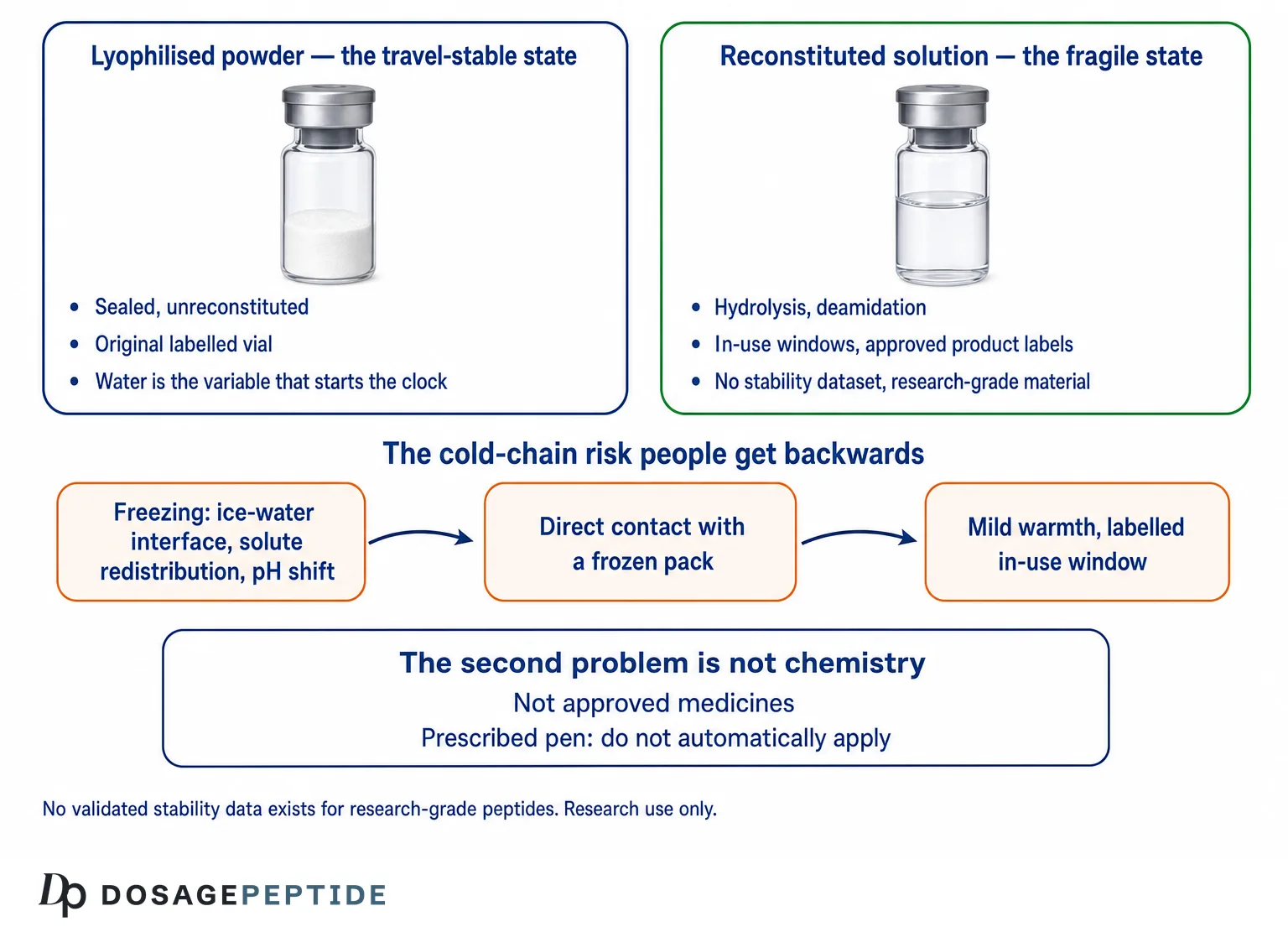
Peptides in solution face two families of degradation chemistry. One is genuinely water-mediated: hydrolysis of the backbone and deamidation of asparagine and glutamine residues. The other — oxidation of residues such as methionine and tryptophan — does not require water, but is far easier to sustain in a mobile aqueous phase than in a dry solid. A forced-degradation study of synthetic liraglutide, using deliberately harsh acidic, basic and oxidative stress rather than ordinary storage conditions, separated and characterised 19 distinct degradation products by LC-HRMS; the authors concluded the peptide is highly susceptible to degradation under those conditions.[1] Read that for what it is: forced degradation maps which pathways exist and where they attack, and does not predict a shelf life. Removing the water removes the largest of those pathways, which is why a review of solid-state protein formulation records that solid forms are frequently required to maintain protein stability during storage, transport and upon administration.[2]
| Lyophilised powder (unreconstituted) | Reconstituted solution | |
|---|---|---|
| Why it behaves this way | Water-dependent degradation pathways are largely suppressed in the dry solid state[2] | Degradation in aqueous solution accelerates with temperature, and its rate depends strongly on pH and buffer composition — measured for semaglutide under laboratory stress conditions[3] |
| Only regulated stability reference points that exist | None that map onto research-grade powder: the approved GLP-1 products reach the market as ready-to-use injectable solutions or as oral tablets, none of them as a vial of powder the end user reconstitutes | FDA-approved analogue labels specify 2 °C to 8 °C storage with defined, finite room-temperature windows (see table below)[4] |
| Freeze tolerance | Freezing is not the primary threat to a dry solid; moisture ingress and heat are | Approved analogue labels state flatly: do not freeze, and do not use if frozen[5] |
| What is genuinely unknown | Sequence-specific stability, residual moisture, excipients and actual purity of research-grade lots are usually undisclosed and unverified | Bacteriostatic solvent behaviour, container closure integrity and real in-use limits for research-grade material are not established by any regulator |
| Practical verdict for transit | The state in which material is most likely to survive being moved | The state in which a temperature excursion is most likely to matter |
This is the same logic that governs everyday handling, not just travel. The distinction between the sealed and the opened state is covered in more depth in our guide to storing peptides before and after reconstitution, and the case for and against refrigeration in each state is set out in do peptides need to be refrigerated.
What the approved analogue labels actually say
The most accessible regulated, verifiable peptide stability numbers are those printed in section 16 of FDA-approved product labels. Each applies to one specific formulated product — a particular peptide, concentration, excipient set and container closure. They are useful reference points for how the industry treats peptide solutions in transit. They are not transferable specifications for a research-grade vial, and treating them as such is a category error. Approved indications and storage text are also revised over time, so the figures below are as published at the time of writing and should be checked against the current label.
| Approved product (peptide) | Approved indication class | Labelled storage | Room-temperature allowance |
|---|---|---|---|
| Ozempic (semaglutide) | Glycemic control in adults with type 2 diabetes; plus indications to reduce major adverse cardiovascular events in type 2 diabetes with established cardiovascular disease, and to reduce sustained eGFR decline, end-stage kidney disease and cardiovascular death in type 2 diabetes with chronic kidney disease | Prior to first use, 2 °C to 8 °C (36 °F to 46 °F); do not freeze and do not use if frozen; do not store in the freezer or directly adjacent to the refrigerator cooling element | After first use, the pen may be stored for 56 days at 15 °C to 30 °C or refrigerated[4] |
| Wegovy (semaglutide) | Reduction of major adverse cardiovascular events in adults with established cardiovascular disease and obesity or overweight; weight reduction and long-term maintenance; and, under accelerated approval, noncirrhotic MASH with moderate-to-advanced (F2–F3) fibrosis in adults | Refrigerate 2 °C to 8 °C; do not freeze and do not use if frozen; do not store in the freezer or directly adjacent to the cooling element | Single-dose pen or syringe, before cap removal: up to 28 days at 8 °C to 30 °C in the original carton[6] |
| Mounjaro (tirzepatide) | Glycemic control in adults and pediatric patients aged 10 years and older with type 2 diabetes mellitus, as an adjunct to diet and exercise | Refrigerate 2 °C to 8 °C (36 °F to 46 °F); do not freeze, do not use if frozen; keep in the original carton, away from heat and light | Single-dose pen or single-dose vial: up to 30 °C (86 °F) for up to a total of 21 days, then discard (multi-dose vials and the KwikPen carry different limits)[7] |
| Zepbound (tirzepatide) | Reduction of excess body weight and long-term maintenance of weight reduction in adults with obesity, or overweight with at least one weight-related comorbid condition; and treatment of moderate-to-severe obstructive sleep apnea in adults with obesity | Refrigerate 2 °C to 8 °C; do not freeze, do not use if frozen; protect from heat and light | Single-dose pen or vial: unrefrigerated at not more than 30 °C for up to a total of 21 days[5] |
Two features deserve attention. First, the room-temperature allowances are cumulative and one-way: 21 days out of the refrigerator means 21 days total across the product’s life, not 21 days per trip, and returning it to a fridge does not reset the clock. Second, every one of these labels forbids freezing outright. For research-grade material no equivalent validated number exists at all — that is the honest answer to “how long can peptides be unrefrigerated”. The temperature dependence itself is real and measurable: controlled stress studies on semaglutide in solution show degradation increasing with temperature and varying sharply with pH and buffer composition.[3][8] What is missing is any validated shelf-life for an unregulated vial of unknown composition.
Why is freezing more dangerous than mild warmth?
This is the single most common misconception in peptide handling. Colder is not monotonically better for a peptide in solution. Freezing a protein or peptide solution introduces several distinct stresses at once: an expanding ice–water interface at which molecules can unfold; cryoconcentration, in which the solute is concentrated into the shrinking unfrozen fraction while the peptide and its stabilising excipients concentrate at different rates; and pH shifts caused by differential crystallisation of buffer components. A systematic freeze–thaw characterisation study names exactly these mechanisms — ice–water interface formation, buffer-induced pH change, redistribution and concentration of solutes, and phase separation — and treats freeze–thaw as a manufacturing stress that has to be engineered around rather than a neutral storage step.[9] One caveat belongs with that citation: the molecule studied was a monoclonal antibody fusion protein, not a small synthetic peptide. The physical mechanisms are general, but how much any particular peptide suffers from them is an extrapolation rather than a measurement, and short unstructured peptides are not automatically as freeze-sensitive as a large folded protein.
The regulated labels say the same thing in plain language. Ozempic’s label instructs handlers not to store it in the freezer or directly adjacent to the refrigerator cooling element, and to discard product that has been frozen.[4] That second clause is the travel-relevant one: it identifies contact with a cold surface, not ambient temperature, as the hazard.
Passive carriers, gel packs and frozen packs
Applied to a travel carrier, the implication is direct: the coldest point in a passive box is the surface of the coolant, not the air, so a vial pressed against a hard-frozen pack sits well below the pack’s nominal rating.
- Never let a vial contact a frozen pack directly. Insulate with a physical barrier — card, foam, cloth — so the vial sees cooled air rather than a freezing surface.
- Refrigerated gel packs are lower-risk than hard-frozen packs for a short passive hold, because they cannot drive the payload below zero. They also hold for less time; that is the trade-off.
- A passive carrier has a hold time, not a temperature setting. Performance depends on ambient temperature, coolant mass, how often the box is opened and how well void space is packed. An under-filled box performs worse than a full one.
- Dry ice is not an improvisable coolant. FAA rules treat it as a regulated hazardous material in air travel: when used to pack perishables it is limited to 2.5 kg (5.5 lb) per package and per passenger, airline approval is required, packaging must vent rather than seal so carbon dioxide gas can escape, and checked packages must be marked with the contents and net quantity.[15] At roughly −78 °C it is also far colder than anything the freeze-damage logic above tolerates.
Excursion logic: what a temperature record can and cannot tell you
Cold-chain thinking is cumulative, not binary. Borrowing from regulated logistics: log the duration and peak of every excursion rather than asking whether a single moment was “too warm”. A min/max thermometer or single-use temperature indicator in the carrier converts an unknown into a record. Be clear-eyed about its limit, though — for research-grade material there is no validated stability profile to compare it against, so a log documents what happened without telling you what it means. It is an input to a judgement, not a verdict.
Carry-on or checked baggage?
Keep temperature-sensitive material in carry-on baggage. Three separate reasons converge on the same answer, and only the first is about temperature. A cargo hold is not an environment whose conditions a traveller can observe or control, and it is not the same environment as the cabin. Checked baggage can also be delayed, misrouted or lost — any of which silently runs a passive carrier past its hold time while nobody is watching it. And a checked bag is opened, if it is opened, outside the traveller’s presence, so a question about the contents becomes a question nobody is there to answer.
Note that this is a handling recommendation about temperature and custody, not a claim that any given item will be permitted. The screening framework described below is written for medication, and whether it reaches research-grade material at all is the question taken up further down. A carrier you can see is simply a carrier you can manage and account for.
What does TSA actually say?
For travel within the United States, the Transportation Security Administration publishes a specific framework for medically necessary liquids. Read it accurately rather than through internet folklore:
- TSA states that it allows larger amounts of medically necessary liquids, gels and aerosols in reasonable quantities for the trip, but that they must be declared to TSA officers at the checkpoint for inspection.[10]
- Before screening begins, the traveller should inform the officer that they have medically necessary liquids or medications and place them in a separate bin, along with associated accessories such as freezer packs, IV bags, pumps and syringes.[11]
- On cooling: TSA states that ice packs, freezer packs, gel packs and other accessories may be presented at the checkpoint in a frozen, partially frozen or melted state to keep medically necessary items cool.[11] That is an exemption, not the general rule: FAA guidance notes that an ordinary carry-on gel or liquid pack over 100 ml must be frozen solid when it goes through security.[15]
- Solid-form medication is screened too, and TSA notes that clearly labelling it facilitates that screening.[11]
- If an item alarms and the alarm cannot be resolved, TSA states the item may not be allowed.[11]
And the decisive line, printed by TSA on its own item pages: the final decision rests with the TSA officer on whether an item is allowed through the checkpoint.[10] No article, forum post or vendor page overrides that. Rules also change; check the current TSA pages before travelling rather than relying on a cached memory of them.
The part most articles skip: research-grade material is not “medication”
Here is the honest crux, and it is a legal question rather than a chemical one. The medically-necessary-liquids framework above is built around medication — an approved, labelled, prescribed product. Research-use-only peptides are, by definition, not approved medicines. They carry no approved indication, no approved labelling and, ordinarily, no prescription. The exemption framing that applies cleanly to a labelled, prescribed GLP-1 pen does not automatically transfer to an unapproved research compound in an unlabelled vial. Assuming it does is the single largest error in this topic area.
International borders raise the stakes further, and they differ sharply from one another. Some jurisdictions treat unapproved injectables as prohibited or controlled imports regardless of the traveller’s intent; some require import permits; some regulate the syringes and needles separately from their contents. Even for the United States, FDA states that in most circumstances it is illegal for individuals to import drugs into the country for personal use, precisely because such products have not been approved by FDA.[12] US Customs and Border Protection tells travellers the same thing from the border side: many foreign-made medications are not approved for use in the United States and are not permitted into the country.[13]
This article will not explain how to move unapproved injectable material across a border, and no legitimate source should. Carrying such material across an international border can be a legal problem with consequences ranging from seizure to prosecution, and the traveller alone is responsible for the law in the origin country, every transit country and the destination. The only responsible course is to verify the position with the relevant national medicines regulator and customs authority in advance, and to obtain qualified legal advice where the answer is not plainly clear. Our overview of the legal status of research peptides explains why the answer is jurisdictional and why an RUO label is not a passport.
Documentation and labelling
Whatever the jurisdiction, the same handling principles reduce ambiguity at an inspection point:
- Keep material in its original, intact, labelled container. CBP tells travellers to bring only the medication they will need and to make sure it is in its original container,[13] and that prescription medications have to be in the traveller’s own name.[14] Note what those instructions presuppose: a prescribed medicine with a name on it. They are not a route by which unapproved material becomes admissible.
- Documentation cannot be manufactured to fit. Where a genuine institutional or laboratory authorisation exists, it is the document that describes the material honestly. Where none exists, that absence is itself the answer about whether the movement is permissible — not a gap to be papered over. Fabricating a prescription, a label or an authorisation is a serious offence in every jurisdiction and creates a far larger problem than the one it purports to solve.
- Decanting and relabelling create problems, not solutions. Material moved into an unlabelled tube cannot be identified by an inspector, cannot be traced to a lot number, and loses the container-closure integrity of the original vial. It turns a documentation question into an unanswerable one.
- Declare when asked, and answer accurately. Misdeclaration is a distinct offence from whatever the underlying import question turns out to be.
After arrival: what inspection can and cannot tell you
On arrival, a visual check of the vial is worth doing. Look for changes in clarity, visible particulates, unexpected colour, a compromised stopper or seal, and any sign the vial has frozen and thawed. Any of those is a reason to discard the material.
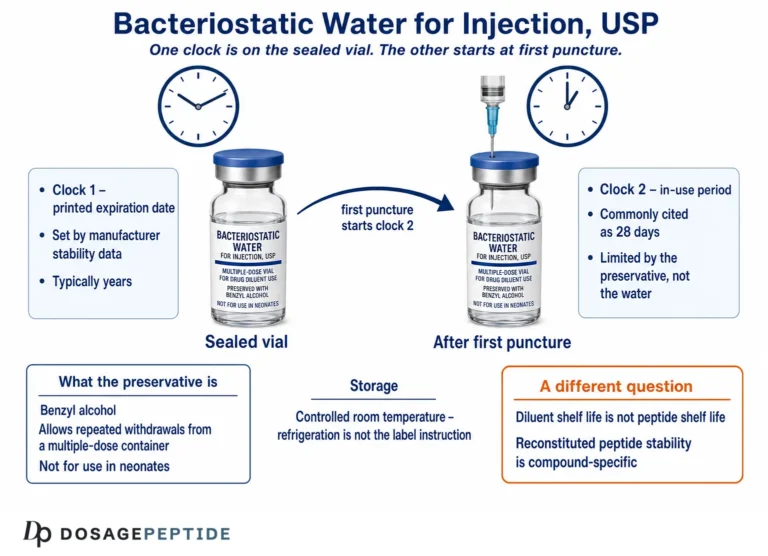
But state the limit plainly: visual inspection cannot confirm potency. The degradation pathways that matter — hydrolysis, deamidation, oxidation — produce species that the studies cited above could only resolve by chromatography and high-resolution mass spectrometry.[1] They are invisible to the eye. A vial that looks entirely normal may have degraded substantially; a clear solution is evidence of nothing except clarity. If a vial was reconstituted before travel the diluent’s own limits apply too — see how long bacteriostatic water remains usable — and where material is brought into solution only after arrival, the sequence is covered in our peptide reconstitution guide.
Research use only. This article is an educational reference about the physical handling and regulatory context of research-grade peptide material. It is not medical, legal or travel advice, it does not describe any human use, and it makes no claim that any compound discussed is safe or effective for any purpose. The FDA-approved products named above are cited solely as regulated stability reference points for their own specific formulations. Nothing here should be read as encouragement to transport unapproved material across any border; the reader is solely responsible for compliance with the law of every jurisdiction involved.
Frequently Asked Questions
How long can peptides be left unrefrigerated?
For research-grade material, there is no validated answer — no regulator has established a shelf life for it, and vendor claims are unverified. The only regulated reference points come from approved analogues: the Mounjaro and Zepbound labels allow single-dose pens or vials up to 30 °C for a cumulative total of 21 days, and Ozempic allows an in-use pen 56 days at 15 °C to 30 °C. Those numbers apply to those specific formulated products, in their own containers, and are not transferable to anything else.
Is lyophilised powder or reconstituted solution better for travel?
Lyophilised powder, clearly. The dominant degradation pathways for peptides in solution — backbone hydrolysis and deamidation — are water-mediated, and oxidation, while not water-dependent, is far easier to sustain in an aqueous phase than in a dry solid. That is why a review of solid-state protein formulation records that solid forms are frequently required to maintain stability during storage, transport and administration. A sealed, unreconstituted vial is the state in which material is most likely to arrive intact.
Can peptide vials be frozen for a long journey?
Freezing a solution is a stress, not a safe default. Freeze–thaw introduces ice–water interfaces, cryoconcentration and buffer-driven pH shifts that can drive aggregation — mechanisms characterised in the literature on a monoclonal antibody fusion protein rather than on a small peptide, so the magnitude for any given peptide is unmeasured. What is not extrapolation is the regulatory instruction: every approved GLP-1 analogue label reviewed here says not to freeze the product and to discard it if it has frozen, and Ozempic and Wegovy go further, warning against storing the pen directly adjacent to a refrigerator’s cooling element.
Does TSA allow ice packs for medication?
TSA states that ice packs, freezer packs, gel packs and other accessories may be presented at the screening checkpoint in a frozen, partially frozen or melted state to keep medically necessary items cool, and that they should be declared and placed in a separate bin. TSA also states plainly that the final decision on whether any item passes the checkpoint rests with the screening officer.
Does the TSA medication exemption apply to research peptides?
Not automatically, and this is the most important caveat in the topic. The medically-necessary-liquids framework is built around medication — approved, labelled, typically prescribed products. Research-use-only compounds are not approved medicines and carry no approved labelling or indication. Assuming a rule written for a prescribed pen covers an unapproved research vial is an unsafe assumption, and officers make the final determination regardless.
What are the rules for taking peptides across an international border?
They vary sharply by country and cannot be summarised generically. Some jurisdictions treat unapproved injectables as prohibited or controlled imports; some require permits; some regulate needles separately. FDA itself states that in most circumstances it is illegal for individuals to import unapproved drugs into the United States for personal use. Verify with the destination’s medicines regulator and customs authority before travelling, and seek qualified legal advice.
Should peptides go in carry-on or checked baggage?
Carry-on, for temperature-sensitive material of any kind. A cargo hold is not an environment whose conditions a traveller can observe or control, and checked baggage can be delayed, misrouted or lost — each of which silently ends a passive cold chain. Material kept in the cabin remains in a monitorable environment, and a carrier you can see is a carrier you can manage.
How can you tell whether a vial degraded during a trip?
You largely cannot, by eye. Cloudiness, visible particulates, unexpected colour, a compromised seal or evidence of freezing are all reasons to discard material — but their absence proves nothing. The degradation products that matter are identified in the literature only by chromatography and high-resolution mass spectrometry, and a vial that looks entirely normal may still have degraded substantially.
Does relabelling or decanting into smaller containers help at a checkpoint?
No — it makes matters worse. CBP tells travellers to keep medication in its original container and to carry only what they need, and requires prescription medications to be in the traveller’s own name. Decanted material cannot be identified by an inspector, cannot be traced to a lot number, and loses the container-closure integrity of the original vial. Fabricating labels or documentation is a separate and serious offence, and it converts a customs question into a fraud question.
References
- Badgujar D, Bawake S, Sharma N. A comprehensive study on the identification and characterization of major degradation products of synthetic liraglutide using liquid chromatography-high resolution mass spectrometry. J Pept Sci. 2025;31(1):e3652. https://pubmed.ncbi.nlm.nih.gov/39162000/
- Angkawinitwong U, Sharma G, Khaw PT, Brocchini S, Williams GR. Solid-state protein formulations. Ther Deliv. 2015;6(1):59–82. (Review.) https://pubmed.ncbi.nlm.nih.gov/25565441/
- Malgave A, Akbar S, Joseph A, et al. Effect of pH, buffers, molarity, and temperature on solution state degradation of semaglutide using LC-HRMS: a preformulation protocol for peptide drug delivery. Eur J Pharm Biopharm. 2025;214:114780. https://pubmed.ncbi.nlm.nih.gov/40490042/
- OZEMPIC (semaglutide) injection — FDA prescribing information, section 16 (How Supplied/Storage and Handling). DailyMed, US National Library of Medicine. https://dailymed.nlm.nih.gov/dailymed/drugInfo.cfm?setid=adec4fd2-6858-4c99-91d4-531f5f2a2d79
- ZEPBOUND (tirzepatide) injection — FDA prescribing information, section 16 (How Supplied/Storage and Handling). DailyMed, US National Library of Medicine. https://dailymed.nlm.nih.gov/dailymed/drugInfo.cfm?setid=487cd7e7-434c-4925-99fa-aa80b1cc776b
- WEGOVY (semaglutide) injection — FDA prescribing information, Recommended Storage. DailyMed, US National Library of Medicine. https://dailymed.nlm.nih.gov/dailymed/drugInfo.cfm?setid=ee06186f-2aa3-4990-a760-757579d8f77b
- MOUNJARO (tirzepatide) injection and MOUNJARO KWIKPEN — FDA prescribing information, sections 1 and 16.2 (Storage and Handling); Eli Lilly and Company. DailyMed, US National Library of Medicine. https://dailymed.nlm.nih.gov/dailymed/drugInfo.cfm?setid=d2d7da5d-ad07-4228-955f-cf7e355c8cc0
- Malgave A, Akbar S, Tiwari A, Hande S, Joseph A, Malayandi R. Influence of buffering capacity, pH, and temperature on the stability of semaglutide: a preformulation study. J Pept Sci. 2025;31(8):e70039. https://pubmed.ncbi.nlm.nih.gov/40635175/
- Jain K, Salamat-Miller N, Taylor K. Freeze-thaw characterization process to minimize aggregation and enable drug product manufacturing of protein based therapeutics. Sci Rep. 2021;11(1):11332. (Study molecule: a monoclonal antibody fusion protein, not a small peptide.) https://pubmed.ncbi.nlm.nih.gov/34059716/
- US Transportation Security Administration. What Can I Bring? — Medications (Liquid). https://www.tsa.gov/travel/security-screening/whatcanibring/items/medications-liquid
- US Transportation Security Administration. Disabilities and Medical Conditions — Medications, 3-1-1 Liquids Rule Exemption, Accessories. https://www.tsa.gov/travel/tsa-cares/disabilities-and-medical-conditions
- US Food and Drug Administration. Personal Importation. https://www.fda.gov/industry/import-basics/personal-importation
- US Customs and Border Protection. Know Before You Go — U.S. Travelers’ Top Ten Travel Tips (medications: foreign-made medications not approved for US use, original containers). https://www.cbp.gov/travel/us-citizens/know-before-you-go/us-travelers-top-ten-travel-tips
- US Customs and Border Protection. Know Before You Go: Traveling Abroad (medications in original packages; prescription medications under the traveler’s name). https://www.cbp.gov/travel/us-citizens/know-before-you-go/know-you-go-traveling-abroad
- US Federal Aviation Administration. PackSafe — Dry Ice (2.5 kg limit, airline approval, venting and marking requirements; 49 CFR 175.10(a)(10)). https://www.faa.gov/hazmat/packsafe/dry-ice