“HGH 191AA” is not a brand, a grade, or a potency rating — it is a description of the molecule itself. It means the preparation consists of the 191-amino-acid polypeptide chain that makes up the main circulating form of human growth hormone, the 22 kDa product of the GH1 gene. Recombinant somatropin, the FDA-approved prescription biologic, has exactly this 191-residue sequence, identical to pituitary-derived human growth hormone.[1]
The number exists as a label because of a specific historical contrast: the first recombinant growth hormone product carried one extra amino acid at the front of the chain and was designated 192 amino acids. That difference mattered immunologically, and the “191AA” designation has survived as a shorthand for “the natural sequence.” This article explains what the sequence is, why the 191 vs 192 distinction arose, what somatropin is actually approved to do, and — bluntly — where the popular anti-aging narrative outruns the published evidence.
| Feature | Somatropin (191AA) | Somatrem (192AA / met-hGH) | GH secretagogues |
|---|---|---|---|
| What it is | Recombinant human growth hormone, full mature sequence | First-generation recombinant GH with an extra N-terminal methionine | Small molecules or peptides that stimulate the pituitary to release its own GH |
| Sequence | 191 amino acids, identical to pituitary hGH | 192 amino acids (Met + the 191-residue chain) | Not GH at all — separate structures acting on GHRH or ghrelin receptors |
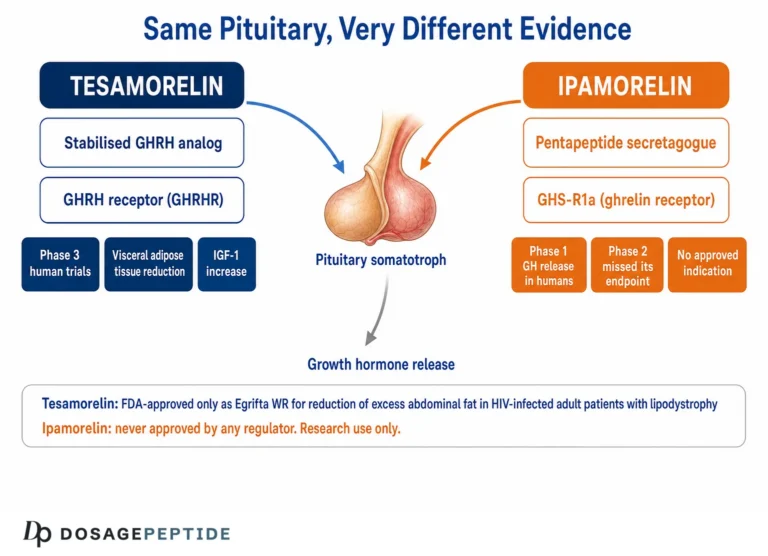
| Regulatory status (US) | FDA-approved prescription biologic for defined indications | Formerly approved; discontinued and no longer marketed | Varies by compound: a few are approved for specific indications (e.g. tesamorelin); the rest are unapproved in the United States and are sold, when sold at all, under a seller-applied “research use only” label, which is a labeling convention rather than an FDA regulatory status |
| Evidence tier | Human clinical trials supporting approved indications; robust label safety data | Historical human clinical data; superseded | Ranges from approved human indications to preclinical/animal-only depending on the specific molecule |
| Effect on GH pattern | Exogenous hormone; supplies GH directly, bypassing pituitary control | Same, with higher reported anti-GH antibody formation in historical use | Amplifies endogenous, pulsatile release; still subject to feedback |
What does “191AA” actually mean at the molecular level?
Human growth hormone is encoded by the GH1 gene on chromosome 17. The primary translation product is a 217-residue precursor: a 26-residue signal peptide that is cleaved during secretion, leaving a mature chain of 191 amino acids. That mature chain is a single polypeptide of roughly 22 kDa, stabilized by two intramolecular disulfide bridges, folded into the four-helix bundle architecture typical of the class I cytokine hormone family. FDA-approved somatropin labeling states the molecular weight of this 191-residue protein as 22,124 daltons.[1]
So “191AA” is simply a count of residues in the mature, biologically active chain. When a product describes itself as “HGH 191AA,” the claim being made is: this is the full-length natural human sequence, not a fragment, not an analog, and not the older methionyl variant.
The 22 kDa form is the main isoform — but not the only one
Circulating growth hormone is not a single uniform molecule. Alternative splicing of GH1 generates a 20 kDa variant lacking residues 32–46 of the mature chain, and further heterogeneity arises from post-translational modification, deamidation, oligomerization, proteolytic fragments, and binding to growth hormone binding proteins in plasma.[6] The 22 kDa, 191-residue isoform is the predominant secreted form and the one recombinant somatropin reproduces. This heterogeneity is one reason growth hormone immunoassays historically disagreed between laboratories — a detail that matters for anyone reading older comparative literature.
Fragments are a different thing entirely
Because the residues are numbered, sub-sequences get named by their coordinates. The most familiar example in the research-peptide space is the C-terminal fragment spanning residues 176–191, studied as a candidate lipolytic peptide independent of the full hormone’s receptor signaling. A fragment is not “HGH 191AA” and does not share its pharmacology; our reference entry on the HGH fragment 176-191 vial reference keeps that distinction explicit. Conflating a 16-residue fragment with the intact 191-residue hormone is one of the most common category errors in this literature.
Why does 191AA vs 192AA exist as a distinction?
The context is the history of how growth hormone was obtained at all. From 1963 to 1985, the U.S. National Hormone and Pituitary Program distributed growth hormone extracted from cadaveric human pituitaries, because no synthetic source existed. In 1985 that program was halted after recipients were found to have developed Creutzfeldt-Jakob disease, a transmissible prion disease traced to the cadaver-derived material.[5] The urgency of replacing cadaveric hormone is precisely what drove recombinant production.
The first recombinant growth hormone product, somatrem (marketed as Protropin), was approved by the FDA in 1985. Because it was expressed in Escherichia coli using a straightforward cytoplasmic expression strategy, the initiating methionine of bacterial protein synthesis remained attached to the N-terminus of the chain. The result was methionyl-hGH: 192 amino acids rather than 191. Everything else about the sequence was the natural human sequence, but the extra N-terminal residue was not part of the native human protein.
In the Swedish Somatonorm (somatrem) experience, anti-growth-hormone antibodies were reported at a high incidence in patients with no prior pituitary hGH exposure, although growth velocity was not decreased in those patients.[7] It is worth being careful about the causal story here: higher rates of anti-growth-hormone antibodies were reported with somatrem than with 191-residue somatropin, but the relative contribution of the extra methionine versus host-cell protein impurities, aggregation state and formulation was never cleanly separated at the time, and comparative rates are better taken from the respective product labels than from any single national series. Once manufacturers solved the expression problem — periplasmic-secretion systems in E. coli that yield a correctly processed N-terminus, and mammalian cell expression — 191-residue somatropin became the standard, and somatrem was eventually withdrawn from the market. It is no longer marketed in the United States.
That is the whole origin of the “191AA” designation. It began as a genuine, clinically relevant manufacturing distinction, and it survives today mostly as an identity signal on labels — including on unregulated products whose actual sequence has never been independently verified.
Is somatropin FDA-approved, and for what exactly?
Yes. Somatropin is an approved prescription biologic in the United States, and the approved indications are narrow and specific. Across the currently marketed products, labeled pediatric indications include growth failure due to inadequate endogenous growth hormone secretion, short stature associated with Turner syndrome, short stature associated with Noonan syndrome, short stature in children born small for gestational age with no catch-up growth by 2 to 4 years of age, idiopathic short stature with a height standard deviation score <-2.25, short stature or growth failure associated with SHOX (short stature homeobox-containing gene) deficiency, growth failure due to Prader-Willi syndrome, and growth failure associated with chronic kidney disease up to the time of renal transplantation.[1][2][3] No single product carries all of them: Prader-Willi syndrome and Noonan syndrome, for example, sit on different labels than SHOX deficiency or chronic kidney disease, which is exactly why “somatropin is approved for X” is a statement that has to be checked brand by brand.
In adults, somatropin is approved for replacement in confirmed adult growth hormone deficiency.[2] Two additional adult indications belong to specific brands: treatment of HIV patients with wasting or cachexia to increase lean body mass, body weight and physical endurance, with concomitant antiretroviral therapy, and treatment of short bowel syndrome in adult patients receiving specialized nutritional support.[4]
Products marketed in the United States as 191-residue somatropin include Genotropin, Norditropin, Humatrope, Omnitrope, Saizen, Nutropin AQ, Zomacton, Serostim and Zorbtive. Three once-weekly products have also been approved — Sogroya (somapacitan, 2020, with pediatric indications added later), Skytrofa (lonapegsomatropin, 2021) and Ngenla (somatrogon, 2023). It is worth being precise here: those long-acting products are not simply “191AA in a slower vehicle.” Somapacitan and somatrogon are structurally modified constructs; lonapegsomatropin is a prodrug engineered to release unmodified somatropin over time. Only the released moiety in the prodrug case is the plain 191-residue chain.
Anti-aging, bodybuilding and athletic “performance” use appear nowhere on any of these labels. That is not a technicality — it is the central fact that most consumer-facing content about “191AA HGH” omits.
How does 191AA growth hormone work?
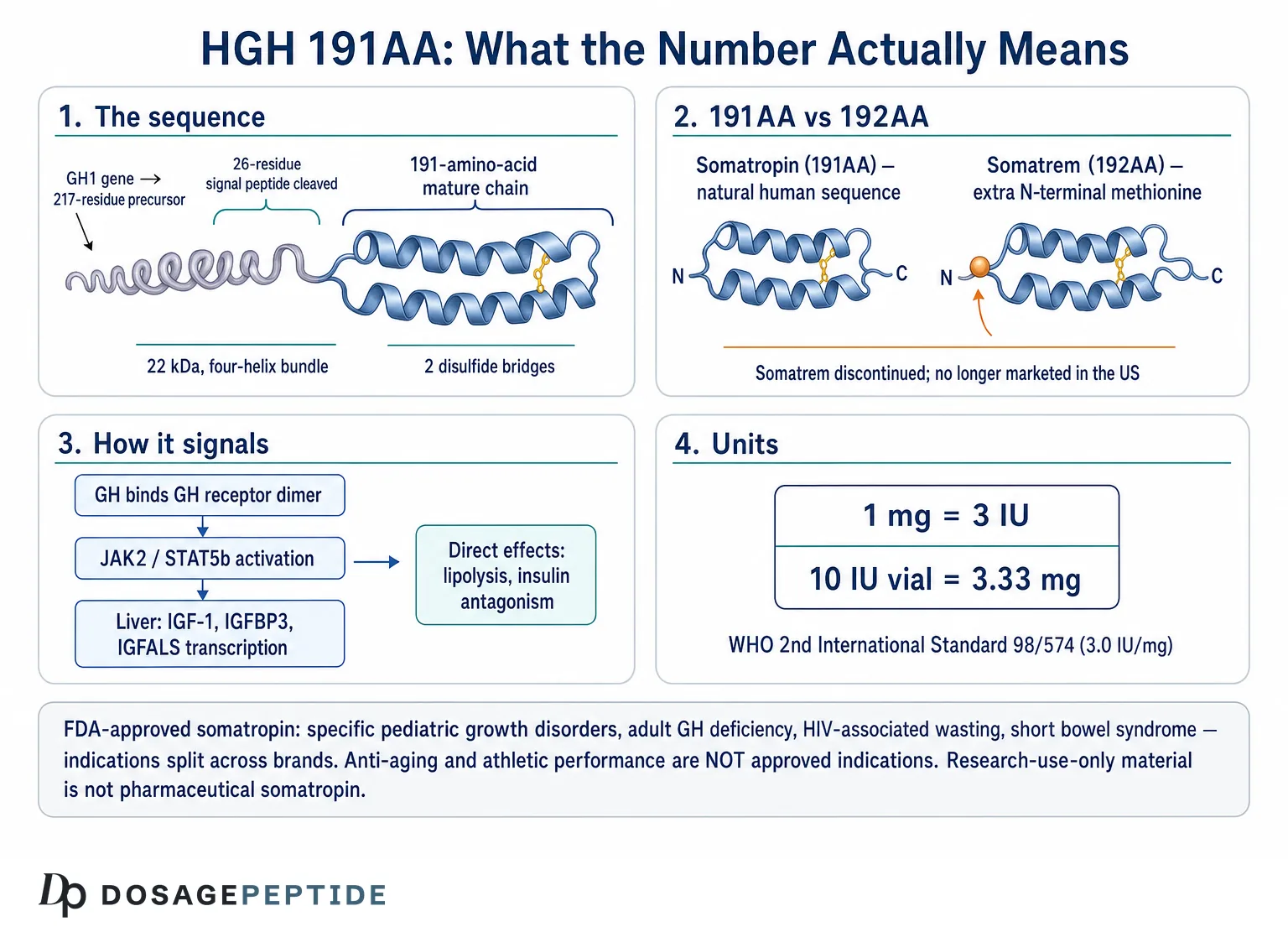
Growth hormone binds a preformed dimer of the growth hormone receptor at the cell surface. Binding triggers a conformational change that activates receptor-associated JAK2 kinase, which phosphorylates STAT5 (principally STAT5b). Phosphorylated STAT5 translocates to the nucleus and drives transcription of growth-related genes, most importantly IGF1, along with IGFBP3 and IGFALS. Parallel MAPK and PI3K signaling branches contribute additional effects.[8]
The practical consequence is a two-track pharmacology. Growth hormone exerts direct effects — notably lipolysis in adipose tissue and antagonism of insulin action — and indirect anabolic effects mediated largely by hepatic IGF-1. This is why IGF-1 concentration is the standard biochemical readout of growth hormone exposure in clinical monitoring, and why downstream IGF-1 analogs are studied as a separate research question; our explainer on IGF-1 LR3 and its mechanism covers that branch.
How this differs from secretagogues
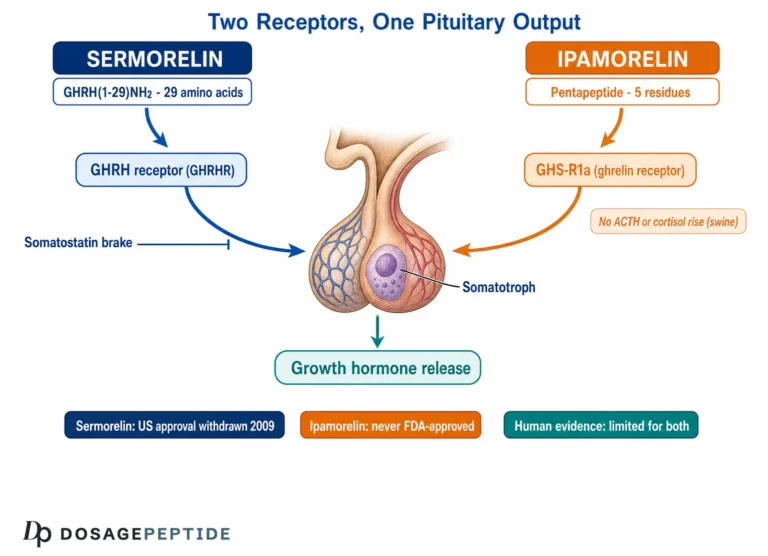
Exogenous somatropin supplies the hormone directly. Growth hormone secretagogues work upstream: growth hormone-releasing hormone analogs act on the GHRH receptor, and ghrelin-receptor agonists act on GHS-R1a, in both cases stimulating the pituitary to release its own stored hormone in a pulsatile pattern that remains subject to somatostatin feedback. That is a genuinely different intervention, not a weaker version of the same one.
The research literature on secretagogues is heterogeneous and should not be read as interchangeable with the somatropin literature. Compounds studied in this space include the GHRH analog covered in our sermorelin reference entry, the ghrelin-receptor peptide discussed in what GHRP-2 is and how it has been studied, and the orally active ghrelin mimetic reviewed in our MK-677 (ibutamoren) overview. Each sits at a different evidence tier, and none of them is an approved anti-aging therapy either.
Does HGH work for anti-aging or performance? What the evidence actually shows
This is where the honest answer diverges sharply from the marketing.
The origin of the anti-aging narrative is a single 1990 study in the New England Journal of Medicine. Rudman and colleagues studied 21 healthy men aged 61 to 81 with low IGF-1; 12 received growth hormone for six months and 9 received no treatment. The treated group showed an 8.8% increase in lean body mass, a 14.4% decrease in adipose tissue mass, and a 1.6% increase in lumbar vertebral bone density.[9] Those numbers have been quoted for thirty-five years. What is quoted far less often: the study enrolled 21 men, ran six months, had no placebo control, and measured body composition — not strength, not function, not longevity, not disease outcomes.
The systematic review that should be read alongside it is Liu and colleagues in Annals of Internal Medicine in 2007, which pooled 31 articles describing 18 study populations, totaling 220 growth-hormone-treated participants and 107 person-years of exposure. Fat mass fell by about 2.1 kg and lean body mass rose by about 2.1 kg, with no significant change in overall body weight. Bone density and lipids other than total cholesterol did not change; total cholesterol fell by a small amount (about 0.29 mmol/L, or 11.2 mg/dL) in the unadjusted analysis, but that reduction was no longer significant after adjusting for the change in body composition. Treated participants were significantly more likely to experience soft tissue edema, arthralgia, carpal tunnel syndrome and gynecomastia, and somewhat more likely to develop diabetes mellitus or impaired fasting glucose. The authors’ conclusion was explicit: growth hormone cannot be recommended as an anti-aging therapy.[10]
The athletic-performance question was addressed by the same group in 2008: 44 articles, 27 study samples, 303 participants receiving growth hormone. Lean body mass increased by about 2.1 kg, but strength and exercise capacity did not appear to improve; exercise lactate was statistically higher in two of the three studies measuring it, and edema and fatigue were more frequent. The stated conclusion was that claims of performance enhancement are not supported by the scientific literature.[11]
The pattern is consistent across both reviews: growth hormone reliably shifts body composition in ways that show up on a DXA scan, and does not demonstrably improve the functional outcomes people actually want. In diagnosed adult growth hormone deficiency — a real endocrine disorder — the picture is different, and replacement is supported by guideline-level evidence for body composition, exercise capacity, skeletal integrity and quality of life measures.[12] Replacing a deficiency is not the same intervention as supraphysiologic administration in someone with normal secretion, and evidence from one does not transfer to the other.
What adverse effects are documented?
The adverse-effect profile of somatropin is well characterized because it comes from decades of approved use rather than from anecdote. Documented effects in the labeled and clinical literature include arthralgia and myalgia, peripheral edema and soft tissue swelling, carpal tunnel syndrome, insulin resistance and impaired glucose tolerance (with new-onset type 2 diabetes reported), gynecomastia, and — rarely — intracranial hypertension, typically presenting with headache and visual changes.[1][10] Approved labeling also carries contraindications relevant to active malignancy, acute critical illness, and severely obese children with Prader-Willi syndrome.[1]
Note that several of these — arthralgia, edema, carpal tunnel syndrome, impaired glucose tolerance — are the same effects that appeared at elevated rates in the healthy-elderly meta-analysis. They are dose-related consequences of growth hormone’s physiology, not idiosyncratic reactions.
Why is the same vial labeled in both mg and IU?
Growth hormone is one of the few biologics still routinely expressed in two units at once, and the resulting confusion is real. The historical reason is that potency was originally assigned in International Units by bioassay, because purity and mass could not be determined reliably. Modern practice assigns content by mass using physicochemical methods.
The WHO Second International Standard for somatropin, preparation 98/574, was established in 2001 through a 16-laboratory international collaborative study and assigns a specific activity of 3.0 IU per mg of somatropin.[13] That is the conversion reflected on current product labeling: 1 mg ≈ 3 IU. Older literature sometimes reflects a different factor of roughly 2.6 IU/mg, which comes from the earlier pituitary-derived hGH standard (WHO 80/505, defined as 4.4 International Units per ampoule containing approximately 1.70 mg of hGH extract).[13] That difference is a genuine source of discrepancy when comparing historical papers to modern labels: check which standard a given paper used rather than assuming 3 IU/mg.
The table below is a pure unit-conversion reference at 3 IU/mg. It says nothing about how much of anything should be used by anyone; it converts one label unit into the other. The “commonly seen as” column notes where a given mass appears as an actual marketed presentation in current US labeling for Genotropin and Norditropin.[1][3] For arbitrary values, our IU to mg converter for somatropin performs the same arithmetic, and the peptide reconstitution reference guide explains the separate question of how concentration relates to volume once a lyophilized vial has diluent added.
| Mass (mg) | Equivalent (IU) | Commonly seen as |
|---|---|---|
| 0.33 mg | 1 IU | Unit reference point |
| 1 mg | 3 IU | Standard conversion factor |
| 1.33 mg | 4 IU | Small single-dose sizes |
| 2 mg | 6 IU | Genotropin MiniQuick single-dose device (2 mg) |
| 3.33 mg | 10 IU | The common “10 IU” research vial |
| 4 mg | 12 IU | Frequently labeled “12 IU” |
| 5 mg | 15 IU | Genotropin 5 mg cartridge; Norditropin FlexPro 5 mg/1.5 mL pen |
| 5.3 mg | 16 IU | Legacy cartridge labeling; not a current US presentation |
| 6.67 mg | 20 IU | Frequently labeled “20 IU” |
| 10 mg | 30 IU | Norditropin FlexPro 10 mg/1.5 mL pen |
| 12 mg | 36 IU | Genotropin 12 mg cartridge |
| 15 mg | 45 IU | Norditropin FlexPro 15 mg/1.5 mL pen |
| 30 mg | 90 IU | Largest marketed pen (Norditropin FlexPro 30 mg/3 mL) |
This duality is exactly why a vial marked “10 IU” and a vial marked “3.33 mg” describe the same nominal mass — and why cross-comparing products labeled in different units without converting is a reliable way to misread the literature. Our reference entry for the HGH 191AA 10 IU vial documents how that particular labeling convention is used in research contexts.
Is “research-grade HGH 191AA” the same as pharmaceutical somatropin?
No, and the gap is not subtle. Approved somatropin products are manufactured under current Good Manufacturing Practice, with regulatory review of the expression system, purification process, release specifications, stability program and labeling. Material sold research-use-only carries none of those guarantees. The vial may state “191AA,” but nothing in the research-chemical supply chain compels that statement to be true, nor compels the stated mass to match the actual content, nor constrains what else is in the vial.
How identity and purity are actually characterized
The analytical methods that establish whether a preparation really is 191-residue somatropin are well established and routinely applied to approved products:
- Reversed-phase HPLC (RP-HPLC) — resolves the main peak from closely related impurities such as deamidated and oxidized forms; the standard quantitative purity measure.
- Size-exclusion HPLC (SE-HPLC) — detects dimers and higher-order aggregates, which are both a potency and an immunogenicity concern. This is the method used to assign content against the WHO International Standard.[13]
- SDS-PAGE — a coarse but useful check of apparent molecular weight and of gross contamination by other proteins.
- Mass spectrometry — intact mass confirms the expected molecular mass of the 191-residue chain (approximately 22,124 Da for somatropin); an extra methionine would shift the mass by roughly 131 Da, which is trivially resolvable on modern instruments.
- Peptide mapping — enzymatic digestion followed by LC-MS confirms the actual sequence, including the N-terminus, rather than inferring it from mass alone.
- Bioassay or cell-based potency assay — confirms that the protein is not only present but correctly folded and biologically active.
A single number on a certificate of analysis — “purity 98%” — tells you almost nothing without knowing which method produced it, what the acceptance criteria were, and whether the laboratory is independent of the seller. An HPLC purity figure says nothing about identity: a highly pure preparation of the wrong protein is still the wrong protein. Conversely, a mass spectrum without a peptide map cannot distinguish certain sequence variants. Documentation is only as meaningful as the analytical package behind it and the independence of the lab that generated it.
What is the legal and regulatory status?
Stated neutrally, as factual context rather than advice: in the United States, growth hormone is subject to a statute that has no analog for most prescription drugs. Under 21 U.S.C. § 333(e), knowingly distributing, or possessing with intent to distribute, human growth hormone for any use in humans other than treatment of a disease or other recognized medical condition authorized by the Secretary of Health and Human Services and pursuant to a physician’s order is a criminal offense. The statute defines “human growth hormone” as somatrem, somatropin, or an analog of either, and expressly authorizes the Drug Enforcement Administration to investigate.[14] In practical terms: unlike ordinary prescription drugs, distributing growth hormone for uses outside those authorized by the Secretary — the non-medical uses this statute was written to reach — carries criminal exposure rather than only regulatory consequences. Where the boundary of an “authorized recognized medical condition” actually falls has been litigated and is not a settled question that this article can resolve.
In sport, growth hormone and its releasing factors, analogs and secretagogues are prohibited at all times — in competition and out of competition — under section S2 of the World Anti-Doping Agency Prohibited List.[15] This applies to the full hormone, to fragments, and to secretagogues alike.
None of the above should be read as guidance on obtaining anything. It is stated because it is part of an accurate description of what this molecule is.
How should the 191AA literature be read?
Three habits make the difference between reading this area accurately and being misled by it.
First, separate the populations. Trials in children with growth hormone deficiency, adults with confirmed deficiency, healthy older adults, and trained athletes are four different literatures with four different answers. Results do not transfer across them, and most consumer-facing content quietly does exactly that transfer.
Second, separate the molecules. Full-length 191-residue somatropin, the 176-191 fragment, GHRH analogs, ghrelin-receptor agonists, and IGF-1 analogs are distinct compounds with distinct evidence bases. “Growth-hormone-related” is not a pharmacological category.
Third, check the unit and the standard. An mg figure and an IU figure describing the same material differ by a factor of three under the standard in current use, and by a slightly different factor in papers written against the earlier pituitary-derived standard. That single arithmetic step resolves a surprising fraction of apparent contradictions in the literature. Definitions for the recurring terminology in this area are collected in our peptide research glossary.
Frequently Asked Questions
What does 191AA mean in HGH?
It means the preparation is the 191-amino-acid mature polypeptide chain of human growth hormone — the 22 kDa product of the GH1 gene after cleavage of its 26-residue signal peptide. Recombinant somatropin has this identical sequence. The label distinguishes it from the older 192-amino-acid methionyl variant, somatrem, which carried one extra N-terminal methionine.
What is the difference between 191AA and 192AA HGH?
Somatrem (192AA) was the first recombinant growth hormone, expressed in E. coli in a way that left the bacterial initiating methionine attached to the chain. Somatropin (191AA) is the natural human sequence with no extra residue. Higher rates of anti-growth-hormone antibody formation were reported with somatrem in clinical use, though the extra methionine was not the only plausible contributor — host-cell protein impurities, aggregation and formulation of that era were never cleanly separated from it. Somatrem was ultimately discontinued and is no longer marketed in the United States.
Is HGH 191AA FDA-approved?
Pharmaceutical somatropin — the 191-residue biologic — is FDA-approved, but only for specific indications, and those indications are split across brands: several pediatric growth disorders, adult growth hormone deficiency, HIV-associated wasting, and short bowel syndrome. Products sold research-use-only as “HGH 191AA” are not approved drugs, are not manufactured under the same regulatory framework, and carry no regulatory guarantee of identity or potency.
How many IU is 1 mg of HGH?
Under the WHO Second International Standard for somatropin (preparation 98/574), the specific activity is 3.0 IU per mg, so 1 mg corresponds to approximately 3 IU. That is the conversion reflected on current product labeling, so a vial labeled 10 IU corresponds to about 3.33 mg. Some older literature reflects roughly 2.6 IU/mg, the factor derived from the earlier pituitary-derived hGH standard, which is a common source of confusion when comparing sources across decades.
Does HGH work for anti-aging?
The published evidence does not support it. A 2007 systematic review in Annals of Internal Medicine pooling 18 study populations found roughly 2 kg of fat loss and 2 kg of lean mass gain, no change in bone density and no change in lipids other than a small total-cholesterol reduction that lost significance after adjustment for body-composition change, and significantly higher rates of edema, arthralgia, carpal tunnel syndrome and gynecomastia. The authors concluded growth hormone cannot be recommended as an anti-aging therapy.
Does growth hormone improve athletic performance?
A 2008 systematic review covering 27 study samples and 303 growth-hormone-treated participants found lean body mass increased by about 2.1 kg, but strength and exercise capacity did not measurably improve, exercise lactate was higher in two of the three studies that measured it, and edema and fatigue were more common. The authors concluded that performance-enhancement claims are not supported by the scientific literature.
How is somatropin different from GH secretagogues?
Somatropin is the hormone itself, administered exogenously, bypassing pituitary regulation entirely. Secretagogues — GHRH analogs and ghrelin-receptor agonists — act upstream to stimulate the pituitary’s own pulsatile release, which remains subject to somatostatin feedback. These are mechanistically different interventions with separate evidence bases, and secretagogue findings should never be read as equivalent to somatropin findings.
What are the documented side effects of somatropin?
From approved-use clinical literature and labeling: arthralgia and myalgia, peripheral edema and soft tissue swelling, carpal tunnel syndrome, insulin resistance and impaired glucose tolerance including new-onset diabetes, gynecomastia, and rarely intracranial hypertension. Labeling also carries contraindications relating to active malignancy, acute critical illness, and severely obese children with Prader-Willi syndrome. These are dose-related consequences of growth hormone physiology.
Can a certificate of analysis prove a vial contains real 191AA?
Only partially, and only when you know what was actually run. HPLC purity says nothing about identity; intact mass spectrometry confirms molecular mass; peptide mapping confirms sequence including the N-terminus; a bioassay confirms correct folding. A COA from a laboratory that is not independent of the seller, or that reports a single unqualified purity number, provides limited assurance about either identity or content.
References
- GENOTROPIN (somatropin) for injection — Full Prescribing Information. DailyMed, U.S. National Library of Medicine (Pfizer). dailymed.nlm.nih.gov
- Somatropin labeling consulted for pediatric and adult indications: HUMATROPE (somatropin) for injection — Full Prescribing Information, DailyMed, dailymed.nlm.nih.gov; NUTROPIN AQ (somatropin) injection — Full Prescribing Information, U.S. Food and Drug Administration, 2025, accessdata.fda.gov
- NORDITROPIN FlexPro (somatropin) injection — Full Prescribing Information. DailyMed, U.S. National Library of Medicine (Novo Nordisk). dailymed.nlm.nih.gov
- Brand-specific adult indications: SEROSTIM (somatropin) for injection — Full Prescribing Information, DailyMed, dailymed.nlm.nih.gov; ZORBTIVE (somatropin) for injection — Full Prescribing Information, DailyMed, dailymed.nlm.nih.gov
- National Hormone and Pituitary Program (NHPP): Information for People Treated with Pituitary Human Growth Hormone. National Institute of Diabetes and Digestive and Kidney Diseases, NIH. niddk.nih.gov
- Baumann G. Growth hormone heterogeneity in human pituitary and plasma. Horm Res. 1999;51(Suppl 1):2-6. PubMed 10393484
- Westphal O. Experiences of Somatonorm in Sweden. Acta Paediatr Scand Suppl. 1986;325:41-44. PubMed 3296639
- Waters MJ, Brooks AJ. Growth hormone and cell growth. Endocr Dev. 2012;23:86-95. PubMed 23182823
- Rudman D, Feller AG, Nagraj HS, et al. Effects of human growth hormone in men over 60 years old. N Engl J Med. 1990;323(1):1-6. PubMed 2355952
- Liu H, Bravata DM, Olkin I, et al. Systematic review: the safety and efficacy of growth hormone in the healthy elderly. Ann Intern Med. 2007;146(2):104-115. PubMed 17227934
- Liu H, Bravata DM, Olkin I, et al. Systematic review: the effects of growth hormone on athletic performance. Ann Intern Med. 2008;148(10):747-758. PubMed 18347346
- Molitch ME, Clemmons DR, Malozowski S, et al. Evaluation and treatment of adult growth hormone deficiency: an Endocrine Society clinical practice guideline. J Clin Endocrinol Metab. 2011;96(6):1587-1609. PubMed 21602453
- International standards for growth hormone unitage: Bristow AF, Jespersen AM. The Second International Standard for somatropin (recombinant DNA-derived human growth hormone): preparation and calibration in an international collaborative study. Biologicals. 2001;29(2):97-106, PubMed 11580214; WHO International Standard, Growth Hormone, Human, Pituitary (NIBSC code 80/505) — Instructions for Use, National Institute for Biological Standards and Control, nibsc.org
- 21 U.S.C. § 333 — Penalties (subsection (e), prohibited distribution of human growth hormone). Legal Information Institute, Cornell Law School. law.cornell.edu
- The Prohibited List (Section S2: Peptide Hormones, Growth Factors, Related Substances and Mimetics). World Anti-Doping Agency. wada-ama.org
Research use only. This article is an educational reference prepared by an independent peptide research library. It is not medical advice, not a recommendation for human use, and not a protocol. Nothing here should be interpreted as a claim that any compound discussed treats, cures, prevents or mitigates any disease outside of the specific indications for which a regulatory authority has approved a specific product. Somatropin is a prescription biologic in the United States and its distribution for non-approved human uses is restricted by federal statute; growth hormone and its secretagogues are prohibited in sport at all times. Materials sold research-use-only are not approved drugs and are intended solely for in-vitro or laboratory investigation by qualified researchers. Consult a qualified licensed clinician for any question relating to human health.