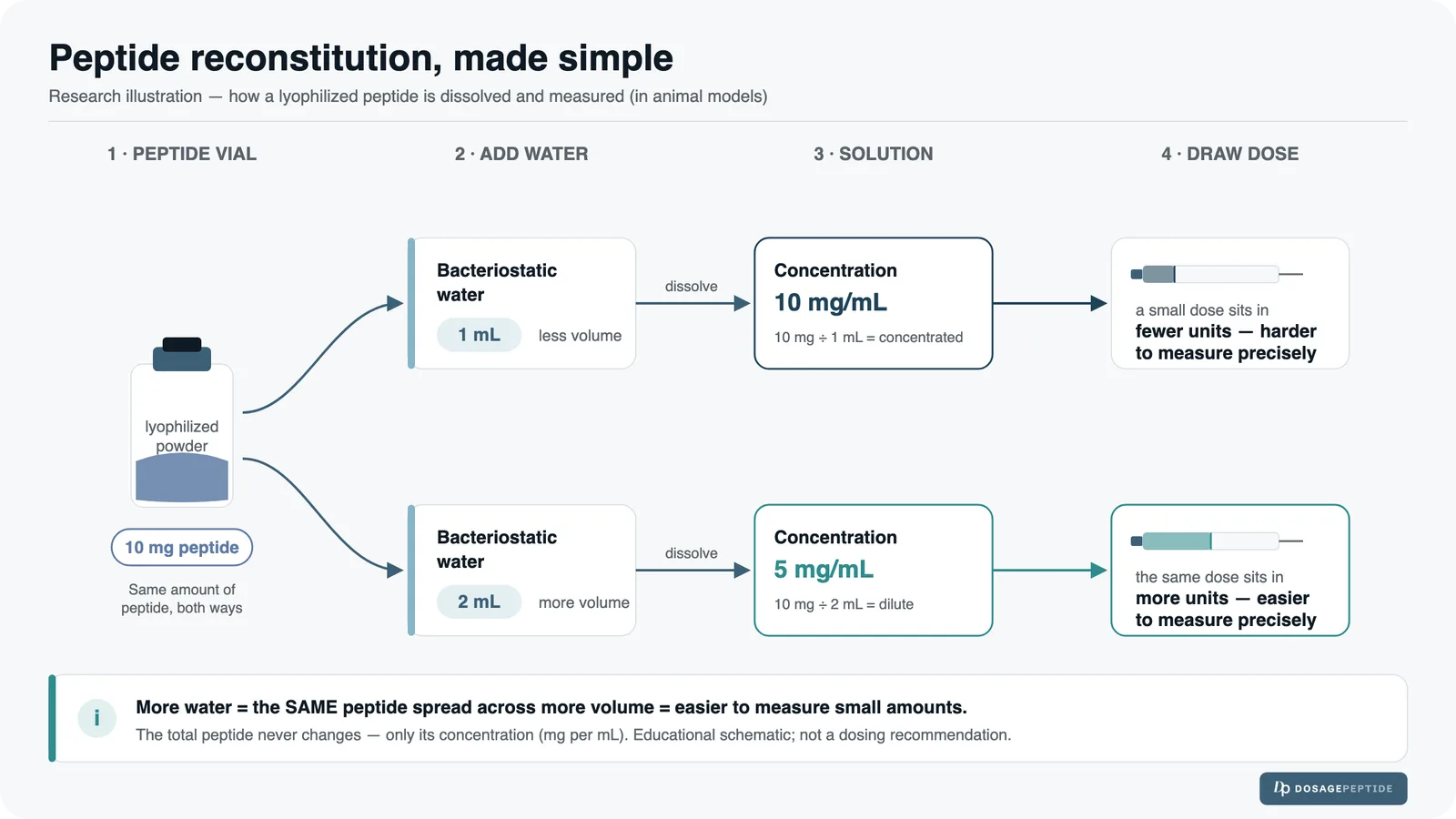
The short answer: 1–3 mL, and the choice is yours. There is no single “correct” amount of bacteriostatic water, because the water does not change how much peptide is in the vial — only how spread out it is. Less water gives a concentrated solution and small, fiddly volumes on the syringe; more water gives a dilute one and bigger, easier-to-read volumes. Pick the volume that puts your intended amount somewhere between roughly 10 and 50 units on a U-100 syringe, and you have chosen well. The tables below give you the numbers for every common vial size.
Everything here is for laboratory and research-use-only contexts. It explains a concept and a technique — it is not medical advice and deliberately names no dose for any peptide. Those numbers live on the protocol pages linked below.

How much bacteriostatic water for each vial size?
This is the reference table most people are actually looking for. Find your vial size, read across to the water volume you are considering, and you have your concentration and how much sits in a single syringe unit. Nothing here is a dose — it is arithmetic.
| Vial size | Water added | Concentration | Per 1 unit (U-100) |
|---|---|---|---|
| 5 mg | 1 mL | 5 mg/mL | 50 mcg |
| 2 mL | 2.5 mg/mL | 25 mcg | |
| 3 mL | 1.67 mg/mL | 16.7 mcg | |
| 10 mg | 1 mL | 10 mg/mL | 100 mcg |
| 2 mL | 5 mg/mL | 50 mcg | |
| 3 mL | 3.33 mg/mL | 33.3 mcg | |
| 15 mg | 2 mL | 7.5 mg/mL | 75 mcg |
| 3 mL | 5 mg/mL | 50 mcg | |
| 20 mg | 2 mL | 10 mg/mL | 100 mcg |
| 3 mL | 6.67 mg/mL | 66.7 mcg | |
| 30 mg | 3 mL | 10 mg/mL | 100 mcg |
Two patterns fall out of the table. A 10 mg vial in 2 mL and a 15 mg vial in 3 mL both land on 50 mcg per unit — different vials, identical measuring experience. And the “round number” combinations (10 mg in 1 mL, 20 mg in 2 mL, 30 mg in 3 mL) all give exactly 100 mcg per unit, which is why they are so commonly used: the mental arithmetic disappears. To run your own vial size and target amount, use the peptide reconstitution calculator.
How many units is 1 mL, 2 mL or 3 mL of bacteriostatic water?
On a standard U-100 insulin syringe, 100 units = 1 mL. So:
- 1 mL = 100 units — one full syringe.
- 2 mL = 200 units — two full syringes.
- 3 mL = 300 units — three full syringes.
This trips people up constantly, because a standard insulin syringe holds 1 mL. Adding 2 mL of bacteriostatic water to a vial therefore means drawing and transferring the water twice, not once. If your syringe is marked to 50 units (a 0.5 mL barrel), it takes four draws to add 2 mL. The syringe markings measure volume, not peptide — the same 30 units means a completely different amount of compound depending on how much water you added. For the syringe side of this, see reading insulin syringe units.
How do I decide how much to use? One simple rule
Choose the water volume that lands your intended amount in the middle of the syringe barrel — roughly 10 to 50 units on a U-100. Below about 5 units, a small hand tremor is a large percentage error. Above about 80 units you are close to the top of the barrel with no room to adjust. Working out from that:
- Small intended amounts, large vial → add more water. It spreads the peptide out and pushes the reading up the barrel where it is easier to hit accurately.
- Large intended amounts, small vial → add less water, so a single draw covers it.
- Unsure → 2 mL into a 10 mg vial is the most forgiving default in the whole table, and gives a clean 50 mcg per unit.
One practical constraint sits on top of that rule: most peptide vials hold 2–3 mL comfortably, so 3 mL is a sensible ceiling regardless of the arithmetic. And the more water you add, the more solution has to stay stable and refrigerated for the life of the vial — a real consideration if you will be drawing from it over several weeks.
Water changes concentration, not quantity
Picture a fixed spoonful of sugar. Stir it into one cup and you get a sweet, concentrated drink; stir the same spoonful into three cups and you get a mild one. The sugar never changed — only how far it was spread. Reconstitution works identically: the vial holds a fixed mass of peptide, and the bacteriostatic water you add is the “cups.” In one line, worth reading twice: the mass of peptide is fixed; water only sets the concentration; concentration only sets the volume you draw — never the amount of active compound. Add more water and you are not “watering down” your peptide, only choosing how easy it will be to measure.
Why bacteriostatic water — and not any other
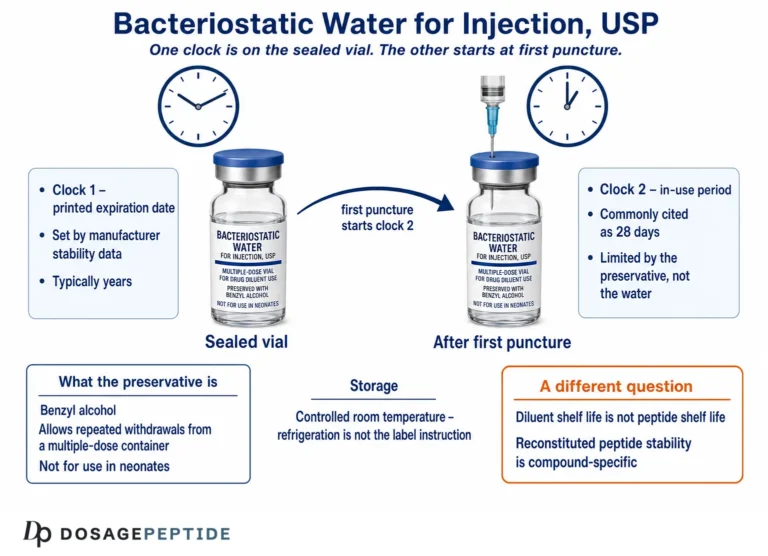
Reconstitution simply means bringing a freeze-dried (lyophilised) powder back into solution, and the liquid you choose decides how long the vial stays usable. Bacteriostatic Water for Injection contains 0.9% (9 mg/mL) benzyl alcohol, an antimicrobial preservative that lets you draw from a multi-use vial repeatedly for up to about 28 days after first puncture. Sterile water has no preservative, so once opened it is really single-use; distilled or tap water isn’t sterile at all and has no place near a research peptide.
| Water type | Preservative | Use pattern | Typical in-use window* |
|---|---|---|---|
| Bacteriostatic water | ~0.9% benzyl alcohol | Multi-use vial | ~28 days refrigerated |
| Sterile water | None | Single use | ~24–48 hours |
| Distilled / tap | None; not sterile | Never — do not use | — |
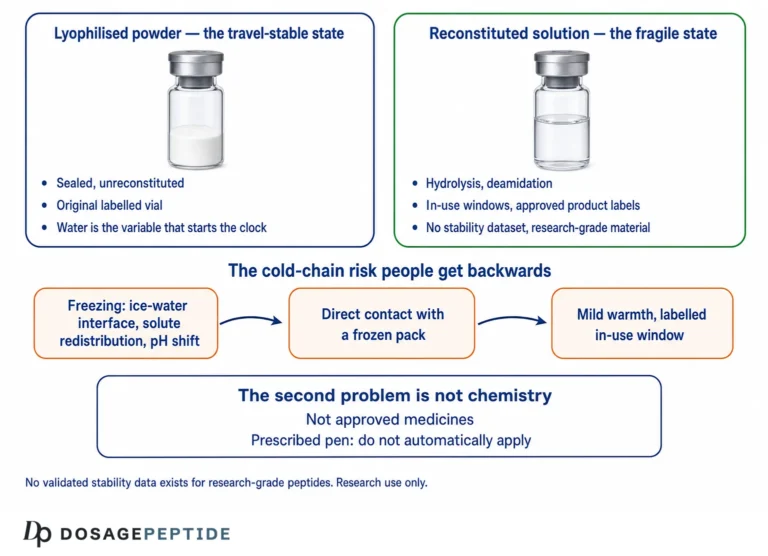
*General ranges; the actual window depends on the specific peptide’s own stability and on handling. The preservative slows contamination, but it doesn’t stop chemistry: the moment water touches the powder, degradation begins — hydrolysis, deamidation, and oxidation — which is exactly why the dry powder is stable for a long time and the mixed solution is not. For how long a reconstituted vial actually keeps, see storing peptides before and after reconstitution.
Add the water without wrecking the peptide
Peptides are delicate molecules, so the technique is gentle. Insert the needle and let the water run slowly down the inside glass wall of the vial rather than firing it straight onto the powder. Then swirl gently or roll the vial between your palms — never shake it (vigorous shaking foams the solution and mechanically shears the peptide). Give it a minute or two to dissolve fully; the liquid should look clear, with no undissolved particles, before you draw. For the complete step-by-step, see the full reconstitution guide.
Frequently Asked Questions
How much bacteriostatic water do I add to a 5 mg vial?
Most commonly 1–2 mL. At 1 mL you get 5 mg/mL (50 mcg per unit on a U-100 syringe); at 2 mL you get 2.5 mg/mL (25 mcg per unit). Neither is more “correct” — 2 mL simply doubles the number of units your intended amount occupies, which makes small amounts easier to measure accurately.
How many units is 2 mL of bacteriostatic water?
200 units on a standard U-100 insulin syringe, since 100 units equals 1 mL. A standard insulin syringe holds only 1 mL, so adding 2 mL to a vial means two full draws. On a 0.5 mL (50-unit) syringe it takes four.
Does more water mean less peptide?
No — this is the number-one confusion. The mass in the vial is fixed. Adding more water lowers the concentration and enlarges the volume you draw, but the total amount of peptide is unchanged; you are spreading the same amount over more liquid, not removing any.
How do I know how much bacteriostatic water to use?
Work backwards from the syringe. Pick the water volume that puts your intended amount roughly between 10 and 50 units on a U-100 barrel — low enough to leave room to adjust, high enough that a small hand movement is not a large percentage error. If you are unsure, 2 mL into a 10 mg vial is the most forgiving starting point.
Can I use tap or bottled water?
No. Neither is sterile, and neither carries the preservative that keeps a multi-use vial safe. Use bacteriostatic water for any repeated-use vial.
I added too much water — did I ruin it?
No. You only made it more dilute; the same peptide is still there and your measured volumes will simply be larger. Re-run the new concentration through the reconstitution calculator to see your updated numbers.
How long does a reconstituted vial last?
The benzyl alcohol supports multi-use for up to about 28 days refrigerated, but the peptide’s own stability may be shorter. Keep it cold, protect it from light, avoid freeze–thaw cycles, and follow the storage guide.
References
- Bacteriostatic Water for Injection, USP (Pfizer) prescribing information — 0.9% (9 mg/mL) benzyl alcohol, multiple-dose container, up to 28-day in-use period, pH 5.7. DailyMed label.
- United States Pharmacopeia (USP–NF), Bacteriostatic Water for Injection monograph.
- Manning MC, Chou DK, Murphy BM, Payne RW, Katayama DS. Stability of protein pharmaceuticals: an update. Pharm Res. 2010;27(4):544–575.
- Dosage Peptide internal references: the peptide reconstitution guide, the reconstitution calculator and the dosage calculator.
Research-use-only disclaimer: The peptides discussed on this site are intended strictly for laboratory and research use only and are not for human consumption. This article explains a general dilution concept and handling technique; it is educational and is not medical advice, a treatment recommendation, or a recommendation to use any peptide. Every number shown is illustrative only and is not a suggested dose. Always consult a qualified professional before making any decisions related to health or to the handling of research materials.