Short answer: no published controlled trial has tested GLP-1 microdosing as a long-term regimen, so nobody can tell you it works — or that it is safe over months. That is not a dodge. It is the whole finding. There is also no agreed definition of a “microdose”, no standard protocol, and no long-horizon dataset at sub-therapeutic exposure.
What the dose-ranging trials do show is more interesting than either side of the argument admits: sub-maintenance exposures produce measurable metabolic effects. Low doses are not inert. But every long-horizon outcome we have — weight maintenance, cardiovascular events, liver histology — was generated at the labelled maintenance dose reached through escalation, and the liver indication is an accelerated approval resting on histological improvement, itself a surrogate.[2] “Measurable at week 12” and “worth doing for a year” are different claims, and only the first has evidence.
This article explains where the practice came from, what the published dose-response curves actually show at the low end, what happens at the point of stopping, and which questions no study has answered — including the two that get least attention: material quality, and how much dosing error an insulin syringe introduces at very small volumes.
What does “microdosing” a GLP-1 actually mean?
The term is borrowed from psychedelic research, where it has a reasonably specific meaning: a fraction of a perceptual threshold dose, taken intermittently. Applied to incretin drugs, it has no consensus definition at all. In practice, people using the term mean one of three different things, and conflating them is the source of most of the confusion.
The three things people call microdosing
- Staying at an escalation-step dose indefinitely. Remaining at semaglutide 0.25 mg or tirzepatide 2.5 mg weekly rather than titrating upward. These are real, labelled doses — but they are labelled as initiation doses, not maintenance doses.
- Dosing below the lowest labelled dose. Drawing a fraction of an escalation-step dose from a vial — a practice that only becomes physically possible when the drug comes in a multi-dose vial rather than a fixed-increment pen.
- Sub-threshold dosing for non-weight goals. Using very low doses in the hope of anti-inflammatory, appetite-modulating, or “longevity” effects without meaningful weight change. This is the version with the least supporting human evidence, and it is discussed separately below.
If you are new to this drug class, the mechanistic background in our overview of what a GLP-1 is and how these compounds signal is worth reading first, because the microdosing argument turns entirely on how receptor exposure relates to effect.
Where did the trend come from?
Three forces converged. First, gastrointestinal adverse events in the pivotal trials were dose-related and concentrated during escalation — in the tirzepatide phase 2 programme, gastrointestinal event rates rose from 23.1% at 1 mg to 66.0% at 15 mg, against 9.8% for placebo[1]. Some people who tolerate a low dose poorly tolerate a high one, and simply stop climbing.
Second, cost. A vial stretched across more weeks is cheaper per week, and the arithmetic is obvious to anyone paying out of pocket.
Third, and most consequentially, the shortage-era expansion of compounded and research-grade material moved these molecules out of fixed-increment pens and into multi-dose vials measured with an insulin syringe. Once the delivery device stopped enforcing the labelled increments, dosing below them became trivially easy — and a practice that was previously impossible became a subculture.
Is a low starting dose the same as a low maintenance dose?
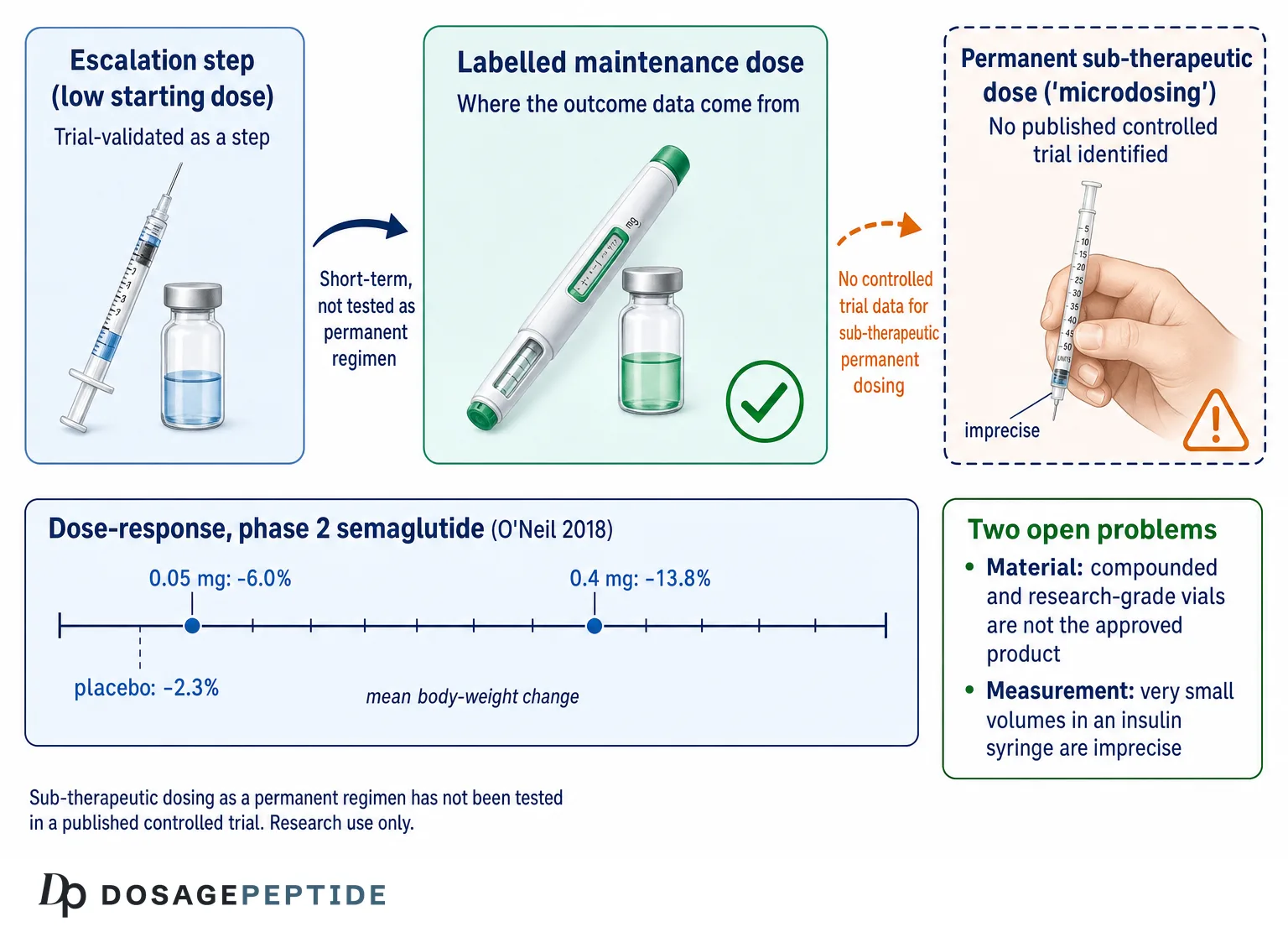
This is the crux, and the labels answer it directly. The FDA-approved prescribing information for Wegovy (semaglutide injection) instructs initiation at 0.25 mg once weekly for four weeks, then escalation every four weeks through 0.5, 1, and 1.7 mg, with maintenance from week 17 onward. For weight reduction and cardiovascular risk reduction the label sets maintenance at either 2.4 mg (the recommended dose) or 1.7 mg, chosen on treatment response and tolerability[2]. The Zepbound (tirzepatide) label is structured identically: 2.5 mg weekly for four weeks as a starting dosage, increased in 2.5 mg increments, with maintenance for weight reduction defined as 5, 10, or 15 mg. Ozempic (semaglutide, indicated for type 2 diabetes and for cardiovascular and kidney risk reduction in that population) initiates at 0.25 mg specifically to reduce the risk of gastrointestinal adverse reactions, with maintenance at 0.5, 1, or 2 mg[3]. Even the newest approval follows the pattern: orforglipron (Foundayo), FDA-approved on 1 April 2026 for use with a reduced-calorie diet and increased physical activity to reduce excess body weight and maintain weight reduction long term in adults with obesity, or adults with overweight and at least one weight-related comorbid condition, starts at 0.8 mg daily and escalates in steps to a maximum of 17.2 mg[4].
The distinction matters because of what the escalation steps were validated for. A starting dose is trial-validated as a tolerability bridge — the trials demonstrated that passing through it reduces adverse events on the way to a dose that was itself tested against an endpoint. It was never randomised as a terminal regimen and followed for weight, cardiovascular events, or liver outcomes. Those are two different claims, and only the first has evidence behind it. Our reference page on the semaglutide titration schedule and the equivalent tirzepatide titration reference document the schedules as they appear in the trial protocols and labels.
What do the dose-response data actually show at the low end?
Here the practice deserves a fair hearing, because the curves are not flat below the maintenance dose. Dismissing microdosing as “a dose so small it does nothing” is not supported by the published dose-ranging work.
Semaglutide: the low end is well above zero
The phase 2 dose-ranging trial in obesity randomised 957 adults without diabetes to daily subcutaneous semaglutide at target doses of 0.05, 0.1, 0.2, 0.3, or 0.4 mg, or to liraglutide 3.0 mg or placebo, for 52 weeks. Estimated mean weight loss was −6.0% at 0.05 mg/day versus −2.3% for placebo, rising to −13.8% at 0.4 mg/day; every semaglutide arm separated significantly from placebo[5]. The lowest arm delivered roughly 0.35 mg of semaglutide per week — a small fraction of the 2.4 mg weekly maintenance dose — and still produced a measurable, statistically significant effect. That is a genuine data point in favour of the claim that low exposure does something.
Two caveats are load-bearing. Daily and weekly dosing produce different concentration profiles, so this is not a clean milligram-for-milligram comparison with the weekly product, and daily subcutaneous semaglutide is not a marketed formulation. And the magnitude gap is large: STEP 1 produced −14.9% at 68 weeks versus −2.4% for placebo, using 2.4 mg weekly after a 16-week escalation[6]. Low exposure is not no effect, but it is not a substitute for the tested dose either.
Tirzepatide: the curve differs by endpoint
Tirzepatide complicates the picture usefully. In the 26-week phase 2 trial in type 2 diabetes, the 1 mg arm produced an HbA1c reduction of −1.06 percentage points versus −0.06 for placebo — a substantial glycaemic effect — but a mean body-weight change of only −0.9 kg, against −11.3 kg at the top dose[1]. In SURMOUNT-1, the approved 5, 10, and 15 mg arms produced −15.0%, −19.5%, and −20.9% at 72 weeks, against −3.1% for placebo[7]. The lesson is that “does a low dose work?” has no single answer — it depends on which endpoint you are asking about, and glycaemic and weight endpoints do not share a dose-response curve.
Retatrutide: measurable at low doses, but investigational
The phase 2 retatrutide trial randomised 338 adults across 1, 4, 8, and 12 mg weekly target doses. The 1 mg arm reached −8.7% at 48 weeks versus −2.1% for placebo; the 12 mg arm reached −24.2%[8]. The sponsor subsequently announced topline results from the phase 3 TRIUMPH-1 trial in May 2026: 2,339 participants randomised to 4, 9, or 12 mg or placebo, with reported changes of −19.0%, −25.9%, and −28.3% at 80 weeks against −2.2% for placebo. Those figures come from a company press release, not a peer-reviewed publication — the sponsor states detailed results are still to be presented and published — so they sit a tier below the phase 2 data in verifiability, even though the trial is larger. Critically, retatrutide remains investigational and is not FDA-approved for any indication; the sponsor describes it as legally available only to participants in its clinical trials[9]. Our retatrutide reference page catalogues the doses used in those trials for research context only.
Evidence table: what has been tested, at which doses
| Molecule | Trial and phase | Dose arms tested | Result in the lowest arm | Evidence tier |
|---|---|---|---|---|
| Semaglutide (daily subcutaneous) | Phase 2 dose-ranging, obesity, 52 weeks[5] | 0.05, 0.1, 0.2, 0.3, 0.4 mg/day; liraglutide 3.0 mg; placebo | −6.0% vs −2.3% placebo at 0.05 mg/day | Peer-reviewed randomised human trial; this daily subcutaneous regimen is not an approved product |
| Semaglutide 2.4 mg weekly | STEP 1, phase 3, 68 weeks[6] | 2.4 mg after 16-week escalation | −14.9% vs −2.4% placebo | Peer-reviewed; supports FDA-approved indication (chronic weight management) |
| Semaglutide 2.4 mg weekly | SELECT, phase 3, mean follow-up 39.8 months[15] | 2.4 mg vs placebo | MACE hazard ratio 0.80 (95% CI 0.72–0.90) | Peer-reviewed; supports FDA-approved cardiovascular risk-reduction indication |
| Semaglutide 2.4 mg weekly | STEP 4 withdrawal, phase 3[10] | Continue 2.4 mg vs switch to placebo | −7.9% continued vs +6.9% withdrawn over 48 weeks | Peer-reviewed randomised trial on maintenance requirement |
| Tirzepatide | Phase 2, type 2 diabetes, 26 weeks[1] | 1, 5, 10, 15 mg weekly; dulaglutide 1.5 mg; placebo | HbA1c −1.06 points but only −0.9 kg at 1 mg | Peer-reviewed randomised human trial; 1 mg is not a marketed dose |
| Tirzepatide | SURMOUNT-1, phase 3, 72 weeks[7] | 5, 10, 15 mg weekly | −15.0% at 5 mg | Peer-reviewed; supports FDA-approved indication (chronic weight management) |
| Retatrutide | Phase 2, obesity, 48 weeks[8] | 1, 4, 8, 12 mg weekly | −8.7% vs −2.1% placebo at 1 mg | Peer-reviewed, but investigational — not FDA-approved |
| Retatrutide | TRIUMPH-1, phase 3, 80 weeks[9] | 4, 9, 12 mg weekly vs placebo | −19.0% at 4 mg | Sponsor topline press release only, not yet peer-reviewed; investigational — not FDA-approved |
| Orforglipron (oral) | Two 72-week randomised placebo-controlled trials supporting approval[4] | 0.8 mg start, escalating to a 17.2 mg maximum | Escalation steps are titration steps, not separately tested terminal regimens | FDA-approved 1 April 2026 for chronic weight management |
| Any molecule | Chronic sub-maintenance dosing as a fixed regimen | — | No such trial identified | Untested |
What has never been studied?
Sub-therapeutic dosing as a permanent regimen
Every arm in the table above escalated, or held a low dose only for the duration of a dose-finding study. Phase 2 dose-ranging arms held a low dose for 26 to 52 weeks, which is genuinely informative — but those were exploratory arms designed to locate a phase 3 dose, not regimens taken forward and tested against clinical endpoints over years. We could identify no published randomised trial that has taken a deliberately sub-maintenance dose, held it indefinitely, and measured what happens to weight, cardiometabolic risk, or event rates over the timescales that matter. The claim “a low dose works long-term” is therefore an extrapolation from short-horizon dose-ranging data, not a finding.
What happens on withdrawal, and what that implies
One relevant piece of evidence sits adjacent to the question. In STEP 4, participants who reached 2.4 mg and then switched to placebo regained weight: +6.9% over 48 weeks, against −7.9% for those who continued[10]. This establishes that the effect is exposure-dependent and does not persist once exposure stops. It does not establish what happens at partial exposure — that intermediate case is precisely the untested region. Anyone citing STEP 4 as proof that microdosing fails is over-reading it, and anyone citing dose-ranging data as proof that it succeeds is over-reading that.
The “longevity” and anti-inflammatory claims
The most speculative version of microdosing holds that sub-threshold doses deliver anti-inflammatory or healthspan benefits without weight loss. There is real mechanistic literature behind the underlying biology: a 2025 review in Immunity summarises evidence that GLP-1 receptor agonists exert anti-inflammatory effects, some of which appear independent of glycaemic control or weight loss, and which the authors attribute to direct signalling through the immune GLP-1 receptor and indirectly via central nervous system circuits[11]. That is a legitimate body of mechanistic work — but it is a narrative review of mechanism, drawn largely from preclinical and laboratory studies at standard exposures, not a demonstration that a sub-therapeutic dose in a healthy human produces a clinical benefit. No trial has randomised people to a deliberately low GLP-1 dose and measured longevity, healthspan, or inflammatory disease endpoints. Treating the mechanism as if it were the outcome is the single most common overreach in this space.
What is the material-quality problem?
Most microdosing does not use the approved product, because the approved pens do not permit sub-increment doses. It uses compounded preparations or research-grade material, and the regulatory picture there has shifted sharply.
The FDA states that compounded drugs are not FDA-approved and are not reviewed for safety, effectiveness, or quality before marketing, and that a compounded drug might be appropriate only where a patient’s medical need cannot be met by an approved drug or the approved drug is not commercially available. The agency documents specific quality concerns for compounded GLP-1s: shipments arriving warm or with inadequate refrigeration; fraudulent products naming pharmacies that did not compound them or do not exist; and semaglutide salt forms — semaglutide sodium and semaglutide acetate — which the agency describes as different active ingredients from the one used in approved products, with no known lawful basis for their use in compounding. As of 31 May 2026, the FDA had received 990 adverse event reports associated with compounded semaglutide and more than 730 associated with compounded tirzepatide, while noting that state-licensed pharmacies which are not outsourcing facilities are not required to report, so the true figures are likely higher[12].
The same page states that retatrutide and cagrilintide cannot be used in compounding under federal law, are not components of any FDA-approved drug, and have not been found safe and effective for any condition — and that the agency has warned telehealth companies, active pharmaceutical ingredient distributors, and outsourcing facilities over retatrutide specifically[12]. On 30 April 2026 the FDA proposed to exclude semaglutide, tirzepatide, and liraglutide from the 503B bulks list, having identified no clinical need for outsourcing facilities to compound them from bulk substances; the proposal was open for comment until 29 June 2026 and is a proposal, not a final determination[13]. Research-grade lyophilised peptide sold for laboratory use is a further step removed again: it is not the approved product, it carries no clinical labelling, and its identity and purity are whatever the certificate of analysis — if any — establishes.
Why is measurement the hidden variable?
This is the part of the microdosing debate that gets the least attention and deserves the most. Reducing a dose to a fraction of an escalation step means drawing very small volumes into an insulin syringe, and the accuracy of that operation has been measured directly — not for GLP-1 drugs, but for insulin, where the underlying problem is the same physical one of metering a few microlitres through a syringe.
In a gravimetric study of low-dose insulin administration, paediatric nurses attempting to deliver 1.0 unit of U100 insulin — 10 µL — delivered a mean of 1.638 units (reported as ±0.376); attempts at 0.5 units delivered a mean of 0.975 units. Using 0.3 mL rather than 0.5 mL syringes did not improve accuracy or precision, and among parents of children with diabetes, individual coefficients of variation for a 1-unit dose ranged from 5% to 33%, with only three of seven able to deliver 1.0 unit with acceptable precision. The authors concluded that with the syringes available to them, injections below 20 µL carry unacceptably large error[14].
That study is from 1993 and concerns a different drug, so it is not direct evidence about GLP-1 dosing; what transfers is the volumetric limit of a syringe, which has not changed. At very small volumes, the delivered dose can diverge from the intended dose substantially, in either direction, and the error is not consistent between individuals. That means a self-reported “microdose” is a noisy quantity, which in turn means anecdotal reports of low-dose outcomes are describing an exposure nobody actually knows. The FDA has separately documented adverse events, some requiring hospitalisation, that may relate to dosing errors where patients measured and self-administered incorrect doses of compounded injectable semaglutide, or where clinicians miscalculated them[12]. Anyone working with lyophilised material in a research context should understand how reconstitution volume propagates into concentration error — our reconstitution reference and concentration calculator exist to make that arithmetic explicit rather than assumed.
What about side effects at low doses?
The dose-related pattern of gastrointestinal adverse events is one of the more robust findings in the class, and it runs in the direction microdosing advocates expect. Tirzepatide phase 2 gastrointestinal event rates rose monotonically from 23.1% (1 mg) through 32.7% (5 mg) and 51.0% (10 mg) to 66.0% (15 mg), against 9.8% for placebo[1], and in the retatrutide phase 2 trial gastrointestinal events were dose-related and partly mitigated by a lower starting dose[8]. Lower exposure would therefore be expected to produce fewer and milder gastrointestinal events — though this is inference from dose-ranging arms, not a trial that tested it.
What does not follow is that low doses are therefore safe in an unqualified sense. The boxed warning on the approved products concerns thyroid C-cell tumours observed in mice and rats, whose human relevance the label states has not been determined; it carries a contraindication in personal or family history of medullary thyroid carcinoma or MEN 2, and that contraindication is label-level and not conditioned on dose[2]. Nor does a lower dose eliminate the question of body composition during weight loss, which is a separate axis entirely and is covered in our review of what the evidence says about lean mass on GLP-1 agonists.
What would it take to answer the question properly?
A trial that settled this would randomise participants to a fixed sub-maintenance dose, the labelled maintenance dose, and placebo; hold those assignments for the 68 to 80 weeks used by the existing phase 3 programmes; use verified drug product so delivered exposure is known; and measure body weight, body composition, cardiometabolic markers, and adverse events. No such trial has been published. Until one is, both “microdosing works” and “microdosing does nothing” outrun the evidence. The accurate statement is narrower: low exposures demonstrably produce partial effects over the horizons dose-ranging studies covered, and the long-term regimen has never been evaluated.
Research use only. DosagePeptide is an independent research reference library. It does not sell peptides, provide medical care, or recommend any human use. Nothing above is a therapeutic claim, a treatment recommendation, or a personal dosing protocol, and the doses cited are reported as they appear in published trials and FDA labelling for reference purposes only. Semaglutide, tirzepatide, and orforglipron are FDA-approved only for their specific labelled indications; retatrutide is investigational and not approved for any indication. Decisions about any medication belong with a qualified, licensed clinician who knows the individual case.
Frequently Asked Questions
Is GLP-1 microdosing FDA-approved?
No. There is no approved regimen consisting of a deliberately sub-maintenance GLP-1 dose held indefinitely. Semaglutide and tirzepatide products carry approved maintenance doses reached through a labelled escalation schedule, and the low doses at the bottom of those schedules are designated initiation doses intended to reduce gastrointestinal adverse reactions on the way to a maintenance dose. Using an escalation step as a permanent regimen is off-label and has not been tested against clinical endpoints.
Does a low dose of semaglutide do anything at all?
Yes, measurably. In the phase 2 dose-ranging trial in obesity, daily subcutaneous semaglutide at 0.05 mg — roughly 0.35 mg per week — produced an estimated mean weight loss of 6.0% at 52 weeks versus 2.3% for placebo, and every semaglutide arm separated significantly from placebo. The effect is real but substantially smaller than the roughly 15% seen at the approved 2.4 mg weekly maintenance dose in STEP 1, and it was measured over one year, not indefinitely.
Why is microdosing tirzepatide different from microdosing semaglutide?
Because the dose-response curves differ by endpoint. In the tirzepatide phase 2 trial in type 2 diabetes, the 1 mg arm delivered a large glycaemic effect — HbA1c down 1.06 percentage points against 0.06 for placebo — but a mean weight change of only 0.9 kg, compared with 11.3 kg at the top dose. So a low tirzepatide dose can be meaningfully active on glucose while being nearly inert on weight. Generalising from one molecule or one endpoint to another is not supported.
What is the status of retatrutide?
Retatrutide is investigational and not FDA-approved for any indication. Its phase 3 TRIUMPH-1 trial was reported by the sponsor as topline results in May 2026, with weight reductions of 19.0% to 28.3% at 80 weeks across the 4, 9, and 12 mg arms; those figures come from a press release and had not yet been peer-reviewed or published in full. The sponsor states retatrutide is legally available only to participants in its clinical trials, and the FDA states that retatrutide cannot lawfully be used in compounding and has not been found safe and effective for any condition.
Are there fewer side effects at lower doses?
Gastrointestinal adverse events are consistently dose-related across the class, so lower exposure would be expected to mean fewer and milder nausea, diarrhoea, and vomiting events. That is the most defensible argument advanced for low dosing, though it is an inference from dose-ranging arms rather than something a trial has tested directly. It also does not follow that low doses are safe without qualification: the boxed warning regarding rodent thyroid C-cell tumours and the contraindications in medullary thyroid carcinoma and MEN 2 are label-level and not conditioned on dose.
Why does the FDA object to compounded GLP-1 products?
Because compounded drugs are not FDA-approved and are not reviewed for safety, effectiveness, or quality before marketing. The agency has documented shipments arriving inadequately refrigerated, fraudulently labelled products naming pharmacies that did not make them, and semaglutide salt forms that it describes as different active ingredients from the approved one. In April 2026 it proposed excluding semaglutide, tirzepatide, and liraglutide from the 503B bulks list, finding no clinical need for outsourcing facilities to compound them from bulk substances.
How much dosing error does an insulin syringe introduce at small volumes?
Enough to matter. In a 1993 gravimetric study of insulin, nurses attempting to deliver 1.0 unit of U100 insulin — 10 microlitres — delivered a mean of 1.638 units, and individual coefficients of variation among parents of children with diabetes ranged from 5% to 33%. Smaller-barrel syringes did not help. The authors recommended against relying on injections below 20 microlitres. That study is about insulin rather than a GLP-1 drug, but the constraint it measured is the syringe, so for very small volumes the delivered dose is a noisy estimate rather than a known quantity.
Do low doses have longevity or anti-inflammatory benefits?
This has not been demonstrated in humans at low doses. A 2025 review summarises mechanistic evidence that GLP-1 receptor agonists exert anti-inflammatory effects, some apparently independent of glucose control or weight loss, attributed to immune GLP-1 receptors and central circuits. That work is mechanistic and drawn largely from preclinical studies at standard exposures. No trial has randomised participants to a deliberately sub-therapeutic dose and measured longevity, healthspan, or inflammatory disease outcomes.
What would settle the question?
A randomised controlled trial comparing a fixed sub-maintenance dose against the labelled maintenance dose and placebo, run for at least 68 to 80 weeks to match the existing phase 3 programmes, using verified drug product so delivered exposure is known, with body weight, body composition, cardiometabolic markers, and adverse events as endpoints. No such trial has been published, which is why both confident endorsement and confident dismissal of microdosing currently outrun the evidence.
References
- Frias JP, Nauck MA, Van J, et al. Efficacy and safety of LY3298176, a novel dual GIP and GLP-1 receptor agonist, in patients with type 2 diabetes: a randomised, placebo-controlled and active comparator-controlled phase 2 trial. Lancet. 2018;392(10160):2180–2193. PubMed 30293770 · doi:10.1016/S0140-6736(18)32260-8
- U.S. Food and Drug Administration. WEGOVY (semaglutide) injection, for subcutaneous use — full prescribing information. Reference ID 5676420. accessdata.fda.gov
- DailyMed (U.S. National Library of Medicine). Prescribing information: ZEPBOUND (tirzepatide) injection and OZEMPIC (semaglutide) injection.
- U.S. Food and Drug Administration. FDA Approves First New Molecular Entity Under National Priority Voucher Program (Foundayo / orforglipron). 1 April 2026. fda.gov
- O’Neil PM, Birkenfeld AL, McGowan B, et al. Efficacy and safety of semaglutide compared with liraglutide and placebo for weight loss in patients with obesity: a randomised, double-blind, placebo and active controlled, dose-ranging, phase 2 trial. Lancet. 2018;392(10148):637–649. PubMed 30122305 · doi:10.1016/S0140-6736(18)31773-2
- Wilding JPH, Batterham RL, Calanna S, et al. Once-Weekly Semaglutide in Adults with Overweight or Obesity (STEP 1). N Engl J Med. 2021;384(11):989–1002. PubMed 33567185 · doi:10.1056/NEJMoa2032183
- Jastreboff AM, Aronne LJ, Ahmad NN, et al. Tirzepatide Once Weekly for the Treatment of Obesity (SURMOUNT-1). N Engl J Med. 2022;387(3):205–216. PubMed 35658024 · doi:10.1056/NEJMoa2206038
- Jastreboff AM, Kaplan LM, Frias JP, et al. Triple-Hormone-Receptor Agonist Retatrutide for Obesity — A Phase 2 Trial. N Engl J Med. 2023;389(6):514–526. PubMed 37366315 · doi:10.1056/NEJMoa2301972
- Eli Lilly and Company. Lilly’s triple agonist, retatrutide, delivered powerful weight loss in pivotal Phase 3 obesity trial (TRIUMPH-1, NCT05929066). Topline press release, 21 May 2026. Press release · ClinicalTrials.gov NCT05929066
- Rubino D, Abrahamsson N, Davies M, et al. Effect of Continued Weekly Subcutaneous Semaglutide vs Placebo on Weight Loss Maintenance in Adults With Overweight or Obesity: The STEP 4 Randomized Clinical Trial. JAMA. 2021;325(14):1414–1425. PubMed 33755728 · doi:10.1001/jama.2021.3224
- Donath MY, Drucker DJ. Obesity, diabetes, and inflammation: Pathophysiology and clinical implications. Immunity. 2025;58(10):2373–2382. Review. PubMed 41045922 · doi:10.1016/j.immuni.2025.09.011
- U.S. Food and Drug Administration. FDA’s Concerns with Unapproved GLP-1 Drugs Used for Weight Loss. fda.gov
- U.S. Food and Drug Administration. FDA Proposes to Exclude Semaglutide, Tirzepatide, and Liraglutide on 503B Bulks List. 30 April 2026. fda.gov
- Casella SJ, Mongilio MK, Plotnick LP, Hesterberg MP, Long CA. Accuracy and precision of low-dose insulin administration. Pediatrics. 1993;91(6):1155–1157. PubMed 8502520
- Lincoff AM, Brown-Frandsen K, Colhoun HM, et al. Semaglutide and Cardiovascular Outcomes in Obesity without Diabetes (SELECT). N Engl J Med. 2023;389(24):2221–2232. PubMed 37952131 · doi:10.1056/NEJMoa2307563