L-carnitine is not a peptide. It is a small quaternary ammonium compound (a betaine) that the body builds from the amino acids lysine and methionine, and it carries no peptide bonds and no amino acid chain of any kind. Its job in the cell is narrow and very well established: it ferries long-chain fatty acids across the inner mitochondrial membrane so they can be burned. That transport role — the carnitine shuttle — is textbook biochemistry. What is far less settled is whether giving extra carnitine to people who already have plenty does anything useful, and that gap between mechanism and outcome is the whole story of this molecule.
The search term “l-carnitine peptide” gets typed thousands of times a month, almost always by people who found carnitine sitting in a research-supply catalogue next to actual peptides. This reference library covers it for exactly that reason, and the honest framing is the one stated above — the same way we handle NAD+, which is a coenzyme, not a peptide. Categorising it correctly matters practically, because carnitine is dosed in milligrams and grams, not in the microgram-to-low-milligram range typical of research peptides, and because the regulatory picture is completely different: one carnitine product is an FDA-approved drug for a rare metabolic disease, while everything sold for “fat burning” is not approved for that at all.
Quick reference: what L-carnitine is and is not
| Question | Answer |
|---|---|
| Chemical class | Quaternary ammonium compound (betaine); formula C7H15NO3, molar mass approximately 161 g/mol |
| Is it a peptide? | No. No peptide bonds, no amino acid sequence. Biosynthesised from lysine and methionine [4] |
| Core biological function | Carrier that moves long-chain fatty acyl groups into the mitochondrial matrix for beta-oxidation [5] |
| FDA-approved drug form | Levocarnitine (CARNITOR and generics), oral and intravenous [2] |
| Approved indications (oral) | Primary systemic carnitine deficiency; acute and chronic treatment of inborn errors of metabolism causing secondary carnitine deficiency [2] |
| Approved indications (IV) | Acute and chronic treatment of inborn errors causing secondary carnitine deficiency; prevention and treatment of carnitine deficiency in end-stage renal disease patients undergoing dialysis [1] |
| NOT approved for | Weight loss, fat loss, body recomposition, athletic performance, energy, anti-ageing, “lipotropic” injections. No FDA approval exists for any of these [2] [3] |
| Units used | Milligrams and grams. Approved adult oral dosing on the label runs roughly 1–3 g/day for a 50 kg subject [2] |
| Also sold as | A dietary supplement (oral) and as a research chemical / research-use-only vial in peptide catalogues |
| Common related forms | Acetyl-L-carnitine (ALCAR), propionyl-L-carnitine (PLC), L-carnitine L-tartrate (LCLT) — distinct evidence bases, not interchangeable |
If you arrived here from a vial listing, the L-carnitine reference protocol page documents the concentration arithmetic. Watch the units: a 200 mg carnitine vial is a different order of magnitude from a 5 mg peptide vial. Unfamiliar terms are defined in the research compound glossary.
The carnitine shuttle: what carnitine actually does
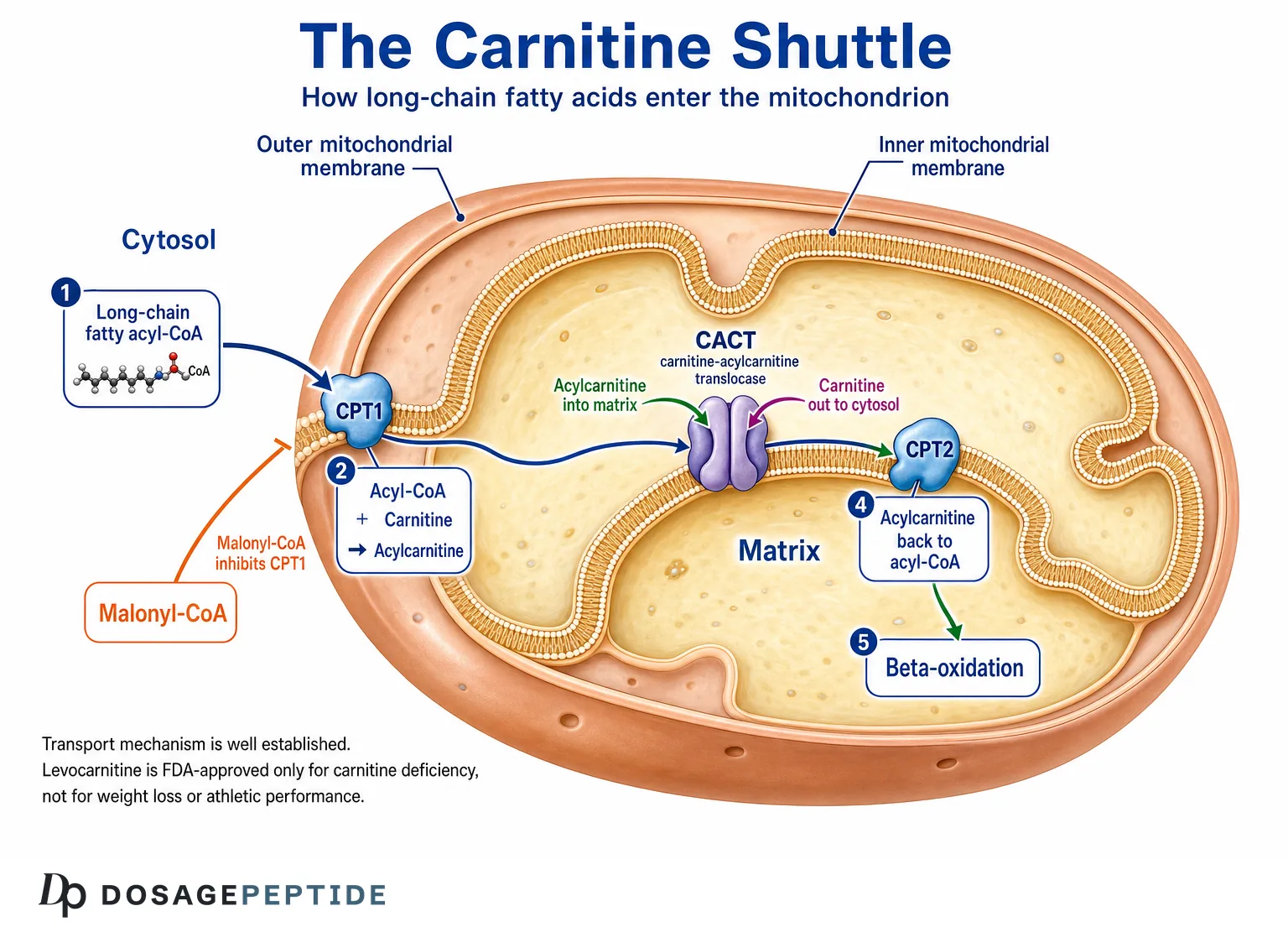
Long-chain fatty acids cannot simply diffuse into mitochondria to be oxidised. Once activated to a fatty acyl-CoA in the cytosol, the molecule is stuck: the inner mitochondrial membrane is impermeable to it, and to coenzyme A itself. The carnitine shuttle is the workaround, and it runs in three steps.
Step 1 — CPT1 on the outer membrane
Carnitine palmitoyltransferase 1 (CPT1), sitting in the outer mitochondrial membrane, transfers the acyl group from acyl-CoA onto carnitine, producing an acylcarnitine and releasing free CoA. This is the committed, rate-limiting step of long-chain fatty acid oxidation [5].
Step 2 — CACT across the inner membrane
Carnitine-acylcarnitine translocase (CACT) exchanges the acylcarnitine into the matrix for a free carnitine moving out. It is a strict antiporter, so the shuttle keeps recycling the same carnitine pool rather than consuming it.
Step 3 — CPT2 on the matrix side
Carnitine palmitoyltransferase 2 (CPT2), on the inner face of the inner membrane, hands the acyl group back to a matrix CoA. The regenerated acyl-CoA enters beta-oxidation; the liberated carnitine returns via CACT.
The regulatory node: malonyl-CoA
The reason this pathway matters for whole-body fuel selection is that CPT1 is inhibited by malonyl-CoA, the first committed intermediate of fatty acid synthesis [5]. In the fed state, when carbohydrate is abundant and malonyl-CoA is high, CPT1 is throttled and fat entry into mitochondria falls. In the fasted state, malonyl-CoA drops, CPT1 opens, and fat oxidation rises. This is the switch that links nutritional state to substrate choice, and it is set by malonyl-CoA rather than by how much carnitine happens to be in the cell — the distinction that any “carnitine burns fat” claim has to get past.
The second job: buffering the acetyl-CoA/CoA ratio
Carnitine has a second function that gets far less marketing attention and is arguably better supported. During high-intensity exercise, glycolytic flux outruns the mitochondria’s ability to oxidise acetyl-CoA, and free CoA gets sequestered. Carnitine accepts the excess acetyl groups as acetylcarnitine, regenerating free CoA and keeping the pyruvate dehydrogenase complex and TCA cycle reactions supplied [7]. In other words, carnitine is a buffer as much as it is a carrier — and its buffering role is what most of the credible human exercise work has actually probed.
Where carnitine comes from, and who is actually short of it
Humans get carnitine from two places. The body synthesises it endogenously, mainly in liver and kidney, starting from protein-bound lysine residues that have been trimethylated using methionine-derived methyl groups. The pathway runs through trimethyllysine, 3-hydroxytrimethyllysine, trimethylaminobutyraldehyde and gamma-butyrobetaine, and depends on iron(II)- and 2-oxoglutarate-dependent hydroxylases that require ascorbate, plus a pyridoxal-phosphate-dependent aldolase step and an NAD+-dependent dehydrogenase step [4]. That cofactor list — vitamin C, iron, vitamin B6, niacin — is why severe deficiencies of those micronutrients can theoretically impair carnitine synthesis.
The second source is diet, overwhelmingly red meat and, to a lesser extent, dairy [6]. Carnitine is then retained aggressively by the kidney, which reabsorbs the great majority of the filtered load using the high-affinity transporter OCTN2 [6].
Two numbers explain almost everything about why supplementation trials disappoint. More than 95% of the body’s carnitine store sits inside skeletal muscle, where resting total carnitine in human vastus lateralis is around 24 mmol per kg dry muscle — while plasma total carnitine is only about 50 µmol/L [7]. The muscle pool is enormous relative to the circulating pool, it is concentrated roughly 100-fold against the gradient, and in a healthy omnivore it is already close to full. Adding carnitine to the blood of someone whose muscle is already saturated is, mechanistically, pushing on a closed door.
Genuine deficiency states
Primary carnitine deficiency is an autosomal recessive disorder caused by defects in SLC22A5, the gene encoding the OCTN2 carnitine transporter. Cells fail to accumulate carnitine, the kidney fails to reabsorb it, urinary losses climb and serum carnitine falls. Presentation ranges from hypoketotic hypoglycaemia and hepatic encephalopathy in infancy to skeletal and cardiac myopathy or sudden death from arrhythmia later in life, typically triggered by fasting or a catabolic state; it is now often picked up on newborn screening through low free carnitine (C0) [6]. This is a real disease with a real, life-saving treatment.
Secondary carnitine deficiency arises when something else depletes the pool: inborn errors of organic acid or fatty acid oxidation metabolism that trap carnitine as acylcarnitine esters, chronic haemodialysis (carnitine is small and freely dialysable), and certain drugs, valproate being the classic example.
Note what these have in common. In every case the deficiency is demonstrated — measured low serum, red cell or tissue carnitine, with a defined mechanism. That is the population in which giving carnitine has been shown to do something.
The approved medical use, stated precisely
Levocarnitine is the pharmaceutical name for the L-enantiomer, and it is a genuinely FDA-approved prescription drug — but the approval is narrow, and it is worth quoting rather than paraphrasing.
The oral label (the CARNITOR oral solution; the tablet labels carry the same indications) states the product is indicated in the treatment of primary systemic carnitine deficiency, and for the acute and chronic treatment of patients with an inborn error of metabolism which results in a secondary carnitine deficiency [2]. Labelled adult dosing runs approximately 1–3 g/day for a 50 kg subject, with paediatric dosing of 50–100 mg/kg/day up to a 3 g/day maximum [2].
The intravenous product carries a different indication set: acute and chronic treatment of patients with an inborn error of metabolism resulting in secondary carnitine deficiency, and prevention and treatment of carnitine deficiency in patients with end-stage renal disease who are undergoing dialysis [1]. The dialysis indication belongs to the injection, not to the oral forms. In fact the oral label carries a precaution that the safety and efficacy of oral levocarnitine has not been evaluated in renal insufficiency, and that chronic administration of high oral doses in patients with severely compromised renal function or in ESRD patients on dialysis may result in accumulation of the potentially toxic metabolites trimethylamine (TMA) and trimethylamine-N-oxide (TMAO), which are normally excreted in the urine [2].
Everything else is not an approval
L-carnitine is simultaneously sold as a dietary supplement. Under the US framework, FDA does not have the authority to approve dietary supplements before they are marketed and generally does not approve supplement claims or labelling before use; the firm — not the agency — is responsible for ensuring its products are not adulterated or misbranded, and must hold substantiation that any structure/function claim is truthful and not misleading [3]. So the sentence “L-carnitine is FDA-approved” is true only in the narrow sense above and false in the sense a fat-loss ad implies.
Compounded injectable “lipotropic” carnitine, and carnitine marketed for body composition, athletic performance or energy, sit outside every approved indication. There is no FDA approval supporting those uses, and this library does not present them as a protocol. If body composition is the underlying question, the honest survey of what does and does not have human evidence is in the peptides studied for fat loss reference — and the same evidence-tier discipline applied there applies here.
What the research actually shows on fat oxidation and exercise
Here is the crux. The shuttle mechanism is real. It does not follow that more carnitine means more fat burned, because in a carnitine-replete person carnitine is not the limiting factor — malonyl-CoA-mediated CPT1 inhibition and mitochondrial capacity are.
Weight and body composition
Meta-analyses of randomised trials do report a statistically detectable but small effect. A 2020 systematic review and dose-response meta-analysis pooling 37 randomised controlled trials in 2,292 participants found a weighted mean difference in body weight of −1.21 kg (95% CI −1.73 to −0.68), BMI −0.24 kg/m², and fat mass −2.08 kg, with no significant effect on waist circumference or body fat percentage; restricting the analysis to high-quality trials only confirmed the body-weight effect [11]. The authors describe the effect as modest and concentrated in adults with overweight or obesity.
Three caveats belong next to that number, not in a footnote. First, roughly one kilogram over a supplementation period is not a body-recomposition result — it is a small average shift with wide heterogeneity between trials. Second, an earlier meta-analysis of nine trials (n = 911) reported a pooled difference of −1.33 kg and found that the magnitude of weight loss attributable to carnitine decreased significantly over time across trial durations, which is not the signature of a durable metabolic effect [12]. Third, most of these trials were conducted in populations with metabolic disease rather than in healthy, carnitine-replete adults, so they do not transfer cleanly to a healthy person hoping for a fat-loss aid.
Exercise performance
A 2021 systematic review of 11 trials separated results by exercise intensity and found a consistent split: oral L-carnitine (roughly 3–4 g taken 60–90 minutes pre-exercise, or 2–2.72 g/day for 9–24 weeks) was associated with improvements in high-intensity performance measures — lower rating of perceived exertion, higher Wingate peak power, greater work capacity — while neither acute nor chronic supplementation improved moderate-intensity performance [10]. That pattern is interesting precisely because it points at the acetyl-group buffering role, not at fat oxidation. The review pooled a small and heterogeneous literature, so it is a signal worth studying rather than a settled conclusion.
The most rigorous single human experiment remains a 24-week randomised, double-blind trial in 14 healthy male recreational athletes. Participants took 80 g carbohydrate twice daily, with or without 2 g L-carnitine L-tartrate per serving — 4 g/day of the tartrate salt, delivering about 2.7 g of L-carnitine. Muscle total carnitine rose 21% in the carnitine arm and was unchanged in control. At 50% VO2max the carnitine group used 55% less muscle glycogen; at 80% VO2max, PDC activation was 38% higher, muscle lactate 44% lower, and the phosphocreatine/ATP ratio better maintained. Work output in the performance trial rose 11% from baseline in the carnitine arm with no change in control [9].
Read that study honestly and it cuts both ways. It is the first demonstration that human muscle carnitine content can be raised by dietary means and that doing so changes fuel metabolism. It is also 14 men, six months, 160 g of carbohydrate a day, and a design that no consumer supplement regimen reproduces. It is a proof of physiological principle, not a validated protocol, and it is research in research participants — not a recommendation.
Why muscle carnitine loading is genuinely hard
The obstacle is the transporter. Skeletal muscle takes up carnitine via sodium-dependent OCTN2 against a steep concentration gradient, and that uptake is insulin-sensitive. Before this was understood, the literature was a graveyard of null results: neither feeding L-carnitine daily for up to three months nor infusing it intravenously for up to five hours changed muscle total carnitine content [7].
The breakthrough was showing that insulin is the missing variable. In eight healthy men given a five-hour intravenous L-carnitine infusion, hypercarnitinaemia alone at fasting insulin did nothing; the same hypercarnitinaemia combined with insulin held at roughly 150 mIU/L raised muscle total carnitine from 22.0 to 24.7 mmol per kg dry matter, alongside a 2.3-fold increase in OCTN2 mRNA [8]. The later 24-week oral study was built directly on that finding — the 80 g of carbohydrate was there to drive insulin, not for calories [9].
Two things follow for reading this literature. Carnitine administered without a substantial insulinaemic stimulus has not been shown to change muscle content meaningfully, which accounts for much of the negative supplement record; and in the studies that did raise the muscle pool, it took months rather than days. This is a transport problem rather than a stability problem — carnitine is a small, highly water-soluble molecule, which is why the handling considerations in the reconstitution and handling guide apply differently to it than to lyophilised peptides.
L-carnitine vs ALCAR vs propionyl-L-carnitine vs L-carnitine L-tartrate
These are frequently discussed as if interchangeable. They are not, and evidence for one is not evidence for another.
| Form | What it is | Best-characterised evidence | Evidence tier |
|---|---|---|---|
| L-carnitine (levocarnitine) | The parent compound | Carnitine deficiency states; the approved drug indications | FDA-approved drug for primary systemic carnitine deficiency and secondary deficiency from inborn errors; IV form also for carnitine deficiency in ESRD on dialysis [1] |
| Acetyl-L-carnitine (ALCAR) | Acetylated ester; crosses membranes differently and donates an acetyl group | Peripheral neuropathic pain: a meta-analysis of four placebo-controlled RCTs (n = 523) reported a mean reduction of 1.20 points on a visual analogue scale (95% CI 0.68–1.72), with a larger effect in diabetic than non-diabetic neuropathy [14] | Investigational for that indication; not an approved use. Small evidence base, authors called for larger trials |
| Propionyl-L-carnitine (PLC) | Propionylated ester with high affinity for muscle carnitine transferase | Intermittent claudication: a Cochrane review included 12 studies (1,423 randomised); across the 9 placebo-controlled studies reporting walking outcomes, maximal walking distance improved by a mean of 50.86 m vs placebo (26% relative improvement, n = 1,121) and pain-free walking distance by 32.98 m (31%, n = 1,151) [13] | Moderate-certainty evidence, described by the reviewers as mild to moderate benefit; high clinical heterogeneity and a high proportion of industry-funded trials. Not FDA-approved for this in the US |
| L-carnitine L-tartrate (LCLT) | Tartrate salt used for solubility and stability in oral products | The form used in the 24-week muscle-loading trial [9] | Research; a delivery salt, not a distinct pharmacology |
The practical takeaway is that the strongest non-deficiency clinical signal in the carnitine family belongs to propionyl-L-carnitine in peripheral arterial disease, and the neuropathic-pain signal belongs to ALCAR — neither of which is a fat-loss or performance claim, and neither of which transfers to plain L-carnitine.
Safety, open questions and the TMAO line of research
Adverse effects reported with oral levocarnitine are dominated by gastrointestinal complaints, and the Cochrane review of propionyl-L-carnitine found adverse events — nausea, gastric intolerance, flu-like symptoms — did not differ greatly from placebo [13]. That is a baseline for supervised oral use, not a blanket safety statement, and it says nothing about unapproved injectable use or unregulated product quality. Research-channel material should be evaluated on its own documentation; the method is set out in the guide to reading a certificate of analysis.
TMAO: an open question, not a verdict
The most interesting unresolved safety question concerns the gut microbiome. Carnitine is a trimethylamine-containing compound, and gut bacteria can convert it to trimethylamine, which the liver oxidises to trimethylamine-N-oxide (TMAO). In the landmark 2013 work, dietary L-carnitine supplementation in mice altered caecal microbial composition, markedly increased TMA and TMAO synthesis, and accelerated atherosclerosis — effects that did not occur when the intestinal microbiota was suppressed. In humans, omnivores produced more TMAO than vegans or vegetarians after ingesting L-carnitine, and among 2,595 subjects undergoing cardiac evaluation, plasma L-carnitine predicted increased risk of prevalent cardiovascular disease and incident major adverse cardiac events — but only among subjects who also had high TMAO levels [15].
Read that carefully. The atherosclerosis acceleration is animal data. The human component is an observational association, conditional on TMAO status, in a cardiac-referral population. It is a serious and biologically coherent hypothesis; it is not established causation in humans, and it has not been tested as a randomised outcome trial of carnitine supplementation. Notably, the oral levocarnitine label names TMA and TMAO by name in its own precaution about metabolite accumulation during chronic high-dose oral dosing in renal failure — so the metabolite itself is recognised in the regulatory record, even though its cardiovascular significance in people with normal renal function is not [2]. The honest summary is: unresolved, worth watching, and a reason for caution rather than alarm.
Other genuinely open questions
- Whether the muscle-loading effect achieved with 24 weeks of carnitine plus large carbohydrate loads can be reproduced with any practical regimen.
- Whether the high-intensity performance signal reflects acetyl-group buffering, and whether it survives larger trials.
- Whether populations with impaired fat oxidation — obesity, type 2 diabetes — respond differently from healthy carnitine-replete individuals, a hypothesis the original insulin work explicitly raised [8].
- Whether long-term supplementation in healthy people has any net cardiovascular consequence, in either direction.
The same category-honesty applies to 5-Amino-1MQ, a small-molecule NNMT inhibitor, while MOTS-c is a genuine mitochondrial-derived peptide and belongs in a different category entirely. General safety framing for this class of compounds is covered in the safety overview.
Frequently Asked Questions
Is L-carnitine a peptide?
No. L-carnitine is a quaternary ammonium compound — a small betaine with the formula C7H15NO3. It contains no peptide bonds and no chain of amino acid residues. It is biosynthesised from lysine and methionine, which is why it is sometimes mistaken for an amino acid derivative, but that describes its origin, not its class. It appears in peptide research catalogues for commercial reasons, not chemical ones.
Is L-carnitine FDA-approved?
Levocarnitine is an FDA-approved prescription drug, but only for narrow indications: primary systemic carnitine deficiency and secondary carnitine deficiency from inborn errors of metabolism, with the intravenous form additionally indicated for prevention and treatment of carnitine deficiency in end-stage renal disease patients on dialysis. It is not approved for weight loss, fat loss, athletic performance or energy. Supplement versions are not FDA-approved at all.
What is the carnitine shuttle?
It is the three-enzyme system that moves long-chain fatty acids into mitochondria. CPT1 on the outer membrane transfers the fatty acyl group from CoA onto carnitine; CACT translocates the resulting acylcarnitine across the inner membrane in exchange for free carnitine; CPT2 on the matrix side regenerates acyl-CoA for beta-oxidation. CPT1 is inhibited by malonyl-CoA, which is what links fed and fasted states to how much fat gets burned.
Does L-carnitine burn fat?
Not in the way the marketing implies. Carnitine is required for fatty acid transport, but in a carnitine-replete person it is not the limiting step — CPT1 regulation and mitochondrial capacity are. Pooled randomised-trial data show a small average body-weight difference of roughly one kilogram, mostly in participants with overweight or obesity, with no significant change in body fat percentage or waist circumference, and the effect shrinks as trial duration lengthens.
What is the difference between L-carnitine and acetyl-L-carnitine?
Acetyl-L-carnitine (ALCAR) is the acetylated ester. It behaves differently pharmacologically and its clinical literature is separate — the best-characterised ALCAR signal is a moderate reduction in peripheral neuropathic pain in a small meta-analysis of four placebo-controlled trials. Evidence for ALCAR is not evidence for plain L-carnitine, and vice versa. Propionyl-L-carnitine is a third distinct ester with its own evidence base in intermittent claudication.
Why does oral L-carnitine barely raise muscle carnitine?
Because muscle uptake runs through the sodium-dependent OCTN2 transporter against a roughly 100-fold concentration gradient, and that uptake is insulin-dependent. Feeding carnitine for up to three months or infusing it for five hours produced no change in muscle content in early studies. Only when hypercarnitinaemia was combined with high insulin did muscle total carnitine rise, and the successful oral study needed 24 weeks plus large carbohydrate co-ingestion.
Who is actually carnitine deficient?
People with primary carnitine deficiency caused by SLC22A5/OCTN2 transporter defects, people with inborn errors of fatty acid or organic acid metabolism that trap carnitine as acylcarnitines, patients on chronic haemodialysis, and patients on certain drugs such as valproate. Deficiency is diagnosed by measuring low serum, red cell or tissue carnitine — not inferred from symptoms. Most healthy omnivores are carnitine-replete.
What does the TMAO research say about carnitine safety?
Gut bacteria convert carnitine to trimethylamine, which the liver oxidises to TMAO. In mice, carnitine supplementation raised TMAO and accelerated atherosclerosis, an effect abolished when the microbiota was suppressed. In humans the data are associative: plasma carnitine predicted cardiovascular events only in people who also had high TMAO. This is an open research question at association level, not established human causation.
Is L-carnitine dosed like a peptide?
No, and confusing the two is a real arithmetic hazard. Research peptides are typically supplied in 2–15 mg vials and discussed in micrograms to low milligrams. Carnitine is handled in hundreds of milligrams to grams — the approved oral drug label runs to roughly 1–3 g/day in adults. Any calculation that treats a carnitine vial with the same mental model as a peptide vial will be off by orders of magnitude.
References
- DailyMed — CARNITOR (levocarnitine) injection, solution — FDA prescribing information. U.S. National Library of Medicine.
- DailyMed — CARNITOR (levocarnitine) oral solution — FDA prescribing information. U.S. National Library of Medicine.
- U.S. Food and Drug Administration. Questions and Answers on Dietary Supplements.
- Vaz FM, Wanders RJA. Carnitine biosynthesis in mammals. Biochem J. 2002;361(Pt 3):417–429.
- McGarry JD, Brown NF. The mitochondrial carnitine palmitoyltransferase system. From concept to molecular analysis. Eur J Biochem. 1997;244(1):1–14.
- Longo N, Frigeni M, Pasquali M. Carnitine transport and fatty acid oxidation. Biochim Biophys Acta. 2016;1863(10):2422–2435.
- Stephens FB, Constantin-Teodosiu D, Greenhaff PL. New insights concerning the role of carnitine in the regulation of fuel metabolism in skeletal muscle. J Physiol. 2007;581(Pt 2):431–444.
- Stephens FB, Constantin-Teodosiu D, Laithwaite D, Simpson EJ, Greenhaff PL. Insulin stimulates L-carnitine accumulation in human skeletal muscle. FASEB J. 2006;20(2):377–379.
- Wall BT, Stephens FB, Constantin-Teodosiu D, Marimuthu K, Macdonald IA, Greenhaff PL. Chronic oral ingestion of L-carnitine and carbohydrate increases muscle carnitine content and alters muscle fuel metabolism during exercise in humans. J Physiol. 2011;589(Pt 4):963–973.
- Mielgo-Ayuso J, Pietrantonio L, Viribay A, Calleja-González J, González-Bernal J, Fernández-Lázaro D. Effect of acute and chronic oral L-carnitine supplementation on exercise performance based on the exercise intensity: a systematic review. Nutrients. 2021;13(12):4359.
- Talenezhad N, Mohammadi M, Ramezani-Jolfaie N, Mozaffari-Khosravi H, Salehi-Abargouei A. Effects of L-carnitine supplementation on weight loss and body composition: a systematic review and meta-analysis of 37 randomized controlled clinical trials with dose-response analysis. Clin Nutr ESPEN. 2020;37:9–23.
- Pooyandjoo M, Nouhi M, Shab-Bidar S, Djafarian K, Olyaeemanesh A. The effect of (L-)carnitine on weight loss in adults: a systematic review and meta-analysis of randomized controlled trials. Obes Rev. 2016;17(10):970–976.
- Kamoen V, Vander Stichele R, Campens L, De Bacquer D, Van Bortel L, de Backer TLM. Propionyl-L-carnitine for intermittent claudication. Cochrane Database Syst Rev. 2021;12:CD010117.
- Li S, Li Q, Li Y, Li L, Tian H, Sun X. Acetyl-L-carnitine in the treatment of peripheral neuropathic pain: a systematic review and meta-analysis of randomized controlled trials. PLoS One. 2015;10(3):e0119479.
- Koeth RA, Wang Z, Levison BS, et al. Intestinal microbiota metabolism of L-carnitine, a nutrient in red meat, promotes atherosclerosis. Nat Med. 2013;19(5):576–585.
Research use only. This page is an independent reference summary of published research on L-carnitine and its esters. It is not medical advice, not a treatment recommendation, and not a dosing protocol for any person. Nothing here should be read as suggesting that L-carnitine or any related compound can diagnose, treat, cure or prevent any disease, or that it is appropriate for human use outside the narrow FDA-approved indications for prescription levocarnitine, which are managed by a licensed clinician. Findings described above occurred in research subjects, animal models or cell systems as stated, and are reported to characterise the state of the evidence — including where that evidence is weak, absent or purely associative. Anyone with a question about carnitine status, metabolic disease or medication interactions should consult a qualified healthcare professional.