SS-31 — known in clinical development as elamipretide, and earlier as MTP-131 or Bendavia — is one of the most intensively studied members of a class of drugs designed to do something that most peptides cannot: concentrate inside the innermost compartment of the mitochondrion and act directly on the machinery of cellular energy production. The research question this article addresses is deceptively simple. What is SS-31, how is it thought to work at the molecular level, and — crucially for anyone trying to separate signal from hype — what has it actually demonstrated in rigorous human trials, including the ones that failed? The honest answer is a study in contrasts: a compound with a remarkably clean and well-characterized mechanism, a long trail of promising preclinical data, a string of high-profile clinical disappointments, and, as of late 2025, a first narrow regulatory approval that few observers would have predicted a few years earlier.
This is an educational, research-oriented overview for readers interested in mitochondrial biology and peptide science. It is not medical advice, and nothing here should be read as a recommendation to use SS-31 or elamipretide. Much of the mechanistic literature discussed below is preclinical — performed in isolated mitochondria, cultured cells, or animal models — and is explicitly labeled as such throughout.
Why do mitochondria and their inner membrane matter so much?
To understand why a molecule like SS-31 was ever designed, you have to start with the organelle it targets. Mitochondria are the double-membraned compartments inside almost every human cell that convert the chemical energy in food into adenosine triphosphate (ATP), the universal energy currency the cell spends on everything from muscle contraction to ion pumping to protein synthesis. Tissues with the highest sustained energy demands — heart, skeletal muscle, brain, kidney, and the retina — are packed with mitochondria, and it is precisely these tissues that dominate the list of diseases SS-31 has been studied in.
Cristae and the electron transport chain
A mitochondrion has two membranes. The outer membrane is relatively smooth and permeable to small molecules. The inner membrane is where the real work happens, and it is not smooth at all: it folds into dense, sheet-like invaginations called cristae. These folds dramatically increase surface area, and their tight curvature and organization are functionally essential rather than incidental. Embedded in the inner membrane are the four large protein complexes of the electron transport chain (ETC), plus ATP synthase. As electrons are passed down the chain from complex to complex, protons are pumped across the inner membrane, creating an electrochemical gradient. ATP synthase then lets those protons flow back through, using the energy to phosphorylate ADP into ATP. This whole process is called oxidative phosphorylation, and it is responsible for the overwhelming majority of ATP a resting human produces.
The efficiency of oxidative phosphorylation depends heavily on how tightly the ETC complexes are packed and organized within the cristae. When they cluster into higher-order assemblies sometimes called supercomplexes, electron transfer is fast and “leaky” side reactions are minimized. When cristae flatten out and the complexes disperse — a hallmark of both disease and aging — electron flow becomes inefficient, more electrons escape prematurely, and the mitochondrion generates more waste and less usable energy.
Cardiolipin: the signature lipid of the inner membrane
The molecular glue that holds this organization together is a distinctive phospholipid called cardiolipin. Cardiolipin is found almost exclusively in the inner mitochondrial membrane, where it makes up a substantial fraction of the lipid content. Its unusual structure — effectively two phospholipids joined by a glycerol bridge, carrying a net negative charge — lets it wedge into the curved geometry of the cristae and bind directly to the ETC complexes, ATP synthase, and other membrane proteins. Cardiolipin is not a passive filler; it is required for cristae to form properly and for the respiratory complexes to assemble into their efficient supercomplex arrangements.[1]
Cardiolipin has an Achilles’ heel, however. Its fatty-acid tails are rich in unsaturated bonds, which makes it especially vulnerable to oxidative damage. When cardiolipin becomes peroxidized, it loses its ability to organize the membrane, the cristae destabilize, and the electron transport chain becomes both less efficient and more prone to generating reactive oxygen species — a vicious cycle. Cardiolipin also normally binds the small electron-carrier protein cytochrome c. Under oxidative stress that interaction can flip cytochrome c into acting as a peroxidase enzyme that actively catalyzes further cardiolipin oxidation, and it can trigger the release of cytochrome c into the cytosol, one of the committed steps of programmed cell death.[2] This cascade — cardiolipin peroxidation, cristae collapse, energy failure, and apoptosis — sits at the center of the rationale for targeting cardiolipin therapeutically.
When mitochondria fail
Mitochondrial dysfunction shows up across an enormous range of conditions. In inherited mitochondrial diseases, mutations in mitochondrial or nuclear DNA directly cripple the ETC. In Barth syndrome, a genetic defect in the enzyme tafazzin corrupts cardiolipin remodeling, leaving the inner membrane full of abnormal, immature cardiolipin. In common acquired conditions — heart failure, ischemia-reperfusion injury after a heart attack, chronic kidney disease, neurodegeneration, and age-related macular degeneration — mitochondrial energy failure and oxidative stress are consistent features, whether as cause, consequence, or both. And in ordinary aging, mitochondrial capacity declines measurably in skeletal and cardiac muscle. A drug that could stabilize the inner membrane and restore efficient energy production would, in principle, have relevance to all of these. That breadth is exactly why SS-31 was pursued in so many indications — and, as we will see, why disappointment in one area did not necessarily doom the whole program.
What is SS-31, and where did it come from?
The Szeto–Schiller peptide family
SS-31 gets the “SS” in its name from its inventors, Hazel H. Szeto and Peter W. Schiller, who developed a series of small aromatic-cationic peptides in the early 2000s. The original insight was that conventional antioxidants often fail in mitochondrial disease not because the chemistry is wrong but because the drug never reaches the site where reactive oxygen species are actually generated — the inner mitochondrial membrane. The Szeto–Schiller peptides were engineered to solve the delivery problem. They share a structural motif of alternating aromatic and basic (positively charged) amino acid residues, which allows them to cross cell membranes without a transporter and then to concentrate inside mitochondria. Early work reported that these peptides accumulate more than a thousand-fold in the inner membrane and can prevent oxidant-induced cell death at nanomolar concentrations.[3] Several numbered members were made — SS-01, SS-02, SS-19, SS-20, SS-31 and others — but SS-31 became the lead compound and the one carried forward into drug development.
The structure of SS-31
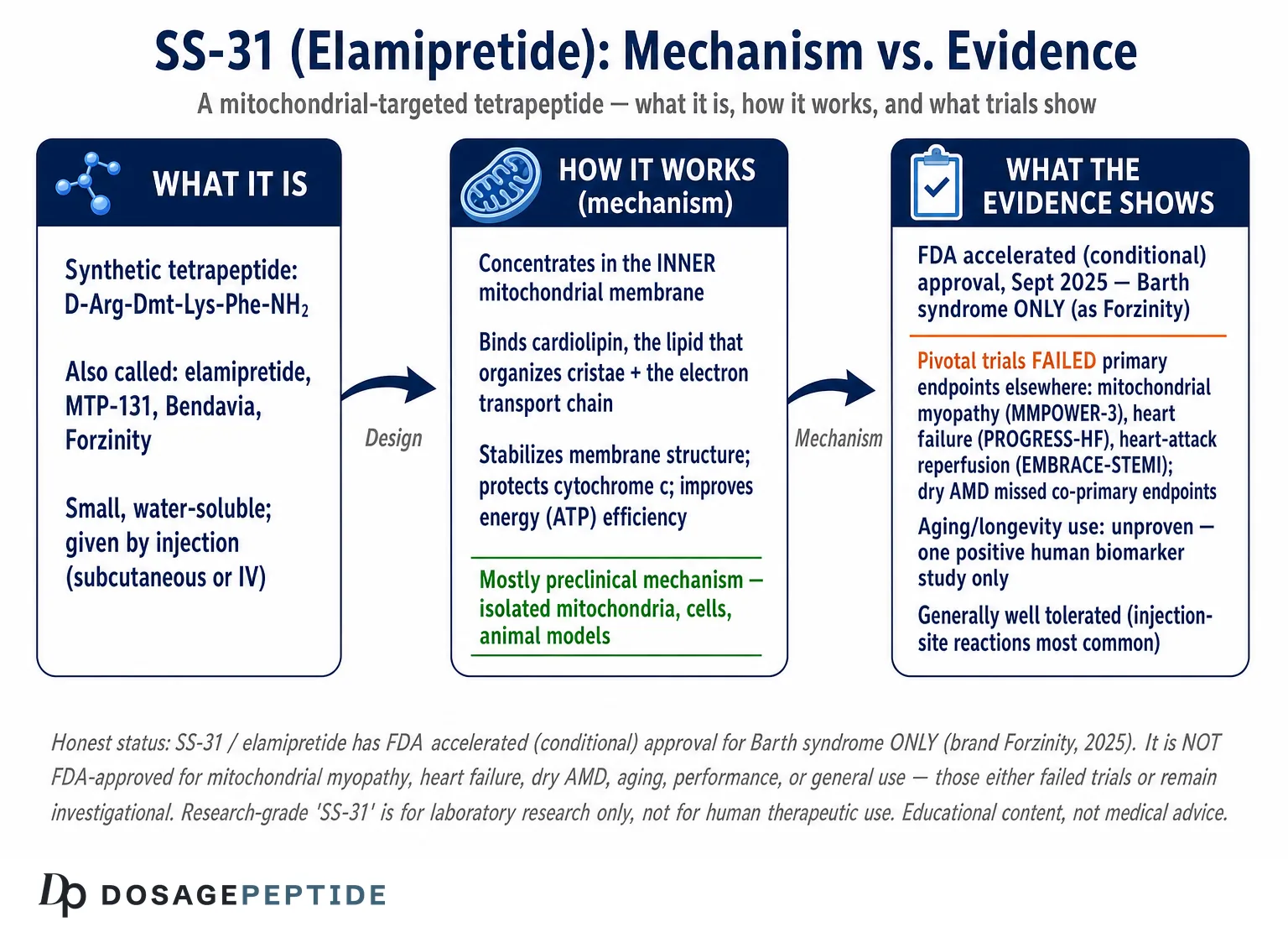
SS-31 is a synthetic tetrapeptide — only four amino acids long — with the sequence D-Arg-2′,6′-dimethyltyrosine-Lys-Phe-NH2 (often written D-Arg-Dmt-Lys-Phe-amide). Several structural features are worth noting. The use of a D-arginine (the mirror-image form of the natural L-amino acid) and the C-terminal amide both make the peptide far more resistant to breakdown by peptidases than an ordinary short peptide would be, which is part of why it survives in the body long enough to be useful. The dimethyltyrosine residue was historically credited with the peptide’s free-radical-scavenging chemistry. The two basic residues (arginine and lysine) give the molecule its net positive charge, which drives its attraction to the negatively charged inner membrane and to cardiolipin. It is a small, water-soluble molecule, which has practical consequences for how it is formulated and administered.
SS-31, elamipretide, MTP-131, Bendavia, Forzinity
One reason the literature can be confusing is that this single molecule has carried at least five names, each attached to a phase of its life. SS-31 is the original research designation and the name under which it is still sold as a research chemical. MTP-131 and Bendavia were development codes used when an earlier company (Stealth Peptides, later Stealth BioTherapeutics) took it into cardiovascular trials. Elamipretide is the official International Nonproprietary Name assigned once it became a clinical drug candidate, and it is the name used in essentially all the modern peer-reviewed trial reports. Forzinity is the brand name under which elamipretide was ultimately approved for a single rare-disease indication in 2025. When you see any of these names, they refer to the same D-Arg-Dmt-Lys-Phe-NH2 tetrapeptide. Our companion peptide research glossary defines many of the related terms used throughout this article.
How does SS-31 actually work?
From “antioxidant” to cardiolipin binder
The way researchers describe SS-31’s mechanism has shifted substantially over two decades, and understanding that shift is important for reading the literature critically. In the earliest papers, SS-31 was framed primarily as a cell-permeable, mitochondrially targeted antioxidant — a molecule that concentrated in mitochondria and directly scavenged reactive oxygen species such as hydrogen peroxide and peroxynitrite, with the dimethyltyrosine residue doing the chemistry.[3] That framing is still sometimes repeated, but the field has largely moved past it. Direct radical scavenging alone could not easily explain the drug’s potency at nanomolar concentrations far below those of the oxidants it was supposed to be neutralizing.
The more modern and better-supported model centers on selective binding to cardiolipin. In an influential 2013 study, Birk and colleagues reported that SS-31 binds cardiolipin with high affinity through combined electrostatic and hydrophobic interactions, effectively decorating the inner membrane where cardiolipin is concentrated.[1] By occupying cardiolipin, SS-31 was shown to interfere with the pathological cardiolipin–cytochrome c interaction: it prevents cardiolipin from turning cytochrome c into a peroxidase, thereby protecting cytochrome c’s normal role as an electron shuttle and cutting down the peroxidase activity that would otherwise oxidize more cardiolipin.[4] In this view, the reduction in reactive oxygen species is largely a downstream consequence of stabilizing the membrane and improving electron-transport efficiency, not the result of stoichiometric radical mopping. In other words, SS-31 does not so much soak up existing damage as prevent the inner membrane from becoming a damage-generating machine in the first place.
Protecting cristae and improving the efficiency of energy production
Because cardiolipin is required for cristae architecture and for the assembly of respiratory supercomplexes, a molecule that protects cardiolipin should, in principle, protect the physical structure of the inner membrane. Preclinical work is consistent with this. In models of ischemic or damaged mitochondria, SS-31 has been reported to preserve cristae membranes, maintain the mitochondrial membrane potential, and restore ATP production — the 2013 paper described the drug as “re-energizing” ischemic mitochondria by acting on cardiolipin.[1] A recurring theme is that SS-31 seems to improve the coupling of respiration — the amount of ATP produced per unit of oxygen consumed — rather than simply pushing mitochondria to burn more fuel. This is an important distinction, because it means the peptide is best understood as a “repair and tune-up” agent for dysfunctional mitochondria rather than a generic stimulant.
The protein interaction landscape
More recent chemical-biology work has refined the picture further. Using cross-linking mass spectrometry, Chavez and colleagues mapped the mitochondrial proteins that SS-31 comes into direct contact with. They found that the drug’s interacting partners are all known cardiolipin-binding proteins, clustering into two functional groups: proteins of the oxidative phosphorylation machinery, and proteins involved in 2-oxoglutarate (a Krebs-cycle intermediate) metabolism. The cross-linked binding regions tended to sit near the sites where cardiolipin itself contacts those proteins.[5] This supports a model in which SS-31 works by associating with cardiolipin-rich protein interfaces across the inner membrane, subtly stabilizing the whole energy-producing assembly rather than hitting a single classical drug target. Other studies have proposed additional facets — for example, effects on how efficiently ADP is imported into mitochondria — but the cardiolipin-centered, membrane-stabilizing model remains the dominant framework. A useful, up-to-date synthesis of these mechanistic threads can be found in recent review articles on elamipretide’s structure and mode of action.[6]
What does the preclinical evidence show, organ by organ?
Before human trials, SS-31 accumulated an unusually broad preclinical dossier. It is worth reviewing the highlights — while keeping firmly in mind that every study in this section was conducted in isolated mitochondria, cultured cells, or animals, and that impressive results in these systems have a long and humbling history of not translating to humans.
Heart and ischemia-reperfusion
The heart was the earliest major focus. When blood flow is restored to heart muscle after a heart attack — reperfusion — the sudden return of oxygen paradoxically triggers a burst of mitochondrial reactive oxygen species and cell death, so-called ischemia-reperfusion injury. In animal models of myocardial infarction, SS-31 given around the time of reperfusion was reported to reduce infarct size, preserve mitochondrial structure and function, and improve cardiac outcomes. These preclinical cardiac results were strong enough to justify moving directly into human heart-attack and heart-failure trials, discussed below.
Kidney
The kidney is another organ with intense energy demands and high susceptibility to ischemic and oxidative injury. Much of the foundational mechanistic work on SS-31 and cardiolipin was in fact published in nephrology journals, reflecting a substantial preclinical program in models of acute kidney injury and chronic kidney disease. In these models SS-31 was reported to protect tubular mitochondria, limit ischemic damage, and preserve renal function, reinforcing the general theme that the peptide protects the inner membrane under energetic stress.[1]
Skeletal muscle and aging
Some of the most striking preclinical data concern aging muscle. In aged mice, treatment with SS-31 was reported to reverse age-related redox stress and improve exercise tolerance, and — in a widely discussed study — an eight-week course in old mice substantially reversed diastolic dysfunction, a characteristic feature of the aging heart. That study found SS-31 normalized excessive proton leak, reduced mitochondrial reactive oxygen species in cardiomyocytes, shifted the heart toward a more reduced (less oxidized) protein state, and improved echocardiographic measures of diastolic function.[7] A 2025 study in aged mice reported that elamipretide improved both cardiac and skeletal muscle function — while notably finding no detectable change in epigenetic or transcriptomic markers of biological age, a useful reminder that a functional benefit is not the same thing as “reversing aging” at the molecular-clock level.[8] These muscle and cardiac-aging findings are the primary scientific basis for the longevity community’s interest in SS-31.
Brain, eye, and beyond
SS-31 has also been studied preclinically in models of neurodegeneration, traumatic and ischemic brain injury, and retinal disease, among others. The retinal work is particularly relevant because the light-sensing photoreceptors and the underlying retinal pigment epithelium are among the most metabolically demanding tissues in the body, and mitochondrial dysfunction is implicated in age-related macular degeneration — the rationale that later drove the dry-AMD clinical program. Across all of these organs the underlying logic is the same, which is both the strength and the weakness of the SS-31 story: one clean mechanism, applied hopefully to a very long list of diseases.
What has SS-31 shown in human clinical trials?
This is the crux of any honest account of SS-31, and it is where enthusiasm most needs to be disciplined by evidence. Stealth BioTherapeutics ran a substantial clinical program spanning cardiology, rare mitochondrial disease, and ophthalmology. The pattern that emerged is sobering: the large, rigorously controlled trials repeatedly failed to meet their primary endpoints, even as some produced tantalizing secondary or open-label signals. What follows is a program-by-program account. Readers who want a curated overview of dosing frameworks used in the research literature can consult our SS-31 research dosage reference, but the point of this section is the efficacy record, not any dosing recommendation.
Primary mitochondrial myopathy: the MMPOWER program
Primary mitochondrial myopathy (PMM) — muscle weakness and exercise intolerance caused by genetically confirmed mitochondrial disease — was a natural first indication. An early randomized crossover study (part of the MMPOWER program) tested short courses of subcutaneous elamipretide and reported an encouraging but not statistically significant improvement on the six-minute walk test (a difference that fell just short of the primary-endpoint threshold), alongside improvements in several patient-reported myopathy symptoms, which was judged enough to justify a larger trial.[9]
The decisive test was MMPOWER-3, a pivotal phase 3, randomized, double-blind, placebo-controlled trial. It enrolled 218 adults with genetically confirmed PMM, randomized 1:1 to 24 weeks of subcutaneous elamipretide (40 mg/day) or placebo, with co-primary endpoints of change in the six-minute walk test distance and change in a validated fatigue score. MMPOWER-3 did not meet either primary endpoint.[10] The drug was well tolerated, and investigators noted some directional differences on the fatigue measure, but by the standard the trial was designed to meet, it was a negative study. Later post-hoc analyses explored whether particular genetic subgroups might have responded, but such analyses are hypothesis-generating, not confirmatory, and do not rescue a failed primary endpoint. The straightforward conclusion is that elamipretide was not shown to be effective for primary mitochondrial myopathy in its pivotal trial.
Barth syndrome: TAZPOWER and the long road to approval
Barth syndrome is an ultra-rare, X-linked disease — affecting on the order of 150 people in the United States — caused by mutations in the tafazzin gene that disrupt cardiolipin remodeling. Because it is fundamentally a cardiolipin disease, it was in some ways the most mechanistically logical target of all. The TAZPOWER trial (NCT03098797) was a small randomized, double-blind, placebo-controlled crossover study in 12 patients, followed by a long open-label extension. In the randomized, blinded portion, elamipretide did not produce a statistically significant benefit on its primary endpoints, including the six-minute walk test.[11] On its face, that is another negative controlled result.
What kept the Barth program alive was the open-label extension. Over 168 weeks of continued treatment, investigators reported sustained tolerability and improvements in functional measures and cardiac parameters, including gains in knee-extensor muscle strength that had not been apparent in the short blinded crossover.[12] Open-label extension data are inherently weaker evidence than a randomized comparison — there is no concurrent placebo group, patients and clinicians know they are receiving the drug, and the natural course of an ultra-rare disease is hard to benchmark. Stealth supplemented the picture with a natural-history comparison. This is a genuinely difficult evidentiary situation, and it played out publicly: after an initial regulatory setback, an FDA advisory committee in October 2024 voted 10 to 6 that the evidence supported effectiveness, and after a complete response letter in May 2025 and a resubmission, the drug was ultimately granted a narrow accelerated approval, discussed in the regulatory section below. The honest summary is that Barth syndrome is the one indication where the totality of evidence — driven largely by open-label and natural-history data rather than a positive randomized trial — was judged sufficient for a conditional approval, and reasonable experts disagreed about it.
Heart failure: PROGRESS-HF
On the strength of the preclinical cardiac data, elamipretide was tested in heart failure with reduced ejection fraction in the PROGRESS-HF phase 2 trial. Seventy-one patients with reduced ejection fraction were randomized to placebo or one of two doses of subcutaneous elamipretide for 28 days, with a cardiac-MRI measure of left ventricular volume as the primary endpoint. Elamipretide did not significantly improve the primary endpoint or other measures of ventricular function versus placebo, though it was well tolerated.[13] The short 28-day duration was a real limitation, but the study did not provide the efficacy signal needed to justify a large phase 3 heart-failure program, and the chronic heart-failure indication did not advance.
Acute myocardial infarction and reperfusion: EMBRACE-STEMI
The reperfusion-injury hypothesis — that giving the drug at the moment blood flow is restored could limit heart-attack damage — was tested in EMBRACE-STEMI, a phase 2a randomized, double-blind, placebo-controlled trial. Patients having their first anterior-wall ST-elevation heart attack received intravenous elamipretide (as MTP-131) or placebo alongside standard emergency angioplasty, with infarct size (measured by the cardiac enzyme CK-MB) as the primary endpoint. The trial did not meet its primary endpoint: elamipretide was safe and well tolerated but did not reduce infarct size compared with placebo.[14] This was an especially notable disappointment given how robust the preclinical cardioprotection data had appeared, and it became a textbook example of the gap between animal models of reperfusion injury and human outcomes.
Dry AMD and geographic atrophy: ReCLAIM and ReNEW
The ophthalmology program targeted dry age-related macular degeneration (AMD) with geographic atrophy, a leading cause of irreversible vision loss with a strong mitochondrial component. The phase 2 ReCLAIM-2 trial randomized patients to daily subcutaneous elamipretide (40 mg) or placebo for 48 weeks. Its co-primary endpoints — change in low-luminance visual acuity and change in geographic atrophy area — were not met. However, prespecified secondary analyses of the ellipsoid zone (a retinal layer reflecting photoreceptor integrity) suggested elamipretide slowed the attenuation of that layer, which the company interpreted as a signal worth pursuing.[15] On the basis of that secondary signal, Stealth advanced into a phase 3 program (ReNEW and ReGAIN) using a photoreceptor-based imaging endpoint. As of 2025 the phase 3 dry-AMD studies were still enrolling and reading out, so the ophthalmology question remains genuinely open — a secondary-endpoint hypothesis being tested prospectively, which is the scientifically correct way to handle such a signal, but not yet an established benefit.
Duchenne cardiomyopathy and other efforts
Elamipretide has also been explored for the cardiomyopathy that develops in Duchenne muscular dystrophy, where regulators reportedly agreed that progression of myocardial scarring on MRI could serve as a trial endpoint; this program was at a relatively early stage, and a follow-on Stealth compound has been discussed for such muscle and cardiac myopathies. Investigator-initiated work has examined the peptide in other mitochondrially linked conditions as well. None of these had produced pivotal positive efficacy results at the time of writing, and they should be regarded as exploratory.
| Program / trial | Indication | Phase & design | Primary-endpoint outcome |
|---|---|---|---|
| MMPOWER (crossover) | Primary mitochondrial myopathy | Randomized crossover, SC | Non-significant 6MWT trend; symptom improvements (hypothesis-generating) |
| MMPOWER-3 | Primary mitochondrial myopathy | Phase 3 RCT, 218 pts, SC | Did NOT meet co-primary endpoints (6MWT, fatigue) |
| TAZPOWER (blinded) | Barth syndrome | Phase 2/3 crossover, 12 pts, SC | Did NOT meet primary endpoints in blinded phase |
| TAZPOWER (open-label extension) | Barth syndrome | 168-week OLE, no placebo | Reported sustained functional / strength gains (weaker evidence) |
| PROGRESS-HF | Heart failure (reduced EF) | Phase 2 RCT, 71 pts, SC, 28 d | Did NOT improve LV volume vs placebo |
| EMBRACE-STEMI | Acute MI / reperfusion | Phase 2a RCT, IV | Did NOT reduce infarct size vs placebo |
| ReCLAIM-2 | Dry AMD / geographic atrophy | Phase 2 RCT, SC, 48 wk | Co-primary endpoints NOT met; ellipsoid-zone secondary signal |
| ReNEW / ReGAIN | Dry AMD / geographic atrophy | Phase 3, SC | Ongoing as of 2025 (photoreceptor endpoint) |
Is elamipretide FDA-approved?
As of 2026, the answer is a carefully qualified yes, for one ultra-rare disease only. On September 19, 2025, the U.S. FDA granted accelerated approval to elamipretide hydrochloride, under the brand name Forzinity (Stealth BioTherapeutics), to improve muscle strength in adult and pediatric patients with Barth syndrome weighing at least 30 kg. This was the first therapy ever approved for Barth syndrome and the first cardiolipin-directed mitochondrial drug to reach the market.[16]
Several features of this approval deserve emphasis, because they are easy to over-read. First, it is an accelerated approval, a pathway that lets a drug reach patients with serious unmet needs based on a reasonably-likely-to-predict surrogate or intermediate measure, with a requirement to confirm clinical benefit in further study; it is conditional, not a full endorsement of established efficacy. Second, as detailed above, the pivotal randomized portion of TAZPOWER did not demonstrate the strength benefit — the improvement in knee-extensor strength emerged in the uncontrolled open-label extension — and the FDA advisory committee split 10 to 6 on effectiveness, with the drug initially receiving a complete response letter in May 2025 before being approved after resubmission.[17] Third, and most importantly for anyone reading this article: this approval is limited to Barth syndrome. It is emphatically not an approval for primary mitochondrial myopathy, heart failure, dry AMD, aging, athletic performance, or general “anti-aging” use, all of which either failed in trials or remain unproven. Outside of the specific Barth indication, elamipretide/SS-31 remains investigational.
Why is there so much interest in SS-31 for aging and longevity?
Despite the clinical disappointments in disease indications, SS-31 retains a devoted following in the aging-research and longevity communities. The reasons are legitimate at the level of biology and worth stating precisely. Mitochondrial decline is one of the recognized hallmarks of aging; muscle mitochondria in older adults produce less ATP and leak more, and the heart stiffens in part through mitochondrial mechanisms. SS-31 targets exactly this failure mode, and the preclinical aging data are genuinely interesting: reversal of diastolic dysfunction in old mice, improved exercise tolerance, and improved cardiac and skeletal muscle function with continued treatment.[7]
There is even a small but real piece of human aging data. In a randomized, placebo-controlled study, a single dose of elamipretide improved in vivo mitochondrial ATP production in the skeletal muscle of healthy older adults with poorly functioning mitochondria, as measured non-invasively by magnetic resonance spectroscopy.[18] This is a mechanistic proof-of-concept — it shows the drug can move a mitochondrial biomarker in older human muscle — but it is a long way from demonstrating that it makes people stronger, healthier, or longer-lived. It is precisely the kind of intermediate result that is easy to inflate into claims the data do not support. The sober position is that SS-31 has a plausible mechanism for age-related mitochondrial decline, encouraging animal data, one positive human biomarker study, and no controlled evidence of meaningful functional or longevity benefit in healthy aging humans. For readers exploring the broader landscape of longevity-oriented peptides, our overview of Epithalon and telomerase aging research covers a different and equally provisional strand of that field.
How does SS-31 compare to other mitochondrial-targeted approaches?
SS-31 is not the only strategy for acting on mitochondria, and placing it in context helps clarify what makes it distinctive. Broadly, mitochondrial-targeted interventions fall into a few conceptual categories.
One approach is targeted small-molecule antioxidants, exemplified by MitoQ (mitoquinone). MitoQ links a ubiquinone antioxidant to a positively charged triphenylphosphonium group that drives accumulation in mitochondria, where it is meant to neutralize reactive oxygen species. Conceptually it sits closer to the original “scavenger” framing that SS-31 has partly moved away from; MitoQ is widely sold as a dietary supplement and has been studied in humans, but robust disease-modifying benefits in large trials remain limited. The key conceptual contrast is that SS-31 is now understood to work primarily by stabilizing cardiolipin and membrane architecture, whereas MitoQ’s rationale is more straightforwardly antioxidant.
A very different category is the mitochondrial-derived peptides, short peptides encoded within the mitochondrial genome itself that act as signaling molecules. MOTS-c is the best-known example. Rather than physically reinforcing the inner membrane the way SS-31 does, MOTS-c functions as a metabolic signal — it influences cellular energy sensing, notably through the AMP-activated protein kinase (AMPK) pathway, and can even translocate to the nucleus to regulate stress-response genes. In other words, SS-31 and MOTS-c both “target mitochondria,” but they do opposite kinds of things: SS-31 is a structural, membrane-acting repair agent, while MOTS-c is an endogenous signaling peptide that reprograms metabolism. Readers interested in that contrast can see our dedicated explainers on what MOTS-c is and how it is classified among mitochondrial-derived peptides and on how MOTS-c regulates AMPK activity during cellular energy stress. A third category — boosting the substrates and cofactors of energy metabolism, such as NAD+ precursors — addresses mitochondrial fuel rather than membrane integrity, and is complementary in principle. Understanding these distinctions matters because “mitochondrial peptide” is often used loosely, as if all such molecules were interchangeable; mechanistically they are not.
How is elamipretide given, and what is known about its safety?
Route and pharmacology
Elamipretide is a peptide and is not absorbed usefully when swallowed, so in trials it has been administered by injection. Early cardiovascular studies (EMBRACE-STEMI, PROGRESS-HF) used intravenous infusion, appropriate to acute hospital settings. The later chronic programs — MMPOWER-3, TAZPOWER, and the dry-AMD studies — used once-daily subcutaneous injection, typically at 40 mg/day in adults, which is also the form of the approved Barth-syndrome product. Its D-amino acid and C-terminal amide modifications give it reasonable metabolic stability for a small peptide, and its water solubility makes subcutaneous formulation straightforward. None of this constitutes dosing guidance; human dosing has only ever been established within controlled trials and, now, within the specific approved Barth-syndrome label.
Adverse events and tolerability
Across its extensive trial program, one of elamipretide’s most consistent features has been that it is generally well tolerated. This is stated explicitly in essentially every pivotal report — MMPOWER-3, TAZPOWER, PROGRESS-HF, and EMBRACE-STEMI all described the drug as safe and well tolerated even when it failed on efficacy. The most common adverse events have been injection-site reactions — redness, itching, pain, or firmness where subcutaneous injections are given — which is expected for a daily injectable peptide.[11] Most reported adverse events across the program have been mild to moderate. It is important to be precise about what this favorable safety picture does and does not mean: a clean safety profile is necessary but not sufficient for a useful drug, and “well tolerated but ineffective” describes most of the elamipretide trial record. A good safety record in monitored trial populations also does not license unsupervised use of research-grade material, where product identity, purity, sterility, and dose are unverified.
Why has it been so hard to turn this mechanism into an approved therapy?
The SS-31 story is, more than anything, a case study in the difficulty of translating an elegant mechanism into demonstrated clinical benefit. Several factors likely contributed to the repeated primary-endpoint failures. Human diseases like heart failure and geographic atrophy are heterogeneous and multifactorial; even if mitochondrial dysfunction is one contributor, correcting it may not move a whole-organ clinical endpoint enough to detect. Trial durations were sometimes short relative to how slowly a structural benefit might accrue — 28 days in PROGRESS-HF, for instance. Endpoints such as the six-minute walk test are influenced by many things besides mitochondrial ATP output, adding noise. Preclinical models, especially of acute reperfusion injury, have a notorious track record of over-predicting human efficacy. And in ultra-rare diseases like Barth syndrome, trials are simply too small to have much statistical power, which is exactly why the evidence there ended up leaning on open-label and natural-history data and why its interpretation was contested. Taken together, these factors explain how a drug can have a well-supported mechanism, a strong safety profile, and interesting biomarkers, yet still fail the endpoints that matter — a pattern that should temper any confident claims about what SS-31 “does” in people.
There is also a subtler lesson about biomarkers versus outcomes. Elamipretide can demonstrably move mitochondrial measures — ATP production in older muscle, ellipsoid-zone attenuation in the retina, cardiac imaging parameters in small studies — and it is tempting to treat those as proof that the drug “works.” But a biomarker only matters clinically if changing it reliably changes how patients feel, function, or survive, and that link is exactly what most of the elamipretide trials failed to establish. This is why regulators generally demand outcome data, and why the accelerated-approval pathway used for Barth syndrome carries a requirement for confirmatory study. The gap between a moved biomarker and a changed life is where many mechanistically attractive drugs, not only this one, have ultimately stalled. For SS-31 specifically, the mechanism is arguably more convincing than the clinical results, and honest scientific communication has to hold both of those facts at once rather than letting the elegance of the biology stand in for evidence the trials did not deliver.
What does research-grade “SS-31” actually mean?
A practical point deserves emphasis. The material sold online as “SS-31” for research is not the same thing as the FDA-approved Forzinity product, and it is not an approved medicine for any use outside the specific, supervised Barth-syndrome indication. Research-grade SS-31 is intended, and lawfully sold, for laboratory research and experimental use only — not for human therapeutic use. Such products are not manufactured to pharmaceutical standards, are not subject to the identity, purity, sterility, and potency controls that a licensed drug undergoes, and carry no assurance that the vial contains what the label claims. Nothing in this article is a protocol or an endorsement of human self-administration. Anyone handling such material for legitimate laboratory work should follow standard reconstitution and handling practices; our general peptide reconstitution guide and the compound-specific SS-31 research reference exist to document what appears in the research literature, not to advise on treating any condition.
The honest bottom line
SS-31 (elamipretide) is a genuinely important research molecule: a small, stable, cardiolipin-binding tetrapeptide with one of the best-characterized mechanisms in mitochondrial pharmacology, capable of stabilizing the inner membrane, protecting cristae, and improving the efficiency of energy production in a wide range of preclinical models. That mechanistic story is real and continues to advance the science of mitochondrial medicine. But the clinical translation has been mostly a story of well-tolerated failures — negative pivotal trials in primary mitochondrial myopathy, heart failure, and acute reperfusion injury, and a missed primary endpoint in dry AMD with an unresolved secondary signal now being tested in phase 3. The single bright spot, a first-ever accelerated approval for the ultra-rare Barth syndrome in 2025, rests on contested, largely open-label evidence and applies only to that disease. For aging and longevity, the interest is scientifically reasonable and supported by one positive human biomarker study, but there is no controlled evidence of meaningful benefit in healthy people. The appropriate stance for a research-minded reader is neither dismissal nor hype: a mechanistically fascinating compound whose clinical promise remains, outside of one narrow indication, unproven. To keep exploring what the research literature documents about this peptide, see our detailed SS-31 research reference and handling overview — a documentation resource, not medical advice or a treatment protocol.
Related: SS-31 dosage: how much per day, and how the research vial compares to the approved elamipretide drug.
Frequently Asked Questions
Is SS-31 the same thing as elamipretide?
Yes. SS-31, elamipretide, MTP-131, and Bendavia are all names for the identical tetrapeptide, D-Arg-dimethyltyrosine-Lys-Phe-amide, used at different stages of its development. SS-31 is the original research code, elamipretide is its official drug name, and Forzinity is the brand name under which it was approved for Barth syndrome in 2025. When articles use these names interchangeably, they are describing the same molecule with the same mechanism.
Is SS-31 approved by the FDA?
Only for one ultra-rare disease. In September 2025 the FDA granted accelerated (conditional) approval to elamipretide, branded Forzinity, to improve muscle strength in Barth syndrome patients weighing at least 30 kg. It is not approved for primary mitochondrial myopathy, heart failure, dry age-related macular degeneration, aging, or performance, all of which either failed in trials or remain unproven. Research-grade SS-31 is not an approved medicine.
How does SS-31 work in the mitochondria?
SS-31 concentrates in the inner mitochondrial membrane and binds cardiolipin, the signature lipid that organizes cristae and the electron transport chain. By stabilizing cardiolipin, it helps preserve cristae structure, protects the normal electron-carrying function of cytochrome c, improves the efficiency of energy production, and reduces reactive oxygen species. Modern research frames this membrane-stabilizing action as its core mechanism, rather than the older idea of direct antioxidant scavenging.
Did SS-31 fail its clinical trials?
Mostly, yes, at least on primary endpoints. The pivotal MMPOWER-3 (mitochondrial myopathy), PROGRESS-HF (heart failure), and EMBRACE-STEMI (heart attack reperfusion) trials all missed their primary endpoints, and the phase 2 dry-AMD trial missed its co-primary endpoints while showing a secondary signal now being tested in phase 3. The exception is Barth syndrome, where largely open-label evidence supported a conditional 2025 approval.
Why do longevity researchers care about SS-31 if trials failed?
Because mitochondrial decline is a hallmark of aging and SS-31 targets exactly that process. In aged mice it reversed diastolic heart dysfunction and improved muscle function, and in one randomized human study a single dose improved mitochondrial ATP production in older adults’ muscle. These are encouraging mechanistic signals, but they are not evidence of real-world benefit in healthy aging, and no controlled trial has shown improved strength, healthspan, or lifespan in people.
How is elamipretide administered, and is it safe?
In trials it was given by injection — intravenously in acute cardiac studies and by once-daily subcutaneous injection in chronic programs, typically 40 mg/day in adults. Across its trials it was consistently described as well tolerated, with injection-site reactions the most common adverse event and most events mild to moderate. A clean safety profile in monitored trials does not, however, justify unsupervised use of unregulated research-grade material.
How is SS-31 different from MOTS-c?
They are both called mitochondrial peptides but work very differently. SS-31 is a synthetic, structural agent that physically binds cardiolipin and stabilizes the inner membrane. MOTS-c is a naturally occurring mitochondrial-derived signaling peptide that reprograms cellular metabolism, notably through the AMPK energy-sensing pathway. SS-31 acts like a membrane repair tool, whereas MOTS-c acts like a metabolic signal — a useful reminder that “mitochondrial peptide” covers mechanistically distinct molecules.
References
- Birk AV, et al. The mitochondrial-targeted compound SS-31 re-energizes ischemic mitochondria by interacting with cardiolipin. Journal of the American Society of Nephrology, 2013. https://pmc.ncbi.nlm.nih.gov/articles/PMC3736700/
- Szeto HH. First-in-class cardiolipin-protective compound as a therapeutic agent to restore mitochondrial bioenergetics. British Journal of Pharmacology, 2014. https://bpspubs.onlinelibrary.wiley.com/doi/10.1111/bph.12461
- Szeto HH. Cell-permeable, mitochondrial-targeted, peptide antioxidants. The AAPS Journal, 2006. https://pmc.ncbi.nlm.nih.gov/articles/PMC3231562/
- Birk AV, Chao WM, Bracken C, et al. Targeting mitochondrial cardiolipin and the cytochrome c/cardiolipin complex to promote electron transport and optimize mitochondrial ATP synthesis. British Journal of Pharmacology, 2014. https://pmc.ncbi.nlm.nih.gov/articles/PMC3976619/
- Chavez JD, et al. Mitochondrial protein interaction landscape of SS-31. PNAS, 2020. https://www.pnas.org/doi/10.1073/pnas.2002250117
- Elamipretide: a review of its structure, mechanism of action, and therapeutic potential. International Journal of Molecular Sciences, 2025. https://www.mdpi.com/1422-0067/26/3/944
- Chiao YA, et al. Late-life restoration of mitochondrial function reverses cardiac dysfunction in old mice. eLife, 2020. https://pmc.ncbi.nlm.nih.gov/articles/PMC7377906/
- Mitchell W, et al. The mitochondria-targeted peptide therapeutic elamipretide improves cardiac and skeletal muscle function during aging without detectable changes in tissue epigenetic or transcriptomic age. Aging Cell, 2025. https://pmc.ncbi.nlm.nih.gov/articles/PMC11565897/
- Karaa A, et al. A randomized crossover trial of elamipretide in adults with primary mitochondrial myopathy. Journal of Cachexia, Sarcopenia and Muscle, 2020. https://pmc.ncbi.nlm.nih.gov/articles/PMC7432581/
- Karaa A, et al. Efficacy and safety of elamipretide in individuals with primary mitochondrial myopathy: the MMPOWER-3 randomized clinical trial. Neurology, 2023. https://www.neurology.org/doi/10.1212/WNL.0000000000207402
- Reid Thompson W, et al. A phase 2/3 randomized clinical trial followed by an open-label extension to evaluate the effectiveness of elamipretide in Barth syndrome (TAZPOWER). Genetics in Medicine, 2021. https://pmc.ncbi.nlm.nih.gov/articles/PMC7935714/
- Reid Thompson W, et al. Long-term efficacy and safety of elamipretide in patients with Barth syndrome: 168-week open-label extension results of TAZPOWER. Genetics in Medicine, 2024. https://pubmed.ncbi.nlm.nih.gov/38602181/
- Daubert MA, et al. Effects of elamipretide on left ventricular function in patients with heart failure with reduced ejection fraction: the PROGRESS-HF phase 2 trial. Journal of Cardiac Failure, 2020. https://pubmed.ncbi.nlm.nih.gov/32068002/
- Gibson CM, et al. EMBRACE STEMI study: a phase 2a trial to evaluate the safety, tolerability, and efficacy of intravenous MTP-131 on reperfusion injury in patients undergoing primary percutaneous coronary intervention. European Heart Journal, 2016. https://pubmed.ncbi.nlm.nih.gov/26586786/
- Allingham MJ, et al. ReCLAIM-2: a randomized phase II clinical trial evaluating elamipretide in age-related macular degeneration, geographic atrophy growth, visual function, and ellipsoid zone preservation. Ophthalmology Science, 2024. https://pmc.ncbi.nlm.nih.gov/articles/PMC11599447/
- U.S. Food and Drug Administration. FDA grants accelerated approval to first treatment for Barth syndrome. FDA news release, September 2025. https://www.fda.gov/news-events/press-announcements/fda-grants-accelerated-approval-first-treatment-barth-syndrome
- Stealth BioTherapeutics. Announcement of FDA accelerated approval of FORZINITY (elamipretide HCl) for Barth syndrome. PR Newswire, September 2025. https://www.prnewswire.com/news-releases/stealth-biotherapeutics-announces-fda-accelerated-approval-of-forzinity-elamipretide-hcl-…-barth-syndrome-302562058.html
- Roshanravan B, et al. In vivo mitochondrial ATP production is improved in older adult skeletal muscle after a single dose of elamipretide in a randomized trial. PLOS ONE, 2021. https://journals.plos.org/plosone/article?id=10.1371/journal.pone.0253849