The link between MOTS-c and glucose control is strong exactly where it costs nothing to be strong, and absent exactly where it would matter. In cells and in rodents the mechanism is coherent and the effects are real: AMPK activation, better glucose uptake, improved insulin sensitivity on clamp studies. In people, every published finding is observational — MOTS-c levels are lower in type 2 diabetes and track inversely with HbA1c. No randomised trial has ever administered MOTS-c to humans and measured glucose control. That gap is the answer to the question.
MOTS-c is not an approved drug. The U.S. Food and Drug Administration has not authorized it for diabetes, insulin resistance, obesity, or any other indication, and it is prohibited in sport by anti-doping authorities as an AMP-activated protein kinase (AMPK) activator.11 Everything that follows should be read against that backdrop: this is an investigational, research-only molecule whose most striking metabolic data come from mice. The purpose of this article is not to sell a conclusion but to do something the marketing literature rarely does — to separate the tiers of evidence, state plainly what each can and cannot support, and let the reader see exactly where the glucose-homeostasis claim is well anchored and where it floats free.
We will proceed roughly in order of evidentiary weight: what MOTS-c is and where it comes from, the proposed molecular mechanism, the foundational rodent studies, a formal grading of the evidence, the human association data, the exercise connection, a comparison with drugs that actually control glucose in people, the subtlety of nuclear versus circulating MOTS-c, the research models and their limits, and finally safety and regulatory status. Throughout, the governing principle is that a strong mechanism is a hypothesis generator, not a substitute for the clinical endpoint it predicts.
The Short Answer on MOTS-c and Glucose
- Cell and molecular level — strong. Folate-cycle inhibition leads to AICAR accumulation, AMPK activation and GLUT4 movement in muscle cells. Coherent and reproducible.
- Rodents — strong, but preclinical. Improved insulin sensitivity on clamp studies, lower glucose and insulin, and reduced diet- and age-related insulin resistance.
- Humans, observational — moderate and correlational. Circulating MOTS-c is consistently lower in type 2 diabetes and inversely correlated with HbA1c in several cohorts. Assays differ between laboratories and reported values vary.
- Humans, exercise — associative. Endogenous MOTS-c rises in muscle and plasma after acute exercise.
- Humans, injected peptide — absent. There is no published randomised controlled trial of exogenous MOTS-c for glucose control.
Why the correlation is not proof. Low MOTS-c in diabetes is equally compatible with MOTS-c being protective, with dysglycemia suppressing MOTS-c, or with both being driven by underlying mitochondrial dysfunction. Only an interventional trial could separate those, and none has been run.
What MOTS-c Is and Where It Comes From
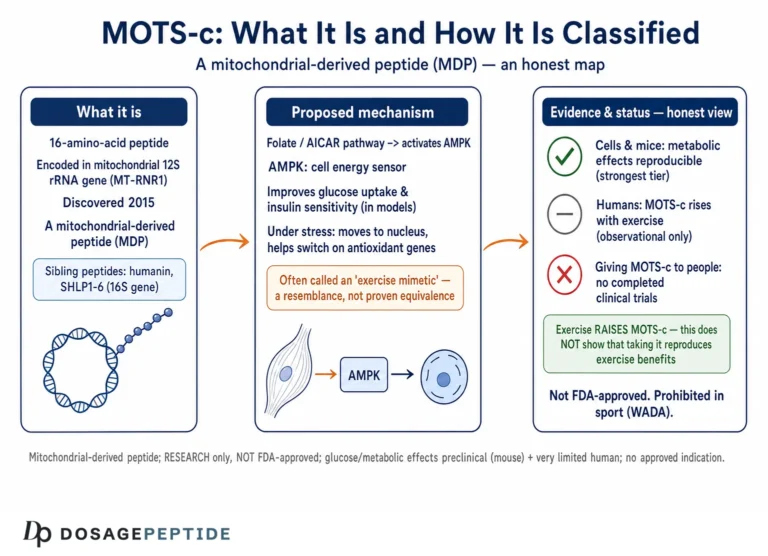
MOTS-c — short for “mitochondrial open reading frame of the twelve-S ribosomal RNA type-c” — is a small peptide of sixteen amino acids. What makes it biologically remarkable, and what distinguishes it from virtually every other peptide discussed on this site, is where its instructions are written. Almost all of the proteins in a human cell are encoded by nuclear DNA. MOTS-c is not. It is encoded within the mitochondrial genome, specifically inside a short open reading frame nested in the 12S ribosomal RNA gene, and it was first characterized as a functional peptide in a 2015 paper in Cell Metabolism from Changhan Lee, Pinchas Cohen, and colleagues.1
This origin places MOTS-c in a small and relatively young family of molecules called mitochondrial-derived peptides (MDPs), which also includes humanin and the SHLP series. The conceptual novelty is significant. For most of the twentieth century, mitochondria were regarded as passive power plants that respond to nuclear commands. The MDP concept inverts part of that picture: it proposes that mitochondria can encode their own signaling peptides and send instructions back to the rest of the cell — and, when secreted into the circulation, potentially to other organs. MOTS-c became the poster molecule for that idea in the metabolic arena because its earliest reported actions were on glucose and lipid handling rather than on cell survival.2
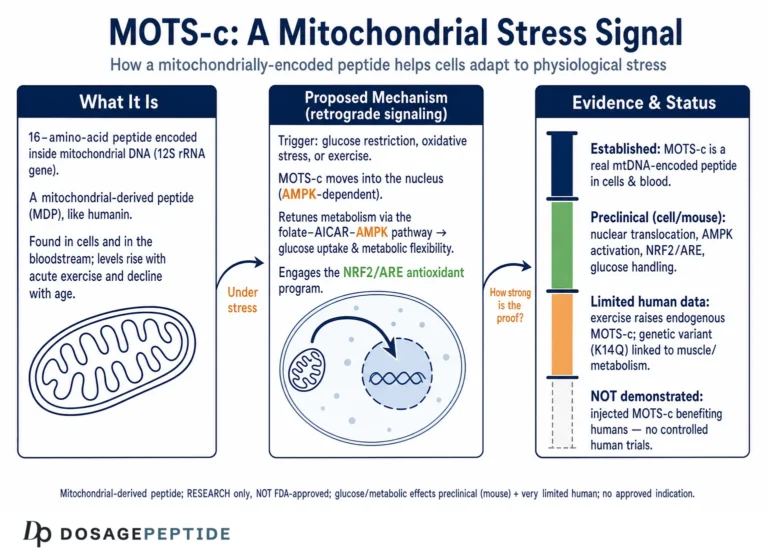
Three features of the molecule matter for the glucose question. First, MOTS-c appears to be detectable in human plasma, which is what makes an endocrine-style, whole-body role even thinkable. Second, its levels are dynamic: circulating and intramuscular MOTS-c change with age and with exercise, which is central to the exercise-mimetic narrative we will scrutinize later.4 Third, and most subtly, MOTS-c does not stay in one place. Under metabolic stress it can move into the cell nucleus and influence gene transcription, meaning its biology is not confined to a tidy receptor-and-second-messenger diagram.3 Keeping those three features in mind — circulating, dynamic, and compartment-shifting — helps explain why the evidence is simultaneously rich in mechanism and thin in clean clinical endpoints.
It is also worth stating what MOTS-c is not. It is not a hormone with a decades-long clinical pharmacology like insulin, nor an incretin-based drug with large randomized trials behind it. It is a recently discovered endogenous peptide whose pharmaceutical development is at an early, largely preclinical stage. Readers who want to calibrate their expectations can compare it with the incretin agents that do have that trial base, such as those discussed in the analysis of whether current evidence supports tirzepatide as a breakthrough therapy for type 2 diabetes. The contrast in evidence maturity is stark and instructive.
The Proposed Mechanism: the Folate Cycle, AICAR, and AMPK
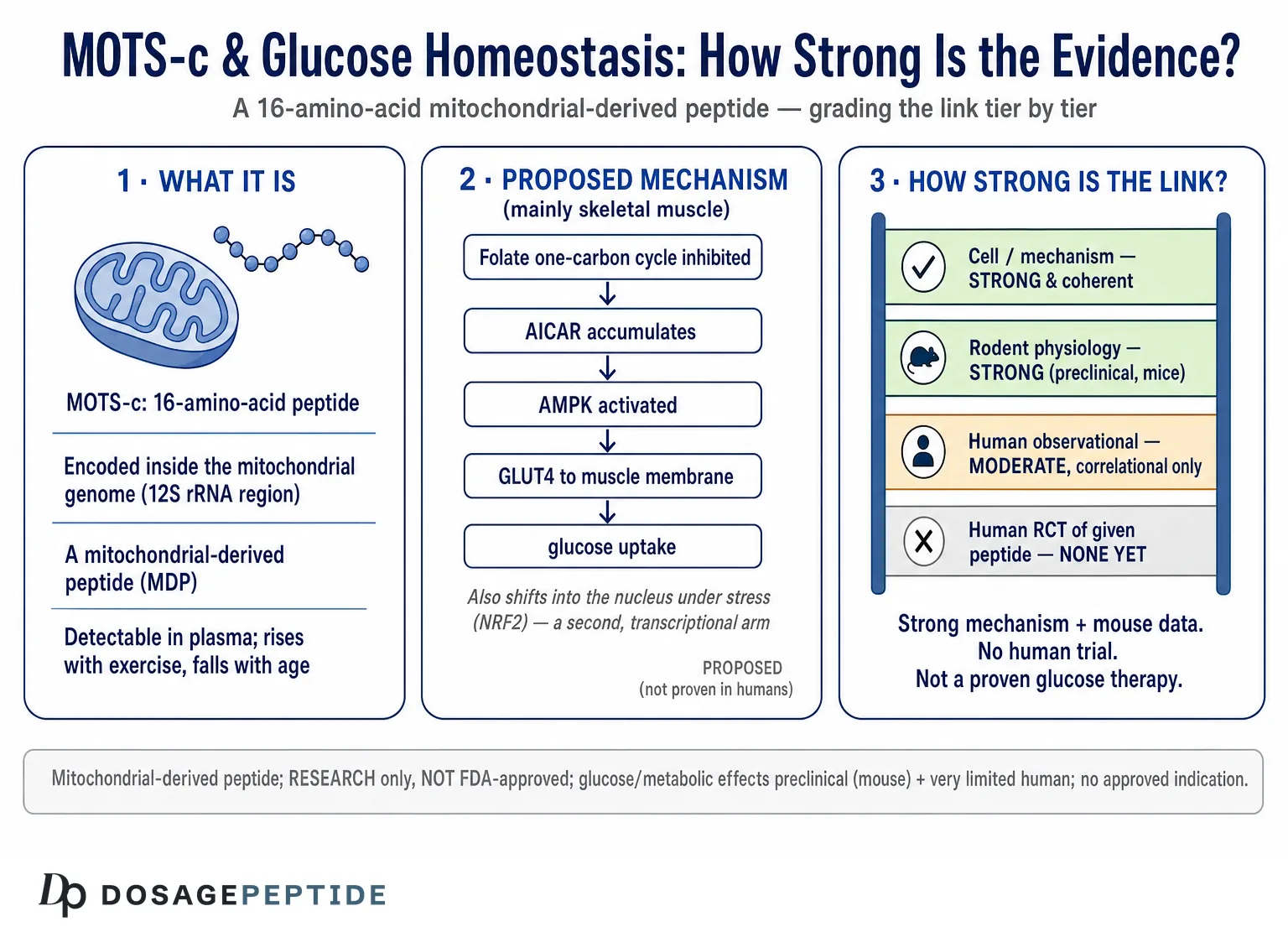
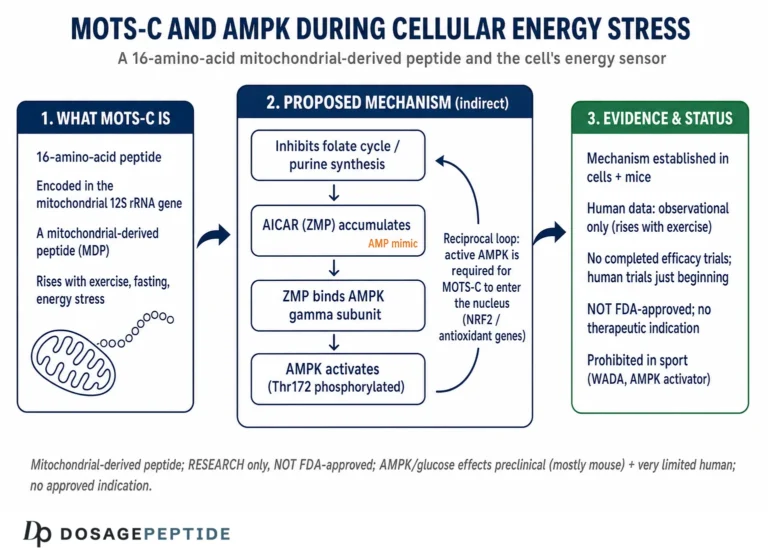
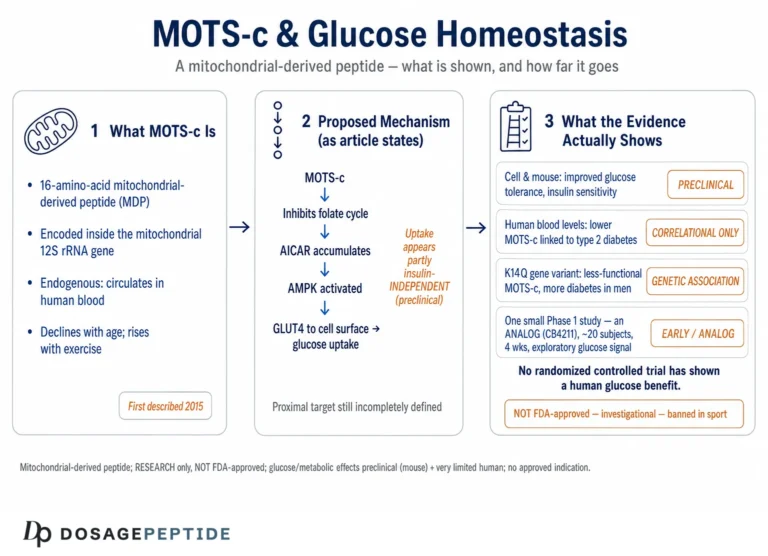
The mechanistic story behind MOTS-c and glucose control is unusually specific for a peptide of its age, and it is the strongest single strand of the overall case. The core proposal, laid out in the 2015 discovery paper and elaborated in subsequent reviews, runs as follows. MOTS-c acts predominantly on skeletal muscle. Inside muscle cells it interferes with the folate one-carbon metabolic cycle and the de novo purine biosynthesis pathway tethered to it. Inhibiting that pathway causes the intracellular accumulation of 5-aminoimidazole-4-carboxamide ribonucleotide, universally abbreviated AICAR.1
AICAR is the pharmacological hinge of the entire mechanism, because AICAR is a well-established endogenous activator of AMPK, the cell’s central energy-sensing enzyme. When cellular energy charge falls, AMPK switches the cell from anabolic storage mode to catabolic energy-generating mode: it promotes glucose uptake, fatty-acid oxidation, and mitochondrial biogenesis while suppressing energy-consuming synthesis. By driving AICAR accumulation, MOTS-c is proposed to activate AMPK in muscle, and downstream of that AMPK activation the studies report increased translocation of the glucose transporter GLUT4 to the muscle-cell membrane, which is the proximate event that lets glucose leave the bloodstream and enter the muscle.28
This is a satisfying mechanism because it connects a mitochondrial peptide to one of the most important nodes in metabolic physiology through a defined biochemical intermediate rather than through hand-waving. It also has a pleasing internal logic: AMPK activation is exactly the signaling state that endurance exercise and the drug metformin are thought to converge on, which is why MOTS-c is so often described as an “exercise mimetic.” If a peptide raises AICAR, activates AMPK, and moves GLUT4 to the membrane, then improved insulin-independent glucose disposal is a reasonable prediction.
It is worth pausing on why AMPK activation should improve glucose control specifically, because the connection is what makes the mechanism relevant to the title rather than merely interesting. Skeletal muscle is the largest sink for post-meal glucose in the body, and it can take up glucose by two broadly distinct routes: an insulin-dependent route, in which insulin signaling recruits GLUT4 to the membrane, and an insulin-independent route, in which contraction and AMPK activation recruit GLUT4 through a parallel pathway. This second route is why exercise lowers blood glucose even in people whose insulin signaling is impaired, and it is the route MOTS-c is proposed to tap. A peptide that could switch on the insulin-independent, AMPK-driven arm would, in principle, help clear glucose in exactly the insulin-resistant states where the insulin-dependent arm is failing. That is the theoretical appeal, and it is a coherent one — it is also, importantly, still theory at the level of human treatment.8
Several caveats keep this from being the whole story. The folate-AICAR-AMPK axis was characterized primarily in cell and rodent systems, and the precise way MOTS-c engages the pathway — whether through a specific receptor, a transporter, or direct enzyme interaction — is not fully resolved. Moreover, the 2018 discovery that MOTS-c translocates to the nucleus and regulates antioxidant-response genes in an AMPK-dependent manner shows the peptide has actions that extend well beyond a linear cytoplasmic cascade.3 Under glucose restriction and oxidative stress, MOTS-c moves to the nucleus within roughly half an hour and interacts with stress-responsive transcription factors including NRF2, regulating a broad program of genes.3 So the mechanism is better described as a network — a metabolic-stress sensor with both rapid cytoplasmic (AMPK/GLUT4) and slower transcriptional (nuclear/NRF2) arms — than as a single tidy pathway. That complexity is scientifically exciting but it also means predicting the net effect of an injected dose in an intact human is genuinely hard.
The Foundational Rodent Evidence for Glucose Control
The heart of the glucose-homeostasis claim lives in mouse experiments, and it is worth describing them concretely because their design determines what they can support. In the 2015 discovery study, MOTS-c administered by intraperitoneal injection to mice produced a coherent metabolic picture. In diet-induced obese mice, MOTS-c treatment improved insulin sensitivity and reduced fat accumulation. In aged mice, which develop age-related insulin resistance, MOTS-c reduced that resistance. Mechanistically consistent with the AMPK story, the treated animals showed enhanced glucose uptake in skeletal muscle.1
The single most rigorous metabolic readout in this literature is the hyperinsulinemic-euglycemic clamp, the gold-standard method for quantifying whole-body insulin sensitivity in vivo. In clamp studies of high-fat-diet-fed mice, MOTS-c treatment increased the glucose infusion rate required to maintain stable blood glucose during insulin infusion — a clear improvement in whole-body insulin sensitivity in the reported experiments.15 A higher glucose infusion rate at a fixed insulin level means the body is disposing of glucose more efficiently, which is the operational definition of improved insulin sensitivity. This is not a soft surrogate; the clamp is about as direct a measure of insulin action as physiology offers, and seeing MOTS-c move it in the predicted direction is a meaningful preclinical result.
A 2019 metabolomics study reinforced the picture from a different angle. Using an unbiased plasma-metabolite screen in obese mice, the investigators found that MOTS-c injection lowered glucose and insulin levels and altered sphingolipid, monoacylglycerol, and dicarboxylate metabolism — changes broadly consistent with improved metabolic health and enhanced insulin sensitivity.5 Because the approach was hypothesis-free, it provides a useful independent check that the glucose effect is not merely an artifact of one assay.
More recent rodent work has extended the glucose story into disease-model territory: a 2025 study in a rat model of type 2 diabetes reported that daily MOTS-c injection restored aspects of impaired mitochondrial respiration in the diabetic heart.12 This is mechanistically interesting and expands the plausibility of a systemic metabolic role, but it remains an animal study in a specialized tissue and should not be read as evidence of clinical cardiac benefit. It is also worth noting how far removed such a protocol is from anything validated for people: the animals received a fixed weight-based dose by injection on a daily schedule chosen by the investigators, in a genetically and dietarily controlled model, with tissue-level respirometry rather than a patient-relevant clinical endpoint as the readout. Nothing about that design licenses a claim that MOTS-c improves heart function, glucose control, or any other outcome in a human being; it is a hypothesis-strengthening result inside the preclinical tier, not a bridge across it.
The fair summary of the rodent tier is that it is genuinely strong for a peptide of this vintage: multiple laboratories, multiple models (diet-induced obesity, aging, diabetic disease models), a gold-standard clamp readout, and a mechanism that predicts the observed direction of effect. The reproducibility and mechanistic coherence are exactly what one wants to see before advancing a candidate. But the tier is still rodent. Mouse insulin physiology, dosing, and the absence of the confounders that dominate human metabolic disease mean that even an excellent mouse result is a starting hypothesis for humans, not a demonstration in them.
It is also worth being precise about what the rodent studies did and did not control for, because these details separate a suggestive result from a definitive one even within the preclinical tier. The clamp experiments were performed in relatively small groups of genetically uniform animals housed under identical conditions and fed identical diets. That uniformity is a methodological virtue — it isolates the peptide’s effect from noise — but it is also the opposite of the human situation, where genetic diversity, wildly variable diets, differing activity levels, comorbidities, and concomitant medications all shape glucose control. A clean clamp improvement in inbred mice on a controlled high-fat diet tells us the peptide can move insulin sensitivity when almost everything else is held constant. It does not tell us how large, or how durable, or how consistent that effect would be against the churning background variability of human metabolic disease, where many interventions that shine preclinically shrink or disappear. The history of metabolic drug development is littered with compounds that produced clean rodent clamp data and then underwhelmed in people, which is exactly why the regulatory system demands human trials rather than accepting mechanism plus mouse physiology as proof.
Grading the Evidence: What Level Are We Actually At?
Because the title asks specifically about the strength of the evidence, it helps to lay the tiers side by side and grade each honestly. The point of the exercise is to resist the common rhetorical move of citing a strong mouse clamp study and a human association study in the same breath, as though they were interchangeable. They are not; they sit at different levels of the evidence hierarchy and support very different claims.
| Evidence tier | What has actually been shown for MOTS-c & glucose | Strength of link |
|---|---|---|
| Molecular mechanism (cell/biochem) | Folate-cycle inhibition → AICAR accumulation → AMPK activation → GLUT4 translocation in muscle cells12 | Strong & coherent |
| Rodent physiology | Improved insulin sensitivity by clamp; lower glucose/insulin; reduced diet- and age-related insulin resistance15 | Strong (preclinical) |
| Human observational / cross-sectional | Circulating MOTS-c lower in type 2 diabetes; inverse correlation with HbA1c and glucose in some cohorts610 | Moderate but correlational |
| Human exercise-induction | Endogenous MOTS-c rises in muscle and plasma after acute exercise4 | Moderate (associative) |
| Human interventional (administered peptide) | No published randomized controlled trial of exogenous MOTS-c for glucose control | Absent |
The shape of this table is the real answer to the article’s question. The link is strong at the mechanistic and rodent tiers, softens to correlational at the human-observational tier, and vanishes at the interventional-human tier where clinical claims would have to be earned. A meta-analysis of mitochondrial-derived peptides and metabolic states, published in 2024, reflects this pattern at the population level: it finds consistent associations between MDP levels and metabolic status while underscoring the heterogeneity of the human data and the absence of the interventional trials needed to establish causation.10
A crucial interpretive point sits underneath the whole table. Associations between low circulating MOTS-c and worse glucose control are compatible with at least three different causal stories. MOTS-c could be protective, so that low levels permit dysglycemia. Or dysglycemia and mitochondrial dysfunction could suppress MOTS-c, making low levels a consequence rather than a cause. Or a third factor — aging, adiposity, physical inactivity — could drive both. Cross-sectional human data cannot distinguish these, and that is precisely why an association, however reproducible, cannot by itself carry the claim that giving MOTS-c would improve human glucose control.
The Human Data: Real, but Almost Entirely Correlational
Human MOTS-c research does exist, and it is more substantial than for many research peptides, but it is important to be precise about what kind of research it is. With very few exceptions, the human literature measures endogenous MOTS-c levels and correlates them with metabolic phenotypes; it does not administer the peptide and measure an outcome.
The recurring observational finding is that circulating MOTS-c tends to be lower in people with type 2 diabetes than in healthy controls, and that lower levels track with worse glycemic control — individuals with higher HbA1c or inadequately controlled diabetes showing the lowest concentrations in several cross-sectional studies.6 Work in specific populations has extended the pattern: a study in polycystic ovary syndrome and healthy subjects examined how lipids and insulin regulate MOTS-c, finding the peptide responsive to metabolic and hormonal context.6 Other cross-sectional work has related MOTS-c to insulin resistance in conditions such as obstructive sleep apnea. The through-line is consistent: in humans, MOTS-c behaves like a biomarker that moves inversely with metabolic dysfunction.
An accompanying commentary in the field framed MOTS-c as a possible “equal-opportunity insulin sensitizer,” capturing the enthusiasm the biomarker pattern generated while also acknowledging the gap between association and demonstrated therapeutic effect.7 That gap is the entire point. A biomarker that is low in disease is a candidate worth investigating; it is not, on that basis alone, a treatment. C-reactive protein is elevated in cardiovascular disease, but lowering it directly is not straightforwardly protective. The same logical caution applies here: the reproducible inverse association between MOTS-c and dysglycemia raises the hypothesis that restoring MOTS-c might help, but only an interventional trial could test it, and none has been published.
There is also meaningful measurement uncertainty at this tier. Circulating MOTS-c is present at low concentrations, assays differ between laboratories, and reported human values vary. Some studies find associations that others do not fully replicate, and circulating levels do not map perfectly onto tissue-level activity — a problem compounded by the fact that a large part of MOTS-c biology is intracellular and nuclear rather than bloodstream-based.3 All of this means the human correlational tier, while real, should be held with appropriate looseness.
The table below summarizes the character of the principal human-relevant observations. The pattern to notice is that every entry is a measurement of the body’s own MOTS-c under some condition, not a test of what happens when MOTS-c is given as a drug — the design that would be required to establish a glucose-control effect.
| Human observation | What was measured | What it can (and cannot) support |
|---|---|---|
| Lower MOTS-c in type 2 diabetes6 | Circulating peptide vs. controls | Supports biomarker link; cannot establish causation or treatment benefit |
| Inverse correlation with HbA1c / glucose610 | Cross-sectional correlation | Consistent with a protective role; equally consistent with reverse causation |
| MOTS-c in PCOS & regulation by lipids/insulin6 | Peptide response to metabolic context | Shows MOTS-c is metabolically responsive; not an efficacy result |
| Exercise-induced rise in muscle & plasma4 | Endogenous induction after exertion | Places MOTS-c in the exercise response; does not prove it mediates glucose benefit |
| Decline of MOTS-c with age9 | Levels across age groups | Fits an aging-metabolism narrative; confounded by many age-linked factors |
Read as a whole, the human tier tells a coherent and biologically sensible story — MOTS-c looks like a metabolically responsive peptide whose levels fall in states of metabolic dysfunction and rise with the healthiest of metabolic stimuli, exercise. That coherence is genuinely encouraging and is a legitimate reason the compound attracts research interest. What it is not is proof of a therapeutic glucose effect, because not a single one of these observations involved giving a person MOTS-c and watching their glucose respond. The distinction is the entire crux of the title’s question.
Exercise, MOTS-c, and the Endogenous Glucose Connection
One of the most cited human-relevant findings is that exercise induces MOTS-c. In both mice and human participants, acute endurance exercise increases MOTS-c expression in skeletal muscle and raises its circulating level, and MOTS-c administration reproduces several training-like adaptations in mice, including enhanced endurance and metabolic gene programs.4 A 2021 study in Nature Communications made the case that MOTS-c is an exercise-induced, mitochondrially encoded regulator of physical decline and muscle homeostasis, showing that late-life intermittent MOTS-c treatment increased physical capacity in aged mice while documenting exercise-driven MOTS-c induction in humans.4
This exercise link is often deployed as the strongest human-facing argument for a glucose role, and it deserves careful handling because it is easy to over-read. What the exercise data robustly establish is that MOTS-c is part of the physiological response to exercise — it goes up when people and animals exert themselves. That is a genuine and important observation, and it is consistent with MOTS-c participating in the well-known glucose-lowering effects of exercise, which operate substantially through AMPK and GLUT4 in muscle.
But two logical steps are frequently skipped. First, showing that exercise raises MOTS-c does not show that MOTS-c mediates exercise’s glucose benefits; MOTS-c could be one marker among many in a redundant, multi-signal response, and the authors of the exercise work themselves note that the auto-, para-, and endocrine relevance of exercise-induced MDPs in mediating training adaptation remains to be firmly established.4 Second, and more importantly for anyone tempted by the “exercise in a vial” framing, demonstrating that endogenous MOTS-c rises with exercise is not the same as demonstrating that injecting supraphysiologic MOTS-c will improve glucose control in a sedentary human. The endogenous peptide is released in a specific spatial and temporal context, in concert with dozens of other exercise signals; a bolus injection is a fundamentally different stimulus. The exercise-mimetic label is a hypothesis dressed as a conclusion.
It is precisely this “exercise mimetic” positioning — and the marketing of MOTS-c as a performance and metabolic-enhancement shortcut — that led anti-doping authorities to prohibit it in sport, a status we return to below.11 For a broader sense of how metabolic research peptides are catalogued and defined, the site’s peptide glossary is a useful reference point, and the general dosage index shows how such compounds are organized for educational purposes.
How MOTS-c Compares With Agents That Actually Control Glucose in People
Placing MOTS-c beside compounds with established human glucose effects is one of the clearest ways to see where it sits. The comparison is not a competition — MOTS-c has never entered the clinical arena these agents occupy — but it calibrates expectations by showing what a mature glucose-control evidence base looks like.
| Agent / class | Primary glucose-relevant mechanism | Human evidence base |
|---|---|---|
| Metformin (biguanide) | Hepatic glucose output suppression; AMPK-linked signaling | Decades of RCTs; first-line approved therapy for type 2 diabetes |
| Tirzepatide (GIP/GLP-1 co-agonist) | Incretin-driven insulin secretion, glucagon suppression, appetite | Large phase 3 program; approved; robust HbA1c reductions10 |
| AICAR (direct AMPK activator) | AMPK activation → muscle glucose uptake | Research/experimental; not an approved oral glucose drug |
| Exercise (physiological) | AMPK/GLUT4-mediated insulin-independent uptake | Overwhelming human evidence for glycemic benefit |
| MOTS-c | Folate-cycle → AICAR → AMPK → GLUT4 in muscle1 | Rodent + human association only; no interventional RCT |
The comparison is clarifying in two directions. On one hand, MOTS-c’s proposed mechanism is not fringe — it converges on the same AMPK/GLUT4 node that metformin and exercise are thought to exploit, which is a point in favor of biological plausibility. On the other hand, plausibility is cheap relative to the evidence these comparators carry. Tirzepatide’s glucose-lowering is anchored in a large randomized program with hard HbA1c endpoints; readers can see how that evidence is built in the discussion of how tirzepatide improves fat loss and insulin sensitivity in clinical research. MOTS-c has none of that. It shares a mechanistic neighborhood with proven agents but has not run the races they have won.
There is a second, subtler lesson in the comparison. Every approved agent in the table acts on a well-defined and pharmacologically tractable target: incretin receptors, hepatic glucose output, a single enzyme. MOTS-c, by contrast, works through a multi-node network with both a cytoplasmic metabolic arm and a nuclear transcriptional arm, and without a cleanly defined receptor. That network character is part of what makes MOTS-c scientifically fascinating, but it also makes it harder to develop as a drug: dose-response relationships are less predictable, off-target effects are harder to anticipate, and the therapeutic window is unknown. Agents with diffuse, pleiotropic mechanisms are not impossible to bring to the clinic, but they typically require more, not less, human data to characterize safely — which sharpens rather than softens the conclusion that MOTS-c’s evidence base is early.
The AICAR line in the table is especially telling. AICAR is the intermediate through which MOTS-c is proposed to act, and AICAR itself — a direct AMPK activator studied for decades — has not become an approved oral glucose-lowering drug, in part because of pharmacokinetic and off-target challenges. That a compound acting through the very same node has struggled to reach the clinic is a sobering reminder that a good mechanism does not guarantee a viable therapy. It also underscores why the leap from “MOTS-c raises AICAR and activates AMPK” to “MOTS-c controls glucose in patients” is larger than it looks.
Nuclear Signaling: Why Injected MOTS-c May Not Equal Endogenous MOTS-c
A recurring and under-appreciated wrinkle in the MOTS-c story is that the peptide’s biology is compartment-dependent, and this bears directly on how confidently we can extrapolate from either rodent injections or human associations to a real therapeutic effect. The 2018 finding that MOTS-c translocates to the nucleus under metabolic stress reframed it from a simple secreted hormone into a retrograde mitochondrial-to-nuclear signal.3 Within about thirty minutes of glucose restriction, serum deprivation, or oxidative stress in cultured cells, MOTS-c relocates to the nucleus, binds chromatin, and cooperates with stress-responsive transcription factors such as NRF2 and ATF1 to regulate antioxidant-response-element genes, in an AMPK-dependent fashion.38
The implication is that a large part of MOTS-c’s activity is intracellular and is triggered by the cell’s own sensing of metabolic stress. Endogenous MOTS-c is produced inside the mitochondrion and can act locally in the nucleus of the same cell, on a schedule dictated by that cell’s energy state. An injected peptide, by contrast, arrives from outside, must reach and enter target cells, and does so regardless of whether those cells are experiencing the metabolic-stress conditions that normally license MOTS-c’s nuclear program. It is not obvious that exogenous administration recapitulates the endogenous signaling faithfully — it may engage the membrane/AMPK arm while imperfectly reproducing the context-gated nuclear arm.9
This is not a fatal objection; many hormones and peptides are given exogenously to good effect despite complex endogenous regulation. But it is a reason for humility about extrapolation. It means that even the strong rodent injection data may capture only part of MOTS-c’s physiology, and that the relationship between a measured plasma level (the human biomarker studies) and the biologically decisive intracellular pool is loose. A comprehensive 2023 review of MOTS-c mechanisms in stress, metabolism, and aging emphasizes exactly this multi-compartment complexity, cautioning that the peptide’s context-dependence complicates any simple dose-response intuition.9
Research Models and Methodological Caveats
Understanding how MOTS-c has been studied clarifies what the evidence can and cannot support, and the glucose literature spans three methodological tiers, each with characteristic strengths and blind spots.
Cell and biochemical models. The mechanistic backbone — folate-cycle inhibition, AICAR accumulation, AMPK activation, GLUT4 translocation, and nuclear translocation with NRF2 — was worked out largely in cultured cells and biochemical systems.13 These systems are ideal for dissecting pathways but say nothing about whole-body glucose control, dosing, or the confounders of intact physiology. A pathway demonstrated in a myotube is a hypothesis about the organism, not a fact about it.
Rodent models. The physiological glucose data come from mice: diet-induced obese mice, aged mice, and disease models such as diabetic-heart preparations, with readouts including the hyperinsulinemic-euglycemic clamp, glucose and insulin levels, and tissue glucose uptake.1512 The clamp studies are a real methodological strength. The limitations are the usual ones: species differences in metabolism, short study durations, controlled diets that eliminate the behavioral confounders central to human diabetes, and dosing regimens (route, frequency, amount) that do not map onto any validated human protocol.
Human studies. Human research is predominantly observational and cross-sectional: measuring circulating MOTS-c and correlating it with diabetes status, HbA1c, insulin resistance indices, and exercise, in cohorts of varying size and design.46 The critical methodological fact is the near-total absence of the design that would establish causation — a randomized, placebo-controlled trial administering MOTS-c and measuring glycemic endpoints. Until that design is executed, published, and replicated, the human tier can support statements about association and about the peptide’s behavior as a biomarker, but not statements about therapeutic efficacy.
A further methodological hazard is specific to the real-world context in which people encounter MOTS-c. Because it is sold as a research chemical outside regulated pharmaceutical channels, material of uncertain identity, purity, and stability circulates widely. Purity, endotoxin content, correct sequence, and proper handling all affect whether a given vial contains what its label claims. Standard research-peptide handling — reconstitution with an appropriate sterile diluent, gentle mixing rather than shaking, cold and dark storage, and avoidance of repeated freeze-thaw — is described in general terms in the site’s peptide reconstitution guide. None of that handling detail, however, changes the evidence question: perfect technique preserves whatever activity the molecule has; it does not manufacture clinical proof that does not exist.
Safety, Tolerability, and the Limits of What We Know
Any honest discussion of MOTS-c and glucose has to be candid about how little controlled human safety data exist, because the enthusiasm around the mechanism can create a false impression of a well-characterized agent. It is not. MOTS-c has not undergone the phased human safety evaluation that approved drugs complete. There is no established human dose, no defined therapeutic window, and no long-term safety dataset in people.
What can be said is limited and indirect. In rodents, MOTS-c administration in the reported metabolic studies did not produce the acute toxicities that would have halted those experiments, and the peptide is endogenous, which some interpret as reassuring. But endogeneity is a weak safety argument: many endogenous molecules are harmful at supraphysiologic or mistimed exposure, and the compartment-dependence discussed above means that flooding the system with exogenous peptide is not equivalent to the body’s own regulated production. The nuclear, transcription-modifying arm of MOTS-c biology is a particular reason for caution, because agents that alter gene-expression programs warrant careful long-term study before any confidence about safety is reasonable.
Several concrete caveats deserve emphasis:
- No human safety trials. There is no published, controlled characterization of adverse effects, dosing, or drug interactions for administered MOTS-c in people.
- Product-quality risk. Research-chemical material varies in purity and provenance; contaminants and mislabeling are real hazards independent of the molecule’s intrinsic properties.
- Hypoglycemia plausibility. If MOTS-c genuinely enhances insulin-independent glucose uptake, combining it with insulin, sulfonylureas, or other glucose-lowering agents could in principle amplify hypoglycemia risk — a theoretical concern that has not been studied.
- Population mismatch. Rodent data derive from otherwise healthy animals on controlled diets, not from older adults with diabetes, polypharmacy, and organ impairment.
The reasonable posture is that absence of documented harm is not evidence of safety. MOTS-c has simply not been tested rigorously enough in humans for anyone to make confident safety claims, and that uncertainty is itself a critical piece of information for a researcher weighing the state of the evidence.
Regulatory and Anti-Doping Status
MOTS-c occupies an unambiguous position on the regulatory map, and it is one that many marketing sources obscure. It is not approved by the FDA, the European Medicines Agency, or any comparable regulator for the treatment of type 2 diabetes, insulin resistance, obesity, or any other condition. There is no approved indication, no approved dosing, and no legal pathway for its use as a medicine outside of authorized research. Sales of MOTS-c are as a research chemical, explicitly not for human consumption, and that framing is a legal boundary, not a marketing formality.
In sport, the status is equally clear. Anti-doping authorities classify MOTS-c as a prohibited substance at all times, listing it under the metabolic-modulators category as an example of an AMP-activated protein kinase activator; athletes cannot obtain a therapeutic-use exemption because there is no approved therapeutic use.11 The reasoning is instructive for the evidence question: it is precisely MOTS-c’s marketed positioning as an exercise-mimicking, performance- and metabolism-enhancing peptide that prompted its prohibition, even though the human efficacy data to justify such claims do not exist. The regulatory system is treating the claims seriously enough to ban the substance while the evidence for those claims remains preclinical.
Returning to the title one last time, it is worth stating the verdict without hedging beyond what the evidence requires. How strongly does the evidence link MOTS-c with glucose homeostasis control? At the level of mechanism and rodent physiology, strongly and coherently: a defined folate-AICAR-AMPK-GLUT4 pathway, clamp-verified insulin-sensitivity gains in mice, and convergent metabolomic and disease-model data. At the level of human association, moderately: MOTS-c is reproducibly lower in dysglycemia and rises with exercise, behaving like a metabolic-health biomarker. At the level that would license calling it a glucose-control agent for people — controlled interventional trials of the administered peptide — not at all, because those trials have not been done. A strong mechanism sitting atop absent clinical proof is not a therapy; it is a well-motivated research program awaiting its decisive experiment. Treating it as more than that is the single most common error in the popular literature on this peptide.
This mismatch — strong claims, banned status, thin human evidence — is the regulatory signature of an investigational compound that has outrun its data in the marketplace. For anyone assessing how strongly evidence links MOTS-c to glucose control, the regulatory picture reinforces the scientific one: the appropriate venue for MOTS-c is authorized preclinical and clinical research, not off-label metabolic self-experimentation. Researchers interested in how the broader field of metabolic and glucose-pathway peptides is developing can follow the site’s coverage of related mechanisms, such as the analysis of how GLP-1 pathways regulate lipid metabolism in atherogenic dyslipidemia, and can contrast MOTS-c’s early-stage status with more mature programs like that reviewed in the discussion of the clinical trial evidence on the fat-burning potential of AOD-9604.
Frequently Asked Questions
How strong is the evidence that MOTS-c controls glucose in humans?
It is strong at the mechanistic and rodent levels and weak at the human clinical level. In mice, MOTS-c improves insulin sensitivity by the gold-standard clamp method and lowers glucose and insulin, through a coherent folate-AICAR-AMPK-GLUT4 mechanism.15 In humans, the evidence is almost entirely observational: circulating MOTS-c is lower in type 2 diabetes and correlates inversely with HbA1c, but no randomized controlled trial has administered MOTS-c to people and measured glucose outcomes.610 So the link is well supported as a hypothesis and unproven as a therapy.
What is the mechanism by which MOTS-c would affect glucose?
MOTS-c acts mainly in skeletal muscle, where it inhibits the folate one-carbon cycle and de novo purine synthesis, causing AICAR to accumulate. AICAR activates AMPK, the cell’s energy sensor, which promotes translocation of the GLUT4 glucose transporter to the muscle-cell membrane and thereby increases glucose uptake.12 MOTS-c also translocates to the nucleus under metabolic stress to regulate antioxidant and metabolic genes via NRF2, adding a transcriptional arm to its activity.3
Does the fact that exercise raises MOTS-c prove it lowers glucose?
No. Exercise reliably increases MOTS-c in muscle and blood, and exercise lowers glucose — but that MOTS-c rises alongside exercise does not establish that MOTS-c causes the glucose benefit. It may be one of many redundant signals. The researchers who documented exercise-induced MOTS-c explicitly note that its causal role in training adaptation remains to be established.4 “Rises with exercise” and “mediates exercise’s glucose effect” are different claims.
Why is circulating MOTS-c lower in people with diabetes?
That is an open question and a good example of why correlation is not causation. Low MOTS-c in diabetes is compatible with MOTS-c being protective (low levels permit disease), with the disease suppressing MOTS-c (low levels are a consequence), or with a shared driver like aging or inactivity affecting both.6 Cross-sectional human data cannot tell these apart, which is why the association cannot by itself justify giving MOTS-c as treatment.
Is MOTS-c FDA-approved for diabetes or insulin resistance?
No. MOTS-c is not approved by the FDA, EMA, or any comparable regulator for diabetes, insulin resistance, obesity, or any other condition. It has no approved indication or dosing and is sold only as a research chemical, not for human use. It is also prohibited in sport as a metabolic modulator and AMPK activator.11
How does MOTS-c compare with drugs like metformin or tirzepatide?
MOTS-c shares mechanistic territory with them — its AMPK/GLUT4 node overlaps with how metformin and exercise are thought to work — but it lacks their evidence base. Metformin and tirzepatide have large randomized trials and regulatory approval with hard glycemic endpoints; MOTS-c has rodent studies and human associations only.10 Sharing a mechanism is not the same as sharing the clinical proof.
Could injected MOTS-c behave differently from the body’s own MOTS-c?
Quite possibly. A large part of MOTS-c biology is intracellular and gated by metabolic stress — the peptide moves into the nucleus under specific conditions to regulate genes.3 An injected dose arrives from outside and regardless of the cell’s energy state, so it may engage some pathways (membrane/AMPK) while imperfectly reproducing the context-dependent nuclear program.9 This is one reason extrapolating from either rodent injections or human blood levels to a predictable human effect is difficult.
What would it take to actually prove MOTS-c controls glucose in people?
A randomized, double-blind, placebo-controlled trial in a defined population (for example, adults with impaired glucose tolerance or type 2 diabetes), administering a specified MOTS-c dose and measuring validated glycemic endpoints such as HbA1c, fasting glucose, or clamp-derived insulin sensitivity, with adequate duration and safety monitoring, and then independent replication. Until such trials exist, statements about MOTS-c controlling human glucose are hypotheses, not findings.
References
- Lee C, Zeng J, Drew BG, et al. The mitochondrial-derived peptide MOTS-c promotes metabolic homeostasis and reduces obesity and insulin resistance. Cell Metab. 2015;21(3):443-454. PMID: 25738453. https://pubmed.ncbi.nlm.nih.gov/25738453/
- Kim SJ, Xiao J, Wan J, Cohen P, Yen K. Mitochondrially derived peptides as novel regulators of metabolism. J Physiol. 2017;595(21):6613-6621. PMID: 28574175. https://pmc.ncbi.nlm.nih.gov/articles/PMC5663826/
- Kim KH, Son JM, Benayoun BA, Lee C. The mitochondrial-encoded peptide MOTS-c translocates to the nucleus to regulate nuclear gene expression in response to metabolic stress. Cell Metab. 2018;28(3):516-524.e7. PMID: 29983246. https://pubmed.ncbi.nlm.nih.gov/29983246/
- Reynolds JC, Lai RW, Woodhead JST, et al. MOTS-c is an exercise-induced mitochondrial-encoded regulator of age-dependent physical decline and muscle homeostasis. Nat Commun. 2021;12(1):470. PMCID: PMC7817689. https://www.ncbi.nlm.nih.gov/pmc/articles/PMC7817689/
- Kim SJ, Miller B, Mehta HH, et al. The mitochondrial-derived peptide MOTS-c is a regulator of plasma metabolites and enhances insulin sensitivity. Physiol Rep. 2019;7(13):e14171. PMCID: PMC6640593. https://pmc.ncbi.nlm.nih.gov/articles/PMC6640593/
- Ramanjaneya M, Bettahi I, Jerobin J, et al. Lipids and insulin regulate mitochondrial-derived peptide (MOTS-c) in PCOS and healthy subjects. Clin Endocrinol (Oxf). 2019;91(2):278-287. https://onlinelibrary.wiley.com/doi/10.1111/cen.14007
- Kim SJ, Miller B, Kumagai H, Yen K, Cohen P. MOTS-c: an equal opportunity insulin sensitizer. J Mol Med (Berl). 2019;97(4):487-490. PMCID: PMC6462348. https://pmc.ncbi.nlm.nih.gov/articles/PMC6462348/
- Kong BS, Lee C, Cho YM. Mitochondrial-Encoded Peptide MOTS-c, Diabetes, and Aging-Related Diseases. Diabetes Metab J. 2023;47(3):315-324. https://www.e-dmj.org/journal/view.php?number=2725
- Wan W, Zhang L, Lin Y, et al. Mitochondria-derived peptide MOTS-c: effects and mechanisms related to stress, metabolism and aging. J Transl Med. 2023;21(1):36. PMCID: PMC9854231. https://pmc.ncbi.nlm.nih.gov/articles/PMC9854231/
- Ali A, et al. The correlation between mitochondrial-derived peptides (MDP) and metabolic states: a systematic review and meta-analysis. Diabetol Metab Syndr. 2024;16:189. https://link.springer.com/article/10.1186/s13098-024-01405-w
- U.S. Anti-Doping Agency. What is the MOTS-c peptide? (Prohibited as a metabolic modulator / AMPK activator, Section 4.4). USADA Spirit of Sport. https://www.usada.org/spirit-of-sport/what-is-mots-c-peptide/
- Pham T, Taberner AJ, Hickey AJR, Han JC. Mitochondria-derived peptide MOTS-c restores mitochondrial respiration in the type 2 diabetic heart. Front Physiol. 2025;16:1602271. https://www.frontiersin.org/journals/physiology/articles/10.3389/fphys.2025.1602271/full
Educational and research-use disclaimer: This article is provided solely for scientific and educational purposes. MOTS-c is an investigational mitochondrial-derived peptide and is not approved by the FDA, EMA, or any comparable regulator for the treatment, cure, or prevention of type 2 diabetes, insulin resistance, obesity, or any other disease. The evidence linking MOTS-c to glucose homeostasis is predominantly preclinical (cell-culture and rodent) together with correlational human observations; no randomized controlled trial has demonstrated a glucose-control effect of administered MOTS-c in humans. Nothing here is medical advice or a recommendation for human use. MOTS-c is prohibited in sport by anti-doping authorities. Any legitimate investigation of this compound should occur within properly authorized preclinical or clinical research under appropriate oversight. Readers should consult qualified professionals and applicable regulations before making any decisions.