Among the synthetic growth hormone secretagogues that emerged from 1980s and 1990s peptide chemistry, hexarelin occupies an unusual position: it is one of the most potent growth-hormone-releasing hexapeptides ever characterized in human endocrine studies, yet it also carries a second pharmacology — binding the scavenger receptor CD36 — that has nothing to do with growth hormone at all. This article examines what the hexarelin peptide is at a molecular level, how it engages the ghrelin receptor GHS-R1a, why it behaves differently from its close relative GHRP-6, and precisely how strong (or weak) the underlying human evidence actually is. The central research question is simple to state and harder to answer honestly: what does the published literature genuinely establish about hexarelin, and where does speculation take over?
What Is Hexarelin, and Where Did It Come From?
Hexarelin — also written as examorelin, and by the developmental code EP-23905 — is a synthetic hexapeptide (a chain of six amino acids) belonging to the family of growth hormone releasing peptide (GHRP) compounds. Its amino-acid sequence is His-D-2-methyl-Trp-Ala-Trp-D-Phe-Lys-NH₂, a structure derived from the earlier GHRP-6 scaffold by introducing a methylated tryptophan residue that increased metabolic stability and potency. The peptide was developed largely through the work of Romano Deghenghi and collaborators at Europeptides in the 1990s, and it became one of the most intensively studied members of the GHRP class in human volunteers during that decade.
The GHRP story begins earlier, with Cyril Bowers, who in the late 1970s and 1980s observed that certain enkephalin-derived peptides could release growth hormone (GH) through a mechanism entirely separate from growth-hormone-releasing hormone (GHRH). GHRP-6 was the first widely characterized member of this family. Hexarelin was engineered as a more potent, more stable successor. Critically, the receptor these peptides act on was not molecularly identified until 1996, when a team at Merck cloned the growth hormone secretagogue receptor (GHS-R) from pituitary and hypothalamic tissue — a discovery that reframed the entire class and eventually led to the identification of the receptor’s natural ligand, ghrelin, in 1999.[1]
It is essential to state plainly at the outset: hexarelin is not an FDA-approved drug, and it holds no approved therapeutic indication in the United States, the European Union, or any other major regulatory jurisdiction. It was investigated in numerous small human endocrine studies in the 1990s and early 2000s, but it never completed the pivotal clinical development required for approval. Today it exists as a research chemical — a compound of scientific and historical interest, sold by laboratory-supply vendors for in-vitro and preclinical use only, and not as a medicine. Everything that follows should be read through that lens. For a structured overview of how researchers catalog the compound’s handling parameters, the hexarelin dosage protocol reference page compiles the reconstitution and stability data commonly cited in the literature, again strictly as reference material rather than a usage recommendation.
Hexarelin at a glance
| Property | Detail |
|---|---|
| Class | Synthetic growth hormone releasing peptide (GHRP), hexapeptide |
| Other names | Examorelin, EP-23905 |
| Primary receptor | GHS-R1a (the ghrelin receptor), a G-protein-coupled receptor |
| Secondary target | CD36, a scavenger receptor (cardiovascular/vascular effects) |
| Regulatory status | Not approved anywhere; research-use-only chemical |
| Human data | Small endocrine studies (GH, ACTH, cortisol, prolactin); no pivotal trials |
| Notable feature | High GH-releasing potency; documented tachyphylaxis with continuous exposure |
How Was Hexarelin Developed and Structurally Optimized?
Hexarelin did not appear in isolation; it was the product of an iterative medicinal-chemistry program that started from natural opioid peptides. Cyril Bowers’ foundational observation was that met-enkephalin derivatives possessed weak but genuine GH-releasing activity that was pharmacologically distinct from GHRH. Systematic modification of that scaffold produced the first practical growth hormone releasing peptide, GHRP-6 (His-D-Trp-Ala-Trp-D-Phe-Lys-NH₂), a hexapeptide with unnatural D-amino acids at key positions to resist enzymatic degradation. Hexarelin was then generated by a single strategic change: replacing the D-tryptophan at position two with 2-methyl-D-tryptophan.
That one modification had outsized consequences. The added methyl group increased resistance to peptidase cleavage and enhanced binding at the (then-unidentified) GHS receptor, yielding a peptide that was both more metabolically stable and more potent than its parent. This is a textbook example of structure-activity optimization in peptide chemistry: small, deliberate substitutions at positions vulnerable to enzymatic attack can convert a fragile lead compound into a more robust research tool. The presence of multiple D-amino acids and the C-terminal amide are the structural features that let hexarelin survive long enough in circulation to produce a measurable GH pulse, and they also underlie its partial oral and intranasal activity — unusual for a peptide, most of which are destroyed in the gut.[8]
Understanding this lineage matters because it explains the family resemblances. Hexarelin, GHRP-6, and GHRP-2 all share the same core hexapeptide architecture and the same receptor, which is why they produce overlapping effects (GH release, some cortisol/prolactin activity). Their differences are the differences of fine substitutions. Ipamorelin broke further from the template — it is a pentapeptide (Aib-His-D-2-Nal-D-Phe-Lys-NH₂) that deliberately dropped the central Ala-Trp dipeptide of the GHRP-1 series, and that structural departure is what produced its unusual GH-selectivity.[6] In other words, the entire GHRP family is a lesson in how amino-acid choices tune both potency and selectivity.
What Is the Research Context for Hexarelin?
To understand why hexarelin was studied so heavily, it helps to appreciate the clinical problem that motivated the entire GHRP field. By the 1980s it was well established that recombinant human growth hormone could be manufactured and administered, but injecting GH directly bypasses the body’s own regulatory feedback. The pituitary normally releases GH in pulses, shaped by the opposing influences of stimulatory GHRH and inhibitory somatostatin, with negative feedback from insulin-like growth factor 1 (IGF-1). Flooding the system with exogenous GH overrides that architecture. Researchers hypothesized that a secretagogue — a compound that prompts the pituitary to release its own GH — might preserve pulsatility and feedback, and therefore might carry a different physiological profile.[4]
Hexarelin became a workhorse molecule for probing this idea in humans. Because it was orally, intranasally, subcutaneously, and intravenously active, and because it produced a strong, reproducible GH response, it was an attractive experimental tool for endocrinologists at the University of Turin (Ghigo, Arvat, Broglio, Maccario and colleagues) and elsewhere. Much of what we know about human GHRP physiology — the age-related decline in responsiveness, the interaction with GHRH, the effects on the pituitary-adrenal axis — comes from studies that used hexarelin as the probe.[7]
The research context, then, is largely mechanistic and endocrine, not therapeutic. Investigators used hexarelin to interrogate how the GHS-R pathway works, how it changes with aging, and how it intersects with cortisol and prolactin regulation. A separate research thread — almost entirely in animal models — explored hexarelin’s cardiovascular actions after the surprising discovery that it binds CD36 in cardiac tissue.[2] These two research streams (GH endocrinology in humans, cardiac biology in rodents) rarely converged into a single approved use, which is why hexarelin remains a research compound rather than a drug.
Where hexarelin sits in the secretagogue landscape
Hexarelin is one node in a broader network of GH secretagogues that researchers frequently compare. The peptidic GHRPs include GHRP-6, GHRP-2, hexarelin, and ipamorelin; the non-peptide, orally bioavailable small molecules include MK-677 (ibutamoren). GHRH analogs such as CJC-1295 and sermorelin act on a different receptor entirely (the GHRH receptor) and are often studied alongside GHRPs because the two classes act synergistically. Researchers surveying this space typically read across the family: the GHRP-6 mechanism and appetite article, the GHRP-2 overview, the ipamorelin primer, and the MK-677 (ibutamoren) explainer together map the family that hexarelin belongs to. Understanding hexarelin in isolation is far less informative than understanding what distinguishes it from its neighbors.
How Does Hexarelin Work? The GHS-R1a Mechanism
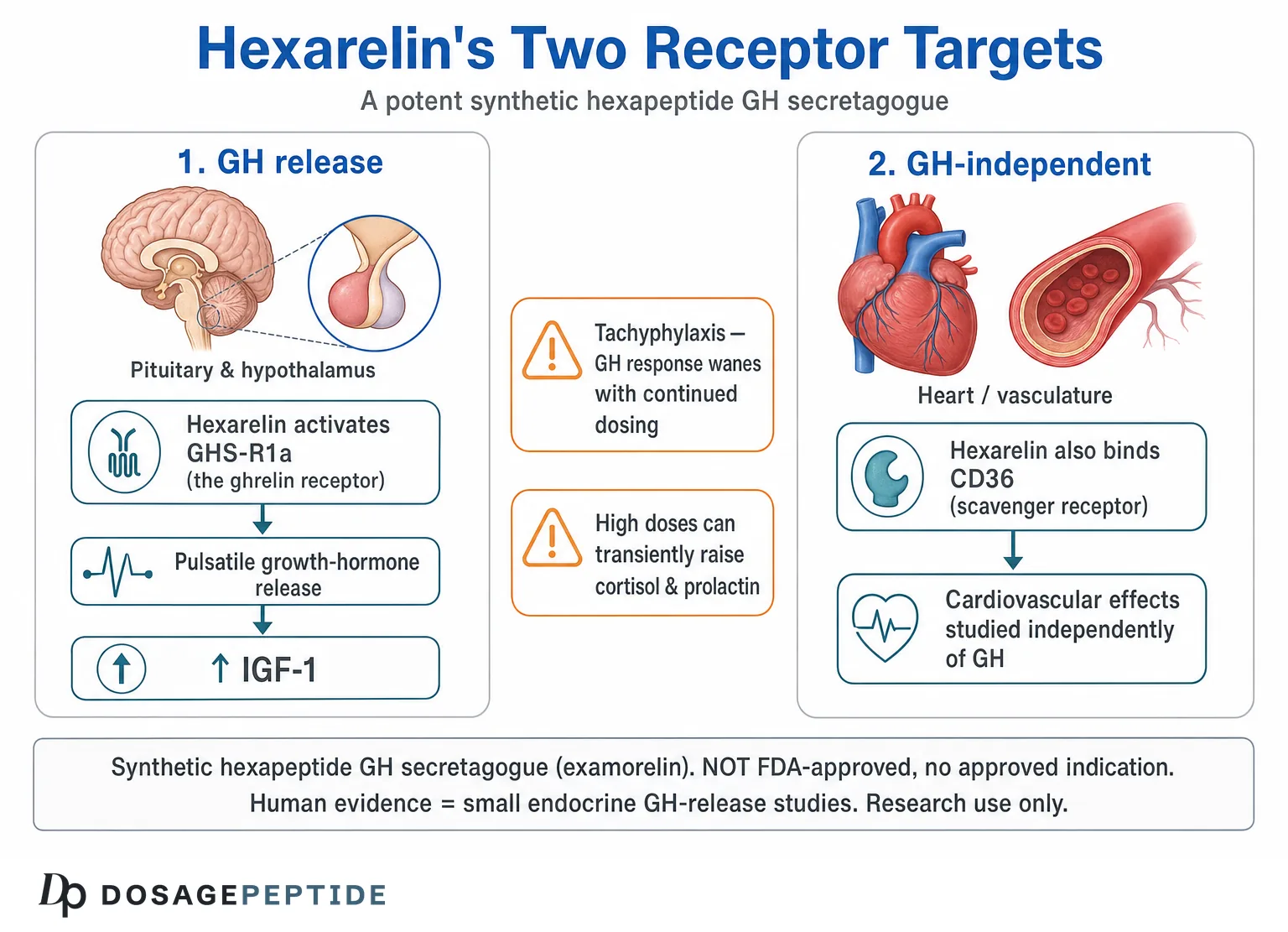
The primary mechanism of hexarelin is agonism at the GHS-R1a receptor — the type 1a growth hormone secretagogue receptor, better known today as the ghrelin receptor. This is the same receptor targeted by ghrelin, the stomach-derived “hunger hormone,” and by every peptidic GHRP. GHS-R1a is a seven-transmembrane G-protein-coupled receptor (GPCR) expressed most densely in the anterior pituitary and in the arcuate nucleus of the hypothalamus, with additional expression in the hippocampus, pancreas, and elsewhere.[1]
When hexarelin binds GHS-R1a, the receptor couples predominantly to the G₁₁ family of G proteins, activating phospholipase C. This drives production of inositol trisphosphate (IP₃) and diacylglycerol, mobilizing intracellular calcium and activating protein kinase C. In pituitary somatotroph cells, this cascade of intracellular calcium release triggers the exocytosis of stored GH into the circulation. Because the mechanism amplifies the mass of GH released per secretory pulse rather than simply forcing a continuous leak, hexarelin tends to enhance the natural pulsatile pattern of GH secretion — a point confirmed in human deconvolution studies.[10]
Why hexarelin and GHRH work together
One of the most robust findings in GHRP research is that GHS-R agonists and GHRH act synergistically. Hexarelin does not simply duplicate what GHRH does; it works through a parallel and partly independent mechanism. Hexarelin appears to release GH by three complementary routes: a direct action on pituitary somatotrophs, amplification of GHRH signaling at the pituitary, and — importantly — functional antagonism of somatostatin, the hormone that brakes GH release. By reducing somatostatin’s inhibitory tone at the hypothalamic and pituitary level, hexarelin effectively takes the foot off the brake while GHRH presses the accelerator. This is the pharmacological rationale behind the widely studied combination of a GHRP with a GHRH analog such as those discussed in the CJC-1295 DAC vs no-DAC article: the two classes together produce a larger GH pulse than either alone in experimental settings.
The downstream GH–IGF-1 axis
Growth hormone released in response to hexarelin acts on the liver and peripheral tissues to stimulate production of IGF-1, the principal mediator of many of GH’s anabolic and metabolic effects. IGF-1 has a much longer half-life than GH and is often used as a stable surrogate marker of GH secretagogue activity in human studies. However, the relationship between an acute GH pulse and a durable rise in IGF-1 is not automatic. In several hexarelin studies, short-term intermittent administration produced only modest or inconsistent changes in circulating IGF-1, even when acute GH release was robust.[8] A retrospective human series using other GHRPs (GHRP-2 and GHRP-6 with sermorelin) did report elevated IGF-1 with sustained thrice-daily dosing, illustrating that dosing frequency and duration strongly shape whether IGF-1 moves at all.[5]
What Is the CD36 Mechanism, and Why Does It Matter?
Here hexarelin departs from a simple “it just releases GH” narrative. In 2002, Bodart and colleagues reported that hexarelin binds a second, entirely distinct target in the heart: CD36, a class B scavenger receptor. Working with rat cardiac membranes, the team used a radiolabeled photoactivatable derivative of hexarelin to fish out its binding partner, purified an 84-kDa protein, and identified it by N-terminal sequencing as CD36. This receptor is expressed on cardiomyocytes and microvascular endothelial cells and is best known for its roles in fatty-acid uptake and the scavenging of oxidized LDL.[2]
The functional consequence was demonstrated directly: in isolated perfused hearts, hexarelin activation of CD36 produced a dose-dependent increase in coronary perfusion pressure. This effect was absent in hearts from CD36-null mice and from spontaneously hypertensive rats that are genetically deficient in CD36 — a clean genetic demonstration that the cardiovascular action was CD36-mediated and independent of the ghrelin receptor.[2] This is what makes the hexarelin CD36 interaction scientifically distinctive: it is a growth hormone secretagogue with a second, GH-independent pharmacology in cardiac and vascular tissue.
Dissecting GHS-R1a from CD36 effects
A particularly instructive experiment came from Torsello and colleagues, who compared hexarelin with ghrelin itself in a rat model of cardiac ischemia and reperfusion. Ghrelin, the natural GHS-R1a ligand, was far less effective than hexarelin at protecting the heart, and passive immunization against endogenous ghrelin did not worsen ischemia-reperfusion damage. The authors concluded that hexarelin’s cardiac effects were mediated only partly through GHS-R1a and largely through CD36 — a receptor that ghrelin does not engage the same way.[3] This dual-receptor picture is why hexarelin is often described as a “non-selective” secretagogue: it hits both the GH pathway and the CD36 pathway, whereas newer compounds like ipamorelin were deliberately engineered to be cleaner.
The magnitude of the hexarelin-versus-ghrelin gap in that experiment is instructive precisely because it is quantitative. Working in hypophysectomized rats pretreated for seven days, the investigators reported that hexarelin substantially outperformed a comparable dose of ghrelin at limiting ischemia-reperfusion damage: protection against the rise in left-ventricular end-diastolic pressure was on the order of 60% for hexarelin versus roughly 15% for ghrelin, with parallel differences in coronary perfusion pressure and in the leakage of creatine kinase into the perfusate.[3] Because the endogenous GHS-R1a ligand was the weaker cardioprotectant, and because removing endogenous ghrelin by passive immunization did not worsen injury, the most parsimonious reading is that hexarelin’s cardiac action is not principally a ghrelin-receptor effect at all. That is a clean piece of mechanistic reasoning — but it remains a rodent result, and the numbers above should be read as pharmacology in an animal model, not as any indication of a human cardiac effect size.
What the cardiac animal literature does — and does not — show
Several rodent studies have reported that hexarelin exerts protective effects on the cardiovascular system in disease models. Pang and colleagues found that chronic subcutaneous hexarelin suppressed plaque formation in a rat model of diet- and vitamin-D3-induced atherosclerosis, shifting the HDL/LDL ratio and increasing vascular nitric oxide.[11] Huang and colleagues reported that hexarelin protected rat cardiomyocytes from in-vivo ischemia-reperfusion injury, apparently by modulating interleukin-1 signaling through cardiac GHS-R1a.[12] Agbo and colleagues described attenuation of coronary-artery-ligation-induced heart failure in rats via modulation of PTEN and the Akt/mTOR pathway.[13]
These are genuinely interesting mechanistic findings — but they are, without exception, animal studies. They demonstrate biological plausibility for a cardiovascular role, not established efficacy in humans. No approved cardiac indication exists for hexarelin, and the leap from “protects rat cardiomyocytes” to “helps human hearts” has not been made in controlled clinical trials. Treating rodent cardioprotection as if it were proven human benefit would be exactly the kind of inflation this field is prone to, and it is not supported by the evidence.
How Does Hexarelin Relate to Ghrelin?
The relationship between hexarelin and ghrelin is one of the most conceptually important threads in this story, and it is frequently misunderstood. When hexarelin and the other GHRPs were first developed, researchers knew they acted on a specific receptor but did not know what the body’s own natural ligand for that receptor was. The synthetic peptides were, in effect, keys to a lock whose intended key had not yet been found. The cloning of the GHS-R in 1996 defined the lock molecularly,[1] and in 1999 ghrelin — a 28-amino-acid, acylated peptide hormone produced mainly by the stomach — was identified as the endogenous ligand. In a real sense, the synthetic GHRPs like hexarelin predicted the existence of ghrelin before it was discovered.
This matters for interpreting hexarelin’s effects. Hexarelin is a synthetic mimic of ghrelin at the GHS-R1a receptor, but it is not identical to ghrelin, and the differences are instructive. Ghrelin carries a unique octanoyl (fatty-acid) modification essential for receptor activation and has its own distribution and metabolism. Crucially, when Torsello and colleagues compared the two head-to-head in cardiac tissue, hexarelin was far more effective than ghrelin at protecting the ischemic heart, and blocking endogenous ghrelin did not reproduce hexarelin’s effect — strong evidence that hexarelin’s cardiac action runs largely through CD36, a target ghrelin does not engage the same way.[3] So while hexarelin borrows ghrelin’s primary receptor for GH release, it is not simply “synthetic ghrelin”: it has a broader and partly distinct pharmacology. This distinction also helps explain why hexarelin, unlike ghrelin and GHRP-6, is a comparatively weaker appetite driver despite sharing the same GH-release receptor — receptor engagement and downstream signaling bias are not uniform across ligands.
How Does Hexarelin Differ From GHRP-6 in Research?
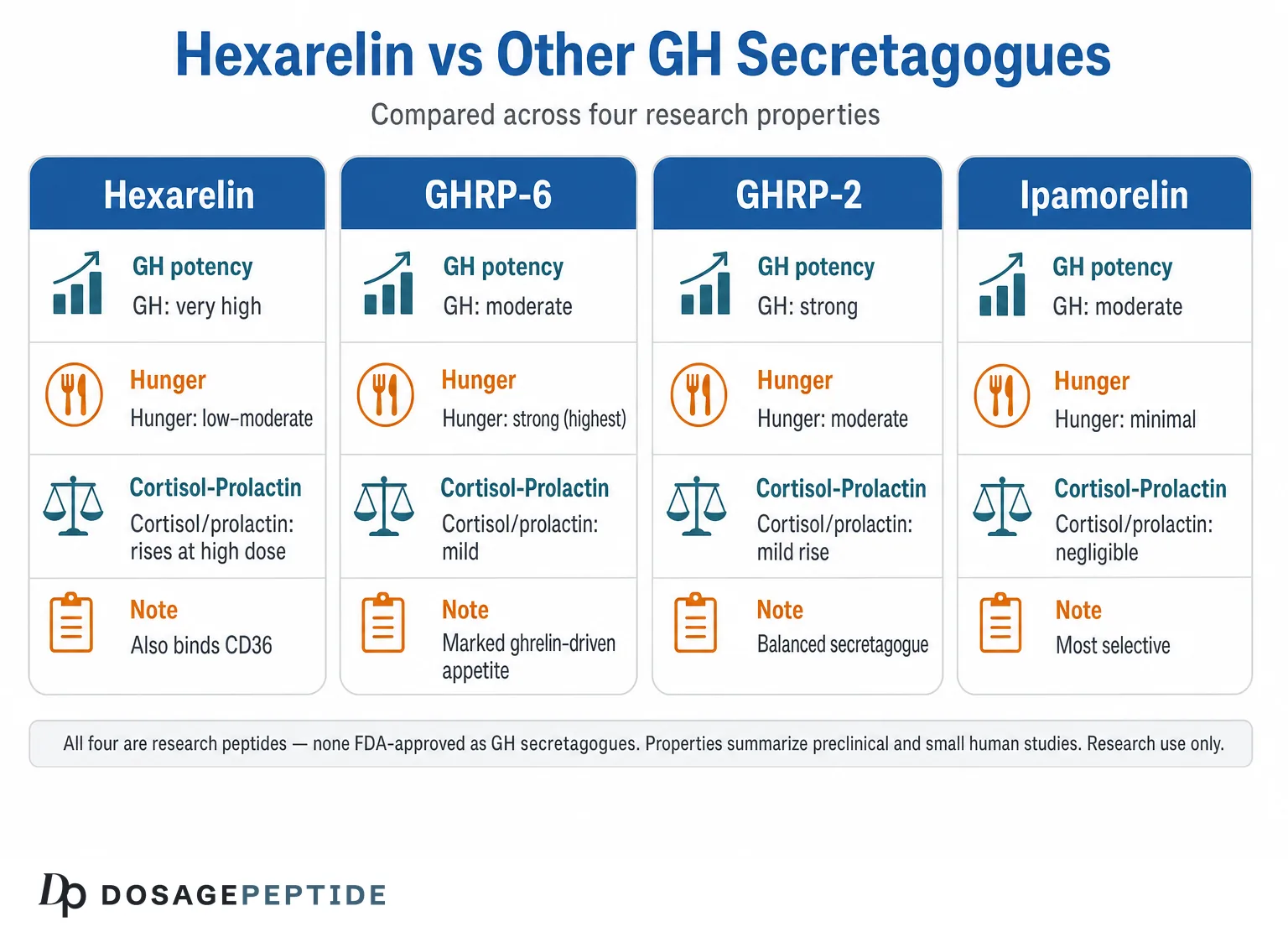
The comparison of hexarelin vs GHRP-6 is one of the most common questions researchers ask, because the two peptides are structurally close cousins — hexarelin was essentially built on the GHRP-6 template — yet they behave differently in ways that matter. Both act as GHS-R1a agonists, both stimulate GH release, and both can raise cortisol and prolactin. But three practical distinctions recur in the literature.
1. Potency for GH release
Hexarelin is generally described as more potent than GHRP-6 for GH release on a weight-for-weight basis, a consequence of the methylated tryptophan substitution that improved its receptor affinity and metabolic stability. In human studies, low microgram-per-kilogram doses of hexarelin produced strong, reproducible GH responses across intravenous, subcutaneous, intranasal, and oral routes.[7] GHRP-6, while effective, is typically positioned as somewhat less potent for pure GH-releasing activity.
2. Appetite stimulation
This is the single most reliable functional difference. GHRP-6 is the strongest appetite stimulant of the common GHRPs, producing pronounced hunger through robust GHS-R1a signaling that mimics ghrelin’s orexigenic action — the mechanism explored in depth in the GHRP-6 ghrelin and appetite article. Hexarelin, despite being a more potent GH releaser, causes less pronounced hunger than GHRP-6 in reported observations. Researchers comparing the two frequently characterize hexarelin as a “stronger GH releaser with weaker appetite drive” relative to GHRP-6. The precise reason is not fully resolved, but it underscores that GH-releasing potency and orexigenic potency are not the same axis.
3. The CD36 dimension
While GHRP-6 and other GHRPs also interact with CD36 to varying degrees, hexarelin is the member of the family in which the CD36 interaction has been most thoroughly characterized, particularly in the cardiac literature.[2] When researchers specifically want to study CD36-mediated effects, hexarelin is often the tool of choice.
Hexarelin vs GHRP-2 and ipamorelin
Broadening the comparison clarifies hexarelin’s position. GHRP-2 (pralmorelin) is another potent GH releaser, generally regarded as slightly less appetite-stimulating than GHRP-6 but still a meaningful trigger of cortisol and prolactin; the GHRP-2 research overview details its profile. Ipamorelin is the outlier: developed by Raun and colleagues at Novo Nordisk as “the first selective growth hormone secretagogue,” it releases GH with potency comparable to GHRP-6 but, remarkably, did not raise ACTH or cortisol even at doses more than 200-fold above its GH-releasing ED₅₀ in swine.[6] That selectivity is the key contrast: hexarelin is potent but “dirty” (it moves cortisol, prolactin, and CD36), whereas ipamorelin is potent and “clean” (GH-selective). Researchers weighing the family often frame it exactly this way, and the ipamorelin mechanism guide develops that selectivity argument in full.
Side-by-side comparison of common GHRPs
| Feature | Hexarelin | GHRP-6 | GHRP-2 | Ipamorelin |
|---|---|---|---|---|
| Class | Hexapeptide GHRP | Hexapeptide GHRP | Hexapeptide GHRP | Pentapeptide GHRP |
| GH-releasing potency | High | Moderate | High | Moderate–high |
| Appetite stimulation | Lower | Strongest | Moderate | Low |
| Cortisol / ACTH rise | Yes (dose-dependent) | Yes | Yes | Minimal (selective) |
| Prolactin rise | Yes (dose-dependent) | Yes | Yes | Minimal |
| CD36 interaction | Well characterized | Present | Present | Less emphasized |
| Notable desensitization | With continuous exposure | With continuous exposure | With continuous exposure | With continuous exposure |
This table summarizes tendencies reported across preclinical and small human studies; it is a research comparison, not a guide to use. None of these compounds is an approved therapy.
What Do the Human GH-Release Studies Actually Show?
The strongest part of the hexarelin evidence base is the acute human endocrine work conducted primarily in the 1990s. These studies consistently demonstrate that hexarelin is a powerful, reproducible GH secretagogue in people. Arvat and colleagues, for example, confirmed a strong GH-releasing effect of intravenous hexarelin across age groups, while documenting that responsiveness declines with age — the GH response in young women was several-fold larger than in postmenopausal or elderly women, and estrogen replacement did not restore the diminished response.[7] That age-related decline is a recurring theme across the GHRP literature and an important caveat to any claim that a secretagogue can simply “restore youthful GH.”
The magnitude of that age effect is worth stating concretely, because it disciplines the “fountain of youth” framing that often surrounds secretagogues. In the Arvat study, the integrated GH response to the maximal effective intravenous dose (2 µg/kg) was several-fold larger in young women (area under the curve on the order of 1,600 µg·min/L) than in post-menopausal women (roughly 450 µg·min/L) or aged women (roughly 780 µg·min/L). Basal estrogen and GH levels were correspondingly lower in the post-menopausal group. Critically, three months of transdermal estradiol restored circulating estradiol to young-adult levels yet left both basal GH and the GH response to hexarelin essentially unchanged, so the diminished somatotroph responsiveness of the post-menopausal period is not simply an estrogen-deficiency phenomenon.[7] For a research audience, the lesson is that the same acute challenge yields very different numbers depending on the physiological state of the subject — which is precisely why age, sex, adiposity, and hormonal status are treated as primary variables rather than nuisance covariates in this literature.
A rigorous 24-hour study by Maccario, Veldhuis, Ghigo and colleagues used deconvolution analysis to quantify exactly how hexarelin reshapes GH secretion. Two or three daily subcutaneous injections of hexarelin increased 24-hour GH secretion equally, selectively amplifying the mass of each GH secretory burst without changing burst frequency, and without altering prolactin, ACTH, or cortisol over the sampling period. Notably, IGF-1 did not change over these one-day treatment schedules.[10] This is a precise, mechanistically clean human finding: hexarelin amplifies GH pulse amplitude.
The cortisol, ACTH, and prolactin question
An important nuance is that hexarelin’s effect on the pituitary-adrenal axis is dose- and context-dependent. At the higher doses used in some acute studies, hexarelin can transiently raise ACTH, cortisol, and prolactin — more so than the selective ipamorelin.[6] Grottoli and colleagues examined the ACTH, cortisol, GH, and prolactin responses to intravenous hexarelin in obese patients, patients with Cushing’s disease, and controls, showing that hexarelin activates the hypothalamic-pituitary-adrenal axis through a hypothalamic route (the benzodiazepine alprazolam blunted the ACTH response in normal and obese subjects).[9] The practical implication for researchers is that hexarelin is not a “GH-only” probe: its interaction with cortisol and prolactin is real and is one of the reasons the more selective ipamorelin was later favored for many purposes.
What Is Tachyphylaxis, and Does Hexarelin Cause It?
Tachyphylaxis — the progressive weakening of a response with repeated or continuous exposure — is one of the defining pharmacological concerns of the GHRP class, and it is essential to understand honestly. The underlying biology is receptor desensitization: sustained GHS-R1a stimulation leads to receptor phosphorylation, internalization, and downregulation, so the same dose produces a smaller GH pulse over time. This is a general property of many GPCR agonists, not a hexarelin-specific flaw.
The human hexarelin data on this point are more nuanced than blanket claims suggest, and getting the nuance right matters. Continuous or very high-frequency GHRP exposure has long been associated with attenuation of the GH response. Yet Ghigo and colleagues specifically tested whether intermittent (rather than continuous) hexarelin would desensitize the axis in elderly subjects. Over 8 days of intranasal or 15 days of oral thrice-daily hexarelin, the GH response was maintained — it did not decline, and there was even a trend toward increase — while IGFBP-3 rose modestly.[8] In the 24-hour Maccario study, however, an intravenous hexarelin challenge given at the end of a day of repeated dosing produced a blunted GH response and an abolished ACTH/cortisol response, indicating partial acute desensitization within a day.[10]
It is worth separating what these short intermittent-dosing studies did and did not establish. In the Ghigo aging study, the acute GH response after 8 days of intranasal treatment was, if anything, numerically higher than baseline rather than lower, and IGF-binding protein 3 (IGFBP-3) rose modestly (from roughly 1.6 to 2.4 mg/L with intranasal dosing), while IGF-1 itself moved only slightly — unchanged with intranasal and marginally increased with the higher oral dose.[8] Those are real but small biochemical shifts over one to two weeks, in a handful of elderly volunteers, with no clinical endpoints measured. The mistake to avoid is reading “responsiveness was preserved over 8 to 15 days” as if it demonstrated durable, months-long efficacy and safety; the study was explicitly designed to test acute desensitization over a short window, not to validate a chronic regimen. Preserved short-term responsiveness and unproven long-term benefit are entirely compatible statements, and both are true of hexarelin.
The honest synthesis is this: desensitization is real and dose/frequency dependent. Continuous high-level GHS-R stimulation reliably attenuates the response; intermittent, spaced dosing preserved responsiveness in the short human studies that tested it. What the literature does not contain is long-term (many-month) human data establishing that any particular dosing pattern maintains GH responsiveness safely and durably. That gap is one of the central reasons hexarelin never became an approved therapy.
What Is the Current Evidence Level for Hexarelin?
This is the section that matters most for anyone trying to calibrate their beliefs about hexarelin, so it is worth being explicit about the evidence tier. Hexarelin’s evidence base can be sorted into three clearly different buckets, and conflating them is the most common error in online writing about the compound.
Tier 1 — Well supported: acute human GH release
That hexarelin acutely stimulates GH secretion in humans is well established, replicated across multiple independent studies, routes of administration, and age groups.[7][10] The mechanism through GHS-R1a is molecularly defined,[1] and the age-related decline in responsiveness is consistent. This is real, reproducible endocrine pharmacology.
Tier 2 — Preclinical / animal only: cardiovascular effects
The CD36-mediated cardiovascular and cardioprotective effects are supported by mechanistically elegant but animal-only studies.[2][3][11][13] These findings justify continued research interest. They do not establish any human cardiac benefit, and no cardiovascular indication is approved or clinically proven.
Tier 3 — Unproven / absent: durable clinical outcomes
Claims that hexarelin produces meaningful long-term body-composition changes, anti-aging effects, durable IGF-1 elevation, or clinical improvements in any disease are not supported by adequate human trials. The compound never completed pivotal clinical development, has no approved indication, and lacks the long-duration randomized controlled trials that would be required to substantiate such claims.[4] A general review of GH secretagogue safety and efficacy concluded that few long-term, rigorously controlled studies exist for the class as a whole, and that important safety questions — including effects on insulin sensitivity and long-term cancer risk — remain open.[4]
In plain terms: hexarelin is a research-chemical / investigational-only compound. It is not FDA-approved for anything. The acute endocrine pharmacology is solid; almost everything downstream of “it releases GH acutely” is either animal-only or unproven in humans. The hexarelin reference protocol page and the sibling GHRP-6 protocol page and GHRP-2 protocol page exist as catalogued reference material for that research context, not as endorsements of use.
Was Hexarelin Studied as a Diagnostic Tool?
One of the more legitimate research applications explored for hexarelin was diagnostic rather than therapeutic. Because hexarelin produces a strong, reproducible GH pulse in individuals with intact pituitary function, investigators studied it as a provocative agent for assessing the GH-secreting capacity of the somatotroph — conceptually similar to how GHRH or insulin-tolerance testing is used to evaluate suspected GH deficiency. The rationale is that a robust GH response indicates functioning somatotrophs, whereas a blunted response may point to pituitary pathology.
The synergy between GHRPs and GHRH made combined provocative testing especially attractive: administering hexarelin together with GHRH produced a larger, more consistent GH rise than either alone, potentially improving the discriminatory power of a diagnostic challenge. Studies also documented that the GH response to hexarelin is markedly reduced in obesity and in Cushing’s disease, and declines with age, all of which are relevant confounders that a diagnostic protocol would need to account for.[9] Even here, though, hexarelin was ultimately not adopted as a standard clinical diagnostic. The GHRH-plus-arginine test and other validated protocols became the workhorses of GH-deficiency diagnosis, and hexarelin remained a research probe. This is a recurring pattern: hexarelin repeatedly demonstrated interesting biology without ever crossing the threshold into approved clinical use.
How Do the Routes of Administration Compare?
An unusual and genuinely notable feature of hexarelin among peptides is that it retained meaningful GH-releasing activity across four routes: intravenous, subcutaneous, intranasal, and oral. Most peptides are effectively inactive orally because gastric acid and digestive proteases destroy them before absorption. Hexarelin’s D-amino-acid content and methyl-tryptophan modification conferred enough stability to survive partial oral and intranasal delivery, which is why the classic Turin studies were able to compare these routes directly.[8]
The comparison, however, also revealed the ceiling of non-injectable delivery. Intravenous administration produced the largest and most immediate GH response; subcutaneous injection was reliably effective; intranasal delivery achieved a substantial but lower response; and oral administration required much larger amounts (in the Ghigo aging study, oral dosing was roughly an order of magnitude higher on a per-kilogram basis than intranasal) to achieve a comparable effect, reflecting poor oral bioavailability.[8] The research takeaway is that route dramatically shapes the pharmacology: the same molecule can look potent or weak depending entirely on how it is delivered. This is a methodological point worth internalizing when reading any secretagogue study — the route and the challenge conditions are not incidental details, they are central determinants of the reported result.
What Are the Pharmacokinetics and Handling Characteristics?
From a research-characterization standpoint, hexarelin is a small peptide with a short plasma half-life, generally reported in the range of tens of minutes — consistent with its use in acute-challenge protocols where a single administration produces a discrete GH pulse rather than a sustained elevation. Its relative stability compared with earlier GHRPs (owing to the methyl-tryptophan modification) is one reason it retained meaningful activity across oral and intranasal routes in human studies, although bioavailability by those routes is far lower than by injection.[8]
As a lyophilized peptide, hexarelin used in laboratory settings is typically supplied as a powder that is reconstituted with bacteriostatic or sterile water for in-vitro and preclinical work, stored cold, and protected from repeated freeze-thaw cycles that degrade peptide integrity. These are standard peptide-handling considerations documented for reference on catalog pages; they describe how the material is characterized and stored in a research setting, and they are not instructions for human administration. Nothing about the physicochemical convenience of a peptide changes its regulatory status: hexarelin remains a not-approved research compound.
Why route and timing shaped the historical studies
Because GH is secreted in pulses and because somatostatin tone varies across the day, the timing of a secretagogue challenge influences the size of the GH response. Researchers designing the classic hexarelin studies controlled for time of day, fasting state, and concurrent GHRH to obtain reproducible measurements. This methodological care is part of why the acute-release data are trustworthy — and also why casual extrapolation from those tightly controlled challenge studies to any real-world regimen is unwarranted.
What Are the Known and Theoretical Risks?
Because hexarelin lacks long-term controlled human safety data, its risk profile is characterized incompletely and must be discussed with appropriate humility. Several considerations recur in the literature and in the broader GH-secretagogue class:
- Cortisol and prolactin elevation. At higher doses, hexarelin can transiently raise ACTH, cortisol, and prolactin, more than the selective ipamorelin.[9] Chronic elevation of these hormones would be undesirable, and the long-term consequences of repeated stimulation are not characterized in humans.
- Insulin sensitivity and glucose. GH secretagogues as a class have been associated with decreases in insulin sensitivity and increases in blood glucose; this is flagged in class-level safety reviews.[4]
- Desensitization. Continuous or high-frequency exposure attenuates the GH response, meaning any sustained-use rationale is undermined by the receptor biology itself.[10]
- Cardiovascular actions via CD36. The same CD36 pharmacology that is “protective” in some rodent models produced coronary vasoconstriction (raised coronary perfusion pressure) in perfused hearts.[2] A GH-independent cardiovascular target is a double-edged consideration, and its net effect in humans is unknown.
- Unknown long-term risks. The class review explicitly calls for evaluation of long-term outcomes including cancer incidence and mortality, precisely because these have not been established.[4] GH and IGF-1 signaling intersect with cell proliferation pathways, which is why long-term secretagogue safety is a legitimate open question rather than a settled matter.
- Product-quality risks. Because research-grade hexarelin is not a regulated pharmaceutical, purity, identity, and endotoxin content are not guaranteed by any regulator. This is a material real-world hazard entirely separate from the peptide’s intrinsic pharmacology.
What Are the Limitations of the Hexarelin Evidence Base?
Every honest account of hexarelin has to foreground its limitations, because they are substantial and they shape how much weight any conclusion can bear.
The human studies are small and acute. The influential endocrine studies typically enrolled a handful to a few dozen volunteers and measured acute or short-term (days to a few weeks) responses.[8][10] They were designed to probe mechanism, not to establish clinical efficacy or long-term safety. There is no large, long-duration, placebo-controlled outcome trial for hexarelin.
The most striking findings are in animals. The cardioprotective and anti-atherosclerotic results that make hexarelin sound exciting are rodent studies.[11][12] Species differences in receptor expression, dosing, and physiology mean these cannot be assumed to translate.
The literature is aging. Much of the core human work dates from the 1990s and early 2000s. It predates modern trial-registration standards, and the field’s attention largely moved on to more selective compounds (ipamorelin) and orally active small molecules (MK-677) that were pursued further in development.
IGF-1 responses were inconsistent. A durable rise in IGF-1 — the biomarker most relevant to any anabolic claim — was not reliably produced by short-term hexarelin dosing in the human studies.[10] This directly undercuts the assumption that acute GH pulses automatically translate into meaningful systemic anabolic effect.
Publication and interpretation bias. Positive mechanistic findings are more likely to be published and repeated than null results, and online summaries tend to amplify the most favorable animal data while omitting the “not approved, no long-term human data” caveats. A calibrated reader should discount accordingly.
How Should Researchers Interpret Hexarelin Today?
Placed in context, hexarelin is best understood as a historically important pharmacological tool rather than a therapy-in-waiting. Its greatest scientific contribution was helping to map the GHS-R pathway before ghrelin was discovered, and its unusual CD36 pharmacology opened a distinct line of cardiovascular research. For a researcher building a mental model of the growth hormone secretagogue family, hexarelin serves as the “potent but non-selective” reference point — more powerful than GHRP-6 for GH release, less hunger-inducing than GHRP-6, and less selective than ipamorelin because it also moves cortisol, prolactin, and CD36.
A useful mental discipline when reading about hexarelin is to ask, for every claim, which evidence tier it belongs to: is this an acute human endocrine finding (well supported), an animal mechanistic result (plausible but unproven in people), or a durable clinical outcome (largely absent)? Applying that filter consistently prevents the most common category error, which is treating a striking rodent result or a single measured GH pulse as though it settled a question about long-term human benefit. It also clarifies why reasonable scientists can find hexarelin genuinely interesting while remaining unconvinced that it is useful medicine.
What hexarelin is not, on the current evidence, is a validated intervention for aging, body composition, cardiac disease, or any other clinical endpoint. The honest position is that the acute endocrine pharmacology is real and interesting, the animal cardiovascular biology is intriguing, and the durable human clinical benefit is unproven. Anyone encountering marketing language that collapses these tiers — presenting rodent cardioprotection or a single GH pulse as if it were established anti-aging efficacy — is reading inflation, not evidence. Reading hexarelin alongside its siblings via the ipamorelin, GHRP-2, and MK-677 references gives a far more accurate picture than any single-compound hype.
Frequently Asked Questions
Is hexarelin FDA-approved?
No. Hexarelin (examorelin) is not approved by the FDA or any other major regulatory agency, and it holds no approved therapeutic indication. It was studied in small human endocrine trials in the 1990s and early 2000s but never completed pivotal clinical development. Today it exists as a research-use-only chemical, meaning it is intended for laboratory and preclinical study rather than human treatment, and its quality is not guaranteed by any regulator.
What is the difference between hexarelin and GHRP-6?
Both are hexapeptide GHS-R1a agonists that stimulate growth hormone release. The main differences: hexarelin is generally more potent for GH release, while GHRP-6 is the strongest appetite stimulant of the common GHRPs and causes more pronounced hunger. Hexarelin also has a well-characterized interaction with the CD36 receptor in cardiac tissue. In short, hexarelin releases more GH with less hunger, whereas GHRP-6 drives stronger appetite.
What is the CD36 receptor and why does hexarelin bind it?
CD36 is a scavenger receptor expressed on cardiomyocytes and endothelial cells, involved in fatty-acid uptake and scavenging oxidized LDL. In 2002, researchers showed hexarelin binds CD36 in the heart, mediating cardiovascular effects that are independent of the ghrelin receptor and independent of growth hormone. This dual pharmacology — GHS-R1a plus CD36 — makes hexarelin distinctive, but the resulting cardiovascular effects have only been demonstrated in animal models, not proven in humans.
Does hexarelin cause tachyphylaxis or desensitization?
Desensitization is a real, dose- and frequency-dependent property of the GHRP class. Continuous or high-frequency GHS-R1a stimulation reduces the growth hormone response over time through receptor downregulation. However, short human studies of intermittent, spaced hexarelin dosing found the GH response was maintained rather than lost. There is no long-term human data establishing that any dosing pattern preserves responsiveness durably and safely, which is a key limitation.
How does hexarelin compare to ipamorelin?
Ipamorelin was developed as the first selective growth hormone secretagogue: it releases GH with potency comparable to GHRP-6 but, unlike hexarelin, does not meaningfully raise cortisol or ACTH even at very high doses. Hexarelin is more potent for GH release but is less selective, transiently increasing cortisol and prolactin at higher doses and engaging CD36. Researchers often frame hexarelin as “potent but non-selective” and ipamorelin as “clean and GH-selective.”
Does hexarelin raise cortisol and prolactin?
At higher doses, yes. Human studies show hexarelin can transiently increase ACTH, cortisol, and prolactin, and it does so more than the selective ipamorelin. The ACTH response appears to be mediated through a hypothalamic route. Whether cortisol and prolactin rise significantly depends on dose and context; some studies with lower or intermittent dosing found no significant change in these hormones over the observation period.
Is hexarelin proven to have anti-aging or cardiac benefits?
No. Rodent studies report cardioprotective and anti-atherosclerotic effects, and hexarelin acutely releases growth hormone in humans, but no controlled human trials establish durable anti-aging, body-composition, or cardiac clinical benefits. The animal findings demonstrate biological plausibility, not proven human efficacy. Class-level reviews specifically note the absence of long-term controlled data and unresolved safety questions, including effects on insulin sensitivity and long-term cancer risk.
What does “research-use-only” mean for hexarelin?
It means the compound is sold and characterized for laboratory and preclinical investigation, not as an approved medicine for human use. Research-grade material is not manufactured under pharmaceutical regulatory oversight, so purity, identity, and sterility are not guaranteed by any authority. This designation reflects both the regulatory reality (no approval) and a genuine quality-control hazard that exists independently of the peptide’s intrinsic pharmacology.
Why did hexarelin never become an approved drug?
Several factors converged: its lack of receptor selectivity (raising cortisol and prolactin), documented desensitization with continuous exposure, inconsistent durable IGF-1 responses, and the absence of large long-term outcome trials. The field’s attention shifted toward more selective peptides like ipamorelin and orally active small molecules like MK-677. Hexarelin remained a valuable research tool for mapping the GHS-R and CD36 pathways rather than advancing to a marketed therapeutic.
Research-use-only disclaimer. This article is an educational and scientific reference intended for researchers and is not medical advice. Hexarelin (examorelin) is not approved by the FDA or any other regulatory agency for any use; it is a research chemical, and nothing here should be interpreted as a recommendation for human use, self-administration, or any dosing protocol. The findings described are drawn from published preclinical and small human endocrine studies and are presented in that experimental context only. No therapeutic benefit is claimed or implied. Anyone with questions about growth hormone, endocrine health, or any medical condition should consult a qualified licensed healthcare professional.
References
- Howard AD, Feighner SD, Cully DF, et al. A receptor in pituitary and hypothalamus that functions in growth hormone release. Science. 1996;273(5277):974–977. PubMed 8688086. doi:10.1126/science.273.5277.974
- Bodart V, Febbraio M, Demers A, et al. CD36 mediates the cardiovascular action of growth hormone-releasing peptides in the heart. Circ Res. 2002;90(8):844–849. PubMed 11988484. doi:10.1161/01.res.0000016164.02525.b4
- Torsello A, Bresciani E, Rossoni G, et al. Ghrelin plays a minor role in the physiological control of cardiac function in the rat. Endocrinology. 2003;144(5):1787–1792. PubMed 12697684. doi:10.1210/en.2002-221048
- Sigalos JT, Pastuszak AW. The safety and efficacy of growth hormone secretagogues. Sex Med Rev. 2018;6(1):45–53. PubMed 28400207. doi:10.1016/j.sxmr.2017.02.004
- Sigalos JT, Pastuszak AW, Allison A, et al. Growth hormone secretagogue treatment in hypogonadal men raises serum insulin-like growth factor-1 levels. Am J Mens Health. 2017;11(6):1752–1757. PubMed 28830317. doi:10.1177/1557988317718662
- Raun K, Hansen BS, Johansen NL, et al. Ipamorelin, the first selective growth hormone secretagogue. Eur J Endocrinol. 1998;139(5):552–561. PubMed 9849822. doi:10.1530/eje.0.1390552
- Arvat E, Gianotti L, Broglio F, et al. Oestrogen replacement does not restore the reduced GH-releasing activity of Hexarelin, a synthetic hexapeptide, in post-menopausal women. Eur J Endocrinol. 1997;136(5):483–487. PubMed 9186268. doi:10.1530/eje.0.1360483
- Ghigo E, Arvat E, Gianotti L, et al. Short-term administration of intranasal or oral Hexarelin, a synthetic hexapeptide, does not desensitize the growth hormone responsiveness in human aging. Eur J Endocrinol. 1996;135(4):407–412. PubMed 8921821. doi:10.1530/eje.0.1350407
- Grottoli S, Arvat E, Gauna C, et al. Effects of alprazolam on the ACTH-, GH- and PRL-releasing activity of hexarelin in obesity and Cushing’s disease. Pituitary. 1999;2(3):197–204. PubMed 11081154. doi:10.1023/a:1009992909247
- Maccario M, Veldhuis JD, Broglio F, et al. Impact of two or three daily subcutaneous injections of hexarelin on 24-h GH, prolactin, adrenocorticotropin and cortisol secretion in humans. Eur J Endocrinol. 2002;146(3):310–318. PubMed 11888836. doi:10.1530/eje.0.1460310
- Pang JJ, Xu Q, Xu X, et al. Hexarelin suppresses high lipid diet and vitamin D3-induced atherosclerosis in the rat. Peptides. 2010;31(4):630–638. PubMed 19931584. doi:10.1016/j.peptides.2009.11.007
- Huang J, Li Y, Zhang J, Liu Y, Lu Q. The growth hormone secretagogue hexarelin protects rat cardiomyocytes from in vivo ischemia/reperfusion injury through interleukin-1 signaling pathway. Int Heart J. 2017;58(2):257–263. PubMed 28321024. doi:10.1536/ihj.16-241
- Agbo E, Liu D, Li M, et al. Modulation of PTEN by hexarelin attenuates coronary artery ligation-induced heart failure in rats. Turk J Med Sci. 2019;49(3):945–958. PubMed 31091855. doi:10.3906/sag-1812-49