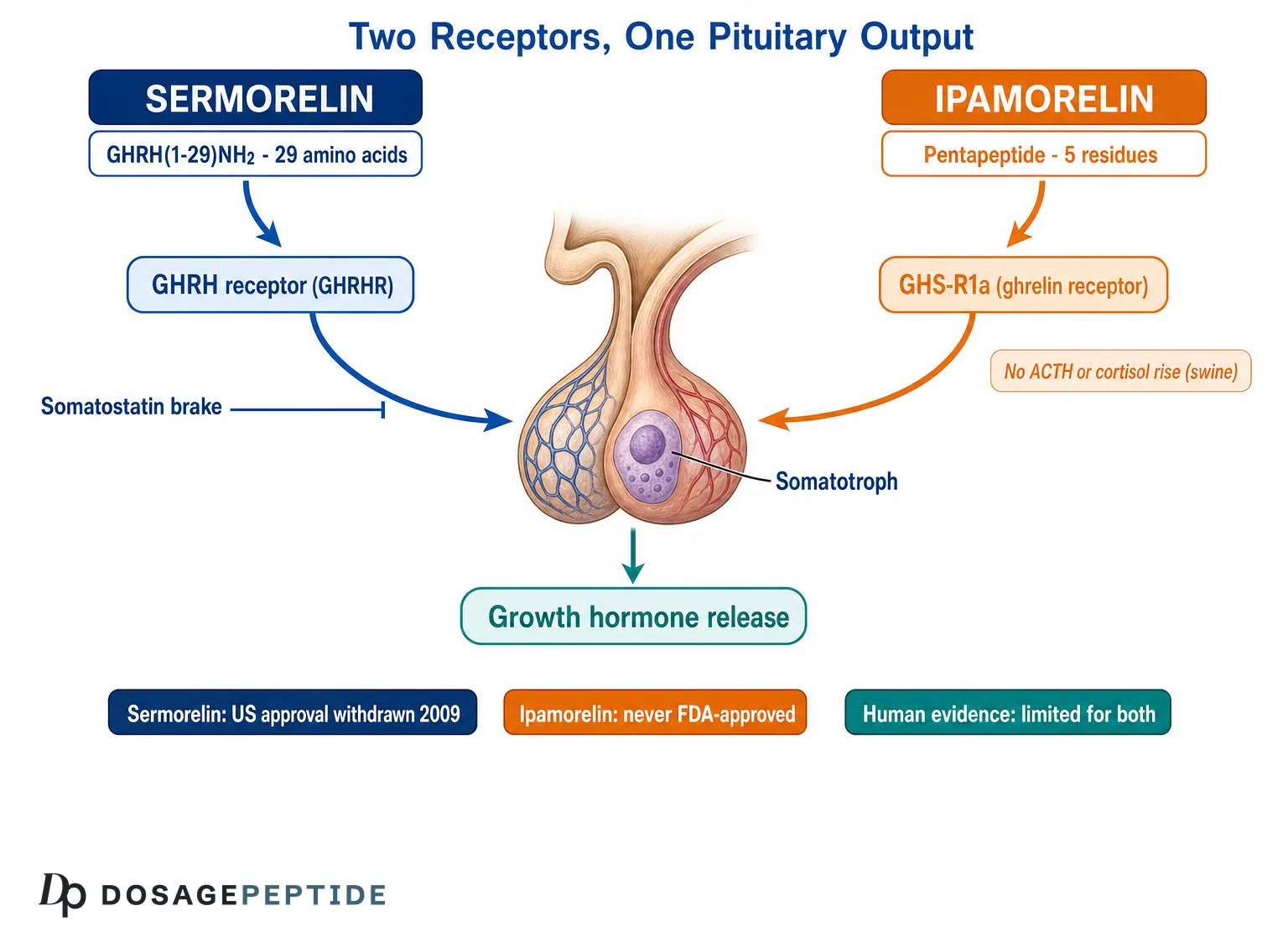
One fact settles most of the choice between sermorelin and ipamorelin: they are not the same class of compound and do not act on the same receptor. Sermorelin is a truncated analog of hypothalamic growth-hormone-releasing hormone acting at the GHRH receptor; ipamorelin is a synthetic pentapeptide acting at the ghrelin receptor. Everything else — duration, selectivity, appetite signal, regulatory status, evidence depth — follows from that.
The short answer. Sermorelin probes the GHRH–somatotroph axis: it amplifies the pituitary’s own GH pulse and stays subject to somatostatin’s inhibitory brake. Ipamorelin probes the ghrelin / GHS-R1a axis: a separate pathway, notable in its original characterisation for releasing GH without the ACTH and cortisol rise seen with earlier secretagogues. Neither is an FDA-approved drug product today, and the human evidence base for both is thin.
| Attribute | Sermorelin | Ipamorelin |
|---|---|---|
| Peptide class | GHRH analog (releasing-hormone analog) | Growth hormone secretagogue / ghrelin mimetic (GHRP family) |
| Receptor target | GHRH receptor (GHRHR), a G-protein-coupled receptor whose activation drives somatotroph proliferation and GH secretion[1] | Growth hormone secretagogue receptor 1a (GHS-R1a), the ghrelin receptor[2] |
| Structure / length | GHRH(1–29)NH2 — 29 amino acids, the N-terminal fragment of human GHRH | Aib-His-D-2-Nal-D-Phe-Lys-NH2 — 5 residues, three of them non-standard[3] |
| Routes used in published work | Intravenous (PK and pituitary testing); once-daily subcutaneous in the pediatric GHD programme[4] | Intravenous only in the published human studies[5]; subcutaneous in rodent work — twice-daily bolus in mice[8], continuous osmotic minipump in rats[14] |
| Duration of action | Disappearance half-time about 4.3 ± 1.4 min after IV infusion in men; GH remained elevated roughly 3 h[6][7] | Terminal half-life about 2 h in healthy men; single GH episode peaking near 0.67 h[5] |
| Selectivity (ACTH / cortisol / prolactin) | Physiological GHRH-pathway agonist: receptor activation drives somatotroph GH secretion[1], and ACTH or cortisol release is not a described feature of GHRH stimulation in the published pituitary-testing literature. No head-to-head hormonal-selectivity study versus ipamorelin exists | In conscious swine, no ACTH or cortisol rise beyond that seen with GHRH, even above 200× the GH ED50; GHRP-6 and GHRP-2 did raise both. PRL, FSH, LH and TSH unaffected by any secretagogue tested[3] |
| Appetite signal | No ghrelin-receptor affinity, so an orexigenic effect is not predicted mechanistically. No published study has measured appetite or food intake with sermorelin, in any species | Ghrelin-receptor agonism is the mechanistic basis for an appetite effect. In GH-intact mice, ipamorelin increased food intake, serum leptin and relative fat mass[8] |
| Regulatory status (US) | Formerly FDA-approved as GEREF (paediatric GHD) and GEREF Diagnostic (pituitary GH secretory capacity); discontinued 2008, approval withdrawn 18 June 2009, not for reasons of safety or effectiveness[9]. Not an FDA-approved product today | Never FDA-approved for any indication. No approval by EMA or another major regulator has been identified either. FDA’s Pharmacy Compounding Advisory Committee reviewed it on 29 October 2024 and voted against adding it to the 503A bulk substances list[10]; that recommendation still stood as of August 2026 |
| Depth of human evidence | Acute PD and PK studies in healthy men, plus a 110-child open-label 12-month multicentre study in GHD (86 evaluable for efficacy)[4]. No modern controlled adult trials for the uses discussed online | One dose-escalation PK/PD study in healthy men and one randomised phase 2 trial (n = 117 randomised; 114 analysed) that missed its endpoint[11] |
What exactly is sermorelin?
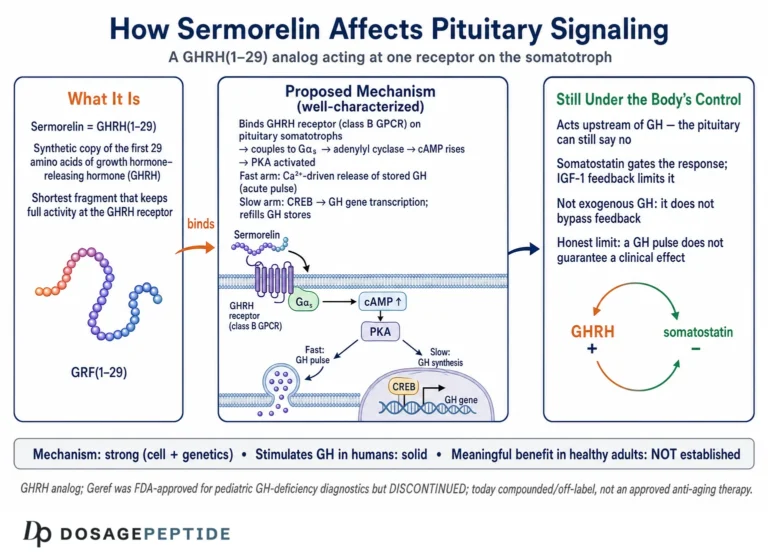
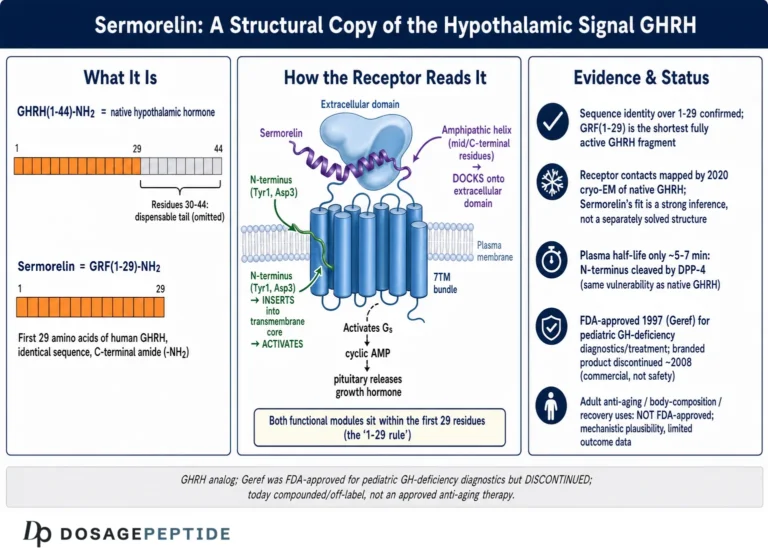
Sermorelin is GHRH(1–29)NH2: the first 29 residues of the 44-amino-acid human growth-hormone-releasing hormone, C-terminally amidated. It binds the GHRH receptor, a G-protein-coupled receptor whose activation drives both somatotroph proliferation and GH synthesis and secretion[1].
The practical consequence: sermorelin cannot manufacture GH out of nothing. It stimulates a pituitary that must already be capable of responding, and the resulting pulse is still shaped by somatostatin, the physiological brake on GH release. That is the origin of the claim that GHRH analogs produce a “more physiological” pattern — a description of the mechanism, not a demonstrated clinical advantage.
The regulatory history matters
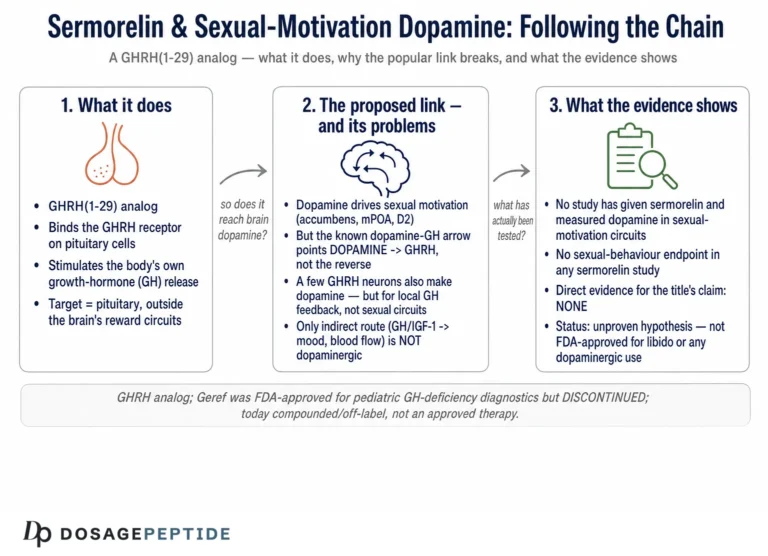
Sermorelin is unusual among research peptides in that it was once an approved drug. GEREF (NDA 020443) was approved for idiopathic growth hormone deficiency in children with growth failure, and GEREF Diagnostic (NDA 019863) for evaluating pituitary somatotroph capacity. Both were discontinued in 2008 and approval was withdrawn effective 18 June 2009; a 2013 Federal Register determination concluded the products were not withdrawn for reasons of safety or effectiveness[9]. Today sermorelin circulates as a compounded or research substance. Compounded drugs are not FDA-approved: the agency has made no finding of safety or effectiveness for any compounded sermorelin preparation, and does not review its manufacture, potency or labelling. Historical approval is not current approval.
What the human data actually consist of
The largest published clinical dataset is the Geref International Study Group report: 110 previously untreated prepubertal GH-deficient children were enrolled, of whom 86 were eligible for the efficacy analysis. The open-label design used once-daily subcutaneous sermorelin for up to 12 months. Among the evaluable children, mean height velocity rose from 4.1 ± 0.9 cm/yr at baseline to 8.0 ± 1.5 cm/yr at 6 months and 7.2 ± 1.3 cm/yr at 12 months. The report noted no adverse biochemical changes, but an uncontrolled open-label design with no comparator cannot establish a safety profile[4]. That regimen applied to diagnosed paediatric GH deficiency under specialist supervision, is not reproducible outside that setting, and is not stated here as a protocol. It says nothing about healthy adults, and is not evidence for the anti-ageing, body-composition or sleep claims that dominate consumer marketing. Reported adverse events are summarised in documented Sermorelin side effects.
What exactly is ipamorelin?
Ipamorelin is a pentapeptide — Aib-His-D-2-Nal-D-Phe-Lys-NH2 — developed at Novo Nordisk within a series engineered by removing the central Ala-Trp dipeptide of GHRP-1. Three of its five residues are non-standard: α-aminoisobutyric acid, D-2-naphthylalanine and D-phenylalanine[3]. Those substitutions were introduced to increase enzymatic stability and receptor selectivity; the selectivity that resulted was characterised in conscious swine (see below), not in humans.
It acts at GHS-R1a, whose endogenous ligand — the acylated 28-residue gastric peptide ghrelin — was identified in 1999, a year after ipamorelin was first described[2]. Raun and colleagues could only say at the time that ipamorelin worked through a “GHRP-like receptor” distinct from GHRHR. A fuller account of the pathway is in our page on what Ipamorelin is.
The human record: one PK study and one failed trial
The dose-escalation study in healthy male volunteers used five 15-minute IV infusion rates (4.21 to 140.45 nmol/kg), eight men per level. Pharmacokinetics were dose-proportional: terminal half-life about 2 h, clearance 0.078 L/h/kg, steady-state volume of distribution 0.22 L/kg. GH release was a single episode peaking near 0.67 h and declining to negligible concentrations at every dose[5].
The only completed randomised human trial we could identify, in the indexed literature and on ClinicalTrials.gov, targeted postoperative ileus, not growth hormone. In a multicentre, double-blind, placebo-controlled phase 2 study (NCT00672074[15]), 117 adults undergoing bowel resection were randomised to 0.03 mg/kg IV ipamorelin or placebo twice daily for up to 7 days; 114 made up the safety and modified intent-to-treat populations. Median time to first tolerated solid meal was 25.3 h with ipamorelin versus 32.6 h with placebo, p = 0.15. The authors found no significant differences in the efficacy analyses, though they reported the drug was well tolerated over the 7-day intravenous course in this small inpatient population — a tolerability observation, not a safety profile[11]. Development stopped there. More detail is in our full Ipamorelin dosing reference.
What does “selectivity” actually mean here — and where does it stop?
This is the most over-quoted claim in the category, so it is worth stating what was actually measured. In conscious swine, ipamorelin released GH with an ED50 of 2.3 ± 0.03 nmol/kg, comparable to GHRP-6. GHRP-6 and GHRP-2 raised plasma ACTH and cortisol; ipamorelin did not raise either beyond the levels seen after GHRH stimulation, even at doses more than 200-fold above its GH ED50. No secretagogue tested affected FSH, LH, prolactin or TSH[3]. That is the entire evidentiary basis for “the first selective growth hormone secretagogue.”
The limits are equally specific: one species, acute dosing, a hormone panel — not a safety profile, not chronic exposure, not human data. Reviews of the wider class note that GHS effects are generally not fully specific for GH, with prolactin, ACTH and cortisol responses documented across the family[12]. Ipamorelin’s advantage over GHRP-6 rests on that one acute swine study and has not, to our knowledge, been independently replicated; extrapolating it into a claim of clean human endocrine selectivity is not supported.
What is the mechanistic rationale for pairing a GHRH analog with a ghrelin-receptor agonist — and what has never been tested?
Because the two receptors sit on different pathways, a combination has a mechanistic rationale. In a single acute study in 18 normal men, submaximal doses of a growth-hormone-releasing peptide (GHRP-6 — not ipamorelin) plus GHRH stimulated GH release synergistically, which the authors read as evidence of independent mechanisms[13]. No study has tested sermorelin with ipamorelin in humans. The proposed explanation is that GHRH drives the somatotroph directly while the secretagogue additionally opposes somatostatin’s inhibitory tone[12].
Two caveats. First, that synergy was demonstrated with GHRP-6[13], and reported across the wider secretagogue class including GHRP-2 and hexarelin[12] — not with sermorelin plus ipamorelin, a combination for which no controlled human trial appears in the published literature. Second: a larger acute GH peak is a pharmacodynamic observation, not an outcome, and no published work establishes that stacking these two classes improves any clinical or functional endpoint. Anyone running comparative work should also read Sermorelin compared with CJC-1295, since the modified-GHRH side changes the pharmacokinetics considerably.
Duration: the fact most comparison articles get backwards
It is widely written that both peptides have half-lives “measured in minutes.” That is accurate for sermorelin, inaccurate for ipamorelin. GHRH(1–29)NH2 had a disappearance half-time of 4.3 ± 1.4 min and a metabolic clearance rate of 39.7 ± 3.9 mL/kg·min during constant IV infusion in normal men — values from the unmodified GHRH(1–29)NH2 comparator arm of a study whose primary subject was the D-Ala2 analog[6]. Ipamorelin’s reported terminal half-life in healthy men was about 2 h[5].
Note also the decoupling between exposure and effect: although sermorelin was cleared within minutes after IV injection, GH concentrations stayed elevated for roughly three hours[7]. Plasma half-life is a poor proxy for duration of effect in this class.
Appetite: what the ghrelin pathway predicts, and what was observed
Because ipamorelin is a ghrelin mimetic, an appetite effect is the mechanistic default expectation. The marketing claim that it “does not increase hunger” traces back to its favourable comparison with GHRP-6 — but that comparison was about ACTH and cortisol, not feeding.
The preclinical record is less flattering than the claim. In GH-deficient (lit/lit) and GH-intact mice, twice-daily subcutaneous ipamorelin produced a roughly 15 % body-weight increase by two weeks and raised fat-pad weight relative to body weight in both groups; in GH-intact mice, ipamorelin and GHRP-6 increased relative fat mass, serum leptin and food intake, while GH itself did not — leading the authors to conclude that secretagogues increase body fat by GH-independent mechanisms that may include increased feeding[8]. A 12-week rat study likewise found body weight increased with ipamorelin, GHRP-6 and GH alike[14]. Human appetite data are effectively absent.
What the evidence does not show
- Neither compound is an FDA-approved drug product for any indication today. Sermorelin’s approvals were withdrawn in 2009; ipamorelin has never held one.
- No head-to-head human trial of sermorelin versus ipamorelin exists in the published literature. Every direct comparison — including this one — is assembled from separate studies in different species, populations and routes.
- No controlled human data support body-composition, recovery, sleep, injury-healing or longevity claims for either peptide. In the 12-week rat study, the increase in bone mineral content disappeared once corrected for body weight, and volumetric bone mineral density was unchanged[14].
- Long-term safety is unknown for both. The longest published human exposure is 12 months of sermorelin in diagnosed children, and 7 days of intravenous ipamorelin in surgical patients.
- Identity and purity of material sold as “research peptide” is not established by any regulator. Handling variables — solvent, concentration, storage — are a real source of between-laboratory variance; see the peptide reconstitution guide. Vial-level arithmetic — volumes and dilutions only, not a human protocol — is set out separately in the Sermorelin 5 mg vial dosage protocol and the Ipamorelin 10 mg vial dosage protocol.
Frequently Asked Questions
Is sermorelin or ipamorelin stronger?
The question has no clean answer: potency is receptor- and species-specific, and the two have never been compared head-to-head in humans. In conscious swine, ipamorelin released GH with an ED50 of about 2.3 nmol/kg, comparable to GHRP-6, while sermorelin’s response is constrained by somatostatin feedback. Comparing numbers across species and routes is not a valid potency comparison.
Is sermorelin FDA-approved?
Not currently. It was approved as GEREF for idiopathic growth hormone deficiency in children with growth failure, and as GEREF Diagnostic for assessing pituitary GH secretory capacity. Both were discontinued in 2008 and FDA withdrew the approvals in June 2009, not for reasons of safety or effectiveness. It exists today only as a compounded or research substance, and compounded preparations carry no FDA finding of safety or effectiveness.
Has ipamorelin ever been approved for anything?
No. Ipamorelin has never been approved by FDA, and holds no marketing authorisation with other major regulators. It reached phase 2 for postoperative ileus, missed its efficacy endpoint, and development stopped. FDA’s Pharmacy Compounding Advisory Committee reviewed ipamorelin on 29 October 2024 and voted against adding it to the 503A bulk drug substances list. Ipamorelin was not among the peptides the committee reconsidered at its July 2026 meeting, so as of August 2026 that 2024 recommendation still stands.
Why are the two often studied together?
Because they act on independent receptors. Published work in normal men showed that a growth-hormone-releasing peptide combined with GHRH produced synergistic GH release, consistent with the two acting through separate mechanisms. That is a mechanistic rationale, not evidence that any combination improves a clinical or functional outcome — and sermorelin with ipamorelin has never been tested in a controlled human trial.
Does ipamorelin raise cortisol?
In the original characterisation in conscious swine, ipamorelin did not raise ACTH or cortisol above the levels seen after GHRH stimulation, even at doses more than 200-fold above its GH ED50 — unlike GHRP-6 and GHRP-2, which did. That result is species-specific, acute and preclinical, and has not been independently replicated. There is no comparable human dataset.
Does ipamorelin increase appetite?
Mechanistically it should, since it is a ghrelin-receptor agonist and ghrelin is the main circulating hunger signal. In mice, ipamorelin increased food intake, serum leptin and relative fat mass. The claim that it has no appetite effect comes from its comparison with GHRP-6 on ACTH and cortisol, a different endpoint. Human appetite data are essentially non-existent.
Can either be used to treat growth hormone deficiency?
Neither is an approved treatment for growth hormone deficiency today. Sermorelin held that approval in children until 2009; recombinant human growth hormone remains the approved option for diagnosed deficiency, and ipamorelin was never approved for it. Nothing here is a treatment recommendation, and management of endocrine disorders belongs with a qualified clinician.
References
- Corazzini V, Salvatori R. Molecular and clinical aspects of GHRH receptor mutations. Endocr Dev, 2013;24:106–17. https://pubmed.ncbi.nlm.nih.gov/23392099/
- Kojima M, Hosoda H, Date Y, et al. Ghrelin is a growth-hormone-releasing acylated peptide from stomach. Nature, 1999;402(6762):656–60. https://pubmed.ncbi.nlm.nih.gov/10604470/
- Raun K, Hansen BS, Johansen NL, et al. Ipamorelin, the first selective growth hormone secretagogue. Eur J Endocrinol, 1998;139(5):552–61. https://pubmed.ncbi.nlm.nih.gov/9849822/
- Thorner M, Rochiccioli P, Colle M, et al. (Geref International Study Group). Once daily subcutaneous growth hormone-releasing hormone therapy accelerates growth in growth hormone-deficient children during the first year of therapy. J Clin Endocrinol Metab, 1996;81(3):1189–96. https://pubmed.ncbi.nlm.nih.gov/8772599/
- Gobburu JV, Agersø H, Jusko WJ, et al. Pharmacokinetic-pharmacodynamic modeling of ipamorelin, a growth hormone releasing peptide, in human volunteers. Pharm Res, 1999;16(9):1412–6. https://pubmed.ncbi.nlm.nih.gov/10496658/
- Soule S, King JA, Millar RP. Incorporation of D-Ala2 in growth hormone-releasing hormone-(1-29)-NH2 increases the half-life and decreases metabolic clearance in normal men. J Clin Endocrinol Metab, 1994;79(4):1208–11. Values cited above are from the unmodified GHRH(1-29)NH2 comparator arm. https://pubmed.ncbi.nlm.nih.gov/7962295/
- Wilton P, Chardet Y, Danielson K, et al. Pharmacokinetics of growth hormone-releasing hormone(1-29)-NH2 and stimulation of growth hormone secretion in healthy subjects after intravenous or intranasal administration. Acta Paediatr Suppl, 1993;388:10–15. https://pubmed.ncbi.nlm.nih.gov/8329825/
- Lall S, Tung LY, Ohlsson C, et al. Growth hormone (GH)-independent stimulation of adiposity by GH secretagogues. Biochem Biophys Res Commun, 2001;280(1):132–8. https://pubmed.ncbi.nlm.nih.gov/11162489/
- Determination That GEREF (Sermorelin Acetate) Injection Products Were Not Withdrawn From Sale for Reasons of Safety or Effectiveness. Federal Register, US Food and Drug Administration, 4 March 2013. https://www.govinfo.gov/content/pkg/FR-2013-03-04/html/2013-04827.htm
- FDA Briefing Document, Pharmacy Compounding Advisory Committee (PCAC) Meeting, 29 October 2024. US Food and Drug Administration. https://www.fda.gov/media/182088/download
- Beck DE, Sweeney WB, McCarter MD. Prospective, randomized, controlled, proof-of-concept study of the ghrelin mimetic ipamorelin for the management of postoperative ileus in bowel resection patients. Int J Colorectal Dis, 2014;29(12):1527–34. https://pubmed.ncbi.nlm.nih.gov/25331030/
- Ghigo E, Arvat E, Camanni F. Orally active growth hormone secretagogues: state of the art and clinical perspectives. Ann Med, 1998;30(2):159–68. https://pubmed.ncbi.nlm.nih.gov/9667794/
- Bowers CY, Reynolds GA, Durham D, et al. Growth hormone (GH)-releasing peptide stimulates GH release in normal men and acts synergistically with GH-releasing hormone. J Clin Endocrinol Metab, 1990;70(4):975–82. https://pubmed.ncbi.nlm.nih.gov/2108187/
- Svensson J, Lall S, Dickson SL, et al. The GH secretagogues ipamorelin and GH-releasing peptide-6 increase bone mineral content in adult female rats. J Endocrinol, 2000;165(3):569–77. https://pubmed.ncbi.nlm.nih.gov/10828840/
- Safety and Efficacy of Ipamorelin for Management of Post-Operative Ileus (NCT00672074). Sponsor: Helsinn Therapeutics (U.S.), Inc. ClinicalTrials.gov, US National Library of Medicine. https://clinicaltrials.gov/study/NCT00672074
Research use only. This article is an independent scientific reference summary prepared for laboratory and educational purposes. Sermorelin and ipamorelin are not FDA-approved drug products for any use, and nothing here is medical advice, a treatment recommendation, or a dosing instruction for any person. Doses cited are those reported in published studies, described for reference only. Dosage Peptide does not sell peptides. Anyone with a health concern should consult a clinician.