Tesamorelin and ipamorelin are routinely treated as interchangeable growth-hormone peptides. They are not, and the gap is not potency — it is receptor target, and how much human data sits behind each.
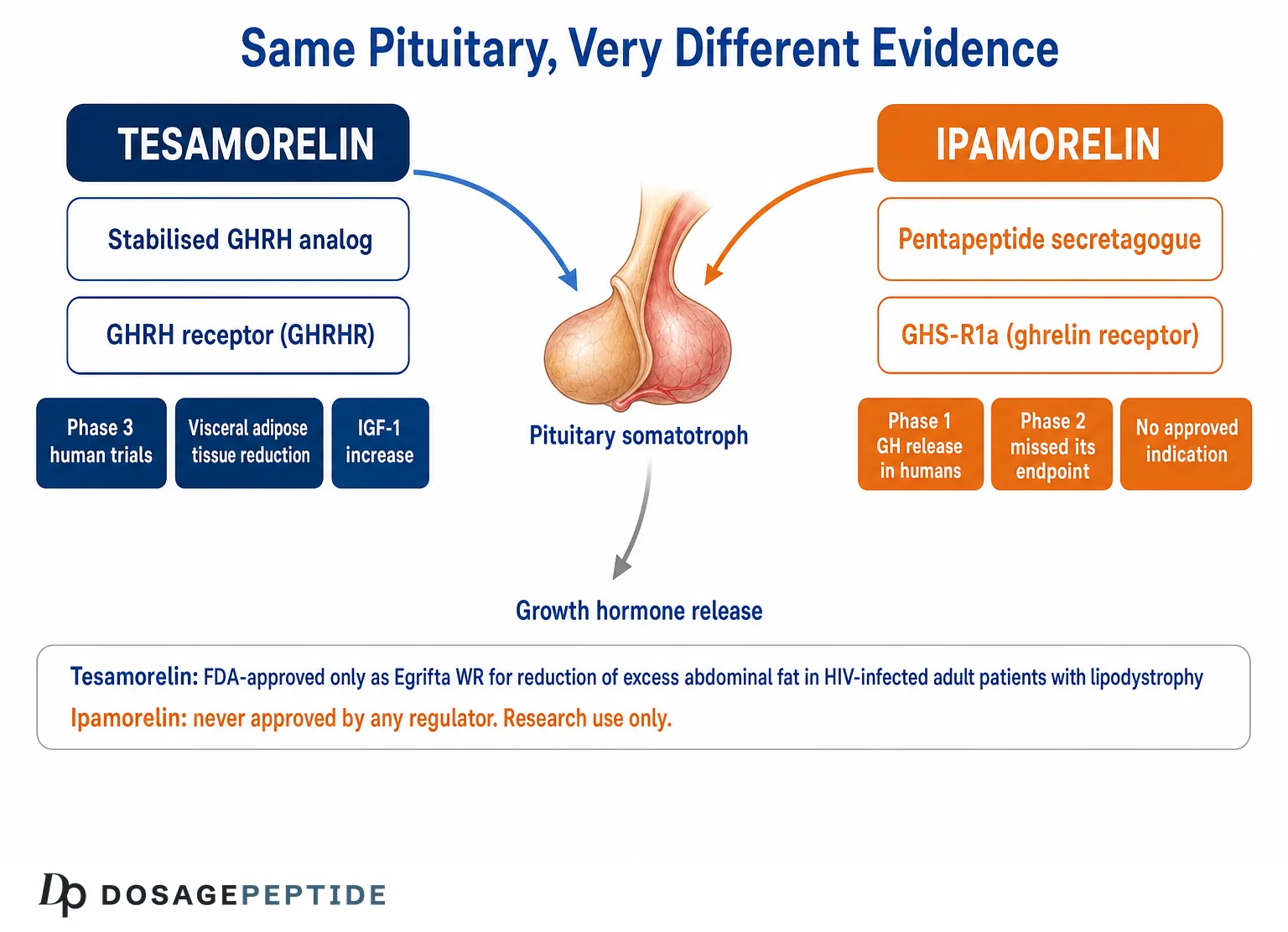
The short answer. Tesamorelin is a stabilised analog of growth hormone-releasing hormone (GHRH) acting on the GHRH receptor. It is FDA-approved for one narrow indication — the reduction of excess abdominal fat in HIV-infected adult patients with lipodystrophy — with an explicit limitation of use stating it is not indicated for weight loss.[6] Ipamorelin is a pentapeptide agonist of the ghrelin receptor (GHS-R1a), never approved anywhere for any indication; its human efficacy record is one failed Phase 2 trial.
| Dimension | Tesamorelin | Ipamorelin |
|---|---|---|
| Peptide class | Stabilised GHRH analog: the 44-amino-acid human GRF sequence plus a hexenoyl moiety, a C6 chain with a double bond at position 3, on the N-terminal tyrosine[6] | Synthetic pentapeptide, Aib-His-D-2-Nal-D-Phe-Lys-NH2; GHRP family[7] |
| Receptor target | GHRH receptor (GHRHR) on pituitary somatotrophs | GHRP-type receptor, subsequently identified as the ghrelin receptor / GHS-R1a[7] |
| Regulatory status | FDA-approved, currently labeled as Egrifta WR, for one indication only: reduction of excess abdominal fat in HIV-infected adult patients with lipodystrophy. Not approved for body composition, anti-aging or performance use[6] | Never approved anywhere, and not in active development: clinical work for postoperative ileus stopped after Phase 2[8] |
| Depth of human evidence | Two placebo-controlled Phase 3 trials (806 randomised, pooled), randomised 26-week extensions, and a 12-month randomised liver-fat trial[1][5] | One Phase 1 PK/PD study in 40 healthy men (GH release confirmed, no efficacy endpoint)[15]; one published Phase 2 proof-of-concept trial (114 analysed) that missed its efficacy endpoint; a larger Phase 2 dose-finding study with no posted results[8][9]. No human efficacy trial in body composition |
| What the trials measured | Visceral adipose tissue (VAT) by CT as primary endpoint; secondary: waist circumference, trunk fat, IGF-1, glucose, body image ratings[2] | Time to tolerance of a standardised solid meal after bowel resection; safety[8] |
| Duration / frequency used in studies | 2 mg subcutaneously once daily for 26 weeks, extended to 52; 2 mg daily for 12 months in the liver-fat trial. Approved product: 1.28 mg once daily[1][6] | 0.03 mg/kg intravenously twice daily for up to 7 days — acute inpatient, not chronic[8] |
| Selectivity profile | Acts through the physiological GHRH pathway, so output stays subject to somatostatin feedback. On-target consequence: large IGF-1 elevation[1] | In swine, did not raise ACTH or cortisol above the levels seen after GHRH stimulation, even at doses more than 200-fold above the GH ED50; no secretagogue tested altered FSH, LH, PRL or TSH. Animal data[7] |
| Research material | Research-grade tesamorelin is not the FDA-approved drug product and carries none of its manufacturing guarantees | Research-chemical grade only, with no approved reference product |
What is tesamorelin, and what did its trials actually measure?
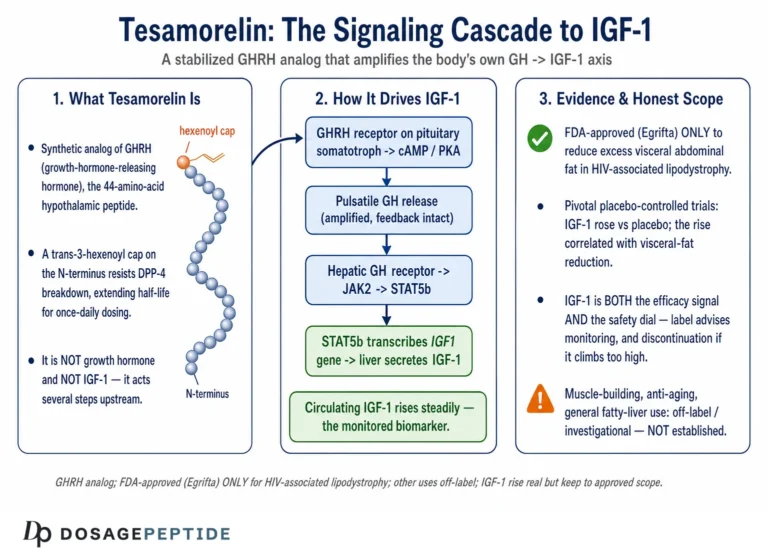
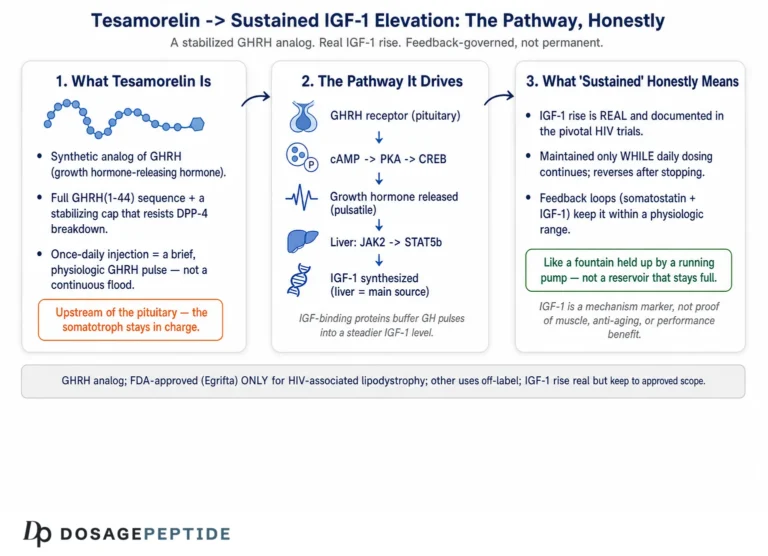
As a GHRH-receptor agonist, tesamorelin prompts somatotrophs to release growth hormone in a pattern that still respects somatostatin feedback.[6] We cover what Tesamorelin is separately, and compare it with the shorter GHRH fragment in Tesamorelin compared with Sermorelin.
What the Phase 3 programme found
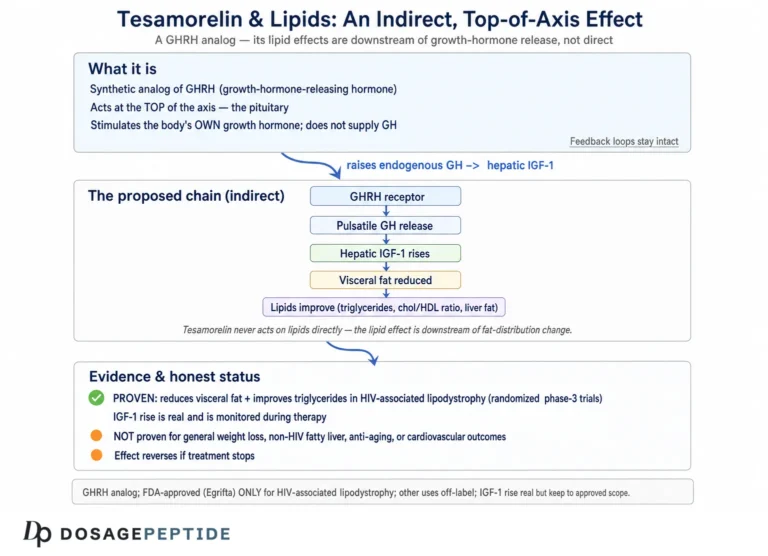
Two multicentre, double-blind, placebo-controlled Phase 3 studies randomised antiretroviral-treated patients with HIV and excess abdominal fat 2:1 to tesamorelin 2 mg subcutaneously daily or placebo for 26 weeks. In the pooled analysis of 806 patients, visceral adipose tissue fell by −24 ± 41 cm² on tesamorelin versus a 2 ± 35 cm² increase on placebo (p<0.001); that is a 15.4% fall from baseline within the tesamorelin arm — a within-group change, not a placebo-adjusted treatment effect. Subcutaneous abdominal fat did not change meaningfully, so the effect was compartment-specific, not general weight loss. Triglycerides fell, and mean IGF-1 rose by 108 ± 112 ng/mL versus −7 ± 64 on placebo.[1] In the 12-month study, VAT fell about 18% in patients who stayed on drug for the full year.[2] Our page on what tesamorelin does to visceral fat covers those endpoints in detail.
Separately, and not as an extension of those efficacy findings, the Tesamorelin 10 mg vial dosage protocol relates the trial amount (2 mg/day) and label amount (1.28 mg/day) — both prescription-product doses — to a 10 mg research vial.
A separate randomised, double-blind, 12-month trial in 61 people with HIV and non-alcoholic fatty liver disease found a −4.1% absolute (−37% relative) reduction in hepatic fat fraction versus placebo, and 35% versus 4% reaching below 5%.[5] That work is investigational: liver fat is not part of the approved indication.
What the documented adverse-effect profile looks like
From the trial record and approved labeling, as documented observations:
- Injection-site reactions. Overall incidence 25% versus 14% on placebo over the first 26 weeks; in the adverse-reactions table a composite term — erythema, pruritus, rash, urticaria, pain, swelling, irritation, haemorrhage — occurred in 17% versus 6%. Erythema is not reported separately.[6]
- Arthralgia, myalgia, peripheral oedema, pain in extremity. In the label’s table of reactions occurring in at least 1% of treated patients and more often than on placebo: arthralgia 13% versus 11%, pain in extremity 6% versus 5%, peripheral oedema and myalgia both 6% versus 2%.[6]
- IGF-1 elevation. At 26 weeks, 47% of treated patients had IGF-1 above 2 standard deviation scores and 36% above 3 SDS.[6]
- Warnings not captured by the frequency tables. The labeling warns on neoplasms — the stated rationale for IGF-1 monitoring, with treatment discontinued on evidence of recurrent malignancy — plus fluid retention and hypersensitivity reactions, and contraindicates the product in active malignancy, disrupted hypothalamic-pituitary axis, and pregnancy.[6]
- Glucose. Mixed, and worth stating precisely. The pooled Phase 3 analysis reported no clinically meaningful between-group differences in glucose parameters at 26 or 52 weeks.[1] The labeling nonetheless records 5% of treated patients developing an HbA1c of 6.5% or above versus 1% on placebo, hazard ratio 3.3.[6] Patients achieving at least an 8% VAT reduction preserved glucose homeostasis better than non-responders,[3] and a predictor analysis of the same 806-patient dataset linked baseline metabolic syndrome and triglycerides above 1.7 mmol/L to the likelihood of a VAT response.[4] The signal tracks with who responds.
What happened when it was stopped
The most under-reported finding in this literature. In the 12-month study, patients treated for the first 6 months were re-randomised to continue or switch to placebo; in the switch group the visceral-fat improvement was rapidly lost.[2] The effect is maintained by continued exposure, not a durable structural change.
What is ipamorelin, and how thin is its human evidence?
Ipamorelin is a pentapeptide from a 1990s Novo Nordisk programme around GHRP-1 analogues. It released GH from rat pituitary cells comparably to GHRP-6, and antagonist profiling showed it acts via the GHRP-type receptor — later identified as the ghrelin receptor, GHS-R1a — not the GHRH receptor.[7]
The selectivity claim, stated accurately
Its reputation rests on one finding: in conscious swine, ipamorelin did not raise ACTH or cortisol above the levels seen after GHRH stimulation, even at doses more than 200-fold above the ED50 for GH release, and no secretagogue tested altered FSH, LH, prolactin or TSH; GHRP-6 and GHRP-2 did raise ACTH and cortisol.[7] That is a well-executed animal finding, not reproduced in humans. The species boundary matters.
The human efficacy record
Ipamorelin went into Phase 2 for postoperative ileus, not body composition. In a randomised, double-blind, placebo-controlled proof-of-concept study in bowel-resection patients (117 enrolled, 114 analysed), intravenous ipamorelin 0.03 mg/kg twice daily for up to 7 days was well tolerated but produced no significant difference from placebo on the key endpoint: median time to first tolerated solid meal 25.3 versus 32.6 hours, p = 0.15.[8] A larger 320-patient Phase 2 dose-finding study completed in 2014 with no results posted and no located publication.[9] No Phase 3 programme, no approval, no human trial measuring body composition.
Beyond that programme, ipamorelin’s human record is a single Phase 1 dose-escalation study in 40 healthy men, which established that intravenous ipamorelin does release GH in humans — terminal half-life about 2 hours, GH peaking near 0.67 hours — but measured no efficacy outcome.[15] The rest is animal work: dose-dependent increases in longitudinal bone growth in adult female rats[10]; partial reversal of glucocorticoid-induced loss of bone formation in rats[11]; accelerated gastrointestinal transit in a rodent ileus model[12].
Ipamorelin therefore has no published human dosing regimen outside that 7-day intravenous inpatient study; the vial arithmetic used in research settings is set out in the Ipamorelin 10 mg vial dosage protocol, and is not derived from any efficacy finding.
Why are tesamorelin and ipamorelin blended?
Because they hit different receptors on the same cell. Somatotrophs express both GHRHR and GHS-R1a, and the pathways are not redundant. The foundational human demonstration is from 1990: in 18 normal men, submaximal doses of a GHRP given with GHRH produced synergistic GH release — more than the sum of either alone — which the authors read as evidence of independent mechanisms.[13] That is the whole rationale for pairing a GHRH analog with a GHRP, and it is legitimate.
The honest part: that synergy was shown with different molecules, on an acute single-dose GH readout — not with tesamorelin plus ipamorelin, not over weeks, not on any body-composition outcome. We could not locate a controlled human trial of the combination. The blend has a rationale; it has no outcome dataset.
The blend is commonly sold at a fixed 1:1 ratio — for example 5 mg tesamorelin with 5 mg ipamorelin in a 10 mg vial — so the components cannot be varied independently, and nothing in the design tells you which one produced an observation. That is a constraint worth stating explicitly in any research protocol write-up; the arithmetic is in the Ipamorelin + Tesamorelin blend protocol and our full Tesamorelin + Ipamorelin dosing reference, and handling in the peptide reconstitution guide.
How should IGF-1 be read as a proxy endpoint?
GH is pulsatile, so a single measurement of it means little; IGF-1 integrates GH exposure over roughly a day. It marks whether the axis was engaged — not whether anything useful happened, and these two peptides show that from opposite directions.
- IGF-1 can rise substantially and still not be the outcome. Tesamorelin raised IGF-1 by roughly 108 ng/mL on average in the Phase 3 pooled analysis,[1] but the endpoint that earned the approval was CT-measured visceral adipose tissue — and about half of treated patients exceeded 2 SDS, which the labeling treats as a neoplasm-risk monitoring trigger, not a success signal.[6]
- An effect can occur without IGF-1 moving. In the rat longitudinal-growth study, ipamorelin increased bone growth rate and body weight while total IGF-1, IGF binding proteins and bone turnover markers were unchanged.[10]
Treat it as a pharmacodynamic and safety marker, not a surrogate for fat or muscle mass.
What the evidence does not show
- Tesamorelin’s approval does not generalise. The indication is the reduction of excess abdominal fat in HIV-infected adult patients with lipodystrophy, and what the trials moved was the visceral compartment, not subcutaneous fat. No trial has shown an equivalent effect in people without HIV, and the labeling states it is not indicated for weight loss and that long-term cardiovascular safety is not established.[6]
- Research-grade material is not the approved drug. A vial of tesamorelin sold for laboratory research shares a name with Egrifta WR and nothing else.
- Ipamorelin has no positive human efficacy result. Not a weak one — none. Its one published human efficacy trial did not separate from placebo.[8]
- The combination has no controlled human outcome data. The GHRH + GHRP synergy literature is acute GH-release physiology with other molecules.[13]
- Neither has anti-aging evidence. No trial in either programme enrolled healthy older adults with an aging-related endpoint.
- Both are prohibited in sport. Tesamorelin appears among the GHRH analogues and ipamorelin among the growth hormone secretagogues in section S2.2.4 of the 2026 WADA Prohibited List; S2 substances are prohibited at all times, in and out of competition.[14]
Which peptide suits which research question?
For visceral adiposity, hepatic fat, GHRH-receptor pharmacology or IGF-1 dose-response: tesamorelin — within this pair, the only compound with replicated placebo-controlled Phase 3 data on a hard imaging endpoint plus a re-randomisation arm. For ghrelin-receptor pharmacology, pulse architecture, selectivity or gut motility: ipamorelin, as a clean GHS-R1a probe rather than a proven intervention. The blend is hypothesis-generating only.
Frequently Asked Questions
Is tesamorelin stronger than ipamorelin?
“Stronger” is the wrong axis: different receptors, so potencies are not comparable per milligram. Evidence is. Tesamorelin has replicated Phase 3 data with an imaging endpoint; ipamorelin has preclinical pharmacology, one Phase 1 study showing GH release in humans, and one Phase 2 trial that missed its endpoint.
Is tesamorelin FDA-approved?
Yes, for one narrow indication only: the reduction of excess abdominal fat in HIV-infected adult patients with lipodystrophy, currently labeled as Egrifta WR. That is not an approval for body-composition, anti-aging or performance use, and the labeling states it is not indicated for weight loss. Research-grade tesamorelin is not the approved product.
Is ipamorelin FDA-approved?
No, and it never has been, by any regulator, for any indication. It reached Phase 2 for postoperative ileus, the published proof-of-concept study found no significant difference from placebo, and development stopped. It exists today as a research chemical.
Why are tesamorelin and ipamorelin sold together as a blend?
Because the two agonists stimulate the same pituitary cells through independent pathways, and a 1990 human study showed a GHRH plus a GHRP produced synergistic acute GH release. That is a mechanistic rationale, not evidence of additive outcomes — no controlled human trial of the combination exists.
What adverse effects were documented in the tesamorelin trials?
Injection-site reactions were most frequent, 25% versus 14% on placebo, with a composite injection-site term at 17% versus 6% in the label’s adverse-reactions table. Arthralgia (13% versus 11%), pain in extremity, peripheral oedema and myalgia also appear; IGF-1 exceeded 2 SDS in 47% of treated patients at 26 weeks. The labeling warns on neoplasms, fluid retention and hypersensitivity.
Can IGF-1 be used to tell whether a GH-axis peptide is working?
It shows the axis was engaged, because it integrates GH exposure over roughly a day, but not that a useful outcome followed. Tesamorelin’s approval rested on CT-measured visceral fat, and in rat work ipamorelin produced growth effects with no change in total IGF-1.
Are tesamorelin and ipamorelin banned in sport?
Yes. Both are named in section S2.2.4 of the 2026 WADA Prohibited List — tesamorelin among the GHRH analogues, ipamorelin among the growth hormone secretagogues — and S2 substances are prohibited at all times.
References
- Falutz J, Mamputu JC, Potvin D, et al. Effects of tesamorelin (TH9507), a growth hormone-releasing factor analog, in HIV-infected patients with excess abdominal fat: a pooled analysis of two multicenter, double-blind placebo-controlled phase 3 trials with safety extension data. J Clin Endocrinol Metab. 2010;95(9):4291–4304. https://pubmed.ncbi.nlm.nih.gov/20554713/
- Falutz J, Potvin D, Mamputu JC, et al. Effects of tesamorelin, a growth hormone-releasing factor, in HIV-infected patients with abdominal fat accumulation: a randomized placebo-controlled trial with a safety extension. J Acquir Immune Defic Syndr. 2010;53(3):311–322. https://pubmed.ncbi.nlm.nih.gov/20101189/
- Stanley TL, Falutz J, Marsolais C, et al. Reduction in visceral adiposity is associated with an improved metabolic profile in HIV-infected patients receiving tesamorelin. Clin Infect Dis. 2012;54(11):1642–1651. https://pmc.ncbi.nlm.nih.gov/articles/PMC3348954/
- Mangili A, Falutz J, Mamputu JC, Stepanians M, Hayward B. Predictors of treatment response to tesamorelin, a growth hormone-releasing factor analog, in HIV-infected patients with excess abdominal fat. PLoS One. 2015;10(10):e0140358. https://pmc.ncbi.nlm.nih.gov/articles/PMC4601733/
- Stanley TL, Fourman LT, Feldpausch MN, et al. Effects of tesamorelin on non-alcoholic fatty liver disease in HIV: a randomised, double-blind, multicentre trial. Lancet HIV. 2019;6(12):e821–e830. https://pmc.ncbi.nlm.nih.gov/articles/PMC6981288/
- EGRIFTA WR (tesamorelin) for injection — US prescribing information. Theratechnologies Inc. DailyMed, National Library of Medicine. https://dailymed.nlm.nih.gov/dailymed/drugInfo.cfm?setid=839334d3-8c1d-4c26-9036-2ab524a6ea75
- Raun K, Hansen BS, Johansen NL, et al. Ipamorelin, the first selective growth hormone secretagogue. Eur J Endocrinol. 1998;139(5):552–561. https://pubmed.ncbi.nlm.nih.gov/9849822/
- Beck DE, Sweeney WB, McCarter MD, et al. Prospective, randomized, controlled, proof-of-concept study of the ghrelin mimetic ipamorelin for the management of postoperative ileus in bowel resection patients. Int J Colorectal Dis. 2014;29(12):1527–1534. https://pubmed.ncbi.nlm.nih.gov/25331030/
- NCT01280344 — Safety and efficacy of ipamorelin compared to placebo for the recovery of gastrointestinal function (Phase 2, Helsinn Therapeutics, completed 2014, no results posted). ClinicalTrials.gov. https://clinicaltrials.gov/study/NCT01280344
- Johansen PB, Nowak J, Skjaerbaek C, et al. Ipamorelin, a new growth-hormone-releasing peptide, induces longitudinal bone growth in rats. Growth Horm IGF Res. 1999;9(2):106–113. https://pubmed.ncbi.nlm.nih.gov/10373343/
- Andersen NB, Malmlöf K, Johansen PB, et al. The growth hormone secretagogue ipamorelin counteracts glucocorticoid-induced decrease in bone formation of adult rats. Growth Horm IGF Res. 2001;11(5):266–272. https://pubmed.ncbi.nlm.nih.gov/11735244/
- Venkova K, Mann W, Nelson R, Greenwood-Van Meerveld B. Efficacy of ipamorelin, a novel ghrelin mimetic, in a rodent model of postoperative ileus. J Pharmacol Exp Ther. 2009;329(3):1110–1116. https://pubmed.ncbi.nlm.nih.gov/19289567/
- Bowers CY, Reynolds GA, Durham D, Barrera CM, Pezzoli SS, Thorner MO. Growth hormone (GH)-releasing peptide stimulates GH release in normal men and acts synergistically with GH-releasing hormone. J Clin Endocrinol Metab. 1990;70(4):975–982. https://pubmed.ncbi.nlm.nih.gov/2108187/
- World Anti-Doping Agency. World Anti-Doping Code International Standard — Prohibited List 2026, section S2.2 (peptide hormones and their releasing factors), sub-section S2.2.4; prohibited at all times. Effective 1 January 2026. https://www.wada-ama.org/sites/default/files/2025-09/2026list_en_final_clean_september_2025.pdf
- Gobburu JV, Agersø H, Jusko WJ, Ynddal L. Pharmacokinetic-pharmacodynamic modeling of ipamorelin, a growth hormone releasing peptide, in human volunteers. Pharm Res. 1999;16(9):1412–1416. https://pubmed.ncbi.nlm.nih.gov/10496658/
This article is provided for research and educational purposes only. Tesamorelin and ipamorelin discussed here as research compounds are intended strictly for laboratory research use and are not for human or veterinary consumption. Nothing above is medical advice, a treatment protocol, or a recommendation to use any compound in humans. Tesamorelin is FDA-approved only as Egrifta WR for the reduction of excess abdominal fat in HIV-infected adult patients with lipodystrophy; ipamorelin is not approved for any indication. Doses cited are descriptions of amounts used in published studies, not instructions. Consult a qualified healthcare professional for any question relating to human health.