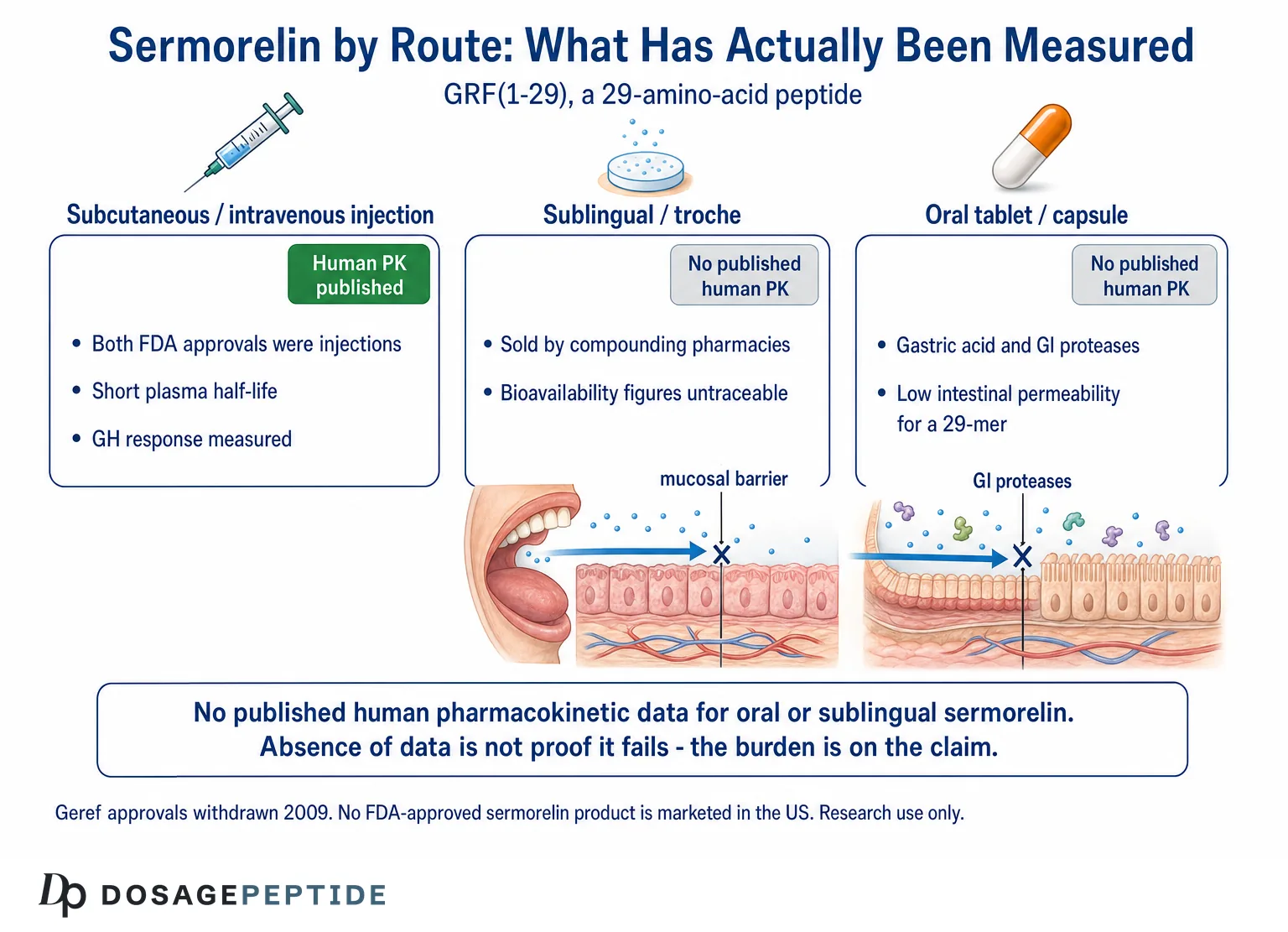
Sermorelin tablets, troches and sublingual drops are sold widely, but the honest answer to whether they work is that nobody has published the data either way. Every registered clinical trial and both FDA approvals sermorelin ever held were for an injected product; the only needle-free route ever measured in humans was intranasal, and it performed poorly. A search of PubMed and ClinicalTrials.gov returns no human absorption or growth-hormone-response study for oral or sublingual sermorelin — so the claim that a troche delivers a meaningful dose is currently an unsupported marketing assertion, not a documented pharmacological fact.
Route comparison: what is actually documented
This table separates what has been measured from what has only been asserted. Read the middle column carefully — the gaps are the story.
| Route | What is documented in the published/regulatory record | What is missing |
|---|---|---|
| Subcutaneous / intravenous injection | Both FDA approvals (GEREF, NDA 19-863 and NDA 20-443) were injections[1]. Archived labeling reports a mean absolute bioavailability of about 6% after subcutaneous dosing, peak levels at 5–20 minutes, and a half-life of roughly 11–12 minutes[2]. Independent human work puts the intravenous disappearance half-time at 4.3 ± 1.4 minutes[3]; review literature cites 10–20 minutes in humans[4]. | Nothing on absorption. This is the only route with a regulatory dossier. |
| Intranasal (not commonly sold, but informative) | In 30 healthy men, GHRH(1–29)-NH2 given intranasally had a bioavailability of only 3–5%, and about 50 µg/kg intranasally was needed to match 1 µg/kg intravenously — a roughly 50-fold dose penalty[5]. | Not carried through to an approved product — the only sermorelin products ever approved in the United States were the two injections[1]. Useful mainly as a ceiling estimate for mucosal routes. |
| Sublingual / buccal troche, lozenge, spray | No published human pharmacokinetic study. No published growth-hormone-response study. No registered clinical trial. A PubMed search pairing sermorelin with the sublingual route returns no human pharmacokinetic or pharmacodynamic study. | Bioavailability, Cmax, Tmax, GH area-under-curve, IGF-1 response, dose equivalence to injection, batch-to-batch consistency. All of it. |
| Oral tablet / capsule (swallowed) | No published human data. Reviews of oral peptide development treat gastrointestinal proteolysis and low epithelial permeability as structural barriers that unmodified peptides do not cross without engineered help[6]. Applying that general principle to a 29-residue amidated peptide of ~3,358 Da, there is no established unassisted route across the gut wall — but that is an inference from the class, not a measurement of sermorelin. | Everything. No permeation-enhancer formulation of sermorelin has been described in the clinical literature. |
“No data” is not the same as “proven not to work.” It means the burden of proof sits with whoever is selling the product, and that burden has not been met publicly. That distinction matters more than any single number below.
What is sermorelin, chemically?
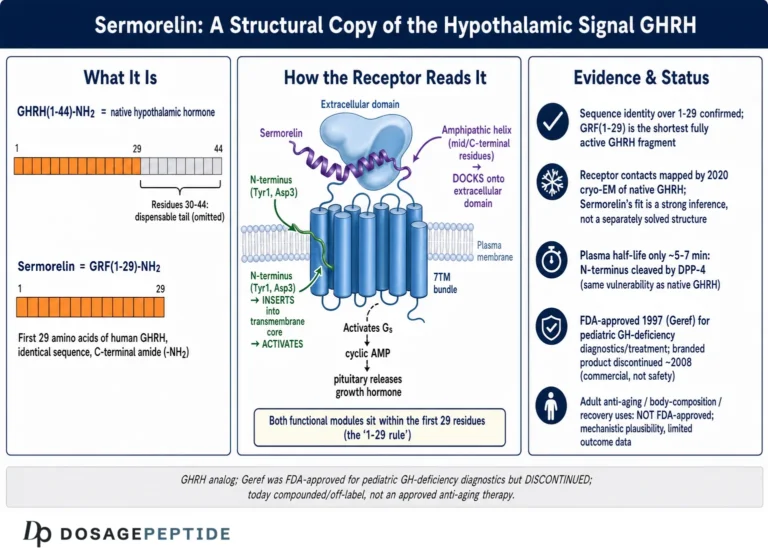
Sermorelin is GRF(1–29)-NH2: the first 29 amino acids of the 44-residue human growth hormone-releasing hormone, with a C-terminal amide. Review literature describes that fragment as maintaining bioactivity in vitro and being almost equally effective in vivo at eliciting endogenous growth hormone secretion compared with the full-length hormone[4]. Its molecular formula is C149H246N44O42S and its molecular weight is approximately 3,358 Da[7].
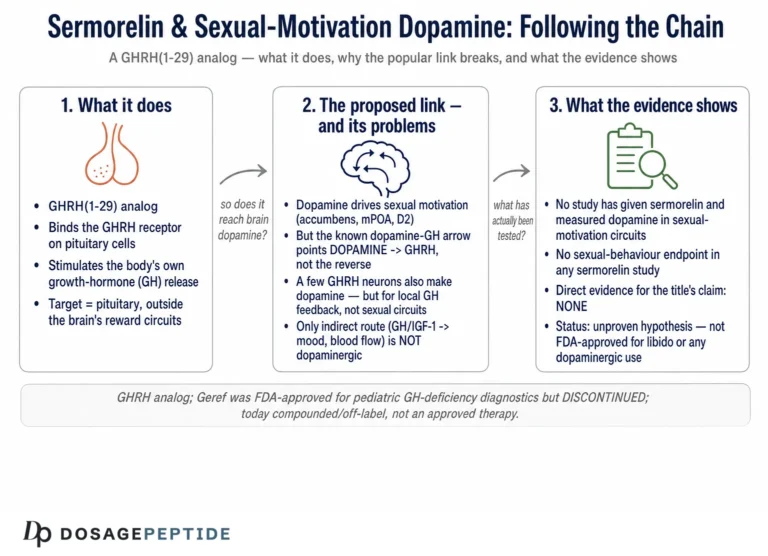
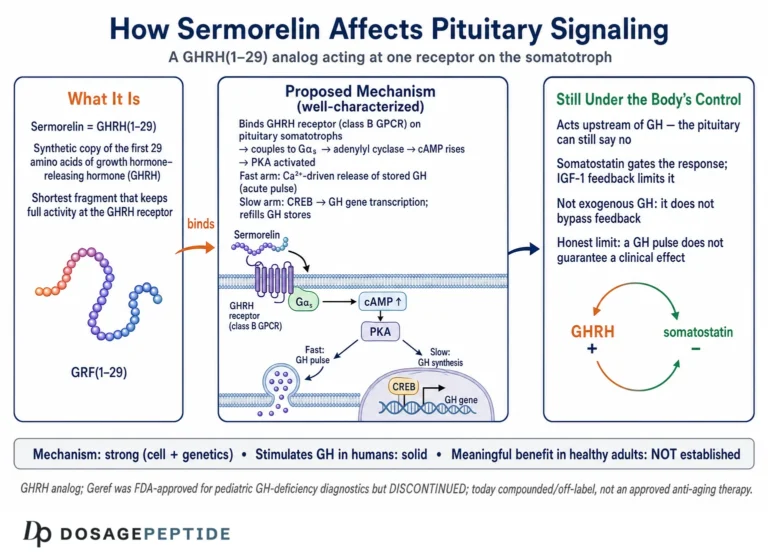
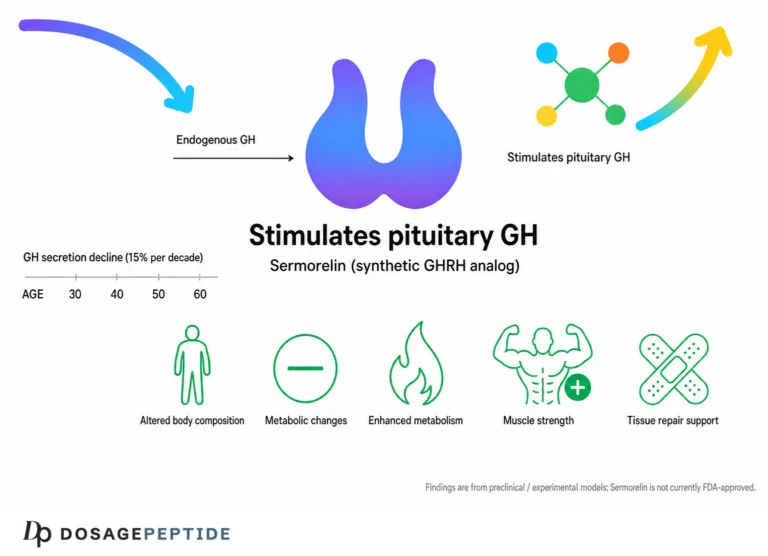
Mechanistically it is a secretagogue: it acts on pituitary somatotrophs to stimulate release of endogenous growth hormone rather than supplying growth hormone itself. Our overview of what research says about sermorelin’s role in stimulating natural growth hormone covers that pharmacology in more detail. For present purposes, the number that matters is 3,358 Da — roughly seven times the ~500 Da rule-of-thumb ceiling normally associated with passive oral absorption of small molecules.
Was sermorelin ever FDA-approved, and what happened to it?
Yes — twice, and both as injections. The regulatory record is unusually clear here, so it is worth stating precisely:
- NDA 19-863, GEREF (sermorelin acetate) injection, 0.05 mg base/amp, held by EMD Serono, initially approved 28 December 1990, indicated for evaluating the ability of the pituitary somatotroph to secrete growth hormone — a diagnostic agent.
- NDA 20-443, GEREF (sermorelin acetate) injection, 0.5 mg and 1.0 mg base/vial, held by EMD Serono, initially approved 26 September 1997, indicated for the treatment of idiopathic growth hormone deficiency in children with growth failure.
EMD Serono notified FDA that the products were being discontinued in letters dated 11 July 2008 (the 0.05 mg/amp form, NDA 19-863) and 2 December 2008 (the 0.5 and 1.0 mg/vial forms, NDA 20-443), requesting withdrawal of NDA 20-443 in the December letter and of NDA 19-863 in a further letter dated 12 December 2008. FDA announced withdrawal of both NDAs effective 18 June 2009[8]. In 2013, responding to a citizen petition, FDA formally determined that GEREF was not withdrawn from sale for reasons of safety or effectiveness[1]. That determination is a commercial-withdrawal finding, not an endorsement.
The practical consequence: there is no marketed FDA-approved sermorelin product in the United States today. Material in circulation comes from compounding pharmacies (frequently via telehealth prescribing) or is sold as research-use-only chemical. Neither category carries approved labeling, and notably, neither approved product was ever an oral or sublingual dosage form — so no oral bioavailability dossier has ever existed for sermorelin at any regulator.
Why is oral delivery of a 29-mer peptide so difficult?
\n
\n
Three independent barriers stack up, and each one alone is usually enough to sink an unmodified peptide.
Gastric acid and gastrointestinal proteases
A swallowed peptide meets stomach acid, pepsin, then pancreatic trypsin and chymotrypsin, then brush-border peptidases. Reviews of oral peptide development treat proteolysis and low permeability as the two structural obstacles that any successful formulation must engineer around — not as incidental losses[6].
Enzymatic inactivation even in plasma
Growth hormone-releasing hormone and its fragments are degraded in plasma primarily by dipeptidyl peptidase-4, which removes the N-terminal Tyr-Ala dipeptide in a single cleavage step; the same rapid cleavage was demonstrated for the 1–29 fragment, with a trypsin-like plasma activity contributing a second cleavage[9]. Review literature attributes sermorelin’s short plasma half-life mainly to renal ultrafiltration plus that N-terminal enzymatic degradation[4]. This is why the CJC-1295 and tesamorelin design work centred on protecting position 2 — a point we cover in sermorelin vs CJC-1295 and tesamorelin vs sermorelin. Any molecule that survives the gut still has to survive this.
The injected route is already inefficient
This is the point most oral marketing skips. Archived GEREF labeling reports mean absolute bioavailability of only about 6% after subcutaneous injection[2]. If pushing the peptide directly into subcutaneous tissue — bypassing the stomach, the gut wall and the liver entirely — still only lands about 6% in the bloodstream, an oral or sublingual route starts from a substantially worse position, not a better one.
Does sublingual delivery solve the problem?
Sublingual and buccal routes are genuinely useful — they bypass gastric acid and hepatic first-pass metabolism, and the sublingual epithelium is thin and richly vascularised. But they are not a free pass for large molecules. A review of published buccal permeability data estimated an effective pore radius of roughly 1.5–3 nm for the buccal paracellular pathway and reported extremely low permeability coefficients for macromolecules — insulin, for example, at a log permeability of −8.18 cm/s — in ex vivo porcine buccal tissue without enhancers[10]. Two caveats belong with those figures: they are animal tissue rather than human in vivo measurement, and they are buccal rather than sublingual mucosa, which is generally regarded as somewhat more permeable. They are therefore an order-of-magnitude orientation, not a sublingual number for sermorelin.
The two most cited “peptides that made it” illustrate the scale of engineering involved — and both got there by a route sermorelin has never been through:
- Desmopressin is a 9-amino-acid peptide, far smaller than sermorelin’s 29 residues. The sublingual lyophilisate (DDAVP Melt) has a documented mean systemic bioavailability of 0.25% (95% CI 0.21–0.31%)[11]. It remains usable at that absorption because the amounts involved are tiny — the sublingual melts are dosed in micrograms[11], whereas the withdrawn sermorelin injections were 0.5–1.0 mg per vial[1]. Losing 99.75% of a microgram dose is survivable; there is no published evidence sermorelin has that kind of margin.
- Oral semaglutide required co-formulation with the permeation enhancer SNAC. Mechanistic work showed absorption takes place in the stomach, confined to a small zone close to the tablet surface, is transcellular, and depends on SNAC buffering the local environment against enzymatic degradation[12]. Even with that purpose-built system, the FDA label gives estimated absolute bioavailability of approximately 0.4% to 1% for the 3 mg, 7 mg and 14 mg tablets[13].
Both of those took formulation programmes with published pharmacokinetics behind them. A compounded sermorelin troche has neither an enhancer system described in the literature nor a published bioavailability figure. Whether one dissolved under the tongue delivers 5%, 0.5% or 0.05% of its label amount into plasma is, at present, simply unknown.
Where does the closest available evidence point?
The most relevant human data point is not oral at all — it is nasal. When GHRH(1–29)-NH2 was given intranasally to 30 healthy men, bioavailability was 3–5%, and roughly 50 times the intravenous dose was needed to produce a comparable growth-hormone response[5].
In fairness to that paper, its authors read their own result optimistically and concluded it would be justified to test intranasal therapy in children with growth hormone deficiency — single-digit bioavailability can still be workable if you are willing to raise the dose enough. Read across to the sublingual question, though, the same data function as a caution. Investigators who deliberately went looking for a needle-free route for this exact molecule reached for the nasal mucosa — thinner and generally more permeable than the lining of the mouth — measured single-digit percentage bioavailability, and never published an oral or sublingual attempt. That is not proof a troche fails. It does mean the “sublingual works almost as well as injection” claim has no experimental foundation in the peer-reviewed record.
What is a compounded sermorelin troche, in regulatory terms?
Sermorelin acetate appears on FDA’s list of bulk drug substances nominated for use in compounding under section 503B, in Category 1 (“under evaluation”), carrying FDA’s asterisk marker for substances that are components of FDA-approved drugs — in sermorelin’s case, drugs whose approvals were withdrawn in 2009[14]. Two things follow, and they are frequently conflated:
- That listing concerns the substance. It says nothing about any particular dosage form, and it is not an approval. FDA states plainly: “Compounded drugs are not FDA-approved. This means the agency does not review their safety, effectiveness or quality before they are marketed.”[15]
- Because there is no approved oral or sublingual sermorelin product anywhere, a compounded troche has no reference labeling, no approved potency specification and no bioavailability dossier to be measured against. The strength printed on the vial or troche is a formulation input, not a demonstrated delivered dose.
Research-use-only vendors sit further outside this framework still: RUO material is not intended for human administration at all, and is not held to pharmaceutical release testing.
What would actually settle the question?
A study design capable of answering “does oral sermorelin work?” is not exotic. It would need, at minimum:
- A randomised crossover in healthy volunteers comparing a defined sublingual or oral formulation against subcutaneous injection of the same nominal dose.
- A validated assay for intact sermorelin (not total GHRH immunoreactivity, which cross-reacts with N-terminally truncated cleavage products) giving Cmax, Tmax, AUC and absolute bioavailability.
- A pharmacodynamic endpoint — serum growth hormone area-under-curve over the hours after dosing, and IGF-1 after repeated administration — because a secretagogue that reaches plasma but produces no GH pulse has failed anyway.
- Content-uniformity and stability data for the specific compounded formulation.
Until something of that shape is published, statements about sublingual sermorelin potency relative to injection should be treated as untested. If you are comparing what is documented for the injected form, our sermorelin 5 mg vial dosage protocol reference and the sermorelin 10 mg vial reference summarise the research-record figures, our peptide reconstitution guide covers how lyophilised material is handled in laboratory settings, and the documented sermorelin adverse-effect profile comes almost entirely from injection-route studies — another reason an unvalidated oral form cannot simply inherit an injected product’s safety record.
Research-use-only notice. Everything above describes published research findings and regulatory records. Sermorelin is not currently available as an FDA-approved product in the United States, and nothing here is a recommendation to use sermorelin by any route, at any dose, in humans. Compounded and research-grade peptides are not approved drugs. Decisions about medical care belong with a qualified, licensed clinician.
Frequently Asked Questions
Do sermorelin tablets work?
There is no published human study measuring absorption or growth-hormone response after swallowed sermorelin, so the question has no evidence-based answer yet. What is known is that a 3,358 Da, 29-residue peptide faces gastric acid, gut proteases and very poor intestinal permeability, and that the peptides which have succeeded orally required purpose-built permeation-enhancer systems. Absence of data is not proof of failure, but the claim remains unsupported.
Is sublingual sermorelin as effective as injections?
No study has ever compared them. A PubMed search pairing sermorelin with the sublingual route returns no human pharmacokinetic or pharmacodynamic study, and no such trial is registered on ClinicalTrials.gov. The nearest relevant human data is intranasal GHRH(1–29), which achieved only 3–5% bioavailability and required roughly 50 times the intravenous dose for a comparable growth-hormone response.
Is sermorelin FDA-approved?
Not currently. Two injectable GEREF products were approved — a diagnostic form in December 1990 (NDA 19-863) and a paediatric growth hormone deficiency treatment in September 1997 (NDA 20-443). Both were voluntarily discontinued by EMD Serono and the approvals were withdrawn effective 18 June 2009. FDA later determined the withdrawal was not for reasons of safety or effectiveness. No oral or sublingual sermorelin has ever been approved.
What is the half-life of sermorelin?
Short. Archived product labeling reports roughly 11–12 minutes after intravenous or subcutaneous administration. A controlled human infusion study measured an intravenous disappearance half-time of 4.3 ± 1.4 minutes for GHRH(1–29)-NH2, and review literature cites 10–20 minutes in humans. The main clearance routes described are renal ultrafiltration and enzymatic cleavage at the N-terminus by dipeptidyl peptidase-4.
Why is oral bioavailability of peptides so low?
Three barriers compound. Gastric acid and pepsin attack the peptide first; pancreatic and brush-border proteases continue the job; and what survives must still cross an intestinal epithelium that is essentially impermeable to hydrophilic molecules of that size. Oral semaglutide, the flagship success, is labelled at an estimated absolute bioavailability of approximately 0.4% to 1% for its 3, 7 and 14 mg tablets despite a dedicated permeation-enhancer co-formulation.
Is a compounded sermorelin troche an FDA-approved product?
No. FDA states that compounded drugs are not FDA-approved and that the agency does not review their safety, effectiveness or quality before they are marketed. Sermorelin acetate does appear in Category 1 of FDA’s 503B nominated bulk substances list, carrying the agency’s marker for components of FDA-approved drugs — here, drugs withdrawn in 2009 — but that concerns the raw substance, not any troche, tablet or spray built from it.
Does research-use-only sermorelin differ from compounded sermorelin?
Yes, in regulatory status and intended use. Research-use-only material is supplied for laboratory work and is not intended for human administration; it is not subject to pharmaceutical release testing. Compounded preparations are made by licensed pharmacies under sections 503A or 503B and are prescription products, but they are still not FDA-approved and carry no approved labeling.
Has any oral GHRH analog reached clinical development?
Not for sermorelin. Published alternative-route work on GHRH(1–29) covered intravenous, subcutaneous and intranasal delivery; no oral or sublingual formulation was carried into published human study. Separately, orally active growth hormone secretagogue receptor agonists — a different receptor and a different chemical class — have been studied clinically, but they are not sermorelin and their data cannot be transferred to it.
What should I make of vendor bioavailability figures for sublingual sermorelin?
Sublingual bioavailability figures in the 10–30% range circulate widely on retail and clinic websites without a traceable primary source. None of them appear in indexed pharmacokinetic literature for sermorelin. A credible figure would come with a study design, an assay method, subject numbers and a confidence interval — the way the desmopressin sublingual figure of 0.25% (95% CI 0.21–0.31%) does.
References
- US Food and Drug Administration. Determination That GEREF (Sermorelin Acetate) Injection… Were Not Withdrawn From Sale for Reasons of Safety or Effectiveness. Federal Register 78 FR 14095, 4 March 2013.
- Sermorelin acetate (GEREF) archived product labeling — Clinical Pharmacology section, reproduced by RxList.
- Soule S, King JA, Millar RP. Incorporation of D-Ala2 in growth hormone-releasing hormone-(1-29)-NH2 increases the half-life and decreases metabolic clearance in normal men. J Clin Endocrinol Metab. 1994;79(4):1208–11.
- Esposito P, Barbero L, Caccia P, et al. PEGylation of growth hormone-releasing hormone (GRF) analogues. Adv Drug Deliv Rev. 2003;55(10):1279–91.
- Wilton P, Chardet Y, Danielson K, Widlund L, Gunnarsson R. Pharmacokinetics of growth hormone-releasing hormone(1-29)-NH2 and stimulation of growth hormone secretion in healthy subjects after intravenous or intranasal administration. Acta Paediatr Suppl. 1993;388:10–15.
- Drucker DJ. Advances in oral peptide therapeutics. Nat Rev Drug Discov. 2020;19(4):277–89.
- National Center for Biotechnology Information. PubChem Compound Summary for CID 16132413, Sermorelin.
- US Food and Drug Administration. Withdrawal of Approval of 92 New Drug Applications and 49 Abbreviated New Drug Applications. Federal Register 74 FR 23407, 19 May 2009.
- Frohman LA, Downs TR, Heimer EP, Felix AM. Dipeptidylpeptidase IV and trypsin-like enzymatic degradation of human growth hormone-releasing hormone in plasma. J Clin Invest. 1989;83(5):1533–40.
- Wanasathop A, Patel PB, Choi HA, Li SK. Permeability of buccal mucosa (narrative review; pooled ex vivo porcine buccal permeability data). Pharmaceutics. 2021;13(11):1814.
- Ferring Pharmaceuticals. DDAVP Melt 60 microgram oral lyophilisate — Summary of Product Characteristics, section 5.2 Pharmacokinetic properties.
- Buckley ST, Bækdal TA, Vegge A, et al. Transcellular stomach absorption of a derivatized glucagon-like peptide-1 receptor agonist. Sci Transl Med. 2018;10(467):eaar7047.
- Novo Nordisk. RYBELSUS (semaglutide) tablets — US prescribing information, section 12.3 Pharmacokinetics, via DailyMed.
- US Food and Drug Administration. Bulk Drug Substances Nominated for Use in Compounding Under Section 503B of the Federal Food, Drug, and Cosmetic Act (503B Category 1 listing; sermorelin acetate; list updated 21 March 2025).
- US Food and Drug Administration. Understanding the Risks of Compounded Drugs.