GHRP-6 is a synthetic six-amino-acid peptide that binds the ghrelin receptor (GHS-R1a) and makes the pituitary release growth hormone. Two things separate it from the rest of its family: it produces the strongest appetite response of any GHRP — hunger arrives within minutes of administration — and at higher doses it also lifts prolactin, ACTH and cortisol, which GHRP-2 and ipamorelin largely do not.
It holds no approved indication anywhere, it is banned in sport under WADA class S2, and it is sold strictly as a research chemical. What follows is what the preclinical work and the older human pharmacology literature actually document: the mechanism, the ghrelin biology, the appetite signature, how it stacks up against GHRP-2 and ipamorelin, and the reported effects. None of it is a dosing recommendation or a therapeutic claim.
Research Context: Why Is GHRP-6 Studied at All?
To understand GHRP-6 you have to rewind to a period before the hormone ghrelin was even known to exist. In the late 1970s and 1980s, Cyril Bowers and colleagues were dissecting how chemically modified opioid peptides — structures derived from met-enkephalin that had lost their opioid activity — could, unexpectedly, release growth hormone (GH) from pituitary tissue. That structure–activity work produced a family of “growth hormone–releasing peptides” — unnatural synthetic oligopeptides that stimulated GH secretion through a pathway clearly distinct from the classical hypothalamic hormone GHRH.[1] GHRP-6, the hexapeptide His-D-Trp-Ala-Trp-D-Phe-Lys-NH₂, became the prototype of this class and, for years, a workhorse pharmacological probe.
The defining early report appeared in 1984, when Bowers, Momany, Reynolds, and Hong described this synthetic hexapeptide — then designated [His¹,Lys⁶]GHRP — as a molecule that specifically elicited dose-related GH release both in cultured pituitary tissue and in living animals, without a concomitant rise in luteinizing hormone, follicle-stimulating hormone, thyroid-stimulating hormone, or prolactin.[15] In that foundational work the peptide was active across a striking range of species — rats, rhesus monkeys, lambs, and calves — underscoring that it was engaging a conserved pituitary mechanism rather than a quirk of one animal model. After intravenous injection in rats, GH levels rose within two minutes, peaked at roughly ten to twenty minutes, and typically returned to baseline by two hours, and the GH response was blunted by somatostatin, the body’s endogenous GH brake.[15] These properties marked the compound as something genuinely new: a small, pituitary-acting agent with the behavior of a hypophysiotropic signal.
The reason researchers kept returning to GHRP-6 was pragmatic and theoretical at once. Practically, it offered a potential diagnostic tool for probing pituitary GH reserve; theoretically, its very existence implied that the body possessed an undiscovered endogenous ligand and receptor system parallel to GHRH.[1] That prediction was spectacularly confirmed when the growth hormone secretagogue receptor (GHS-R) was cloned in 1996 and its natural ligand, ghrelin, was isolated from stomach tissue in 1999. GHRP-6, in other words, was the synthetic key that led investigators to a lock and then to the hormone that fits it. For readers new to the terminology used across this literature, our peptide research glossary defines terms such as secretagogue, agonist, and pulsatility that recur throughout this article.
It is important to state the evidence tier plainly from the outset. GHRP-6 is not an FDA-approved drug and carries no approved therapeutic indication in any jurisdiction. A large share of the human data is decades old and was generated as GH-secretion pharmacology or as diagnostic-test research, while much of the appetite and tissue-repair literature is preclinical — rodent, swine, or cell-culture work. Nothing in the sections that follow should be read as a treatment claim, and the historical human studies described here measured hormone responses in small volunteer groups, not clinical outcomes.
What Exactly Is GHRP-6?
GHRP-6 is a synthetic hexapeptide — six amino acids — belonging to the growth hormone secretagogue (GHS) class. Its sequence incorporates two D-amino acids (D-tryptophan and D-phenylalanine) alongside natural L-residues. Those D-substitutions are not cosmetic: they confer resistance to enzymatic degradation and are central to the molecule’s ability to fold into a shape that engages its receptor. Because naturally occurring peptides are built almost entirely from L-amino acids, the introduction of D-isomers slows the action of the peptidases that would ordinarily clip the molecule apart, extending its functional lifetime relative to an all-L sequence. The compound is a small, water-soluble peptide typically supplied as a lyophilized powder for laboratory reconstitution; researchers handling such material commonly consult a standardized peptide reconstitution guide to prepare consistent stock solutions for in-vitro or in-vivo protocols.
Chemically, GHRP-6 sits within a broader lineage. Bowers described it as one member of a class ranging from small synthetic peptides through to peptidomimetics — non-peptide small molecules engineered to mimic the same receptor interaction.[14] Later relatives such as GHRP-2 (pralmorelin) and the pentapeptide ipamorelin were developed by trimming or modifying the core structure to tune potency and receptor selectivity.[9] Ipamorelin, for instance, was identified from a chemistry programme built around removing the central Ala-Trp dipeptide of an earlier GHRP, illustrating how small structural edits translate into large differences in the hormonal “fingerprint” a secretagogue produces.[9] GHRP-6 is therefore best understood as the original, relatively “unrefined” template — potent at releasing GH but also comparatively promiscuous in the secondary hormonal responses it provokes.
It helps to place GHRP-6 within its named family. The growth hormone–releasing peptides were developed as a numbered series — GHRP-1, GHRP-2, and GHRP-6 among the peptide members, joined by related analogs such as hexarelin — all sharing the same essential pharmacology of acting on the ghrelin receptor to release GH.[1] What distinguishes them is fine structural tuning that shifts potency, duration, oral availability, and the breadth of secondary hormone responses. The original structure–activity work established that GH release depended on a specific minimal arrangement of residues and, importantly, that the effect was not species-dependent, appearing in rats, monkeys, lambs, and calves alike — strong evidence that the peptide engaged a conserved receptor rather than an incidental target.[15] That conservation is exactly what one would later expect of a molecule imitating an ancient, widely distributed hormone.
One useful way to frame GHRP-6 is that it is a pharmacological tool that behaves like a partial imitation of a natural hormone. It is not a hormone the body makes, it is not a nutrient, and it is not a vitamin. It is a designed molecule whose entire scientific interest flows from a single fact: it fits, and switches on, a receptor that evolution built for ghrelin. Every downstream property discussed in this article — GH release, appetite stimulation, stress-axis activation — is a consequence of that receptor engagement.
How Does GHRP-6 Differ From GHRH?
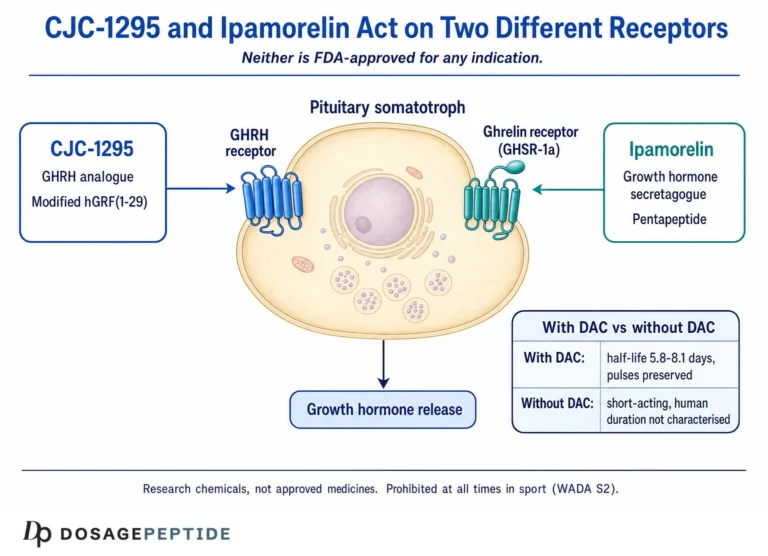
A frequent point of confusion is the relationship between GHRP-6 and growth hormone–releasing hormone (GHRH). They are not the same, and this distinction is mechanistically the whole point. GHRH is the endogenous hypothalamic peptide that acts on the GHRH receptor to drive GH synthesis and release. GHRP-6 acts on a completely separate receptor — the ghrelin receptor / GHS-R1a — and its GH-releasing action persists even when GHRH signaling is blocked.[1] The two systems also differ in the intracellular language they speak: GHRH works largely through the cyclic-AMP second-messenger pathway, whereas GHRP-6 recruits a phospholipase-C/calcium cascade, as detailed below. Because the two pathways are complementary rather than redundant, combining a GHRP-class secretagogue with a GHRH analog produces effects that are more than additive, a synergy explored in a later section and in our overview of CJC-1295 DAC versus no-DAC research.
How Does GHRP-6 Work? Mechanisms Studied
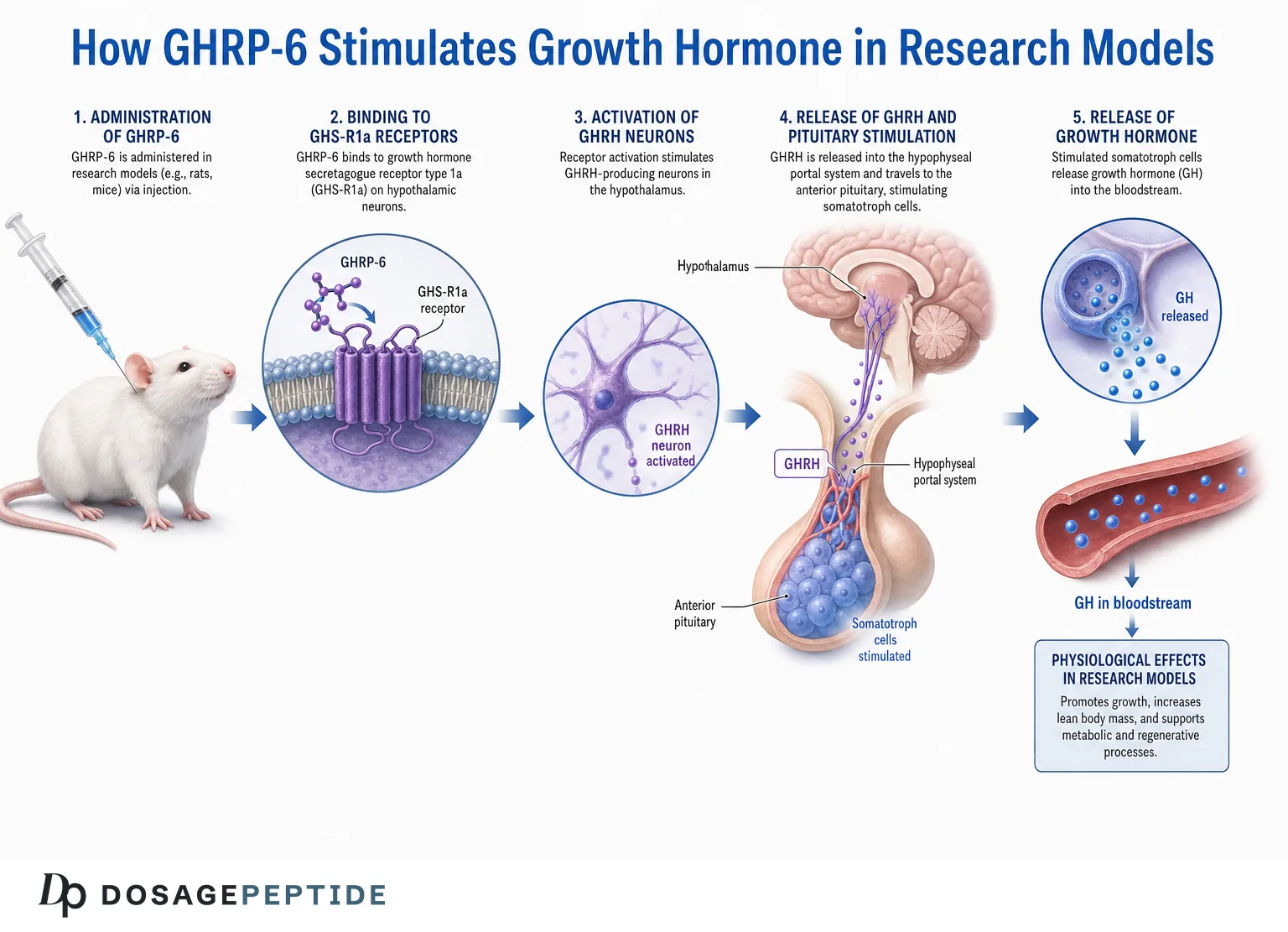
The mechanistic account of GHRP-6 has three layers: the receptor it binds, the intracellular signaling it triggers inside pituitary cells, and the dual site of action across the pituitary and hypothalamus. These are the parts of the GHRP-6 story that rest on the firmest experimental ground, because they have been reproduced across species and across in-vitro and in-vivo systems.
The GHS-R1a Receptor
The molecular target of GHRP-6 is the type 1a growth hormone secretagogue receptor (GHS-R1a), a G-protein–coupled receptor. When the receptor was cloned from pituitary and hypothalamic tissue in 1996, researchers demonstrated that it was the direct target of the synthetic secretagogues and that it defined a neuroendocrine pathway for pulsatile GH release — leading the authors to propose that these compounds mimicked an as-yet-undiscovered hormone.[2] The cloning work localized the receptor to the pituitary and to the arcuate and ventromedial regions of the hypothalamus in swine and humans, a distribution that neatly explained why a secretagogue could act at two levels of the GH axis at once.[2] That predicted hormone turned out to be ghrelin. GHRP-6 thus functions as a synthetic agonist of the ghrelin receptor, which is why it is often described in the literature as a “ghrelin mimetic.”
Intracellular Signaling in Somatotrophs
Once GHRP-6 engages GHS-R1a on pituitary somatotrophs (the GH-producing cells), it activates a phospholipase C–based cascade rather than the cyclic-AMP pathway used by GHRH. Work in cultured human pituitary somatotroph cells showed that GHRP-6 drove a dose-dependent increase in phosphatidylinositol (PI) turnover, the second-messenger system that mobilizes intracellular calcium and activates protein kinase C.[5] In that study, PI turnover rose 2- to 8-fold across eight separate tumor samples, and GH secretion increased in parallel, with effects detectable within fifteen minutes and peaking around two hours.[5] Critically, the response was independent of the cAMP pathway — it occurred regardless of whether the cells carried activating gsp oncogene mutations that lock the cAMP system on — underscoring that GHRP-6 and GHRH converge on GH release through distinct upstream machinery.[5] Downstream, the rise in intracellular calcium and the activation of protein kinase C are the proximate triggers that cause somatotrophs to release their stored GH, which is why calcium and PKC had already been implicated in GHRP-6 action before the PI-turnover mechanism was pinned down.
A Dual Hypothalamic and Pituitary Action
GHRP-6 does not act only at the pituitary. Bowers and others characterized its action as “dual and complementary,” operating at both the hypothalamus and the pituitary gland.[1] At the hypothalamic level, systemic GHRP administration increases expression of the immediate-early gene c-fos in specific neuronal populations and appears to modulate the neurons that produce GHRH and somatostatin.[8] In female dwarf rats treated continuously with GHRP-6 for two weeks, investigators using in-situ hybridization observed increased GHRH messenger RNA in the posterior arcuate nucleus and decreased somatostatin mRNA in the posterior periventricular nucleus, with no significant change in several neighboring regions.[8] In plain terms, GHRP-6 appears to nudge the hypothalamus toward releasing more of its own GH-promoting signal while easing off the brake (somatostatin) — amplifying the pituitary response beyond what a purely pituitary action would achieve. Whether that hypothalamic effect is direct or is relayed through another intermediary factor was left unresolved by the original investigators, and it remains an honest gap in the mechanistic picture.[8]
Preserving Pulsatility: Why a Secretagogue Is Not Exogenous GH
A conceptual point that recurs throughout the secretagogue literature is that GHRP-6 does not add growth hormone to the body from outside; it prompts the pituitary to release its own. This is mechanistically distinct from administering recombinant GH, and the distinction has real consequences in how the two behave in research models. A secretagogue works only insofar as the pituitary has GH to release and only within the regulatory limits the hypothalamus imposes — most importantly, the GH response to GHRP-6 is blunted by somatostatin, the physiological brake, just as it was in the earliest characterization of the peptide.[15] Because of this, secretagogue-driven GH release tends to retain a pulsatile shape rather than producing a flat, artificial plateau, and it remains embedded within the axis’s own feedback loops.[1] That property is scientifically attractive for studying normal GH physiology, but it is not a safety guarantee: preserving pulsatility says nothing about the consequences of repeatedly driving the axis, which have never been characterized in controlled human trials for this compound.
What Role Does the Ghrelin System Play?
GHRP-6 cannot be understood in isolation from the endogenous hormone whose receptor it hijacks. Ghrelin was isolated in 1999 from rat stomach as a 28–amino-acid peptide bearing an unusual octanoyl (fatty-acid) modification on its third serine residue — a modification shown to be essential for receptor activity.[3] Remove or fail to add that eight-carbon fatty-acid tail, and the peptide loses its ability to switch on GHS-R1a; this is one of the most distinctive features in all of peptide endocrinology, because very few hormones require a lipid modification to function.[3] Human ghrelin differs from the rat sequence by only two amino acids, indicating a highly conserved system across mammals.[3] The discovery reframed the entire GHRP field: these synthetic peptides had been probing a genuine physiological system all along, one in which a stomach-derived hormone signals to the brain to regulate both GH release and energy balance.
The dual identity of the ghrelin system — GH secretagogue and appetite signal — is exactly why GHRP-6, as a ghrelin-receptor agonist, produces its characteristic pairing of GH release and hunger. Ghrelin-producing cells sit in the stomach and hypothalamus, and ghrelin receptors are distributed across brain regions that govern feeding as well as the pituitary.[4] When researchers describe GHRP-6 as having “strong orexigenic activity,” they are describing an agonist acting on a receptor whose natural job includes stimulating appetite. It is worth stressing that GHRP-6 mimics only part of ghrelin’s biology: ghrelin is a lipid-modified hormone with a broad physiological remit spanning gastric motility, glucose metabolism, and cardiovascular tone, whereas GHRP-6 is a lean synthetic agonist that engages the receptor without reproducing every facet of the natural signal. Understanding this system also clarifies why later peptides were engineered to be more “selective” — the goal was to keep the GH-releasing action while minimizing the appetite and stress-axis effects that flow from broad ghrelin-receptor engagement.
The ghrelin system is best pictured as a stomach-to-brain axis. Ghrelin is secreted largely by the food-deprived stomach and communicates a nutritional-status signal to hypothalamic circuits, where it stimulates feeding and helps regulate energy homeostasis and GH release.[3][4] This gut–brain framing explains why an agonist at this receptor tends to couple metabolic and growth signals together: the receptor sits at a crossroads of feeding behavior and somatotropic control. It also explains why the ghrelin pathway became a magnet for translational interest in conditions of pathological appetite loss and wasting — the same biology that makes GHRP-6 orexigenic in animals is what made ghrelin-receptor agonism an attractive concept for cachexia research more broadly. GHRP-6 reproduces the GH-and-appetite arm of this natural signal without reproducing ghrelin’s full metabolic and cardiovascular repertoire, which is one reason findings in the two cannot be treated as interchangeable.
Why Is GHRP-6 Known for Appetite Stimulation?
Among the growth hormone secretagogues, GHRP-6 has a reputation for being an especially potent hunger stimulus. That reputation traces directly to its ghrelin-receptor agonism and the downstream hypothalamic circuitry ghrelin controls. The title premise of this article — that GHRP-6 “causes appetite” — is more precisely framed as an open, mechanistically grounded research observation: in animal models, activation of the ghrelin receptor reliably increases food intake, and GHRP-6 is a ghrelin-receptor agonist. It is not a licensed appetite drug, and the human appetite data are far thinner than the animal data.
The Hypothalamic Feeding Circuit
The orexigenic mechanism has been mapped in rodents. Intracerebroventricular ghrelin strongly stimulated feeding and increased body-weight gain in rats, and it did so even in animals genetically deficient in growth hormone — demonstrating that the appetite effect is separable from the GH effect.[4] Mechanistically, ghrelin activated neuropeptide Y (NPY) and agouti-related protein (AgRP) neurons in the arcuate nucleus, and antagonists of NPY and AgRP abolished the feeding response.[4] The same investigators found that ghrelin augmented NPY gene expression and could block the feeding-reducing effect of leptin, the principal satiety hormone — positioning ghrelin as a direct counterweight to leptin in the arcuate circuitry — while anti-ghrelin antibodies robustly suppressed feeding, confirming a physiological role rather than a merely pharmacological one.[4] Because GHRP-6 engages the same GHS-R1a receptor, the working model is that it drives feeding through this same NPY/AgRP pathway. This is preclinical, animal-model evidence; it should not be read as a demonstration that GHRP-6 is an appetite therapy in humans.
Evidence From Antagonist and Chronic-Dosing Studies
Some of the most informative appetite data come from blocking the receptor rather than stimulating it. A ghrelin-receptor antagonist derived from the GHRP-6 scaffold, [D-Lys³]-GHRP-6, is a standard research tool for probing the system. In a tumor-bearing rodent model of cancer anorexia–cachexia, this antagonist worsened anorexia and hastened decline, while potentiating ghrelin signaling improved food intake and other symptoms — underscoring how central ghrelin-receptor tone is to appetite regulation.[11] In another model, continuous administration of the GHRP-6 agonist restored cumulative food intake that had been suppressed by a high-salt diet.[12] Complementary work with the selective secretagogue ipamorelin, another ghrelin-receptor agonist, showed that repetitive dosing — but notably not a single dose — increased food intake and body-weight gain in a rodent postoperative-ileus model, a reminder that the appetite signature of these compounds can depend on repeated stimulation rather than a one-off exposure.[10] The earliest evidence pointed the same way: chronic subcutaneous administration of the original hexapeptide to immature rats increased body-weight gain over multi-week dosing while the pituitary remained fully responsive.[15] Together these studies establish appetite and weight modulation as robust, receptor-mediated features of the ghrelin/GHS-R1a system in experimental settings.
The cancer anorexia–cachexia work is worth unpacking because it shows how ghrelin-receptor tone is embedded in a wider network. In tumor-bearing rats, both ghrelin insufficiency and a degree of ghrelin resistance were observed, and the anorexia was linked to excessive hypothalamic signaling through corticotropin-releasing factor and the serotonin 2c receptor; blocking those upstream brakes improved food intake, whereas the [D-Lys³]-GHRP-6 antagonist worsened anorexia and shortened survival.[11] Ghrelin itself attenuated the syndrome in the short term but did not, on its own, prolong survival in that model.[11] The nuance matters for honesty: even in the disease model where ghrelin-receptor agonism looks most promising mechanistically, the benefit was partial and context-dependent, which is a very different thing from a proven treatment. It is this kind of careful, qualified result — not a headline claim — that the appetite literature actually contains.
What Side Effects Are Reported? Prolactin, ACTH and Cortisol
A defining pharmacological characteristic of GHRP-6 — and a major reason later analogs were developed — is that it is not perfectly selective for GH. At sufficient doses it can also raise levels of other pituitary-driven hormones, particularly the stress-axis hormones ACTH (corticotropin) and cortisol. Its effect on prolactin, by contrast, is far less consistent and is best described as minor: the original characterization of the hexapeptide reported specific GH release without a concomitant rise in prolactin,[15] and in a controlled swine comparison none of the GH secretagogues tested significantly altered prolactin levels.[9] Any prolactin response to GHRP-6 should therefore be treated as inconsistent and modest rather than a reliable feature.
The corticotropic effect, however, is well documented in humans. In a controlled study of healthy young men, repeated intravenous boluses of GHRP-6 significantly increased not only GH but also ACTH and cortisol secretion across the night (each p<0.02), while also modestly increasing stage-2 sleep.[6] Notably, the cortisol effect ran opposite to that of GHRH, which tends to blunt cortisol — another reminder that GHRP-6 and GHRH engage different systems.[6] A follow-up study found that these secondary hormonal effects were highly dependent on dose and route of administration: oral GHRP-6 left GH, ACTH, and cortisol essentially unchanged, sublingual delivery produced only a trend toward higher GH, whereas intranasal delivery raised GH significantly with only a trend toward increased ACTH and no change in cortisol.[7] The practical lesson from that comparison is that the hormonal “noise” associated with GHRP-6 is not a fixed property of the molecule but a function of how much reaches the circulation and how quickly.
The contrast with the selective secretagogue ipamorelin is instructive. When ipamorelin was profiled against GHRP-6 and GHRP-2 in swine, both GHRP-6 and GHRP-2 raised ACTH and cortisol, but ipamorelin did not elevate these hormones even at doses more than 200-fold above its GH-releasing threshold.[9] This is the key differentiator researchers cite: GHRP-6 is potent but comparatively “noisy” on the stress axis, whereas newer analogs were engineered toward a cleaner GH-selective profile.
How Does GHRP-6 Affect the GH/IGF-1 Axis Downstream?
The proximate action of GHRP-6 is to release growth hormone, but GH itself acts largely through a downstream mediator: insulin-like growth factor 1 (IGF-1), produced mainly by the liver in response to GH. In the classical endocrine cascade, a secretagogue stimulus at the pituitary produces a pulse of GH, which in turn drives hepatic IGF-1 output, and IGF-1 mediates many of the anabolic and growth-related effects attributed to the GH axis. IGF-1 also closes a negative-feedback loop, feeding back on the hypothalamus and pituitary to restrain further GH release, which is one reason the axis is self-limiting and why sustained, unregulated stimulation does not map cleanly onto sustained IGF-1 elevation. Readers interested in the downstream limb of this pathway can review our dedicated explainer on IGF-1 LR3 mechanism and research.
A physiologically important nuance is that GHRP-class peptides tend to produce GH release that preserves the pulsatile character of natural secretion, rather than a flat, sustained elevation. Because GHRP-6 amplifies GH pulses partly by modulating hypothalamic somatostatin tone, the resulting secretion pattern in research models more closely mirrors endogenous rhythms.[8] Pulsatility matters because the biological reading of GH is encoded not only in how much is released but in the pattern of its peaks and troughs, and tools that raise GH while preserving that pattern have long been prized for physiological studies. This is one reason the ghrelin-receptor secretagogues attracted sustained scientific interest as tools for studying the physiology of GH pulsatility — a topic distinct from any therapeutic application. It bears repeating that documenting a GH or IGF-1 response in a research subject is a mechanistic observation, not evidence of clinical benefit or safety, and no controlled trial has established that GHRP-6-driven IGF-1 changes translate into any defined outcome in humans.
How Do Research Models Actually Study GHRP-6?
Because GHRP-6 is a research compound rather than a therapy, the way it is studied is itself part of understanding what the literature can and cannot say. Three experimental designs recur across the primary sources cited here, and each illuminates a different facet of the molecule.
Isolated pituitary and cell-culture assays. The original characterization used pituitary incubate assays in which cultured tissue is exposed to graded concentrations of the peptide and GH output is measured directly, establishing dose–response behavior and minimum active concentrations without the confounds of a whole animal.[15] Later work extended this to cultured human somatotroph cells to dissect the second-messenger pathway, which is how the phospholipase-C/PI-turnover mechanism was resolved.[5]
Rodent food-intake and gene-expression models. Appetite is quantified by measuring food consumption, body-weight trajectory, and, in mechanistic studies, the activity of feeding-related neurons. Intracerebroventricular delivery of ghrelin, activation of c-fos and NPY/AgRP neurons, and pharmacological blockade with NPY/AgRP antagonists are the tools that established the feeding circuit,[4] while in-situ hybridization in dwarf rats revealed how chronic GHRP-6 shifts hypothalamic GHRH and somatostatin transcription.[8] Continuous-infusion designs using mini-osmotic pumps have been used to separate the appetite effect from blood-pressure effects in salt-sensitive rats.[12]
Human GH-secretion and diagnostic pharmacology. The human studies were designed to profile hormone release — sampling GH, ACTH, and cortisol over hours after intravenous, oral, intranasal, or sublingual dosing, often alongside sleep-EEG recording.[6][7] These are the studies that generated GHRP-6’s reputation as a probe of pituitary GH reserve, and they are the closest the compound ever came to a defined clinical use — as a stimulus in GH-secretion testing rather than as a treatment.
A recurring interpretive caution cuts across all three model types: dose and route rarely transfer cleanly from one setting to another. The concentrations that release GH in a pituitary incubate, the microgram-per-kilogram intravenous boluses used in human sleep-endocrine studies, and the intracerebroventricular or continuous-pump regimens used to demonstrate central feeding effects in rodents are not comparable numbers, and none of them constitutes guidance for any other context.[7] The Frieboes route-of-administration comparison is the clearest cautionary example: the same peptide produced a robust endocrine response intravenously and essentially none orally, so a result obtained by one route says little about another.[7] Reading the GHRP-6 literature responsibly means keeping the experimental design attached to every number.
How Does GHRP-6 Compare to GHRP-2 and Ipamorelin?
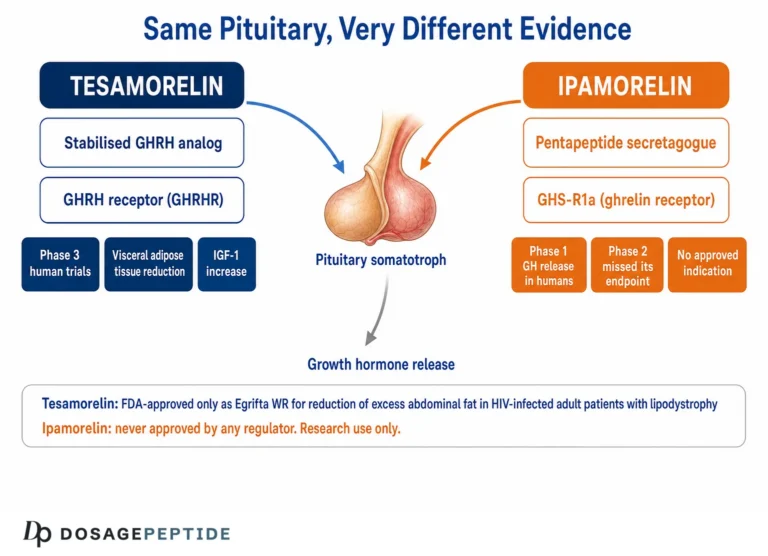
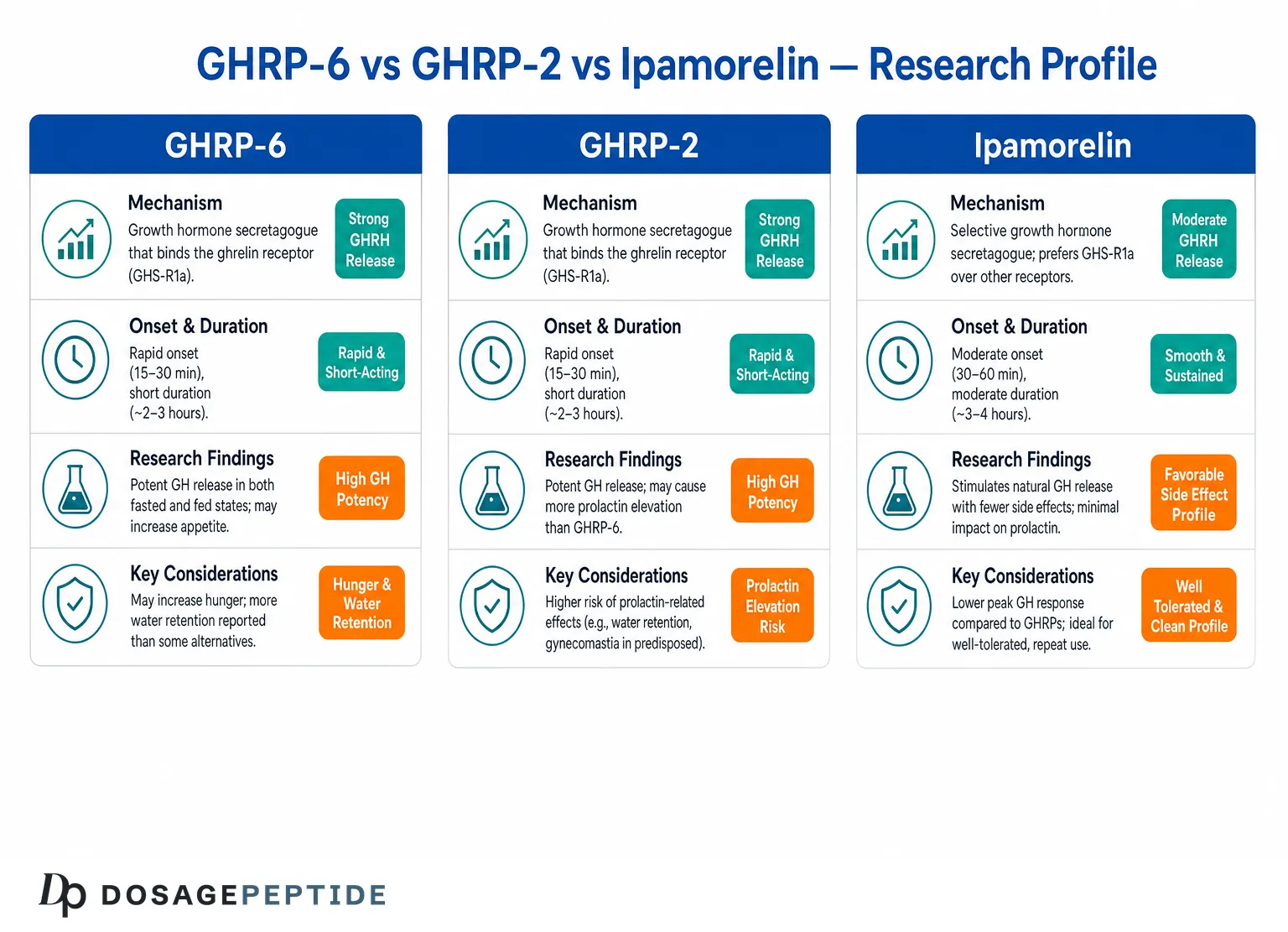
Because GHRP-6 is the prototype of a family, it is most usefully understood alongside its two best-studied relatives. GHRP-2 (pralmorelin) is a closely related synthetic secretagogue often characterized as more potent per unit dose for GH release; ipamorelin is a later pentapeptide specifically engineered for selectivity. Our companion articles on GHRP-2 research and CJC-1295 provide deeper single-compound treatments; the comparison table below summarizes the axes on which these three are typically distinguished in the literature.
| Feature | GHRP-6 | GHRP-2 (pralmorelin) | Ipamorelin |
|---|---|---|---|
| Peptide length | Hexapeptide (6 aa) | Hexapeptide (6 aa) | Pentapeptide (5 aa) |
| Receptor target | GHS-R1a (ghrelin receptor) | GHS-R1a (ghrelin receptor) | GHS-R1a (ghrelin receptor) |
| Relative GH-releasing potency | Reference standard | Reported higher potency, lower maximal efficacy in swine[9] | Comparable efficacy to GHRP-6 in vitro/in vivo[9] |
| Appetite (orexigenic) effect | Strong (marked) | Present, generally milder than GHRP-6 | Present but comparatively modest |
| ACTH / cortisol effect | Raised at higher doses[6] | Raised (ACTH/cortisol)[9] | Not significantly raised even at high doses[9] |
| Prolactin effect | Inconsistent / minor[15] | Not significantly raised in swine[9] | Not significantly raised in swine[9] |
| Selectivity | Lowest (broad) | Intermediate | Highest (GH-selective) |
| Regulatory status | Not FDA-approved; research use | Not approved as a therapeutic; used as a diagnostic agent in some regions | Not FDA-approved; research use |
The practical research takeaway is that these three compounds trade off potency, selectivity, and side-signal breadth. GHRP-6 delivers robust GH release and the strongest appetite signal but recruits the stress axis; ipamorelin was designed to strip away the ACTH/cortisol and much of the appetite activity while retaining GH release.[9] GHRP-2 sits between them — in the swine comparison it displayed higher potency but lower maximal efficacy than GHRP-6 for GH release, while still raising ACTH and cortisol.[9] Which compound a laboratory selects depends entirely on the research question — whether appetite, GH pulsatility, or receptor selectivity is the variable of interest. For structured reference parameters, the GHRP-6 dosage protocol reference page and the GHRP-2 dosage protocol reference page compile the vial and reconstitution figures typically reported for laboratory handling.
Why Is GHRP-6 Studied Alongside GHRH Analogs Like CJC-1295?
One of the most consistent themes in the secretagogue literature is synergy between the two arms of GH control. Because GHRP-6 acts on the ghrelin receptor while GHRH analogs act on the GHRH receptor, combining them recruits both pathways simultaneously. Bowers characterized the GHRP action as complementary to GHRH, and human diagnostic studies going back decades showed that GHRH plus a GHRP produced GH responses substantially greater than either agent alone — a synergy also observed for orally administered GHRP-2 combined with GHRH in children.[8] This more-than-additive interaction became the basis of a well-known combined GHRH-plus-GHRP pituitary-function test, one of the few contexts in which a GHRP found a defined, if narrow, diagnostic role.
This is also the mechanistic rationale behind the widely studied research pairing of a GHRP-class peptide with a long-acting GHRH analog such as CJC-1295. In experimental designs, the GHRH component raises the amplitude of the GH pulse and the GHRP component both triggers release and suppresses somatostatin tone, so the two act on different levers of the same system. Our article on CJC-1295 DAC versus no-DAC details how the presence or absence of the drug-affinity complex changes the half-life and pulsatility profile, and the CJC-1295 no-DAC and ipamorelin blend reference page documents a commonly studied GHRH-analog-plus-secretagogue combination. GHRP-6 occupies the same conceptual slot as ipamorelin in these pairings but with its distinctive appetite and stress-axis profile. None of this constitutes a recommendation to combine compounds; it describes why the combinations are of scientific interest.
What Does the Current Evidence Show?
Assembling the evidence base honestly requires separating what is well-established from what is preliminary or purely preclinical. The GHRP-6 literature is unusual in that its most solid findings are also its oldest, and its most eye-catching claims are also its least clinically validated.
Well-Established (Mechanistic and Older Human Pharmacology)
The strongest, most reproducible findings concern mechanism. It is firmly established that GHRP-6 is a GHS-R1a agonist, that it releases GH via a phospholipase-C/PI-turnover pathway distinct from GHRH’s cAMP pathway, and that it acts at both hypothalamus and pituitary.[5][1] The GH-releasing action was documented across multiple species in the earliest characterization and confirmed to be receptor-specific once GHS-R1a was cloned.[15][2] Older controlled human studies reliably document that intravenous GHRP-6 raises GH and, dose-dependently, ACTH and cortisol, with the magnitude and even the direction of secondary effects depending heavily on route of administration.[6][7] These are genuine human data, but they were generated largely as GH-secretion pharmacology and diagnostic-test research, not as trials of a therapy, and the participant groups were small.
Preclinical and Exploratory
The appetite literature is compelling mechanistically but is dominated by animal and cell models. The NPY/AgRP feeding circuit, the effects of ghrelin-receptor agonism and antagonism on food intake, and the cachexia and postoperative-ileus models are all preclinical.[4][11][10] Beyond appetite and GH, exploratory preclinical work has examined GHRP-6 in tissue-protection contexts — for example, a hepatic ischemia/reperfusion model in rats in which GHRP-6 pre-treatment, alone or combined with epidermal growth factor, reduced markers of hepatic, intestinal, lung, and renal injury by roughly 50–85% — but the authors themselves framed these as early findings warranting further study.[13] Cardiovascular signals are similarly early-stage; a rodent study of chronic ghrelin-receptor antagonism, for instance, implicated the system in salt-sensitive blood-pressure regulation, but this is mechanistic animal work, not a human outcome.[12] None of these exploratory lines has advanced to controlled human efficacy testing for GHRP-6 itself.
Why It Was Never Approved as a Drug
Despite sustained interest, GHRP-6 was never developed into an approved medicine. Several factors contributed: its lack of GH selectivity (the ACTH/cortisol and appetite effects), the difficulty of achieving effective systemic exposure by convenient oral routes, and the arrival of more selective secretagogues and orally active peptidomimetics that offered cleaner profiles for any prospective indication.[14] The field’s attention shifted toward compounds like ipamorelin and toward small-molecule GHS-R agonists that could be taken by mouth, and toward using GHRP-6 primarily as a research probe rather than a drug candidate.[9] The result is that GHRP-6 today sits firmly in the category of a historical and mechanistic tool compound, not a medicine that failed late-stage trials so much as one that was overtaken before it ever reached them.
There is a subtle but important corollary to this history. The closest GHRP-6 came to a legitimate applied use was diagnostic rather than therapeutic — as a provocative stimulus to test pituitary GH reserve, sometimes in combination with GHRH.[8] That a member of this family (GHRP-2/pralmorelin) went on to be used as a diagnostic agent in some regions, while none became an approved treatment, tells you where the science actually landed: these peptides proved genuinely useful for interrogating how the GH axis works and for measuring its capacity, but they never accumulated the controlled efficacy and safety evidence that a therapeutic indication demands. Reading GHRP-6 as a “growth” or “anti-aging” treatment therefore inverts the historical record; its documented value is as a research and diagnostic probe.
What Are the Limitations of the GHRP-6 Evidence?
Any honest reading of the GHRP-6 literature must foreground its limitations, which are substantial and which shape how much confidence any statement about the compound can carry.
Age and purpose of the human data. Much of the human evidence dates from the 1990s and was designed to characterize GH secretion or to develop diagnostic tests, not to evaluate GHRP-6 as a treatment for any condition. Sample sizes were small — often a handful of healthy young male volunteers — and endpoints were hormonal, not clinical.[6] Findings from small, single-sex, single-age-group cohorts do not generalize confidently to women, older adults, or people with underlying conditions.
Preclinical-to-clinical gap. The most striking claims about GHRP-6 — strong appetite stimulation, tissue protection — rest largely on rodent, swine, and cell-culture models. Effects observed after intracerebroventricular or high-dose parenteral administration in animals do not translate directly to humans, and the leap from “ghrelin-receptor agonism increases feeding in rats” to any human claim is not warranted by the current data.[4] Routes of administration used to demonstrate central effects in animals frequently have no practical human counterpart.
Selectivity and off-target signaling. The stress-axis activation (ACTH, cortisol) and appetite effects are confounds for interpreting any downstream observation, because a molecule that simultaneously raises GH, cortisol, and hunger is difficult to attribute a single clean effect to.[9] This is precisely the interpretive problem that motivated the development of selective agents like ipamorelin.
No standardized human safety dataset. Because GHRP-6 never advanced through the regulatory process, there is no modern, adequately powered human safety and efficacy dataset of the kind that supports approved drugs. Long-term effects, especially of chronic GH-axis stimulation, are not characterized in controlled human trials, and questions such as tachyphylaxis, effects on glucose metabolism, and consequences of sustained cortisol elevation remain inadequately answered for this specific compound. For all these reasons, GHRP-6 should be treated as a laboratory research compound, and any interpretation of its effects should remain within that frame.
Quality of the secondary literature. A final, practical limitation is that a large share of what is written about GHRP-6 outside the primary sources cited here is non-peer-reviewed — vendor pages, forum posts, and secondary summaries that frequently blur the line between animal and human findings or restate mechanistic observations as if they were outcomes. The primary literature is comparatively small, largely predates the modern clinical-trial era, and does not support the confident performance claims that circulate informally. Where a statement about GHRP-6 cannot be traced to a controlled study of the compound itself, it should be treated as extrapolation. The disciplined position, and the one this article adopts, is to report only what the experimental record documents and to label its evidence tier explicitly.
Related research: hexarelin, a more potent growth hormone-releasing peptide.
Frequently Asked Questions
Is GHRP-6 approved for any medical use?
No. GHRP-6 is not approved by the FDA or, to the best of the available evidence, any comparable regulator as a therapeutic drug. It holds no approved indication for growth, appetite, body composition, or any other condition. It is used in laboratory and preclinical research and as a historical pharmacological probe of the growth hormone secretagogue system. Any use outside of a properly authorized research setting falls outside established regulatory and safety frameworks.
What is the difference between GHRP-6 and ghrelin?
Ghrelin is the body’s natural hormone — a 28–amino-acid, octanoylated peptide produced mainly in the stomach that activates the GHS-R1a receptor to stimulate both GH release and appetite.[3] GHRP-6 is a synthetic six–amino-acid peptide that binds the same receptor, effectively mimicking part of ghrelin’s action, but without the fatty-acid modification and broad physiology of the natural hormone. GHRP-6 was actually discovered before ghrelin and helped researchers predict and then identify the natural hormone and its receptor.
Why is GHRP-6 associated with hunger?
Because it activates the ghrelin receptor (GHS-R1a), which in animal models drives feeding through neuropeptide Y and agouti-related protein neurons in the hypothalamus.[4] This appetite effect is a receptor-level property of ghrelin-system agonism and is separable from GH release. It is documented primarily in preclinical models, so the strong “hunger” reputation should be read as a mechanistic, animal-model observation rather than a proven human effect.
How does GHRP-6 compare to GHRP-2 and ipamorelin?
All three are ghrelin-receptor (GHS-R1a) agonists that release GH. GHRP-6 is the original hexapeptide, with the strongest appetite effect and notable activation of ACTH and cortisol at higher doses. GHRP-2 is often described as more potent for GH release, though in the swine comparison it showed lower maximal efficacy than GHRP-6. Ipamorelin was engineered for selectivity and, unlike GHRP-6 and GHRP-2, did not significantly raise ACTH or cortisol even at high doses in swine studies.[9]
Does GHRP-6 raise cortisol?
In controlled human studies, intravenous GHRP-6 significantly increased ACTH and cortisol along with GH, with effects that were dose- and route-dependent — oral administration in one study left these hormones essentially unchanged, while intravenous boluses raised them.[6][7] This lack of GH selectivity is one of the main reasons more selective secretagogues were subsequently developed.
Does GHRP-6 raise prolactin?
The evidence for a prolactin effect is weak and inconsistent. The original characterization of the hexapeptide reported specific GH release without a concomitant prolactin rise,[15] and a controlled swine comparison found that none of the GH secretagogues tested, GHRP-6 included, significantly altered prolactin.[9] Any prolactin response should therefore be regarded as minor and unreliable rather than a defining feature of the compound.
What receptor does GHRP-6 act on?
GHRP-6 acts on the type 1a growth hormone secretagogue receptor (GHS-R1a), a G-protein–coupled receptor that is also the natural receptor for ghrelin. The receptor was cloned in 1996 and identified as the target of synthetic secretagogues, which led to the discovery of ghrelin as its endogenous ligand.[2] Inside pituitary cells, receptor activation drives a phospholipase-C / calcium / protein kinase C cascade rather than the cAMP pathway used by GHRH.[5]
Why is GHRP-6 combined with GHRH analogs in research?
Because GHRP-6 and GHRH act on different receptors and different intracellular pathways, combining them recruits both arms of GH control at once, producing a GH response greater than either alone.[8] This complementary mechanism is the scientific rationale behind studying GHRP-class peptides alongside long-acting GHRH analogs such as CJC-1295, and it also underlies the classic combined GHRH-plus-GHRP pituitary-function test. It is a research design principle, not a usage recommendation.
Is there human clinical trial evidence for GHRP-6 as a treatment?
There is no body of modern, adequately powered human clinical trials establishing GHRP-6 as a treatment for any condition. The human literature consists mostly of small older pharmacology and diagnostic studies measuring hormone responses, while the appetite and tissue-related findings are preclinical.[13] Consequently, GHRP-6 has no established therapeutic efficacy or safety profile and remains a research compound.
References
- Bowers CY. Growth hormone-releasing peptide (GHRP). Cell Mol Life Sci. 1998;54(12):1316–29.
- Howard AD, Feighner SD, Cully DF, et al. A receptor in pituitary and hypothalamus that functions in growth hormone release. Science. 1996;273(5277):974–7.
- Kojima M, Hosoda H, Date Y, et al. Ghrelin is a growth-hormone-releasing acylated peptide from stomach. Nature. 1999;402(6762):656–60.
- Nakazato M, Murakami N, Date Y, et al. A role for ghrelin in the central regulation of feeding. Nature. 2001;409(6817):194–8.
- Lei T, Buchfelder M, Fahlbusch R, Adams EF. Growth hormone releasing peptide (GHRP-6) stimulates phosphatidylinositol (PI) turnover in human pituitary somatotroph cells. J Mol Endocrinol. 1995;14(1):135–8.
- Frieboes RM, Murck H, Maier P, et al. Growth hormone-releasing peptide-6 stimulates sleep, growth hormone, ACTH and cortisol release in normal man. Neuroendocrinology. 1995;61(5):584–9.
- Frieboes RM, Murck H, Antonijevic IA, Steiger A. Effects of growth hormone-releasing peptide-6 on the nocturnal secretion of GH, ACTH and cortisol and on the sleep EEG in man: role of routes of administration. J Neuroendocrinol. 1999;11(6):473–8.
- Argente J, García-Segura LM, Pozo J, Chowen JA. Growth hormone-releasing peptides: clinical and basic aspects. Horm Res. 1996;46(4–5):155–9.
- Raun K, Hansen BS, Johansen NL, et al. Ipamorelin, the first selective growth hormone secretagogue. Eur J Endocrinol. 1998;139(5):552–61.
- Venkova K, Mann W, Nelson R, Greenwood-Van Meerveld B. Efficacy of ipamorelin, a novel ghrelin mimetic, in a rodent model of postoperative ileus. J Pharmacol Exp Ther. 2009;329(3):1110–6.
- Fujitsuka N, Asakawa A, Uezono Y, et al. Potentiation of ghrelin signaling attenuates cancer anorexia-cachexia and prolongs survival. Transl Psychiatry. 2011;1(7):e23.
- Sato T, Nakashima Y, Nakamura Y, Ida T, Kojima M. Continuous antagonism of the ghrelin receptor results in early induction of salt-sensitive hypertension. J Mol Neurosci. 2010;43(2):193–9.
- Cibrián D, Ajamieh H, Berlanga J, et al. Use of growth-hormone-releasing peptide-6 (GHRP-6) for the prevention of multiple organ failure. Clin Sci (Lond). 2006;110(5):563–73.
- Bowers CY. On a peptidomimetic growth hormone-releasing peptide. J Clin Endocrinol Metab. 1994;79(4):940–2.
- Bowers CY, Momany FA, Reynolds GA, Hong A. On the in vitro and in vivo activity of a new synthetic hexapeptide that acts on the pituitary to specifically release growth hormone. Endocrinology. 1984;114(5):1537–45.
Disclaimer: This article is provided by dosagepeptide.com for educational and informational purposes only and describes findings from published preclinical and older human pharmacology research. GHRP-6 is a research compound; it is not an FDA-approved drug and has no approved therapeutic indication. Nothing here is medical advice, nor a recommendation for human use, self-administration, or the diagnosis, treatment, cure, or prevention of any disease. The compounds discussed are intended for laboratory research use only. Always consult a qualified, licensed healthcare professional regarding any health concern, and comply with all applicable laws and institutional regulations.