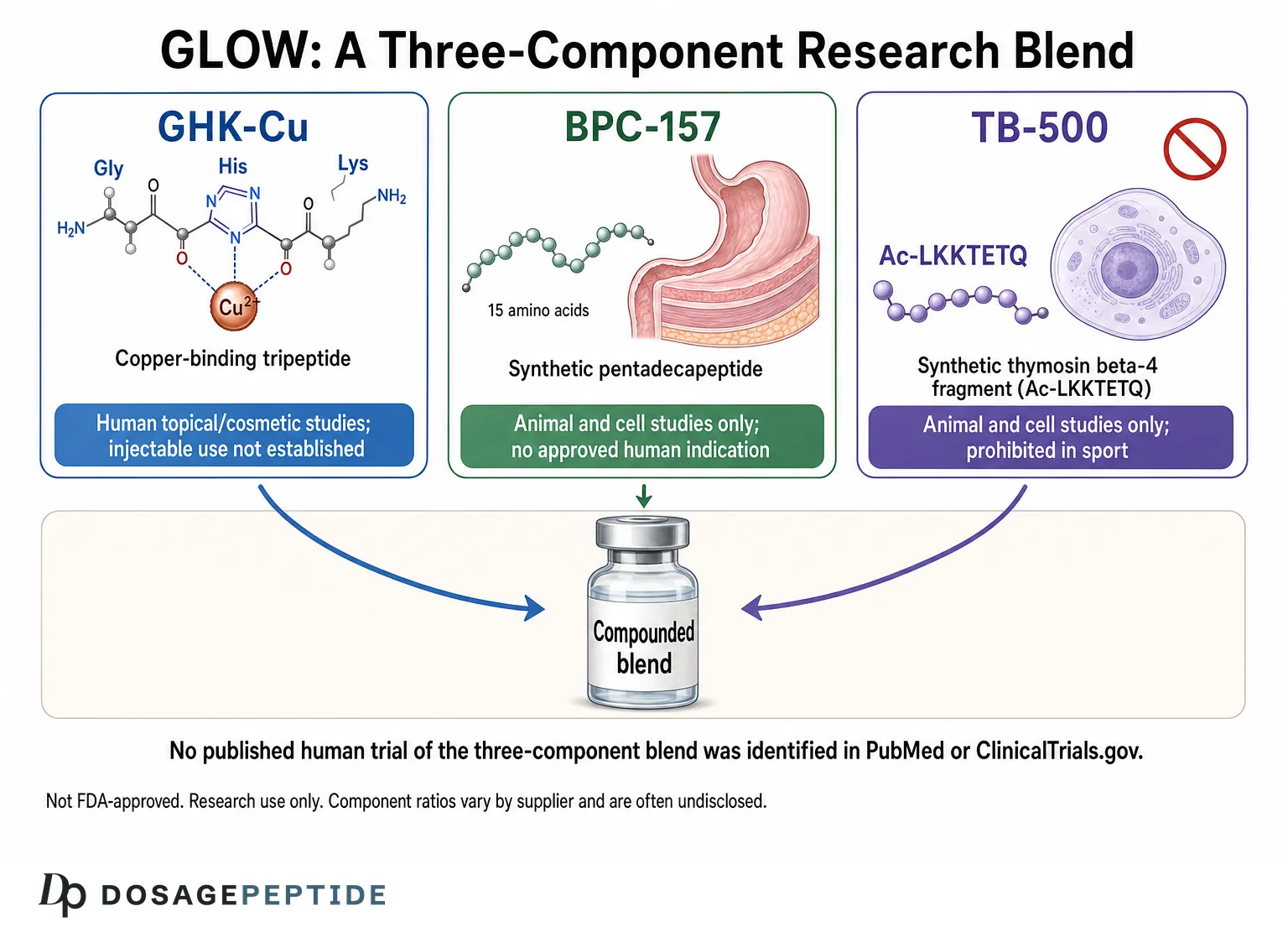
- What is in it: GHK-Cu (a copper-binding tripeptide), BPC-157 (a synthetic pentadecapeptide) and TB-500 (a fragment of thymosin β4), mixed in one vial.
- No published human clinical trial of the blend as a blend could be identified.
- Everything claimed for GLOW is inferred from the three components separately — and most of that research is preclinical.
- The ratio is not standardised. “GLOW” has no INN, no CAS number and no defined composition, so it means whatever a given supplier put in the vial.
- Not FDA-approved, with no approved indication anywhere.
GLOW is not a single peptide. It is a compounded blend — a name given by research chemical suppliers to a vial that typically contains three separate substances mixed together: GHK-Cu (a copper-binding tripeptide), BPC-157 (a synthetic pentadecapeptide), and TB-500 (a synthetic fragment of thymosin β4). GLOW is not an FDA-approved drug, has no approved indication anywhere, and — critically — no published human clinical trial of the blend as a blend could be identified. Everything commonly said about it is inferred from research on the individual components, most of which is preclinical.
That gap between what the name implies and what the evidence actually supports is the whole story of this article. Below, each component is separated out, its real evidence tier stated precisely, and the combination itself examined for what is documented versus what is assumed.
What does “GLOW peptide” actually refer to?
“GLOW” is a market name, not a pharmacological one. It does not appear in any pharmacopoeia, does not have an INN (International Nonproprietary Name), does not have its own CAS number, and is not registered with any drug regulator. It is a label applied by peptide vendors and compounding-adjacent suppliers to a lyophilised powder containing a mixture of three research chemicals.
This matters more than it might sound. When a substance has an official name, that name maps to one defined molecular entity with a defined purity specification. “GLOW” maps to whatever a given supplier decided to put in the vial. Two vials labelled GLOW from two different sources may contain different absolute quantities, different ratios, and in some cases different salt forms of the same components.
The name itself is marketing shorthand — it gestures at skin appearance, which reflects the cosmetic reputation of GHK-Cu rather than any established property of the mixture. No regulatory body has evaluated whether the blend does anything the name suggests.
GLOW versus a compounded prescription product
It is worth separating three very different categories that get conflated in peptide discussions:
- FDA-approved drug — reviewed for safety and efficacy for a specific indication, with an approved label. GLOW is not this, and neither is any of its three components.
- Compounded preparation — made by a licensed 503A or 503B pharmacy for an identified patient, using a bulk substance that must be eligible under the applicable statutory pathway. The regulatory position of all three GLOW components here is unsettled, and is detailed below.
- Research chemical — sold for laboratory use only, not evaluated for human administration, with no pharmaceutical-grade oversight of manufacture. This is the category GLOW products are typically sold under.
GLOW as encountered in the peptide market falls almost entirely into the third category. Any claim that positions it alongside approved medicines is misrepresenting its status.
What is actually in a GLOW blend, and in what ratio?
The standard composition most suppliers advertise is GHK-Cu + BPC-157 + TB-500. The most commonly listed presentation is a 70 mg total vial, though 50 mg and 100 mg presentations also circulate. The reference breakdown for the 70 mg format is documented on our GLOW 70 mg vial dosage protocol page, which lays out what published vendor labelling states about component quantities and reconstitution volumes.
However — and this is a genuine limitation, not a hedge — the ratio varies by supplier and is frequently undisclosed. Some vendors publish per-component milligram amounts. Many publish only a total peptide mass. When only a total is given, there is no way for anyone, including a researcher, to know how much of each substance is present.
The consequences of that are concrete:
- Results cannot be attributed to a component. If an effect is observed, there is no way to know which of the three produced it, or whether it required all three.
- Findings cannot be replicated across sources. A 70 mg GLOW from vendor A and a 70 mg GLOW from vendor B are not the same preparation unless both disclose identical breakdowns.
- Component amounts cannot be adjusted independently. This is the defining structural limitation of any fixed-ratio blend: changing the amount administered necessarily changes all three components in lockstep. A researcher who wants more of one and less of another cannot get there with a premixed vial.
- Copper content is fixed to the GHK fraction. GHK-Cu carries a copper ion. Its quantity is therefore not a free variable once the blend ratio is set.
For anyone comparing documented blend compositions side by side, our comparison of KLOW, GLOW and Wolverine blends sets out what each label claims to contain and where the disclosure gaps are.
Component 1: GHK-Cu — the strongest evidence, but the narrowest
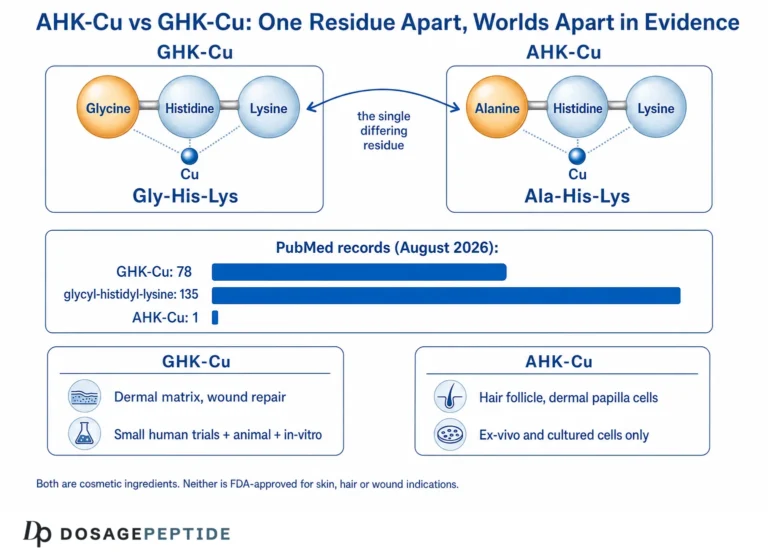
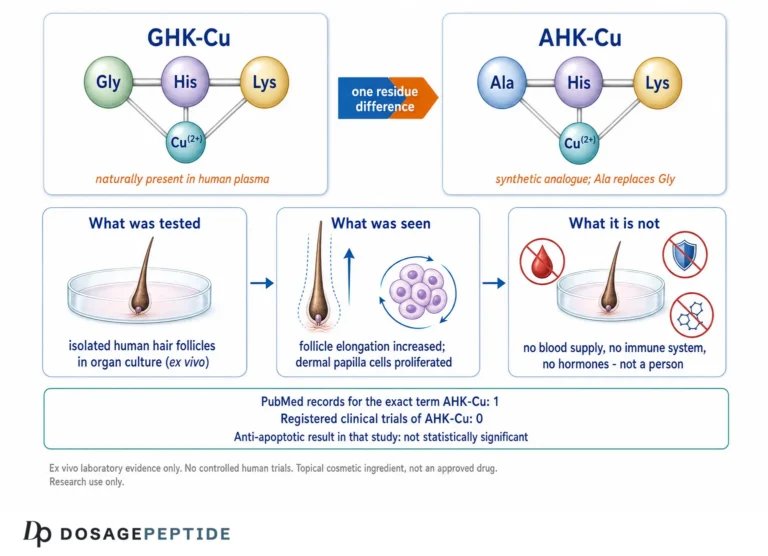
GHK is a naturally occurring human tripeptide (glycyl-L-histidyl-L-lysine). It is not synthetic in origin — it is present in human plasma, saliva and urine, and it binds copper(II) with an affinity comparable to the copper transport site on albumin, forming the complex GHK-Cu.[1] The published literature describes plasma GHK levels as declining with age, which is the origin of most “restoration” framing around it.
What the evidence tier actually is
GHK-Cu has the best-supported human evidence base of the three components — but that evidence is overwhelmingly topical and cosmetic, not systemic and not therapeutic. Published reviews describe controlled studies in which GHK-Cu applied to aged or photodamaged skin was associated with improvements in measures such as skin density, firmness, fine lines and hyperpigmentation.[2] That is a cosmetic evidence tier: it concerns appearance endpoints, measured on skin, from products applied to skin.
One caveat belongs with those reviews rather than after them: the most frequently cited GHK-Cu reviews are authored by a researcher who founded and runs a company selling copper-peptide skin products.[1][2] That does not make the underlying studies wrong, but a literature summarised largely by a commercially interested author is weaker evidence than an independent systematic review, and none of these are systematic reviews.
The mechanistic literature is broader. GHK and GHK-Cu have been reported to stimulate both synthesis and breakdown of collagen and glycosaminoglycans and to modulate the activity of metalloproteinases and their inhibitors.[1] Gene-expression work has described GHK as capable of altering the expression of a large number of human genes, and has been used to argue for a broad regulatory role.[3] These are mechanistic and cell-level observations; they are not evidence of a clinical outcome.
What is not established for GHK-Cu
Injectable, systemic use of GHK-Cu is not an established practice with a supporting human evidence base. The controlled human data sit on topical application. Extrapolating a topical cosmetic result to a subcutaneous injection is a category jump, not a dose adjustment — the exposure route, distribution, and copper handling are all different. There is no FDA-approved injectable GHK-Cu product, and no approved indication for GHK-Cu by any route.
This is not merely an inference. FDA has separately addressed GHK-Cu for injectable routes of administration in its documentation of bulk substances that may present significant safety risks, stating that compounded injectable drugs containing GHK-Cu may pose a risk for immunogenicity due to the potential for aggregation and peptide-related impurities, and that there are limited data in humans to inform safety-related considerations.[8] In other words, the regulator has explicitly flagged the injectable route that the topical evidence base does not cover.
There is also a copper consideration specific to this component that does not apply to the other two: GHK-Cu delivers copper. Copper homeostasis is tightly regulated in humans, and repeated systemic administration of a copper-carrying complex raises a question the topical literature simply does not answer, because topical exposure and systemic exposure are not comparable.
Component 2: BPC-157 — extensive animal data, almost no human data
BPC-157 is a synthetic pentadecapeptide (15 amino acids) corresponding to a partial sequence of a protein described in human gastric juice. It is often marketed as “body protection compound.”
What the evidence tier actually is
BPC-157 is preclinical. It has no approved human indication anywhere in the world. The animal literature is genuinely large and consistent — a substantial body of rodent work, much of it from one research group in Zagreb, describes effects on gastrointestinal lesions, muscle healing, and vascular occlusion models.[4] Separate in vitro work has described promotion of tendon fibroblast outgrowth and migration, with signalling attributed to the FAK–paxillin pathway.[5]
A 2025 review in Current Reviews in Musculoskeletal Medicine assessed the breadth and quality of this evidence and concluded that despite broad preclinical support, human data are extremely limited — the review identified only three pilot human studies (in intraarticular knee pain, interstitial cystitis, and intravenous safety/pharmacokinetics), and stated that BPC-157 should be considered investigational until well-designed clinical trials are conducted.[6] That characterisation, from a peer-reviewed musculoskeletal journal, is the most accurate one-line summary of BPC-157’s status available. A Phase 2 trial of BPC 157 in acute grade II hamstring strain is registered on ClinicalTrials.gov and listed as recruiting, with an estimated primary completion in 2027; a registered trial is a study in progress, not a result.[7]
The regulatory position — stated precisely
This is the point most commonly overstated in both directions, and it has moved recently, so here is what is documented as of August 2026:
- FDA maintains a public list of bulk drug substances nominated for use in compounding that the agency has identified as potentially presenting significant safety risks — the “category 2” grouping under its interim policies. BPC-157 was placed in that grouping in 2023.[8]
- Its current position on that page is more specific than “category 2.” FDA now lists BPC-157 under “bulk drug substances nominated but withdrawn” — substances previously in category 2 whose nominations were withdrawn by the nominators — while retaining the agency’s safety-risk description: risk of immunogenicity for certain routes of administration, complexities regarding peptide-related impurities and active pharmaceutical ingredient characterisation, and no or only limited safety-related information for the proposed routes.[8] Any article still describing BPC-157 simply as “currently category 2” is working from an outdated snapshot.
- Either way, this is not the same as a ban on the substance. It concerns eligibility as a bulk substance in pharmacy compounding under a specific statutory pathway. It does not, by itself, criminalise possession or make laboratory research use unlawful. The operative point is that BPC-157 is not on the 503A bulks list, so it is not an ingredient a 503A pharmacy may lawfully compound with.
- On 23–24 July 2026, FDA’s Pharmacy Compounding Advisory Committee voted 8–6, with one abstention, to recommend adding BPC-157 to the 503A bulks list — and voted by the same margin in favour of TB-500. In both cases the committee voted against the written recommendation of FDA’s own review staff, who had concluded that the evaluation criteria weighed against adding BPC-157.[9] An advisory committee recommendation is non-binding. It is not an approval, and any change requires formal rulemaking, which had not been completed at the time of writing.
The practical takeaway: BPC-157 is not an approved drug, is not a permitted 503A bulk substance, and remains under regulatory consideration. Product sold under the name is sold as a research chemical.
Component 3: TB-500 — a fragment, not the full protein
This component is routinely mislabelled, including by suppliers, so the distinction is worth stating carefully.
Thymosin β4 (Tβ4) is an endogenous 43-amino-acid protein — the major monomeric actin-sequestering molecule in eukaryotic cells, present in essentially all cells and body fluids.[10] Its biology is well characterised, and specific active regions have been mapped: the amino-terminal Ac-SDKP sequence is associated with anti-inflammatory and anti-fibrotic activity, while the central actin-binding domain (residues 17–22) plus one additional amino acid — giving LKKTETQ — has been linked to angiogenesis, cell migration and wound healing.[11]
TB-500 is not thymosin β4. Analytical work carried out at a doping-control laboratory identified the peptide present in TB-500 as the N-terminally acetylated 17–23 fragment of human thymosin β4 (Ac-LKKTETQ), characterised by high-resolution mass spectrometry and confirmed against a synthesised reference standard.[12] FDA uses the same identification, listing the substance as “Thymosin beta-4, fragment (LKKTETQ), also known as TB-500.”[8] It is one short active region of the parent protein, not the intact molecule. Anything that depends on the rest of the Tβ4 sequence is not necessarily reproduced by the fragment.
What the evidence tier actually is
Human clinical trial data exist for full-length Tβ4, not for TB-500, and they are ophthalmic. RGN-259, a 0.1% Tβ4 ophthalmic solution, was studied in randomised placebo-controlled Phase 2 trials in dry eye disease. In one Phase 2 trial neither pre-specified primary endpoint — ocular discomfort and inferior corneal staining — reached significance, though several secondary endpoints did;[13] a separate, very small multicentre trial in severe dry eye (nine patients) reported significant improvements in signs and symptoms versus vehicle.[14] Neither result concerns an injected product, and Tβ4 is not approved for any indication.
For the fragment itself, the absence of human data is documented rather than merely assumed: FDA states that it has not identified any human exposure data for drug products containing thymosin beta-4 fragment, and flags immunogenicity risk from potential aggregation and peptide-related impurities.[8]
So the honest framing is: full-length Tβ4 has investigational human data in a specific topical ophthalmic setting and is not approved; TB-500, the injectable fragment sold to the research market, has no identified human exposure data of its own. Borrowing Tβ4’s clinical file to support TB-500 is not valid.
Anti-doping status
The WADA Prohibited List names this component explicitly. Under section S2.3 (growth factors and growth factor modulators), the list includes “Thymosin-ß4 and its derivatives e.g. TB-500,” and section S2 substances are prohibited at all times, both in and out of competition.[15] Detection is not theoretical either: doping-control laboratories have published analytical strategies for identifying the TB-500 peptide in plasma and urine.[12] On the face of the list as written, a blend containing TB-500 falls within a class prohibited for athletes subject to anti-doping rules.
The three components side by side
| Component | What it is | Best-supported evidence tier | What is NOT established |
|---|---|---|---|
| GHK-Cu | Endogenous human tripeptide (Gly-His-Lys) complexed with copper(II) | Cosmetic / topical. Controlled studies of topical application to aged and photodamaged skin, reported largely in reviews by a commercially interested author, plus mechanistic fibroblast and gene-expression work | Injectable systemic use; any approved medical indication; systemic copper handling with repeated administration; efficacy when delivered as part of a fixed-ratio injectable blend. FDA has flagged injectable GHK-Cu for immunogenicity risk and limited human data |
| BPC-157 | Synthetic 15-amino-acid peptide, partial sequence of a protein described in gastric juice | Preclinical / animal-dominant. Large rodent literature across GI, muscle and vascular models; three small human pilot studies identified in a 2025 review; one Phase 2 trial recruiting | Any approved human indication; efficacy in adequately powered human trials; long-term safety; eligibility as a 503A compounding bulk substance (not on the 503A bulks list; nomination withdrawn after category 2 placement) |
| TB-500 | Synthetic acetylated fragment (Ac-LKKTETQ, residues 17–23) of the 43-aa endogenous protein thymosin β4 — not the full protein | Research chemical; no identified human exposure data on the fragment itself. The parent protein Tβ4 has investigational Phase 2 ophthalmic data (topical, dry eye) | That the fragment reproduces full-length Tβ4 biology; any human efficacy or safety data for injected TB-500; any approved indication. Named in WADA S2.3 and prohibited at all times |
Why are these three combined?
The rationale offered for GLOW is a mechanistic complementarity argument: each component is described as acting on a different node of the tissue-repair sequence, so combining them is presented as covering more of that sequence than any one alone.
Mapped onto the published mechanistic literature, the argument runs roughly as follows:
- GHK-Cu → extracellular matrix. Modulation of collagen and glycosaminoglycan synthesis and of metalloproteinase activity — the matrix-remodelling end of repair.[3]
- BPC-157 → angiogenesis and vascular signalling. Preclinical work describes VEGFR2 engagement and nitric oxide synthesis via the Akt-eNOS axis, with effects reported in poorly vascularised tissue such as tendon.[6]
- TB-500 / Tβ4 → cell migration. The actin-binding region is associated with cytoskeletal dynamics and directed cell movement into a repair site.[11]
On paper, matrix + vasculature + migration reads as a coherent division of labour. But the entire argument is constructed from separate literatures, and every one of those mechanisms was characterised in isolation — most of them in cell culture or in rodents. None of the three components was studied in the presence of the other two in the work that generated those mechanistic claims.
What the combination argument does not rest on:
- No published pharmacokinetic study of the mixture was identified. Whether co-administration alters absorption, distribution or degradation of any component is uncharacterised.
- No demonstrated synergy. “Different mechanisms” predicts additivity at best. Synergy is a specific, measurable claim requiring a factorial design that does not appear in the published literature.
- No interaction data. The possibility of antagonism, or of copper interacting with the other peptides in solution, has not been characterised in published work.
- No stability data for the mixture. Three peptides sharing a vial and a diluent is a different chemical environment from three separate vials. General handling considerations for reconstituted peptides are covered in our guide on storing peptides before and after reconstitution, but blend-specific stability is not published.
The broader principle applies to all fixed combinations and is discussed further in our overview of how peptide stacking is approached in research settings: combining agents multiplies the number of unknowns rather than dividing them.
What is still unknown about GLOW
To state it plainly, because this is the section most GLOW content omits entirely:
- No published human clinical trial of the GLOW blend as a blend could be identified in PubMed or ClinicalTrials.gov. Every claim about GLOW is a claim about one of its components, transplanted.
- No published animal study of the three-component combination could be identified either. The preclinical literature is component-level as well.
- The blend has no established safety profile. The safety of A, plus the safety of B, plus the safety of C, does not constitute the safety of A+B+C — particularly when the safety files for B and C are themselves thin, and when the regulator has flagged immunogenicity and impurity-characterisation concerns for all three.[8]
- Component doses cannot be separated. As noted above, a fixed-ratio vial removes the single most basic experimental control: varying one variable at a time.
- Product identity is unverified. In its briefing document for the July 2026 advisory committee, FDA noted that BPC-157 is a common name rather than a United States Adopted Name, and that the agency has encountered multiple salts and derivatives — including different active moieties — sold commercially under that same common name, which it characterised as a safety risk because a patient may receive a different substance than the one intended.[9] Research-market blends are not subject to pharmaceutical identity testing.
For the general framing of how peptide risk should be reasoned about when evidence is this thin, see our discussion of what “are peptides safe” can and cannot mean.
How GLOW relates to other named blends
GLOW is one of several vendor-named combinations built from an overlapping pool of the same handful of research peptides. The most closely related is KLOW, which is generally described as GLOW plus KPV, a tripeptide fragment of α-MSH. Wolverine blends typically pair BPC-157 with TB-500 without the GHK-Cu component.
The pattern is instructive: the blends are combinatorial rearrangements of the same small ingredient set, differentiated by name rather than by any comparative evidence. No published head-to-head study of any two of these blends could be identified. Anyone treating the names as meaningfully distinct therapeutic entities is reading branding, not science.
How is GLOW handled in the lab?
Framed strictly as what published vendor labelling and standard laboratory practice document — not as instructions for anyone:
GLOW is supplied as a lyophilised powder, and supplier documentation describes reconstitution with bacteriostatic water. Because the vial contains a summed peptide mass rather than a single molecule, the volume of diluent determines the concentration of all three components simultaneously. Our peptide reconstitution calculator handles the arithmetic for a given vial size and diluent volume, and the background on how that volume is chosen is covered in how much bacteriostatic water is used for reconstitution.
None of that arithmetic makes the underlying evidence any stronger. Precise measurement of an unvalidated preparation is still an unvalidated preparation.
Frequently Asked Questions
Is GLOW peptide FDA-approved?
No. GLOW is not an FDA-approved drug, has no approved indication, and is not a recognised pharmaceutical product. None of its three components is FDA-approved for any human use either. It is sold as a research chemical blend by peptide suppliers. Claims positioning GLOW as a treatment for any condition are not supported by any regulatory approval anywhere in the world.
What exactly is in a GLOW peptide vial?
The standard advertised composition is three substances: GHK-Cu (a copper-bound tripeptide), BPC-157 (a synthetic 15-amino-acid peptide), and TB-500 (a synthetic fragment of thymosin β4). The most commonly listed format is a 70 mg total vial. The exact milligram split between components varies by supplier and is often not disclosed, which is a significant limitation when interpreting anything about the product.
Are there human studies on the GLOW blend?
No published human clinical trial has studied the GLOW blend as a blend, and no published animal study of the three-component combination could be identified. All available evidence is component-level, and for BPC-157 and TB-500 that component-level evidence is largely preclinical. Any statement about what GLOW does is an extrapolation across studies that never tested the mixture.
Is GHK-Cu the same in a cream as in an injectable blend?
No. The controlled human evidence for GHK-Cu concerns topical formulations applied to skin, with appearance endpoints such as firmness and fine lines. Injectable systemic administration is a different route with different distribution and different copper handling, and it is not supported by an equivalent human evidence base. FDA has separately flagged injectable GHK-Cu for immunogenicity risk and limited human safety data. The topical file cannot be transferred to injection.
Is TB-500 the same thing as thymosin beta-4?
No. Thymosin β4 is a 43-amino-acid endogenous protein. Doping-control analytical work identified commercially sold TB-500 as the N-terminally acetylated 17–23 fragment (Ac-LKKTETQ), and FDA lists the substance under that same fragment identity. Human Phase 2 trial data exist for full-length Tβ4 in a topical ophthalmic formulation; they do not apply to the injectable fragment.
Did the FDA ban BPC-157?
Not in the sense the word “ban” usually implies, and the status has shifted. FDA placed BPC-157 in category 2 of its bulk drug substances documentation in 2023 — substances identified as potentially presenting significant safety risks. On the current FDA page, BPC-157 appears under substances “nominated but withdrawn,” meaning the nomination was withdrawn by the nominator, though FDA’s safety-risk description remains published. The practical effect is unchanged: BPC-157 is not on the 503A bulks list, so a 503A pharmacy cannot lawfully compound with it. None of this criminalises the substance itself.
What did the July 2026 FDA advisory committee vote change?
On its own, nothing. On 23–24 July 2026 the Pharmacy Compounding Advisory Committee voted 8–6 with one abstention to recommend adding BPC-157 to the 503A bulks list, and by the same margin for TB-500, in both cases against the written recommendation of FDA’s own review staff. Advisory committee votes are non-binding recommendations. Adding a substance to the bulks list requires formal rulemaking, which had not been completed at the time of writing.
Is GLOW prohibited for competitive athletes?
The WADA Prohibited List names “Thymosin-ß4 and its derivatives e.g. TB-500” under section S2.3, and S2 substances are prohibited at all times, in and out of competition. Since TB-500 is a standard GLOW component, a GLOW blend falls within a prohibited class on the face of the list. Athletes subject to anti-doping rules are directed to their anti-doping organisation for status determinations on any specific product.
Why is a fixed-ratio blend a problem for research?
Because the components cannot be varied independently. Changing the amount administered changes all three in lockstep, so no component can be isolated, titrated separately, or removed to test its contribution. Combined with undisclosed ratios and no published pharmacokinetic or stability data for the mixture, this makes any observed outcome difficult to attribute to a specific cause.
References
- Pickart L, Vasquez-Soltero JM, Margolina A. GHK Peptide as a Natural Modulator of Multiple Cellular Pathways in Skin Regeneration. Biomed Res Int. 2015;2015:648108. https://pubmed.ncbi.nlm.nih.gov/26236730/
- Pickart L. The human tri-peptide GHK and tissue remodeling. J Biomater Sci Polym Ed. 2008;19(8):969-88. https://pubmed.ncbi.nlm.nih.gov/18644225/
- Pickart L, Margolina A. Regenerative and Protective Actions of the GHK-Cu Peptide in the Light of the New Gene Data. Int J Mol Sci. 2018;19(7):1987. https://pubmed.ncbi.nlm.nih.gov/29986520/
- Sikiric P, Gojkovic S, Krezic I, et al. Stable Gastric Pentadecapeptide BPC 157 May Recover Brain-Gut Axis and Gut-Brain Axis Function. Pharmaceuticals (Basel). 2023;16(5):676. https://pubmed.ncbi.nlm.nih.gov/37242459/
- Chang CH, Tsai WC, Lin MS, Hsu YH, Pang JHS. The promoting effect of pentadecapeptide BPC 157 on tendon healing involves tendon outgrowth, cell survival, and cell migration. J Appl Physiol (1985). 2011;110(3):774-80. https://pubmed.ncbi.nlm.nih.gov/21030672/
- McGuire FP, Martinez R, Lenz A, Skinner L, Cushman DM. Regeneration or Risk? A Narrative Review of BPC-157 for Musculoskeletal Healing. Curr Rev Musculoskelet Med. 2025;18(12):611-619. https://pubmed.ncbi.nlm.nih.gov/40789979/
- ClinicalTrials.gov. A Randomized, Double-Blind, Placebo-Controlled Phase 2 Trial of Pentadecapeptide BPC 157 for Accelerated Repair of Acute Grade II Hamstring Strain Confirmed by MRI. NCT07437547. https://clinicaltrials.gov/study/NCT07437547
- U.S. Food and Drug Administration. Certain Bulk Drug Substances for Use in Compounding that May Present Significant Safety Risks. https://www.fda.gov/drugs/human-drug-compounding/certain-bulk-drug-substances-use-compounding-may-present-significant-safety-risks
- U.S. Food and Drug Administration. FDA Briefing Document, Pharmacy Compounding Advisory Committee (PCAC) Meeting, July 23-24, 2026: BPC-157-Related Bulk Drug Substances. https://www.fda.gov/media/193343/download
- Goldstein AL, Hannappel E, Kleinman HK. Thymosin beta4: actin-sequestering protein moonlights to repair injured tissues. Trends Mol Med. 2005;11(9):421-9. https://pubmed.ncbi.nlm.nih.gov/16099219/
- Sosne G, Qiu P, Goldstein AL, Wheater M. Biological activities of thymosin beta4 defined by active sites in short peptide sequences. FASEB J. 2010;24(7):2144-51. https://pubmed.ncbi.nlm.nih.gov/20179146/
- Esposito S, Deventer K, Goeman J, Van der Eycken J, Van Eenoo P. Synthesis and characterization of the N-terminal acetylated 17-23 fragment of thymosin beta 4 identified in TB-500, a product suspected to possess doping potential. Drug Test Anal. 2012;4(9):733-8. https://pubmed.ncbi.nlm.nih.gov/22962027/
- Sosne G, Ousler GW. Thymosin beta 4 ophthalmic solution for dry eye: a randomized, placebo-controlled, Phase II clinical trial conducted using the controlled adverse environment (CAE) model. Clin Ophthalmol. 2015;9:877-84. https://pubmed.ncbi.nlm.nih.gov/26056426/
- Sosne G, Dunn SP, Kim C. Thymosin β4 significantly improves signs and symptoms of severe dry eye in a phase 2 randomized trial. Cornea. 2015;34(5):491-6. https://pubmed.ncbi.nlm.nih.gov/25826322/
- World Anti-Doping Agency. The Prohibited List. https://www.wada-ama.org/en/prohibited-list
Research use only. This article is an educational summary of published literature and regulatory documentation. It is not medical advice, not a treatment recommendation, and not a protocol for human use. GLOW and its components are not approved by the FDA or any other regulator for the diagnosis, treatment, cure or prevention of any disease.