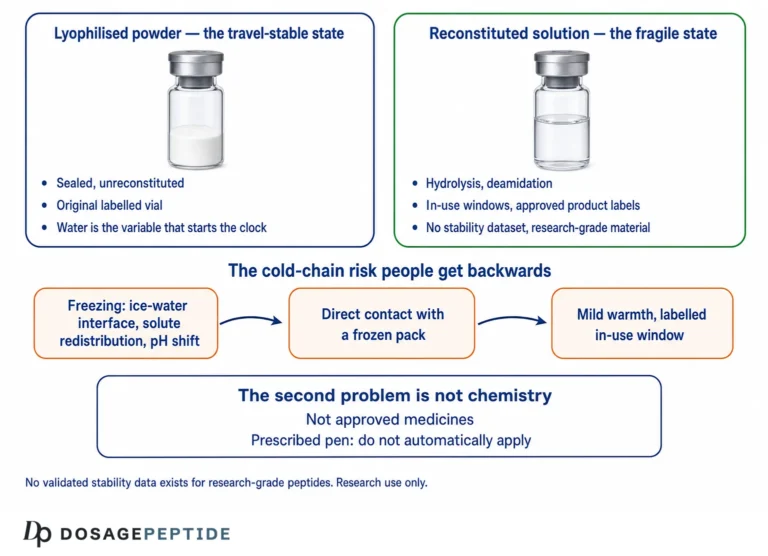
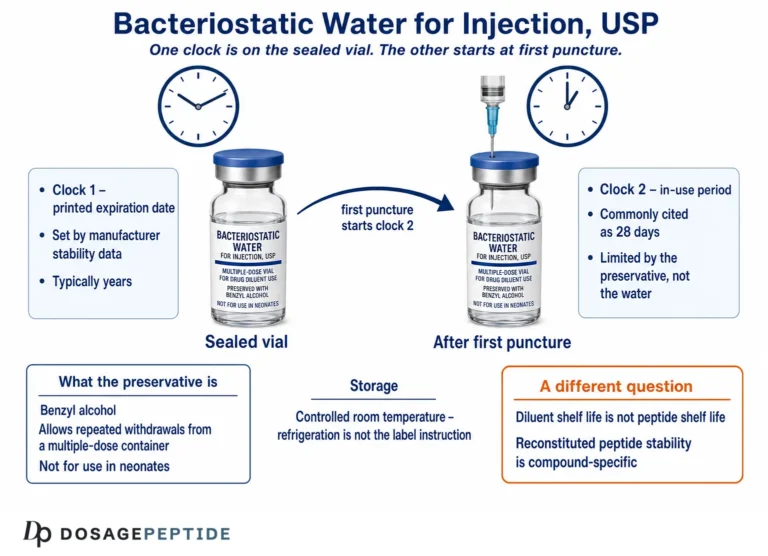
The short answer. A peptide has two lives, and they follow different rules.
- Sealed dry powder (lyophilized): freezer at −20 °C or below — months to years. A fridge at 2–8 °C is acceptable for the medium term; room temperature is for shipping, not storage. Let a cold vial warm to room temperature before you open it, or humid air will condense onto the powder.
- Reconstituted liquid: fridge at 2–8 °C, at the back, away from the door and away from light. Do not freeze it — freeze-thaw cycles damage peptides in solution in ways you cannot see.
- How long once mixed: with bacteriostatic water, roughly 28 days refrigerated is the conventional in-use window — a microbiological limit set by the preservative, not a chemistry guarantee. With plain sterile water there is no preservative and no multi-use window at all.
- Two clocks, take the shorter one. The diluent sets a contamination clock (~28 days); the peptide itself sets a chemical clock that may be shorter for a fragile compound stored warm. Date-label every vial at reconstitution.
- Never shake. Swirl or roll. Agitation drives aggregation at the air-liquid interface.
Each of those numbers has a mechanism behind it, and knowing the mechanism is what lets you judge the cases the rules do not cover. That is the rest of this guide.
Storage is the quiet variable that decides whether a research peptide behaves the way its literature says it should. A vial can arrive from a reputable source at high purity, be handled by careful hands, and still lose most of its integrity before it is ever used — not through any dramatic accident, but through the slow, invisible chemistry that begins the moment the molecule leaves the freeze-dryer and continues, faster, once water is added back. Peptides are chains of amino acids held together by bonds that are perfectly happy to come apart under the right conditions: warmth, light, oxygen, agitation, repeated freezing, or simply the passage of time in solution. Understanding how to protect them — before reconstitution as a dry powder, and after reconstitution as a liquid — is not a peripheral housekeeping detail. It is the difference between working with the compound you think you have and working with a partially degraded mixture whose composition you can no longer describe.
This guide is written for researchers and educated readers who want an honest, mechanism-grounded account of peptide storage. It is strictly educational: it describes the physical chemistry of peptide stability and the storage practices that follow from it, as documented in the pharmaceutical-sciences literature and on regulated product labels. It is not medical advice, not a usage protocol, and not a suggestion that any research peptide is safe or effective for human use. What it offers is a clear map of why peptides degrade and how storage conditions slow that degradation, so that anyone handling these materials in a laboratory context can reason from first principles rather than from folklore. We will cover the degradation chemistry itself, the stable lyophilized state, what changes at reconstitution, the crucial choice of diluent, temperature and light management, the specific hazard of freeze-thaw cycling, beyond-use dating, how to recognize a peptide that has gone bad, and a candid section on what the evidence does not tell you.
Why Peptide Storage Is a Scientific Question, Not an Afterthought
The instinct to treat storage as a formality — put it in the fridge, use it eventually — comes from experience with small, robust molecules. Table salt, aspirin, most laboratory reagents: these tolerate a wide range of conditions because their structures are simple and thermodynamically stable. Peptides are not like this. They are marginally stable molecules whose biological activity depends on an intact primary sequence and, often, on a specific folded conformation or disulfide arrangement. The same properties that make peptides useful signaling molecules — reactive side chains, hydrolyzable amide bonds, an ability to adopt and shift conformation — also make them vulnerable to a whole catalog of degradation reactions that proceed spontaneously under ordinary conditions.12
The pharmaceutical-sciences literature has studied this problem for decades precisely because protein and peptide drugs are so much harder to keep stable than conventional small-molecule drugs. The foundational reviews of protein-pharmaceutical stability, from Manning and colleagues’ 1989 survey through their 2010 and later updates, establish a consistent picture: peptides and proteins degrade by both chemical routes (covalent changes to the molecule, such as oxidation, deamidation, and bond cleavage) and physical routes (non-covalent changes, such as unfolding, aggregation, and adsorption to surfaces).23 Both categories are accelerated by heat, and both are far faster in solution than in the dry state, a framework that the most recent surveys of protein-pharmaceutical stability continue to reinforce.10 This is the single most important fact in all of peptide storage: water is not a neutral medium. Water participates directly in hydrolysis and deamidation and provides the mobility that lets molecules collide, unfold, and aggregate. Remove the water, and most of these reactions slow to a crawl. Add it back, and the clock starts running.14
This is why the entire architecture of research-peptide handling revolves around one transition: the shift from lyophilized powder to reconstituted solution. Before that transition, the molecule sits in a low-energy, low-mobility, low-water environment where it can remain intact for months or years under the right cold conditions. After that transition, it is a dissolved species subject to the full menu of degradation chemistry, with a shelf life measured in days to weeks rather than months to years. Everything practical about storage flows from respecting that divide. The site’s peptide reconstitution guide walks through the mechanics of the transition itself; this article focuses on protecting the molecule on both sides of it.
There is also a purely epistemic reason to take storage seriously. A degraded peptide is not merely “weaker.” Degradation produces a heterogeneous mixture: intact molecule plus deamidated variants, oxidized variants, hydrolysis fragments, and aggregates, in proportions that depend on how the material was stored and for how long. From a research standpoint, that heterogeneity is fatal to interpretation. You no longer know what you are studying. Any observation made with an improperly stored peptide is confounded by an unknown and uncharacterized impurity profile — which is why storage discipline is, at bottom, a matter of experimental validity, not just economy.
How Peptides Degrade: The Chemistry You Are Storing Against
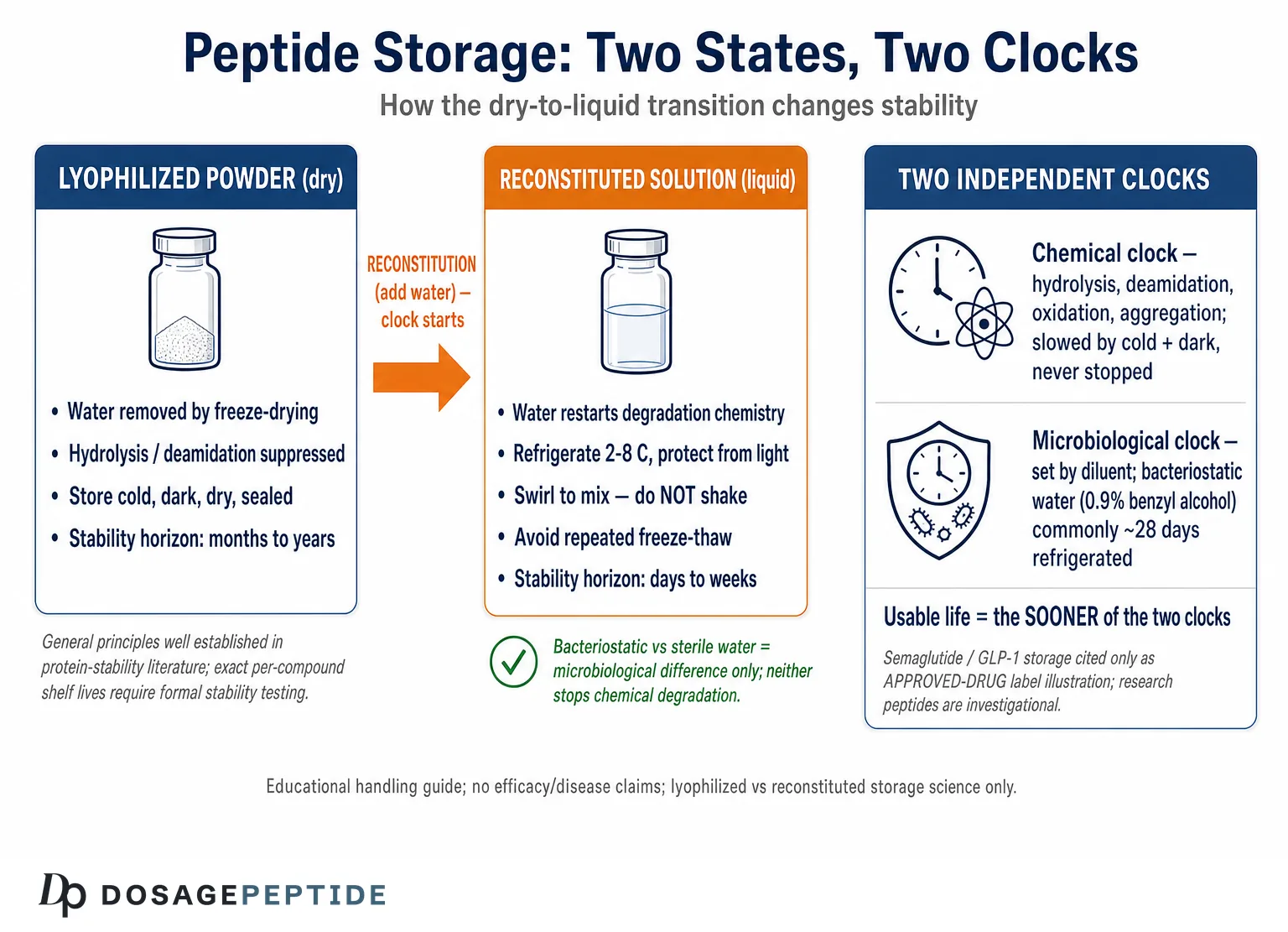
To store a peptide intelligently, you have to know what you are protecting it from. The degradation pathways are well characterized, and each one maps to a specific storage countermeasure. Broadly, they divide into chemical degradation (which alters the covalent structure) and physical degradation (which alters the assembly or conformation without necessarily breaking bonds).12
Hydrolysis is the cleavage of the peptide backbone by water. It is catalyzed by acids and bases and therefore depends strongly on pH, and it accelerates with temperature. Certain bonds are especially labile — the aspartate-proline bond is a classic hot spot — and the reaction proceeds spontaneously in aqueous solution.1 Hydrolysis is the most intuitive form of degradation: it literally chops the molecule into fragments. It is also the most obvious reason a dry powder outlasts a solution by such a wide margin, because in the absence of liquid water there is little to drive the reaction.
Deamidation is the conversion of asparagine and glutamine side chains into aspartate and glutamate residues, usually proceeding through a cyclic succinimide intermediate that then hydrolyzes into a mixture of aspartyl and isoaspartyl products. Deamidation is one of the most common degradation routes for peptides and can proceed faster than backbone hydrolysis under neutral-to-alkaline conditions.1 It changes the molecule’s charge and can seed downstream aggregation; studies have shown that even a few percent of deamidated impurity can nucleate amyloid-like aggregates.1 Deamidation is highly pH-sensitive, which is part of why the literature repeatedly identifies a mildly acidic window (roughly pH 3–5) as the sweet spot for peptide stability in solution.1
Oxidation attacks the sulfur-containing residues methionine and cysteine and the aromatic residues tryptophan, tyrosine, and histidine. It is driven by dissolved oxygen, catalyzed by trace transition-metal ions, and, critically for storage, promoted by light — photo-oxidation of aromatic side chains is a well-documented pathway.1 Oxidation is why the storage literature is so insistent on excluding air, protecting from light, and, in formulation contexts, adding chelating agents and antioxidants. For cysteine-containing peptides, oxidation can also scramble disulfide bonds, altering the folded structure.
Aggregation is the flagship physical-degradation pathway and, in many respects, the hardest to reverse. Peptide molecules that partially unfold expose hydrophobic surfaces that then associate with one another, forming dimers, higher oligomers, and eventually visible particulates. Aggregation is promoted by elevated temperature, high concentration, agitation (which drives molecules to the air-water interface where they unfold), and freezing.5 The comprehensive review by Zapadka and colleagues catalogs the many factors that push a peptide toward aggregation — sequence, concentration, pH, net charge, surfaces, interfaces, temperature, agitation, and lyophilization stress among them — and it is a sobering reminder that a peptide in solution is a metastable system constantly probing routes to a lower-energy aggregated state.5 Once formed, aggregates are frequently irreversible, which is why aggregation-driven losses cannot be recovered by simply re-cooling or diluting.
Two features of this chemistry structure everything that follows. First, temperature accelerates essentially all of it. As a rough rule of thumb borrowed from reaction kinetics, degradation rates rise steeply with temperature, so every reduction in storage temperature buys disproportionate stability.2 Second, water enables most of it. Hydrolysis and deamidation require water as a reactant; aggregation and unfolding require the molecular mobility that solution provides. This is the mechanistic justification for the two pillars of peptide storage: keep it cold, and keep it dry until you need it. A useful reference for the vocabulary in this section — succinimide, isoaspartate, lyophilization, and the rest — is the site’s peptide glossary, which defines the technical terms that recur across the stability literature.
Storing the Lyophilized Powder: The Stable State
Lyophilization — freeze-drying — is the process by which a peptide solution is frozen and then dried under vacuum by sublimation, removing water directly from the solid state and leaving behind a dry, porous cake or powder. The point of the exercise is stability. By stripping residual moisture down to low single-digit percentages (often below 1–2%), lyophilization removes the reactant that drives hydrolysis and deamidation and the medium that enables aggregation, converting a fragile solution into a comparatively durable solid.4 This is why virtually all research peptides ship as lyophilized powder rather than pre-mixed liquid: the dry state is how the material survives manufacturing, shipping, and shelf time.
But “durable” is relative, and the lyophilized state has its own storage rules. Even a dry peptide will degrade if exposed to heat, humidity, or repeated temperature cycling, because residual moisture and any water that intrudes through an imperfect seal can still support slow reactions.24 The governing variables for powder storage are temperature, moisture, and light, in roughly that order of importance.
Temperature. The colder the powder, the slower any residual chemistry proceeds. The pharmaceutical convention, reflected across the formulation literature and industry practice, is that deep-freeze storage (−20 °C or lower, and −80 °C for the most sensitive or long-term cases) maximizes shelf life, refrigeration (2–8 °C) is a reasonable medium-term compromise, and ambient room temperature is acceptable only for short windows.2 The general principle — that lower temperature yields longer stability, and that the dried state is far more forgiving than solution — is a direct consequence of the degradation kinetics discussed above and is a recurring theme in the protein-pharmaceutical stability reviews.23
Moisture. Because the whole stability advantage of lyophilization comes from the absence of water, moisture ingress is the powder’s chief enemy. This is why vials should be kept sealed until use, why some products include a desiccant, and why letting a cold vial warm to room temperature before opening it is standard practice: opening a chilled vial in humid air invites condensation onto the cold powder, reintroducing exactly the water the freeze-dryer removed. Allowing the vial to equilibrate to room temperature while still sealed avoids that condensation.
Light. Photo-oxidation does not stop simply because the molecule is dry. Aromatic residues can still be oxidized by light, so lyophilized peptides are best stored in the dark — in their original carton, an opaque container, or simply a closed freezer.1 The cost of light protection is essentially zero, and it removes one whole degradation pathway.
The practical upshot is that a properly sealed, low-moisture lyophilized peptide stored cold and dark is genuinely stable for extended periods — the reason vendors can quote multi-month or multi-year shelf lives for powder while quoting only weeks for reconstituted material. It is worth internalizing that this stability is a property of the dry, cold, dark, sealed state specifically. Remove any of those conditions — leave the vial on a bench in the sun, cycle it in and out of a frost-free freezer, or let humid air in — and the advantage erodes.
Reconstitution: The Moment Everything Changes
Reconstitution is the act of dissolving the lyophilized powder in a liquid diluent to produce a usable solution. It is also, in stability terms, the most consequential thing that happens to a research peptide, because it reintroduces water and, with it, the entire catalog of degradation chemistry that the dry state had suppressed.14 The instant a peptide dissolves, hydrolysis and deamidation become live reactions, molecular mobility permits unfolding and aggregation, and any dissolved oxygen or trace metal in the diluent can begin driving oxidation. From that moment the material has a finite, and much shorter, useful life.
How reconstitution is performed also affects the outcome, because the physical stresses of mixing can themselves damage peptides. Two techniques recur throughout the handling literature, both grounded in the aggregation chemistry described earlier. First, the diluent should be added slowly and directed against the inside wall of the vial rather than sprayed forcefully onto the powder; a hard stream creates local turbulence and air-water interface, both of which promote unfolding and aggregation.5 Second, the vial should be dissolved by gentle swirling or by letting it stand, never by vigorous shaking. Shaking generates foam and drives peptide molecules to the air-liquid interface, where they preferentially unfold and aggregate — agitation is one of the classic accelerants of physical instability.5 The rule of thumb “swirl, do not shake” is not fussiness; it is a direct application of interfacial-aggregation physics.
Reconstitution volume is a separate matter from stability but worth clarifying because it is often conflated with it. The volume of diluent chosen sets the concentration of the resulting solution — a fixed mass of peptide dissolved in more liquid yields a lower concentration per unit volume, and vice versa — but it does not change the total amount of peptide present, and within normal ranges it is not primarily a stability decision. Concentration can influence aggregation (very high concentrations increase molecular crowding and aggregation propensity), but the everyday choice of reconstitution volume is really about arithmetic convenience, not shelf life.5 For the calculation side of that arithmetic, the site’s reconstitution calculator illustrates how concentration follows from mass and volume; the point for this article is simply that once the powder is in solution, the stability clock has started regardless of the concentration selected.
The conceptual takeaway is that reconstitution converts a months-stable solid into a days-to-weeks-stable liquid, and it does so instantly and irreversibly. Everything about post-reconstitution storage — the diluent choice, the temperature, the light protection, the avoidance of freeze-thaw — is about slowing the degradation that reconstitution set in motion.
Bacteriostatic vs. Sterile Water: The Diluent Decides the Clock
The choice of reconstitution fluid is one of the most misunderstood aspects of peptide handling, and it matters for a reason that has nothing to do with the peptide’s chemical stability and everything to do with microbiology. The two diluents most often discussed are sterile water for injection and bacteriostatic water for injection, and the difference between them is a single additive.
Sterile water for injection is exactly what it sounds like: purified water that has been sterilized and contains no additives. It is sterile at the moment it is sealed, but it has no preservative, which means that once a vial is opened and a needle is introduced, any microorganisms that enter can grow unchecked. For that reason sterile water is generally treated as single-use or very-short-window material once broached.
Bacteriostatic water for injection is sterile water containing 0.9% (9 mg/mL) benzyl alcohol as a bacteriostatic preservative. It is supplied specifically as a multiple-dose preparation intended for repeated withdrawals to dissolve or dilute drugs.8 The term “bacteriostatic” is precise and worth parsing: benzyl alcohol does not kill bacteria outright (that would be bactericidal); it inhibits their reproduction, holding microbial growth in check across the multiple entries a multi-dose vial is designed to withstand. That bacteriostatic action is what underlies the extended in-use window that bacteriostatic water permits, whereas plain sterile water, lacking any preservative, offers no such protection against contamination between uses.8
It is important to be exact about what the preservative does and does not do. Benzyl alcohol addresses microbiological stability — it slows the growth of bacteria that enter during handling. It does not stop the chemical degradation of the peptide itself: hydrolysis, deamidation, oxidation, and aggregation proceed in bacteriostatic water just as they do in any aqueous solution, governed by temperature, pH, light, and time.1 In other words, the diluent choice sets the microbiological clock, while temperature and handling set the chemical clock, and the shorter of the two governs the material’s usable life. A peptide can be microbiologically protected by benzyl alcohol yet still chemically degrade if left warm or exposed to light; conversely, chemically stable material in plain sterile water is still a contamination risk once broached.
| Property | Sterile water for injection | Bacteriostatic water for injection |
|---|---|---|
| Additive | None | 0.9% benzyl alcohol (9 mg/mL)8 |
| Microbial control after opening | None — no preservative | Inhibits bacterial growth (bacteriostatic)8 |
| Intended use format | Typically single-use once broached | Multiple-dose; repeated withdrawals8 |
| Typical in-use window once opened | Very short; discard promptly | Commonly 28 days refrigerated per multi-dose convention89 |
| Effect on peptide chemical stability | None directly; water still enables degradation | None directly; benzyl alcohol does not stop hydrolysis/oxidation1 |
| What it controls | Sterility at seal only | Microbial growth across multiple entries8 |
One further caveat belongs here. Benzyl alcohol is a genuine preservative with a defined concentration, and its bacteriostatic efficacy is not permanent: across repeated punctures and weeks of refrigerated use, preservative capacity is gradually consumed and the cumulative probability of a contamination event rises. This is the microbiological basis of the widely cited 28-day beyond-use window for opened multi-dose bacteriostatic water, discussed in the beyond-use section below.89 The diluent decides the clock, but even the preserved clock runs out.
Storing Reconstituted Peptides: Temperature, Light, and the In-Use Window
Once a peptide is in solution, storage becomes an exercise in slowing degradation as much as physically possible while the material is in use. Three levers dominate: temperature, light, and time.
Temperature is the master variable. Refrigeration at 2–8 °C is the standard storage condition for reconstituted peptides because cold dramatically slows every chemical degradation route and reduces molecular mobility.2 The magnitude of the effect is easy to underestimate. Approved peptide drug products give a concrete, real-world illustration: unopened semaglutide pens, for example, must be stored refrigerated at 2–8 °C, and although the in-use pen may be kept at controlled room temperature for a defined period, the product must be discarded after a fixed number of days regardless.7 The general lesson from such labels — that a peptide in solution is refrigerated by default and has a strictly bounded life at warmer temperatures — transfers directly to the research context. Warmth is not a matter of convenience; every degree above refrigeration speeds the loss of intact material.
Light protection is nearly free and worth taking. Because photo-oxidation degrades aromatic residues even in the cold, reconstituted peptides should be kept out of direct light — wrapped, boxed, or simply stored in an opaque or closed container.1 Approved injectable products are routinely labeled to be kept in their original cartons to protect from light, and manufacturer storage guidance for marketed peptide products similarly specifies refrigeration with bounded in-use windows at warmer temperatures — a practice that reflects the same underlying chemistry.711 There is no downside to protecting a vial from light, and it removes a pathway that operates silently.
Time is the variable you cannot pause, only slow. Even under ideal refrigeration and darkness, a reconstituted peptide is degrading, just slowly. This is why solution shelf life is quoted in days to weeks rather than the months to years appropriate to powder. The exact usable window depends on the specific peptide’s intrinsic stability, the diluent, and the storage conditions, and rigorous figures come only from stability studies on that particular compound. In the absence of compound-specific data, the conservative research-context defaults are: keep it cold, keep it dark, minimize the time in solution, and treat the microbiological beyond-use limit of the diluent as a hard ceiling.
A useful mental model is that reconstituted peptide storage is about managing two simultaneous clocks. The chemical clock — hydrolysis, deamidation, oxidation, aggregation — is slowed by cold and dark but never stopped. The microbiological clock — the beyond-use date set by the preservative in the diluent — runs independently. The material is only as good as the sooner of the two limits. Storing cold and dark extends the chemical clock; using preserved (bacteriostatic) diluent extends the microbiological clock; neither substitutes for the other. Researchers documenting these parameters for specific compounds often tabulate them alongside reconstitution details, as the site does in its handling-protocols discussion for research studies, which frames storage as an inseparable part of the handling chain rather than an afterthought.
Freeze-Thaw: The Damage You Cannot See
Of all the storage mistakes that quietly destroy peptides, repeated freeze-thaw cycling is among the most damaging and the least visible. The intuition that “colder is always better, so refreezing must be fine” is dangerously wrong for peptides in solution, and understanding why requires looking at what actually happens to a solution as it freezes.
When an aqueous peptide solution freezes, water crystallizes into ice, but the solutes — peptide, salts, buffer components — do not enter the ice lattice. Instead they are excluded and concentrated into the shrinking pockets of unfrozen liquid between the growing ice crystals, a phenomenon called cryoconcentration. In those pockets, peptide concentration, ionic strength, and local pH can all swing to extremes far outside the values of the original solution.6 The peptide is simultaneously crowded together (promoting aggregation), exposed to a large ice-water interface (promoting unfolding at the interface), and subjected to local pH shifts (promoting pH-dependent degradation). Thawing then reverses the temperature but not necessarily the damage: aggregates formed during freezing are frequently not redissolved on warming.
The controlled biophysical literature confirms both the mechanism and its consequences. Studies of freeze-thaw stress on model proteins document colloidal instability (aggregate formation), conformational change, and loss of biological activity as direct results of freeze-thaw cycling, and they show that the outcome depends on formulation factors such as buffer, excipient, concentration, and the number of cycles.6 Crucially, the damage is cumulative: each cycle inflicts a small increment of aggregation and structural change, and those increments add up across cycles.6 A solution frozen and thawed once may be largely intact; the same solution frozen and thawed five times may have lost a substantial fraction of its intact peptide to irreversible aggregates — aggregates that a visual glance at a still-clear vial will not reveal until they grow large enough to scatter light.
The same literature also points to why some formulations survive freeze-thaw better than others: cryoprotective excipients such as sucrose and glycerol can markedly reduce freeze-thaw aggregation and even improve the reversibility of any aggregates that do form, whereas unprotected solutions fare worse.6 This is a formulation lever available in manufacturing, not something a researcher improvises at the bench, but it explains why bare peptide-in-water is particularly vulnerable to freezing damage.
The practical rules that follow are simple and strict. Do not refreeze a reconstituted peptide as a matter of routine convenience. If long-term storage of dissolved material is genuinely necessary, the damage-minimizing approach documented in the literature is to aliquot the solution into single-use portions before freezing, so that each aliquot is thawed exactly once and never subjected to repeated cycling. And recognize that the lyophilized powder is the format designed for freezer storage; the solution is not. The powder tolerates cold storage precisely because there is little free water to form the ice crystals and cryoconcentrated pockets that drive freeze-thaw damage in solution. When freezer-duration storage is the goal, the dry state is almost always the right state.
Beyond-Use Dating: How Long Is Too Long?
“Beyond-use date” (BUD) is a specific concept borrowed from pharmacy practice, and it is worth distinguishing carefully from “expiration date.” An expiration date, set by a manufacturer, applies to an unopened product stored under labeled conditions and is supported by formal stability data. A beyond-use date applies after a product has been opened, reconstituted, or otherwise altered, and it reflects both chemical stability and the microbiological risk introduced by broaching a sterile container. For reconstituted peptides, the operative limit is almost always the beyond-use date, not the powder’s expiration date.
The most concrete, widely cited BUD in peptide handling comes from the diluent. Multi-dose bacteriostatic water for injection, once first punctured, is conventionally assigned a 28-day in-use window when stored refrigerated, in line with the standards governing multiple-dose sterile preparations — the framework articulated in USP General Chapter <797> on sterile compounding and reflected on product labeling.89 The rationale is microbiological rather than chemical: over roughly four weeks of repeated punctures, the benzyl-alcohol preservative’s capacity to hold microbial growth in check declines and the cumulative probability of a contamination event rises, so 28 days represents a balance between the preservative’s efficacy and the accumulating risk of repeated entries.8 This 28-day figure is the ceiling imposed by the diluent, independent of the peptide.
The peptide’s own chemical stability imposes a separate ceiling, which may be shorter or, occasionally, longer than 28 days depending on the compound and the storage conditions. For an intrinsically labile peptide stored suboptimally, meaningful chemical degradation can occur well within the microbiological window; for a robust peptide kept cold and dark, the chemistry may comfortably outlast the diluent’s 28 days, in which case the microbiological limit governs. The disciplined posture is to treat the earlier of the two limits as the effective beyond-use date, and to shorten it further whenever storage was imperfect — a warm shipment, a missed refrigeration, an accidental freeze-thaw, or exposure to light all argue for discarding sooner rather than later.
| State / format | Typical storage condition | Relative stability horizon | Governing limit |
|---|---|---|---|
| Lyophilized powder, sealed | −20 °C or below, dark, dry2 | Months to years | Manufacturer expiration; moisture/heat exposure |
| Lyophilized powder, sealed | 2–8 °C, dark, dry | Medium-term (weeks to months) | Residual moisture + temperature |
| Lyophilized powder, sealed | Room temperature, short transit | Short; minimize duration2 | Heat-accelerated degradation |
| Reconstituted solution | 2–8 °C, dark, no refreezing | Days to weeks | Sooner of chemical vs microbiological clock |
| Reconstituted in bacteriostatic water | 2–8 °C, multi-dose | Up to ~28 days (diluent ceiling)89 | Preservative beyond-use date |
| Reconstituted, subjected to freeze-thaw | Any | Reduced — cumulative aggregation6 | Irreversible physical degradation |
These horizons are directional, not guarantees. Real numbers for any specific peptide come only from stability testing of that molecule in that formulation, which is exactly the kind of data that manufacturer labels for approved peptide drugs encapsulate.7 For research materials without such data, the conservative reading of the table is: powder cold and dry buys the most time, solution buys the least, freeze-thaw quietly steals it, and the beyond-use date is a ceiling you can only lower, never raise.
Reading the Signs: When a Peptide Has Degraded
Because degradation is largely invisible in its early stages, researchers lean on both visual inspection and, where available, analytical methods to judge whether stored material remains usable. Neither is a substitute for proper storage, but both are part of a disciplined workflow.
Visual cues. A correctly reconstituted peptide solution is typically clear and colorless. Departures from that baseline are warning signs. Cloudiness or turbidity suggests light-scattering aggregates or particulates. Visible particles, flakes, or a haze indicate advanced aggregation or precipitation. Discoloration can signal oxidation or other chemical change. Approved injectable peptide products explicitly instruct users to inspect the solution and discard it if it is cloudy, discolored, or contains particles — a practice grounded in the same aggregation chemistry discussed above.7 The important caveat is that visual inspection only catches advanced degradation: a solution can have lost a meaningful fraction of its intact peptide to soluble aggregates and deamidation while still looking perfectly clear. A clear vial is necessary but not sufficient evidence of integrity.
Analytical confirmation. Definitive assessment of peptide integrity requires analytical methods — high-performance liquid chromatography (HPLC) to quantify purity and detect degradation products, and mass spectrometry to identify specific modifications such as oxidation (a mass increase of 16 for an added oxygen) or deamidation (a mass increase of 1).1 These techniques are how the stability literature actually measures degradation, and they are the gold standard for deciding whether stored material still matches its label. They are, of course, beyond the reach of casual handling, which is precisely why preventive storage discipline matters so much: when you cannot easily measure degradation, you must prevent it.
The honest summary is that you cannot reliably tell, by eye, that a peptide is intact — you can only tell, by eye, when it has clearly failed. This asymmetry is the strongest possible argument for treating storage as prevention rather than triage. The molecule you protected properly from the start is the one you can still describe with confidence.
Peptide-Specific Considerations and Common Handling Errors
General storage principles apply to all peptides, but the degree of vulnerability varies with sequence, and a handful of recurring handling errors account for most avoidable losses. Knowing both refines the general rules into practice.
Sequence sets the risk profile. A peptide’s amino-acid composition predicts which degradation routes threaten it most. Methionine, cysteine, tryptophan, tyrosine, and histidine residues flag oxidation susceptibility; asparagine and glutamine flag deamidation; aspartate-proline and similar motifs flag hydrolysis hot spots; and cysteine-containing peptides carry the added risk of disulfide scrambling.1 A peptide rich in these residues warrants extra caution with light, oxygen, and time, whereas a short, additive-free sequence may be comparatively forgiving. This is also why blanket storage numbers are unreliable across compounds: the same conditions that comfortably preserve one peptide may allow measurable loss in another with a more reactive sequence.15
The common errors are remarkably consistent. Across the handling literature, the same mistakes recur: shaking the vial during reconstitution (interfacial aggregation); opening a cold vial before it warms (condensation and moisture ingress); leaving reconstituted material at room temperature for convenience (accelerated chemical degradation); storing solution in direct light (photo-oxidation); and, most insidiously, repeatedly freezing and thawing the same solution (cumulative, irreversible aggregation).56 Each of these maps cleanly to a degradation pathway covered earlier, which is the useful part: every rule in peptide storage is a countermeasure to a specific, known chemical or physical mechanism, not an arbitrary ritual.
A further practical error worth naming is over-reliance on the diluent’s preservative. Because bacteriostatic water permits a multi-week in-use window, it is tempting to treat that window as a guarantee of the peptide’s integrity for the same period. It is not. The preservative addresses microbes, not chemistry; a peptide can be well within its diluent’s beyond-use date and still have degraded chemically if it was stored warm, in light, or subjected to freeze-thaw.18 The two clocks are independent, and the microbiological one tells you nothing about the chemical one.
These distinctions — sequence-dependent vulnerability, the specific mapping of errors to mechanisms, the independence of the two clocks — are the sort of detail that separates rote storage habits from genuine understanding. For readers building that understanding across the peptide field, the site’s central dosages index catalogs compounds alongside their handling parameters, and foundational explainers such as the overview of what BPC-157 is illustrate how storage sits within the broader context of a specific compound’s research profile.
What the Evidence Does — and Does Not — Establish
Honesty about storage means being clear about the boundaries of what the underlying science supports. A great deal is well established; some commonly repeated specifics are less firmly grounded than they sound.
What is well established. The core mechanisms are not in doubt. Peptides degrade by hydrolysis, deamidation, oxidation, and aggregation; these reactions are accelerated by heat, enabled by water, and promoted by light, oxygen, agitation, and freezing; the dry lyophilized state is far more stable than solution; cold and dark storage slows degradation; and repeated freeze-thaw causes cumulative, often irreversible, physical damage. All of this is supported by decades of peer-reviewed protein-pharmaceutical stability research and is not seriously contested.12356 The microbiological framework for multi-dose preserved diluents, including the 28-day beyond-use convention for opened bacteriostatic water, is likewise well documented in pharmacy standards and product labeling.89
What is less certain than it is often made to sound. The precise numbers — “stable for exactly X months at −20 °C,” “good for exactly Y days once reconstituted” — are frequently quoted with a confidence the evidence does not always support for a specific research peptide. Rigorous shelf-life figures come from formal stability studies on a particular molecule in a particular formulation, of the kind that underlie approved-drug labels.7 Many peptides sold for research use have no such published stability data, and general benchmarks — useful as directional guidance — are extrapolations from the behavior of other peptides and proteins, not measurements of the compound in hand. Treating a generic number as if it were a validated shelf life for a specific, unstudied peptide is a category error worth avoiding. The correct posture is to use general principles to minimize degradation and to recognize that, absent compound-specific data, the exact usable window is an estimate.
What storage cannot do. Finally, and most importantly, no amount of careful storage confers efficacy, safety, or therapeutic value on a research compound. Perfect handling preserves whatever the molecule intrinsically is; it does not make an investigational or unapproved peptide into an approved therapy, and it says nothing about whether the compound does anything useful in a living system. Storage discipline is about experimental integrity — keeping the material you study identical to the material you think you are studying — not about clinical benefit. It is entirely possible to store a peptide flawlessly and still be handling a compound with no demonstrated efficacy for any indication. Those are separate questions, and this article speaks only to the first.
The evidence, then, gives us a robust qualitative framework and reliable general principles, while leaving compound-specific quantitative shelf lives to formal stability testing that most research materials simply have not undergone. That combination — strong on mechanism, appropriately humble on exact numbers — is the honest state of peptide-storage science, and it is a sturdier foundation for good practice than any single memorized figure.
Frequently Asked Questions
Do lyophilized peptides really last much longer than reconstituted ones?
Yes, and the difference is large. Lyophilization removes almost all water, which suppresses the hydrolysis and deamidation reactions that require water and greatly reduces the molecular mobility that drives aggregation.4 Stored cold, dark, dry, and sealed, a lyophilized peptide can remain stable for months to years, whereas the same peptide in solution is typically usable only for days to weeks because reconstitution restarts the full menu of degradation chemistry.12 This is why research peptides ship as powder and are reconstituted only when needed.
What temperature should I store peptides at?
Colder is better, because degradation rates fall steeply with temperature.2 For lyophilized powder, deep-freeze storage (−20 °C or below, and −80 °C for the most sensitive or longest-term cases) maximizes shelf life, refrigeration is a medium-term compromise, and room temperature should be limited to short transit windows. Reconstituted solution is stored refrigerated at 2–8 °C and, importantly, is not a good candidate for freezer storage because freezing a solution invites freeze-thaw aggregation. The dry powder, not the solution, is the format designed for the freezer.6
What is the difference between bacteriostatic and sterile water, and does it matter?
Sterile water contains no preservative; bacteriostatic water contains 0.9% benzyl alcohol, which inhibits bacterial growth and makes it suitable as a multiple-dose diluent.8 The difference is microbiological, not chemical: bacteriostatic water lets a reconstituted vial be entered repeatedly over a defined window (conventionally up to 28 days refrigerated), whereas plain sterile water offers no protection against contamination once broached. Neither additive stops the peptide’s own chemical degradation, which is governed by temperature, light, and time regardless of diluent.18
Why is shaking the vial discouraged?
Shaking drives peptide molecules to the air-liquid interface and generates foam, and interfaces are where peptides preferentially unfold and aggregate.5 Agitation is one of the classic accelerants of physical (aggregation) degradation. The recommended alternative is to add the diluent gently against the vial wall and dissolve the powder by slow swirling or by letting it stand, minimizing the interfacial stress that promotes aggregation.
How bad is it to freeze and thaw a reconstituted peptide more than once?
Worse than most people expect, and the damage is cumulative. Each freeze concentrates the peptide and salts into shrinking unfrozen pockets (cryoconcentration), producing local pH and ionic-strength extremes and a large ice-water interface that together drive aggregation; thawing does not reliably reverse the aggregates that form.6 Every cycle adds a small, often irreversible increment of damage. If dissolved material must be frozen, the damage-minimizing approach is to split it into single-use aliquots first so each is thawed only once.6
How long can I keep a reconstituted peptide?
The usable window is set by the sooner of two independent clocks. The microbiological clock is the diluent’s beyond-use date — conventionally up to about 28 days for opened multi-dose bacteriostatic water stored refrigerated.89 The chemical clock is the peptide’s own degradation, which cold and dark storage slows but never stops. Exact figures require stability data on the specific compound; absent that, keep it cold and dark, minimize time in solution, and treat the earlier of the two limits as the ceiling — shortening it if storage was ever imperfect.
Can I tell by looking whether a peptide has gone bad?
Only partly. A degraded solution may turn cloudy, develop visible particles, or discolor, and approved injectable products instruct users to discard solution that is cloudy, discolored, or contains particles.7 But visual inspection catches only advanced degradation; a solution can lose a meaningful fraction of intact peptide to soluble aggregates and deamidation while still appearing clear. Definitive assessment requires analytical methods such as HPLC and mass spectrometry.1 Because you cannot see early degradation, prevention through proper storage matters far more than after-the-fact inspection.
Does careful storage make a research peptide safe or effective?
No. Storage preserves whatever the molecule intrinsically is; it does not create efficacy, confer safety, or turn an investigational or unapproved compound into an approved therapy. A flawlessly stored peptide can still be a compound with no demonstrated efficacy for any indication. Storage discipline is about experimental integrity — keeping the material identical to what you believe you are studying — and is a separate question from clinical benefit, which this educational article does not address.
References
- Nugrahadi PP, Hinrichs WLJ, Frijlink HW, Schöneich C, Avanti C. Designing Formulation Strategies for Enhanced Stability of Therapeutic Peptides in Aqueous Solutions: A Review. Pharmaceutics. 2023;15(3):935. PMID 36986796; PMCID PMC10056213. https://pmc.ncbi.nlm.nih.gov/articles/PMC10056213/
- Manning MC, Chou DK, Murphy BM, Payne RW, Katayama DS. Stability of protein pharmaceuticals: an update. Pharm Res. 2010;27(4):544-575. PMID 20143256. https://pubmed.ncbi.nlm.nih.gov/20143256/
- Manning MC, Patel K, Borchardt RT. Stability of protein pharmaceuticals. Pharm Res. 1989;6(11):903-918. PMID 2687836. https://pubmed.ncbi.nlm.nih.gov/2687836/
- Wang W. Instability, stabilization, and formulation of liquid protein pharmaceuticals. Int J Pharm. 1999;185(2):129-188. PMID 10460913. https://pubmed.ncbi.nlm.nih.gov/10460913/
- Zapadka KL, Becher FJ, Gomes dos Santos AL, Jackson SE. Factors affecting the physical stability (aggregation) of peptide therapeutics. Interface Focus. 2017;7(6):20170030. PMID 29147559; PMCID PMC5665799. https://pmc.ncbi.nlm.nih.gov/articles/PMC5665799/
- Wöll AK, Hubbuch J. Investigation of the reversibility of freeze/thaw stress-induced protein instability using heat cycling as a function of different cryoprotectants. Bioprocess Biosyst Eng. 2020;43(7):1309-1327. PMID 32198550; PMCID PMC7261286. https://pmc.ncbi.nlm.nih.gov/articles/PMC7261286/
- U.S. Food and Drug Administration. OZEMPIC (semaglutide) injection — Highlights of Prescribing Information (storage and handling). https://www.accessdata.fda.gov/drugsatfda_docs/label/2023/209637s020s021lbl.pdf
- Pfizer/Hospira. Bacteriostatic Water for Injection, USP (0.9% benzyl alcohol) — Multiple-Dose Vial Prescribing Information / DailyMed label. https://dailymed.nlm.nih.gov/dailymed/lookup.cfm?setid=87d6e9dc-fe3b-4593-ac9a-d7493d1959c7
- United States Pharmacopeia. General Chapter <797> Pharmaceutical Compounding — Sterile Preparations (beyond-use dating and multiple-dose container standards). https://www.usp.org/compounding/general-chapter-797
- Manning MC, et al. Stability of Protein Pharmaceuticals: Recent Advances. Pharm Res. 2024;41(7):1301-1367. PMID 38937372. https://pubmed.ncbi.nlm.nih.gov/38937372/
- Novo Nordisk Medical. GLP-1 Receptor Agonists — Storage & Stability (in-use temperature and light-protection guidance). https://www.novonordiskmedical.com/product-information/storage-and-stability/glp-1-ras.html
Educational and research-use disclaimer: This article is provided solely for scientific and educational purposes and describes the physical chemistry of peptide stability and general laboratory storage practices as documented in the pharmaceutical-sciences literature and on regulated product labels. It is not medical advice, not a usage protocol, and not a recommendation for human use. Research peptides discussed in general terms here are not represented as safe or effective for the treatment, cure, or prevention of any disease, and proper storage confers no efficacy or safety on any compound. Any legitimate handling of these materials should occur within appropriately authorized research settings and in compliance with applicable regulations. Readers should consult qualified professionals and relevant standards before making any decisions.