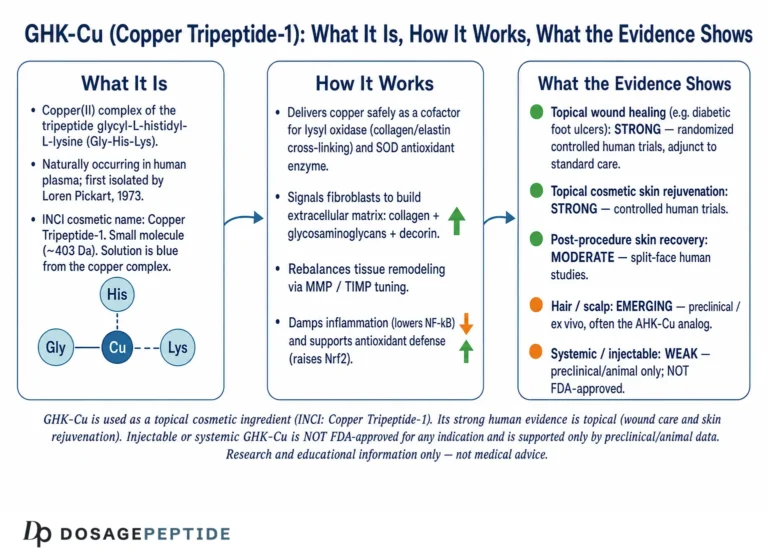
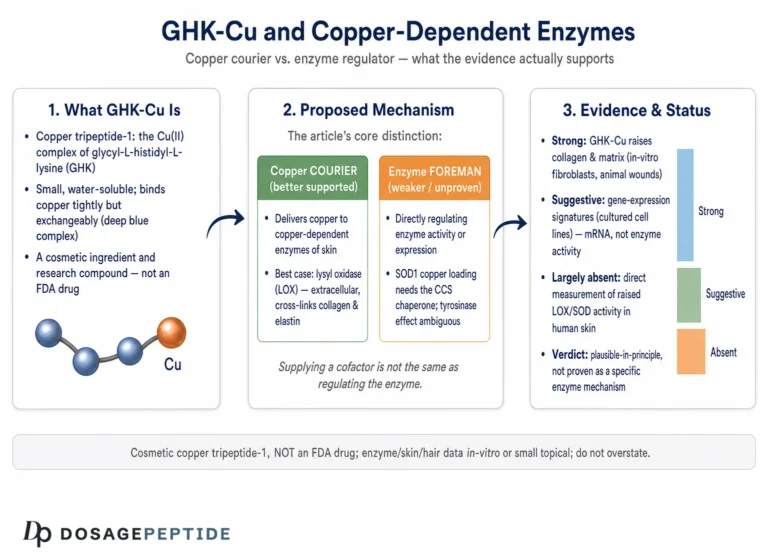
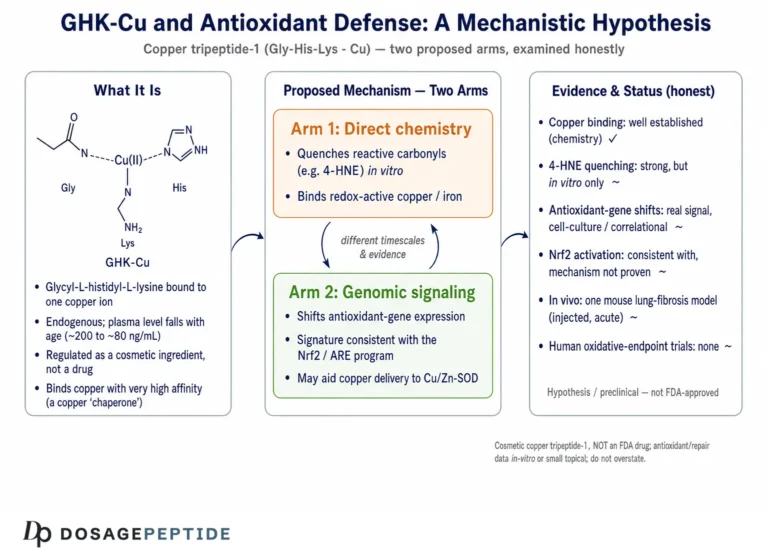
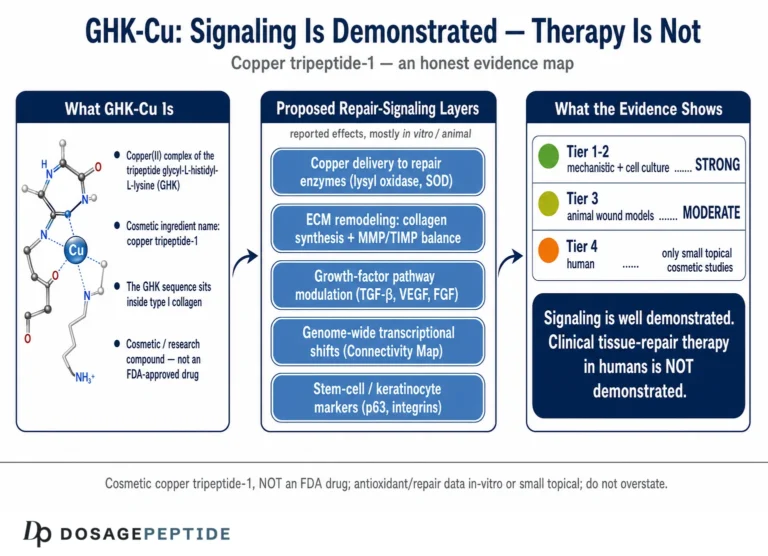
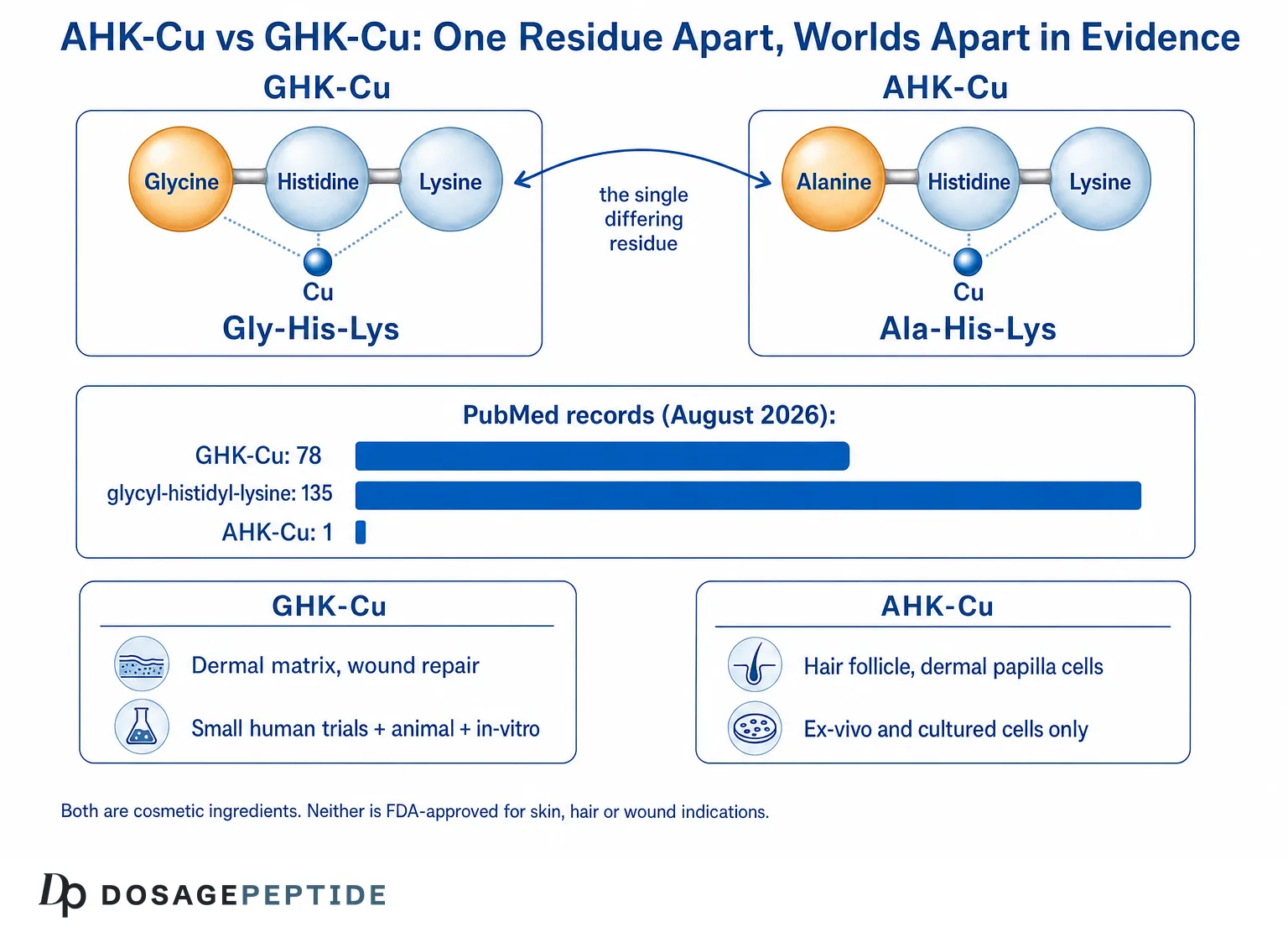
The two are studied for different things. Almost everything published on AHK-Cu concerns hair follicle cells; GHK-Cu carries essentially the entire copper-peptide literature on skin, wound repair and connective tissue [2]. The molecules differ by a single amino acid at position one — alanine instead of glycine — but that one-letter change is not what separates them in practice.
What separates them is how much has actually been measured. GHK-Cu has been studied since 1980 across wound-healing, fibroblast and gene-expression work [1]. The most cited AHK-Cu result rests on a single 2007 study on cultured human hair follicles and dermal papilla cells [8]. So the honest comparison is not “which one works better”: it is an evidence asymmetry large enough that the two sit in different research categories. Neither holds a United States drug approval for hair, skin or wound indications; both circulate as cosmetic ingredients and research-grade materials [14]. This page compares what has been measured, in what species, and by what route.
AHK-Cu vs GHK-Cu at a glance
| Attribute | GHK-Cu | AHK-Cu |
|---|---|---|
| Peptide sequence | Glycyl-L-histidyl-L-lysine (Gly-His-Lys) | L-alanyl-L-histidyl-L-lysine (Ala-His-Lys) |
| Free-peptide formula / mass | C14H24N6O4, 340.38 g/mol [13] | C15H26N6O4, 354.41 g/mol [13] |
| Occurs naturally in humans? | Yes — identified in human plasma; described by Pickart from 1973 onward [2] | Not established as an endogenous human peptide; a synthetic analogue |
| PubMed records mentioning the term (search run August 2026) | 78 for “GHK-Cu”; 135 for “glycyl-histidyl-lysine” | 1 for “AHK-Cu” |
| Registered clinical trials (ClinicalTrials.gov, August 2026) | At least one Phase 2 topical wound-healing study, recruiting [12] | None found |
| Where the research clusters | Dermal matrix, wound repair, collagen and glycosaminoglycan accumulation, MMP modulation | Hair follicle elongation and dermal papilla cells — from a single 2007 report [8] |
| Highest evidence tier reached | Small human trials plus extensive animal and in-vitro work; two indexed randomised human trials were negative on their objective endpoints [7][15] | Ex-vivo human follicles and cultured cells only |
| Route with almost all the data | Topical / applied to skin; also injected into rodent wound chambers in animal studies | Topical and direct culture-medium exposure |
| Regulatory status | Cosmetic ingredient; no FDA drug approval for skin, hair, or wound indications [14] | Cosmetic ingredient; no FDA drug approval for any indication |
Is AHK-Cu the same as GHK-Cu?
No. They are distinct chemical entities with distinct CAS registrations, and the difference is not cosmetic naming. GHK is glycyl-L-histidyl-L-lysine, PubChem CID 73587, CAS 49557-75-7 [13]. AHK is L-alanyl-L-histidyl-L-lysine, PubChem CID 7408502, CAS 126828-32-8, and its copper complex is catalogued separately as PubChem CID 168431292, CAS 682809-81-0 [13]. The substitution of alanine for glycine at position one adds a single methyl group — 14 g/mol — to the free peptide.
That single methyl is chemically small but biologically untested. Nobody has published a head-to-head comparison of the two complexes in the same model, at the same concentrations, measuring the same endpoints. Any statement that AHK-Cu is “stronger for hair” or “GHK-Cu with better follicle affinity” is an inference drawn across separate papers using different tissues, not a measured comparison.
How each peptide holds copper
The copper-binding chemistry is the part the two molecules genuinely share. In GHK, the donor set that grips Cu(II) is built from the N-terminal amine, the deprotonated backbone amide nitrogen, and the imidazole nitrogen of the central histidine, with the lysine side chain contributing to solubility and to interactions with negatively charged surfaces. Early work by Pickart and Thaler showed that the free tripeptide associates at physiological pH with copper, cobalt, iron, molybdenum, manganese, nickel, and zinc, while showing no affinity for calcium, potassium, or sodium (the original abstract lists manganese in both groups, an unresolved inconsistency in the source) — and that copper and iron were the most biologically active partners in their hepatoma-cell assays [1].
The affinity is high enough to matter physiologically: review literature places GHK’s copper binding constant at log 16.44, marginally above the log 16.2 reported for albumin’s high-affinity copper transport site, which is the basis of the argument that GHK can accept copper from albumin rather than strip it destructively from elsewhere [2]. Because AHK retains the same histidine at position two and the same N-terminal amine, its donor atoms are expected to be equivalent — but that is a prediction from structure, not a published measurement. No comparable stability constant for AHK-Cu appears in the indexed literature.
Why is GHK-Cu so much better studied than AHK-Cu?
Largely because GHK-Cu arrived through human biochemistry rather than through cosmetic screening. It was pulled out of human plasma as an activity that changed how aged liver tissue behaved, and the observation that its plasma level falls with age — reported as roughly 200 ng/mL at age 20 down to about 80 ng/mL by age 60 [2] — gave academic groups a reason to keep working on it for fifty years. It also spent time in pharmaceutical development as a wound-care candidate, which generated animal studies with real controls.
AHK-Cu has no comparable origin story. It appears in the peer-reviewed record essentially once, in a 2007 Korean dermatology study, and otherwise lives in cosmetic-industry material and supplier documentation. A PubMed search for the exact term “AHK-Cu” run in August 2026 returns a single record; “GHK-Cu” returns 78, and “glycyl-histidyl-lysine” returns 135. A ClinicalTrials.gov query for AHK-Cu or alanyl-histidyl-lysine returns nothing. For background on each molecule separately, we maintain a dedicated overview of what AHK-Cu is and where its hair-follicle research comes from and a companion page on GHK-Cu’s proposed mechanisms and documented limitations.
What has GHK-Cu actually been shown to do?
Rodent wound models: the strongest preclinical signal
The most quantitatively convincing GHK-Cu data come from rat wound-chamber experiments. Maquart and colleagues implanted stainless-steel mesh cylinders subcutaneously in rats and injected either saline or GHK-Cu, then analysed the contents. They found a concentration-dependent increase in dry weight, DNA, total protein, collagen, and glycosaminoglycan content; collagen synthesis was stimulated about twice as much as non-collagen protein synthesis; type I and type III collagen mRNAs rose while TGF-β mRNA did not; and a control tripeptide, L-glutamyl-L-histidyl-L-proline, produced no significant effect [3]. That control arm is what makes the result interesting: the effect tracked the specific sequence, not merely the presence of a tripeptide.
A follow-up study in the same model examined matrix metalloproteinases. Interstitial collagenase activity in wound fluid was unchanged by GHK-Cu, but MMP-9 expression persisted in the treated chambers until day 22, suggesting the complex shifts the timing of matrix remodelling rather than simply switching collagen production on [4].
Two experimental animal studies published in veterinary journals extend this to topical application; both used purpose-made surgical wounds in laboratory animals, not naturally occurring wounds in patients. In 24 rats with 6 mm full-thickness wounds created inside an ischaemic bipedicle flap, topical tripeptide-copper complex reduced wound area by 64.5 percent at day 13, versus 45.6 percent for the vehicle and 28.2 percent for untreated controls, with lower TNF-α, MMP-2, and MMP-9 in treated tissue [5]. In 18 New Zealand rabbits, topical tripeptide-copper complex produced significantly smaller unhealed wound areas than no treatment at days 7, 14, and 21, and outperformed zinc oxide at day 7 [6].
Human data: thinner than the marketing implies
This is where readers are most often misled. The cosmetic literature routinely reports that GHK-containing creams improved skin laxity, density, and wrinkle depth in placebo-controlled use, and review articles summarise those findings [2]. But much of that material originates in industry-sponsored studies and conference presentations rather than in independently indexed randomised trials, which is a materially weaker evidence tier.
The two randomised human trials that are indexed are not flattering. The larger one is also the older one: Bishop and colleagues ran a prospective randomised evaluator-blinded trial in venous stasis ulcers, in which 86 evaluable patients completed treatment with a 0.4 percent tripeptide-copper complex cream, 1 percent silver sulfadiazine cream, or an inert vehicle placebo. Silver sulfadiazine significantly reduced ulcer size compared with both of the others, and between the copper-peptide cream and the placebo there was no difference [15].
The second is smaller and more recent. Miller and colleagues randomised patients undergoing circumoral carbon-dioxide laser resurfacing to post-treatment skincare regimens with or without GHK-Cu; 13 patients completed. Computer analysis and blinded evaluators found no statistically significant difference between groups in resolution of erythema, and no significant difference in wrinkles or overall skin quality. The only endpoint favouring GHK-Cu was patient-reported overall skin quality on a questionnaire, at P = .04 [7]. A 13-patient study is small enough that neither the negative objective results nor the positive subjective one should be treated as settled.
The picture may change. A Phase 2, randomised, double-blind, vehicle-controlled split-wound study of topical GHK-Cu gel in standardised punch-biopsy wounds began recruiting in February 2026, with an estimated 60 participants and quadruple masking; each participant receives two wounds, one randomised to gel and one to vehicle [12]. That design controls for participant-level healing differences and would be the first properly registered controlled read on GHK-Cu in acute human wounds. It has not reported.
What has AHK-Cu actually been shown to do?
The single study, described precisely
Pyo and colleagues, publishing in Archives of Pharmacal Research in 2007, tested AHK-Cu on human hair follicles cultured ex vivo and on cultured human dermal papilla cells. At concentrations from 1 picomolar to 1 nanomolar, AHK-Cu stimulated elongation of the isolated follicles and proliferation of the dermal papilla cells. Flow cytometry with annexin V and propidium iodide showed a reduction in apoptotic dermal papilla cells at 1 nanomolar — but the authors state explicitly that this decrease was not statistically significant. The Bcl-2 to Bax ratio rose, and cleaved caspase-3 and cleaved PARP fell [8].
The paper’s own framing of tripeptide-copper complexes as agents that raise VEGF production and lower TGF-β1 secretion in dermal fibroblasts is background context drawn from prior copper-peptide work, not a new AHK-Cu measurement in that study. This distinction matters because that VEGF sentence is the one most frequently lifted out of context and presented as an AHK-Cu finding.
What that study cannot tell you
An ex-vivo follicle is a piece of tissue in a dish, disconnected from circulation, immune signalling, and androgen environment. Elongation over days in organ culture is a legitimate mechanistic readout, and it is not a demonstration that anything happens on a scalp. There is no published animal model of AHK-Cu applied to skin, no published human study of any design, and no registered trial. Everything downstream of that 2007 paper — vehicle choice, concentration, stability in a finished formulation, tolerability over weeks — is unstudied in the indexed literature. Our AHK-Cu 50 mg vial reference page documents how the material is handled in laboratory settings and where the published concentration ranges came from, precisely so that those numbers are not mistaken for a human protocol.
Do the two peptides target different tissues?
Partly, but the split is a split in where researchers looked, not a demonstrated difference in tissue selectivity. GHK-Cu research concentrated on dermal fibroblasts, extracellular matrix accumulation, and wound repair because that is where its original wound-care development pointed. AHK-Cu research consists of one hair-follicle study because that is what its authors chose to test.
Nothing in the published record shows that GHK-Cu fails in follicles or that AHK-Cu fails in dermal matrix. In fact GHK itself has been examined in epidermal biology: in dermal skin equivalents, GHK-Cu at 0.1 to 10 micromolar increased expression of epidermal stem cell markers such as integrins and p63 in basal keratinocytes, which is read as an effect on basal-cell stemness [2]. Treating “GHK-Cu for skin, AHK-Cu for hair” as an established division of labour is a marketing simplification that the primary literature does not support.
Which delivery route actually carries the evidence?
Topical application, overwhelmingly — and even there the penetration data are messier than usually presented. GHK-Cu is strongly hydrophilic: measured distribution coefficients in octanol against phosphate-buffered saline ran between log D −2.38 and −2.49 across pH 4.5 to 7.4 [11], which is exactly the profile that struggles to cross an intact, lipid-rich stratum corneum.
Two in-vitro human-skin studies illustrate how much the answer depends on the model. Using flow-through diffusion cells with an aqueous copper tripeptide preparation under infinite-dose conditions, Hostynek and colleagues measured a permeability coefficient of 2.43 ± 0.51 × 10⁻⁴ cm/h through dermatomed human skin, with 136.2 ± 17.5 µg/cm² of copper permeating and 82 ± 8.1 µg/cm² retained as a tissue depot over 48 hours [9]. A microneedle study reached the opposite baseline conclusion: in nine hours, 134 ± 12 nanomoles of peptide and 705 ± 84 nanomoles of copper crossed microneedle-pretreated human skin, while almost none crossed intact human skin [10].
Those two results do not reconcile cleanly, and the gap between them is one of the genuinely open questions in the field. What both agree on is that the barrier, the vehicle, and the copper form dominate the outcome. For AHK-Cu, no equivalent skin-penetration study exists at all — not one. Any claim about how well AHK-Cu penetrates skin is extrapolated from GHK-Cu data on a molecule that has never been measured the same way. Reported adverse effects and irritation signals for the better-studied peptide are collected on our GHK-Cu side effect and tolerability page.
How do they compare on stability and handling as studied?
Only GHK-Cu has published preformulation data. In a stability-indicating HPLC study, GHK-Cu was susceptible to hydrolytic cleavage under basic and oxidative stress and, to a lesser degree, acidic stress, with first-order degradation profiles. Counter-intuitively, it proved stable in water and in pH 4.5 to 7.4 buffers for at least two weeks at 60 °C. Three principal degradation products were identified by mass spectrometry, one of them free histidine. The complex was compatible with Span 60-based niosomes but less stable in the presence of the negatively charged lipid dicetyl phosphate [11].
Two practical implications follow, both about laboratory handling rather than personal use. Oxidising conditions and alkaline pH are the documented enemies of the complex, and anionic excipients can destabilise it. Whether AHK-Cu behaves identically has not been published; the extra methyl group is unlikely to change hydrolytic susceptibility much, but “unlikely” is an assumption, not data. Our vial reference pages for the GHK-Cu 100 mg vial and the GHK-Cu 50 mg vial summarise reconstitution and storage as described in laboratory sources.
Is either peptide approved for anything?
No. Neither AHK-Cu nor GHK-Cu holds an FDA drug approval for hair loss, skin ageing, wound healing, or any other indication, and a search of FDA drug approval records returns no marketed product with either as an active ingredient. Both circulate as cosmetic ingredients, and under the Federal Food, Drug, and Cosmetic Act cosmetic products and ingredients other than colour additives do not require FDA approval before going to market — what turns a product into a drug is its intended use, meaning that a copper-peptide cream marketed to regrow hair or treat a condition would be making a drug claim regardless of what the ingredient is [14].
The practical reading: “used in cosmetics for decades” is a statement about regulatory category, not about efficacy. It is not evidence of clinical benefit, and it says nothing about routes of administration that cosmetics never use.
What would actually settle the comparison?
A single well-designed study would move this question further than another twenty years of separate papers: the same vehicle, the same model, matched molar concentrations of AHK-Cu and GHK-Cu, and a vehicle-only arm, reading out a defined endpoint — follicle elongation, collagen accumulation, or re-epithelialisation. That study does not exist. Until it does, the comparison is structural chemistry plus two unequal literatures, and the responsible summary is that GHK-Cu has a real if largely preclinical record with two small randomised human trials that were negative on their objective endpoints, while AHK-Cu has a single in-vitro and ex-vivo report and nothing else.
Frequently Asked Questions
Is AHK-Cu just a modified version of GHK-Cu?
Structurally it is a close analogue — alanine replaces glycine at position one, adding one methyl group to a 340 g/mol peptide. Chemically they are separate registered substances with separate CAS numbers. Functionally, nobody has compared them directly in a published experiment, so calling AHK-Cu a “modified GHK-Cu” describes the structure accurately but implies a functional relationship that has never been measured.
Which copper peptide has more research behind it?
GHK-Cu, by a very wide margin. A PubMed search in August 2026 returns 78 records for the exact term “GHK-Cu” and 135 for “glycyl-histidyl-lysine”, against a single record for “AHK-Cu”. ClinicalTrials.gov lists a recruiting Phase 2 topical wound study for GHK-Cu and no registered study of AHK-Cu at all. The gap is not a matter of degree; it is a different evidence category.
Does AHK-Cu grow hair?
That is not something the published evidence can support. The only peer-reviewed AHK-Cu study measured elongation of isolated human hair follicles in organ culture and proliferation of cultured dermal papilla cells at picomolar to nanomolar concentrations. There is no animal study, no human study, and no registered trial. Organ-culture elongation is a mechanistic observation, not evidence of an effect on a living scalp.
Is GHK-Cu proven to reduce wrinkles?
Not to a clinical-trial standard. Cosmetic-industry studies summarised in review articles report improvements in skin density, laxity, and wrinkle depth, but the two randomised human trials indexed in PubMed were negative on their objective endpoints. An 86-patient venous stasis ulcer trial found no difference in ulcer size between a tripeptide-copper cream and an inert placebo, and a 13-patient trial after carbon-dioxide laser resurfacing found no significant difference in blinded assessments of wrinkles, skin quality, or erythema resolution, with only self-reported skin quality favouring GHK-Cu.
Why is GHK-Cu called a natural human peptide?
Because the free tripeptide GHK was identified in human plasma and characterised biochemically from 1973 onward, and its plasma concentration has been reported to fall from roughly 200 ng/mL at age 20 to about 80 ng/mL by age 60. That endogenous origin is what drove five decades of academic interest. AHK has no comparable documented status as a human plasma constituent.
Do copper peptides actually penetrate skin?
The in-vitro answer conflicts. One diffusion-cell study measured substantial copper permeation and skin retention from an aqueous copper tripeptide preparation over 48 hours; a microneedle study found that almost no peptide or copper crossed intact human skin in nine hours without pretreatment. GHK-Cu is highly hydrophilic, with log D around −2.4, which is consistent with poor passive transport. No penetration data exist for AHK-Cu.
Is either peptide FDA-approved?
Neither is an FDA-approved drug for any indication, and no marketed drug product lists either as an active ingredient. Both are used as cosmetic ingredients, and cosmetic ingredients other than colour additives do not require FDA premarket approval. A product making a therapeutic claim — treating hair loss, healing a wound — would be regulated as a drug regardless of the ingredient, based on intended use.
What is the difference in how each is studied — topical or injected?
Nearly all human-relevant work on both peptides is topical or in cell and tissue culture. GHK-Cu was additionally injected directly into implanted wound chambers in rodent studies, which is a laboratory model rather than a route used in people. No study of either peptide has evaluated systemic administration in humans, so route-related safety questions remain entirely unaddressed in the published record.
Can findings about one be applied to the other?
Not reliably. Shared copper-binding chemistry makes a shared mechanism plausible, but single-residue changes in short peptides can alter conformation, protease susceptibility, and cell-surface interaction. Because no head-to-head experiment exists, transferring GHK-Cu’s wound-healing data onto AHK-Cu — or AHK-Cu’s follicle observation onto GHK-Cu — is extrapolation, not evidence.
References
- Pickart L, Thaler MM. Growth-modulating tripeptide (glycylhistidyllysine): association with copper and iron in plasma, and stimulation of adhesiveness and growth of hepatoma cells in culture by tripeptide-metal ion complexes. J Cell Physiol. 1980;102(2):129–139. PubMed 6246126
- Pickart L, Vasquez-Soltero JM, Margolina A. GHK peptide as a natural modulator of multiple cellular pathways in skin regeneration. Biomed Res Int. 2015;2015:648108. PMC4508379
- Maquart FX, Bellon G, Chaqour B, et al. In vivo stimulation of connective tissue accumulation by the tripeptide-copper complex glycyl-L-histidyl-L-lysine-Cu2+ in rat experimental wounds. J Clin Invest. 1993;92(5):2368–2376. PubMed 8227353
- Siméon A, Monier F, Emonard H, et al. Expression and activation of matrix metalloproteinases in wounds: modulation by the tripeptide-copper complex glycyl-L-histidyl-L-lysine-Cu2+. J Invest Dermatol. 1999;112(6):957–964. PubMed 10383745
- Canapp SO Jr, Farese JP, Schultz GS, et al. The effect of topical tripeptide-copper complex on healing of ischemic open wounds. Vet Surg. 2003;32(6):515–523. PubMed 14648529
- Cangul IT, Gul NY, Topal A, Yilmaz R. Evaluation of the effects of topical tripeptide-copper complex and zinc oxide on open-wound healing in rabbits. Vet Dermatol. 2006;17(6):417–423. PubMed 17083573
- Miller TR, Wagner JD, Baack BR, Eisbach KJ. Effects of topical copper tripeptide complex on CO2 laser-resurfaced skin. Arch Facial Plast Surg. 2006;8(4):252–259. PubMed 16847171
- Pyo HK, Yoo HG, Won CH, et al. The effect of tripeptide-copper complex on human hair growth in vitro. Arch Pharm Res. 2007;30(7):834–839. PubMed 17703734
- Hostynek JJ, Dreher F, Maibach HI. Human skin retention and penetration of a copper tripeptide in vitro as function of skin layer towards anti-inflammatory therapy. Inflamm Res. 2010;59(11):983–988. PubMed 20703511
- Li H, Low YS, Chong HP, et al. Microneedle-mediated delivery of copper peptide through skin. Pharm Res. 2015;32(8):2678–2689. PubMed 25690343
- Badenhorst T, Svirskis D, Wu Z. Physicochemical characterization of native glycyl-L-histidyl-L-lysine tripeptide for wound healing and anti-aging: a preformulation study for dermal delivery. Pharm Dev Technol. 2016;21(2):152–160. PubMed 25384620
- ClinicalTrials.gov. A Phase 2, Randomized, Double-Blind, Vehicle-Controlled, Split-Wound Study of Topical GHK-Cu (Copper(II)-Peptide Complex) Gel. Identifier NCT07437586. ClinicalTrials.gov NCT07437586
- National Center for Biotechnology Information. PubChem Compound Summaries: CID 73587, glycyl-L-histidyl-L-lysine; CID 7408502, L-alanyl-L-histidyl-L-lysine; CID 168431292, AHK-Cu
- U.S. Food and Drug Administration. Is It a Cosmetic, a Drug, or Both? (Or Is It Soap?). FDA Cosmetics Laws & Regulations
- Bishop JB, Phillips LG, Mustoe TA, et al. A prospective randomized evaluator-blinded trial of two potential wound healing agents for the treatment of venous stasis ulcers. J Vasc Surg. 1992;16(2):251–257. PubMed 1495150
Research use only. This article is an independent literature summary published for research and educational reference. AHK-Cu and GHK-Cu are not approved drugs for any human indication, and nothing here is medical advice, a treatment recommendation, or a dosing instruction. Studies are described as they were conducted — species, model, and concentration used in that experiment — and those parameters must not be interpreted as guidance for human use. Consult a qualified healthcare professional for any medical question.