AHK-Cu is a synthetic copper-binding tripeptide — alanine–histidine–lysine (Ala-His-Lys) complexed with copper(II) — used almost entirely as a topical cosmetic ingredient in hair and scalp products. Its entire reputation in hair research rests on one laboratory study, published in 2007, in which isolated human hair follicles kept alive in culture elongated more when AHK-Cu was added to the medium [1]. As of this writing, a PubMed search for the exact term “AHK-Cu” returns that single record, and a ClinicalTrials.gov search returns no registered trials at all. That is the honest state of the evidence, and everything below is built around it.
The proposed mechanism is straightforward on paper. Dermal papilla cells sit at the base of the hair follicle and act as its control centre, and copper-tripeptide complexes have been reported to stimulate fibroblast proliferation, raise vascular endothelial growth factor (VEGF) output and lower transforming growth factor beta-1 (TGF-β1) [1] — a signal independently associated, in the wider hair-cycle literature, with the regression phase. More papilla-cell survival, more perifollicular blood supply and less regression signalling would, in principle, keep a follicle in its growth phase longer. The gap between “in principle, in a dish” and “on a human scalp” is the whole subject of this page.
AHK-Cu vs GHK-Cu at a glance
| AHK-Cu | GHK-Cu | |
|---|---|---|
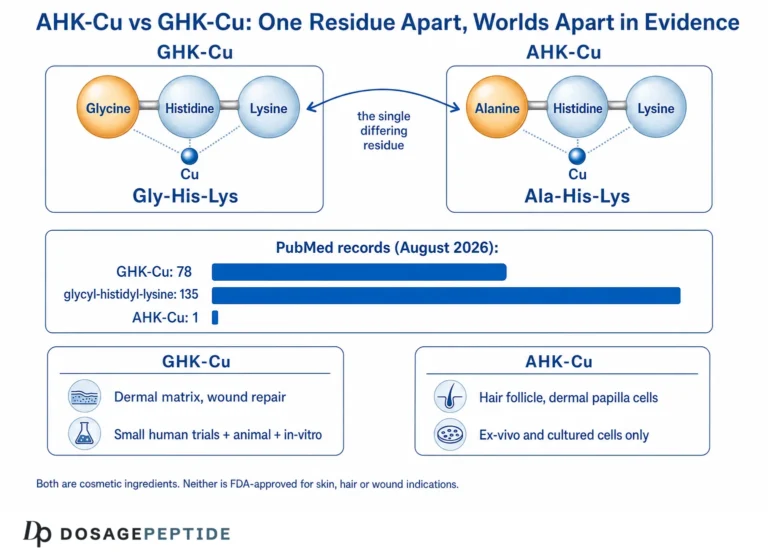
| Sequence | L-alanyl-L-histidyl-L-lysine + Cu(II). Free peptide C15H26N6O4, MW 354.4 [13] | Glycyl-L-histidyl-L-lysine + Cu(II). Differs only by one methyl group: glycine at position 1 instead of alanine |
| Natural occurrence | Not established as a free circulating human peptide. The Ala-His-Lys sequence does appear as residues 2–4 of the human serum albumin N-terminus (Asp-Ala-His-Lys), but that is a protein motif, not a free tripeptide pool | Genuinely present in human serum; the tripeptide was sequenced from plasma in 1977 [2]. Serum levels average roughly 200 ng/mL at age 20 and about 80 ng/mL by age 60 [3] |
| Main studied use | Hair follicle and dermal papilla stimulation; marketed for scalp serums | Wound healing, skin remodelling, extracellular-matrix and gene-expression research; also skin cosmetics |
| Strongest evidence tier | Ex vivo human hair-follicle organ culture plus cell culture — one study [1] | Large in vitro and animal literature, plus a small number of human studies — including one 6-month randomised, double-blind, placebo-controlled trial in which GHK was combined with 5-aminolevulinic acid, not used alone [11] |
| Indexed literature (verified count) | 1 PubMed record for the exact term “AHK-Cu” | 178 PubMed records for “GHK-Cu” OR “glycyl-histidyl-lysine” |
| Typical form | Cosmetic-grade powder blended into serums and scalp sprays at fractions of a percent; also sold as research-chemical vials | Cosmetic creams and serums; also sold as research-chemical vials |
| Recognised cosmetic (INCI) name | Inconsistent across suppliers. Widely sold as “Copper Tripeptide-3”, a name with no traceable dictionary entry; suppliers and chemical catalogues more often map AHK-Cu (CAS 682809-81-0) to Copper Tripeptide-34, which we could not confirm against an authoritative sequence definition | Copper Tripeptide-1, reviewed under that name in the Cosmetic Ingredient Review expert-panel assessment [12] |
| What is NOT known | Whether it penetrates human scalp skin at cosmetic concentrations; whether it changes hair count, density or thickness on a real head; long-term safety under chronic use; anything at all about injected use | Whether topical results generalise across formulations and populations; optimal concentration; effect size for hair specifically, independent of co-ingredients |
What exactly is AHK-Cu?
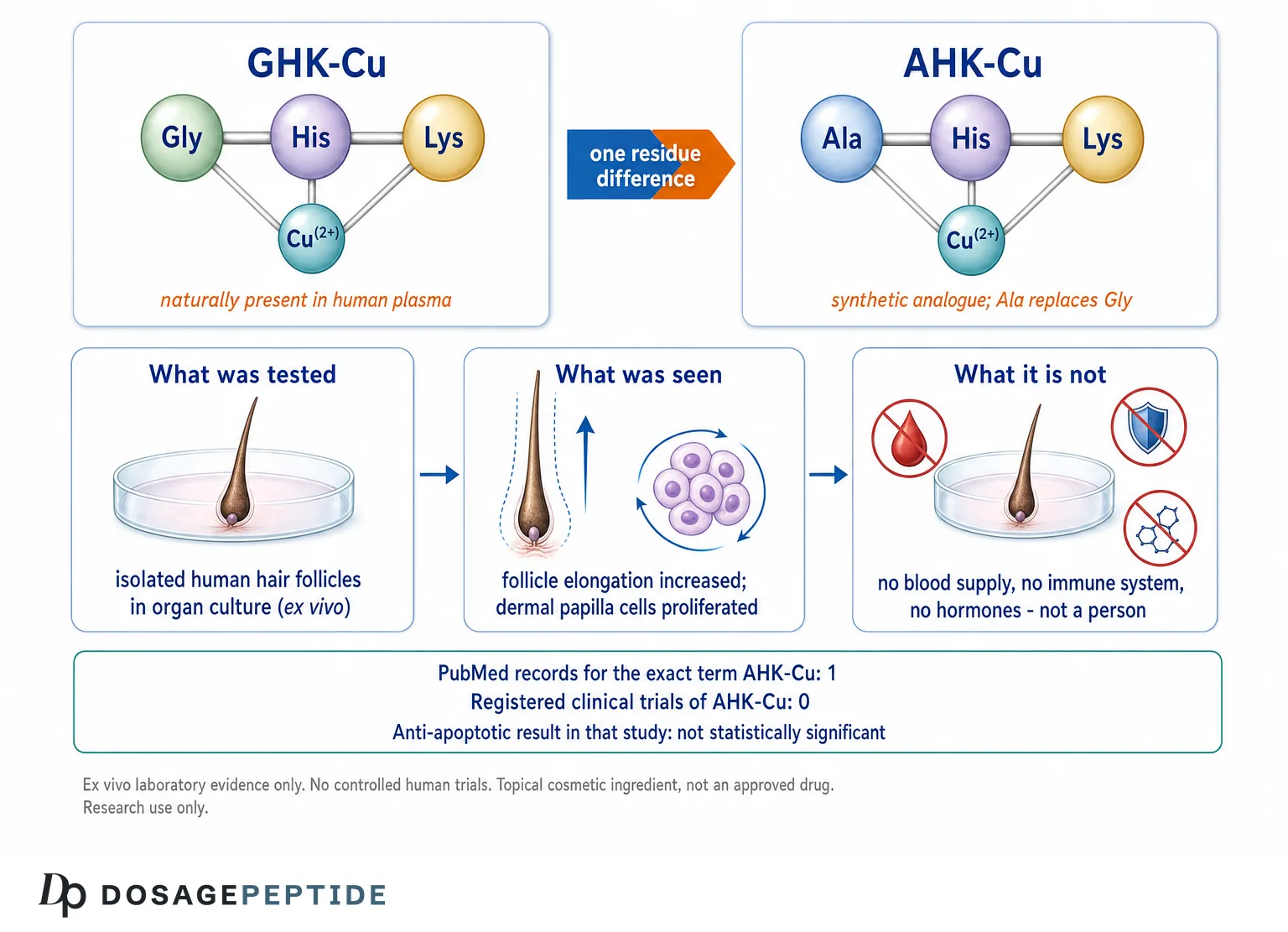
AHK-Cu is a three-amino-acid peptide — alanine, histidine, lysine — carrying a chelated copper(II) ion. Chemically it is a deliberate analogue of GHK: take the naturally occurring tripeptide glycyl-histidyl-lysine and swap the N-terminal glycine for alanine, and you have AHK. That is a difference of a single methyl group. The copper complex is catalogued in PubChem, where the indexed entry is the monohydrochloride form [13].
That small structural difference matters less to copper chemistry than you might expect, and more to biology than vendors usually admit. Both peptides place a histidine at position 2, which puts them in the same structural class of copper ligands. What differs sharply is provenance: GHK was isolated from human serum as a growth-modulating factor and characterised as such in the 1970s [2]. AHK was designed.
Does AHK occur naturally in the body?
This is where careful language earns its keep. GHK is a documented endogenous human peptide, measurable in serum, with a well-described age-related decline in concentration [3]. AHK is not established in that way. There is a genuine and interesting wrinkle, though: the sequence Ala-His-Lys is embedded in the N-terminus of human serum albumin, whose first four residues are Asp-Ala-His-Lys — abbreviated DAHK in the biochemistry literature and studied extensively as a copper-binding motif in its own right. So the AHK sequence is not alien to human proteins. But being a fragment of a protein sequence is not the same as circulating as a free bioactive tripeptide, and no body of work establishes a physiological free-AHK pool comparable to GHK’s. The accurate framing is this: AHK-Cu is a synthetic analogue inspired by a natural copper-peptide system, not a naturally circulating human factor.
Is “copper tripeptide-3” the correct INCI name?
A great deal of supplier and retail copy states flatly that AHK-Cu is “Copper Tripeptide-3”. We could not confirm that. The Cosmetic Ingredient Review expert panel’s safety assessment of this ingredient family covers ten ingredients — Tripeptide-1, Palmitoyl Tripeptide-1, Myristoyl Tripeptide-1, Copper Tripeptide-1, Bis(Tripeptide-1) Copper Acetate, Manganese Tripeptide-1, Hexapeptide-12, Palmitoyl Hexapeptide-12, Myristoyl Hexapeptide-12 and Palmitoyl Tetrapeptide-7 — and in that document “Tripeptide-1” is explicitly defined as the Gly-His-Lys sequence, that is, GHK, not AHK [12]. The public ingredient databases we checked carry entries for Copper Tripeptide-1 and Copper Tripeptide-34, but no Copper Tripeptide-3 entry at all. Note the likelier mapping: several peptide suppliers and chemical catalogues list “Copper Tripeptide-34” and “Copper Tripeptide-34 HCl” as trade designations for AHK-Cu, sharing its CAS number 682809-81-0. We could not confirm that identification in an authoritative ingredient dictionary — the public entries for Copper Tripeptide-34 give no peptide sequence, and the PubChem record for AHK-Cu carries no numbered copper-tripeptide synonym at all — so we report it as the most credible candidate rather than as settled fact. What is settled is that “Copper Tripeptide-3” has no traceable dictionary entry behind it.
The practical takeaway: naming for AHK-Cu is inconsistent across suppliers, and a label claim of “copper tripeptide” does not by itself tell you which peptide is in the bottle. Some products state the peptide sequence; many do not. Where a numbered INCI name is used loosely, the safety and efficacy literature attached to the correctly named ingredient does not automatically transfer with it.
What does the AHK-Cu hair-follicle research actually show?
The study everyone cites is Pyo HK, Yoo HG, Won CH, Lee SH, Kang YJ, Eun HC, Cho KH and Kim KH, “The effect of tripeptide-copper complex on human hair growth in vitro”, published in Archives of Pharmacal Research in July 2007 (volume 30, issue 7, pages 834–839), from the Department of Dermatology at Seoul National University [1].
What the researchers did, in plain terms: they took isolated human hair follicles and maintained them in organ culture — live follicles floating in nutrient medium, disconnected from any blood supply, immune system or hormonal environment — and they separately cultured human dermal papilla cells (DPCs). They then exposed both to AHK-Cu across a picomolar-to-nanomolar range (10−12 to 10−9 M).
What they reported:
- AHK-Cu stimulated elongation of the isolated human hair follicles ex vivo.
- AHK-Cu increased proliferation of cultured dermal papilla cells in vitro.
- At 10−9 M, the ratio of Bcl-2 to Bax — a pro-survival versus pro-apoptotic protein balance — rose, and the cleaved forms of caspase-3 and PARP, markers of cells committing to programmed death, fell.
- Flow cytometry with Annexin V/propidium iodide labelling showed fewer apoptotic DPCs at 10−9 M — but the authors state plainly that this decrease was not statistically significant.
The authors’ own conclusion is appropriately hedged: they proposed that AHK-Cu promotes the growth of human hair follicles, and that the effect may occur through proliferation and reduced apoptosis of dermal papilla cells. That is a hypothesis-generating result, correctly described as such by the people who produced it.
What this study does not show
A follicle in a dish is not a person. Organ culture removes the follicle from androgen signalling, from immune surveillance, from the perifollicular vasculature, and from the multi-year hair-cycle dynamics that determine whether someone’s hairline actually recedes. A compound that lengthens a follicle over days in medium may do nothing measurable through a scalp over months. That is a routine outcome in hair biology, not a rare disappointment.
Three further limits deserve stating outright. First, the concentrations used were picomolar to nanomolar in a bath surrounding a naked follicle — not a topical dose applied to intact stratum corneum — and there is no published pharmacokinetic work showing what fraction of applied AHK-Cu reaches a follicle through human scalp skin. Second, the apoptosis finding, the one most often quoted as proof of a survival effect, did not reach statistical significance. Third, this is one experiment from one laboratory that has not, as far as we can establish, been independently replicated in the peer-reviewed literature. Single unreplicated studies are the raw material of science, not its conclusions.
Are there human clinical trials of AHK-Cu for hair growth?
No published controlled human clinical trials of AHK-Cu for hair growth could be located. A ClinicalTrials.gov query for AHK-Cu returns zero registered studies [14], and PubMed indexes exactly one record for the term. There is no efficacy readout in humans: no hair count, no hair density, no phototrichogram data, no investigator global assessment, no placebo arm.
Compare that with the reference standards in this field. Topical minoxidil and oral finasteride (the latter approved for men only) are the drugs FDA-approved for pattern hair loss, and they reached approval through large randomised placebo-controlled trials with objective hair-count endpoints. AHK-Cu has none of that apparatus behind it. Anyone placing the two side by side is comparing a regulated drug-development programme with a single organ-culture experiment.
The nearest human data in this chemical family involves GHK, not AHK, and it is not a clean read on the peptide either. A six-month randomised, double-blind study in 45 men with pattern hair loss tested a complex of 5-aminolevulinic acid and GHK peptide against placebo, reporting hair-count increases of 52.6 and 71.5 in the two active groups versus 9.6 in placebo, with the 50 mg/mL group reaching statistical significance on the ratio of change [11]. Two honest caveats: the tested agent was a combination, so the copper peptide’s independent contribution cannot be isolated; and the higher concentration underperformed the lower one, which is not the dose–response you would expect from a clean pharmacological effect. Even this — the strongest human signal anywhere near copper tripeptides and hair — is not AHK-Cu and is not evidence for it. For a fuller treatment of the GHK-Cu side, see our breakdown of how GHK-Cu affects hair follicle stem cells and hair growth and our wider survey of the peptides studied for hair growth.
Why the copper matters: chemistry that is easy to get wrong
“Copper peptide” is not a marketing flourish. The metal is doing real chemical work, and the peptide determines how it behaves.
Peptides that begin with a free amine followed by histidine at position 2 — the NH2-Xxx-His motif, which covers both GHK and AHK — coordinate Cu(II) through three nitrogen donors in the equatorial plane, with the fourth site occupied by an exchangeable ligand. Peptides carrying histidine at position 3 instead (the NH2-Xxx-Zzz-His motif, as in the albumin N-terminus DAHK) wrap all four nitrogens around the copper [5], and copper exchanges out of that four-nitrogen form far more slowly [6]. The difference is largely kinetic rather than thermodynamic: isothermal titration calorimetry puts the conditional dissociation constants at pH 7.4 within a factor of three of each other — 2.6 × 10⁻¹⁴ M for Cu-DAHK against 7.0 × 10⁻¹⁴ M for Cu-GHK [4]. Detailed structural and thermodynamic work of this kind exists for Cu-GHK and Cu-DAHK [6]; we could not locate an equivalent published speciation study of Cu-AHK, so placing AHK in the three-nitrogen class here is an inference from its sequence motif, not a measured result for AHK itself. That distinction is worth flagging rather than papering over.
Why does binding mode matter practically? Because it governs whether a complex behaves as a quiet copper carrier or as a redox-active species. In the published cyclic-voltammetry work, both Cu-GHK and Cu-DAHK are inert under moderate redox potentials, but Cu-GHK — unlike Cu-DAHK — could be reduced to Cu(I) at around −0.62 V versus Ag/AgCl, with subsequent release of the copper ion [6]. In a separate radical-production assay, Cu-GHK generated more hydroxyl radical in the presence of ascorbate than Cu-DAHK did [7]. Copper delivery and copper-catalysed oxidative chemistry are two sides of the same molecule.
Lysyl oxidase, collagen cross-linking, and why copper is genuinely relevant
Copper is a mandatory cofactor for lysyl oxidase and the LOX-like enzymes, which are copper-dependent amine oxidases that cross-link collagen and elastin chains and thereby build the mechanical integrity of the extracellular matrix [8]. Without adequate copper, cross-linking fails and connective tissue suffers. This is not speculative. In Menkes disease, an X-linked disorder of the ATP7A copper transporter that starves copper-dependent enzymes, the recognised clinical picture includes hair twisting — pili torti, the source of the historical name “kinky hair syndrome” — along with skin and joint laxity and vascular tortuosity [9]. Copper deficiency demonstrably damages hair-shaft structure and connective tissue.
More copper is not better
Here is the inference that vendor copy makes and that biology does not support: because copper deficiency harms hair, adding copper must help hair. That does not follow. In people who are copper-replete — which is most people — there is no established deficit for a topical copper peptide to correct, and no published evidence that a scalp serum raises follicular copper-enzyme activity in a way that changes hair growth.
Copper is also not an inert cosmetic filler. Free and loosely bound copper participates in Fenton-type chemistry and generates reactive oxygen species; the reason the body keeps copper bound to albumin, ceruloplasmin and dedicated chaperones is precisely to prevent that. The redox comparisons above show that copper-peptide complexes are not all equally well behaved [7]. Whatever else is true of AHK-Cu, “it is just copper, so more is safer” is not a defensible position.
How AHK-Cu is actually supplied and used
In practice AHK-Cu appears in two very different channels, and conflating them is a mistake.
As a topical cosmetic ingredient. This is the mainstream use: leave-on serums, scalp sprays and hair tonics, where copper peptides are formulated at fractions of a percent. For context, the CIR expert panel recorded that typical use concentrations across the closely related GHK-tripeptide ingredient family were below 10 ppm — under 0.001% — and concluded that those named ingredients were safe in the practices of use and concentration then reported [12]. Supplier literature for AHK-Cu frequently suggests much higher figures, typically somewhere in the 0.1–2% region depending on the seller. Those are formulation recommendations from sellers, not safety conclusions from an expert panel, and the CIR conclusion cannot simply be stretched to cover a different peptide at a different concentration.
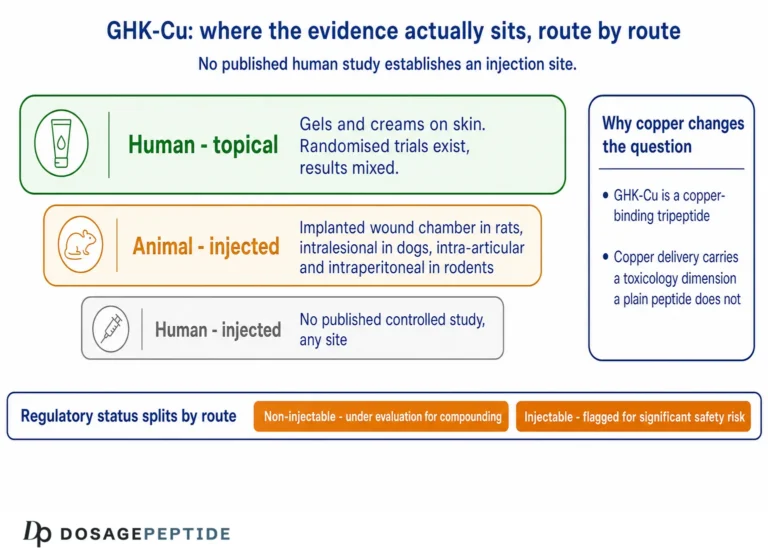
As a research chemical. AHK-Cu powder is also sold in vials for laboratory use, which is the context our AHK-Cu 50 mg vial reference page documents — reconstitution arithmetic and vial handling for laboratory work, not instructions for a person. To be explicit: there is no clinical evidence supporting any injected use of AHK-Cu in humans, no established human dosing, and this article does not provide dosing guidance of any kind. The same route question recurs constantly for the better-studied cousin peptide, which is why we treat it separately in GHK-Cu injectable versus topical research.
The regulatory frame is worth stating once, cleanly. Under the Federal Food, Drug, and Cosmetic Act, a product’s category follows its intended use: articles applied to the body for cleansing or beautifying are cosmetics, while articles intended to diagnose, cure, mitigate, treat or prevent disease — or to affect the structure or any function of the body — are drugs [15]. A scalp serum that claims to grow hair is making a drug claim regardless of what its ingredient list says. AHK-Cu is not an FDA-approved drug for any indication.
The borrowed-evidence problem
The single most common error in AHK-Cu marketing is evidence laundering: citing GHK-Cu’s research and letting the reader assume it applies to AHK-Cu.
GHK-Cu does have a substantial literature. It has been studied for wound healing and skin repair, for effects on collagen and glycosaminoglycan synthesis, for modulation of matrix metalloproteinases and their inhibitors, and for broad gene-expression changes in cultured cells [10]. Reasonable people disagree about how much of that translates into visible outcomes in intact human skin, and a fair amount of the review literature is authored by researchers with commercial interests in the ingredient — worth knowing when weighing it. Our detailed treatment of that body of work sits in what GHK-Cu is, how it works, and where its evidence stops.
None of it is AHK-Cu data. The two molecules differ by one methyl group, which sounds trivial and is not: in peptide pharmacology, single-residue substitutions routinely change receptor engagement, enzymatic stability, cellular uptake and potency. The entire point of making an analogue is that it behaves differently. You cannot claim novelty for the substitution and then borrow the parent compound’s evidence file. When you see “AHK-Cu boosts collagen by X%” or “AHK-Cu resets thousands of genes”, check whether the underlying citation is about GHK. Usually it is. The same discipline applies to any peptide marketed on adjacent evidence — it is why cosmetic peptides such as SNAP-8 (acetyl octapeptide-3) have to be judged on their own studies rather than on the reputation of the class.
What we still do not know about AHK-Cu
An honest research agenda for this compound would start with the basics, because the basics are missing:
- Skin penetration. No published data establishing whether AHK-Cu crosses intact human scalp stratum corneum at cosmetic concentrations, or reaches the dermal papilla in biologically relevant amounts.
- Stability and speciation in formulation. Copper complexes are pH-sensitive and can exchange copper with other chelators in a product base; what is actually on the scalp after months on a shelf is not documented in the peer-reviewed literature.
- Any human efficacy endpoint. No hair count, no density, no anagen-to-telogen ratio, no standardised photography, from any controlled trial.
- Replication. The 2007 organ-culture result has not, as far as we can establish, been independently reproduced.
- Comparative pharmacology. No head-to-head data on whether the glycine-to-alanine substitution makes AHK-Cu more, less or equally active than GHK-Cu on follicular endpoints.
- Long-term topical safety. The CIR conclusion covers named GHK-family ingredients at documented low use levels, not AHK-Cu at supplier-recommended concentrations [12].
None of this makes AHK-Cu uninteresting. A copper tripeptide that lengthens human follicles in organ culture at picomolar concentrations is a legitimate lead worth chasing, and the mechanistic story around VEGF and TGF-β1 is coherent enough to justify a proper trial. It simply is not, today, a compound with human evidence behind it — and pages that present it as one are describing a hope, not a finding.
Frequently Asked Questions
What is AHK-Cu?
AHK-Cu is a synthetic tripeptide — alanine, histidine and lysine — complexed with copper(II). It is a designed analogue of the naturally occurring copper peptide GHK-Cu, differing only in that the first amino acid is alanine rather than glycine. It is used mainly as a cosmetic ingredient in topical hair and scalp formulations, and is also sold as a research-chemical powder for laboratory use.
Is AHK-Cu the same as copper tripeptide-3?
Many suppliers say so, but we could not verify it. The expert-panel safety documentation for this ingredient family defines Tripeptide-1 as the Gly-His-Lys sequence and names Copper Tripeptide-1 accordingly; no “Copper Tripeptide-3” entry exists in the databases we checked. Suppliers and chemical catalogues more often list AHK-Cu (CAS 682809-81-0) under the name Copper Tripeptide-34, which is the likelier mapping, but we could not confirm that sequence assignment in an authoritative ingredient dictionary. Treat “copper tripeptide-3” as inconsistent supplier nomenclature rather than a confirmed INCI identity, and look for a stated peptide sequence instead.
Is AHK-Cu proven to grow hair?
No. There are no published controlled human clinical trials of AHK-Cu for hair growth, and ClinicalTrials.gov lists no registered studies. The evidence base is one 2007 study in which isolated human hair follicles in organ culture elongated more with AHK-Cu present, alongside increased dermal papilla cell proliferation in cell culture. That is preclinical laboratory evidence, not proof of an effect on people.
What is the difference between AHK-Cu and GHK-Cu?
Sequence, provenance and evidence depth. AHK-Cu has alanine at position 1; GHK-Cu has glycine. GHK is a genuine human plasma peptide, identified in the 1970s, whose serum level declines with age, and it carries a literature of well over a hundred indexed papers. AHK is synthetic, with one indexed study. They are chemically close relatives, but they are not interchangeable, and GHK-Cu’s research does not transfer to AHK-Cu.
How is AHK-Cu used in cosmetic products?
Topically, at low concentrations, in leave-on serums, scalp sprays and tonics. The expert-panel assessment covering the related GHK-tripeptide ingredients recorded typical use concentrations below 10 ppm, while suppliers of AHK-Cu commonly suggest concentrations somewhere in the 0.1–2% region in finished formulas. Those supplier figures are formulation guidance, not safety findings, and no published clinical study establishes an effective topical concentration for AHK-Cu.
Can AHK-Cu be injected?
There is no clinical evidence supporting any injected use of AHK-Cu in humans, no established human dose, and no regulatory approval for any route of administration. Research-chemical vials of AHK-Cu powder exist for laboratory work only. This article does not provide dosing or administration guidance, and nothing here should be read as suggesting human use.
Why does copper matter in a copper peptide?
Copper is a required cofactor for lysyl oxidase and related enzymes that cross-link collagen and elastin, which is why severe copper deficiency — as in Menkes disease — produces abnormal hair shafts and lax connective tissue. But copper is also redox-active: bound copper can generate reactive oxygen species depending on how the peptide holds it, and different copper-peptide complexes behave very differently in this respect. More copper is not automatically better.
Is AHK-Cu safe?
Its safety profile has not been characterised in published human studies. The Cosmetic Ingredient Review assessment that is often invoked covers named GHK-family ingredients at low documented use levels, not AHK-Cu, and its conclusions cannot be extended to a different peptide at higher concentrations. Absence of reported problems in cosmetic use is not the same as demonstrated safety, particularly for chronic use or for any non-topical route.
Does AHK-Cu work better than minoxidil?
That comparison cannot be made from the available evidence. Topical minoxidil is an FDA-approved drug for pattern hair loss, supported by randomised placebo-controlled trials with objective hair-count endpoints. AHK-Cu has no human trial data at all. Comparing them means setting a regulated drug-development record against a single organ-culture experiment; there is no basis for ranking the two.
References
- Pyo HK, Yoo HG, Won CH, Lee SH, Kang YJ, Eun HC, Cho KH, Kim KH. The effect of tripeptide-copper complex on human hair growth in vitro. Archives of Pharmacal Research. 2007;30(7):834–839. PubMed 17703734 (DOI 10.1007/BF02978833). Record retrieved via PubMed.
- Schlesinger DH, Pickart L, Thaler MM. Growth-modulating serum tripeptide is glycyl-histidyl-lysine. Experientia. 1977;33(3):324–325. PubMed 858356.
- Dou Y, Lee A, Zhu L, Morton J, Ladiges W. The potential of GHK as an anti-aging peptide. Aging Pathobiology and Therapeutics. 2020;2(1):58–61. PMC8789089.
- Trapaidze A, Hureau C, Bal W, Winterhalter M, Faller P. Thermodynamic study of Cu2+ binding to the DAHK and GHK peptides by isothermal titration calorimetry (ITC) with the weaker competitor glycine. Journal of Biological Inorganic Chemistry. 2012;17(1):37–47. PubMed 21898044.
- Gonzalez P, Vileno B, Bossak K, El Khoury Y, Hellwig P, Bal W, Hureau C, Faller P. Cu(II) binding to the peptide Ala-His-His, a chimera of the canonical Cu(II)-binding motifs Xxx-His and Xxx-Zzz-His. Inorganic Chemistry. 2017;56(24):14870–14879. PubMed 29190078.
- Hureau C, Eury H, Guillot R, Bijani C, Sayen S, Solari PL, Guillon E, Faller P, Dorlet P. X-ray and solution structures of Cu(II) GHK and Cu(II) DAHK complexes: influence on their redox properties. Chemistry – A European Journal. 2011;17(36):10151–10160. PubMed 21780203.
- Guilloreau L, Combalbert S, Sournia-Saquet A, Mazarguil H, Faller P. Redox chemistry of copper–amyloid-beta: the generation of hydroxyl radical in the presence of ascorbate is linked to redox-potentials and aggregation state. ChemBioChem. 2007;8(11):1317–1325. PubMed 17577900.
- Al-U’datt D, Allen BG, Nattel S. Role of the lysyl oxidase enzyme family in cardiac function and disease. Cardiovascular Research. 2019;115(13):1820–1837. PubMed 31504232.
- Smpokou P, Samanta M, Berry GT, Hecht L, Engle EC, Lichter-Konecki U. Menkes disease in affected females: the clinical disease spectrum. American Journal of Medical Genetics Part A. 2015;167A(2):417–420. PMC4351723.
- Pickart L, Margolina A. Regenerative and protective actions of the GHK-Cu peptide in the light of the new gene data. International Journal of Molecular Sciences. 2018;19(7):1987. PMC6073405. Note: narrative review authored by researchers affiliated with a commercial copper-peptide skincare company; read with that interest in mind.
- Lee WJ, Sim HB, Jang YH, Lee SJ, Kim DW, Yim SH. Efficacy of a complex of 5-aminolevulinic acid and glycyl-histidyl-lysine peptide on hair growth. Annals of Dermatology. 2016;28(4):438–443. PMC4969472. Note: tests GHK in combination with 5-ALA — not AHK-Cu, and not GHK alone.
- Cosmetic Ingredient Review Expert Panel. Safety Assessment of Tripeptide-1, Hexapeptide-12, their Metal Salts and Fatty Acyl Derivatives, and Palmitoyl Tetrapeptide-7 as Used in Cosmetics. Final Report, 30 June 2014. cir-safety.org (PDF). Non-peer-reviewed industry expert-panel safety assessment; a version was subsequently published in the International Journal of Toxicology (2018).
- PubChem. AHK-Cu, CID 168431292 (copper complex, hydrochloride form); Ala-His-Lys free peptide, CID 7408502. National Center for Biotechnology Information. PubChem CID 168431292. Chemical database record, not a study.
- ClinicalTrials.gov. Registry search for “AHK-Cu” — no registered studies returned at the time of writing. clinicaltrials.gov. Registry query, cited as evidence of absence.
- U.S. Food and Drug Administration. Is It a Cosmetic, a Drug, or Both? (Or Is It Soap?). fda.gov. Official regulator guidance page.
Research use only. This article is an educational summary of published laboratory research and regulatory documentation. AHK-Cu is not an approved drug for any indication in any jurisdiction, has not been shown in controlled human trials to grow hair, and nothing here is medical advice, a treatment recommendation, or a dosing protocol. Dosagepeptide.com does not sell peptides. Where this site links to a commercial supplier, that link may be a paid or affiliate placement; no such link appears in this article, and no vendor reviewed, funded or approved its contents. Consult a qualified clinician about any question concerning hair loss or personal health.