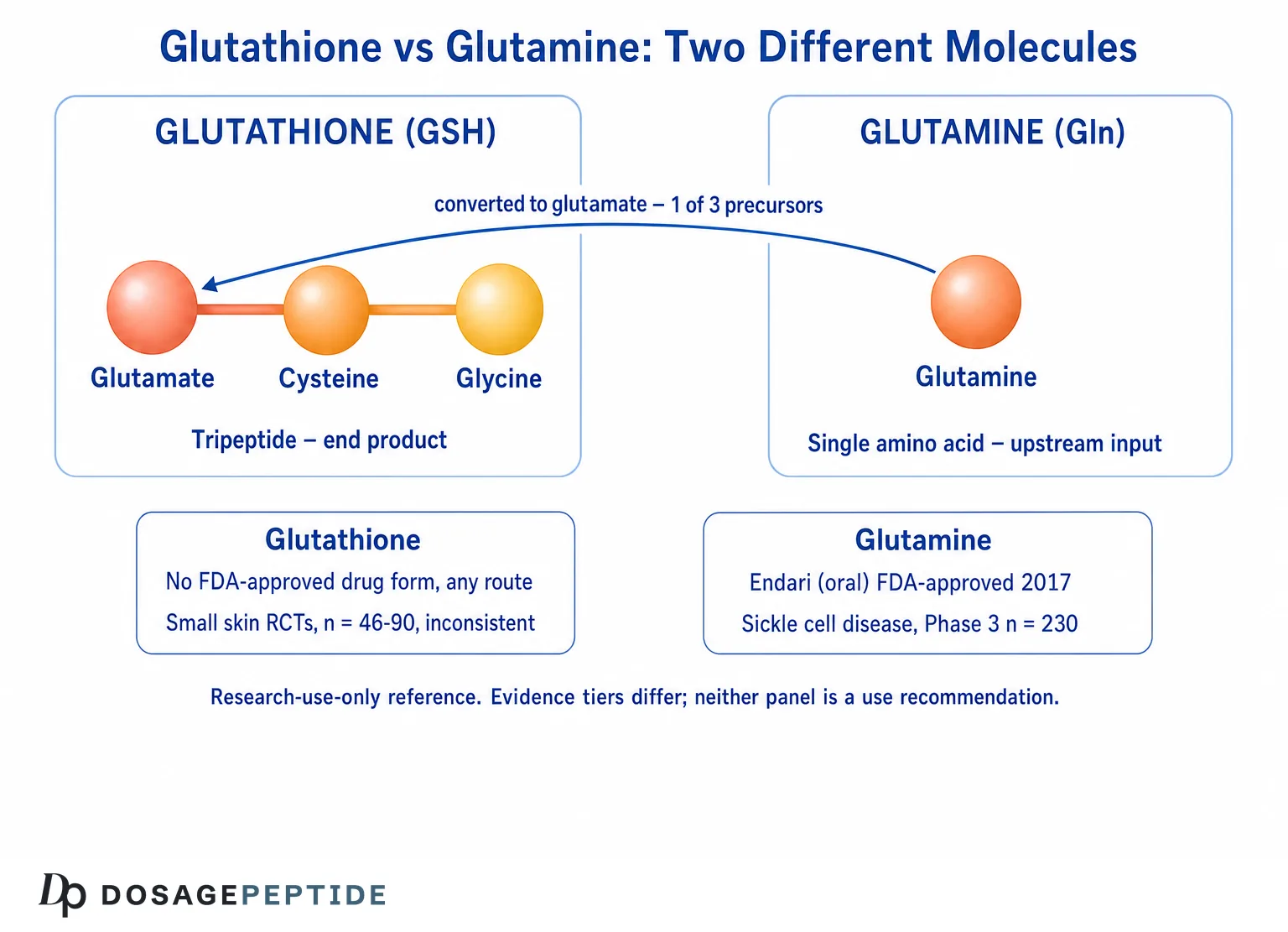
No — they are not the same molecule, and one is not a form of the other. Glutathione is a tripeptide: three amino acids joined together (glutamate, cysteine and glycine) that act inside the cell as an antioxidant [1]. Glutamine is a single amino acid that the body converts into glutamate, one of those three building blocks [14]. The names look alike only because both trace back to glutamic acid; that is the entire source of the confusion.
Where they genuinely part company is the evidence. Glutamine has an FDA-approved prescription drug form and a large, genuinely mixed clinical trial literature that includes a trial in which it was associated with increased mortality. Glutathione has no FDA-approved drug form at all, a thin cosmetic evidence base built on small short trials, and a separate FDA safety alert about compounded injectables [8]. This page sets out what each research record actually contains, what it does not, and where the two overlap.
| Glutathione (GSH) | Glutamine (Gln) | |
|---|---|---|
| Molecule class | Tripeptide — γ-L-glutamyl-L-cysteinyl-glycine | Single (proteinogenic) amino acid |
| Building blocks | Glutamate + cysteine + glycine | Not built from other amino acids; it is a building block |
| Relationship | End product | Upstream input — converted to glutamate, one of the three GSH precursors |
| Primary biological role | Intracellular antioxidant and electrophile-conjugating thiol; redox buffer [1] | Nitrogen carrier, enterocyte and lymphocyte fuel, conditionally essential in catabolic states [14] |
| FDA-approved drug form? | No — Drugs@FDA lists no approved glutathione application by any route [15]; compounded injectables are the subject of an FDA alert [8] | Yes — Endari (L-glutamine oral powder), approved 7 July 2017 [9] |
| Approved indication | None | “To reduce the acute complications of sickle cell disease in adult and pediatric patients 5 years of age and older” [10] |
| Best human evidence | Small RCTs (n = 46–90) on skin melanin index, inconsistent results [4][6] | Phase 3 RCT, n = 230, 48 weeks, positive [11] |
| Strongest negative signal | Negligible bioavailability from a single oral dose [2]; FDA endotoxin adverse-event alert for compounded injectables [8] | REDOXS: glutamine associated with significantly higher in-hospital and 6-month mortality in critically ill adults with multiorgan failure (28-day mortality a non-significant trend, P = 0.05) [12] |
| Typical research context | Skin pigmentation, oxidative stress markers, compounded IV use | Sickle cell disease, critical care, burns, gut barrier, short bowel syndrome |
Is glutathione the same as glutamine?
No. They differ in size, structure, how the body makes them, and what happens when you swallow them. The similarity is limited to a shared etymological root and one shared metabolic thread.
Glutathione is a tripeptide, not an amino acid
Glutathione is the most abundant low-molecular-weight thiol synthesised inside cells, and it is a peptide: three amino acid residues joined by peptide bonds [1]. Its structural signature is the gamma linkage — the bond between glutamate and cysteine forms at glutamate’s side-chain carboxyl group rather than its alpha-carboxyl. That is why glutathione resists ordinary peptidases and is cleaved only by gamma-glutamyl transferase on the outer surface of certain cell membranes. The free thiol (–SH) on the cysteine residue is the reactive part: it reduces peroxides, conjugates to electrophiles, and is what oxidises to the disulfide dimer GSSG.
Glutamine is one input, and not the limiting one
Glutamine is a standard proteinogenic amino acid and the most abundant free amino acid in human plasma and skeletal muscle. It is classified as conditionally essential: healthy adults synthesise enough, but in catabolic states — sepsis, major trauma, burns, prolonged critical illness — endogenous production can fall short of demand [14]. Glutamine connects to glutathione only indirectly: glutaminase deamidates glutamine to glutamate, and glutamate is one of the three residues glutathione needs.
The important nuance is that glutamate is rarely the bottleneck. In most human and animal work, the constraint on glutathione synthesis is cysteine availability and the activity of the first synthetic enzyme, glutamate–cysteine ligase, which is feedback-inhibited by glutathione itself [1]. So the popular framing — “take glutamine to raise glutathione” — is upstream of a step that is usually not rate-limiting. That is a mechanistic argument, not a demonstrated human outcome, and it should be read as one.
How does the body actually build glutathione?
Synthesis is a two-step, ATP-dependent process that happens inside the cell, not in the bloodstream:
- Glutamate + cysteine → gamma-glutamylcysteine, catalysed by glutamate–cysteine ligase (GCL). This is the rate-limiting step and the point of feedback control [1].
- Gamma-glutamylcysteine + glycine → glutathione, catalysed by glutathione synthetase.
Two consequences follow. Because synthesis is intracellular, circulating glutathione is a downstream readout rather than a direct dial. And because extracellular glutathione is cleaved by gamma-glutamyl transferase in the gut and liver, swallowing intact glutathione is not the same as delivering it to tissue.
What does the human research on glutathione actually show?
Oral bioavailability is the central unresolved question
The foundational human pharmacokinetic study gave seven healthy volunteers a single oral dose of 0.15 mmol/kg (roughly 3 g) of glutathione and measured plasma glutathione, cysteine and glutamate over 270 minutes. None rose significantly. The authors concluded that systemic availability of oral glutathione is negligible in humans, attributing it to hydrolysis by intestinal and hepatic gamma-glutamyl transferase [2]. That 1992 finding is still the reason the whole oral-glutathione field is contested.
A later 6-month randomised, double-blind, placebo-controlled trial in 54 non-smoking adults reached a different conclusion using repeated dosing and different compartments. At 1,000 mg/day, mean glutathione rose roughly 30–35% in erythrocytes, plasma and lymphocytes and about 260% in buccal mucosal cells at 6 months; at 250 mg/day, increases were 17% in whole blood and 29% in erythrocytes (p < 0.05). Levels returned to baseline after a one-month washout [3]. The honest reading is that chronic oral dosing can move measured body stores of glutathione in healthy adults, while a single dose does not meaningfully raise plasma levels — and that neither finding is a clinical outcome. Raising a biomarker is not the same as changing health, appearance or disease risk.
The skin-lightening evidence is small, short and inconsistent
This is the application most people are searching for, and it is where the evidence tier needs to be stated bluntly: small, short, single-region trials with mixed results, no FDA approval, and no long-term safety data.
- 500 mg/day, 4 weeks, n = 60 (Thailand). Melanin index fell at all six measured sites, but the reduction was statistically significant versus placebo at only two of six — the right side of the face (p = 0.021) and the sun-exposed left forearm (p = 0.036). The authors explicitly noted that long-term safety had not been established [4].
- 250 mg/day GSH or GSSG, 12 weeks (Thailand, three-arm). Melanin index and UV spots tended to be lower than placebo; a significant wrinkle reduction appeared at some sites in the reduced-glutathione arm. “Tended to be lower” is the authors’ own hedge, not a rewriting [5].
- Glutathione + ascorbic acid + alpha-lipoic acid + zinc, 12 weeks, n = 90 enrolled, 83 completed (Indonesian multicentre RCT, participants aged 33–50). Reductions in UV spots, spot polarisation and skin tone were larger in the supplement group, but the differences were not statistically significant [6].
- Topical plus oral combination, 8 weeks, n = 46 (Indonesia). The combination group showed a lower melanin index and L* score than placebo (p < 0.05), with the combination outperforming either route alone [7].
Across these trials the largest enrolment is 90 people (83 of whom completed), the longest follow-up is 12 weeks, and the outcome is an instrument-measured pigmentation index rather than a health endpoint. Two of the four did not reach significance on their primary comparisons. That combination — small n, short duration, surrogate endpoint, split results — is what “thin evidence base” means in practice. Our companion overview of the research literature on glutathione as an endogenous antioxidant goes through the mechanistic claims separately.
Injectable glutathione: unapproved, and the subject of an FDA safety alert
There is no FDA-approved injectable glutathione product in the United States. In February 2019 the FDA warned compounders not to use a specific L-glutathione powder distributed as a dietary ingredient to compound sterile injectable drugs, after receiving reports of adverse events attributed to potentially high endotoxin levels. In one report, seven patients at an outpatient clinic received 7 mL (1,400 mg) of compounded intravenous L-glutathione and developed nausea, vomiting, lightheadedness, chills, body aches and sneezing within minutes; one developed low blood pressure and breathing difficulty and was transferred to hospital. A second report described a patient who received 12 mL (2,400 mg) and was admitted for a possible bloodstream infection. FDA’s investigation found the ingredient’s manufacturer marketed it in the US only for use in dietary supplements, not sterile drugs [8].
Drugs@FDA contains no approved new drug application for glutathione by any route, so every injectable glutathione preparation in circulation is either compounded or unapproved [15]. This is the regulatory reality behind every vial on the research market. Researchers comparing preparations across the 600 mg glutathione vial reconstitution reference and the 1500 mg vial reference are looking at research-grade material, not approved medicines — and the reported adverse event profile documented in the literature should be read alongside the FDA alert above.
What does the human research on glutamine actually show?
Glutamine has an actual approved drug file — with a narrow indication
On 7 July 2017 the FDA approved Endari (L-glutamine oral powder) for patients aged five years and older with sickle cell disease — which the agency described at the time as “the first treatment approved for patients with sickle cell disease in almost 20 years” [9]. The current label indication reads: “ENDARI is an amino acid indicated to reduce the acute complications of sickle cell disease in adult and pediatric patients 5 years of age and older.” It is supplied as 5 g of L-glutamine per packet, dosed twice daily by weight band (5 g under 30 kg, 10 g at 30–65 kg, 15 g above 65 kg) [10].
The registration evidence is a genuine phase 3 trial: 230 patients aged 5 to 58 with sickle cell anaemia or sickle β-thalassaemia and at least two pain crises in the prior year, randomised 2:1 to L-glutamine 0.3 g/kg per dose twice daily or placebo for 48 weeks. Median pain crises were 3.0 with glutamine versus 4.0 with placebo (p = 0.005) and median hospitalisations 2.0 versus 3.0 (p = 0.005). Two-thirds of patients in both arms were also on hydroxyurea. Low-grade nausea, non-cardiac chest pain, fatigue and musculoskeletal pain were more frequent with glutamine [11].
A second oral glutamine drug, NutreStore, was approved in 2004 for short bowel syndrome in patients receiving specialised nutritional support, used in conjunction with an approved recombinant human growth hormone; Drugs@FDA lists NDA 021667 as approved on 10 June 2004 with a marketing status of discontinued [15]. Note what both approvals have in common: narrow, specific populations. Neither is an approval for “gut health,” recovery, or general supplementation.
REDOXS: the trial that should change how anyone reads glutamine
The single most important counterweight in the glutamine literature is the REDOXS trial. In a blinded 2×2 factorial design, 1,223 critically ill adults with multiorgan failure on mechanical ventilation across 40 ICUs in Canada, the US and Europe received glutamine, antioxidants, both, or placebo — delivered both intravenously and enterally, starting within 24 hours of ICU admission. There was a trend toward increased 28-day mortality with glutamine (32.4% versus 27.2%; adjusted odds ratio 1.28, 95% CI 1.00 to 1.64; P = 0.05), and in-hospital mortality and 6-month mortality were significantly higher in patients who received glutamine. Antioxidants showed no effect on any endpoint [12].
A later, much larger burns trial pointed the same direction on efficacy without the mortality signal. RE-ENERGIZE randomised 1,209 patients with severe burns (mean 33% of total body-surface area) to enteral glutamine 0.5 g/kg/day or placebo. Median time to discharge alive was 40 versus 38 days (subdistribution hazard ratio 0.91, 95% CI 0.80 to 1.04; P = 0.17), and 6-month mortality was 17.2% versus 16.2% (hazard ratio 1.06, 95% CI 0.80 to 1.41) — no benefit [13].
These trials matter because they show what the glutathione literature has never had the power to show in either direction: what happens at scale, in sick humans, with hard endpoints. Outside its approved indication, the answer for glutamine was no benefit — and in one severely ill population, harm.
Gut barrier and immune work is largely preclinical or mechanistic
Glutamine is the preferred fuel of enterocytes and rapidly dividing immune cells — for the gut it is quantitatively more relevant than glucose as an energy substrate — and reviews of its metabolism describe it as only conditionally essential, becoming critical in catabolic states such as sepsis, trauma and major surgery [14]. The cellular work behind that description is largely animal and cell-culture data, including human colon epithelial cell lines. When you see “glutamine heals the gut lining,” the underlying citation is usually rodent or enterocyte data, not a human clinical endpoint.
Which research record is stronger, and stronger at what?
| Evidence dimension | Glutathione | Glutamine |
|---|---|---|
| Largest randomised human trial | n = 90 enrolled (83 completed), 12 weeks, cosmetic endpoint, not significant [6] | n = 1,223, ICU mortality endpoint [12] |
| Evidence tier for the popular use case | Research-chemical / cosmetic-ingredient; skin-lightening claims unapproved | Supplement for general use; approved drug only for sickle cell disease |
| Oral pharmacokinetics | Contested — negligible after single dose [2], measurable after 6 months [3] | Well characterised; standard amino acid absorption |
| Documented harm signal | Endotoxin-related reactions from compounded injectables [8] | Associated with increased in-hospital and 6-month mortality in ICU multiorgan failure [12] |
| What is genuinely unknown | Whether raised tissue GSH changes any clinical outcome; long-term safety of chronic dosing | Whether supplementation helps anyone outside sickle cell disease and specific nutritional-support settings |
Neither record supports the marketing claims that dominate search results. Glutamine’s record is larger and more definitive — which is precisely why it contains a clear negative result. Glutathione’s record is smaller and more ambiguous, which is often mistaken for “promising” when it should be read as “unresolved.”
Where the two literatures actually intersect
One legitimate link is worth stating precisely, because it seeds the confusion. Reviews of glutamine metabolism cite maintenance of intracellular redox status — a glutathione-dependent process, with glutamine supplying the glutamate arm — as one proposed mechanism behind glutamine’s cytoprotective effects in catabolic states [14]. Note the direction of travel: that is glutamine research borrowing a glutathione mechanism to explain glutamine findings. It is not evidence that glutamine supplementation raises human tissue glutathione measurably, and not evidence that the two are interchangeable.
Three specific errors show up repeatedly in consumer material, and all three are avoidable:
- Treating “glutathione precursor” as equivalent to glutathione. Glutamine feeds only the glutamate arm, and glutamate is generally not the limiting substrate — cysteine and GCL activity are [1].
- Citing Endari’s approval as validation of glutamine generally. The approval is for reducing acute complications of sickle cell disease in patients 5 and older — nothing broader [10].
- Presenting IV glutathione as an established medical procedure. No injectable glutathione drug is FDA-approved, and the agency has documented adverse events from compounded preparations [8]. Reference material such as the glutathione concentration and reconstitution chart used in published protocols documents what has appeared in the literature; it does not describe an approved therapy.
Frequently Asked Questions
Is glutathione the same as glutamine?
No. Glutathione is a tripeptide made of glutamate, cysteine and glycine joined by peptide bonds, including an unusual gamma linkage. Glutamine is a single amino acid. Glutamine can be converted to glutamate, which is one of glutathione’s three building blocks, so glutamine sits upstream of glutathione in metabolism — but the two molecules have different structures, different functions and entirely different clinical evidence bases.
Does taking glutamine raise glutathione levels?
The mechanistic argument exists, because glutamine yields glutamate and glutamate is a glutathione precursor. But glutamate is usually not the limiting factor in glutathione synthesis — cysteine availability and glutamate–cysteine ligase activity are. No large human trial has established that glutamine supplementation raises tissue glutathione enough to change a clinical outcome, and research reviews present this as a proposed mechanism rather than a demonstrated effect.
Is glutathione approved by the FDA?
No glutathione drug product is FDA-approved for antioxidant use or skin lightening — Drugs@FDA contains no approved application for glutathione by any route [15]. In 2019 the agency issued a compounding alert after adverse events involving compounded intravenous L-glutathione with potentially high endotoxin levels, noting the ingredient had been marketed in the US only for dietary-supplement use rather than sterile drug manufacturing.
What is glutamine FDA-approved for?
Endari (L-glutamine oral powder) was approved on 7 July 2017 to reduce the acute complications of sickle cell disease in adult and pediatric patients 5 years of age and older. NutreStore, an earlier oral L-glutamine product approved in 2004 for short bowel syndrome alongside recombinant human growth hormone, is now listed as discontinued. Drugs@FDA lists no approved intravenous glutamine product in the United States [15].
Which has more human clinical evidence, glutathione or glutamine?
Glutamine, by a wide margin. Its literature includes a 230-patient phase 3 registration trial, a 1,223-patient ICU trial and a 1,209-patient burns trial, all with hard clinical endpoints. Glutathione’s human record consists mainly of randomised trials of 46 to 90 participants lasting 4 to 12 weeks, measuring instrument-recorded pigmentation indices rather than health outcomes, with results split between significant and non-significant.
Why did a trial find glutamine increased mortality?
In the REDOXS trial, 1,223 critically ill adults with multiorgan failure on mechanical ventilation received high-dose glutamine intravenously and enterally starting within 24 hours of ICU admission. In-hospital and 6-month mortality were significantly higher in the glutamine groups, with a trend toward higher 28-day mortality. The finding is specific to that population, that dose and that timing — but it is a real, published counterweight to the assumption that amino acid supplementation is inherently benign.
Does oral glutathione actually get absorbed?
The evidence is genuinely split. A 1992 study in seven volunteers found no significant rise in plasma glutathione after a single ~3 g oral dose, attributing it to hydrolysis by gamma-glutamyl transferase in the gut and liver. A 2015 six-month randomised trial in 54 adults found measurable increases in erythrocyte, plasma, lymphocyte and buccal-cell glutathione at 250 and 1,000 mg/day, reversing after washout. Chronic dosing appears to move the biomarker; single doses do not.
Is glutathione effective for skin lightening?
The published randomised trials are small, short and inconsistent. A 4-week trial at 500 mg/day reached statistical significance versus placebo at only two of six measured sites. A 12-week Indonesian multicentre trial of a glutathione combination supplement found larger reductions than placebo but no statistically significant difference. A 12-week Thai trial reported that melanin index “tended to be lower.” No long-term safety data exist and no regulator has approved glutathione for this use.
Can glutathione and glutamine be compared on dosing?
Not meaningfully. Endari has a weight-banded prescription regimen for one specific disease, established through a controlled trial. Glutathione has no approved dose for any indication; the figures circulating in research contexts come from small trials with different routes, formulations and endpoints, and cannot be translated into human use recommendations.
References
- Forman HJ, Zhang H, Rinna A. Glutathione: overview of its protective roles, measurement, and biosynthesis. Mol Aspects Med. 2009;30(1–2):1–12. PMC2696075
- Witschi A, Reddy S, Stofer B, Lauterburg BH. The systemic availability of oral glutathione. Eur J Clin Pharmacol. 1992;43(6):667–669. PubMed 1362956
- Richie JP Jr, Nichenametla S, Neidig W, et al. Randomized controlled trial of oral glutathione supplementation on body stores of glutathione. Eur J Nutr. 2015;54(2):251–263. PubMed 24791752
- Arjinpathana N, Asawanonda P. Glutathione as an oral whitening agent: a randomized, double-blind, placebo-controlled study. J Dermatolog Treat. 2012;23(2):97–102. PubMed 20524875
- Weschawalit S, Thongthip S, Phutrakool P, Asawanonda P. Glutathione and its antiaging and antimelanogenic effects. Clin Cosmet Investig Dermatol. 2017;10:147–153. PMC5413479
- Sitohang IBS, Anwar AI, Jusuf NK, et al. Evaluating oral glutathione plus ascorbic acid, alpha-lipoic acid, and zinc aspartate as a skin-lightening agent: an Indonesian multicenter, randomized, controlled trial. J Clin Aesthet Dermatol. 2021;14(7):E53–E58. PMC8570360
- Wahab S, Anwar AI, Zainuddin AN, et al. Combination of topical and oral glutathione as a skin-whitening agent: a double-blind randomized controlled clinical trial. Int J Dermatol. 2021;60(8):1013–1018. PubMed 33871071
- U.S. Food and Drug Administration. FDA highlights concerns with using dietary ingredient glutathione to compound sterile injectables. Compounding Alert, 7 June 2019. FDA.gov
- U.S. Food and Drug Administration. FDA approves new treatment for sickle cell disease. Press announcement, 7 July 2017. FDA.gov
- DailyMed (U.S. National Library of Medicine). ENDARI (glutamine) powder, for solution — prescribing information. DailyMed
- Niihara Y, Miller ST, Kanter J, et al. A phase 3 trial of L-glutamine in sickle cell disease. N Engl J Med. 2018;379(3):226–235. PubMed 30021096
- Heyland D, Muscedere J, Wischmeyer PE, et al. A randomized trial of glutamine and antioxidants in critically ill patients (REDOXS). N Engl J Med. 2013;368(16):1489–1497. PubMed 23594003
- Heyland DK, Wibbenmeyer L, Pollack JA, et al. A randomized trial of enteral glutamine for treatment of burn injuries (RE-ENERGIZE). N Engl J Med. 2022;387(11):1001–1010. PubMed 36082909
- Cruzat V, Macedo Rogero M, Noel Keane K, Curi R, Newsholme P. Glutamine: metabolism and immune function, supplementation and clinical translation. Nutrients. 2018;10(11):1564. PMC6266414
- U.S. Food and Drug Administration. Drugs@FDA: FDA-Approved Drugs — a database search for “glutathione” returns no approved application; NUTRESTORE (L-glutamine powder for oral solution), NDA 021667, approved 10 June 2004, marketing status discontinued. Drugs@FDA search · NDA 021667 overview · NUTRESTORE prescribing information
Research use only. This article is an independent summary of published scientific and regulatory literature and is provided strictly for research and educational purposes. It is not medical advice, it is not a treatment protocol, and nothing here should be interpreted as a recommendation for human use of glutathione or glutamine. Neither compound is approved for skin lightening or general antioxidant supplementation; the only FDA-approved glutamine drug indications are those stated in the referenced labels. Dosages described above are the amounts administered in the cited studies and are reported to characterise those studies, not to guide any individual. Consult a qualified healthcare professional for any health-related decision.