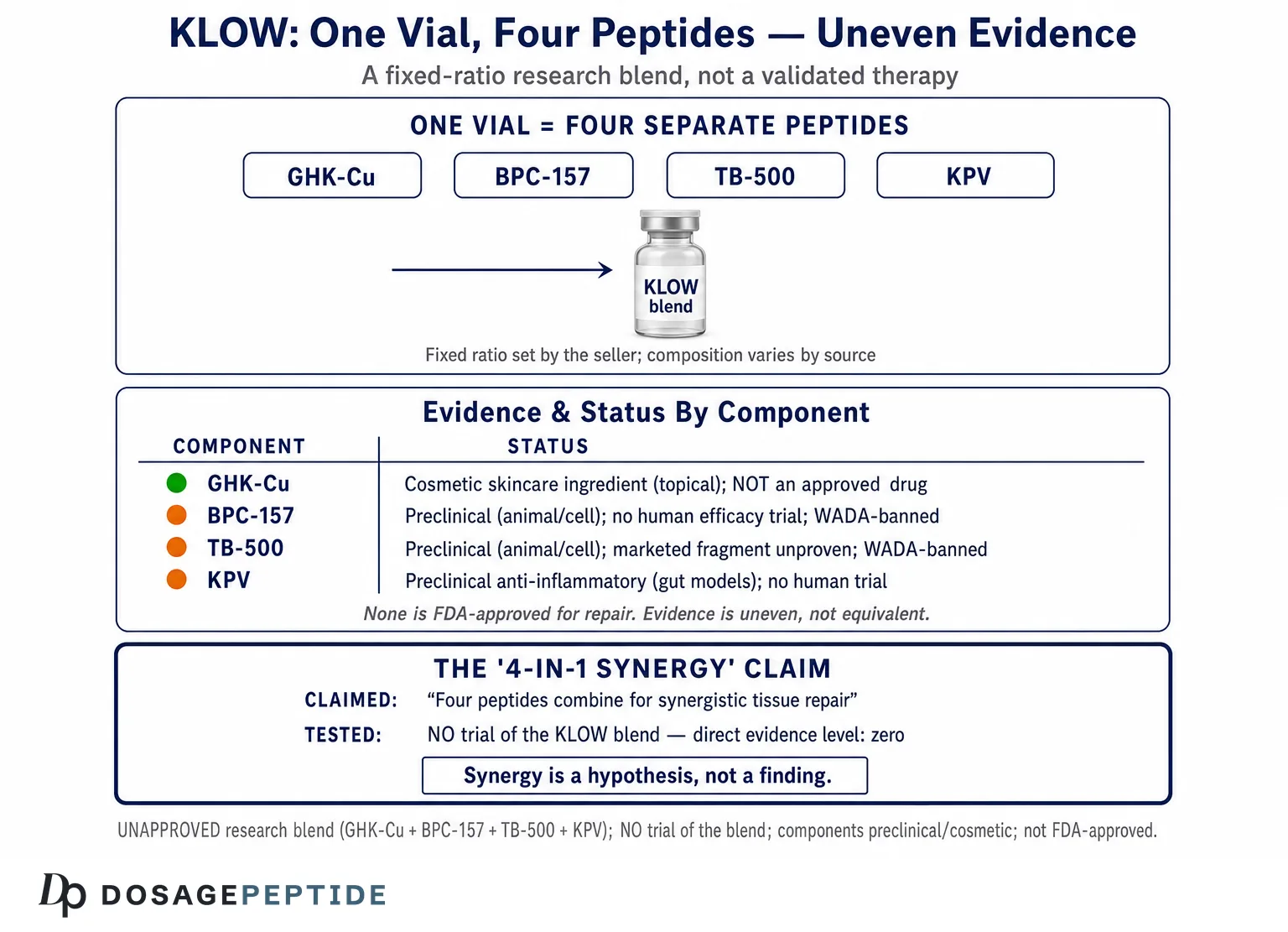
KLOW is one of those product names that promises more than any dataset can currently deliver. Sold as a single lyophilized vial, it is not a peptide in its own right but a fixed blend of four separate compounds — GHK-Cu, BPC-157, TB-500, and KPV — combined under the marketing shorthand of a “4-in-1 repair” or “recovery” formula. The pitch writes itself: bundle a collagen-stimulating copper peptide, two celebrated “healing” research peptides, and an anti-inflammatory tripeptide into one injection, and you supposedly get compounding, synergistic tissue repair. It is a tidy story. The problem is that the story is assembled almost entirely from the reputations of the individual ingredients, not from any study of the blend itself.
This article takes the blend seriously enough to be honest about it. We will look at what each of the four peptides actually is, where its evidence comes from, and how strong that evidence really is — because the four components are not equivalent in either their biology or their level of validation. One is a well-characterized cosmetic and wound-care molecule with decades of literature; two are research peptides whose impressive-sounding results come almost entirely from rodents and cell culture and which are banned in sport; and one is a preclinical anti-inflammatory tripeptide that has never completed a human efficacy trial. None of the four is an FDA-approved drug. And crucially, there is no published trial of KLOW as a combination. The synergy claim — the entire reason the blend exists as a product — is a hypothesis, not a finding.
The goal here is not to dismiss these compounds, several of which are genuinely interesting research tools, nor to hype them. It is to give a researcher or an educated reader an accurate map: what is known, what is merely plausible, and what is simply asserted by vendors. Throughout, the labels matter. “Cosmetic” is not “approved drug.” “Preclinical” is not “proven in humans.” And a blend of four things with animal-level evidence does not become clinically validated by virtue of being mixed together.
What KLOW Actually Is: Four Peptides in One Vial
The name KLOW is a loose acronym assembled from its ingredients — most commonly parsed as KPV, the healing peptides (BPC-157 and TB-500, sometimes grouped under “Wolverine” branding), and the O/GHK-Cu copper peptide, though vendors are inconsistent about the exact letter-to-compound mapping. That inconsistency is itself a small tell: KLOW is a commercial construct, not a defined pharmaceutical entity with a fixed, standardized composition. Different sellers offer different total peptide masses per vial and different ratios among the four components, which means “KLOW” from one source is not chemically identical to “KLOW” from another.
What the four components share is a loose thematic association with tissue repair, healing, and anti-inflammatory signaling. That shared theme is the marketing logic. But biologically the four are quite different molecules operating through distinct, only partly overlapping mechanisms:
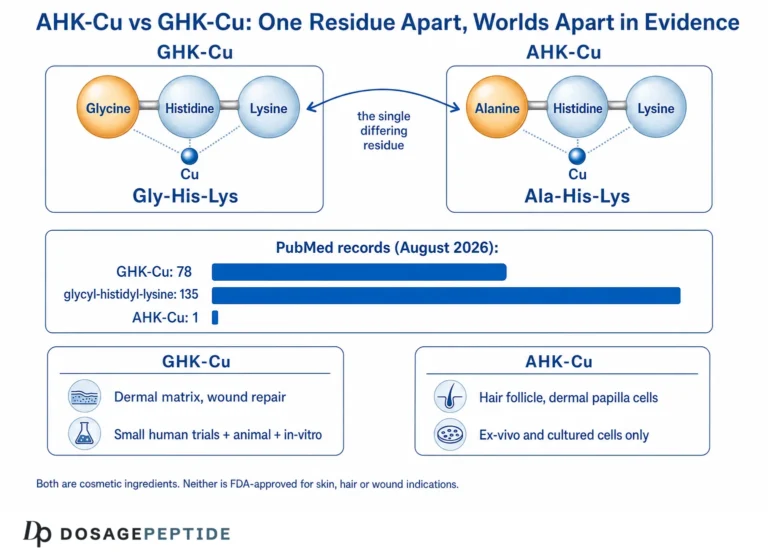
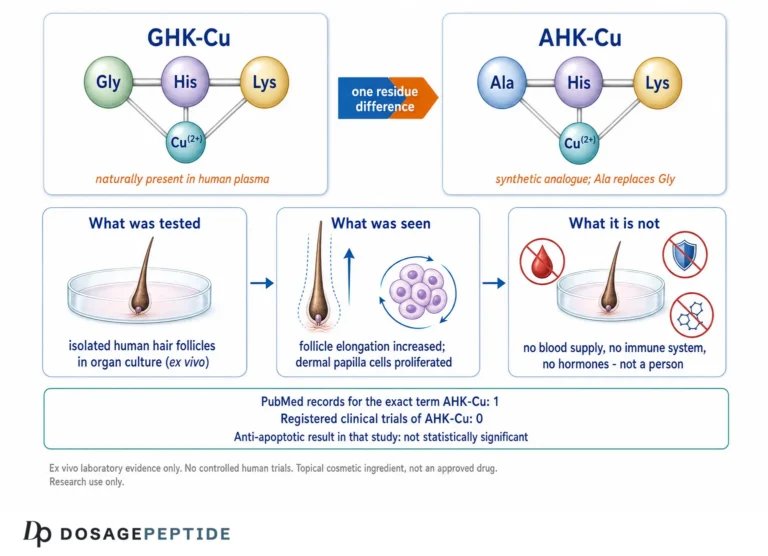
- GHK-Cu (glycyl-L-histidyl-L-lysine plus copper) is a naturally occurring human tripeptide-copper complex, best characterized as a modulator of skin remodeling, collagen synthesis, and antioxidant gene expression. It is widely used as a cosmetic ingredient.12
- BPC-157 is a synthetic 15-amino-acid peptide (“body protection compound”) derived from a sequence in human gastric juice, studied in animals for tendon, muscle, gut, and vascular healing. It has no completed human efficacy trials and is prohibited in sport.56
- TB-500 is a synthetic fragment corresponding to the active region of thymosin β4, an actin-sequestering protein involved in cell migration, angiogenesis, and wound repair — again, almost entirely on the strength of animal and cell-culture data, and also banned in sport.78
- KPV (lysine-proline-valine) is the C-terminal tripeptide of α-melanocyte-stimulating hormone (α-MSH), studied preclinically for anti-inflammatory effects in models of colitis and skin inflammation, with no confirmatory human trials.34
Two features unify them from a regulatory standpoint. First, none is an approved therapeutic for any disease in the United States, Europe, or comparable jurisdictions. Second, the depth of evidence behind each is wildly uneven — ranging from GHK-Cu’s substantial cosmetic and gene-expression literature to KPV’s handful of preclinical papers. When these are blended, the marketing tends to average upward, borrowing GHK-Cu’s legitimacy and BPC-157’s internet fame to imply that the whole package is well-supported. It is not. The honest way to understand KLOW is to evaluate each component on its own evidence and then ask what, if anything, is known about combining them. For readers who want the single-compound deep dives, the site’s pillar explainer on what BPC-157 is is a useful companion to this piece.
GHK-Cu: The Cosmetic Copper Tripeptide
Of the four ingredients, GHK-Cu has by far the deepest and most credible research base — though it is important to be precise about what that research actually establishes. GHK is a small tripeptide (glycyl-L-histidyl-L-lysine) that occurs naturally in human plasma, saliva, and urine. It binds copper(II) with high affinity, forming the GHK-Cu complex, and plasma levels of GHK decline with age, which fueled early interest in it as a signal of tissue-repair capacity.2 Loren Pickart, who first isolated GHK in the 1970s, and later collaborators built a substantial body of work around the molecule’s effects on skin and connective tissue.
Mechanistically, GHK-Cu is one of the better-understood peptides in the cosmetic space. The copper complex acts as a delivery vehicle and signaling molecule that has been reported to stimulate collagen, elastin, and glycosaminoglycan synthesis in dermal fibroblasts; to attract repair cells such as macrophages and capillary endothelial cells; and to exert antioxidant and anti-inflammatory effects, in part by supporting superoxide dismutase activity and dampening reactive oxygen species.12 A widely cited 2018 analysis by Pickart and Margolina examined GHK’s influence on gene expression and reported that the peptide modulates a strikingly large number of human genes — with enrichment in pathways governing tissue remodeling, antioxidant response, and DNA repair.1 Broader reviews of tripeptides in wound healing place GHK-Cu among the best-documented small peptides for stimulating fibroblast migration and extracellular-matrix remodeling.11
Here is where honesty matters. Most of GHK-Cu’s human evidence is cosmetic — topical creams and serums evaluated for wrinkle reduction, skin firmness, and photodamage — not pharmaceutical evidence for systemic tissue repair delivered by injection. Its gene-expression findings, while genuinely interesting, come largely from in-vitro and computational analyses of expression data rather than from controlled clinical outcomes. GHK-Cu is an approved and widely marketed skincare ingredient, and that is the domain where its reputation is earned. Extrapolating from “improves skin appearance in topical formulations” and “modulates repair-related genes in cultured cells” to “drives whole-body tissue regeneration when injected as part of a blend” is a substantial leap that the cosmetic literature does not underwrite. The site’s overview of what GHK-Cu does for skin health and collagen synthesis reflects this more measured, dermatology-anchored reading of the evidence.
It also helps to understand why copper is central to the story rather than incidental. Copper is a required cofactor for lysyl oxidase, the enzyme that cross-links collagen and elastin fibers into mature, load-bearing matrix, and for antioxidant enzymes such as copper-zinc superoxide dismutase. GHK’s high affinity for copper(II) — comparable to the copper-transport site on serum albumin — lets the tripeptide act as a shuttle that delivers the metal to cells and tissues in a controlled, non-toxic form.2 This is a genuinely elegant piece of biochemistry, and it is the reason GHK-Cu is more than a generic “peptide”: the copper is doing real chemical work. But it is worth noticing that this mechanism is squarely about connective-tissue matrix and redox balance in skin, precisely the domain in which the human evidence sits. It is not, by itself, a demonstration that adding GHK-Cu to an injected recovery blend accelerates the healing of a torn tendon or an inflamed gut.
So GHK-Cu enters the KLOW blend as its most legitimate member, but with an important asterisk: its legitimacy lives in cosmetics and dermal biology, not in validated systemic-repair pharmacology. It contributes real science to the mixture, but not the kind of science that automatically transfers to the ambitious injury-recovery claims made for the blend as a whole. A useful mental discipline throughout this article is to keep asking, for each component, “evidence for what, in which tissue, by which route?” For GHK-Cu the honest answers are: matrix and antioxidant biology, in skin, largely topical — a narrower claim than the blend’s branding implies.
BPC-157: The “Body Protection Compound” and Its Preclinical Case
BPC-157 is the ingredient that gives KLOW most of its internet gravity. Known as the “body protection compound,” it is a stable synthetic pentadecapeptide (15 amino acids) whose sequence is derived from a protein found in human gastric juice. In the hands of Predrag Sikiric’s laboratory in Zagreb and a small number of other groups, BPC-157 has produced a remarkable volume of positive animal results across an unusually wide range of tissues: gastrointestinal ulcers and fistulas, tendon and ligament transection, muscle crush injury, bone, and even nerve and vascular injury.5
The proposed mechanisms are coherent and biologically plausible. BPC-157 is reported to promote angiogenesis, in part through upregulation of vascular endothelial growth factor receptor 2 (VEGFR2) and the nitric-oxide (Akt-eNOS) pathway, and to accelerate the migration and survival of fibroblasts. In a frequently cited in-vitro study, BPC-157 promoted the outgrowth of tendon fibroblasts from explants, enhanced their migration, and improved cell survival under stress, effects linked to activation of the FAK-paxillin pathway.6 A large 2021 review catalogs the breadth of wound-healing findings across organ systems and lays out the vascular and cytoprotective hypotheses in detail.5
Now the necessary corrective. Nearly all of this evidence is preclinical — rodents, rabbits, and cell culture. As of mid-2026 there are no published, adequately powered, randomized controlled human efficacy trials demonstrating that BPC-157 heals tendons, ligaments, muscle, or gut in people. A candid 2025 narrative review of BPC-157 for musculoskeletal healing makes exactly this point, noting that the human evidence base is essentially absent and that enthusiasm has outrun data.13 A further complication that reviewers repeatedly flag is that a large fraction of the positive literature originates from a single research group, which raises the standard scientific concern about independent replication. This does not mean the findings are wrong; it means they should be treated as promising leads awaiting confirmation, not as established facts.
It is worth being specific about why the “single-laboratory” concern is not merely academic pedantry. When a compound’s literature is broad in scope but narrow in provenance, the field cannot easily separate a true biological effect from methodological choices, publication patterns, or model-specific quirks that a second independent group would surface. The gold standard — multiple laboratories, blinded and randomized animal work, pre-registered outcomes, and eventually human trials — has largely not been applied to BPC-157. The peptide has also never been characterized in humans the way an approved drug is: there is no established human pharmacokinetic profile, no dose-ranging efficacy study, and no long-term safety dataset. Enthusiasts sometimes counter that BPC-157 is “natural” because its sequence derives from a gastric protein, but the marketed compound is a synthetic partial sequence, and “derived from a human protein” is not a safety or efficacy credential. The molecule is best understood as a high-interest preclinical lead whose real-world human profile is genuinely unknown.
There is also a regulatory and safety dimension that KLOW marketing tends to omit. BPC-157 is prohibited in sport by the World Anti-Doping Agency (it is treated as a non-approved substance under category S0), and anti-doping bodies have explicitly warned athletes that its use can trigger multi-year bans.9 In the United States, the Department of Defense’s Operation Supplement Safety and the FDA have flagged BPC-157 as an unapproved drug with unresolved concerns about impurities and immunogenicity when sold in injectable “research” products, and it has been the subject of ongoing compounding-eligibility review rather than approval.10 The honest summary: BPC-157 is a genuinely intriguing preclinical peptide with a wide, coherent animal literature, meaningful independent-replication and human-data gaps, and a real regulatory shadow — not a proven human therapeutic. Readers exploring the inflammation-and-joint angle can see the same caution reflected in the discussion of whether BPC-157 is a missing link in treating inflammation and joint pain.
TB-500: The Thymosin β4 Fragment and Actin Biology
The third KLOW component, TB-500, is a synthetic peptide corresponding to the active region of thymosin β4 (Tβ4), one of the most abundant intracellular actin-binding proteins in mammalian cells. Understanding TB-500 requires distinguishing two things that vendors routinely blur: the full 43-amino-acid natural protein thymosin β4, which has a large and legitimate research literature, and the shorter synthetic fragment TB-500 sold in research vials, which is marketed as a functional stand-in for it. The two are related but not identical, and most of the strongest primary data concern thymosin β4 itself.
Thymosin β4’s core molecular function is well established: it sequesters monomeric G-actin, binding it roughly 1:1 and regulating the balance between free actin and the polymerized filaments that drive cell shape and movement.7 Because cell migration is central to wound repair, this actin biology gives Tβ4 a plausible route to influence healing. Beyond actin sequestration, Tβ4 has been reported to promote angiogenesis, endothelial cell migration, and keratinocyte movement, and to exert anti-inflammatory effects. A foundational 1999 study showed that topical or systemic thymosin β4 accelerated dermal wound re-epithelialization by roughly 40–60% in rodent models, with increased collagen deposition and angiogenesis.8 A 2005 review framed Tβ4 memorably as an actin-sequestering protein that “moonlights” to repair injured tissues when released after injury.7
The candid caveats mirror those for BPC-157. The regenerative evidence is overwhelmingly animal and cell-culture data; a recent scoping review of thymosin β4 and TB-500 in musculoskeletal repair confirms that the human clinical evidence base remains thin to absent, and that much of what circulates as “TB-500 research” is really thymosin β4 biology being borrowed by association.12 Thymosin β4 did advance into some human trials for specific indications such as ophthalmic and cardiac injury, but the injectable “TB-500” research peptide used in blends like KLOW has not been validated in controlled human recovery trials. And like BPC-157, TB-500 (and thymosin β4 derivatives generally) is prohibited in sport by WADA under the growth-factor provisions, so for any tested athlete it is a straightforward anti-doping violation regardless of pharmacology.9 The site’s review of what evidence shows about TB-500 in tendon and ligament repair similarly stresses that the tendon-and-ligament story is preclinical rather than clinically proven.
There is a subtlety here that repays attention, because it recurs throughout the peptide-marketing world. Thymosin β4 is a legitimate, extensively studied biological molecule, and some of its human-trial work — for corneal wounds, pressure ulcers, and post-infarction cardiac repair — is real. TB-500, the shorter synthetic fragment sold in vials, is marketed as though it simply is thymosin β4, so that every finding about the parent protein is quietly transferred to the fragment. But a fragment is not guaranteed to reproduce the full protein’s activity, stability, or safety profile, and the specific injectable material in a KLOW vial has not been the subject of the controlled human trials that the parent protein has entered. This “parent-protein halo” is exactly parallel to the “full-length hormone halo” that inflates claims for other peptide fragments: the reputation of the large, well-studied molecule is borrowed to dress up a smaller, less-studied stand-in. Keeping thymosin β4 and TB-500 mentally distinct is the single most useful habit for reading TB-500 marketing critically.
TB-500 therefore enters the blend as a second animal-validated, human-unproven repair peptide with a compelling mechanistic story (actin dynamics, cell migration, angiogenesis) and the same two structural weaknesses as BPC-157: no robust human efficacy data for the marketed fragment, and a sport ban. Its inflammation-modulating claims, sometimes emphasized in blend marketing, rest on the same preclinical footing; the site’s discussion of whether TB-500 is a promising therapy for chronic inflammatory conditions applies the same preclinical-versus-clinical caution used here.
KPV: The Anti-Inflammatory Tripeptide From α-MSH
KPV is the quietest and least-studied of the four, and also the one whose evidence base is most clearly labeled “preclinical only.” It is a tripeptide — lysine-proline-valine — corresponding to the C-terminal three residues (positions 11–13) of α-melanocyte-stimulating hormone. The appeal of KPV is that it appears to retain much of α-MSH’s well-documented anti-inflammatory activity while shedding the pigmentation effects associated with melanocortin-receptor signaling.4
The most influential primary work is a 2008 Gastroenterology study by Dalmasso and colleagues, which showed that KPV is transported into intestinal epithelial cells via the peptide transporter PepT1 and, once inside, reduces pro-inflammatory signaling. In mouse models of colitis (DSS- and TNBS-induced), orally delivered KPV decreased pro-inflammatory cytokine expression and attenuated disease severity.3 Importantly, this study clarified a mechanistic subtlety often garbled in marketing copy: KPV’s intestinal anti-inflammatory effect in that model was not mediated through melanocortin receptors but through PepT1-dependent uptake and downstream inhibition of NF-κB signaling. A comprehensive 2008 review of α-MSH and related tripeptides in Endocrine Reviews situates KPV within the broader melanocortin anti-inflammatory literature and its potential in immune-mediated inflammatory disease.4
The parent-hormone logic is genuinely interesting in KPV’s case. α-MSH is a broadly anti-inflammatory neuropeptide that acts on melanocortin receptors to suppress inflammatory mediators, but its melanocortin activity also drives pigmentation and other effects that complicate therapeutic use. By stripping the molecule down to its terminal three residues, researchers hoped to keep the anti-inflammatory tail while discarding the receptor-driven pigmentation — and the colitis data suggest that at least some of KPV’s activity runs through a receptor-independent, transporter-mediated route rather than classic melanocortin signaling.34 That is a mechanistically satisfying story, and it is why KPV is a legitimate object of anti-inflammatory research. It is also a cautionary illustration of how much context a mechanism carries: the best-characterized KPV effect depends on an intestinal transporter (PepT1) abundant in gut epithelium, which is one reason KPV has been explored mainly for oral delivery in bowel inflammation rather than as a general-purpose systemic anti-inflammatory.
The honest boundary is stark: KPV’s evidence is almost entirely cell-culture and rodent work. There are no large, completed human clinical trials establishing that KPV treats or resolves any inflammatory disease, and the peptide is not approved for any indication. Its most-cited results concern gut inflammation via a specific intestinal transporter — a context quite different from the systemic, subcutaneous “recovery” use implied by an injectable blend. KPV is a legitimately interesting anti-inflammatory research tripeptide with a plausible mechanism, and nothing more than that has been demonstrated. In the KLOW package, it functions as the “anti-inflammatory” note in the chord, but it is the note with the least human validation behind it.
The Combination Logic — and Why “4-in-1” Is a Marketing Claim, Not a Finding
Having examined the parts, we can now examine the whole — and this is where KLOW’s central claim comes apart under scrutiny. The rationale offered for the blend is intuitive: pair a collagen-and-matrix stimulator (GHK-Cu), two broad-spectrum “healing” peptides that promote angiogenesis and cell migration (BPC-157 and TB-500), and an anti-inflammatory tripeptide (KPV), and you cover the major phases of tissue repair — inflammation control, angiogenesis, cell recruitment, and matrix synthesis — in a single injection. On a whiteboard, the pathways look complementary.
The trouble is that a plausible pathway diagram is not evidence. There is no published clinical trial of the KLOW combination, and no controlled preclinical study demonstrating that these four peptides, dosed together at the ratios sold commercially, produce greater repair than any one of them alone — let alone that they do so safely, or that they do anything measurable in humans at all. Every confident statement about KLOW’s “synergy” is an extrapolation stacked on top of four separate bodies of evidence, three of which are preclinical and one of which is cosmetic. Stacking extrapolations does not add certainty; it multiplies uncertainty.
Several specific problems undercut the synergy narrative:
- Untested interactions. Combining bioactive peptides can produce additive, synergistic, or antagonistic effects, and can alter pharmacokinetics and immunogenicity in ways no one has measured for this mixture. Assuming the best case (synergy) rather than the neutral or worst case is an act of marketing optimism, not science.
- Mismatched evidence and delivery. GHK-Cu’s strongest data are topical and cosmetic; KPV’s are oral and intestinal; BPC-157 and TB-500 are subcutaneous/systemic in animals. Bundling them into one subcutaneous injection ignores that each compound’s evidence was generated in a different context, route, and tissue.
- Dose and ratio are arbitrary. Because there is no trial, the amount of each peptide in a KLOW vial reflects a vendor’s choice, not an optimized, tested formulation. Different products use different ratios, so results (or anecdotes) cannot even be compared across sources.
- Compounded quality risk. Four separate peptides in one vial means four separate opportunities for impurity, mislabeling, endotoxin, or degradation — risks that are entirely about sourcing and manufacturing and have nothing to do with the molecules’ intrinsic biology.
There is a deeper conceptual problem with the “covers all four phases of repair” pitch. Wound healing is not a checklist of independent boxes to be ticked by four separate agents; it is a tightly choreographed sequence in which inflammation, angiogenesis, proliferation, and matrix remodeling must occur in the right order, in the right place, and then resolve. Timing and termination matter as much as initiation. An intervention that suppresses inflammation at the wrong moment can impair the debridement and signaling that healing depends on; excessive or poorly timed angiogenesis can produce disorganized tissue; and continuous pro-synthetic signaling can tip toward fibrosis and scarring rather than functional repair. Applying four bioactive peptides to all phases simultaneously, at fixed ratios, with no feedback control, is not obviously an improvement on the body’s own regulation — and no one has tested whether it helps, hurts, or does nothing. The “more mechanisms must be better” intuition is exactly the kind of reasoning that controlled trials exist to check, because biology is full of interventions that looked additively beneficial on paper and proved neutral or harmful in practice.
None of this proves KLOW is useless. It proves that the blend’s marquee claim — that four peptides combine into a validated, synergistic repair therapy — is unsupported by direct evidence and rests on inference. The intellectually honest description of KLOW is not “a proven 4-in-1 repair blend” but “an untested fixed-ratio combination of four unapproved peptides, three preclinical and one cosmetic, marketed on the borrowed reputations of its parts.” For context on how the individual repair-signaling claims are evaluated at the component level, the discussion of what evidence supports KLOW peptides in angiogenesis and tissue repair is a useful companion, and the related look at what studies reveal about KLOW peptides and energy metabolism shows how quickly component-level findings get generalized into blend-level promises they cannot support.
What the Evidence Does NOT Show
Because the marketing around KLOW is so confident, it is worth stating plainly and in one place what the current evidence does not establish. This is not a rhetorical flourish; it is the practical core of an honest assessment.
It does not show that KLOW works as a blend. There is no human trial and no controlled animal study of the four-peptide combination. Any claim about the blend’s efficacy is untested.
It does not show that BPC-157 or TB-500 heals injuries in humans. Their impressive results are preclinical. The marketed research fragments have not been validated in adequately powered, randomized, controlled human efficacy trials for tendon, ligament, muscle, or joint recovery. Promising animal data is a reason to run trials, not a substitute for them.51213
It does not show that GHK-Cu, injected as part of a systemic repair blend, does what topical GHK-Cu does for skin. GHK-Cu’s human evidence is dermatological and cosmetic. That is a real domain of legitimacy, but it is not evidence for injected whole-body regeneration.12
It does not show that KPV treats any human inflammatory disease. KPV’s data are preclinical, concentrated in gut-inflammation models with a transporter-specific mechanism, with no confirmatory human trials.34
It does not show that the combination is safe. Absence of large safety signals in short, separate studies of individual components in narrow populations is not the same as demonstrated safety of a fixed four-peptide injectable used repeatedly. Long-term and combination-specific safety data simply do not exist.
It does not show regulatory legitimacy. None of the four is FDA-approved; two are WADA-prohibited; and BPC-157 in particular sits under active regulatory scrutiny as an unapproved drug.910
The correct scientific posture toward KLOW is therefore neither dismissal nor enthusiasm but calibrated agnosticism: the components include genuinely interesting molecules with plausible mechanisms, and the blend as sold is an unvalidated commercial product whose central promise has never been tested. Where a compound (or combination) has not been studied for a use, the responsible default is to say so, rather than to fill the gap with mechanism talk and cross-species extrapolation.
How KLOW Compares to Its Individual Parts and to Approved Repair Therapies
A comparison table clarifies where each component stands and how the blend relates to interventions that actually carry regulatory approval or high-quality human evidence for tissue repair. The contrast is instructive: it shows what “validated” looks like and how far KLOW’s components sit from that bar.
| Component / comparator | What it is | Best-supported mechanism | Highest level of evidence | Regulatory / sport status |
|---|---|---|---|---|
| GHK-Cu | Natural human copper tripeptide complex | Collagen/matrix synthesis; antioxidant & remodeling gene modulation | Human cosmetic (topical) + extensive in-vitro/gene data12 | Cosmetic ingredient; not an approved drug |
| BPC-157 | Synthetic 15-aa gastric-juice-derived peptide | Angiogenesis (VEGFR2, NO/eNOS); fibroblast migration | Preclinical (rodent/cell); no completed human efficacy RCTs5613 | Unapproved; WADA-prohibited (S0)910 |
| TB-500 | Synthetic thymosin β4 active-region fragment | Actin sequestration; cell migration; angiogenesis | Preclinical (rodent/cell); marketed fragment human-unproven7812 | Unapproved; WADA-prohibited (growth factors)9 |
| KPV | α-MSH C-terminal tripeptide (Lys-Pro-Val) | PepT1 uptake; NF-κB inhibition; anti-inflammatory | Preclinical (colitis/skin models); no human efficacy trials34 | Unapproved for any indication |
| KLOW blend | Fixed-ratio mix of all four | Hypothesized multi-phase repair “synergy” | No trials of the blend — evidence level zero | Unapproved compounded product |
| Approved biologic repair (e.g., PDGF/becaplermin for diabetic ulcers) | Recombinant growth-factor gel | Chemotaxis/proliferation of repair cells | FDA-approved with human RCT evidence for a defined indication | Approved (labeled indication) |
The pattern is unmistakable. A validated repair therapy is defined for a specific indication, tested in controlled human trials, and carries a regulatory approval that binds its claims to its data. KLOW’s components range from a legitimate cosmetic ingredient to interesting preclinical peptides, but none clears that bar, and the blend itself has never been formally studied at all. The table also highlights an asymmetry the marketing exploits: it lets the strongest-sounding mechanistic claim from any single component stand in for the evidentiary status of the whole. In reality the blend can be no better validated than its least-tested premise — and that premise (that the four work better together in humans) has zero direct support.
It is worth adding that even purpose-built, single-agent repair therapies with human trials often struggle to convert mechanism into durable, clinically meaningful outcomes. That history sets a sober expectation: a four-peptide blend assembled from preclinical and cosmetic parts, with no combination trial, is not a shortcut past the hard work of clinical validation — it is a product that has simply skipped it.
Regulatory and Anti-Doping Status
The regulatory picture around KLOW is layered and frequently misrepresented, so precision helps. There are really four separate regulatory questions — drug approval, cosmetic status, compounding eligibility, and sport prohibition — and they have different answers for different components.
Drug approval. None of the four peptides is approved as a drug for tissue repair, injury recovery, inflammation, or any other indication by the U.S. Food and Drug Administration, the European Medicines Agency, or comparable regulators. The KLOW blend, correspondingly, has no approved status and no approved indication. Any product presenting it as a treatment for injury, tendinopathy, gut disease, or aging is making claims unsupported by regulatory review.
Cosmetic status. GHK-Cu is legitimately marketed as a cosmetic skincare ingredient, and that is where its human evidence and legal footing are strongest. But cosmetic legitimacy for a topical skin ingredient is a narrow permission; it says nothing about the safety or efficacy of the same molecule injected systemically as part of a blend, which is a fundamentally different regulatory and biological proposition.
Compounding scrutiny. In the United States, BPC-157 in particular has been the subject of ongoing review over whether it may be compounded under Section 503A. The FDA previously flagged it over impurity, characterization, and immunogenicity concerns, and its status within the compounding framework has been unsettled rather than settled in its favor.10 Injectable “research chemical” peptides sold outside regulated pharmacy channels carry documented quality risks — variable purity, mislabeling, contamination — that are independent of the molecules’ pharmacology and that multiply in a four-component blend.
Anti-doping prohibition. This is the clearest and most consequential point for any athlete. Both BPC-157 and TB-500 (thymosin β4 and its derivatives) are prohibited at all times under the WADA Prohibited List — BPC-157 as a non-approved substance (S0) and TB-500 under the growth-factor provisions — and there is no therapeutic-use-exemption pathway for non-approved substances.9 Anti-doping authorities have sanctioned athletes for using these peptides, including multi-year bans.9 Because a KLOW vial contains both banned peptides, its use by a tested athlete is essentially a guaranteed anti-doping rule violation. That is a hard, factual hazard that no amount of “recovery” framing changes.
The regulatory synthesis: KLOW occupies an ambiguous, largely unregulated middle ground — one cosmetic-legitimate component, three unapproved research peptides, two of them sport-banned, and a blend with no approval or trial behind it. For any legitimate exploration of these compounds, the appropriate path is formal preclinical and clinical research under oversight, not informal use of a compounded injectable.
Handling and Reconstitution in a Research Context
Because KLOW is most often supplied as a lyophilized (freeze-dried) powder in a sealed vial, a brief, strictly educational note on laboratory handling is warranted — with the emphasis that this describes standard research-peptide practice, not a usage recommendation, and that KLOW is not an approved therapeutic for any indication.
Lyophilized peptides are generally reconstituted with sterile or bacteriostatic water for laboratory purposes. The diluent is directed slowly against the inside wall of the vial rather than sprayed onto the powder, and the vial is gently swirled rather than shaken, because vigorous agitation can shear peptide bonds and denature the material. A multi-peptide blend adds a wrinkle: the four components may have different solubilities and stabilities, so a blend is not necessarily as forgiving as a single well-characterized peptide, and there is no standardized, validated reconstitution protocol for KLOW the way there is for approved injectables. The volume of diluent chosen simply sets the total concentration; because the ratio of the four peptides is fixed by the manufacturer, the researcher cannot adjust one component independently of the others.
Stability and storage considerations that recur across the research-peptide literature include:
| Parameter | Typical research-context practice |
|---|---|
| Lyophilized storage | Cool, dark conditions; long-term stability favored by freezing |
| After reconstitution | Refrigerated; used within a limited window |
| Light and heat | Minimize exposure; both degrade peptides |
| Agitation | Swirl gently; avoid shaking or foaming |
| Freeze-thaw | Repeated cycles degrade peptides; avoid |
| Sterility | Aseptic technique; bacteriostatic water for multi-use practice |
| Blend-specific caveat | Mixed peptides may differ in solubility/stability; no validated standard protocol exists |
It bears repeating that meticulous handling changes nothing about the evidence question. A perfectly reconstituted, high-purity KLOW vial is still an untested four-peptide combination with no clinical validation. Good technique preserves whatever biological activity the molecules have; it does not create efficacy where none has been demonstrated, and it does not resolve the sourcing and purity risks that come with unregulated injectable products. General, non-compound-specific background on the arithmetic and technique of reconstitution is covered in the site’s peptide reconstitution guide.
Frequently Asked Questions
Is KLOW an FDA-approved medicine?
No. KLOW is not approved by the FDA, the EMA, or any comparable regulator for tissue repair, injury recovery, inflammation, or any other condition. None of its four components — GHK-Cu, BPC-157, TB-500, or KPV — is an approved drug for these uses either. GHK-Cu is legitimately used as a cosmetic skincare ingredient, but that is a narrow permission that does not extend to an injectable systemic-repair blend. Any product marketing KLOW as a treatment is making claims not supported by regulatory review.
Is there any clinical trial of the KLOW blend?
No. There is no published human clinical trial — and no controlled preclinical study — of the four-peptide KLOW combination. Every claim about the blend’s “synergy” or “4-in-1 repair” effect is an extrapolation from separate studies of the individual components, three of which are preclinical (animal/cell) and one of which is cosmetic. On the specific question of whether the blend works, the direct evidence level is zero.
Do BPC-157 and TB-500 actually heal injuries?
They show impressive healing effects in animals and cell culture — angiogenesis, fibroblast and endothelial migration, tendon and wound repair — but these results have not been confirmed in adequately powered, randomized controlled human trials for the marketed research peptides.5678 Recent narrative and scoping reviews specifically note the near-absence of human efficacy data and, for BPC-157, a reliance on a limited number of research groups.1213 Promising preclinical data is a reason to run trials, not a substitute for them.
What does GHK-Cu contribute to the blend?
GHK-Cu is the best-characterized ingredient, a natural human copper tripeptide with a substantial literature on collagen and matrix synthesis, antioxidant gene modulation, and skin remodeling.12 But its strongest human evidence is cosmetic and topical. Injecting it as part of a systemic repair blend is a different proposition that the cosmetic literature does not validate. GHK-Cu lends the blend scientific legitimacy in dermal biology, not proof of injected whole-body regeneration.
Is KPV a proven anti-inflammatory treatment?
No. KPV is a tripeptide from α-MSH with genuinely interesting preclinical anti-inflammatory data, most notably in mouse colitis models where it is taken up by the intestinal transporter PepT1 and inhibits NF-κB signaling.34 But there are no completed human clinical trials showing it treats any inflammatory disease, and it is not approved for any indication. Its best evidence is in gut inflammation via a specific transporter — a different context from an injectable recovery blend.
Can athletes use KLOW?
Athletes subject to anti-doping testing should treat KLOW as prohibited. Both BPC-157 and TB-500 (thymosin β4 and derivatives) are banned at all times by WADA, and there is no therapeutic-use-exemption pathway for non-approved substances.9 Athletes have received multi-year bans for using these peptides. Because a KLOW vial contains both, its use by a tested athlete is effectively a guaranteed anti-doping rule violation regardless of how the product is marketed.
Is KLOW safe?
Its safety as a blend is unknown. Short, separate studies of individual components in narrow populations have not raised dramatic signals, but that is not the same as demonstrated safety for a fixed four-peptide injectable used repeatedly over time. No long-term or combination-specific safety data exist. On top of that, unregulated injectable “research” peptides carry real sourcing risks — variable purity, mislabeling, endotoxin, and contamination — and a four-component vial multiplies those opportunities for error.10
Why is the blend marketed so confidently if the evidence is thin?
Because the marketing borrows credibility. GHK-Cu’s real cosmetic science and BPC-157’s viral internet reputation are used to imply that the whole package is well-supported. In reality the blend can be no better validated than its least-tested assumption — that the four peptides work better together in humans — and that assumption has never been tested. Confident language resting on component reputations rather than blend data is the single most common error to watch for around KLOW.
How is KLOW handled in a research setting?
As a lyophilized powder, it is reconstituted with sterile or bacteriostatic water using gentle technique (swirl, do not shake), stored cool and dark, and protected from freeze-thaw cycles — standard research-peptide practice. A blend adds the caveat that its four components may differ in solubility and stability and that no validated standard reconstitution protocol exists for it. Handling quality preserves activity but has no bearing on the absence of blend-level efficacy data.
References
- Pickart L, Margolina A. Regenerative and Protective Actions of the GHK-Cu Peptide in the Light of the New Gene Data. Int J Mol Sci. 2018;19(7):1987. PMID: 29986520; PMCID: PMC6073405. https://pubmed.ncbi.nlm.nih.gov/29986520/
- Pickart L. The human tri-peptide GHK and tissue remodeling. J Biomater Sci Polym Ed. 2008;19(8):969-988. PMID: 18644225. https://pubmed.ncbi.nlm.nih.gov/18644225/
- Dalmasso G, Charrier-Hisamuddin L, Nguyen HTT, Yan Y, Sitaraman S, Merlin D. PepT1-Mediated Tripeptide KPV Uptake Reduces Intestinal Inflammation. Gastroenterology. 2008;134(1):166-178. PMID: 18061177; PMCID: PMC2431115. https://pmc.ncbi.nlm.nih.gov/articles/PMC2431115/
- Brzoska T, Luger TA, Maaser C, Abels C, Böhm M. Alpha-melanocyte-stimulating hormone and related tripeptides: biochemistry, antiinflammatory and protective effects in vitro and in vivo, and future perspectives for the treatment of immune-mediated inflammatory diseases. Endocr Rev. 2008;29(5):581-602. PMID: 18612139. https://pubmed.ncbi.nlm.nih.gov/18612139/
- Seiwerth S, Milavic M, Vukojevic J, et al. Stable Gastric Pentadecapeptide BPC 157 and Wound Healing. Front Pharmacol. 2021;12:627533. PMCID: PMC8275860. https://pmc.ncbi.nlm.nih.gov/articles/PMC8275860/
- Chang CH, Tsai WC, Lin MS, Hsu YH, Pang JHS. The promoting effect of pentadecapeptide BPC 157 on tendon healing involves tendon outgrowth, cell survival, and cell migration. J Appl Physiol. 2011;110(3):774-780. PMID: 21148156. https://pubmed.ncbi.nlm.nih.gov/21148156/
- Goldstein AL, Hannappel E, Kleinman HK. Thymosin β4: actin-sequestering protein moonlights to repair injured tissues. Trends Mol Med. 2005;11(9):421-429. PMID: 16099219. https://pubmed.ncbi.nlm.nih.gov/16099219/
- Malinda KM, Sidhu GS, Mani H, et al. Thymosin beta4 accelerates wound healing. J Invest Dermatol. 1999;113(3):364-368. PMID: 10469335. https://pubmed.ncbi.nlm.nih.gov/10469335/
- U.S. Anti-Doping Agency. BPC-157: Experimental Peptide Creates Risk for Athletes (BPC-157 and TB-500/thymosin β4 prohibited under the WADA Prohibited List). https://www.usada.org/spirit-of-sport/bpc-157-peptide-prohibited/
- Operation Supplement Safety (U.S. Department of Defense). BPC-157: a prohibited peptide and an unapproved drug found in health and wellness products. https://www.opss.org/article/bpc-157-prohibited-peptide-and-unapproved-drug-found-health-and-wellness-products
- Exploring the Role of Tripeptides in Wound Healing and Skin Regeneration: A Comprehensive Review. Int J Med Sci. 2025;22:4175. https://www.medsci.org/v22p4175.htm
- McGuire C, et al. Thymosin Beta-4 and TB-500 in Tissue Healing, Regeneration, and Musculoskeletal Repair: A Scoping Review. Appl Sci. 2026;16(12):6202. DOI: 10.3390/app16126202. https://www.mdpi.com/2076-3417/16/12/6202
- Regeneration or Risk? A Narrative Review of BPC-157 for Musculoskeletal Healing. Curr Rev Musculoskelet Med. 2025. PMCID: PMC12446177. https://pmc.ncbi.nlm.nih.gov/articles/PMC12446177/
Educational and research-use disclaimer: This article is provided solely for scientific and educational purposes. KLOW is an unapproved research blend of GHK-Cu (a cosmetic copper tripeptide), BPC-157 and TB-500 (research peptides supported by preclinical/animal data and prohibited in sport by WADA), and KPV (a preclinical anti-inflammatory tripeptide). Neither the KLOW blend nor its individual components is approved by the FDA, EMA, or any comparable regulator for the treatment, cure, or prevention of any disease, and no human trial of the blend itself has been published. Nothing here is medical advice or a recommendation for human use. BPC-157 and TB-500 are prohibited in sport. Any legitimate investigation of these compounds should occur within properly authorized preclinical or clinical research under appropriate oversight. Readers should consult qualified professionals and applicable regulations before making any decisions.
KLOW peptide — frequently asked questions
Is KLOW better than GLOW?
KLOW and GLOW share three components (GHK-Cu, BPC-157, TB-500); KLOW adds a fourth, KPV, researched for anti-inflammatory and gut activity. “Better” depends on the research goal — KLOW is broader, GLOW is simpler. Neither is a proven or approved therapy. See the KLOW peptide dosage chart for documented research doses.
Is KLOW better than GHK-Cu alone?
KLOW contains GHK-Cu plus three other peptides, so it is studied for broader tissue-repair and anti-inflammatory signalling rather than GHK-Cu’s narrower skin and collagen focus. All of it is research-use-only and unproven in humans.
Is KLOW FDA approved?
No. None of KLOW’s four components is FDA-approved for these uses; KLOW is an unapproved research blend supplied for laboratory and research purposes only — this is not medical advice.
Is KLOW a daily injection?
In documented research protocols KLOW is typically reconstituted and dosed once daily by subcutaneous injection, often in multi-week cycles. This is reference research information, not a recommendation to self-administer.
Why is KLOW peptide blue?
Reconstituted KLOW often looks blue or blue-green because of its GHK-Cu (copper peptide) component — the copper ion gives the solution its characteristic blue tint. It is a normal property of copper-containing peptide blends, not a sign of contamination.