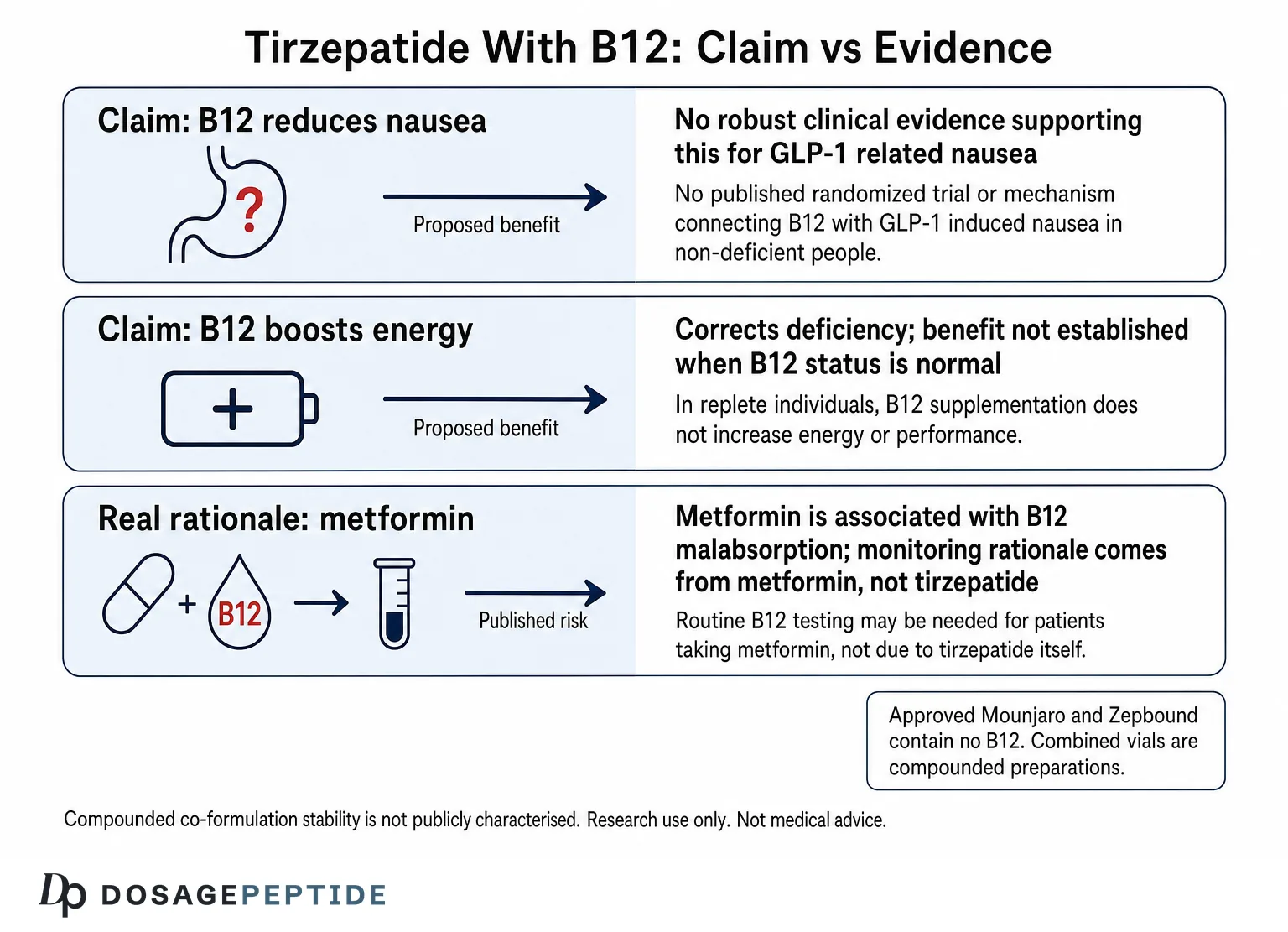
- Approved tirzepatide contains no B12. Neither Mounjaro nor Zepbound includes vitamin B12. The combination is created by compounding pharmacies and telehealth sellers.
- The two selling points are not supported. That B12 reduces GLP-1 nausea, and that it restores energy, are not backed by clinical trial evidence in people who are not B12-deficient.
- March 2026 changed the picture: peer-reviewed analytical testing identified a chemical reaction product that forms when tirzepatide and B12 sit in the same solution.
- Eli Lilly has publicly warned about compounded tirzepatide-B12 products on the same grounds.
- The real B12 story in metabolic medicine is metformin, which has documented B12 depletion — not tirzepatide.
“Tirzepatide with B12” refers to a compounded preparation in which a vitamin B12 analog — usually cyanocobalamin — is dissolved in the same vial as tirzepatide. The two FDA-approved tirzepatide products, Mounjaro and Zepbound, contain no vitamin B12 at all[1][2]. The combination exists because compounding pharmacies and telehealth sellers put it there. The two rationales usually offered — that B12 blunts GLP-1-related nausea, and that it restores energy during rapid weight loss — are not supported by clinical trial evidence in people who are not B12 deficient. And since March 2026 the combination is no longer merely uncharacterized: peer-reviewed analytical testing has identified a chemical reaction product formed when tirzepatide and B12 sit in the same solution[6]. This article separates the marketing claim from what the published record documents.
What does “tirzepatide with B12” actually mean?
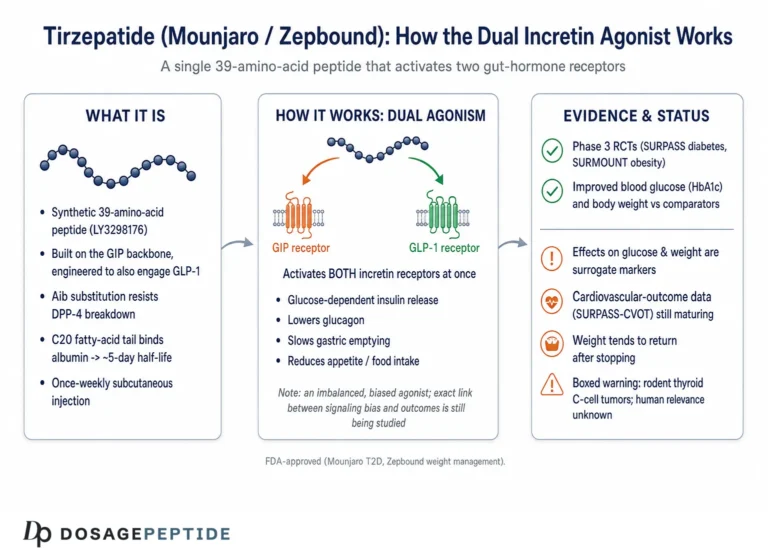
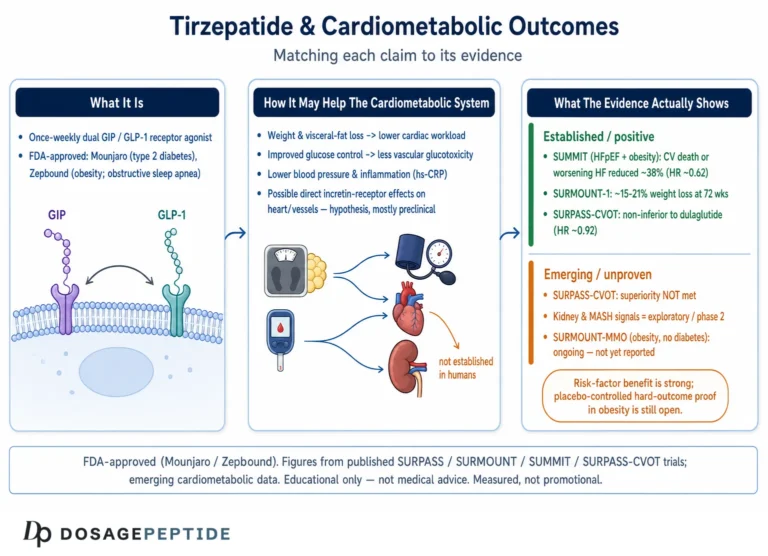
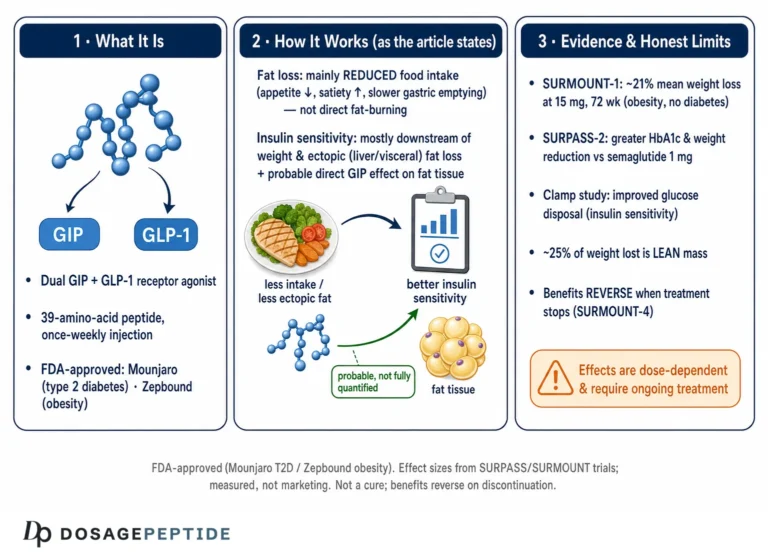
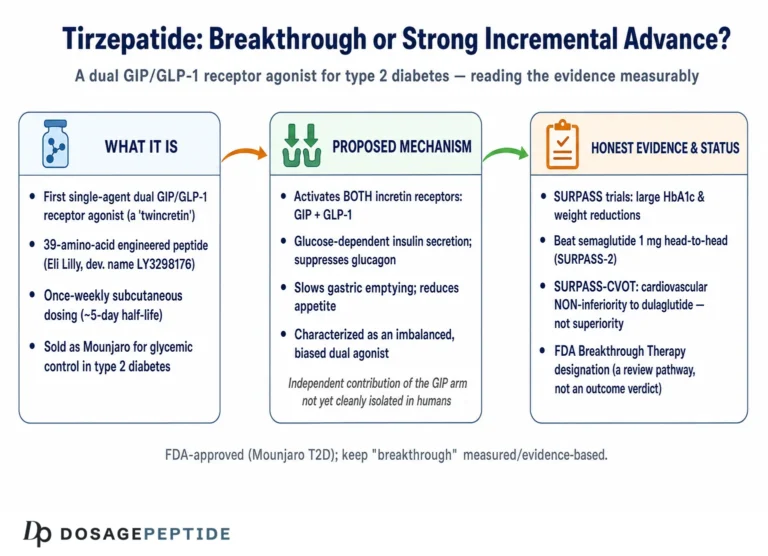
Tirzepatide is a dual GIP and GLP-1 receptor agonist. Two products carry FDA approval. Mounjaro is indicated as an adjunct to diet and exercise to improve glycemic control in adults and in pediatric patients 10 years of age and older with type 2 diabetes mellitus[1]. Zepbound is indicated, in combination with a reduced-calorie diet and increased physical activity, to reduce excess body weight and maintain weight reduction long term in adults with obesity or adults with overweight plus at least one weight-related comorbid condition, and to treat moderate-to-severe obstructive sleep apnea in adults with obesity[2]. Neither indication is “weight loss” in the open-ended sense the marketing around compounded copies often implies. Our background explainer covers what tirzepatide is and how the approved products are labeled.
The approved labeling also specifies exactly what is in the vial. Zepbound single-dose presentations list sodium chloride, sodium phosphate dibasic heptahydrate and water for injection; the multi-dose vial and KwikPen add benzyl alcohol, glycerin and phenol as excipients, and the solution is specified at pH 6.5 to 7.5[2]. No cobalamin appears anywhere in either product.
Cyanocobalamin injection is separately an old, well-characterized approved drug, labeled for vitamin B12 deficiency states such as pernicious anemia and malabsorption. It has a long documented history in that indication. What does not exist as an approved product is the two of them in one syringe.
A “tirzepatide + B12” vial is a compounded preparation. FDA states plainly that compounded drugs are not FDA approved, and that the agency does not review them for safety, effectiveness or quality before they are marketed[3]. That distinction is not a technicality. It determines what evidence exists about what is actually in the vial.
Is compounded tirzepatide with B12 legal in 2026?
This is the part most articles on the topic get wrong, because the ground moved.
Compounding copies of an approved drug is broadly permitted while that drug is on FDA’s shortage list. Tirzepatide came off that list, and FDA’s periods of enforcement discretion ended — for state-licensed pharmacies and physicians compounding under section 503A in February 2025, and for outsourcing facilities under section 503B on March 19, 2025. FDA’s own compounding page states that tirzepatide and semaglutide do not currently appear on the 503B bulks list or on FDA’s drug shortage list[4]. On April 30, 2026, FDA went further and proposed to exclude semaglutide, tirzepatide and liraglutide from the 503B bulks list outright, having found no sufficient clinical need for outsourcing facilities to compound them from bulk substances[5].
This matters for the B12 question specifically. Adding an ingredient is one of the arguments used to claim a compounded product is not “essentially a copy” of the approved drug — that it is a “personalized” formulation. Whether a given preparation qualifies is a determination for FDA and, in the 503A context, for the prescribing practitioner documenting a clinically significant difference for an identified patient[4]. The presence of B12 does not by itself settle it, and nothing in the public record indicates FDA has accepted “we added B12” as establishing clinical need.
The 2026 finding: a tirzepatide–B12 reaction product
Until 2026, the honest answer about co-formulated tirzepatide/B12 was “nobody has published anything.” That is no longer true, and what was published is not reassuring.
Analytical testing of compounded tirzepatide/B12 samples obtained from multiple U.S. market sources identified a previously unreported impurity arising from a chemical reaction between tirzepatide and certain B12 analogs. The authors report the products are mass marketed as comparable to the approved products despite undergoing no evaluation of potency or impurity profile, and they state that the clinical effects of the impurity are unknown[6]. The manufacturer of the approved products issued a parallel public statement on March 12, 2026, describing the same finding and noting that nothing is known about the impurity’s effects in humans, its toxicity, its immunogenicity, or how it is absorbed, distributed, metabolized and eliminated[7].
The conflict of interest here is obvious and should be stated rather than hidden: every author of the published analysis is an employee of Eli Lilly, which manufactures Mounjaro and Zepbound and has a direct commercial interest in discrediting compounded competitors[6]. That is a real reason to want independent replication. It is not a reason to dismiss the chemistry. Two things are simultaneously true: the finding comes from an interested party, and no one on the other side has published potency or impurity data at all. An absence of counter-evidence from compounders is not a rebuttal.
What the finding does settle is the framing. A co-formulated vial is not “tirzepatide, plus a vitamin.” It is a solution in which two molecules demonstrably interact.
Does B12 reduce tirzepatide nausea?
Gastrointestinal adverse events are the dominant tolerability problem with tirzepatide. In SURMOUNT-1, the most common adverse events were gastrointestinal, most were mild to moderate, and they occurred primarily during dose escalation[9]. In SURPASS-1, nausea was reported in 12–18% of tirzepatide participants across the 5, 10 and 15 mg groups versus 6% on placebo[10]. Nausea is therefore the single most commercially valuable objection to neutralize when selling a compounded alternative.
Two threads probably fed the claim. First, injected B-vitamins carry a long folk-medical association with nausea — although the vitamin with an established place in guideline-recommended therapy for nausea and vomiting of pregnancy is vitamin B6 (pyridoxine), typically combined with doxylamine, not B12. Different molecule, different mechanism, different evidence base. Second, cobalamin solution is a vivid red-pink liquid, so a co-formulated vial looks visibly different from plain tirzepatide — a differentiator that costs a compounder very little to add.
What is missing is the study. No published randomized controlled trial has demonstrated that adding a B12 analog to tirzepatide reduces the incidence, severity or duration of GIP/GLP-1 receptor agonist-related nausea. In the trial literature, the documented determinants of gastrointestinal tolerability are dose level and escalation pace, which is why the titration schedules used in the pivotal trials are the relevant variable rather than anything else in the vial. Our overview of what the tirzepatide labeling and trials document as adverse events covers the reported profile.
What drives GLP-1-related nausea mechanistically?
Nausea and emesis signaling involves the area postrema, a brainstem region with a permeable blood-brain barrier. In mice, single-nucleus sequencing and cell-specific manipulation mapped area postrema neuron types that mediate nausea-associated behaviors, and showed that ablating GLP-1 receptor-expressing area postrema neurons reduced flavor avoidance conditioned by the GLP-1 receptor agonist exendin-4[11]. That work is preclinical rodent neuroscience, not a human study, and it describes the pathway rather than any intervention on it. Delayed gastric emptying contributes as well. Nothing in that pathway has been shown to be modulated by cobalamin status. No mechanism has been described by which supplying vitamin B12 would attenuate receptor-mediated central nausea signaling.
Does B12 actually boost energy?
This is where the claim is half-true in a way that is easy to exploit. Vitamin B12 has a genuine role in DNA synthesis, methylation and mitochondrial metabolism, and clinical deficiency produces haematological and neurological manifestations[12]. Correcting a documented deficiency in a deficient person resolves deficiency-related symptoms.
The leap is the next step. In people with normal B12 status, supplementation has not been shown to increase energy, endurance or metabolic rate. The NIH Office of Dietary Supplements notes that manufacturers commonly promote B12 for energy, athletic performance and endurance, and states that supplementation appears to have no beneficial effect on performance in the absence of a nutritional deficit[13]. B12 is water-soluble, and once binding capacity is saturated the excess is largely excreted. Our explainer covers what cyanocobalamin does in energy metabolism in more detail.
There is a separate, real point that gets conflated with this. Marked reduction in caloric intake reduces intake of everything, including B12-containing animal foods, and sustained low intake can matter in people with pre-existing marginal status, prior bariatric surgery, atrophic gastritis or vegan diets[12]. That is an argument for measuring B12 status, not for pre-emptively injecting a fixed dose in the same syringe as an unrelated drug.
The real B12 story: metformin
Here is the genuinely well-evidenced connection, and it has nothing to do with tirzepatide itself.
In a 4.3-year randomised placebo-controlled trial in 390 patients with type 2 diabetes receiving insulin, metformin was associated with a mean 19% decrease in vitamin B12 concentration versus placebo, and the absolute risk of B12 deficiency (<150 pmol/L) at study end was 7.2 percentage points higher in the metformin group[14]. In the Diabetes Prevention Program Outcomes Study, low B12 was more common with metformin at 5 years (4.3% vs 2.3%), each year of metformin use was associated with increased odds of deficiency, and the authors concluded that routine B12 testing in metformin-treated patients should be considered[15].
A large share of people prescribed tirzepatide for type 2 diabetes are also taking metformin. B12 monitoring in that population has a real, published rationale — because of the metformin, not because tirzepatide depletes B12. No published evidence establishes that tirzepatide itself causes vitamin B12 deficiency or malabsorption. Conflating the two is the most common error in this space, and it flatters the compounded product with evidence that belongs to a different drug.
Claimed benefit versus what is documented
| Claim made for tirzepatide + B12 | What the record actually shows | Evidence tier |
|---|---|---|
| “B12 reduces tirzepatide nausea” | No published randomized trial of co-formulated tirzepatide + B12 versus tirzepatide alone on nausea endpoints. No described mechanism linking cobalamin status to area postrema GLP-1 signaling. | Unsupported. Marketing claim, no clinical data. |
| “B12 restores energy lost during weight loss” | Correcting documented deficiency resolves deficiency-related symptoms. In people who are replete, no demonstrated energy or performance benefit. | True only for documented deficiency. Not established otherwise. |
| “Tirzepatide depletes B12, so it must be replaced” | No published evidence that tirzepatide causes B12 malabsorption or deficiency. The depletion literature concerns metformin. | False attribution. Evidence belongs to a different drug. |
| “B12 monitoring matters for people on GLP-1 therapy” | Legitimate where metformin is co-prescribed, intake is markedly reduced, or malabsorption risk factors exist. Supported by randomized and long-term cohort data. | Reasonable clinical rationale — for status monitoring, not fixed co-injection. |
| “Co-formulation is equivalent to the approved product” | Compounded preparations are not FDA approved and are not reviewed by FDA for safety, effectiveness or quality before marketing. | Incorrect. Different regulatory category entirely. |
| “The two ingredients simply coexist in the vial” | Peer-reviewed analytical testing of market samples identified an impurity formed by a chemical reaction between tirzepatide and B12 analogs; clinical effects unknown. Authors are manufacturer employees. | Contradicted by the only published chemistry, from a conflicted source, with no counter-data published. |
| “Adding B12 is harmless anyway” | Cobalamin itself has a wide safety margin. The uncharacterized entity is the reaction product, alongside preservative system and compounding quality — not cobalamin toxicity. | Wrong risk framing. The risk was never the vitamin. |
| “Adding B12 makes it a legal personalized formulation” | Tirzepatide is off FDA’s shortage list and not on the 503B bulks list; enforcement discretion ended in 2025 and FDA proposed permanent exclusion in April 2026. Added ingredients do not by themselves establish clinical need. | Legally contested at best. Not a determination sellers make for themselves. |
What mixing two drugs in one vial changes
Putting two active ingredients in one aqueous vial is a formulation decision, not a convenience. Several things become open questions the moment it is done:
- Chemical reactivity. This is no longer hypothetical. The published analysis of market samples reports an impurity generated by reaction between tirzepatide and B12 analogs[6]. Peptide integrity over an assigned beyond-use date in a mixed vial remains unpublished by the compounders producing them.
- Formulation conditions. The approved tirzepatide products specify a defined buffer system and a solution pH of 6.5 to 7.5[2]. A cobalamin-containing mixture is not that formulation, and no equivalence data has been published.
- Light sensitivity. Cobalamin is photolabile, and approved cyanocobalamin products carry light-protection storage instructions. A multi-dose vial repeatedly removed from refrigeration and handled under room lighting is an environment nobody has publicly characterized for this mixture. FDA has separately received complaints of compounded GLP-1 products arriving warm or inadequately refrigerated[3]. Our guide on storage conditions before and after reconstitution covers the general principles.
- Preservative system. Multi-dose vials require antimicrobial preservation; the approved multi-dose tirzepatide presentations use benzyl alcohol and phenol at specified amounts[2]. Preservative choice, cumulative exposure across a multi-week vial and interaction with a peptide are variables approved products resolve through testing and compounded ones frequently do not disclose.
- Dose independence is lost. Once the two are in one vial at a fixed ratio, the B12 dose is locked to the tirzepatide dose. Escalating tirzepatide escalates B12 by the same factor. No clinical logic makes B12 requirement scale with GIP/GLP-1 agonist dose.
- Concentration and unit conversion. Compounded vials are supplied at non-standard concentrations, shifting all volume-to-dose arithmetic away from pen-based conventions. FDA has received adverse event reports, some requiring hospitalization, that may relate to dosing errors from patients measuring and self-administering incorrect doses and from clinicians miscalculating doses[3]. Our reference on insulin syringe units and volume conversion exists because this arithmetic is a common failure point.
What has the FDA actually said?
Precision matters here, because this space attracts both overstatement and dismissal.
FDA maintains a standing page on unapproved GLP-1 drugs used for weight loss. As of its June 2026 update it documents: adverse event reports possibly related to dosing errors with compounded semaglutide and tirzepatide, including cases requiring hospitalization; fraudulent compounded products bearing labels of pharmacies that did not make them or do not exist; improper cold-chain handling in shipping; and the position that salt forms of semaglutide — semaglutide sodium and semaglutide acetate — are different active ingredients from the approved substance, with no lawful basis identified for their use in compounding. That salt-form statement is about semaglutide specifically, not tirzepatide. The same page reports that, as of May 31, 2026, FDA had received 990 adverse event reports associated with compounded semaglutide and more than 730 associated with compounded tirzepatide, while noting that state-licensed pharmacies are not required to submit adverse events, so these are likely underreported[3].
Independently, a pharmacovigilance analysis of the FDA Adverse Event Reporting System covering 2018–2024 identified 707 reports involving compounded GLP-1 receptor agonists out of 81,078 GLP-1 reports. Compounded products showed higher reporting odds ratios for preparation errors, prescribing errors, contamination and compounding or manufacturing issues, and for hospitalization[8]. In fairness to the other direction, the same analysis found lower reporting odds for administration errors and dosing errors in compounded products[8]. Spontaneous reporting data has well-known limitations — reporting bias, no denominator, no causality determination — so this is signal, not proof.
What FDA has not done is issue a specific determination about tirzepatide-plus-B12 co-formulations as a class. Anyone claiming FDA endorsement of the combination, and anyone claiming FDA has specifically condemned the B12 component, is going beyond the record.
Which B12 form is used, and does it matter?
Compounded preparations use cyanocobalamin, methylcobalamin or hydroxocobalamin; the published impurity analysis examined tirzepatide combined with B12 analogs generally and reported the reaction with certain of them[6]. Cyanocobalamin is the most common choice for straightforward reasons: it is the most stable form, it has the longest injectable product history, and it is inexpensive. The marketing preference for methylcobalamin in the supplement world runs ahead of the comparative clinical evidence. We work through the differences in cyanocobalamin versus methylcobalamin and the other B12 forms.
For how standalone B12 vials are documented and reconstituted in research reference contexts — separately from any GLP-1 product — the worked 10 mg B12 vial reconstitution and concentration reference lays out the arithmetic. It is reference documentation of what protocols describe, not an instruction to follow.
How B12 status is assessed in the literature
Where the question is whether someone needs B12 at all, the published approach is measurement rather than presumption. Serum total B12 is the usual first-line test and has recognized limitations, including overlap between deficient and replete ranges. Methylmalonic acid and homocysteine rise in cobalamin deficiency and serve as functional markers, and transcobalamin-bound B12 (holotranscobalamin) reflects the metabolically active fraction. Exact cut-offs for classifying clinical versus subclinical deficiency remain debated[12].
There is a practical consequence worth noting: once injected B12 has been given, serum levels become uninterpretable for establishing whether deficiency was present beforehand. Pre-emptive supplementation forecloses that determination, and a fixed co-formulation forecloses it by design.
What the evidence base still does not answer
An honest inventory of the gaps, updated for 2026:
- No head-to-head trial of tirzepatide + B12 versus tirzepatide alone on any endpoint — nausea, weight change, adherence or subjective energy.
- No independent, non-manufacturer replication of the tirzepatide–B12 reaction product, and no characterization of its pharmacology, toxicity or immunogenicity in humans.
- No published potency, stability or peptide-integrity data from the compounders producing these preparations, over any beyond-use period.
- No characterization of what B12 dose is actually delivered per injection across compounders, since ratios are not standardized.
- No prospective data on B12 status trajectory in tirzepatide-treated people who are not taking metformin.
- No evidence that reported satisfaction with combination vials reflects anything other than the tirzepatide component plus expectation effects.
The absence of these studies is itself informative. A combination sold at scale for several years with no comparative data behind its headline claim is a commercial construction, not a clinical finding — and the one piece of chemistry that has now been published points the wrong way for it.
Frequently Asked Questions
Does Mounjaro or Zepbound contain vitamin B12?
No. Mounjaro, indicated for glycemic control in type 2 diabetes in adults and pediatric patients 10 years and older, and Zepbound, indicated for weight reduction and long-term maintenance in adults meeting specified criteria and for moderate-to-severe obstructive sleep apnea in adults with obesity, both contain tirzepatide plus the excipients named in their labeling. No cobalamin is present in either. Any tirzepatide product containing B12 is a compounded preparation, not an FDA-approved product, and has not been reviewed by FDA for safety, effectiveness or quality.
Is there evidence that B12 reduces nausea from tirzepatide?
No. No published randomized controlled trial shows that adding a B12 analog to tirzepatide reduces the incidence, severity or duration of nausea. No mechanism has been described by which cobalamin would modulate the area postrema GLP-1 receptor signaling implicated in this type of nausea, which has been mapped in rodents rather than humans. The claim appears in marketing materials, not in the clinical literature.
What did the 2026 impurity finding actually show?
Analytical testing of compounded tirzepatide/B12 samples from multiple U.S. sources identified a previously unreported impurity produced by a chemical reaction between tirzepatide and B12 analogs. The published report states that the clinical effects of that impurity are unknown. Every author is employed by the manufacturer of the approved tirzepatide products, which is a genuine conflict of interest and a reason to seek independent replication. No compounder has published potency or impurity data contradicting it.
Does tirzepatide cause vitamin B12 deficiency?
No published evidence establishes that tirzepatide causes B12 malabsorption or deficiency. The well-documented drug–B12 relationship in this patient population involves metformin, associated in randomized and long-term cohort data with reduced B12 concentrations and increased deficiency risk. Because many people taking tirzepatide for type 2 diabetes also take metformin, the two get conflated — but the depletion evidence belongs to metformin.
Why is B12 added to compounded tirzepatide at all?
The stated rationales are nausea reduction and energy support, neither of which has clinical trial support for this combination. Practical factors likely contribute: cobalamin is inexpensive and stable, it gives the solution a distinctive red-pink color that visually differentiates the product, and an added ingredient supports an argument that the preparation is “personalized” rather than a copy of an approved drug. None of these are clinical justifications.
Do B12 injections increase energy when B12 status is already normal?
Not on current evidence. Correcting documented B12 deficiency resolves deficiency-related symptoms. In people who are already replete, supplementation has not been shown to increase energy, endurance or metabolic rate; the NIH Office of Dietary Supplements states that supplementation appears to have no beneficial effect on performance in the absence of a nutritional deficit. B12 is water-soluble and excess is largely excreted.
Is compounded tirzepatide still legal in 2026?
The picture is narrow and contested. Tirzepatide is not on FDA’s drug shortage list and not on the 503B bulks list, and FDA’s periods of enforcement discretion for compounders ended during 2025. In April 2026 FDA proposed excluding semaglutide, tirzepatide and liraglutide from the 503B bulks list on a finding of no sufficient clinical need. Limited 503A compounding for an identified patient with a documented clinically significant difference remains a separate question determined by the prescriber and FDA, not by a seller’s marketing copy.
What has the FDA said about compounded GLP-1 products?
FDA documents adverse event reports possibly related to dosing errors with compounded semaglutide and tirzepatide including hospitalizations, fraudulent products bearing false pharmacy labels, and cold-chain failures in shipping. It states that semaglutide salt forms are different active ingredients from the approved substance with no lawful basis identified for compounding. As of May 31, 2026 it reported 990 adverse event reports for compounded semaglutide and more than 730 for compounded tirzepatide, while noting these are likely underreported. FDA has not issued a class determination specific to tirzepatide-plus-B12 preparations.
How is vitamin B12 status actually measured?
Serum total B12 is the usual first-line test, with recognized limitations at borderline values. Functional markers — methylmalonic acid and homocysteine, both of which rise in cobalamin deficiency — and holotranscobalamin, the metabolically active fraction, add information. Diagnostic cut-offs remain debated in the literature. Once injected B12 has been given, serum levels become uninterpretable for establishing whether deficiency was originally present.
References
- DailyMed, U.S. National Library of Medicine. MOUNJARO (tirzepatide) injection — full prescribing information, Eli Lilly and Company. https://dailymed.nlm.nih.gov/dailymed/drugInfo.cfm?setid=d2d7da5d-ad07-4228-955f-cf7e355c8cc0
- DailyMed, U.S. National Library of Medicine. ZEPBOUND (tirzepatide) injection — full prescribing information, Eli Lilly and Company. https://dailymed.nlm.nih.gov/dailymed/drugInfo.cfm?setid=487cd7e7-434c-4925-99fa-aa80b1cc776b
- U.S. Food and Drug Administration. FDA’s Concerns with Unapproved GLP-1 Drugs Used for Weight Loss (content current as of June 15, 2026). https://www.fda.gov/drugs/drug-alerts-and-statements/fdas-concerns-unapproved-glp-1-drugs-used-weight-loss
- U.S. Food and Drug Administration. FDA clarifies policies for compounders as national GLP-1 supply begins to stabilize. https://www.fda.gov/drugs/drug-alerts-and-statements/fda-clarifies-policies-compounders-national-glp-1-supply-begins-stabilize
- U.S. Food and Drug Administration. FDA Proposes to Exclude Semaglutide, Tirzepatide, and Liraglutide on 503B Bulks List (April 30, 2026). https://www.fda.gov/news-events/press-announcements/fda-proposes-exclude-semaglutide-tirzepatide-and-liraglutide-503b-bulks-list
- Jordan B, Arbogast L, Clemens M, Huang L, Snyder M. A novel, widespread impurity in mass-compounded tirzepatide/B12 products: potential patient safety implications. Expert Opin Drug Saf. 2026;25(5):837–845. (All authors are employees of Eli Lilly and Company.) https://pubmed.ncbi.nlm.nih.gov/42010938/
- Eli Lilly and Company. An open letter from Eli Lilly and Company warning of potential patient safety risks associated with tirzepatide compounded with vitamin B12 (March 12, 2026). https://investor.lilly.com/news-releases/news-release-details/open-letter-eli-lilly-and-company-warning-potential-patient
- McCall KL, Mastro Dwyer KA, Casey RT, et al. Safety analysis of compounded GLP-1 receptor agonists: a pharmacovigilance study using the FDA adverse event reporting system. Expert Opin Drug Saf. 2026;25(3):581–588. https://pubmed.ncbi.nlm.nih.gov/40285721/
- Jastreboff AM, Aronne LJ, Ahmad NN, et al. Tirzepatide Once Weekly for the Treatment of Obesity (SURMOUNT-1). N Engl J Med. 2022;387(3):205–216. https://pubmed.ncbi.nlm.nih.gov/35658024/
- Rosenstock J, Wysham C, Frías JP, et al. Efficacy and safety of a novel dual GIP and GLP-1 receptor agonist tirzepatide in patients with type 2 diabetes (SURPASS-1): a double-blind, randomised, phase 3 trial. Lancet. 2021;398(10295):143–155. https://pubmed.ncbi.nlm.nih.gov/34186022/
- Zhang C, Kaye JA, Cai Z, Wang Y, Prescott SL, Liberles SD. Area Postrema Cell Types that Mediate Nausea-Associated Behaviors. Neuron. 2021;109(3):461–472.e5. https://pubmed.ncbi.nlm.nih.gov/33278342/
- Green R, Allen LH, Bjørke-Monsen AL, et al. Vitamin B12 deficiency. Nat Rev Dis Primers. 2017;3:17040. https://pubmed.ncbi.nlm.nih.gov/28660890/
- National Institutes of Health, Office of Dietary Supplements. Vitamin B12 — Fact Sheet for Health Professionals. https://ods.od.nih.gov/factsheets/VitaminB12-HealthProfessional/
- de Jager J, Kooy A, Lehert P, et al. Long term treatment with metformin in patients with type 2 diabetes and risk of vitamin B-12 deficiency: randomised placebo controlled trial. BMJ. 2010;340:c2181. https://pubmed.ncbi.nlm.nih.gov/20488910/
- Aroda VR, Edelstein SL, Goldberg RB, et al. Long-term Metformin Use and Vitamin B12 Deficiency in the Diabetes Prevention Program Outcomes Study. J Clin Endocrinol Metab. 2016;101(4):1754–1761. https://pubmed.ncbi.nlm.nih.gov/26900641/
This article is published for research and educational reference only. It documents what regulatory labeling, published trial reports, and peer-reviewed literature state. It is not medical advice, not a treatment recommendation, and not a dosing instruction for any individual. Nothing here should be used to diagnose, treat, cure, or prevent any disease. Decisions about any medication, supplement, or compounded preparation belong with a qualified licensed clinician.