Few nutrients carry as heavy a reputation-to-evidence mismatch as vitamin B12. Marketed everywhere as an “energy vitamin,” cobalamin is in truth one of the most rigorously characterized cofactors in human biochemistry: an absolute requirement for two enzymes that sit at the crossroads of methylation metabolism and mitochondrial energy production. The science is unambiguous where it matters most — B12 deficiency causes megaloblastic anemia and can permanently damage the nervous system, and correcting that deficiency is life-changing. Where the science is far less flattering is the popular claim that a B12 shot will lift energy or sharpen the mind in people who already have enough. This article walks through the mechanism, the physiology of red-cell and neurological function, who actually becomes deficient and why, how deficiency is diagnosed, the injection-versus-oral debate, and an honest reckoning with whether cyanocobalamin does anything for energy or cognition in replete individuals.
What is vitamin B12 and why is its chemistry unusual?
Vitamin B12, or cobalamin, is the largest and most structurally complex of all the vitamins. Chemically it is a corrinoid — a cobalt ion held at the center of a corrin ring, a porphyrin-like macrocycle.[1] What makes cobalamin biochemically distinctive is that cobalt, a transition metal rarely used in mammalian enzymes, forms an unusual carbon–cobalt bond in the biologically active coenzyme forms. This organometallic bond is what allows B12 to perform chemistry no other vitamin can.
The upper axial ligand attached to the cobalt defines the specific form of the vitamin. In cyanocobalamin, that ligand is a cyanide group; in hydroxocobalamin it is a hydroxyl group; and in the two physiologically active coenzymes it is either a methyl group (methylcobalamin) or a 5′-deoxyadenosyl group (adenosylcobalamin).[2] Humans cannot synthesize cobalamin — only certain bacteria and archaea can — so we depend entirely on dietary intake, ultimately of microbial origin, that concentrates up the food chain into animal tissues.
The corrin ring itself resembles the porphyrin found in heme and chlorophyll, but it is more reduced and lacks one of the bridging carbons between the pyrrole units, giving cobalamin a more contracted, flexible macrocycle. Beneath the cobalt, a “lower” ligand — a dimethylbenzimidazole nucleotide tail — coordinates to the metal from the opposite face in most physiological forms, holding the cobalt in a well-defined electronic environment. It is this precisely tuned coordination chemistry that allows the cobalt to cycle among the Co(III), Co(II), and highly reactive Co(I) oxidation states during catalysis. The Co(I) state is one of the most powerful biological nucleophiles known, and its transient formation is what lets methionine synthase strip and transfer methyl groups. No other vitamin-derived cofactor performs radical-based carbon rearrangements or supernucleophilic methyl chemistry of this kind, which is why cobalamin has no functional substitute in human metabolism.
Why cyanocobalamin, if the body uses methyl- and adenosylcobalamin?
Cyanocobalamin does not occur meaningfully in nature; it is a synthetic, semi-stable form manufactured for supplements, food fortification, and injectable pharmaceuticals. The cyanide ligand stabilizes the corrin structure against light and oxidative degradation, which is precisely why it is the preferred form for shelf-stable products.[1] Once inside cells, cyanocobalamin is enzymatically processed: the cobalt is reduced from the Co(III) to lower oxidation states, the cyanide is removed, and the molecule is converted into methylcobalamin in the cytosol or adenosylcobalamin in the mitochondria — the two forms the body’s enzymes actually use.[2]
A perennial worry is the “cyanide” in cyanocobalamin. The quantity is trivially small, and the freed cyanide is detoxified by the enzyme rhodanese to thiocyanate and excreted by the kidneys.[1] For context, hydroxocobalamin — a close chemical relative — is used at gram-level doses as an antidote for cyanide poisoning, binding cyanide to form cyanocobalamin. The cyanide load from a therapeutic B12 dose is far below any concern for a person with normal renal and hepatic function.
How does B12 work? The two cobalamin-dependent enzymes
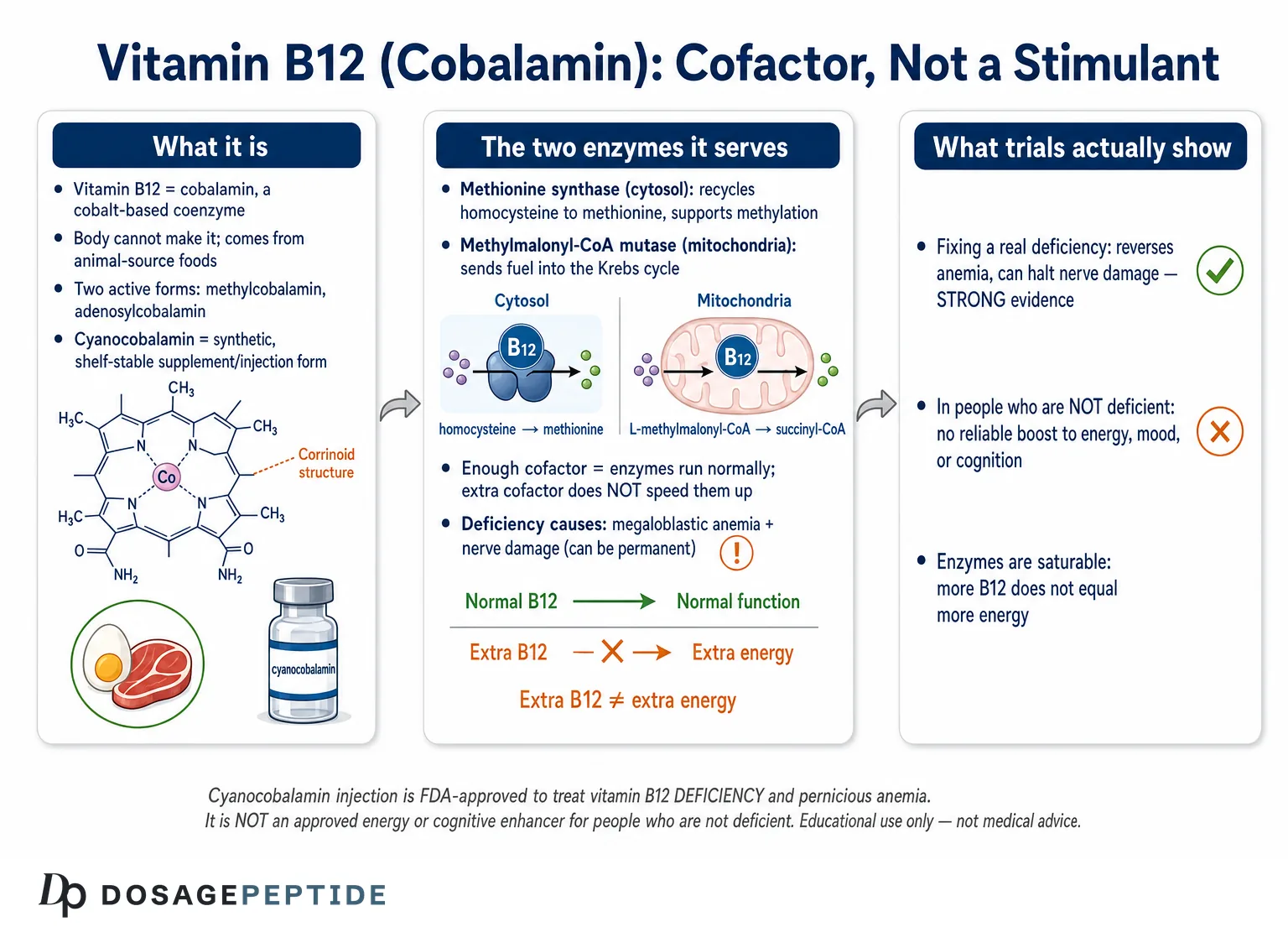
In human cells, cobalamin serves as a coenzyme for exactly two enzymes. Understanding these two reactions explains nearly everything about why B12 matters, why deficiency produces the symptoms it does, and why laboratory markers move the way they do.[2]
Methionine synthase and the methylation cycle
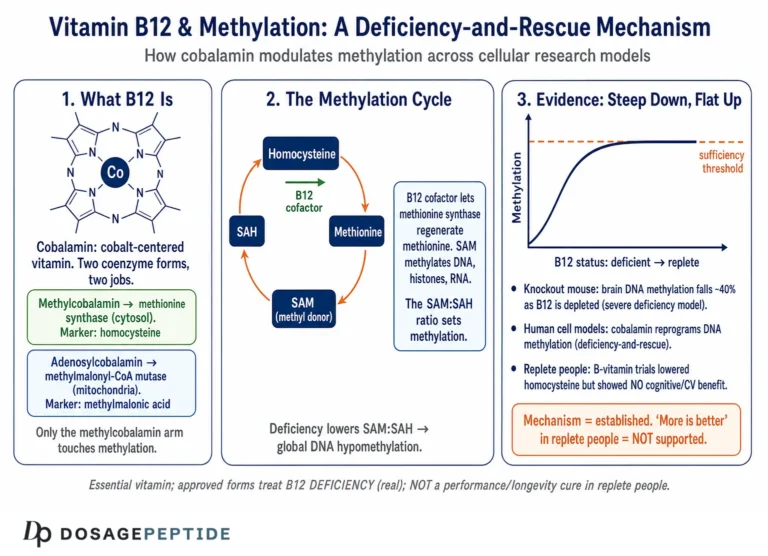
Methylcobalamin is the cofactor for cytosolic methionine synthase (also called 5-methyltetrahydrofolate–homocysteine methyltransferase). This enzyme catalyzes the transfer of a methyl group from 5-methyltetrahydrofolate to homocysteine, regenerating methionine and, in the same step, releasing free tetrahydrofolate.[2] This single reaction sits at the junction of two metabolic cycles — the folate cycle and the methionine cycle — and it does two crucial jobs at once.
First, methionine is the precursor of S-adenosylmethionine (SAM), the universal methyl donor that supplies methyl groups for the methylation of DNA, RNA, proteins, phospholipids, and neurotransmitters. When methionine synthase falters, SAM availability drops and cellular methylation reactions suffer broadly. Second, because the reaction is the only route by which the body recycles 5-methyltetrahydrofolate back into the usable folate pool, a B12 deficiency effectively traps folate as 5-methyltetrahydrofolate — the so-called “methyl-folate trap.” The result is a functional folate deficiency even when folate intake is adequate, which is the mechanistic reason B12 and folate deficiencies produce an identical megaloblastic anemia.[2]
It is worth tracing the downstream logic, because it explains why a single enzyme’s failure ramifies so widely. Once SAM donates its methyl group it becomes S-adenosylhomocysteine, which is then hydrolyzed to homocysteine — closing the loop and setting up the next round of remethylation by methionine synthase. When B12 is scarce, homocysteine cannot be efficiently remethylated to methionine, so it backs up in the blood (the basis of the homocysteine marker) and is diverted down the alternative transsulfuration pathway toward cysteine and glutathione. Meanwhile SAM production sags. Because SAM-dependent methylation governs gene expression through DNA and histone methylation, the synthesis of the myelin lipid phosphatidylcholine, the production of creatine, and the turnover of catecholamine and indoleamine neurotransmitters, a chronic SAM shortfall touches processes as diverse as epigenetic regulation, nerve insulation, and mood chemistry. This breadth is why B12 deficiency can present in so many guises — hematologic, neurological, psychiatric — from a single upstream lesion.[2]
The interdependence of B12 and folate also runs the other way. Folate, as 5,10-methylenetetrahydrofolate, supplies the one-carbon units needed to convert dUMP to dTMP (thymidylate) for DNA synthesis. When B12 deficiency traps folate in its methyl form, that thymidylate-synthesis pathway is starved, DNA replication stalls, and the megaloblastic changes appear. This is the precise biochemical handshake that makes the two vitamins’ deficiency syndromes so hard to tell apart hematologically, and it is why clinicians measure both and why the “folic acid masking” problem exists at all — themes developed further below.
Methylmalonyl-CoA mutase and mitochondrial energy metabolism
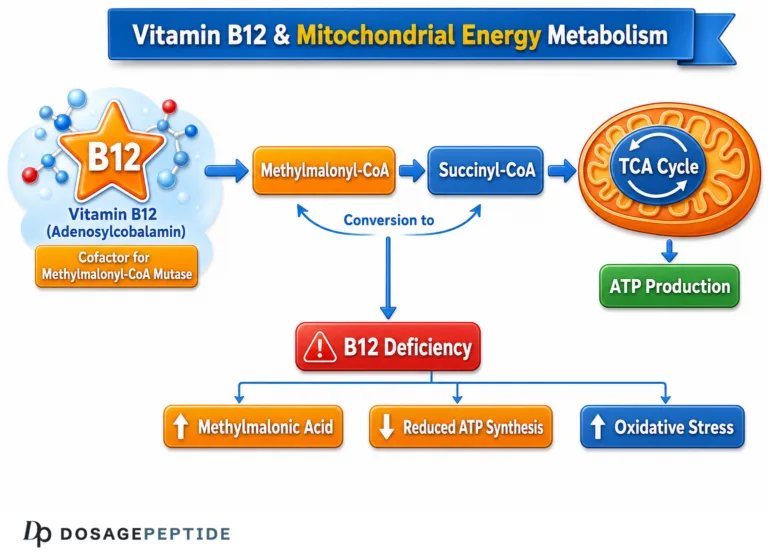
Adenosylcobalamin is the cofactor for mitochondrial methylmalonyl-CoA mutase. This enzyme catalyzes the reversible isomerization of L-methylmalonyl-CoA to succinyl-CoA, using adenosylcobalamin to generate a radical intermediate that permits the carbon-skeleton rearrangement.[3] Succinyl-CoA is a tricarboxylic acid (Krebs) cycle intermediate, so this reaction is the doorway through which several substrates enter mitochondrial energy production.
Specifically, the catabolism of the branched-chain amino acids isoleucine and valine, the amino acids methionine and threonine, the side chain of cholesterol, and odd-chain fatty acids all funnel through propionyl-CoA and then methylmalonyl-CoA before entering the Krebs cycle as succinyl-CoA.[3] When adenosylcobalamin is deficient, methylmalonyl-CoA accumulates and is hydrolyzed to methylmalonic acid — which is exactly why methylmalonic acid is such a specific laboratory marker of functional B12 deficiency. It is in this literal, biochemical sense that B12 is genuinely part of “energy metabolism”: not as a stimulant, but as the required cofactor letting certain fuels reach the mitochondrial engine.
The mechanistic chemistry here is remarkable. Methylmalonyl-CoA mutase belongs to the small family of adenosylcobalamin-dependent isomerases that operate by homolytic cleavage of the cobalt–carbon bond. When the enzyme engages its substrate, the weak Co–C bond of adenosylcobalamin breaks homolytically to generate a 5′-deoxyadenosyl radical and cob(II)alamin. That carbon radical abstracts a hydrogen atom from the substrate, triggering a 1,2-carbon-skeleton rearrangement — the migration of the thioester group — that converts the branched methylmalonyl-CoA into the straight-chain succinyl-CoA. The hydrogen and radical are then handed back, the Co–C bond reforms, and the coenzyme is regenerated for another cycle. Few reactions in human biochemistry rely on controlled free-radical chemistry, and this dependence on a fragile organometallic bond is precisely why the reaction has no backup pathway and why its cofactor cannot be substituted.[3]
There is a second, subtler consequence of methylmalonyl-CoA mutase failure that is directly relevant to the neurological syndrome. The methylmalonyl-CoA and propionyl-CoA that accumulate can be incorporated into abnormal, branched, odd-chain fatty acids, which are then built into aberrant myelin lipids. Some investigators argue that this abnormal fatty-acid incorporation, combined with the methylation deficit from the methionine-synthase side, jointly explains why B12 deficiency preferentially damages myelinated tracts. In other words, the two enzymes do not fail in isolation — their combined dysfunction converges on the nervous system, giving B12 deficiency its characteristic double signature of blood and nerve disease.
| Coenzyme form | Enzyme | Location | Reaction | Marker when deficient |
|---|---|---|---|---|
| Methylcobalamin | Methionine synthase | Cytosol | Homocysteine → methionine (remethylation); regenerates tetrahydrofolate | ↑ Homocysteine |
| Adenosylcobalamin | Methylmalonyl-CoA mutase | Mitochondria | L-methylmalonyl-CoA → succinyl-CoA (into Krebs cycle) | ↑ Methylmalonic acid |
How is B12 connected to red blood cells and the nervous system?
The two enzyme reactions above explain the two organ systems that suffer most in B12 deficiency: the bone marrow and the nervous system.
Megaloblastic anemia: the hematologic consequence
Through the methyl-folate trap, B12 deficiency impairs the synthesis of thymidine and therefore DNA. In rapidly dividing bone-marrow precursors, cytoplasmic maturation (hemoglobin synthesis) proceeds normally while nuclear maturation lags because DNA replication is stalled. The result is large, immature red-cell precursors — megaloblasts — and, in the peripheral blood, enlarged red cells (macrocytosis, elevated MCV) with a characteristic megaloblastic picture.[4] The same DNA-synthesis defect can affect white cells and platelets, producing hypersegmented neutrophils and, in severe cases, pancytopenia. Because folate deficiency causes the identical hematologic lesion, blood-count findings alone cannot distinguish the two causes.
Subacute combined degeneration: the neurological consequence
The neurological damage of B12 deficiency is distinct and, unlike the anemia, can be irreversible. The classic syndrome is subacute combined degeneration of the spinal cord, in which the dorsal (posterior) columns and lateral corticospinal tracts undergo demyelination and vacuolar, spongy degeneration of the myelin sheaths.[5] Clinically this produces symmetric paresthesias, loss of vibration and position sense, gait ataxia, weakness, hyperreflexia or areflexia, and in advanced disease, cognitive and behavioral changes.[6]
The mechanism is thought to combine impaired methylation (SAM is needed to methylate myelin basic protein and phospholipids) with the toxic accumulation of methylmalonate and abnormal fatty-acid incorporation into myelin.[5] The clinically critical point is that neurological injury can occur without anemia, and it can become permanent if deficiency is not corrected early. This dissociation — nerve damage progressing while the blood count looks normal — is the single most important reason B12 deficiency must be caught and treated promptly.
The temporal pattern of recovery underscores the stakes. When treatment begins, the hematologic response is prompt and dramatic: reticulocytes surge within days and the anemia resolves over weeks. The neurological response is slower and less certain. Deficits present for a short time often improve substantially over months of repletion, but damage that has persisted for many months to years may only partially reverse or may leave permanent sensory loss and gait impairment.[6] Beyond the spinal cord, chronic deficiency can produce a peripheral neuropathy, optic-nerve involvement with visual disturbance, and neuropsychiatric features ranging from irritability and depression to frank confusion — the historical “megaloblastic madness.” The nervous system, in short, offers a narrower window for full recovery than the bone marrow, which is the entire clinical argument for early detection.
How is vitamin B12 absorbed, and why is that pathway so fragile?
B12 absorption is one of the most elaborate in human physiology, involving the mouth, stomach, pancreas, and terminal ileum in sequence. Each step is a potential point of failure, which is why so many distinct medical conditions converge on B12 deficiency.[7]
- Release from food. Dietary B12 is bound to animal proteins. Gastric acid and pepsin liberate it in the stomach.
- Binding to haptocorrin. Freed B12 binds haptocorrin (R-protein) from saliva and gastric secretions, which protects it through the acidic stomach.
- Transfer to intrinsic factor. In the duodenum, pancreatic proteases degrade haptocorrin, releasing B12 to bind intrinsic factor (IF), a glycoprotein secreted by gastric parietal cells.
- Ileal uptake. The IF–B12 complex travels to the terminal ileum, where it binds the cubam receptor (cubilin/amnionless) and is taken up by enterocytes.
- Delivery to tissues. Inside the enterocyte, B12 is released and loaded onto transcobalamin II, which carries the biologically available fraction (holotranscobalamin) through the blood to tissues.[7]
Because the intrinsic-factor pathway is saturable, only a small fraction of a large oral dose is absorbed through it. However, a second, IF-independent route exists: roughly 1% of any oral dose is absorbed by passive diffusion across the intestinal mucosa, independent of intrinsic factor.[8] This passive 1% is the pharmacological basis for high-dose oral therapy even in people who lack intrinsic factor — a point that becomes central in the injection-versus-oral debate below.
Body stores and enterohepatic recycling: why deficiency is slow
One feature of B12 physiology has enormous clinical consequence: the body holds unusually large reserves relative to its daily needs. Total body stores are on the order of a few milligrams, concentrated mainly in the liver, against a daily requirement measured in low micrograms.[8] A well-stocked adult who suddenly stops absorbing any B12 at all can take several years to become clinically deficient. This large-reserve, slow-depletion pattern is why a newly vegan adult typically does not develop deficiency for a long time, whereas a breastfed infant of a chronically deficient mother — who never built stores — can become symptomatic within months.
Reinforcing that buffer is an efficient enterohepatic circulation. B12 is secreted into bile bound to haptocorrin, and much of it is reabsorbed downstream through the same intrinsic-factor pathway. In healthy people this recycling recaptures a substantial fraction of biliary B12, further stretching the reserves. But the recycling is a double-edged sword: in someone whose absorption is impaired — say, by loss of intrinsic factor — not only is dietary B12 poorly absorbed, but the recycled biliary B12 is lost too. This is why malabsorptive deficiency, once it begins, can progress faster than a purely dietary one and why it does not spontaneously correct with an ordinary diet.[7]
Who is actually at risk of B12 deficiency?
Deficiency arises from one of three broad mechanisms: inadequate intake, impaired absorption, or drug interference. Certain groups sit squarely in the crosshairs.
Vegans and strict vegetarians
Because B12 is essentially absent from unfortified plant foods, people following vegan or strict vegetarian diets are at clear risk unless they use fortified foods or supplements.[8] Infants breastfed by B12-deficient vegan mothers are especially vulnerable and can suffer serious neurological harm, making supplementation during pregnancy and lactation important in this group.
Older adults
B12 deficiency becomes markedly more common with age. In adults over 60, the prevalence of deficiency is often cited around 10–15%, and functional or subclinical deficiency rises further in the oldest old.[4] The leading driver is food-cobalamin malabsorption: with atrophic gastritis and reduced gastric acid, older adults lose the ability to cleave B12 from food proteins even though the intrinsic-factor machinery may be intact. Notably, such individuals can often still absorb crystalline (supplemental) B12 that is not protein-bound — a nuance with practical implications.
Pernicious anemia and gastrointestinal disease
Pernicious anemia is the classic autoimmune cause: autoantibodies against parietal cells or intrinsic factor destroy the capacity to make IF, producing a profound absorptive block that historically was fatal.[1] Other structural causes include gastrectomy or bariatric surgery (loss of acid- and IF-producing tissue), ileal resection or Crohn’s disease (loss of the absorption site), chronic pancreatitis (failure to degrade haptocorrin), and bacterial overgrowth. Each maps onto a specific step of the absorption cascade.
Metformin and proton-pump inhibitors
Two very commonly prescribed drug classes measurably lower B12 status. Metformin interferes with the calcium-dependent ileal uptake of the IF–B12 complex; a meta-analysis of numerous studies found that metformin users carry roughly a two-fold increased risk of B12 deficiency, and the effect appears dose- and duration-dependent.[9] Proton-pump inhibitors and H2 blockers suppress gastric acid, impairing the release of B12 from food; long-term use is associated with lower B12 levels, and combining metformin with an acid-suppressing drug is associated with a modestly higher adjusted risk of deficiency than metformin alone — one 2025 cohort reported roughly an 18% higher adjusted risk for the combination, even though the crude deficiency rates in the two groups were similar.[10] Periodic B12 monitoring is widely recommended for long-term users of either drug, especially when combined with other risk factors.
Other causes worth knowing: alcohol, nitrous oxide, and inherited defects
Several additional causes complete the picture. Chronic heavy alcohol use contributes through poor intake, gastritis-impaired absorption, and disturbed hepatic handling of the vitamin. Nitrous oxide deserves particular attention because it does not lower B12 levels — it inactivates B12’s function directly. Nitrous oxide irreversibly oxidizes the cobalt core of methylcobalamin from the active Co(I)/Co(II) state to inactive Co(III), disabling methionine synthase even when serum B12 measures normal. Repeated recreational use, or prolonged anesthetic exposure in someone with marginal stores, can precipitate a functional deficiency with the full neurological picture of subacute combined degeneration despite a “normal” B12 result — a scenario where methylmalonic acid and homocysteine are far more informative than the level itself.[4]
Finally, rare inherited errors of cobalamin transport, cellular uptake, and intracellular processing (the cbl complementation groups) can produce deficiency of one or both coenzyme forms from birth, sometimes with isolated methylmalonic aciduria, isolated homocystinuria, or both, depending on which step is affected.[2] These are uncommon but mechanistically instructive: they map the intracellular trafficking pathway that converts absorbed cobalamin into usable methyl- and adenosylcobalamin, and they explain why a person can have adequate circulating B12 yet still be functionally deficient at the enzyme level.
| At-risk group | Mechanism of deficiency | Absorption step affected |
|---|---|---|
| Vegans / strict vegetarians | Inadequate dietary intake | None (intake problem) |
| Older adults with atrophic gastritis | Food-cobalamin malabsorption | Release from food; may retain crystalline uptake |
| Pernicious anemia | Autoimmune loss of intrinsic factor | IF production |
| Gastrectomy / bariatric surgery | Loss of acid + IF-producing cells | Release + IF production |
| Ileal disease / resection (Crohn’s) | Loss of absorption site | Ileal uptake |
| Metformin users | Impaired ileal IF–B12 uptake | Ileal uptake |
| Long-term PPI / H2-blocker users | Reduced gastric acid | Release from food |
What are the symptoms of B12 deficiency?
Because B12 touches both hematopoiesis and the nervous system, the clinical picture is broad and often nonspecific, which is precisely why deficiency is under-recognized.
- Hematologic: fatigue, pallor, breathlessness on exertion, and palpitations from macrocytic (megaloblastic) anemia.[4]
- Neurological: symmetric tingling and numbness (paresthesia), loss of vibration and position sense, unsteady gait, and in advanced disease weakness, spasticity, and visual disturbance.[6]
- Neuropsychiatric: impaired concentration and memory, irritability, low mood, and in severe cases confusion or a dementia-like state.[5]
- Mucosal / other: a smooth, sore tongue (glossitis), mouth ulcers, and appetite loss.
The overlap between these symptoms and everyday complaints — tiredness, “brain fog,” low mood — is exactly what fuels the popular perception of B12 as a general tonic. The important distinction, developed below, is that these symptoms respond to B12 when they are caused by deficiency, and generally not otherwise.
How is B12 deficiency diagnosed? Homocysteine and methylmalonic acid
Diagnosis is more subtle than a single serum B12 number, because total serum B12 measures cobalamin bound to all carrier proteins, most of which is not biologically deliverable. Four markers are commonly used, and they fall into two categories.[11]
- Direct markers: total serum B12, and holotranscobalamin (the “active B12” fraction bound to transcobalamin II that tissues can actually take up).
- Functional (metabolic) markers: homocysteine and methylmalonic acid, both of which rise when the corresponding B12-dependent enzyme is undersupplied.
The functional markers are mechanistically elegant. When methionine synthase lacks methylcobalamin, homocysteine accumulates; when methylmalonyl-CoA mutase lacks adenosylcobalamin, methylmalonic acid accumulates.[12] Of the two, methylmalonic acid is the most specific marker of B12 deficiency because — unlike homocysteine, which also rises in folate deficiency, renal impairment, and other states — MMA elevation points cleanly to inadequate B12. Holotranscobalamin and MMA generally show the best diagnostic performance for detecting early or subclinical deficiency, and metabolic markers are especially useful when total B12 sits in the ambiguous “low-normal” gray zone.[11]
The folic acid masking problem
A historically important interaction deserves emphasis. Because folate and B12 deficiencies produce the same megaloblastic anemia, giving high-dose folic acid to a B12-deficient person can correct the blood picture while doing nothing for the neurological deficit — potentially allowing nerve damage to progress silently.[13] The magnitude and modern relevance of this “masking” is debated, and improvements in laboratory testing make dangerous masking far less likely than in the 1950s. Nonetheless, the principle underpins the standing clinical rule: rule out B12 deficiency before treating a megaloblastic anemia with folate alone, and never treat presumed B12 deficiency with folic acid in isolation.[13]
Why are B12 injections used, and are they better than oral?
Cyanocobalamin (and hydroxocobalamin) given by intramuscular or subcutaneous injection is an established, FDA-approved treatment for B12 deficiency, pernicious anemia, and B12 deficiency arising from malabsorptive states such as atrophic gastritis, gastrectomy, and certain GI conditions.[1] The logic of injection is straightforward: it bypasses the entire absorption cascade — no gastric acid, no intrinsic factor, no ileal receptor required — and delivers cobalamin directly into the systemic circulation. For someone with pernicious anemia, injections have historically been given at intervals (often monthly after loading) and are typically continued for life, because stopping allows the deficiency, and its neurological consequences, to return.[1]
The evidence: high-dose oral can match injection for many patients
The intuitive assumption that injection must be superior does not survive contact with the randomized evidence. A Cochrane review of trials comparing oral versus intramuscular B12 found that high-dose oral cobalamin (on the order of 1,000–2,000 mcg daily) can be as effective as intramuscular administration at normalizing serum B12 and metabolic markers, and appears at least as safe.[14] The reason lies in that IF-independent passive diffusion: roughly 1% of a large oral dose is absorbed regardless of intrinsic factor, so 1% of 1,000–2,000 mcg still substantially exceeds daily requirements.[8] More recent systematic reviews and meta-analyses continue to find no clinically significant difference between oral, sublingual, and intramuscular routes for raising cobalamin levels and lowering homocysteine.[15]
So why are injections still used? Several practical reasons: patients with severe neurological involvement or very low levels are often loaded parenterally to guarantee rapid repletion; adherence to a daily high-dose oral regimen can be poor whereas a periodic injection is a discrete, verifiable event; some clinicians and patients simply prefer the certainty of a route that does not depend on gut function at all; and injectable therapy is well established with a long track record. The evidence supports oral therapy as a legitimate first-line option for many, but does not make injections obsolete, particularly in acute or severe presentations.[16]
| Feature | Intramuscular / subcutaneous injection | High-dose oral |
|---|---|---|
| Requires intrinsic factor? | No (bypasses gut entirely) | No — relies on ~1% passive diffusion |
| Typical repletion efficacy | Reliable, rapid | Comparable at 1,000–2,000 mcg/day in trials |
| Best suited to | Severe deficiency, neurological involvement, adherence concerns | Maintenance, mild–moderate deficiency, patient preference |
| Adherence dynamic | Discrete, supervised event | Requires consistent daily dosing |
| Approval status | FDA-approved for deficiency / pernicious anemia | Widely used; strong RCT support |
What does repletion actually look like?
Correcting an established deficiency typically follows a two-phase logic: a loading phase to refill depleted stores rapidly, followed by a maintenance phase to keep them full. In parenteral regimens, this often means a series of closely spaced injections over the first weeks, then a switch to a widely spaced maintenance interval — commonly monthly for a condition like pernicious anemia, and continued indefinitely because the underlying absorptive defect does not resolve.[1] High-dose oral regimens follow a parallel structure, relying on daily large doses so that the IF-independent 1% absorption keeps pace with needs.
Two practical points deserve emphasis. First, when repletion begins in a severely deficient, anemic patient, the sudden surge of new blood-cell production can drive potassium into the new cells and precipitate hypokalemia; profound cases are monitored for this. The rapid cellular proliferation can likewise unmask or worsen a co-existing iron deficiency as iron is consumed to build hemoglobin. Second, because folate can partially patch the hematologic picture but not the neurological one, treatment of a suspected B12 deficiency should ensure B12 is replaced and should not rely on folate alone — the recurring theme of this article.[13]
For readers exploring the numbers behind reconstituting and dosing a lyophilized B12 vial, the compound-specific B12 10 mg vial dosage protocol lays out concentrations and volumes, and the general peptide reconstitution guide and dosage calculator cover the arithmetic of turning a vial into a measured dose.
Why does B12 get called the “energy vitamin”?
Before examining the trial data, it helps to name the specific reasoning error behind the “energy vitamin” label, because it is a general pattern that recurs across nutrition marketing. The syllogism runs: B12 is required for energy metabolism; therefore B12 gives you energy; therefore more B12 gives you more energy. The first premise is true. The conclusions do not follow.
The confusion collapses two different meanings of the word “energy.” In biochemistry, energy metabolism refers to the enzymatic pathways that extract chemical energy (ATP) from fuels — the process in which B12, via methylmalonyl-CoA mutase, plays a required cofactor role for a specific set of substrates. In everyday language, “energy” means subjective vigor, alertness, and freedom from fatigue — a felt psychological state driven by sleep, mood, cardiovascular fitness, thyroid status, iron stores, and much else. A cofactor that permits a metabolic reaction is not the same thing as a stimulant that raises felt arousal, and the two are only linked when the reaction is actually rate-limited by a shortage of the cofactor.
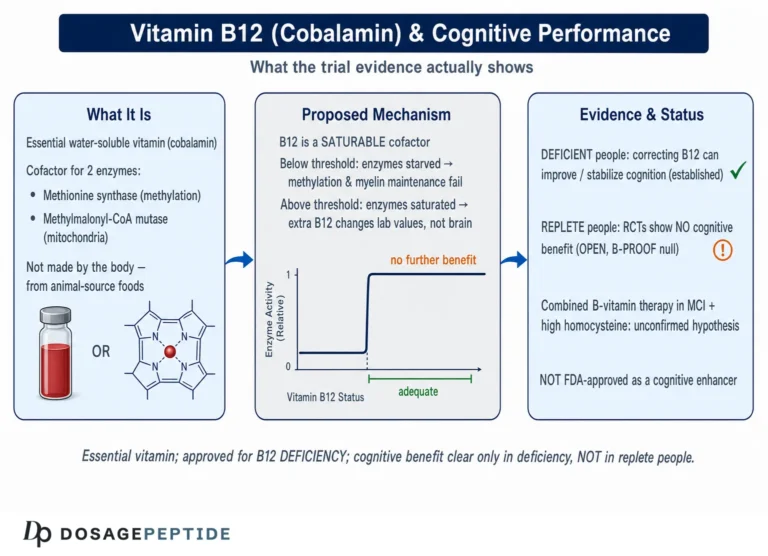
That last condition is the crux. Enzymes are saturable. Once methylmalonyl-CoA mutase and methionine synthase have enough coenzyme to run at their physiological rate, adding more cobalamin does not make them run faster — it simply occupies binding sites that were already occupied or is excreted. There is no evidence that supraphysiological B12 accelerates the Krebs cycle, increases ATP output, or raises metabolic rate in a replete person. The metabolic machinery is already going as fast as its regulators dictate, and its speed is set by demand for ATP, not by the abundance of a cofactor that is already sufficient. This is why the honest mechanistic prediction is that correcting a shortage restores normal function, while adding surplus does nothing — exactly what the controlled trials go on to show.
Does B12 boost energy or cognition in people who are not deficient?
This is where the evidence and the marketing diverge most sharply, and where scientific honesty matters most. The “energy vitamin” branding rests on a real biochemical fact — B12 is a cofactor in energy metabolism — but commits a logical error: a nutrient being necessary for a process does not mean extra nutrient accelerates that process once requirements are met. Enzymes work at capacity when their cofactor is sufficient; adding more cofactor does not make them work faster.
The trial evidence in non-deficient people
Systematic review evidence is consistent and unflattering to the “boost” narrative. A systematic review, meta-analysis, and meta-regression of randomized controlled trials examining B12 supplementation on cognitive function, depressive symptoms, and fatigue found no evidence that B12 improved these outcomes in people without overt deficiency.[17] A large randomized controlled trial of B12 supplementation in older people likewise found no benefit on neurological or cognitive function in participants who were not clearly deficient.[18] In short, for a replete adult, a B12 supplement or injection reliably raises a blood number without reliably changing how they feel or perform.
This is entirely consistent with the mechanism. The subjective “lift” some people report after a B12 shot is best explained by three things: genuine correction of an unrecognized deficiency (a real effect in the right person), regression to the mean around the time symptoms are worst, and expectation or placebo effects, which are substantial for fatigue and mood endpoints.
The nuance: homocysteine, cognition, and specific subgroups
Honesty cuts both ways: the evidence is not uniformly null, and the boundary conditions matter. B vitamins including B12 do lower plasma homocysteine, and the VITACOG randomized trial in older adults with mild cognitive impairment reported that B-vitamin supplementation slowed the rate of brain atrophy compared with placebo.[19] Crucially, the benefit was concentrated in participants who had elevated homocysteine at baseline — that is, in a subgroup already showing a functional derangement — and not in those with normal homocysteine: a follow-up voxel-based analysis of the same trial found the slowing of gray-matter atrophy was confined to those whose baseline homocysteine sat above the median (about 11 µmol/L), with a roughly seven-fold difference in atrophy rate in the medial temporal lobe.[20] The parallel cognitive-outcomes analysis likewise showed clinical benefit clustered in the higher-homocysteine participants rather than across the whole sample.[21] Whether elevated homocysteine actively drives neurodegeneration or is merely a marker of broader metabolic trouble remains debated, and larger trials have not consistently translated homocysteine-lowering into clinical dementia prevention across unselected populations.
The reasonable synthesis is this: B12 supplementation helps cognition and energy when a functional B12-related deficit exists — overt deficiency, or arguably a state of elevated homocysteine in an at-risk older person — and offers little to nothing for the well-nourished, biochemically replete individual seeking an energy edge. The honest headline is not “B12 does nothing” but “B12 fixes a shortage; it does not create a surplus of function where none was missing.”
How much B12 do you need, and is it safe?
The Recommended Dietary Allowance for adults is 2.4 mcg per day, rising to 2.6 mcg in pregnancy and 2.8 mcg during lactation.[8] These are small quantities easily met by a mixed omnivorous diet — mean intakes in US adults substantially exceed the RDA — which is why primary dietary deficiency is largely a problem of restricted diets or, far more commonly, of impaired absorption rather than low intake.
Dietary sources are almost entirely of animal origin: fish and shellfish (clams and oysters are exceptionally rich), beef and beef liver, poultry, eggs, milk, and dairy. Fortified foods — some breakfast cereals and nutritional yeasts — are the practical route for those avoiding animal products.[8]
On safety, B12 has a wide margin. No Tolerable Upper Intake Level has been established because of its low toxicity potential; the body absorbs only a small fraction of large doses and excretes excess.[8] This favorable safety profile is part of why supplemental and injectable B12 is used liberally — but low toxicity is not the same as benefit, and a wide safety margin is not a reason to expect an effect in someone who does not need it.
Readers comparing cofactor-style “metabolic support” compounds may also find the mechanistic contrasts with the NAD+ dosage protocol and the L-carnitine dosage protocol useful, since each intersects mitochondrial energy metabolism through a different node. Unfamiliar terms throughout this article are defined in the site peptide and compound glossary.
Cyanocobalamin versus methylcobalamin: does the form matter?
A common marketing claim is that methylcobalamin — a “natural, active” form — is superior to synthetic cyanocobalamin. The mechanistic reality is more measured. Because the body interconverts cobalamin forms and must reduce and re-ligand any incoming cobalamin to make the active coenzymes, both cyanocobalamin and methylcobalamin ultimately feed the same two enzymes.[2] Reviews comparing the forms have concluded that the coenzyme forms are not clearly superior to cyanocobalamin or hydroxocobalamin for preventing or treating deficiency in typical patients.[22]
There are narrow theoretical caveats — cyanocobalamin conversion requires removing the cyanide ligand, which could matter in rare inborn errors of cobalamin metabolism or in the setting of significant renal impairment where cyanide clearance is a consideration — but for the overwhelming majority of people with garden-variety deficiency, the choice of form is a minor consideration relative to dose, route, and adherence. Hydroxocobalamin is often preferred in clinical practice for its longer retention and is the form used in some countries as standard injectable therapy.
Putting it together: what the evidence actually supports
The strength of the B12 evidence base is highly asymmetric, and stating that asymmetry plainly is the whole point of an honest review.
- Well-established (strong evidence): B12 is an essential cofactor for methionine synthase and methylmalonyl-CoA mutase. Deficiency causes megaloblastic anemia and can cause irreversible neurological damage. Correcting deficiency — orally at high dose or by injection — reverses the anemia and can halt or improve neurological injury if treated early. Cyanocobalamin injection is an approved, standard treatment for deficiency and pernicious anemia.
- Reasonably supported (moderate evidence): High-dose oral B12 is comparable to injection for most patients. Metabolic markers (MMA, homocysteine) outperform total serum B12 for detecting early deficiency. B vitamins reduce homocysteine, with possible cognitive benefit concentrated in older, high-homocysteine subgroups.
- Weak or negative (poor evidence for benefit): B12 supplementation improving energy, mood, or cognition in replete, non-deficient people. The “energy vitamin” positioning is not supported by controlled trials in this population.
For the scientifically literate reader, the takeaway is clean: B12 is indispensable and its deficiency is serious and eminently treatable, but it is not a stimulant and not a general enhancer. The right question is never “will more B12 help?” but “is there a B12-related shortage to correct?” Everything the evidence supports flows from that distinction.
This article is for research and educational purposes only and is not medical advice. Vitamin B12 vials referenced here are presented for research use. Cyanocobalamin injection is FDA-approved for the treatment of vitamin B12 deficiency and pernicious anemia; decisions about diagnosis and treatment should be made with a qualified healthcare professional.
Frequently Asked Questions
Is B12 really an “energy vitamin”?
Only in a strict biochemical sense. B12 is a required cofactor for methylmalonyl-CoA mutase, an enzyme that lets certain fuels enter the mitochondrial Krebs cycle, so it is genuinely part of energy metabolism. But being necessary is not the same as being stimulating. Controlled trials show that supplementing B12 in people who are not deficient does not improve energy or reduce fatigue. It corrects a shortage; it does not create surplus energy.
What is the difference between cyanocobalamin and methylcobalamin?
They differ only in the chemical group attached to the cobalt atom: cyanide in cyanocobalamin, a methyl group in methylcobalamin. Cyanocobalamin is synthetic and shelf-stable; methylcobalamin is one of the two active coenzyme forms. The body converts cyanocobalamin into the active forms after removing the cyanide. For typical deficiency, reviews find no clear clinical superiority of one form over the other; dose, route, and adherence matter far more.
Are B12 injections better than oral supplements?
Not necessarily. Injections bypass the gut entirely and are valuable in severe deficiency, neurological involvement, or when adherence is a concern. But randomized trials, including a Cochrane review, show that high-dose oral B12 (1,000–2,000 mcg daily) can match injections at normalizing B12 and metabolic markers, because roughly 1% is absorbed passively without intrinsic factor. Route is often a matter of severity, preference, and adherence rather than efficacy.
Why does metformin cause B12 deficiency?
Metformin interferes with the calcium-dependent uptake of the intrinsic factor–B12 complex in the terminal ileum, reducing absorption. Studies find metformin users carry roughly double the risk of B12 deficiency, and the effect grows with higher doses and longer use. Adding an acid-suppressing drug like a proton-pump inhibitor is associated with a modestly higher adjusted risk than metformin alone, so periodic B12 monitoring is commonly recommended for long-term users.
Can B12 deficiency damage nerves even if blood counts are normal?
Yes, and this is the most important clinical point. Neurological injury from B12 deficiency, including subacute combined degeneration of the spinal cord, can develop and progress before or without any megaloblastic anemia appearing on a blood count. Because this nerve damage can become permanent, deficiency should be identified and treated early rather than waiting for the anemia to declare itself.
Which lab test best detects B12 deficiency?
Total serum B12 alone is imperfect because it measures cobalamin bound to carriers that tissues cannot all use. Functional markers are more informative: methylmalonic acid is the most specific indicator of B12 deficiency, since it rises only when B12-dependent methylmalonyl-CoA mutase is undersupplied. Homocysteine and holotranscobalamin are also useful. These metabolic markers are especially valuable when total B12 falls in the ambiguous low-normal range.
Why can’t you give folic acid to a B12-deficient person?
Folate and B12 deficiencies cause the same megaloblastic anemia, so folic acid can correct the blood picture while leaving the B12 deficiency untreated, potentially allowing neurological damage to progress unnoticed. The magnitude of this historical “masking” is debated and modern testing makes it less likely, but the clinical rule stands: rule out B12 deficiency before treating megaloblastic anemia with folate, and never treat B12 deficiency with folic acid alone.
Does B12 help prevent cognitive decline or dementia?
The evidence is mixed and conditional. B vitamins lower homocysteine, and the VITACOG trial found slowed brain atrophy with B-vitamin supplementation in older adults with mild cognitive impairment — but the benefit concentrated in those with elevated homocysteine at baseline, not in everyone. Larger trials have not consistently shown dementia prevention in unselected populations. B12 appears to help a specific at-risk subgroup, not the general population.
References
- Ankar A, Kumar A. Vitamin B12 Deficiency / Cyanocobalamin. StatPearls, NCBI Bookshelf. https://www.ncbi.nlm.nih.gov/books/NBK555964/
- Froese DS, Fowler B, Baumgartner MR. Vitamin B12, folate, and the methionine remethylation cycle—biochemistry, pathways, and regulation. J Inherit Metab Dis. 2019. https://onlinelibrary.wiley.com/doi/10.1002/jimd.12009 (PubMed: 30693532)
- Takahashi-Iñiguez T, et al. Role of vitamin B12 on methylmalonyl-CoA mutase activity. PMC. https://pmc.ncbi.nlm.nih.gov/articles/PMC3370288/
- Vitamin B12 Deficiency. StatPearls, NCBI Bookshelf. https://www.ncbi.nlm.nih.gov/books/NBK441923/
- Subacute Combined Degeneration of the Spinal Cord Caused by an Impairment in the Functional Vitamin B12 Metabolic Pathway. PMC. https://pmc.ncbi.nlm.nih.gov/articles/PMC11565457/
- Vitamin B12 Deficiency. Merck Manual Professional Edition. https://www.merckmanuals.com/professional/nutritional-disorders/vitamin-deficiency-dependency-and-toxicity/vitamin-b12-deficiency
- Physiology, Gastric Intrinsic Factor. StatPearls, NCBI Bookshelf. https://www.ncbi.nlm.nih.gov/books/NBK546655/
- Vitamin B12 — Health Professional Fact Sheet. NIH Office of Dietary Supplements. https://ods.od.nih.gov/factsheets/VitaminB12-HealthProfessional/
- Long-term metformin therapy and vitamin B12 deficiency: an association to bear in mind. PMC. https://pmc.ncbi.nlm.nih.gov/articles/PMC8311483/
- Jung, et al. Concomitant use of metformin and proton pump inhibitors increases vitamin B12 deficiency risk in type 2 diabetes. J Diabetes Investig. 2025. https://onlinelibrary.wiley.com/doi/10.1111/jdi.70037
- Jarquin Campos A, et al. Diagnostic Accuracy of Holotranscobalamin, Vitamin B12, Methylmalonic Acid, and Homocysteine in Detecting B12 Deficiency. PMC. https://pmc.ncbi.nlm.nih.gov/articles/PMC7017578/
- Biomarkers and Algorithms for the Diagnosis of Vitamin B12 Deficiency. Frontiers in Molecular Biosciences. https://www.frontiersin.org/journals/molecular-biosciences/articles/10.3389/fmolb.2016.00027/full
- Miller JW, et al. Excess Folic Acid and Vitamin B12 Deficiency: Clinical Implications? PMC. https://pmc.ncbi.nlm.nih.gov/articles/PMC11288374/
- Wang H, et al. Oral vitamin B12 versus intramuscular vitamin B12 for vitamin B12 deficiency (Cochrane Review). PMC. https://pmc.ncbi.nlm.nih.gov/articles/PMC5112015/
- Efficacy of sublingual and oral vitamin B12 versus intramuscular administration: a systematic review and meta-analysis. Frontiers in Pharmacology. 2025. https://www.frontiersin.org/journals/pharmacology/articles/10.3389/fphar.2025.1602976/full
- Oral vs. Intramuscular Vitamin B12 for Treating Vitamin B12 Deficiency. American Family Physician. 2022. https://www.aafp.org/pubs/afp/issues/2022/0600/p663.html
- Markun S, et al. Effects of Vitamin B12 Supplementation on Cognitive Function, Depressive Symptoms, and Fatigue: A Systematic Review, Meta-Analysis, and Meta-Regression. PMC. https://pmc.ncbi.nlm.nih.gov/articles/PMC8000524/
- Dangour AD, et al. Effects of vitamin B-12 supplementation on neurologic and cognitive function in older people: a randomized controlled trial. PubMed. https://pubmed.ncbi.nlm.nih.gov/26135351/
- Smith AD, et al. Homocysteine-lowering by B vitamins slows the rate of accelerated brain atrophy in mild cognitive impairment (VITACOG). PMC. https://www.ncbi.nlm.nih.gov/pmc/articles/PMC2935890/
- Douaud G, Refsum H, de Jager CA, Jacoby R, Nichols TE, Smith SM, Smith AD. Preventing Alzheimer’s disease-related gray matter atrophy by B-vitamin treatment. Proc Natl Acad Sci USA. 2013;110(23):9523–8. https://pmc.ncbi.nlm.nih.gov/articles/PMC3677457/
- de Jager CA, Oulhaj A, Jacoby R, Refsum H, Smith AD. Cognitive and clinical outcomes of homocysteine-lowering B-vitamin treatment in mild cognitive impairment: a randomized controlled trial. Int J Geriatr Psychiatry. 2012;27(6):592–600. https://pubmed.ncbi.nlm.nih.gov/21780182/
- Obeid R, et al. Cobalamin coenzyme forms are not likely to be superior to cyano- and hydroxyl-cobalamin in prevention or treatment of cobalamin deficiency. Mol Nutr Food Res. 2015. https://onlinelibrary.wiley.com/doi/full/10.1002/mnfr.201500019