The dosing figure that actually appears in the published trials is 1.6 mg subcutaneously, twice weekly — the regimen given for 26 weeks in the pivotal chronic hepatitis B study, and the same unit written into a registered post-resection liver-cancer protocol.[1] If you are holding a 5 mg or 10 mg research vial, the practical questions are how much bacteriostatic water turns it into measurable 1.6 mg units, how many of those units a vial holds, and how long a documented course runs. The charts below answer all three, with every calculation shown so it can be checked.
One thing most dosage charts blur, and this page does not: thymosin alpha-1 is approved as thymalfasin (Zadaxin) in a number of countries, but it is not FDA-approved in the United States. Every figure here describes what specific trial populations received under supervision. None of it is an instruction for any person. For the vial-by-vial version of the same arithmetic, see the 5 mg vial protocol and the 10 mg vial protocol.
Research Context: What Thymosin Alpha-1 Is
Thymosin alpha-1 (Tα1, sometimes written thymosin α1) is a 28-amino-acid, N-terminally acetylated peptide. It is not a synthetic invention: it is produced in vivo by proteolytic cleavage of the larger precursor protein prothymosin alpha, and is found across diverse mammalian tissues.[7] It was first described and characterised by Allan Goldstein in 1972.[7] The material was isolated from thymic tissue as the compound responsible for restoring immune function to thymectomised mice — that is, it was identified functionally, by what a crude thymic fraction could do to an animal whose thymus had been removed, before it was identified chemically.[8]
That origin story is not trivia; it shapes how the entire downstream literature should be read. Tα1 was never designed against a target. It was found because removing an organ produced an immune deficit and a tissue extract reversed it. Everything since has been an attempt to work backwards from that observation to a mechanism, and the mechanism that eventually emerged — described in detail further below — is one of regulation, not stimulation.
Tα1 is therefore best characterised as an endogenous regulator of immune homeostasis rather than as an antiviral or an antineoplastic agent in any direct sense.[7] It does not attack a pathogen. In the models where it has been studied, it modulates the host’s own immune signalling. This distinction explains a recurring and initially confusing pattern in the trial data — that Tα1’s measured effects frequently appear after the treatment period rather than during it, which is the opposite of what one expects from a direct antiviral, and which has consequences for how any duration or “cycle” question should be framed.
The naming tangle: Tα1, thymalfasin, Zadaxin
Three names refer to the same molecule, and search results mix them freely:
| Term | What it denotes |
|---|---|
| Thymosin alpha-1 / Tα1 | The peptide itself, as discussed in the research literature |
| Thymalfasin | The International Nonproprietary Name (INN) — the drug-substance name used in regulatory filings and reference databases[14] |
| Zadaxin | The trade name under which SciClone Pharmaceuticals marketed thymalfasin[14] |
| “Ta1” / “T-alpha-1” / “Tα-1” | Informal orthographic variants; no separate meaning |
When you search PubMed for “thymosin alpha 1”, the indexer silently maps it to the MeSH term “Thymalfasin”. This is why the clinical literature can look sparse from one search term and dense from another, and why vendor pages and forum threads routinely cite a much smaller slice of the evidence than exists. If you are surveying this compound, search both the peptide name and the INN, and check the ClinicalTrials.gov intervention field for the “otherName” entry — registry records for Tα1 studies frequently file the drug under thymalfasin with Zadaxin as an alias. A broader orientation to the compound’s biology is available in our overview of what thymosin alpha-1 is and how it is studied in immune modulation research.
Why this compound is the exception in this library
Most pages in a peptide dosage reference face a structural problem: the compound has no approved product anywhere, so every number in circulation traces back to either an animal study with a mg/kg figure that was never validated in humans, or to a vendor’s suggestion with no provenance at all. On those pages the honest answer to “what is the dose” is “there isn’t one, and here is why the numbers you have seen are not what they appear to be.”
Tα1 is genuinely different. An approved product exists in multiple jurisdictions, the pivotal trials are indexed in PubMed, and the amount, route, frequency and duration are all stated in abstracts that anyone can read. That does not make Tα1 safe, effective for any given purpose, or appropriate for anyone; it makes the documentation better. The rest of this page is an attempt to use that better documentation carefully — and to be equally clear about the large territory it does not cover.
What Is the Regulatory Status of Thymosin Alpha-1?
This is where most content on this compound goes wrong, in both directions. Vendors flatten it to “approved in 35 countries!” and critics flatten it to “not FDA approved.” Both are technically true statements that together produce a false picture. The accurate description is multi-tier, and each tier needs stating separately.
Tier 1: Approved — but not in the United States
Thymalfasin is an approved prescription drug in a substantial number of countries outside the US, with indications that in various markets have included chronic hepatitis B, chronic hepatitis C, and use as a vaccine adjuvant or immune enhancer. It was developed and marketed as Zadaxin, and regulatory reference databases describe its marketing status as “Possibly Marketed Outside US.”[14] Reported country counts vary between roughly 30 and 35+ depending on the source and the year, and approvals in individual countries lapse, transfer and change over time — treat any specific count as approximate, and treat any specific indication as market-specific rather than universal.
The practical significance of Tier 1 is narrow but real: it means a regulator somewhere reviewed a dossier and a label exists. It does not mean the compound cleared the evidentiary bar that a different regulator would apply, and it does not mean the approved indication resembles the use a reader is likely interested in.
Tier 2: Not FDA-approved in the US
Thymalfasin has not received FDA marketing approval in the United States for any indication. The NCATS Inxight Drugs record states plainly that thymalfasin is not approved by the FDA, and lists its approval year as “Unknown.”[14] There is consequently no US label, no FDA-reviewed dosing section, and no US prescribing information to consult. Any dosing figure a US reader encounters comes from foreign labelling, from trial publications, or from someone’s inference.
In the European Union, an EU orphan designation exists (EU/3/02/110).[14] No EU marketing authorisation for thymalfasin was located in preparing this page. That is a statement about what this review found, not a definitive statement about EMA action, and it is worth stating in exactly that limited form rather than asserting more than the available record supports.
Tier 3: Orphan designation — which is not approval
This is the tier most often misrepresented. Thymalfasin has been granted multiple FDA orphan drug designations (recorded designation IDs include 132600, 52990, 218806 and 109597) and one EU orphan designation (EU/3/02/110).[14] Designations reported for this compound have covered indications such as hepatocellular carcinoma and malignant melanoma.
Orphan drug designation is not approval. It is a regulatory incentive status granted to a compound being developed for a rare disease, conferring benefits such as fee waivers, tax credits and a period of market exclusivity if the drug is subsequently approved. Designation is granted on the basis of a plausible scientific rationale and the rarity of the target condition. It involves no finding that the drug works, no review of efficacy data, and no conclusion about safety. Orphan designation and orphan approval are separately tracked statuses precisely because most designated products never reach the second one. A compound can hold orphan designation for decades and never be approved — which is the situation here.
The reason this matters for a dosage page is that “FDA orphan drug” appears constantly in marketing copy for this compound, and it reads to a non-specialist as a form of FDA endorsement. It is closer to the opposite: it is a status that exists specifically to encourage development of drugs that have not been shown to work yet.
Why this three-tier reality matters for reading dosage claims
| Jurisdiction / status | Tier | Implication for dosing information |
|---|---|---|
| Approved in ~30+ countries as thymalfasin/Zadaxin | Marketing approval | A real labelled dosing precedent exists and is citable[14] |
| United States (FDA) | Not approved | No US label; no US-approved dosing standard exists[14] |
| European Union | Orphan designation EU/3/02/110; no marketing authorisation located | No EU dosing label identified in this review[14] |
| US orphan designation (multiple) | Designation only | Confers incentives, not evidence of efficacy; not approval[14] |
| Research vials (5 mg / 10 mg) | Research chemical supply | Not a pharmaceutical product; no label, no regulated purity or sterility standard |
The practical consequence is a specific and important one. Because an approved product exists somewhere in the world, this article can point to a real, sourceable number — which is more than can be said for most peptides in this library. But the vial in a researcher’s hand is not that approved product. It is a research chemical of unverified identity, purity and sterility that happens to be nominally the same molecule. The documented figures below describe what was administered in registered trials and approved-product literature. They are not a protocol for anyone.
What Amount and Route Does the Approved-Product Literature Document?
The anchor figure is 1.6 mg administered subcutaneously, twice weekly. This is not a vendor-derived number or an internet convention. It traces to the pivotal chronic hepatitis B trials, it is reproduced in the pooled analyses of those trials, and it reappears in the planned regimen of a registered Phase 4 study in a second indication. Few research peptides have a figure with this much independent corroboration behind it.
The Chien 1998 randomized controlled trial
Chien and colleagues, publishing in Hepatology, randomised 98 patients with clinicopathologically proven chronic hepatitis B into three arms: a 26-week course of Tα1 at 1.6 mg by subcutaneous injection twice weekly (T6); the same regimen extended to 52 weeks (T12); and an untreated control group followed for 18 months (T0).[1]
The reported complete virological response rates (clearance of both serum HBV DNA and HBeAg), assessed 18 months after entry, were:
| Arm | Regimen documented | Complete virological response at 18 mo | vs control |
|---|---|---|---|
| Group A (T6) | 1.6 mg SC twice weekly × 26 weeks | 40.6% | P = .004 |
| Group B (T12) | 1.6 mg SC twice weekly × 52 weeks | 26.5% | P = .068 (not significant) |
| Group C (T0) | No specific treatment, 18 mo follow-up | 9.4% | — |
Three features of this result deserve emphasis, because they are routinely misreported.
First, the longer course did not perform better. The 52-week arm produced a numerically lower response rate than the 26-week arm and did not reach statistical significance against control. The authors’ conclusion was specifically that a 26-week course appeared effective and safe.[1] Anyone citing this trial to justify longer cycles is citing it backwards.
Second, response rates were similar across all three groups when first assessed at the end of therapy. The separation emerged only over subsequent follow-up — the authors noted a trend for complete virological response to increase or accumulate gradually after therapy ended. This is the signature of an immune modulator rather than a direct antiviral, and it means end-of-treatment measurements would have shown nothing.
Third, none of the responders lost HBsAg. Blinded histological assessment did show significant improvement in treated patients, particularly in lobular necroinflammation. No significant side effects were observed in the trial.[1]
Note also what this trial did not do: it did not compare 1.6 mg against any other amount. There is no dose-ranging arm. The 1.6 mg figure is not the winner of a comparison between doses — it is the amount that was carried forward into the pivotal work, and no published head-to-head against a higher or lower amount was located for this review. That is a meaningful gap, because it means the figure’s status is “the amount that was studied”, not “the amount that was found to be optimal”.
The pooled result reported within Lau’s 2000 review
A pooled analysis of four randomized controlled studies, reported within Lau’s 2000 review of immunomodulatory therapy for chronic hepatitis B, found that six months of Tα1 monotherapy at 1.6 mg twice weekly almost doubled the sustained response rate — 36% versus 19% in controls (P = 0.04).[2] This corroborates both the 1.6 mg twice-weekly unit and the roughly six-month duration across a pooled body of trials.
A precision note that matters for evidence-tiering: this source is indexed in PubMed as a review article, not as a standalone systematic review or meta-analysis. The pooled figure is a result reported inside a narrative review. The numbers are what they are and the corroboration is genuine, but a within-review pooled estimate does not carry the same methodological standing as a registered, protocol-driven meta-analysis, and this page does not treat it as though it does.
A second, non-hepatitis dosing datapoint — and what it actually is
One further human dosing figure for Tα1 appears in a source that is very frequently miscited, and describing it accurately is more instructive than the figure itself. Xiao and colleagues published a three-arm, Chinese-language randomised trial (n = 90) in Zhongguo Zhong Xi Yi Jie He Za Zhi whose purpose was to test acupuncture in sepsis patients. Thymosin alpha-1 was not the subject of that trial — it served as an active comparator. The Tα1 arm (n = 30) received 1.6 mg subdermally once daily for 6 days.[9]
So: the dosing figure is genuine and sourceable, but it comes from a 30-patient comparator arm of a non-English acupuncture study, not from a trial designed to evaluate Tα1. It is worth knowing that an acute-setting regimen of once-daily 1.6 mg for six days has been administered somewhere in the record. It is not worth treating as a sepsis protocol, and any page that lists it as “Sepsis RCT — 1.6 mg daily × 6 days” without that context is misrepresenting its source. It is included here specifically because the same figure circulates widely with the context stripped off.
A registered second-indication regimen
The registry record for NCT02281266 — a Phase 4 study of thymalfasin as adjuvant therapy after curative resection of HBV-related hepatocellular carcinoma — states its planned regimen explicitly: thymalfasin administered subcutaneously at 1.6 mg twice a week for 12 months following resection, followed by 12 months of observation. The intervention record names ZADAXIN as an other-name for the study drug.[13]
This is a useful corroboration of the 1.6 mg twice-weekly unit in a completely different disease context. It is also, emphatically, a protocol rather than a finding. The registry confirms hasResults = false: no results have been posted for this study. A planned regimen tells you what investigators intended to administer. It tells you nothing whatsoever about whether it worked.
Summary table of documented regimens
| Setting | Amount | Route | Frequency | Duration | Source |
|---|---|---|---|---|---|
| Chronic hepatitis B (RCT, n=98) | 1.6 mg | Subcutaneous | Twice weekly | 26 weeks | Chien 1998[1] |
| Chronic hepatitis B (RCT, n=98) | 1.6 mg | Subcutaneous | Twice weekly | 52 weeks | Chien 1998 — did not outperform 26 wk[1] |
| Chronic hepatitis B (pooled result within a narrative review, 4 RCTs) | 1.6 mg | Not specified in abstract | Twice weekly | 6 months | Lau 2000[2] |
| Sepsis — comparator arm (n=30) of a Chinese-language acupuncture trial (n=90) | 1.6 mg | Subdermal | Once daily | 6 days | Xiao 2015[9] |
| HBV-related HCC, post-resection adjuvant — planned regimen only | 1.6 mg | Subcutaneous | Twice weekly | 12 months | NCT02281266 — no results posted[13] |
Note what this table does not contain: any documented human regimen for immune enhancement in healthy individuals, for “immune support”, for longevity, or for any of the wellness-adjacent uses under which this compound is most often marketed. The 1.6 mg twice-weekly figure is a hepatitis B figure that a registry record has also proposed for post-resection HCC. Its transplantation to other contexts is an extrapolation, not a citation.
What route does the literature document?
Subcutaneous injection is the documented route in the pivotal work. Chien et al. specify a 1.6 mg subcutaneous injection.[1] The NCT02281266 registry record likewise specifies subcutaneous administration.[13] The Xiao comparator arm is described as subdermal.[9]
Tα1 is a 28-amino-acid peptide and, like other peptides of this class, would not be expected to survive gastrointestinal proteolysis intact — oral administration has no documented precedent here. There is no documented intranasal, transdermal or sublingual Tα1 regimen in the trial literature reviewed for this page. Products marketed in those formats are not delivering the regimen the trials describe, whatever else they may be doing. General site considerations for subcutaneous work are covered in our guide to peptide injection sites.
The 3–4 day spacing convention
Secondary sources frequently state that twice-weekly injections should be spaced 3–4 days apart (Monday/Thursday, for instance). This spacing follows arithmetically from “twice weekly” — it is what dividing a week in two produces — but the published trial abstracts specify frequency, not a mandated inter-dose interval. The Monday/Thursday framing is a reasonable reading of “twice weekly” rather than an independently sourced protocol detail, and it should not be repeated as though a trial protocol specified it.
How Is a Thymosin Alpha-1 Vial Reconstituted?
The mechanics are the same as for any lyophilised peptide: bacteriostatic water is introduced slowly down the vial wall, and the vial is swirled — not shaken — until the cake dissolves. Our peptide reconstitution guide covers the general technique; what follows is the arithmetic specific to Tα1’s 5 mg and 10 mg vial sizes, and the vial-economics question that those sizes create.
The arithmetic, shown explicitly
Every figure below follows from two operations. If Y mL of bacteriostatic water is added to an X mg vial:
- Concentration = X ÷ Y mg per mL
- Per insulin-syringe unit = (X ÷ Y) ÷ 100 mg per unit = (X ÷ Y) × 10 mcg per unit
The second operation depends on the fact that a U-100 insulin syringe carries 100 units per 1 mL. One unit is therefore 0.01 mL. This is the only conversion in play, and it is where most errors originate; our guide to reading insulin syringe units for peptides covers the failure modes in detail. The most common one is treating “units” as though they were a measure of peptide rather than a measure of volume: a unit is 0.01 mL of whatever is in the vial, and how much peptide sits in that 0.01 mL depends entirely on the dilution chosen.
5 mg vial reconstitution table
| Bacteriostatic water | Concentration | Per unit (U-100) | Volume for a 1.6 mg equivalent | Units for 1.6 mg |
|---|---|---|---|---|
| 1 mL | 5 mg/mL | 50 mcg | 0.32 mL | 32 units |
| 2 mL | 2.5 mg/mL | 25 mcg | 0.64 mL | 64 units |
| 2.5 mL | 2 mg/mL | 20 mcg | 0.80 mL | 80 units |
| 3 mL | ≈1.667 mg/mL | ≈16.7 mcg | 0.96 mL | 96 units |
| 5 mL | 1 mg/mL | 10 mcg | 1.60 mL | 160 units — exceeds a 1 mL syringe |
Worked check on row 2: 5 mg ÷ 2 mL = 2.5 mg/mL. Per unit = 2.5 ÷ 100 = 0.025 mg = 25 mcg. For 1.6 mg: 1.6 ÷ 2.5 = 0.64 mL = 64 units. Worked check on row 4: 5 ÷ 3 = 1.667 mg/mL; per unit = 16.7 mcg; 1.6 ÷ 1.667 = 0.96 mL = 96 units — just inside a 1 mL syringe, with almost no margin.
10 mg vial reconstitution table
| Bacteriostatic water | Concentration | Per unit (U-100) | Volume for a 1.6 mg equivalent | Units for 1.6 mg |
|---|---|---|---|---|
| 1 mL | 10 mg/mL | 100 mcg | 0.16 mL | 16 units |
| 2 mL | 5 mg/mL | 50 mcg | 0.32 mL | 32 units |
| 3 mL | ≈3.333 mg/mL | ≈33.3 mcg | 0.48 mL | 48 units |
| 4 mL | 2.5 mg/mL | 25 mcg | 0.64 mL | 64 units |
| 5 mL | 2 mg/mL | 20 mcg | 0.80 mL | 80 units |
Worked check on row 3: 10 mg ÷ 3 mL = 3.333 mg/mL. Per unit = 3.333 ÷ 100 = 0.0333 mg ≈ 33.3 mcg. For 1.6 mg: 1.6 ÷ 3.333 = 0.48 mL = 48 units. Worked check on row 1: 10 ÷ 1 = 10 mg/mL; per unit = 100 mcg; 1.6 ÷ 10 = 0.16 mL = 16 units.
Two physical constraints on choosing a volume
The water must fit in the vial. This is the single most common planning error. Small peptide vials frequently have a usable capacity under 3 mL, and a 5 mL reconstitution simply cannot be performed in a 3 mL vial regardless of what an online calculator returns. Physical vial capacity is therefore a constraint on dilution choice, independent of what the arithmetic returns.
The resulting volume must fit the syringe. The 5 mg vial at 5 mL is instructive: it produces a clean 10 mcg/unit concentration, but a 1.6 mg equivalent then requires 1.60 mL — 160 units, or two full draws on a 1 mL U-100 syringe. That is a dilution that looks tidy on paper and is unusable in practice. Working out these interactions in advance is what our peptide dosage calculator is built for.
Why a middle dilution reads better than either extreme
There is a tension in the tables above that is worth naming, because it is the actual decision the arithmetic poses.
At low water volumes the concentration is high and the draw is small. A 10 mg vial at 1 mL puts a 1.6 mg equivalent at 16 units. Sixteen units is a very short distance along a syringe barrel, which means the graduation error on the syringe — the difference between the mark you intend and the mark you hit — is a larger proportion of the intended amount. Missing by one unit at 16 units is a 6.25% error. High concentration also concentrates the consequence of any deviation between label claim and actual vial content.
At high water volumes the concentration is low and the draw is long. A 10 mg vial at 5 mL puts the same 1.6 mg equivalent at 80 units. Missing by one unit there is a 1.25% error — better. But the vial now holds 5 mL of solution that must sit refrigerated for the weeks it takes to work through, exposed to repeated septum punctures, and the vial must physically accept 5 mL in the first place.
| Dilution style (10 mg vial) | Units per 1.6 mg equivalent | Effect of a 1-unit graduation miss | Trade-off |
|---|---|---|---|
| 1 mL — concentrated | 16 units | ≈6.3% of the intended amount | Small draw; least solution to store; highest proportional graduation error |
| 2 mL | 32 units | ≈3.1% | Fits most vial capacities; reasonable margin |
| 3 mL | 48 units | ≈2.1% | Good resolution; concentration is a repeating decimal |
| 5 mL — dilute | 80 units | ≈1.25% | Best resolution; may exceed vial capacity; largest standing volume |
None of this is a recommendation — it is a description of how the arithmetic and the hardware interact, and the reason the “just use 1 mL” and “just use 5 mL” conventions circulating online are both answers to only half the problem. The bacteriostatic water volume question in general is addressed in how much bacteriostatic water to use.
What do 5 mg and 10 mg vials represent in 1.6 mg units?
Here is the genuinely useful observation on this page, and the one nobody makes: research vial sizes do not divide evenly into the documented 1.6 mg unit. Neither 5 nor 10 is a multiple of 1.6. This has direct consequences for planning and for waste.
| Vial | ÷ 1.6 mg | Full 1.6 mg equivalents | Peptide used | Residual (insufficient for a further full unit) | Coverage at twice weekly |
|---|---|---|---|---|---|
| 5 mg | 3.125 | 3 | 4.8 mg | 0.2 mg (4% of vial) | 1.5 weeks |
| 10 mg | 6.25 | 6 | 9.6 mg | 0.4 mg (4% of vial) | 3 weeks |
So a 10 mg vial is not “six and a bit doses” in any usable sense — it is six 1.6 mg equivalents plus a 0.4 mg remainder. Since 0.4 ÷ 1.6 = 0.25, that remainder is a quarter of a unit and cannot be made into a seventh. Both vial sizes strand approximately 4% of their contents. That figure is identical for the two sizes because 10 is exactly twice 5, so the fractional part of the division (0.125 and 0.25 respectively) scales in proportion to the vial.
This is worth stating plainly because vendor and forum arithmetic almost always divides vial mass by dose mass and reports the quotient — “10 mg ÷ 1.6 mg = 6.25 doses”. There is no such thing as 6.25 administrations. The usable count is the floor of that division, and everything above the floor is stranded unless it is combined across vials, which introduces its own sterility and identity questions.
Scaling to the documented 26-week course
The Chien 26-week regimen was 1.6 mg twice weekly.[1] Applying the arithmetic:
| Documented course | Total administrations | Total Tα1 | 10 mg vials required | 5 mg vials required |
|---|---|---|---|---|
| 26 weeks × 2/week | 52 | 83.2 mg | 9 (at 6 usable units each) | 18 (at 3 usable units each) |
| 52 weeks × 2/week | 104 | 166.4 mg | 18 | 35 |
Note that 83.2 mg ÷ 10 mg = 8.32 vials in raw mass terms, but the answer is 9 vials, and not by rounding 8.32 up — it is 52 administrations ÷ 6 usable units per vial = 8.67, rounded up to 9. The two routes happen to land on the same integer here, but they do not always: the residual-stranding effect is what pushes the requirement up, and mass-based arithmetic alone systematically understates it. At 52 weeks the divergence is visible — 166.4 ÷ 10 = 16.64 by mass, but 104 ÷ 6 = 17.33 → 18 vials by usable units. For the 5 mg size: 52 ÷ 3 = 17.33 → 18 vials, and 104 ÷ 3 = 34.67 → 35 vials.
The 5 mg size is materially less efficient in vial count for the same total exposure — 18 vials versus 9 for the 26-week course — which is arithmetic, not opinion, and is the sort of thing worth checking before assuming a supply plan. Vial-size-specific breakdowns are covered in more depth in our protocol pages for the Thymosin Alpha-1 5 mg vial and the Thymosin Alpha-1 10 mg vial.
One caveat sits over this entire section, and it is not a formality: the arithmetic above is arithmetic about a label claim. It assumes the vial contains 5 mg or 10 mg of thymosin alpha-1. For a pharmaceutical product manufactured under regulatory oversight, that assumption is underwritten by release testing. For a research chemical it is underwritten by nothing.
Mechanisms Studied
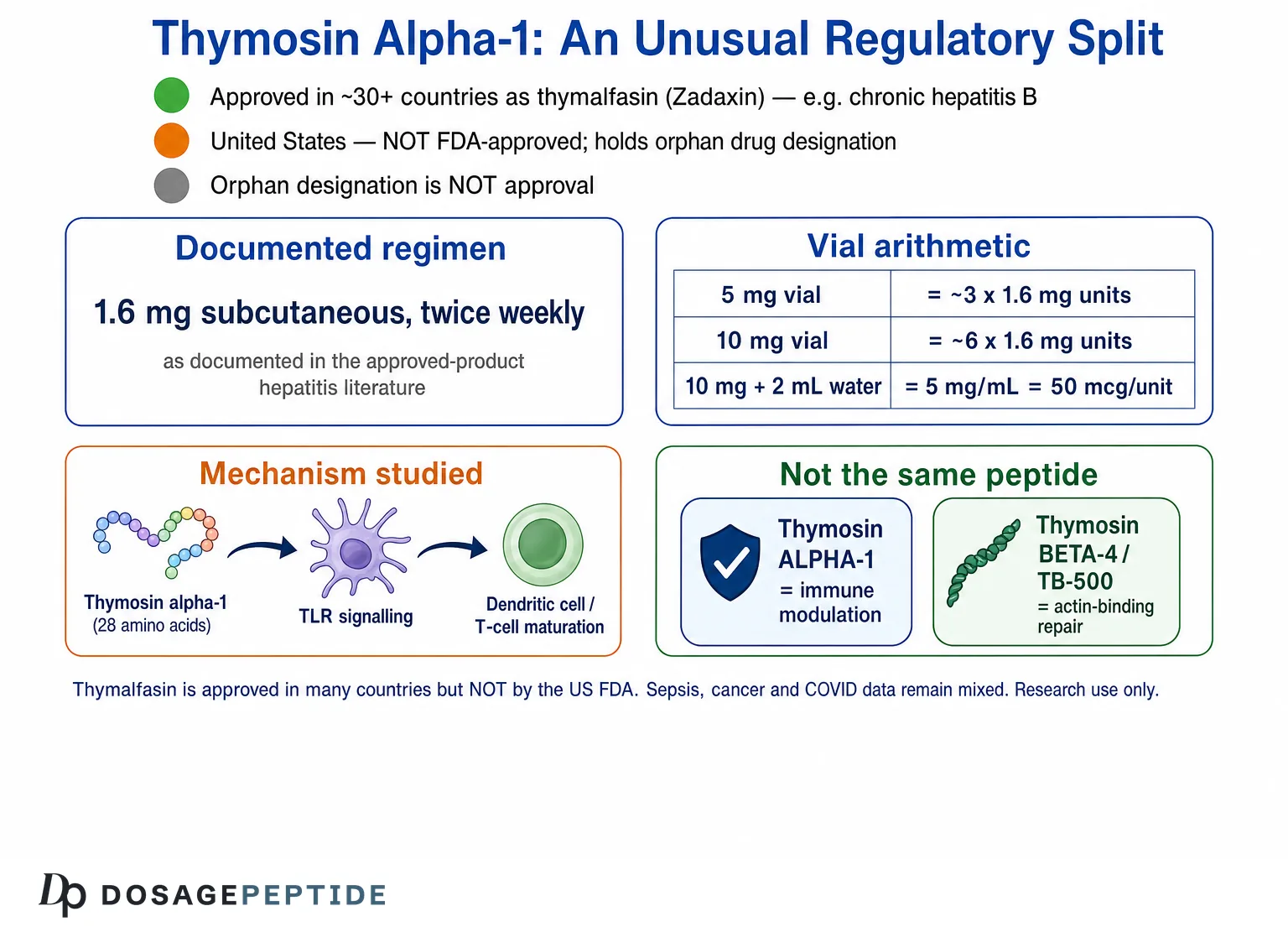
Tα1’s mechanism is better characterised than most peptides in this category, and the primary work is worth reading directly rather than through vendor paraphrase — because the primary work says something noticeably different from the paraphrase.
Toll-like receptor signalling in dendritic cells
The central mechanistic finding is that Tα1 acts through Toll-like receptors in both myeloid and plasmacytoid dendritic cells, activating signalling pathways and initiating production of immune-related cytokines.[8] Romani and colleagues characterised this in detail, reporting that Tα1:
- primed dendritic cells for antifungal Th1 resistance through TLR/MyD88-dependent signalling, which translated in vivo into protection against aspergillosis in mice;[7]
- activated plasmacytoid dendritic cells via TLR9/MyD88-dependent viral recognition, leading to activation of interferon regulatory factor 7 and promotion of the IFN-α/IFN-γ-dependent effector pathway — in vivo, protection against primary murine cytomegalovirus infection;[7]
- induced indoleamine 2,3-dioxygenase (IDO) activity in dendritic cells, affecting tolerisation toward self and microbial non-self antigens; in vivo this produced transplantation tolerance and protection from inflammatory allergy.[7]
The caveat that belongs on every line above: these are murine and ex vivo findings. Aspergillosis protection, CMV protection and transplantation tolerance were demonstrated in mice, not in humans. They are a mechanistic account of what the molecule can do in a controlled model system. They are not clinical outcomes, and the distance between the two is where most of this compound’s marketing lives.
The tolerance side — why “immune booster” is the wrong frame
The IDO finding deserves particular attention because it cuts against how this compound is usually marketed. Romani et al., publishing in Blood, showed that Tα1 activates dendritic cell tryptophan catabolism via IDO — and that IDO activation by Tα1 required TLR9 and type I interferon receptor signalling, resulting in interleukin-10 production and generation of regulatory T cells.[6]
IL-10 and regulatory T cells are immunosuppressive outputs. That is not a footnote to the mechanism; it is half of the mechanism. The authors’ framing is that Tα1-primed dendritic cells fulfil multiple requirements simultaneously — inducing Th1 immunity within a regulatory environment — and they describe the result as establishing a balance of inflammation and tolerance.[6]
This is a modulator with outputs in both directions, not an amplifier. The mechanistic literature describes Tα1 as an endogenous regulator of immune homeostasis.[7] Any claim that it simply “boosts immunity” is a misreading of the mechanism, not merely an oversimplification of it — it asserts a directionality that the source data explicitly contradict. A compound that generates Tregs is not, in any straightforward sense, turning the immune system up.
Why the mechanism predicts the delayed-response pattern
The two halves of this page — the mechanism and the trial data — fit together in a way worth making explicit, because it is the strongest internal-consistency argument available for this compound.
If Tα1 worked by clearing virus, the effect would appear during exposure and fade after it. That is what direct antivirals do. Instead, the trial data show effects that are absent at end-of-treatment and that accumulate over months of follow-up.[1] That shape is what you would predict from a compound whose proximal action is on dendritic cell maturation and T-cell priming: the peptide does something to the antigen-presenting compartment, and the downstream consequence — an altered adaptive response — takes time to develop and then persists on its own timescale, independent of whether the peptide is still present.
This coherence is genuine and it is a point in the compound’s favour as a piece of biology. It is not evidence of clinical benefit in any indication where clinical benefit has not been shown. A mechanistically coherent story about why something should work is exactly the kind of reasoning that trials exist to check.
What Does the Literature Report About Cycle Length?
The word “cycle” is worth interrogating here, because it carries assumptions imported from a different context entirely. In the Tα1 literature there is no on/off cycling structure of the kind associated with anabolic compounds, no concept of receptor downregulation requiring a washout, and no published rationale for periodising exposure. There are treatment courses of defined duration, and the durations that were actually studied are:
| Duration | Context | Outcome reported |
|---|---|---|
| 26 weeks | Chronic hepatitis B RCT | 40.6% complete virological response at 18 mo vs 9.4% control (P = .004); authors concluded 26 weeks effective and safe[1] |
| 6 months | Pooled result within a narrative review, 4 RCTs | 36% sustained response vs 19% control (P = 0.04)[2] |
| 52 weeks | Chronic hepatitis B RCT | 26.5% — lower than the 26-week arm; not significant vs control[1] |
| 12 months | Post-resection HCC adjuvant — planned protocol | No results posted[13] |
| 6 days | Comparator arm (n=30) of an acupuncture trial in sepsis | Reported alongside acupuncture and control arms; not a Tα1 efficacy trial[9] |
The durations cluster at roughly six months for chronic viral hepatitis, and the evidence specifically does not support the intuition that longer is better. That is a finding, not an absence of one — and it is the single most commonly inverted fact about this compound.
The delayed-response pattern, quantified
Across multiple independent analyses, Tα1’s measurable effects accumulate after treatment ends. Chien reported complete response rates that were similar across groups at end-of-therapy and separated only over follow-up.[1] Yang and colleagues’ meta-analysis comparing Tα1 against interferon-alpha found the same shape quantitatively: at the end of 6 months’ treatment, odds ratios for Tα1 over IFNα were below 1 (virological 0.62, biochemical 0.60, complete response 0.54) — Tα1 was doing worse. At the end of 6 months’ post-treatment follow-up, the odds ratios inverted (virological 3.71, biochemical 3.12, complete 2.69).[3]
This is a striking and consistent signal, and it is mechanistically coherent with an immune modulator: the compound is not clearing virus, it is altering a host response whose consequences take time to manifest. It also means any evaluation performed at end-of-treatment would conclude the compound had failed — and, symmetrically, that any short study of Tα1 is structurally incapable of detecting its reported effect. That is worth holding in mind when reading short-duration Tα1 studies in any indication.
Current Evidence Level
The evidence for Tα1 is highly uneven across indications, and collapsing it into a single verdict — in either direction — misrepresents it. Tiered honestly:
| Indication | Evidence tier | Honest characterisation |
|---|---|---|
| Chronic hepatitis B (monotherapy) | RCTs + pooled analyses; approved in some countries | Strongest. Consistent modest benefit, delayed onset[1][2] |
| Hepatitis B + nucleos(t)ide combination | Meta-analyses of RCTs, largely single-region | Positive but geographically confined; benefit attenuates over time[5] |
| Sepsis | 11 RCTs, meta-analysed; TSA-inconclusive | Unresolved. Overall signal disappears in high-quality subgroups[11] |
| COVID-19 | 8 studies meta-analysed, high heterogeneity | Weak / not practice-changing. Authors themselves call for RCTs[10] |
| Post-acute sequelae of SARS-CoV-2 | Ex vivo only | Hypothesis-generating; no clinical outcome data[12] |
| Hepatocellular carcinoma (adjuvant) | Orphan designation; Phase 4 trial with no posted results | Unestablished — a registered protocol, not a finding[13] |
| Antifungal / anti-CMV immunity | Murine / preclinical | Mechanistically interesting; animal-only[7] |
| “Immune support” in healthy individuals | None | No trials; no documented regimen; entirely extrapolated |
Hepatitis B combination therapy: real but qualified
Zhang et al. meta-analysed eight trials (583 patients) of lamivudine plus Tα1 versus lamivudine alone in HBeAg-positive patients, reporting superiority for combination on ALT normalisation (80.2% vs 68.8%, P = 0.01), virological response (84.7% vs 74.9%, P = 0.002) and HBeAg seroconversion (45.1% vs 15.2%, P < 0.00001).[4] The seroconversion contrast is the largest effect anywhere in the Tα1 literature, and it is worth noting that it is a combination result — it says something about Tα1 added to a nucleoside analogue, not about Tα1 alone.
Peng et al. examined entecavir plus Tα1 versus entecavir alone in HBV-related cirrhosis across seven RCTs (1,144 subjects), and their results are more instructive for their time-dependence than their headline. At 24 weeks post-treatment, HBV DNA undetectable rate and HBeAg loss rate favoured combination (RR 1.91 and 2.05). But at 48 and 52 weeks, the differences disappeared (RR 1.07, 95% CI 0.96–1.18; RR 1.17, 95% CI 0.89–1.55). HBsAg loss at week 52 showed no significant difference (RR 1.03, 95% CI 0.15–7.26 — note the width of that confidence interval, which spans from a substantial harm to a sevenfold benefit and therefore excludes essentially nothing). The authors flag explicitly that all included patients were from mainland China and call for worldwide RCTs with larger samples.[5]
The Peng pattern is the mirror image of the Chien/Yang pattern, and the tension between them is unresolved: in monotherapy against interferon, Tα1’s advantage appears after treatment ends; in combination with entecavir, its advantage disappears as follow-up extends. Both patterns are reported in the same disease. Neither analysis explains the other, and this page does not attempt to reconcile them — it notes that anyone claiming a clean, consistent time-course for this compound is smoothing over a real discrepancy in the data.
Sepsis: the most rigorous analysis is the least encouraging
The 2025 sepsis meta-analysis is a model of careful methodology and worth understanding properly. Gu and colleagues screened 3,003 studies, included 11 RCTs (967 Tα1 vs 960 control), and reported a significant reduction in 28-day mortality (OR 0.73, 95% CI 0.59–0.90, P = 0.003).[11]
That headline does not survive scrutiny, and the authors say so. In the high-quality subgroup, OR 0.82 (95% CI 0.65–1.03, P = 0.09) — not significant. In the multi-centre subgroup, OR 0.86 (95% CI 0.68–1.08, P = 0.20) — not significant. Trial sequential analysis indicated the current sample size is inadequate to draw a conclusion. Potential subgroup benefits (cancer, diabetes, coronary heart disease) were rated moderate-to-low credibility by the ICEMAN instrument.[11]
The pattern — a positive overall effect that vanishes when restricted to better-conducted and multi-centre trials — is the classic signature of small-study and quality-related bias. It is worth being explicit about what that means: it does not prove Tα1 does nothing in sepsis. It means the positive overall figure is being carried by the weaker studies, that the stronger studies do not reproduce it, and that the total evidence base is not large enough to settle the question either way. This is the most methodologically rigorous Tα1 analysis available, and its honest conclusion is unresolved. Anyone citing the 0.73 odds ratio without the subgroup analysis is citing the part of the paper the authors themselves discounted.
COVID-19: be honest about how thin this is
The COVID-era Tα1 literature is largely observational, small, and was not practice-changing. Soeroto et al. pooled 8 studies and reported significantly lower mortality (RR 0.59, 95% CI 0.37–0.93, P = 0.02) — but with I² = 84%, indicating very high heterogeneity, and with no difference in need for mechanical ventilation (RR 0.83, 95% CI 0.48–1.44) or hospital length of stay. Meta-regression found that the mortality benefit was significantly affected by sample size (P = 0.0000), a red flag for small-study effects, and by sex (P = 0.0117). The authors conclude that RCTs are still required to verify the findings.[10]
Consider what that combination of results implies. Mortality is reportedly reduced, but the need for mechanical ventilation is not, and length of stay is not. A treatment that genuinely altered the course of severe COVID-19 would ordinarily be expected to move at least one of those intermediate outcomes. A mortality-only effect with I² = 84% and a strong sample-size dependence is more consistent with confounding across heterogeneous observational cohorts than with a real treatment effect — which is why the authors’ own call for RCTs is the operative sentence in that abstract, not the risk ratio.
The PASC work is weaker still in terms of clinical inference: it is explicitly an ex vivo study of lymphocyte responses, not a treatment trial with clinical endpoints.[12] It generates a hypothesis. It does not test one in patients, and no dosing figure can be derived from it.
How Does Thymosin Alpha-1 Differ From Thymosin Beta-4 and TB-500?
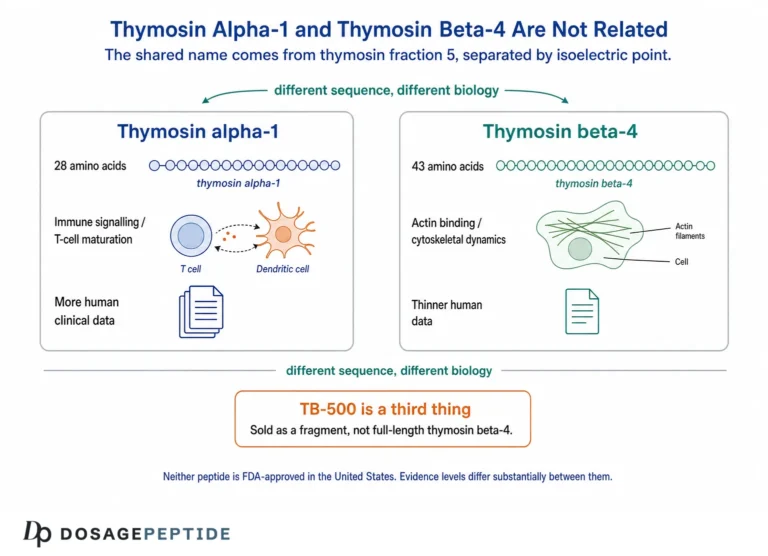
These are conflated constantly, and the conflation is not a minor naming quibble — the two peptides are unrelated in size, structure, mechanism and research application. They share the word “thymosin” for historical reasons: both were originally isolated from the same crude thymic extract fractions, which is a statement about 1970s biochemistry, not about biology. Had they been discovered a decade later by different groups, they would not share a name at all.
| Thymosin Alpha-1 (Tα1) | Thymosin Beta-4 (Tβ4) | |
|---|---|---|
| Length | 28 amino acids, N-terminally acetylated | 43 amino acids |
| Family | α-thymosin; cleaved from prothymosin alpha[7] | β-thymosin family |
| Core mechanism | TLR-mediated dendritic cell / T-cell maturation and immune modulation[6] | Major actin-sequestering protein; regulates actin cytoskeleton dynamics[15] |
| Studied for | Immune modulation: hepatitis, sepsis, cancer adjuvant[8] | Cell morphogenesis/motility, wound healing, angiogenesis, anti-inflammation[15] |
| Regulatory | Approved in some countries as thymalfasin; not FDA-approved[14] | Not approved; research-chemical status |
| Documented human regimen | 1.6 mg SC twice weekly, 26 weeks (chronic hepatitis B)[1] | No approved-product precedent of comparable standing |
| “TB-500” | Unrelated | A research-chemical designation associated with Tβ4-related material — not a synonym for full-length Tβ4 |
The practical takeaway: no dosing figure transfers between these two peptides. The 1.6 mg twice-weekly Tα1 number derives from hepatitis B trials of an immune modulator and has no bearing whatsoever on Tβ4 or TB-500, which have no comparable approved-product precedent. The mechanisms are not merely different, they are addressing different cellular problems: one is signalling to antigen-presenting cells, the other is binding monomeric actin. There is no biological reason a quantity appropriate to one would be appropriate to the other, and no published bridge between them. We cover the Tβ4/TB-500 distinction — itself a source of confusion, since the two are also not interchangeable — separately in Thymosin Beta-4 vs TB-500.
Related thymic peptides
Tα1 is sometimes discussed alongside other thymic-derived or immune-oriented peptides with their own, generally much thinner, evidence bases — including Thymalin, a thymic peptide preparation studied largely in a distinct regional literature, and Crystagen, a short synthetic immune bioregulator. Neither shares Tα1’s approved-product status, and neither has anything resembling the Chien or Lau data behind it. Grouping them under a shared “thymic peptides” heading is a taxonomic convenience that quietly implies an evidentiary equivalence which does not exist. Terminology across this cluster is defined in our peptide research glossary.
Storage and Stability
Lyophilised Tα1 is typically supplied as a powder intended for refrigerated storage, and stability considerations follow the general pattern for lyophilised peptides: the dry cake is substantially more stable than the reconstituted solution, and reconstitution starts a clock.
| State | General handling considerations |
|---|---|
| Lyophilised (unreconstituted) | Refrigerated; protected from light and moisture; most stable state |
| Reconstituted with bacteriostatic water | Refrigerated; the benzyl alcohol preservative in bacteriostatic water is what permits multiple withdrawals from the same vial |
| Reconstituted with sterile (non-bacteriostatic) water | No preservative — not suitable for multi-withdrawal use over time |
| Any state | Freeze-thaw cycling and agitation are generally destabilising for peptides |
The storage question interacts directly with the vial arithmetic above, and the interaction is worth spelling out. A 10 mg vial covers three weeks at twice-weekly frequency. That means a reconstituted vial is expected to sit refrigerated for roughly 21 days and be punctured six times. A 5 mg vial covers 1.5 weeks and is punctured three times. The dilution decision is therefore also a storage decision: choosing 5 mL of water instead of 2 mL does not change how long the solution must last, but it does change how much preserved solution is standing in the vial and how much is discarded when the peptide runs out.
Two honest caveats. First, published peptide-specific stability data for Tα1 in bacteriostatic water at defined temperatures and timepoints is not something this review located in the primary literature; general peptide handling principles are being applied, and specific day-count claims circulating online should be treated as convention rather than measurement. Anyone quoting “stable for 30 days” for this particular peptide in this particular diluent should be asked for the measurement, because this page could not find one.
Second — and more importantly — stability is a question about the molecule, not about the vial’s contents. A research-chemical vial’s actual identity and purity are unverified regardless of how it is stored, and careful storage of an unverified material preserves whatever is actually in there, not what the label says. Our guide on storing peptides before and after reconstitution covers the general principles.
Limitations: What the Evidence Does Not Establish
Given that Tα1 has more genuine clinical anchoring than most compounds in this library, it is especially important to be precise about where that anchoring stops — and about the structural features of the evidence base that constrain how far any of it can be pushed.
The boundaries of the claim
- The evidence does not establish any use in healthy individuals. Every documented human regimen comes from a disease population — chronic hepatitis B, sepsis, cancer. There is no trial of Tα1 for immune support, wellness, prevention or performance in healthy people, and therefore no documented amount, frequency or duration for any such use. This is the single largest gap between what this compound is marketed for and what it has been studied for.
- It does not establish that the 1.6 mg figure generalises. That number is a hepatitis B number from hepatitis B trials, subsequently proposed in a registry protocol for post-resection HCC. Its appearance in other contexts is transplantation by analogy. Nor was it selected by dose-ranging: no published head-to-head against another amount was located for this review.
- It does not establish HBsAg clearance. Chien reported that none of the responders lost HBsAg.[1] Peng found no significant difference in HBsAg loss at week 52, with a confidence interval spanning 0.15 to 7.26.[5] Functional cure is not on the table in this data.
- It does not establish sepsis mortality benefit. The signal does not survive restriction to high-quality or multi-centre trials, and trial sequential analysis indicates the evidence base is underpowered to settle the question.[11]
- It does not establish COVID-19 efficacy. Heterogeneity is very high, the effect is sample-size dependent, intermediate outcomes are null, and the meta-analysis authors call for RCTs.[10]
- It does not establish durable combination benefit. Combination advantages over entecavir observed at 24 weeks were gone at 48–52 weeks.[5]
- It does not establish the murine findings in humans. Aspergillosis protection, CMV protection and transplantation tolerance are mouse results.[7]
- It does not establish that longer courses help. The 52-week arm underperformed the 26-week arm.[1]
- It does not establish anything about research-vial material. The trials used a pharmaceutical product. A research vial is not that product.
Geographic concentration
A large fraction of the Tα1 clinical literature originates from a small number of regions, and this is not incidental — it reflects where the drug is approved and used. Peng et al. state directly that all patients in their meta-analysis were from mainland China and that worldwide RCTs are needed.[5] Several hepatitis B meta-analyses drew substantially on Chinese-language databases (CNKI, VIP, CBM), and the one non-hepatitis dosing datapoint reproduced on this page comes from a Chinese-language acupuncture trial.[9] This raises questions about generalisability and about publication practices that the authors themselves flag. It is not a dismissal of the work; it is a reason the same authors keep asking for multi-regional trials that have not been run.
Small and dated pivotal trials
The trial that anchors the 1.6 mg figure enrolled 98 patients and was published in 1998.[1] Ninety-eight patients split three ways is roughly 32 per arm — small enough that a single-digit difference in responders moves the headline percentage by several points. The Lau review pooled four RCTs.[2] The Yang analysis pooled four trials totalling 199 patients.[3] By modern standards these are small.
Moreover, the hepatitis B treatment landscape has changed substantially since 1998. The comparators in these trials are not current standard of care, which limits what the results say about Tα1’s place today even in its best-supported indication. A compound can be genuinely better than a 1998 control arm and still be irrelevant against a 2026 one.
Registered trials without posted results
The Phase 4 adjuvant HCC trial (NCT02281266) planned 360 patients in a randomised, open-label Phase 4 design at a single registered site (Zhongshan Hospital, Shanghai), sponsored by Fudan University, with 2-year recurrence-free survival as its primary endpoint. Its last known status was NOT_YET_RECRUITING and its registry status is UNKNOWN. Its estimated completion date was October 2018, and no results are posted.[13]
A registered trial is a plan, not a finding. This record is genuinely useful for one purpose only — it documents a planned 1.6 mg twice-weekly subcutaneous regimen in a second indication, corroborating the unit — and useless for the purpose it is most often cited for, namely as evidence that Tα1 does something in HCC. A study registered as not-yet-recruiting, with an unknown current status and a completion date eight years in the past, is a study about which nothing is known.
Commercial authorship
Some of the review literature is authored by individuals affiliated with the company that developed and marketed the product — the King and Tuthill review, for example, carries SciClone Pharmaceuticals affiliations.[8] This does not invalidate the work, and the review is a useful mechanistic synthesis that this page cites. It is a disclosure a careful reader should register when weighting review conclusions against primary data — particularly since review articles are where the “approved in 30+ countries” framing tends to originate and where the orphan-designation-versus-approval distinction tends to blur.
Research-chemical material is an unquantified variable
Every number on this page derives from studies using pharmaceutical-grade thymalfasin, manufactured under regulatory oversight with verified identity, purity and sterility. Research vials carry none of those assurances. Peptide content may deviate from the label, and neither purity nor sterility is independently established. This is not a minor caveat appended for form’s sake: it means the arithmetic in the reconstitution tables above is arithmetic about a label claim, not about a verified quantity of peptide. A 4% stranding calculation is precise to the second decimal place and rests entirely on an assumption that nobody has tested.
Frequently Asked Questions
Is thymosin alpha-1 FDA approved?
No. Thymalfasin is not approved by the FDA for any indication.[14] It holds multiple FDA orphan drug designations, but designation is a development incentive status, not approval, and involves no finding of efficacy. In the EU an orphan designation exists (EU/3/02/110); no EU marketing authorisation was located for this review. It is separately approved as a prescription drug in a number of other countries, marketed as Zadaxin. All of those statements are true simultaneously.
What is the standard thymosin alpha 1 dosage?
There is no US standard, because there is no US label. The documented figure from the pivotal chronic hepatitis B literature is 1.6 mg subcutaneously, twice weekly, for 26 weeks.[1] The same 1.6 mg twice-weekly unit appears as the planned regimen in a registered post-resection HCC study.[13] That number describes specific disease populations in registered trials. It is a description of what was studied, not a recommendation.
How much bacteriostatic water for a 10 mg thymosin alpha-1 vial?
It depends on the concentration wanted and on the vial’s physical capacity. 2 mL yields 5 mg/mL (50 mcg per U-100 unit; a 1.6 mg equivalent = 32 units). 3 mL yields about 3.33 mg/mL (about 33.3 mcg/unit; 48 units). 5 mL yields 2 mg/mL (20 mcg/unit; 80 units). Physical vial capacity constrains this choice; many small vials cannot accept 5 mL.
How many doses are in a 10 mg vial?
Six full 1.6 mg equivalents, plus a 0.4 mg remainder too small for a seventh. 10 ÷ 1.6 = 6.25, so approximately 4% of the vial is stranded — the 0.25 fractional part is a quarter of a unit, and there is no such thing as a quarter of an administration. At twice-weekly frequency, one 10 mg vial covers about three weeks. A 5 mg vial yields three full equivalents (4.8 mg used, 0.2 mg residual, also 4%), covering about 1.5 weeks.
Is thymosin alpha-1 the same as TB-500?
No — they are entirely different peptides. Tα1 is a 28-amino-acid immune modulator acting via Toll-like receptors on dendritic cells.[6] TB-500 is a research-chemical designation associated with thymosin beta-4 material — a 43-amino-acid actin-sequestering protein studied for cytoskeletal dynamics and wound repair.[15] They share a name because both were isolated from the same crude thymic fractions in the 1970s. No dosing figure transfers between them.
Why did the 52-week course perform worse than the 26-week course?
The trial data show it, but do not explain it. Chien reported 26.5% complete virological response for the 52-week arm versus 40.6% for the 26-week arm, with the longer arm failing to reach significance against control.[1] With 98 patients split three ways, arm sizes are around 32 and the difference may partly reflect chance. The honest reading is that longer exposure showed no advantage — not that a mechanism for inferiority has been demonstrated.
Does thymosin alpha-1 boost the immune system?
“Boost” misdescribes the mechanism. Tα1 induces IDO activity in dendritic cells, producing interleukin-10 and generating regulatory T cells — immunosuppressive outputs — while also priming Th1 responses.[6] Researchers characterise it as an endogenous regulator of immune homeostasis balancing inflammation and tolerance.[7] It is bidirectional, and no trials have examined it in healthy individuals for any purpose.
What does the COVID-19 research on thymosin alpha-1 show?
Less than is often claimed. A meta-analysis of 8 studies reported lower mortality (RR 0.59, 95% CI 0.37–0.93) but with I² = 84% — very high heterogeneity — and no difference in mechanical ventilation need or length of stay. Benefit was significantly affected by sample size, suggesting small-study effects, and the authors state RCTs are still required.[10] The literature is largely observational and was not practice-changing.
Why do effects appear after treatment ends rather than during it?
This is consistent across the monotherapy literature and mechanistically coherent for an immune modulator. Yang’s meta-analysis quantified it: at end-of-treatment, odds ratios for Tα1 versus interferon-alpha were below 1 (0.62, 0.60, 0.54); at 6 months post-treatment they inverted to 3.71, 3.12 and 2.69.[3] Tα1 does not clear virus directly; it alters host immune responses whose consequences take time to manifest.
References
- Chien RN, Liaw YF, Chen TC, Yeh CT, Sheen IS. Efficacy of thymosin alpha1 in patients with chronic hepatitis B: a randomized, controlled trial. Hepatology. 1998;27(5):1383-7. https://pubmed.ncbi.nlm.nih.gov/9581695/
- Lau GK. Use of immunomodulatory therapy (other than interferon) for the treatment of chronic hepatitis B virus infection. J Gastroenterol Hepatol. 2000;15 Suppl:E46-52. (Indexed as a review article; contains a pooled analysis of four RCTs.) https://pubmed.ncbi.nlm.nih.gov/10921382/
- Yang YF, Zhao W, Zhong YD, Yang YJ, Shen L, Zhang N, Huang P. Comparison of the efficacy of thymosin alpha-1 and interferon alpha in the treatment of chronic hepatitis B: a meta-analysis. Antiviral Res. 2008;77(2):136-41. https://pubmed.ncbi.nlm.nih.gov/18078676/
- Zhang YY, Chen EQ, Yang J, Duan YR, Tang H. Treatment with lamivudine versus lamivudine and thymosin alpha-1 for e antigen-positive chronic hepatitis B patients: a meta-analysis. Virol J. 2009;6:63. https://pmc.ncbi.nlm.nih.gov/articles/PMC2693103/
- Peng D, Xing HY, Li C, Wang XF, Hou M, Li B, Chen JH. The clinical efficacy and adverse effects of Entecavir plus Thymosin alpha-1 combination therapy versus Entecavir monotherapy in HBV-related cirrhosis: a systematic review and meta-analysis. BMC Gastroenterol. 2020;20(1):348. https://pmc.ncbi.nlm.nih.gov/articles/PMC7574490/
- Romani L, Bistoni F, Perruccio K, et al. Thymosin alpha1 activates dendritic cell tryptophan catabolism and establishes a regulatory environment for balance of inflammation and tolerance. Blood. 2006;108(7):2265-74. https://pubmed.ncbi.nlm.nih.gov/16741252/
- Romani L, Bistoni F, Montagnoli C, et al. Thymosin alpha1: an endogenous regulator of inflammation, immunity, and tolerance. Ann N Y Acad Sci. 2007;1112:326-38. https://pubmed.ncbi.nlm.nih.gov/17495242/
- King R, Tuthill C. Immune modulation with thymosin alpha 1 treatment. Vitam Horm. 2016;102:151-78. https://pubmed.ncbi.nlm.nih.gov/27450734/
- Xiao QS, et al. [Effect of Acupuncture on Prognosis and Immune Function of Sepsis Patients]. Zhongguo Zhong Xi Yi Jie He Za Zhi. 2015;35(7):783-6. (Chinese-language three-arm trial of acupuncture; thymosin alpha-1 served as an active comparator arm.) https://pubmed.ncbi.nlm.nih.gov/26380438/
- Soeroto AY, Suryadinata H, Yanto TA, Hariyanto TI. The efficacy of thymosin alpha-1 therapy in moderate to critical COVID-19 patients: a systematic review, meta-analysis, and meta-regression. Inflammopharmacology. 2023;31(6):3317-3325. https://pubmed.ncbi.nlm.nih.gov/37845598/
- Gu B, Zhou Y, Nie Y, et al. Efficacy of thymosin α1 for sepsis: a systematic review and meta-analysis of randomized controlled trials. Front Cell Infect Microbiol. 2025;15:1673959. https://pmc.ncbi.nlm.nih.gov/articles/PMC12440967/
- Minutolo A, Petrone V, Fanelli M, et al. Thymosin alpha 1 restores the immune homeostasis in lymphocytes during post-acute sequelae of SARS-CoV-2 infection. Int Immunopharmacol. 2023;118:110055. https://pmc.ncbi.nlm.nih.gov/articles/PMC10030336/
- ClinicalTrials.gov. Thymalfasin adjuvant therapy in hepatitis B virus (HBV)-related hepatocellular carcinoma (HCC) after curative resection. NCT02281266. https://clinicaltrials.gov/study/NCT02281266
- NCATS Inxight Drugs. THYMALFASIN (UNII W0B22ISQ1C) — regulatory status and orphan designations. https://drugs.ncats.io/drug/W0B22ISQ1C
- Kim J, Jung Y. Thymosin beta 4 is a potential regulator of hepatic stellate cells. Vitam Horm. 2016;102:121-49. https://pubmed.ncbi.nlm.nih.gov/27450733/
Research-use-only disclaimer. This article is an educational reference describing what the published scientific literature and approved-product documentation report about thymosin alpha-1. It is not medical advice, not a treatment protocol, and not a recommendation that any person administer this or any compound. Dosing figures reproduced here are descriptions of amounts administered in registered clinical trials involving specific patient populations under medical supervision using pharmaceutical-grade product — they are not instructions and do not transfer to any other context. Thymosin alpha-1 is not approved by the FDA for any indication; an EU orphan designation exists but no EU marketing authorisation was located for this review, and orphan drug designation is not approval in any jurisdiction. Materials sold as research peptides are not pharmaceutical products, are not verified for identity, purity or sterility, and are not intended for human or veterinary use or for diagnostic purposes. Anyone with questions about a medical condition should consult a qualified licensed healthcare professional.