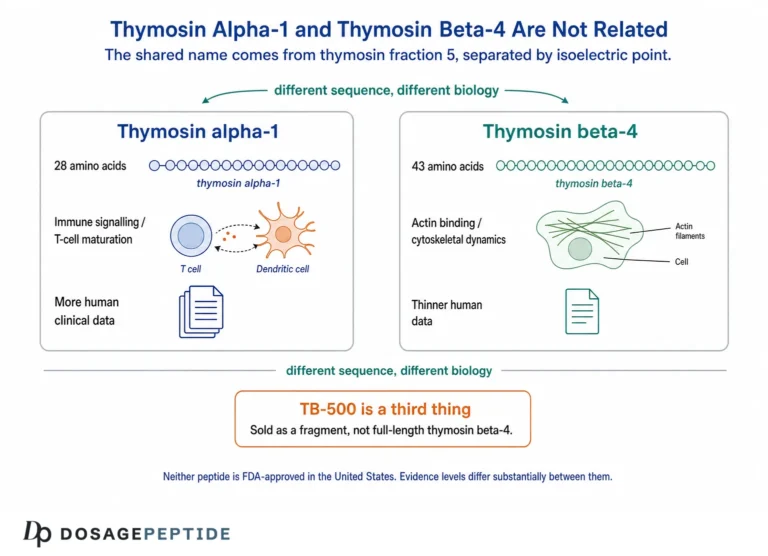
Among the dozens of peptides circulating in research and wellness discussions, Thymosin Alpha-1 (Tα1) occupies an unusual position: it is one of the very few with a genuine, decades-long clinical dossier rather than a handful of animal experiments. Marketed abroad as thymalfasin (brand name Zadaxin), it has been approved in roughly 35 countries as a treatment for chronic viral hepatitis and as a vaccine adjuvant, and it has been tested in randomized trials for conditions as varied as sepsis, cancer, and COVID-19. Another peptide central to innate host defense is LL-37, the human cathelicidin. The central research question this article examines is a demanding one: where the human evidence for Thymosin Alpha-1 is actually strong, where it is merely suggestive, and where enthusiasm has outrun the data. The honest answer is that Tα1 is simultaneously better-evidenced than most peptides and still short of the large, modern, blinded trials that would settle its most-hyped uses.
What is Thymosin Alpha-1?
Thymosin Alpha-1 is a small, 28-amino-acid peptide first isolated from calf thymus in the 1970s by Allan Goldstein and colleagues, who were dissecting the crude thymic extract “thymosin fraction 5” in search of the molecules responsible for its immune-restoring activity. In the body, Tα1 is not synthesized as an independent gene product. It is the acetylated N-terminal 28-residue fragment of a larger 109-amino-acid precursor protein called prothymosin alpha, released through cleavage by the enzyme asparagine endopeptidase (legumain).[1] This origin matters: it means Tα1 is a naturally occurring, endogenous immune-signaling molecule, not a foreign construct, which helps explain its generally clean tolerability record.
The historical arc is worth appreciating, because it explains why this peptide has a real clinical file when so many others do not. The thymus had long been recognized as the organ where T lymphocytes mature, and mid-twentieth-century researchers reasoned that it must secrete soluble factors governing immune development. Thymosin fraction 5 was a crude soup of dozens of peptides; Tα1 was purified from it as one of the most biologically active components, sequenced, and then chemically synthesized so that a defined, reproducible molecule could be studied rather than an ill-characterized tissue extract. That transition — from animal-tissue fraction to synthetic, sequence-defined thymalfasin — is precisely the step that allowed rigorous randomized trials to be run in hepatitis and, later, in sepsis and cancer. It is also the reason the peptide accumulated formal drug approvals abroad while remaining, in the United States, an unapproved substance whose research-grade form is sold only as a laboratory reagent.
Structure and physical properties
The peptide has a molecular weight of approximately 3108 Da. It is highly acidic, with an isoelectric point around 4.2, and its N-terminus is acetylated — a modification that appears important for biological activity.[1] Nuclear magnetic resonance studies of the free peptide in solution describe it as largely unstructured in water but capable of adopting a partially helical, “distorted helical” configuration with two more stable regions when placed in membrane-mimicking or structure-promoting solvents.[2] This conformational flexibility is thought to let the peptide interact with several different receptors and membrane environments rather than acting as a single-lock-and-key ligand.
Thymalfasin: the synthetic, pharmaceutical-grade version
The molecule used in clinical trials and approved medicines is not extracted from thymus tissue; it is a chemically synthesized, sequence-identical copy. Its international nonproprietary name is thymalfasin, and it is sold under the brand name Zadaxin (originally developed by SciClone Pharmaceuticals). When you read that Thymosin Alpha-1 is “approved in more than 35 countries,” it is thymalfasin/Zadaxin — a defined, quality-controlled pharmaceutical product — that carries those approvals.[2] This is a distinction with real consequences, which the regulatory section below addresses directly. Vials sold to laboratories as “research-use-only” Thymosin Alpha-1 are not the same thing as the approved drug: they carry no pharmaceutical labeling, no assurance of identity or purity, and no approval for administration to people. For anyone comparing what a study used against what a research vendor supplies, the peptide-identity guide at our practical, evidence-based guide to peptides is a useful primer on why source and characterization matter so much.
How does Thymosin Alpha-1 modulate the immune system?
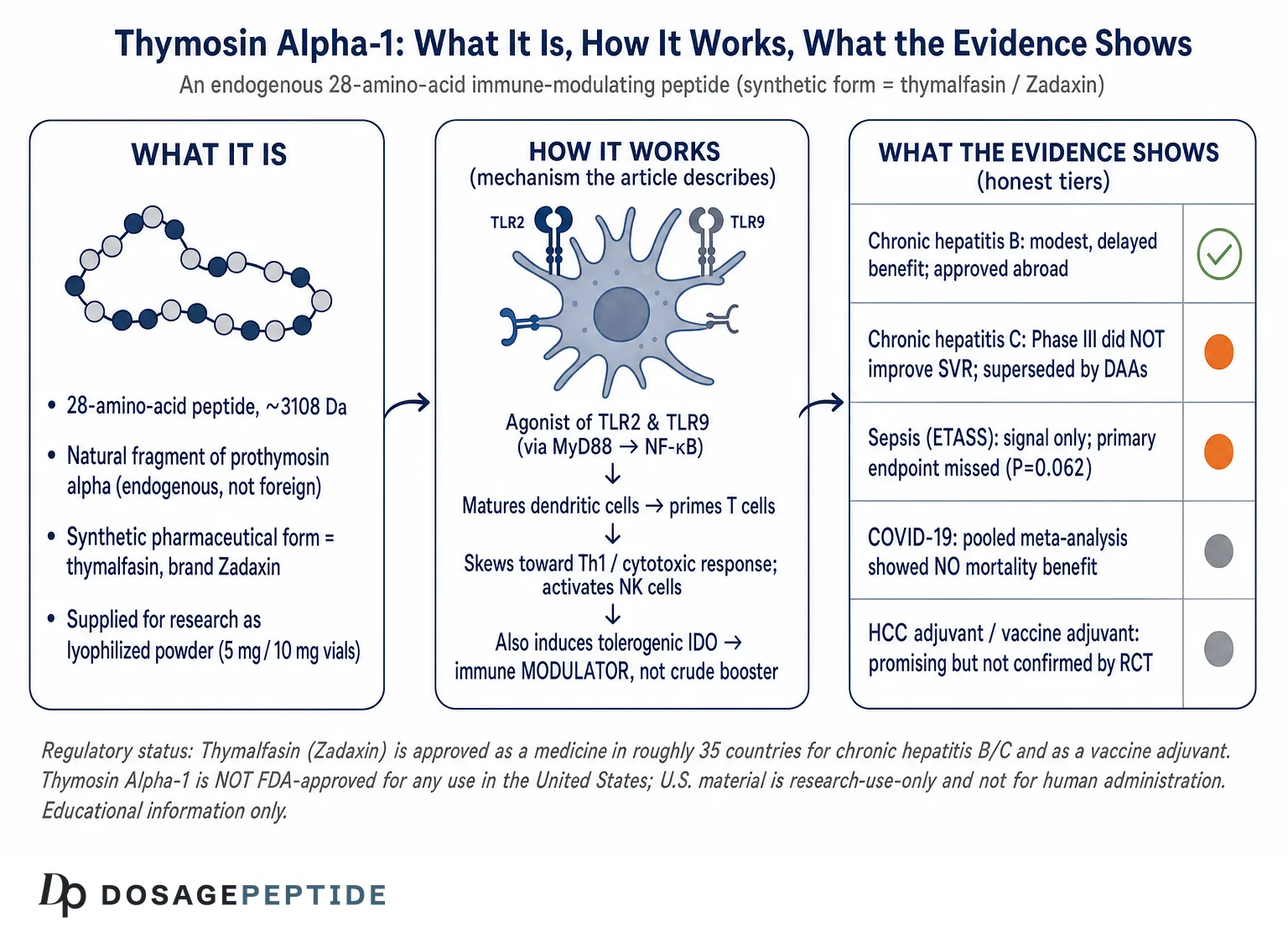
Thymosin Alpha-1 is best understood not as an immune “booster” in the colloquial sense but as an immune modulator — a molecule that nudges a dysregulated immune system back toward balance. It does not simply amplify inflammation; in different contexts it can promote pathogen-directed responses while also engaging tolerogenic pathways that prevent runaway immune damage. The mechanistic picture that has emerged over the past two decades centers on pattern-recognition receptors, dendritic cells, and T-cell biology.
Toll-like receptor signaling (TLR2 and TLR9)
The most consistently reported molecular mechanism is that Tα1 acts as an agonist of Toll-like receptors, principally TLR9 and TLR2, on dendritic cells, monocytes, and macrophages.[2] Engagement of these receptors recruits the adaptor protein MyD88, which in turn activates downstream signaling through NF-κB and interferon regulatory factors. The net effect is that innate immune cells receive a “danger-like” signal that primes them to mature and to instruct the adaptive immune system.[1] Reviews of the peptide in viral disease describe additional involvement of TLR3, TLR5, and TLR7, though TLR2 and TLR9 dominate the literature.[1]
Two features of this TLR mechanism deserve emphasis because they distinguish Tα1 from a generic immune stimulant. First, TLR9 and TLR2 are pattern-recognition receptors normally triggered by microbial signatures — unmethylated CpG DNA in the case of TLR9, and bacterial lipoproteins in the case of TLR2. By acting on these receptors, Tα1 essentially mimics part of the “infection is present” signal to the innate immune system, which is why its effects are most pronounced when the immune system is depressed or misfiring rather than in a healthy, already-competent host. Second, because it works through endogenous signaling machinery rather than by supplying a foreign antigen, its action is self-limiting and context-dependent: the same peptide can enhance antiviral defenses in one setting and dampen destructive inflammation in another. This context-dependence is the single most important concept for interpreting the clinical trials, and it predicts — correctly, as the data below show — that Tα1’s benefit should concentrate in immunosuppressed populations and largely disappear when trials enroll unselected patients.
Dendritic-cell maturation and the innate-adaptive bridge
Dendritic cells (DCs) are the professional antigen-presenting cells that decide, in large part, what kind of adaptive immune response the body mounts. Tα1 promotes the functional maturation of DCs through its TLR signaling, increasing their capacity to present antigen and to prime naive T cells.[1] Crucially, Tα1 also induces expression of indoleamine 2,3-dioxygenase (IDO) in dendritic cells via TLR9.[1] IDO is a tolerogenic, anti-inflammatory pathway. The coexistence of a pro-immunogenic action (DC maturation, T-cell priming) with a tolerogenic action (IDO induction) is the molecular basis for describing Tα1 as a balancer rather than a one-directional stimulant — a property that is attractive precisely in conditions like sepsis, where the immune system is simultaneously overactive and exhausted.
Mechanistically minded readers sometimes ask whether Tα1 has a single dedicated receptor. The current answer is that it does not appear to; rather, it engages a set of pattern-recognition and signaling pathways, with TLR9 and TLR2 as the best-documented entry points, and its conformational flexibility likely allows it to interact with more than one partner. This “hub-like” mode of action — touching innate sensing, dendritic-cell instruction, T-cell polarization, checkpoint expression, and tolerogenic enzymes at once — is a strength for restoring a dysregulated system but a weakness for reductionist trial design, because there is no single pharmacodynamic readout that cleanly captures whether the drug is “working” in a given patient. That ambiguity is part of why the clinical literature, for all its volume, has struggled to produce a single unambiguous, universally accepted efficacy result.
T-cell differentiation, Th1 skewing, and cytokines
Downstream of dendritic-cell activation, Tα1 shapes the T-cell response. It promotes the differentiation of naive T cells toward cytotoxic CD8+ T lymphocytes and skews CD4+ helper responses toward a T-helper-1 (Th1) phenotype.[1] Th1 responses are the arm of adaptive immunity most relevant to clearing intracellular pathogens such as viruses. Accordingly, Tα1 stimulates the production of Th1-associated cytokines, particularly interferon-gamma (IFN-γ) and interleukin-2 (IL-2), and reviews also report increases in IL-12, IFN-α, and, notably, the anti-inflammatory cytokine IL-10.[2] The peptide has also been reported to raise reduced T-cell rosette percentages in patients with T-cell lymphopenia, consistent with an effect on T-cell number as well as function.[2]
NK cells and reversal of exhausted immunity
Beyond T cells, Tα1 directly activates natural killer (NK) cell-mediated cytotoxicity, a first-line defense against virally infected and transformed cells.[1] One of the most clinically interesting recent observations concerns “exhausted” T cells — lymphocytes that, under chronic infection or severe illness, upregulate inhibitory checkpoint receptors such as PD-1 and Tim-3 and lose their effector function. In severely ill COVID-19 patients, Tα1 treatment was associated with reduced PD-1 and Tim-3 expression on CD8+ T cells relative to untreated cases, alongside signs of restored thymic output.[3] This “reversal of exhaustion” hypothesis is mechanistically appealing, but — as the COVID-19 section shows — the clinical evidence that it translates into better survival is far weaker than the laboratory rationale suggests. For readers interested in how immune-modulating peptides more generally intersect with mucosal and gut immunity, our discussion of KPV, the anti-inflammatory peptide for gut, skin, and beyond covers a different but complementary corner of this field.
What does the clinical evidence show in chronic hepatitis B and C?
Chronic viral hepatitis is where Thymosin Alpha-1 has its deepest clinical roots and its formal regulatory approvals. The therapeutic logic is straightforward: chronic hepatitis B and C persist in part because the host fails to mount an adequate, sustained antiviral T-cell response, and Tα1’s Th1-promoting, DC-maturing profile is exactly the kind of immune correction that might tip the balance toward viral control.
Chronic hepatitis B
Several randomized controlled trials and meta-analyses have examined thymalfasin in chronic hepatitis B (CHB), used alone or combined with interferon or nucleos(t)ide analogues. A recurring and important theme is a delayed response pattern: unlike direct antivirals that suppress viral load quickly, thymalfasin’s benefit tends to emerge gradually and is often most apparent 6 to 12 months after treatment ends, consistent with a mechanism that reconstitutes immune control rather than directly blocking replication. Pooled analyses have reported sustained response rates on the order of the mid-30% range with thymalfasin versus roughly half that in controls at 12 months of follow-up, and pilot combination studies have reported higher complete-response rates.[4] A review by Ciancio and Rizzetto notes that pilot studies of thymalfasin combined with interferon or a nucleoside analogue produced complete sustained response rates as high as about 70% in selected patients.[4]
The honest caveats: many of these CHB trials are older, relatively small, heterogeneous in their endpoints, and conducted largely in Asia before the current era of highly potent nucleos(t)ide analogues (entecavir, tenofovir) that now achieve profound viral suppression in most patients. Thymalfasin’s monotherapy effect sizes are modest, and its place in modern hepatitis B management — where the bar set by today’s antivirals is very high — is far from settled.
There is, however, a coherent scientific reason the hepatitis B signal is taken seriously even by skeptics. Chronic hepatitis B is fundamentally a disease of immune tolerance: the virus persists because the host’s HBV-specific T cells are functionally exhausted and fail to clear infected hepatocytes. Nucleos(t)ide analogues suppress viral replication superbly but do not restore that immune control, which is why most patients relapse if the drug is stopped and why true functional cure (loss of HBsAg) remains rare. A peptide that reconstitutes Th1-biased, HBV-specific immunity is attacking a different and complementary axis of the disease. This is exactly why the most interesting contemporary framing of thymalfasin in hepatitis B is not as a standalone therapy but as a potential immune-restoration partner to antivirals — a hypothesis that, notably, has never been settled by an adequately powered modern trial. The delayed-response signature seen across studies fits this immunological logic: the drug is not blocking the virus in real time; it is slowly rebuilding the host response that then does the work.
Chronic hepatitis C
The hepatitis C story is a cautionary one that illustrates why honest reporting matters. Although early data were promising, a large Phase III European trial of thymalfasin added to pegylated interferon plus ribavirin in prior non-responders did not improve the rate of sustained virologic response — the outcome that actually matters — even though it significantly reduced the relapse rate among patients who completed therapy.[4] In other words, the headline efficacy endpoint was negative. This is a critical corrective to the common online claim that Tα1 is a proven hepatitis C therapy. Moreover, the entire interferon-based hepatitis C landscape has been rendered largely obsolete by direct-acting antivirals, which cure the great majority of patients in 8 to 12 weeks. Thymalfasin’s role in hepatitis C today is essentially historical.
| Indication | Best evidence tier | Honest summary of effect |
|---|---|---|
| Chronic hepatitis B | RCTs + meta-analyses (older, mostly Asian) | Modest, delayed sustained-response benefit; approved abroad; role uncertain vs. modern antivirals |
| Chronic hepatitis C | Phase III RCT (non-responders) | Did not improve SVR; reduced relapse only; superseded by direct-acting antivirals |
| Severe sepsis | RCT (ETASS) + meta-analyses | Signal toward lower mortality; primary endpoint missed statistical significance; subgroups inconsistent |
| COVID-19 | Retrospective cohorts + meta-analysis | Mixed; pooled analysis showed no mortality benefit; low-tier evidence |
| HCC (post-resection adjuvant) | Retrospective, propensity-matched | Associated with better recurrence-free survival; not confirmed by RCT |
| Vaccine adjuvant | Small RCTs/pilots (elderly, dialysis) | Improved seroconversion in immunocompromised; small studies |
What is the evidence in sepsis and critical illness?
Sepsis is arguably the most mechanistically compelling indication for Tα1, and also the one where the trial data are most instructive about the gap between “promising” and “proven.” Severe sepsis is now understood to involve not only a hyperinflammatory phase but also a subsequent state of profound immune paralysis — lymphocyte apoptosis, reduced monocyte HLA-DR (mHLA-DR) expression, and impaired pathogen clearance. A drug that could restore immune competence without inflaming an already inflamed patient is exactly what Tα1’s dual pro-immune/tolerogenic profile suggests it might be.
The ETASS trial
The landmark study is the ETASS trial (Efficacy of Thymosin Alpha 1 for Severe Sepsis), a multicenter, single-blind, randomized, controlled trial conducted across six Chinese teaching hospitals between 2008 and 2010, published in Critical Care in 2013 by Wu and colleagues.[5] A total of 361 patients with severe sepsis were randomized 1:1 to standard care alone or standard care plus subcutaneous Tα1 (1.6 mg twice daily for five days, then once daily for two days). The primary endpoint was 28-day all-cause mortality.
The results are frequently over-simplified, so precision matters here. Mortality at 28 days was 26.0% (47 of 181) in the Tα1 group versus 35.0% (63 of 180) in the control group — an absolute reduction of 9.0 percentage points, with a relative risk of 0.74 (95% CI 0.54 to 1.02).[5] Critically, the primary nonstratified analysis did not reach conventional statistical significance (P = 0.062); the confidence interval crossed 1.0. A log-rank survival analysis was borderline (P = 0.049). On the immunological secondary endpoint, Tα1 significantly improved mHLA-DR expression at days 3 and 7, providing biological plausibility that the drug was doing something to immune function.[5] The authors themselves listed six major limitations, including a heterogeneous patient population, limited immune biomarkers, short follow-up, and the use of single-blind rather than double-blind methodology.[5] ETASS is best described as an encouraging signal that fell short of definitive proof.
Meta-analyses since ETASS
Subsequent pooled analyses have generally leaned favorable while remaining cautious. A 2025 systematic review and meta-analysis by Gu and colleagues in Frontiers in Cellular and Infection Microbiology combined 11 randomized controlled trials totaling 1,927 patients and reported that Tα1 significantly reduced 28-day mortality overall (odds ratio 0.73, 95% CI 0.59 to 0.90, P = 0.003).[6] But the same analysis contains a sobering internal check: when restricted to high-quality studies, the effect was no longer significant (OR 0.82, 95% CI 0.65 to 1.03, P = 0.09), and the same was true for multicenter studies (OR 0.86, 95% CI 0.68 to 1.08, P = 0.20). The authors flagged evident publication bias and noted that trial sequential analysis indicated the accumulated sample size is still inadequate to draw a firm conclusion.[6] A further complication is that nearly all sepsis trials to date were conducted in China, limiting generalizability. The reasonable read: Tα1 may reduce sepsis mortality, the effect concentrates in lower-quality studies, and a large, rigorous, multinational, double-blind trial is genuinely needed before this becomes standard of care anywhere.
Why sepsis remains the most scientifically compelling indication
It is worth pausing on why sepsis, despite the imperfect data, is where many immunologists think Tα1 has its strongest rationale. The modern understanding of sepsis has shifted decisively away from the old “cytokine storm only” model. In many patients who survive the initial hyperinflammatory phase, the real threat is a prolonged state of immunoparalysis: apoptotic depletion of lymphocytes, exhausted T cells expressing inhibitory checkpoints, and monocytes that downregulate HLA-DR and can no longer present antigen or produce inflammatory cytokines on demand. These patients die not of the original insult but of secondary and opportunistic infections they can no longer fight. Low monocyte HLA-DR (mHLA-DR) expression is one of the best-validated biomarkers of this immunosuppressed state and a predictor of poor outcome.
Tα1’s mechanism maps almost point-for-point onto this problem: it matures dendritic cells, reverses T-cell exhaustion, and — as ETASS specifically demonstrated — raises mHLA-DR expression.[5] This is why the field’s most sophisticated criticism of the existing trials is not that Tα1 doesn’t work, but that the trials enrolled the wrong patients: by giving the drug to all-comers with sepsis rather than only to those with demonstrable immunoparalysis, they likely diluted a real effect in the immunosuppressed subgroup with a null effect in patients who were not immunosuppressed to begin with. The next generation of sepsis immunotherapy research is expected to be biomarker-guided for exactly this reason, and Tα1 is one of several candidate agents (alongside interferon-gamma, IL-7, and anti-PD-1 approaches) being reconsidered through that lens.
What was studied in COVID-19?
COVID-19 produced a burst of interest in Thymosin Alpha-1 because severe disease features exactly the lymphopenia and T-cell exhaustion that Tα1 is theorized to correct. It is essential to state up front that virtually all of the COVID-19 evidence is low-tier: retrospective, observational, single-country, and vulnerable to confounding. None of it constitutes proof.
The early retrospective signals
An early and widely cited retrospective study by Liu and colleagues, published in Clinical Infectious Diseases in 2020, reviewed 76 severe COVID-19 patients across two Wuhan hospitals. Mortality was 11.1% in the Tα1-treated group versus 30.0% in the untreated group (P = 0.044), and treated patients showed reduced PD-1 and Tim-3 expression on CD8+ T cells alongside evidence of restored thymic output.[3] Taken alone, this looks striking. But retrospective allocation is a serious problem: physicians may have chosen to give Tα1 to patients they judged more salvageable, and untreated patients may have differed systematically in ways no statistical adjustment fully captures.
Why the pooled evidence is unconvincing
When the accumulated COVID-19 studies are combined, the optimistic picture dissolves. A 2022 systematic review and meta-analysis by Shang and colleagues in International Immunopharmacology pooled 9 studies (7 retrospective cohorts and 2 randomized trials) covering 5,352 patients. The pooled mortality effect was essentially null — risk ratio 1.03 (95% CI 0.60 to 1.75, P = 0.92) — with extreme heterogeneity (I² = 90%). The authors concluded that the evidence does not support the use of Tα1 in hospitalized adults with COVID-19, while noting a hypothesis-generating hint of possible benefit in older, more severe patients that would need dedicated trials to confirm.[7] Consistent with this, other work found no benefit of Tα1 on restoring CD4+ and CD8+ T-lymphocyte counts in COVID-19 patients — a direct challenge to the mechanistic rationale. The COVID-19 chapter is a textbook example of a compelling mechanism failing to survive contact with rigorous aggregate data, and it should temper any claim that Tα1 is an established antiviral.
What the COVID-19 episode teaches about evidence hierarchy
The gap between the Liu retrospective study and the Shang meta-analysis is a useful lesson in how to weigh research-peptide claims generally. The single retrospective study looked dramatic — a nearly three-fold difference in mortality — and it is the kind of result that gets quoted endlessly in marketing copy. But retrospective, non-randomized data sit near the bottom of the evidence hierarchy precisely because the decision to treat is entangled with prognosis. In a real hospital during a surging pandemic, the patients selected for an extra immunomodulator, the timing of that decision, and the concurrent care they received were all non-random. When many such studies are pooled and their heterogeneity examined, the apparent signal can evaporate entirely, as it did here (risk ratio 1.03, essentially no effect).[7] The practical takeaway for anyone reading about Thymosin Alpha-1 — or any peptide — is to ask what tier of evidence a claim rests on: a randomized, blinded, adequately powered, multicenter trial is worth far more than a stack of favorable retrospective series, no matter how striking the individual numbers look.
Cancer adjuvant and vaccine-adjuvant research
Two additional research areas round out the Tα1 dossier, both worth reporting honestly and briefly.
Cancer adjuvant (hepatocellular carcinoma)
Because Tα1 enhances anti-tumor immunity (NK activity, cytotoxic T cells, DC function) and because patients with hepatitis B-related hepatocellular carcinoma (HCC) frequently have both immune impairment and ongoing viral drive, adjuvant Tα1 after tumor resection has been studied as a way to reduce recurrence. A retrospective, propensity-score-matched analysis by He and colleagues in Medicine (2021), covering 468 patients with solitary HBV-related HCC after curative resection, found meaningfully better outcomes with adjuvant Tα1: 5-year recurrence-free survival of 58.2% versus 32.6%, and 5-year overall survival of 55.5% versus 47.2%, with Tα1 an independent predictor of both on multivariate analysis (recurrence-free survival HR 0.38; overall survival HR 0.31; both P < 0.001).[8] These are large effect sizes — but the design is retrospective and observational, not a randomized trial, and propensity matching cannot eliminate all confounding. The signal justifies a prospective RCT; it does not establish efficacy. More recent early-phase work has begun pairing Tα1 with anti-PD-1 checkpoint inhibitors in high-recurrence-risk HCC, an interesting mechanistic combination that remains investigational.
Vaccine adjuvant
The vaccine-adjuvant indication is one of thymalfasin’s formal approvals abroad, aimed at populations that respond poorly to vaccination — the elderly and the immunocompromised. In a pilot randomized study, hemodialysis patients (who mount notoriously weak vaccine responses) received an adjuvanted pandemic H1N1 influenza vaccine with or without Tα1; the combination groups achieved higher seroconversion and seroprotection and met regulatory immunogenicity criteria by day 21 when the vaccine-alone group did not, with no adverse effect on hematology or blood chemistry.[9] Earlier work in elderly men similarly suggested augmented influenza antibody responses. These are small studies, but they are mechanistically coherent and form part of the basis for thymalfasin’s adjuvant approvals.
The vaccine-adjuvant data are, in one sense, the cleanest illustration of the “help the impaired, not the healthy” pattern that runs through the entire Tα1 story. The elderly and dialysis patients targeted in these trials suffer from immunosenescence and uremia-related immune dysfunction respectively — states in which naive T-cell output has declined and antibody responses to new antigens are blunted. A peptide that pushes dendritic-cell maturation and Th1 help is well positioned to rescue a response that would otherwise be inadequate. In a young, immunocompetent vaccinee, by contrast, there is little room to improve on an already robust response, and one would not expect much benefit. This is exactly the shape of the reported data, and it reinforces the interpretive rule for the whole peptide: effect size tracks the degree of baseline immune impairment. It also cautions against extrapolating the adjuvant findings to healthy populations, where the studies were not done and where a meaningful effect is mechanistically unlikely.
Regulatory status: approved abroad vs not FDA-approved in the US
This is the single most misrepresented fact about Thymosin Alpha-1 online, and it deserves an unambiguous statement.
Thymalfasin (Zadaxin) is approved as a pharmaceutical in roughly 35 countries — including China, Italy, and several others across Asia, Europe, and South America — principally for chronic hepatitis B, chronic hepatitis C, and as an immune/vaccine adjuvant in defined populations.[2] In those jurisdictions it is a regulated medicine prescribed by physicians.
Thymosin Alpha-1 is NOT FDA-approved for any indication in the United States. It has never received U.S. marketing approval as a hepatitis or immune therapy. It has at times been the subject of orphan-drug designations for specific oncology settings (orphan designation is a development incentive, not an approval, and does not mean the drug is authorized for sale), but that is a separate matter from approval. The U.S. Food and Drug Administration has more recently taken restrictive positions on peptide compounding, and “approved abroad” must never be read as “FDA-approved.”
The practical implication for the research community is important. Material sold in the U.S. as Thymosin Alpha-1 is offered on a research-use-only basis. It is not the approved thymalfasin pharmaceutical, it is not intended for human administration, and it should be handled strictly as a laboratory reagent. Educational protocol references such as our Thymosin Alpha-1 10 mg vial reference protocol and the companion Thymosin Alpha-1 5 mg vial reference protocol exist to document what has been studied and how research-grade material is characterized — not to constitute clinical or dosing advice for people.
It is also worth being precise about what “orphan-drug designation” means, because it is frequently misquoted as evidence of approval. An orphan designation is a regulatory incentive granted early in development for a drug targeting a rare disease; it confers benefits such as fees waivers and market exclusivity if the drug is later approved, but it says nothing about whether the drug works or is safe, and it is not a marketing authorization. Thymalfasin’s history includes designations of this kind for narrow oncology settings, but none of that changes the bottom line: there is no FDA approval permitting Thymosin Alpha-1 to be marketed or administered as a therapy in the United States. Anyone encountering the peptide domestically is encountering an unapproved substance whose only lawful use is laboratory research.
Handling, reconstitution and stability in research settings
The following is general laboratory-handling information for research-use-only lyophilized peptide, provided for educational completeness. It is not a directive to administer anything to a human being.
Research-grade Thymosin Alpha-1 is typically supplied as a white lyophilized (freeze-dried) powder, commonly in 5 mg or 10 mg vials. In the dry, sealed state it is comparatively stable and is generally stored cold; long-term storage of lyophilized peptide is usually recommended in a freezer, protected from moisture and light. As a general rule, peptides in solution are far less stable than the dry powder, so reconstitution is done shortly before an experiment rather than far in advance.
A few properties of Tα1 specifically are relevant to why careful handling matters. Because the peptide is highly acidic (isoelectric point around 4.2) and its N-terminus is acetylated, its solubility and behavior in solution differ from a generic peptide, and its documented biological activity depends on that intact acetylation and sequence.[1] Degradation, oxidation, or aggregation of the peptide can therefore silently change what a laboratory is actually studying, which is why reproducibility in peptide research hinges on documenting the source, purity (commonly reported as HPLC percentage), and mass-spec confirmation of identity for each lot. This is also where the research-grade versus pharmaceutical-grade distinction becomes concrete: approved thymalfasin is manufactured under pharmaceutical controls that guarantee identity, potency, sterility, and endotoxin limits, whereas research-use-only material carries none of those guarantees unless the supplier provides — and the researcher verifies — a certificate of analysis.
- Reconstitution solvent: lyophilized peptide is generally reconstituted with bacteriostatic or sterile water for research purposes; the diluent is added slowly down the vial wall rather than injected directly onto the powder, to limit foaming and shear stress on the peptide.
- Gentle mixing: the vial is swirled or rolled, not shaken vigorously, because agitation can denature or aggregate peptides.
- Concentration bookkeeping: the final concentration (mass of peptide divided by volume of solvent) must be tracked carefully so that any research measurement is accurate.
- After reconstitution: solutions are kept refrigerated and used within a limited window; repeated freeze-thaw cycles are avoided.
For the underlying arithmetic and general principles, our peptide reconstitution guide and reconstitution and concentration calculator walk through the math, while how to store peptides before and after reconstitution covers stability in more depth. Terms used throughout this article are defined in our peptide research glossary.
Safety profile and limitations discussed in the literature
Across the clinical trial literature, Thymosin Alpha-1 (as pharmaceutical thymalfasin) has a reputation for being well tolerated. Because it is an endogenous peptide fragment rather than a foreign molecule, and because it modulates rather than crudely stimulates immunity, serious drug-attributable adverse events have been uncommon in trials. In the ETASS sepsis trial and in vaccine-adjuvant studies, Tα1 did not produce concerning safety signals; the hemodialysis influenza study specifically reported no adverse effect on hematology or blood chemistry.[9] Reported reactions in various studies have generally been mild and self-limited, such as local injection-site reactions.
That favorable profile, however, comes with essential caveats that the literature and basic immunology make clear:
- Immune modulation is double-edged. Any agent that alters immune signaling carries theoretical risk in people with autoimmune disease, transplant recipients on immunosuppression, or those on immune-active medications. Safety data are drawn from specific studied populations and cannot be assumed to generalize.
- Approved-drug safety is not research-vendor safety. The reassuring tolerability record belongs to characterized, pharmaceutical-grade thymalfasin manufactured to regulatory standards. It does not automatically transfer to unregulated research-use-only material of unknown identity, purity, endotoxin content, or sterility.
- Long-term and combination safety are under-characterized. Most trials are short. Effects of prolonged use, and interactions with other immunomodulators or checkpoint inhibitors, are not well defined.
Research gaps: what large modern trials still need to answer
Despite being one of the better-studied peptides in existence, Thymosin Alpha-1 leaves major questions open. An honest research agenda would prioritize the following:
- Definitive sepsis RCTs. ETASS missed its primary endpoint, and the favorable meta-analytic signal weakens in high-quality and multicenter subgroups, with evident publication bias and inadequate cumulative sample size.[6] A large, double-blind, multinational trial — ideally enriched for patients with documented immunoparalysis (low mHLA-DR) — is the single most valuable study that could be run.
- Geographic diversity. The overwhelming majority of positive trials come from China. Reproducing effects in genetically, epidemiologically, and clinically diverse populations is essential before global conclusions are drawn.
- Biomarker-guided patient selection. Tα1’s dual pro-immune/tolerogenic mechanism suggests it should help immunosuppressed patients more than hyperinflamed ones. Trials that stratify by immune phenotype could reconcile the inconsistent subgroup results seen to date.
- Cancer adjuvant confirmation. The HCC recurrence data are large in effect but retrospective; prospective randomized trials, including modern combinations with checkpoint inhibitors, are needed.[8]
- Head-to-head relevance in hepatitis. Given that modern nucleos(t)ide analogues and direct-acting antivirals have transformed hepatitis B and C care, any future hepatitis role for thymalfasin must be tested against — or in combination with — today’s standard of care, not older comparators. The most defensible hypothesis to test is whether adding Tα1 to potent antiviral suppression increases functional cure (HBsAg loss) in chronic hepatitis B, since that is the one endpoint current antivirals rarely achieve on their own.
- Pharmacodynamic biomarkers and dosing. Because Tα1 acts as a network hub with no single clean readout, the field needs validated pharmacodynamic markers (for example, mHLA-DR recovery, checkpoint expression, or antigen-specific T-cell responses) to confirm target engagement and to optimize dose and duration. Much of the existing dosing is empirical and inherited from early hepatitis studies rather than derived from modern dose-finding work.
- Independent replication outside China. The concentration of positive results within one research ecosystem, combined with the publication bias flagged in the sepsis meta-analysis, means that independent replication in other countries is not a formality but a genuine open question about whether the effect is real and generalizable.
Until those trials exist, the accurate summary is this: Thymosin Alpha-1 is a real, endogenous immunomodulatory peptide with a coherent mechanism, genuine regulatory approvals abroad for hepatitis and vaccine-adjuvant use, and encouraging-but-inconclusive data in sepsis and oncology — while its most-hyped modern application, COVID-19, was not supported by the pooled evidence. It is better evidenced than most peptides and still awaits the definitive trials that would move it from “promising” to “proven.”
Frequently Asked Questions
Is Thymosin Alpha-1 FDA-approved in the United States?
No. Thymosin Alpha-1 (thymalfasin) is not FDA-approved for any indication in the United States. It is approved as a pharmaceutical medicine in roughly 35 other countries under the brand name Zadaxin, chiefly for chronic hepatitis B and C and as a vaccine adjuvant. In the U.S., any material sold under its name is offered on a research-use-only basis and is not authorized for human use.
What is the difference between Thymosin Alpha-1, thymalfasin, and Zadaxin?
They refer to the same 28-amino-acid peptide. “Thymosin Alpha-1” is the biological name of the endogenous molecule; “thymalfasin” is the international nonproprietary drug name for the synthetic, pharmaceutical-grade version; and “Zadaxin” is the brand name under which thymalfasin is marketed abroad. Research-use-only vials are chemically the same sequence but carry no pharmaceutical labeling, approval, or quality assurance.
How does Thymosin Alpha-1 actually work?
It acts mainly as an agonist of Toll-like receptors TLR2 and TLR9 on dendritic cells and macrophages, signaling through MyD88 and NF-κB. This matures dendritic cells, skews T cells toward a Th1/cytotoxic phenotype, boosts interferon-gamma and IL-2, and activates NK cells — while simultaneously inducing tolerogenic IDO. The result is immune modulation and rebalancing rather than crude stimulation.
Does the sepsis evidence prove Thymosin Alpha-1 saves lives?
Not definitively. The ETASS randomized trial showed a 9-percentage-point lower 28-day mortality with Tα1, but the primary analysis missed statistical significance (P = 0.062). Meta-analyses lean favorable overall yet lose significance in high-quality and multicenter subgroups and show publication bias. The signal is encouraging but requires a large, rigorous, multinational trial to confirm.
Did Thymosin Alpha-1 work against COVID-19?
The best available synthesis says no clear benefit. Early retrospective studies suggested lower mortality and reduced T-cell exhaustion, but a 2022 meta-analysis of over 5,000 patients found no effect on mortality (risk ratio 1.03) with very high heterogeneity, and concluded the data do not support its use. All COVID-19 evidence is low-tier, observational, and largely from a single country.
Is Thymosin Alpha-1 safe?
In clinical trials of pharmaceutical thymalfasin, it has been generally well tolerated, with mostly mild reactions such as injection-site effects and no major safety signals in sepsis or vaccine studies. However, that record belongs to regulated pharmaceutical material in studied populations. It does not transfer to unregulated research-use-only products, and immune modulation carries theoretical risks in autoimmune, transplant, and immunosuppressed individuals.
Why does the hepatitis B benefit appear late rather than immediately?
Because Thymosin Alpha-1 does not directly block viral replication the way antivirals do. It works by helping the host reconstitute an effective antiviral T-cell response, which takes time to develop and consolidate. Trials repeatedly show the sustained-response advantage emerging 6 to 12 months after treatment ends — a delayed pattern consistent with an immune-restoration mechanism.
Is Thymosin Alpha-1 a proven cancer treatment?
No. It is being studied as an adjuvant, most notably to reduce recurrence after resection of hepatitis B-related hepatocellular carcinoma, where retrospective propensity-matched data show markedly better recurrence-free survival. But those studies are observational, not randomized, so they cannot prove causation. Prospective randomized trials, including combinations with checkpoint inhibitors, are needed before any efficacy claim is justified.
References
- Tao N, Xu X, Ying Y, et al. Thymosin α1 and Its Role in Viral Infectious Diseases: The Mechanism and Clinical Application. Molecules. 2023;28(8):3539. https://pmc.ncbi.nlm.nih.gov/articles/PMC10144173/
- Dominari A, Hathaway III D, Pandav K, et al. Thymosin alpha 1: A comprehensive review of the literature. World Journal of Virology. 2020;9(5):67–78. https://pmc.ncbi.nlm.nih.gov/articles/PMC7747025/
- Liu Y, Pang Y, Hu Z, et al. Thymosin Alpha 1 (Tα1) Reduces the Mortality of Severe COVID-19 by Restoration of Lymphocytopenia and Reversion of Exhausted T Cells. Clinical Infectious Diseases. 2020;71(16):2150–2157. https://pmc.ncbi.nlm.nih.gov/articles/PMC7314217/
- Ciancio A, Rizzetto M. Thymalfasin in the treatment of hepatitis B and C. Annals of the New York Academy of Sciences. 2010;1194:141–146. https://pubmed.ncbi.nlm.nih.gov/20536462/
- Wu J, Zhou L, Liu J, et al. The efficacy of thymosin alpha 1 for severe sepsis (ETASS): a multicenter, single-blind, randomized and controlled trial. Critical Care. 2013;17(1):R8. https://ccforum.biomedcentral.com/articles/10.1186/cc11932
- Gu W, et al. Efficacy of thymosin α1 for sepsis: a systematic review and meta-analysis of randomized controlled trials. Frontiers in Cellular and Infection Microbiology. 2025. https://www.frontiersin.org/journals/cellular-and-infection-microbiology/articles/10.3389/fcimb.2025.1673959/full
- Shang W, et al. Thymosin alpha1 use in adult COVID-19 patients: A systematic review and meta-analysis on clinical outcomes. International Immunopharmacology. 2022;114:109584. https://pmc.ncbi.nlm.nih.gov/articles/PMC9754924/
- He L, et al. Thymosin alpha-1 therapy improves postoperative survival after curative resection for solitary hepatitis B virus-related hepatocellular carcinoma: A propensity score matching analysis. Medicine (Baltimore). 2021;100(20):e25749. https://pmc.ncbi.nlm.nih.gov/articles/PMC8137107/
- Carraro G, et al. Thymosin-alpha 1 (Zadaxin) enhances the immunogenicity of an adjuvanted pandemic H1N1v influenza vaccine (Focetria) in hemodialyzed patients: A pilot study. Vaccine. 2012;30(6):1170–1180. https://www.sciencedirect.com/science/article/abs/pii/S0264410X11019372