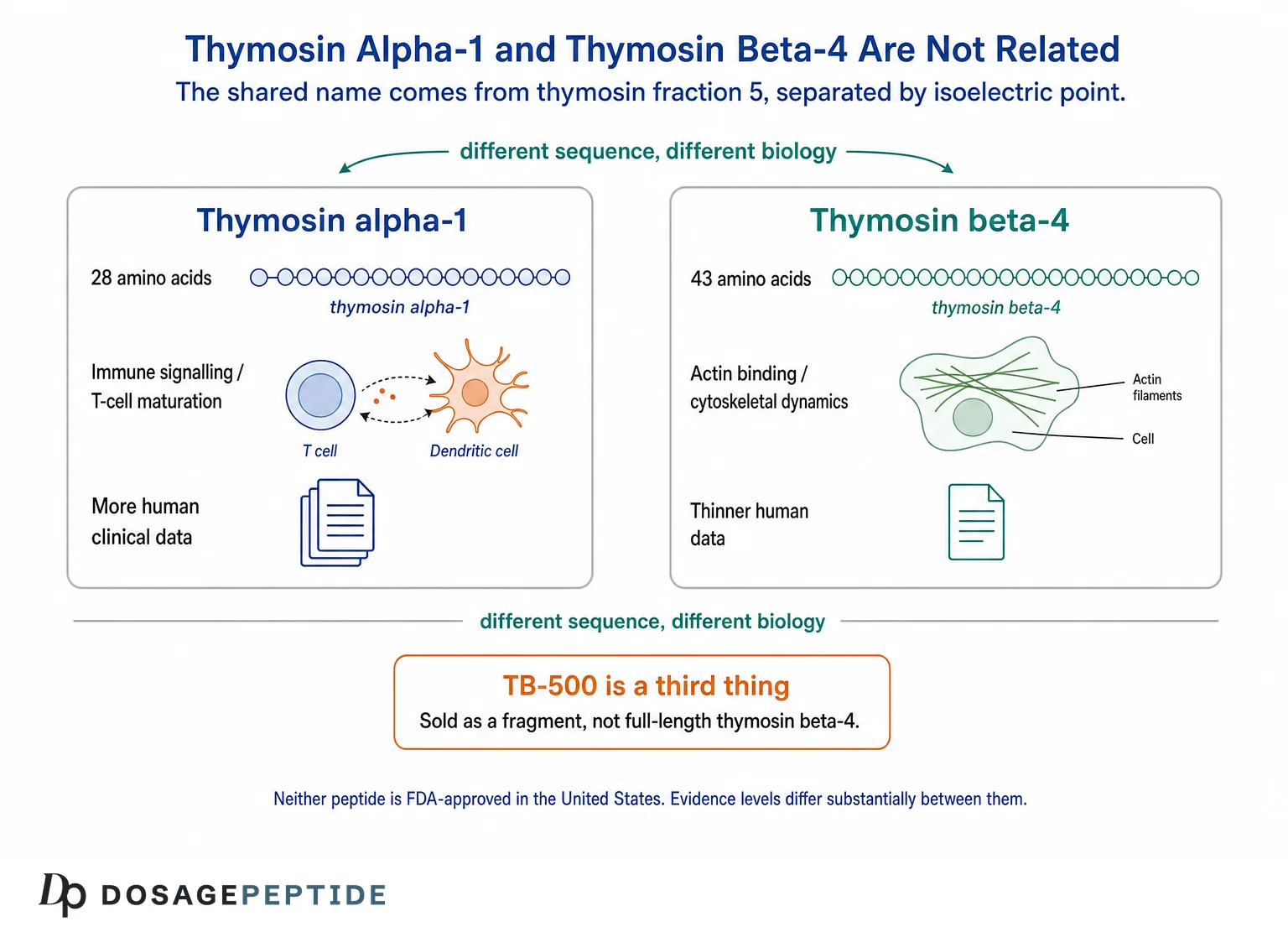
Thymosin alpha-1 and thymosin beta-4 are not two versions of the same molecule. They are two structurally unrelated peptides that ended up sharing a name because both were pulled out of the same crude calf-thymus extract in the 1970s and sorted by electrical charge rather than by any biological relationship. One is a 28-residue immunomodulatory fragment of prothymosin alpha; the other is a 43-residue intracellular actin-binding protein. This article sets out what each one actually is, what the human evidence supports for each, and why the shared prefix is a historical accident that continues to cause confusion in peptide research literature.
Side-by-side: what actually separates them
The single most useful thing to know is that essentially every column below differs. When Low and Goldstein sequenced thymosin beta-4 in 1982, they reported that comparing its sequence to other thymic hormones and to published protein sequences revealed no statistically significant relationship[3]. That finding, from the original characterisation paper, is the cleanest available answer to “are these related?”
| Thymosin alpha-1 (Tα1, thymalfasin) | Thymosin beta-4 (Tβ4) | |
|---|---|---|
| Length | 28 amino acids[1], N-terminally acetylated (acetylserine)[2] | 43 amino acids in the mature chain, N-terminally acetylated[3] |
| Parent molecule | Residues 2–29 of prothymosin alpha (gene PTMA)[5] | Its own gene product (TMSB4X); not a fragment of anything larger[6] |
| Sequence overlap | None of any significance. Both happen to start Ser-Asp; beyond that the sequences diverge completely[5][6] | |
| Isoelectric point | 4.2[2] | 5.1[3] |
| Principal molecular role | Extracellular immune signalling; described as acting largely through Toll-like receptors on dendritic cells and other immune cells[7] | Intracellular G-actin sequestration — the main monomeric-actin buffer in most vertebrate cells[4] |
| Where it is found | Released from prothymosin alpha; studied as a circulating immune mediator | High concentration in almost every cell[4] |
| Human evidence tier | Multiple randomised controlled trials, including a 1,106-participant phase 3 sepsis trial and hepatitis B combination trials — results mixed to negative on hard endpoints[9][11] | Thinner: mostly preclinical, plus small-to-mid-size topical ophthalmic and wound trials, several of which missed their primary endpoints[13] |
| US regulatory status | Not FDA-approved; absent from Drugs@FDA. A review reports the synthetic form, thymalfasin, as approved in over 35 other countries[7] | Not FDA-approved anywhere as a systemic drug; investigational |
| Compounding status (US) | Was placed in FDA’s category 2 (significant safety risks) as a nominated bulk substance; nomination later withdrawn[14] | Same status for the LKKTETQ fragment sold as TB-500[14] |
| Anti-doping | Not named on the WADA Prohibited List | Thymosin-β4 and its derivatives, including TB-500, are prohibited at all times[15] |
| Typical research domain | Immunology, infectious disease, oncology adjunct | Cytoskeletal biology, angiogenesis, wound and corneal repair |
Why do they share the name “thymosin”?
Because the name was assigned to a mixture before anyone knew what was in it.
Thymosin fraction 5 and the isoelectric alphabet
In the 1970s, Allan Goldstein’s group prepared a partially purified calf-thymus extract called thymosin fraction 5 — a mixture of many polypeptides that showed immune activity in bioassays. As they began isolating individual components they proposed a naming convention, in the 1977 paper reporting the sequence of thymosin alpha-1[1]. It sorted peptides by where they migrated on isoelectric focusing: the most acidic band group became “alpha,” the intermediate group “beta,” the basic group “gamma.” The numeric subscript recorded only the order in which each peptide happened to be purified.
So “alpha” and “beta” here mean what “shelf A” and “shelf B” would mean: a sorting step, not a structural family, not a receptor class, not a shared ancestry — unlike the insulin A and B chains or the TGF-beta isoforms, where the letters do track real relatedness.
The polypeptide β1 lesson
The clearest demonstration that the fraction 5 labels carried no biological meaning is polypeptide β1. Low and Goldstein sequenced it alongside thymosin alpha-1: 74 residues, isoelectric point 6.7, inactive in their assay systems — and its sequence reported as identical with ubiquitin[2]. Later review work refined that to ubiquitin truncated by its two C-terminal glycine residues, which is why the count is 74 rather than ubiquitin’s 76[4]. A molecule provisionally filed under “thymic hormone” was one of the most universal housekeeping proteins in biology, and had simply co-purified.
Reviewing the field decades later, Hannappel put the conclusion bluntly: starting from fraction 5, several main peptides were isolated and tested, and none of them were really thymic hormones — they were biologically important peptides with diverse functions[4]. Thymosin beta-4 in particular was reclassified around 1990 when Safer and colleagues identified it as a G-actin-sequestering peptide, a role that has nothing to do with thymic immunity.
Thymosin alpha-1: what the record actually shows
Origin and proposed mechanism
Thymosin alpha-1 corresponds to residues 2–29 of prothymosin alpha, a 111-residue nuclear protein[5]. Mechanistic work describes it as an immunostimulatory peptide interacting with several Toll-like receptors — TLR2, TLR3, TLR4, TLR7 and TLR9 have all been implicated — with downstream effects on dendritic cell maturation, T-cell function and cytokine output[7]. Note the tier: that receptor mapping is largely cell-culture and animal work, not human pharmacodynamics. The site’s overview of thymosin alpha-1 immune modulation research goes deeper on the immunology.
Regulatory status, stated precisely
This is where most write-ups overreach. Thymosin alpha-1 is not an FDA-approved drug in the United States for any indication. There is no thymalfasin or Zadaxin entry in Drugs@FDA. Under the international nonproprietary name thymalfasin, the synthetic form is described in the review literature as approved in over 35 other countries, for hepatitis B and C and for immune-regulating uses[7]. Where you see the phrase “FDA orphan drug” attached to it, read it precisely: orphan designation is a development incentive granted before efficacy is established, it names a rare condition rather than a proven use, and it is not a marketing approval. Letting a reader hear “FDA approved” there is the single most common error in this space.
In the compounding channel, FDA lists thymosin-alpha 1 under bulk drug substances nominated but withdrawn — substances previously in category 2, whose nominations the nominators pulled. The agency’s stated concerns were immunogenicity risk for certain routes, peptide-related impurities, characterisation complexity, and safety information inadequate to judge the risk[14]. Withdrawal removed the nomination, not the concerns.
Human trials, including the ones that did not work
Thymosin alpha-1 has genuinely more human data than most peptides discussed in research forums — and the honest summary is that the large, well-controlled studies have been disappointing.
- Sepsis, ETASS (2013). A multicentre, single-blind randomised trial in six Chinese hospitals randomised 361 patients with severe sepsis. Twenty-eight-day all-cause mortality was 26.0% with Tα1 versus 35.0% in controls, with a relative risk of 0.74 (95% CI 0.54 to 1.02). The result was borderline and direction-dependent on the test used: not significant on the nonstratified analysis (P=0.062), marginally significant by log rank (P=0.049)[8].
- Sepsis, TESTS (2025). The definitive follow-up was a double-blind, placebo-controlled phase 3 trial across 22 centres, enrolling 1,106 adults. Twenty-eight-day all-cause mortality was 23.4% with Tα1 versus 24.1% with placebo (hazard ratio 0.99, 95% CI 0.77 to 1.27). No secondary or safety outcome differed significantly. The authors concluded there was no clear evidence that thymosin alpha-1 reduces 28-day mortality in sepsis[9].
- Pooled sepsis evidence (2025). A systematic review of 11 randomised trials found an overall mortality signal (OR 0.73, 95% CI 0.59 to 0.90), but the effect disappeared when restricted to high-quality trials (OR 0.82, 95% CI 0.65 to 1.03) or multicentre trials (OR 0.86, 95% CI 0.68 to 1.08), and trial sequential analysis indicated the accumulated sample size remains inadequate[10]. That pattern — benefit in the smaller and lower-quality studies, null in the rigorous ones — is a classic signature of bias rather than effect.
- Chronic hepatitis B. A meta-analysis of seven randomised trials (1,144 participants) comparing entecavir plus Tα1 with entecavir alone in HBV-related cirrhosis found higher HBV DNA undetectable and HBeAg loss rates at 24 weeks, but no significant difference at 48 and 52 weeks, and no difference in HBsAg loss at week 52. All included patients were from mainland China[11].
Handling and reconstitution literature for laboratory work is documented separately in the thymosin alpha-1 5 mg vial reference and the accompanying reconstitution notes. Those pages record what published protocols specified; they are not instructions for use.
Thymosin beta-4: what the record actually shows
A cytoskeletal protein first
Thymosin beta-4 is the most abundant beta-thymosin, present in high concentration in almost every vertebrate cell. Its established function is binding monomeric G-actin in a 1:1 complex, buffering against unwanted polymerisation while supplying a monomer pool when the cell needs filaments[4]. The regenerative effects attributed to extracellular Tβ4 — chemotaxis, angiogenesis, reduced inflammation, wound closure — sit on top of that, and the molecular mechanisms mediating them have been described as poorly understood even in review literature sympathetic to the peptide[4].
The human trial record
Most Tβ4 clinical work has been topical rather than systemic, and the ophthalmic formulation RGN-259 has gone furthest. The published SEER-1 study in neurotrophic keratopathy is labelled phase 3 but reads as a pilot: 10 patients on drug, 8 on placebo. Complete healing at four weeks — the primary endpoint — was 6 of 10 versus 1 of 8, which the authors themselves report as a trend that did not reach significance (P=0.0656); significance came at later timepoints and on comfort measures[12]. The registry records that same trial as terminated, 18 enrolled. In dry eye, ARISE-3 — the largest of three phase 3 trials, 700 participants, primary completion November 2020 — carried co-primary endpoints of inferior corneal fluorescein staining and ocular discomfort at day 15[13]; the sponsor announced in May 2021 that both were missed, reporting a secondary symptom measure instead. A European phase 3 in neurotrophic keratopathy (SEER-3) also missed its primary endpoint, per its sponsor; a US phase 3 in that indication is still recruiting[13]. Systemically the record is worse: an intravenous phase 1 in myocardial ischaemia and a phase 2 in ST-elevation myocardial infarction were both withdrawn with zero enrolment, and a phase 2 in epidermolysis bullosa was terminated. Two phase 2 topical wound studies did complete at 72 participants each — and neither progressed to phase 3[13].
The tier statement: thymosin beta-4 is investigational. Its strongest human signals are topical and ocular, not systemic and not musculoskeletal, and the framing of Tβ4 as a proven tendon or muscle repair agent in humans is animal and cell-culture evidence wearing a human label. The site’s thymosin beta-4 10 mg vial reference catalogues what published research protocols specified.
Why “TB-500” is a third thing entirely
This matters more than the alpha/beta confusion, because it involves what is physically in a vial. “TB-500” is a research-chemical trade label, not a molecular identity. FDA’s own compounding records name the substance explicitly: “Thymosin beta-4, fragment (LKKTETQ), also known as TB-500” — and note that the agency identified no human exposure data for products containing that fragment[14]. LKKTETQ corresponds to residues 17–23 of the 43-residue mature thymosin beta-4 chain: the actin-binding motif, seven amino acids out of forty-three[6].
A separate fragment adds a third layer. Ac-SDKP is the acetylated N-terminal tetrapeptide of thymosin beta-4 (residues 1–4 of the mature chain), annotated in sequence databases as a haemoregulatory peptide generated by enzymatic cleavage and studied in its own right[6][4].
So a paper reporting an effect of full-length recombinant Tβ4 does not transfer to a heptapeptide fragment, and vice versa. Vendor labelling in the research-chemical market is inconsistent about which of these is supplied, and research-grade material is in no case the same thing as an approved or clinically studied product. The full breakdown is in the dedicated comparison of thymosin beta-4 versus TB-500.
Anti-doping: only one of the two is listed
Thymosin-β4 and its derivatives, with TB-500 given as the named example, appear under the growth-factor heading of section S2 of the WADA Prohibited List. S2 substances are prohibited at all times, in and out of competition, and are non-specified[15]. Thymosin alpha-1 is not named on that list, which is not the same as an exemption — a substance can still be caught by a category description. The list is revised annually and section numbering shifts between editions, so the current edition is the only authority.
How to read literature that conflates them
Three practical checks when you encounter a “thymosin” claim:
- Read the subscript, then ignore the prefix. A finding about alpha-1 carries no information about beta-4, or the reverse.
- Ask which sequence was actually used. Full-length 43-residue Tβ4, the LKKTETQ fragment, and Ac-SDKP are three different test articles with three different literatures.
- Separate designation, approval and marketing. Approved elsewhere is not FDA-approved. Orphan designation is not approval. Investigational is not proven.
The same discipline applies across the wider immune-peptide cluster: thymalin is another thymic-extract-derived preparation with its own distinct history, while KPV and LL-37 are unrelated immune-active peptides that also appear in FDA’s nominated-substance records with limited or absent human safety data[14].
Frequently Asked Questions
Are thymosin alpha-1 and thymosin beta-4 the same peptide?
No. They are 28 and 43 amino acids respectively, come from different genes, have different isoelectric points and have no meaningful sequence homology. The 1982 characterisation of thymosin beta-4 reported no statistically significant relationship between its sequence and other thymic hormones. They share a prefix because both were isolated from the same crude calf-thymus extract and grouped by charge.
Why are they both called thymosin if they are unrelated?
The name was applied to thymosin fraction 5, a mixture, before its components were known. Peptides were then labelled alpha, beta or gamma by where they migrated on isoelectric focusing, and numbered by order of isolation. The scheme was proposed in the 1977 paper reporting thymosin alpha-1’s sequence. It captures a purification step, not a molecular family.
Is thymosin alpha-1 FDA-approved?
No. Thymosin alpha-1 is not FDA-approved for any indication in the United States. There is no thymalfasin or Zadaxin entry in Drugs@FDA. Review literature describes the synthetic form, thymalfasin, as approved in over 35 other countries for hepatitis B and C and for immune-regulating uses. Orphan-drug designation is sometimes cited alongside it; designation is a development incentive granted before efficacy is established, not a marketing approval.
Did thymosin alpha-1 work in sepsis trials?
The large trial said no. TESTS, a 1,106-participant double-blind placebo-controlled phase 3 trial published in 2025, found 28-day mortality of 23.4% versus 24.1% for placebo, hazard ratio 0.99. The earlier, smaller ETASS trial showed a borderline mortality difference that was not significant on its nonstratified analysis (P=0.062) and marginally significant by log rank (P=0.049). A 2025 meta-analysis found the apparent benefit vanished when limited to high-quality or multicentre trials.
Is TB-500 the same as thymosin beta-4?
Generally not. FDA’s compounding records identify TB-500 as the thymosin beta-4 fragment LKKTETQ, which is residues 17 to 23 of the 43-residue mature peptide. That is seven amino acids out of forty-three. Research on full-length recombinant thymosin beta-4 does not automatically apply to the fragment, and vendor labelling in the research-chemical market is inconsistent about which is supplied.
What is Ac-SDKP and how does it relate?
Ac-SDKP is the acetylated N-terminal tetrapeptide of thymosin beta-4 — residues 1 to 4 of the mature chain — generated by enzymatic cleavage of the parent peptide. It has its own separate research literature, largely around haematopoiesis and antifibrotic effects. It is a distinct molecular entity from both full-length thymosin beta-4 and from the LKKTETQ fragment sold as TB-500.
Which of the two has stronger human evidence?
Thymosin alpha-1, by volume of controlled human data — but volume is not the same as positive results. Its largest rigorous trials were null. Thymosin beta-4 has a thinner human record concentrated in topical ophthalmic indications, where a 700-participant dry eye phase 3 and a European neurotrophic keratopathy phase 3 both missed their primary endpoints, and the one published phase 3 in neurotrophic keratopathy enrolled 18 people and missed its own primary timepoint. Neither compound has an approved indication in the United States.
Does thymosin beta-4 repair tendons in humans?
That is not established. The tendon, muscle and cardiac repair literature for thymosin beta-4 is overwhelmingly animal and cell-culture based. Its registered systemic human programmes did not deliver: an intravenous phase 1 in myocardial ischaemia and a phase 2 in ST-elevation myocardial infarction were both withdrawn with zero enrolment, and a phase 2 in epidermolysis bullosa was terminated. Two phase 2 topical wound studies completed at 72 participants each without progressing to phase 3. No controlled human trial has demonstrated a tendon repair benefit. Treating preclinical regeneration findings as human evidence is the most common inflation in this area.
References
- Goldstein AL, Low TL, McAdoo M, et al. Thymosin alpha1: isolation and sequence analysis of an immunologically active thymic polypeptide. Proc Natl Acad Sci USA. 1977;74(2):725–729. https://pubmed.ncbi.nlm.nih.gov/265536/
- Low TL, Goldstein AL. The chemistry and biology of thymosin. II. Amino acid sequence analysis of thymosin alpha1 and polypeptide beta1. J Biol Chem. 1979;254(3):987–995. https://pubmed.ncbi.nlm.nih.gov/762108/
- Low TL, Goldstein AL. Chemical characterization of thymosin beta 4. J Biol Chem. 1982;257(2):1000–1006. https://pubmed.ncbi.nlm.nih.gov/7054160/
- Hannappel E. beta-Thymosins. Ann N Y Acad Sci. 2007;1112:21–37. https://pubmed.ncbi.nlm.nih.gov/17468232/
- UniProt Consortium. Prothymosin alpha, human (P06454) — thymosin alpha-1 peptide annotation, residues 2–29. https://www.uniprot.org/uniprotkb/P06454/entry
- UniProt Consortium. Thymosin beta-4, human (P62328) — mature chain 2–44 and AcSDKP peptide annotation. https://www.uniprot.org/uniprotkb/P62328/entry
- Tao N, Xu X, Ying Y, et al. Thymosin α1 and its role in viral infectious diseases: the mechanism and clinical application. Molecules. 2023;28(8):3539. https://pubmed.ncbi.nlm.nih.gov/37110771/
- Wu J, Zhou L, Liu J, et al. The efficacy of thymosin alpha 1 for severe sepsis (ETASS): a multicenter, single-blind, randomized and controlled trial. Crit Care. 2013;17(1):R8. https://pubmed.ncbi.nlm.nih.gov/23327199/
- Wu J, Pei F, Zhou L, et al. The efficacy and safety of thymosin α1 for sepsis (TESTS): multicentre, double blinded, randomised, placebo controlled, phase 3 trial. BMJ. 2025;388:e082583. https://pubmed.ncbi.nlm.nih.gov/39814420/
- Gu B, Zhou Y, Nie Y, et al. Efficacy of thymosin α1 for sepsis: a systematic review and meta-analysis of randomized controlled trials. Front Cell Infect Microbiol. 2025;15:1673959. https://pubmed.ncbi.nlm.nih.gov/40969554/
- Peng D, Xing HY, Li C, et al. The clinical efficacy and adverse effects of entecavir plus thymosin alpha-1 combination therapy versus entecavir monotherapy in HBV-related cirrhosis: a systematic review and meta-analysis. BMC Gastroenterol. 2020;20(1):348. https://pubmed.ncbi.nlm.nih.gov/33076834/
- Sosne G, Kleinman HK, Springs C, et al. 0.1% RGN-259 (thymosin β4) ophthalmic solution promotes healing and improves comfort in neurotrophic keratopathy patients in a randomized, placebo-controlled, double-masked phase III clinical trial. Int J Mol Sci. 2023;24(1):554. https://pubmed.ncbi.nlm.nih.gov/36613994/ — registry record (SEER-1, NCT02600429; status terminated, 18 enrolled): https://clinicaltrials.gov/study/NCT02600429
- ClinicalTrials.gov registry records for thymosin beta-4 programmes. ARISE-3 dry eye, phase 3, n=700, completed (NCT03937882): https://clinicaltrials.gov/study/NCT03937882. SEER-2 neurotrophic keratopathy, phase 3, recruiting (NCT05555589): https://clinicaltrials.gov/study/NCT05555589. Intravenous phase 1, myocardial ischaemia, withdrawn (NCT00743769): https://clinicaltrials.gov/study/NCT00743769. RGN-352 STEMI phase 2, withdrawn (NCT01311518): https://clinicaltrials.gov/study/NCT01311518. Epidermolysis bullosa phase 2, terminated (NCT00311766): https://clinicaltrials.gov/study/NCT00311766. Venous stasis ulcers phase 2, completed (NCT00832091): https://clinicaltrials.gov/study/NCT00832091. Pressure ulcers phase 2, completed (NCT00382174): https://clinicaltrials.gov/study/NCT00382174
- US Food and Drug Administration. Certain bulk drug substances for use in compounding that may present significant safety risks (category 2 and withdrawn nominations; content current as of 22 April 2026). https://www.fda.gov/drugs/human-drug-compounding/certain-bulk-drug-substances-use-compounding-may-present-significant-safety-risks
- World Anti-Doping Agency. The Prohibited List (current edition; S2 peptide hormones, growth factors, related substances and mimetics). https://www.wada-ama.org/en/prohibited-list
This article is an independent research reference for laboratory and educational use only. Neither thymosin alpha-1 nor thymosin beta-4 is approved by the FDA for any indication in the United States, and nothing here is a recommendation, protocol, or endorsement for human use. Compounds discussed are research chemicals; research-grade material is not equivalent to any approved pharmaceutical product. Regulatory and anti-doping status change — verify against the current primary sources. Consult a qualified licensed clinician for any medical question.