Larazotide acetate (AT-1001, also designated INN-202) is a synthetic eight–amino–acid peptide — sequence Gly-Gly-Val-Leu-Val-Gln-Pro-Gly — structurally related to the Vibrio cholerae zonula occludens toxin, developed as an orally administered regulator of intestinal tight junctions. The single most important fact about it, and the one most pages get wrong, is the trial outcome: the phase 3 celiac disease study (NCT03569007, sponsor 9 Meters Biopharma) was terminated by the sponsor in June 2022 after a pre-specified interim sample-size re-estimation concluded that the additional enrolment needed to demonstrate a significant difference versus placebo was too large to justify continuing, and no efficacy results have ever been posted to ClinicalTrials.gov.[1] Larazotide is not approved by the FDA for any indication, and as of August 2026 there is still no approved pharmacological treatment for celiac disease anywhere — the gluten-free diet remains the only established management.
What is larazotide acetate, chemically and pharmacologically?
Larazotide acetate is a single-chain octapeptide of the sequence H-Gly-Gly-Val-Leu-Val-Gln-Pro-Gly-OH (GGVLVQPG), supplied as the acetate salt. It was designed at Alba Therapeutics as a structural analogue of a region of the Vibrio cholerae zonula occludens toxin (Zot) — the enterotoxin that pries intercellular tight junctions open. The design intent was inversion: take a fragment that engages the junction-regulating pathway and build a peptide that occupies it without triggering the opening signal. In the review by Slifer and colleagues, larazotide is described as a tight junction regulator that “is thought to act as a zonulin antagonist to reduce zonulin-induced increases in barrier permeability” — note the hedge in the source itself.[2]
The property that separates larazotide from almost every other peptide discussed in research-peptide circles is where it acts. It is given orally and works from inside the gut lumen; in the words of the investigators who mapped its intestinal distribution in pigs, “the peptide is broken down in the small intestine and there is no systemic absorption of LA or the fragments.”[3] That has consequences covered below.
A naming collision worth knowing about: two different “AT-1001” molecules
The code name AT-1001 is not unique. Alba Therapeutics used AT-1001 for larazotide acetate; Amicus Therapeutics independently used AT1001 for migalastat hydrochloride, a small-molecule pharmacological chaperone for Fabry disease that is FDA-approved (as Galafold, for adults with Fabry disease and an amenable GLA variant). A search of ClinicalTrials.gov for “AT-1001” returns both programmes mixed together, and secondary sources routinely conflate them — attributing migalastat’s approval, its oral bioavailability, or its Fabry trial data to larazotide. If a page tells you AT-1001 is an approved drug, it has almost certainly merged the two molecules. Larazotide has no approval anywhere.
Is larazotide an injectable peptide? No — and that matters
Larazotide is an oral agent that is deliberately engineered not to be systemically absorbed. Its target — the apical surface of the small-intestinal epithelium — faces the gut lumen, so the drug only has to reach the inside of the intestine, not the bloodstream. That is the opposite of the design brief for most research peptides discussed on this site, which are handled as lyophilised powders for parenteral laboratory use.
The evidence for non-absorption is direct rather than inferred. Across the early human trials, plasma concentrations of larazotide and its fragments sat below the lower limit of quantification of 0.5 ng/mL at every dose tested (0.25, 1, 4 and 8 mg), and remained below that limit even after a 12 mg oral dose — so a systemic pharmacokinetic profile could not be derived at all.[3] Because there was nothing to measure in blood, a porcine study of a delayed-release formulation approached the question from the other direction and sampled the gut itself: peak intraluminal concentrations of roughly 0.32–1.76 µM were measured about one hour after dosing in the distal duodenum and proximal jejunum — precisely the segments where celiac mucosal damage occurs — with drug still detectable there at two to four hours. That study measured intestinal fluid only; it did not sample porcine plasma, and it should not be cited as if it had.[3]
Three practical consequences follow for anyone reading about this compound:
- Systemic-exposure framing is pharmacologically wrong here. Any source describing larazotide in terms of subcutaneous administration, circulating half-life, or systemic peptide handling is describing a different pharmacology than the one the molecule was built for.
- Dose figures are small and luminal, not weight-scaled systemic doses. The doses used in the published trials were 0.25 mg, 0.5 mg, 1 mg, 2 mg, 4 mg and 8 mg administered three times daily — quantities chosen to sit in the gut, not to achieve a plasma concentration. These are historical trial parameters, not guidance for any use. The dose ranges and formulation notes reported across those published trials are catalogued on our larazotide 0.5 mg research dosage protocol reference.
- Reconstitution logic does not transfer. The handling conventions in our peptide reconstitution guide were written for lyophilised powders intended for parenteral laboratory work; an orally delivered, enterically formulated luminal peptide is a different pharmaceutical problem entirely.
How is larazotide supposed to work at the tight junction?
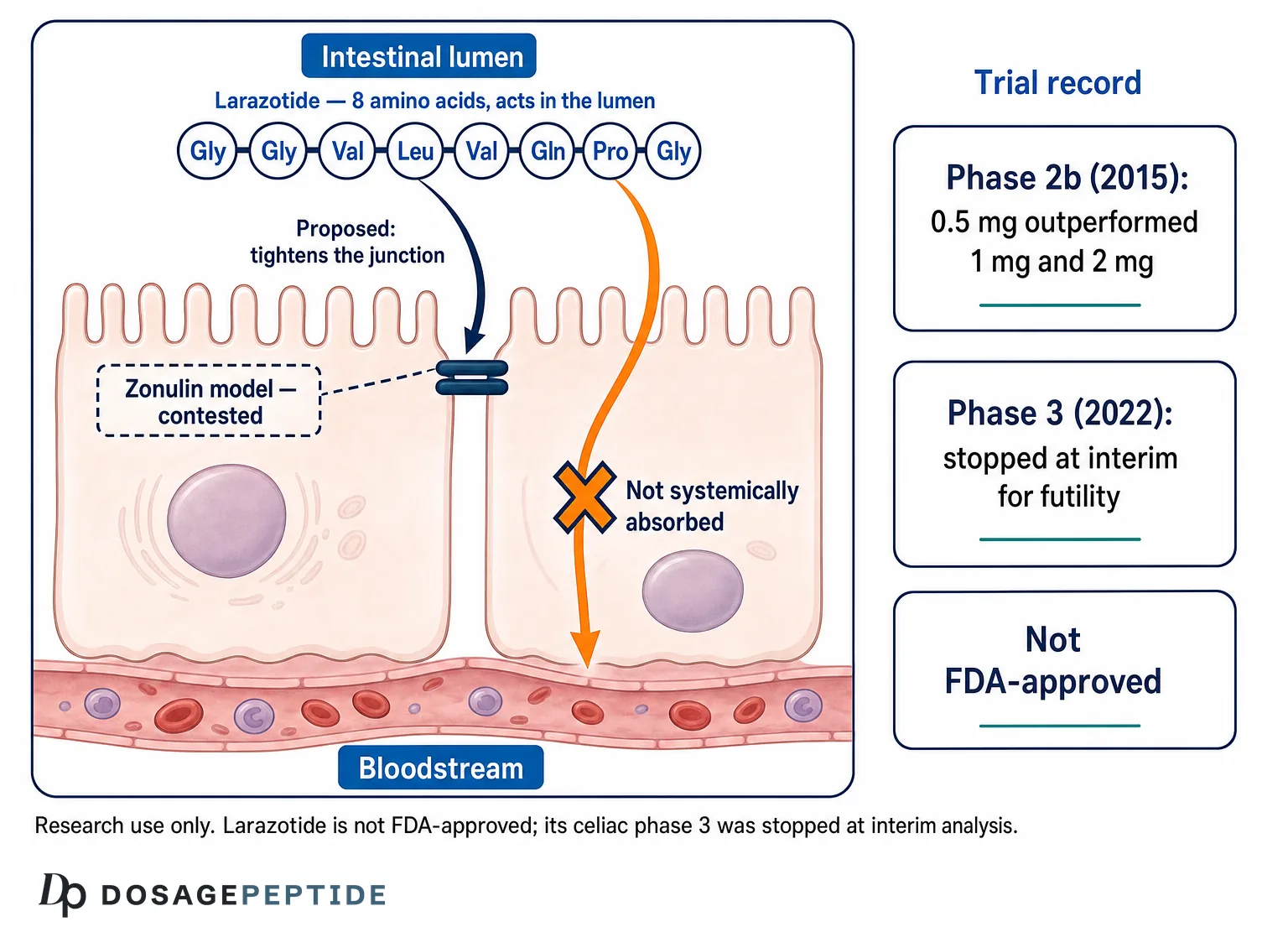
Tight junctions are the multi-protein seals between adjacent epithelial cells that set paracellular permeability. Their state is dynamic: cytokines, bacterial products, and — in the celiac model — gliadin fragments can trigger reorganisation of the junctional proteins ZO-1, occludin and the claudins, together with rearrangement of the perijunctional actomyosin ring, loosening the seal.
In cell and animal work, larazotide acetate opposes that sequence. Gopalakrishnan and colleagues showed that larazotide inhibited the ZO-1 and actin redistribution caused by gliadin fragments and by the Zot-derived agonist peptide AT-1002 in Caco-2 and IEC6 monolayers, blocked the associated fall in transepithelial electrical resistance, reduced translocation of an immunogenic gliadin 13-mer across the monolayer, and — notably — blunted permeability increases when cytokines were applied to the basolateral side while the peptide sat apically.[4] In gliadin-sensitised HLA-HCD4/DQ8 transgenic mice, it limited intestinal macrophage accumulation and preserved junctional structure.[4]
Mechanistically the picture has broadened since the original “zonulin receptor antagonist” description. Larazotide has more recently been linked to inhibition of myosin light chain kinase, which the review’s authors say “likely reduces tension on actin filaments, thereby facilitating tight junction closure” — again a proposed mechanism rather than a demonstrated one. The same review notes that the barrier-regulating effect has been reproduced well outside celiac models — in collagen-induced arthritis in mice and in intestinal ischemic injury in pigs.[2] These are in vitro and animal findings; they characterise a mechanism, they do not demonstrate clinical benefit.
For the broader question of how intestinal permeability is measured and what the peptide literature does and does not establish about it, see our overview of peptides and gut barrier / intestinal permeability research.
Is the zonulin model settled science?
No, and this deserves to be stated plainly rather than assumed. Larazotide is routinely marketed as a “zonulin inhibitor,” which implies a well-defined target with a well-defined assay. Both halves of that implication are contested.
Zonulin was proposed as the endogenous human analogue of Zot and later identified as pre-haptoglobin-2, the uncleaved precursor of haptoglobin 2. The complication is that the commercial assays used to generate much of the “serum zonulin” literature appear not to measure that protein. Scheffler and colleagues found that a widely used commercial zonulin ELISA did not recognise recombinant pre-haptoglobin-2 at all, that its signal was uncorrelated with haptoglobin genotype, and that mass spectrometry identified properdin and other structurally related proteins as the likely captured antigens.[5] Independently, Ajamian and colleagues immunoprecipitated the antigen detected by two commercial kits and identified haptoglobin and complement C3 — concluding that “current commercial zonulin assays are not detecting the actual protein as prehaptoglobin-2” and advising caution in treating serum zonulin as a barrier-integrity marker.[6]
What this does not mean: it does not mean tight junction regulation is fake, and it does not invalidate the direct cell-biology observations of larazotide’s effect on ZO-1, occludin and actin, which were made with imaging and electrophysiology rather than with a zonulin ELISA. What it does mean is that the causal chain “leaky gut → measurable serum zonulin → disease → correctable by a zonulin antagonist” is a model under active dispute, not an established fact. Any page presenting zonulin as a routinely quantifiable clinical biomarker is running ahead of the assay literature. Definitions of these terms are collected in our peptide research glossary.
What did the larazotide phase 3 trial actually show?
The phase 3 study was CeD-LA-3001 (NCT03569007), a randomised, double-blind, placebo-controlled trial of larazotide 0.25 mg or 0.50 mg three times daily versus matching placebo in adults with celiac disease who still had symptoms despite a gluten-free diet. It began on 29 May 2019, ran at 160 sites, and was designed for 525 patients split evenly across three arms (175 each). The primary endpoint is recorded slightly differently in the two available sources, which is worth flagging: the registry lists “proportion of subjects who are binary responders” based on reduction in CeD PRO abdominal domain scores at 12 weeks, while the sponsor’s own press release describes it as mean change from baseline in the CeD PRO abdominal domain score over 12 weeks.[1][7]
On 21 June 2022, 9 Meters Biopharma announced completion of a pre-specified interim analysis, conducted by an independent statistician with, in the company’s words, “the sole purpose of re-estimating the treatment group size required to detect a statistically significant clinical effect of larazotide.” The interim “included the first approximately 50% of the initial target enrollment and followed the completion of the 12-week double-blind efficacy portion of study.” The conclusion: “the additional number of patients needed to determine a significant clinical outcome between placebo and larazotide is too large to support trial continuation.”[7] The registry now lists the study as terminated, reason “Trial terminated by Sponsor,” with 307 participants actually enrolled against the 525 planned, and completion recorded 21 July 2022.[1]
Precision matters here, and it cuts both ways. Note what this analysis was and was not. It was a sample-size re-estimation, not a formal futility boundary and not a published negative topline readout. No treatment effect estimate, no p-value and no confidence interval was released; the only quantity disclosed was a judgement that the required additional enrolment was prohibitive. The trial never completed, and as of August 2026 no results section has been posted to ClinicalTrials.gov.[1] So pages claiming “larazotide failed its phase 3 endpoint with p = X” are inventing a figure that was never published. Equally, pages claiming the trial was stopped for funding reasons, or that it is “still ongoing,” are wrong in the other direction: the sponsor’s own stated reason was the interim sample-size projection. The company also said it would analyse the data further to see whether any subgroup or individual symptom responded; no such analysis has since appeared in the peer-reviewed literature or on the registry. The sponsor filed for Chapter 7 bankruptcy in July 2023, and no phase 3 celiac programme for larazotide has been reactivated since.
The larazotide trial record at a glance
| Study | Phase / population | N | Doses tested | Reported outcome |
|---|---|---|---|---|
| Human plasma exposure across early trials | Phase 1–2, healthy adults and celiac patients | — | 0.25, 1, 4, 8 mg; also 12 mg single dose | Plasma larazotide and metabolites below the limit of quantification (0.5 ng/mL) at every dose, so no systemic PK profile could be derived[3] |
| Leffler et al., Am J Gastroenterol 2012 | Phase 2b, celiac, 14-day gluten challenge (2.4 g/day) | 86 randomised | 0.25, 1, 4, 8 mg TID | Primary endpoint (urinary lactulose/mannitol ratio) not interpretable — outpatient LAMA too variable. Some lower doses limited symptom worsening; the highest dose did not[8] |
| Kelly et al., Aliment Pharmacol Ther 2013 | Phase 2b, celiac, 6-week gluten challenge (2.7 g/day) | 184 | 1, 4, 8 mg TID | No difference in LAMA ratio. 1 mg reduced GSRS symptoms (P = 0.002); anti-tTG IgA rise blunted at all three doses (placebo ratio 19.0 vs 5.78 / 3.88 / 7.72)[9] |
| Leffler et al., Gastroenterology 2015 (NCT01396213) | Phase 2b, persistent symptoms on a gluten-free diet | 342 | 0.5, 1, 2 mg TID | Primary endpoint met at 0.5 mg only (ANCOVA P = 0.022; MMRM P = 0.005). 1 mg and 2 mg no different from placebo on any endpoint. Safety comparable to placebo[10] |
| CeD-LA-3001 (NCT03569007) | Phase 3, persistent symptoms on a gluten-free diet | 307 enrolled (525 planned) | 0.25, 0.50 mg TID | Terminated by sponsor, June 2022, after a pre-specified interim sample-size re-estimation found the required additional enrolment too large to continue. No efficacy figures released; no results posted[1] |
| MIS-C proof of concept (NCT05022303) | Phase 2a, paediatric MIS-C | 12 | Weight-based oral, QID | Terminated — registry reason “Decline in MISC cases.” No results posted[15] |
| Long COVID (NCT05747534) | Phase 2a, ages 7 to 50 | 107 | 250 or 500 µg QID, 21 days | Active, not recruiting; last registry update 22 May 2026, estimated primary completion 5 June 2026 — a date now passed without a registry update or posted results[11] |
A 2021 systematic review and meta-analysis pooling four randomised trials (626 patients; 465 on larazotide, 161 on placebo) reached a restrained conclusion: no significant effect on the lactulose-to-mannitol permeability ratio regardless of gluten status; some symptomatic benefit on GSRS scores in the gluten-challenge subgroup; and no significant symptomatic difference in patients on a gluten-free diet. The authors called for further trials rather than declaring efficacy.[12]
Why did 0.5 mg outperform 1 mg and 2 mg?
This is the strangest feature of the larazotide record and it should not be smoothed over. In the 342-patient phase 2b trial, the primary endpoint was met at the lowest dose studied, 0.5 mg three times daily, while 1 mg and 2 mg were no different from placebo on any endpoint.[10] The earlier gluten-challenge studies show the same shape: lower doses appeared to limit symptom worsening while the 8 mg dose did not.[8]
A non-monotonic (inverted-U) dose response is not automatically disqualifying — receptor-level explanations exist, including self-aggregation of the peptide at higher luminal concentrations reducing the free monomer available to engage the target, or partial-agonist behaviour emerging at higher occupancy. But it is a pattern that also arises when a modest signal is being read out of multiple dose arms and multiple endpoints, which raises the prior probability that the “winning” dose was partly a chance finding. The phase 3 design took the honest route and carried the low doses forward — 0.25 mg and 0.50 mg, straddling the phase 2b winner — rather than escalating.[1] That the confirmatory trial then stopped because the projected separation from placebo would have required an impractical number of extra patients is the most informative single data point in the whole programme, precisely because the design gave the phase 2b result its best chance to replicate. It is not proof that larazotide does nothing — a stopped trial cannot prove that — but it is the closest thing to a verdict the programme ever produced.
What is larazotide’s regulatory status in August 2026?
Unambiguously: larazotide acetate is not FDA-approved, not EMA-approved, and not approved anywhere for any indication. It remains an investigational compound whose most advanced programme was terminated.
The programme did hold an FDA Fast Track designation for celiac disease: at the August 2019 launch of the phase 3 trial — then run by Innovate Biopharmaceuticals, which merged into 9 Meters Biopharma in 2020 — the Celiac Disease Foundation reported plainly that “larazotide acetate has received Fast Track designation from the FDA for celiac disease.”[13] A designation is a process status, not a verdict on the drug: Fast Track grants more frequent FDA interaction and rolling-review eligibility for a serious condition with unmet need. It says nothing about whether the compound works, and it confers no approval. Orphan-drug designation would be a separate mechanism and is implausible for this indication in any case, since celiac disease affects on the order of 1% of the US population — far above the fewer-than-200,000-patient threshold that defines a rare disease for orphan purposes.
The wider context: FDA has published a formal guidance for industry on developing drugs as adjunctive treatment to a gluten-free diet in celiac disease,[14] and several mechanistically distinct candidates — gluten-degrading enzymes, transglutaminase 2 inhibitors, anti-IL-15 antibodies, tolerising approaches — are in trials. None has reached approval. The gluten-free diet remains the only established treatment for celiac disease.
What larazotide research continues outside celiac disease?
The tight junction mechanism outlived the celiac programme, and the remaining work is genuinely early. It should be read as hypothesis-generating, not as evidence of benefit.
- Long COVID (NCT05747534) — a phase 2a randomised, double-blind, placebo-controlled study at Massachusetts General Hospital in 107 participants aged 7 to 50, testing 250 or 500 µg four times daily for 21 days against placebo. The record was last updated on 22 May 2026 and still reads active, not recruiting, with an estimated primary completion of 5 June 2026 — a date that has now passed with no registry update and no results posted.[11] This is currently the only active clinical larazotide study on the registry, and nothing is yet known about its outcome.
- Multisystem inflammatory syndrome in children — an open-label case series of four children aged 3 to 17, given larazotide as an adjuvant to steroids and/or intravenous immunoglobulin, reported spike antigenemia falling to undetectable levels and shorter time to resolution of gastrointestinal symptoms (P = 0.03) and to spike clearance (P = 0.04) versus 22 children receiving standard therapy alone.[15] Four patients, open label, everyone on background therapy, non-randomised comparison — the authors themselves called for trial expansion. That is a signal to test, nothing more. The follow-on phase 2a was terminated with 12 participants, the registry reason being a decline in MIS-C cases, and no results were posted.[15]
- Inflammatory arthritis and intestinal ischemia (animal only) — the barrier-regulating effect has been reproduced in collagen-induced arthritis in mice and in ischemia-injured porcine jejunum, alongside continuing in vitro work on tight junction repair and sustained-release delivery formats.[2] Preclinical only, with no human data in either indication.
Readers comparing barrier-directed research peptides may find our explainers on KPV, the anti-inflammatory tripeptide and on BPC-157 and gut lining protection in ulcer models useful for contrast — those compounds sit at very different evidence tiers again, and both are also unapproved. Our general reference on peptide safety questions in research contexts covers why an absent human safety database is not the same thing as a clean one.
Frequently Asked Questions
Is larazotide FDA-approved for celiac disease?
No. Larazotide acetate has never been approved by the FDA or any other regulator, for celiac disease or any other condition. Its phase 3 celiac trial was terminated by the sponsor in June 2022 and never completed. The programme held an FDA Fast Track designation, which speeds regulatory interaction for serious unmet-need conditions but is not an approval and says nothing about whether a drug works.
Did larazotide fail its phase 3 trial?
It was stopped, which is not identical to a published failure. At a pre-specified interim analysis covering the first roughly 50% of target enrolment, an independent statistician re-estimated the group size needed to detect a significant effect; the sponsor concluded the additional patients required were too many to justify continuing, and discontinued the trial in June 2022. This was a sample-size re-estimation rather than a formal futility boundary. No phase 3 efficacy figures, p-values or confidence intervals were ever released and no results have been posted to ClinicalTrials.gov, so any page quoting a phase 3 p-value is fabricating it.
Is larazotide injected or taken orally?
Orally. Larazotide acts locally inside the intestinal lumen on the apical surface of the epithelium, and is designed not to be systemically absorbed. Human plasma concentrations of larazotide and its fragments sat below the limit of quantification of 0.5 ng/mL at every dose tested in the early trials, so systemic pharmacokinetics could not be characterised at all. Descriptions of larazotide as an injectable or systemically circulating peptide misrepresent the molecule’s basic pharmacology.
What is the amino acid sequence of larazotide acetate?
Larazotide acetate is the octapeptide H-Gly-Gly-Val-Leu-Val-Gln-Pro-Gly-OH, written GGVLVQPG in single-letter code, supplied as the acetate salt. It was designed as a structural analogue of a region of the Vibrio cholerae zonula occludens toxin, the enterotoxin that opens tight junctions, with the intent of occupying the pathway without triggering junction opening.
What does “zonulin inhibitor” actually mean, and is zonulin real?
Zonulin was proposed as the human analogue of the cholera Zot toxin and identified as pre-haptoglobin-2. The model is contested: independent groups have shown that widely used commercial zonulin ELISAs do not detect pre-haptoglobin-2, instead capturing properdin, haptoglobin or complement C3. Tight junction regulation itself is well established; the specific zonulin measurement chain used to support it is not, so treat “zonulin inhibitor” as a mechanistic hypothesis.
Why did the 0.5 mg dose work better than higher doses?
In the 342-patient phase 2b trial, only 0.5 mg three times daily met the primary endpoint, while 1 mg and 2 mg were indistinguishable from placebo on every endpoint. Explanations offered include peptide self-aggregation at higher luminal concentrations reducing free active monomer. The honest alternative reading is that a modest signal across multiple dose arms and endpoints may not have been a real dose effect — and the phase 3 trial, which carried the low doses forward, did not confirm it.
Is larazotide the same as AT-1001 used in Fabry disease?
No. Two unrelated compounds share that code. Alba Therapeutics used AT-1001 for larazotide acetate; Amicus Therapeutics used AT1001 for migalastat hydrochloride, a small-molecule chaperone approved for Fabry disease in patients with amenable GLA variants. Registry and literature searches return both, and secondary sources frequently transfer migalastat’s approval status onto larazotide. They are chemically and pharmacologically unrelated.
Are any larazotide trials still running in 2026?
One. A phase 2a randomised, placebo-controlled study of larazotide in Long COVID at Massachusetts General Hospital (NCT05747534) enrolled 107 participants aged 7 to 50 and, per the 22 May 2026 registry update, is active but no longer recruiting. Its estimated primary completion date of 5 June 2026 has passed without a further registry update, and no results have been posted. No celiac disease programme for larazotide is active.
Is there any approved drug for celiac disease?
No. As of August 2026 there is no approved pharmacological treatment for celiac disease; a strict lifelong gluten-free diet remains the only established management. FDA has issued a guidance document on developing drugs as adjuncts to a gluten-free diet, and several candidates with different mechanisms are in clinical trials, but none has been approved.
References
- ClinicalTrials.gov. A Phase 3, Randomized, Double-Blind, Placebo Controlled Study to Evaluate the Efficacy and Safety of Larazotide Acetate for the Relief of Persistent Symptoms in Patients With Celiac Disease on a GFD (CeD-LA-3001). NCT03569007. Status: Terminated. https://clinicaltrials.gov/study/NCT03569007
- Slifer ZM, Krishnan BR, Madan J, Blikslager AT. Larazotide acetate: a pharmacological peptide approach to tight junction regulation. Am J Physiol Gastrointest Liver Physiol. 2021;320(6):G983–G989. PubMed 33881350
- Enomoto H, Yeatts J, Carbajal L, Krishnan BR, Madan JP, Laumas S, Blikslager AT, Messenger KM. In vivo assessment of a delayed release formulation of larazotide acetate indicated for celiac disease using a porcine model. PLoS One. 2021;16(4):e0249179. PLoS One (open access)
- Gopalakrishnan S, Durai M, Kitchens K, et al. Larazotide acetate regulates epithelial tight junctions in vitro and in vivo. Peptides. 2012;35(1):86–94. PubMed 22401908
- Scheffler L, Crane A, Heyne H, et al. Widely used commercial ELISA does not detect precursor of haptoglobin2, but recognizes properdin as a potential second member of the zonulin family. Front Endocrinol (Lausanne). 2018;9:22. PubMed 29459849
- Ajamian M, Steer D, Rosella G, Gibson PR. Serum zonulin as a marker of intestinal mucosal barrier function: may not be what it seems. PLoS One. 2019;14(1):e0210728. PubMed 30640940
- 9 Meters Biopharma, Inc. 9 Meters Biopharma Announces Interim Analysis of Phase 3 Study of Larazotide for Celiac Disease Does Not Support Trial Continuation. Press release, 21 June 2022 (filed with the SEC as Exhibit 99.1). SEC EDGAR. Contemporaneous coverage: Celiac Disease Foundation, 9 Meters Discontinues Phase 3 Clinical Trial for Potential Celiac Disease Drug Larazotide
- Leffler DA, Kelly CP, Abdallah HZ, et al. A randomized, double-blind study of larazotide acetate to prevent the activation of celiac disease during gluten challenge. Am J Gastroenterol. 2012;107(10):1554–1562. PubMed 22825365
- Kelly CP, Green PHR, Murray JA, et al. Larazotide acetate in patients with coeliac disease undergoing a gluten challenge: a randomised placebo-controlled study. Aliment Pharmacol Ther. 2013;37(2):252–262. PubMed 23163616
- Leffler DA, Kelly CP, Green PHR, et al. Larazotide acetate for persistent symptoms of celiac disease despite a gluten-free diet: a randomized controlled trial. Gastroenterology. 2015;148(7):1311–1319.e6. PubMed 25683116
- ClinicalTrials.gov. Phase 2a Randomized, Double-Blind, Placebo-Controlled, Multi-Center Study to Evaluate the Safety and Efficacy of Larazotide (AT1001) for the Treatment of Long COVID in Children and Adults. NCT05747534. https://clinicaltrials.gov/study/NCT05747534
- Hoilat GJ, Altowairqi AK, Ayas MF, et al. Larazotide acetate for treatment of celiac disease: a systematic review and meta-analysis of randomized controlled trials. Clin Res Hepatol Gastroenterol. 2022;46(1):101782. PubMed 34339872
- Celiac Disease Foundation. First Patient Dosed in First Ever Phase 3 Clinical Trial for Celiac Disease. 15 August 2019. celiac.org
- U.S. Food and Drug Administration. Celiac Disease: Developing Drugs for Adjunctive Treatment to a Gluten-Free Diet — Guidance for Industry. fda.gov
- Yonker LM, Swank Z, Gilboa T, et al. Zonulin antagonist, larazotide (AT1001), as an adjuvant treatment for multisystem inflammatory syndrome in children: a case series. Crit Care Explor. 2022;10(2):e0641. PubMed 35211683. Follow-on trial: ClinicalTrials.gov, AT1001 for the Treatment of COVID-19 Related MIS-C, NCT05022303 — terminated (“Decline in MISC cases”), 12 participants, no results posted
Research-use-only notice. This article is an independent scientific reference summary compiled for research and educational purposes. Larazotide acetate is an unapproved investigational compound with no approved indication in any jurisdiction; nothing here is a therapeutic claim, a treatment recommendation, or a dosing instruction for humans or animals. Dosagepeptide.com does not sell peptides and is not a clinic. Any handling of research compounds is restricted to qualified personnel in appropriately controlled laboratory settings under applicable law.