VIP (vasoactive intestinal peptide) is a 28-amino-acid endogenous neuropeptide of the secretin/glucagon superfamily that signals mainly through two class B G-protein-coupled receptors, VPAC1 and VPAC2, and weakly through PAC1. Its biology as a human signalling molecule is not in doubt — but its plasma half-life is about one minute, and its synthetic form, aviptadil, is not FDA-approved for any indication: the largest randomised trial ever run on it, the NIH-sponsored TESICO trial in COVID-19 respiratory failure, was stopped for futility and showed no benefit. Everything else on this page follows from those two facts.
What is VIP (vasoactive intestinal peptide)?
VIP was isolated in 1970 by Sami Said and Viktor Mutt from hog small intestine, described in Science as a 28-residue polypeptide with “potent and diverse biological action” — systemic vasodilation, hypotension, increased cardiac output, respiratory stimulation and hyperglycaemia — and shown to be chemically distinct from the kinins, substance P, glucagon and secretin.[1] That original description is worth reading carefully, because it already contains the whole tension of the field: a molecule that does many things, in many tissues, at once.
Structurally, VIP belongs to the secretin/glucagon/PACAP superfamily. It shares roughly two-thirds of its sequence identity with pituitary adenylate cyclase-activating polypeptide (PACAP), which is why the two peptides cross-react extensively at the same receptors. In humans, VIP is encoded by the VIP gene; the prepropeptide is processed to yield both VIP and a second bioactive peptide, PHM-27 (peptide histidine methionine). The mature peptide is C-terminally amidated, a post-translational modification required for full receptor potency — a detail that matters for anyone evaluating the identity and purity of research-grade material.
VIP is not a classical endocrine hormone travelling from a gland to a distant target. It is produced by, and acts within, the tissue where it is released:
- Enteric nervous system. VIP is one of the principal inhibitory neurotransmitters of the gut, mediating smooth-muscle relaxation, sphincter relaxation, vasodilation of the splanchnic bed and stimulation of intestinal water and electrolyte secretion.
- Central nervous system. VIP-expressing neurons form a defined population within the suprachiasmatic nucleus, the master circadian pacemaker, alongside AVP-expressing neurons. VIP is also present in cortex and hippocampus as a marker of a major interneuron class.
- Lung. VIP-containing nerve fibres innervate airway smooth muscle and pulmonary vessels; VIP is a pulmonary vasodilator and bronchodilator. This is the anatomical basis of every inhaled-VIP programme ever attempted.
- Immune system. VIP is released by activated T cells and acts on macrophages, dendritic cells and lymphocytes, where in preclinical models it suppresses pro-inflammatory cytokine production and favours regulatory T-cell phenotypes.[2]
That last bullet is the reason VIP appears in immune and gut research alongside molecules such as KPV, the tripeptide fragment of α-MSH, and LL-37, the human cathelicidin. All three are genuine endogenous molecules with real preclinical immunology behind them, and all three have far less controlled human evidence than the internet suggests.
Which receptors does VIP act on, and where are they expressed?
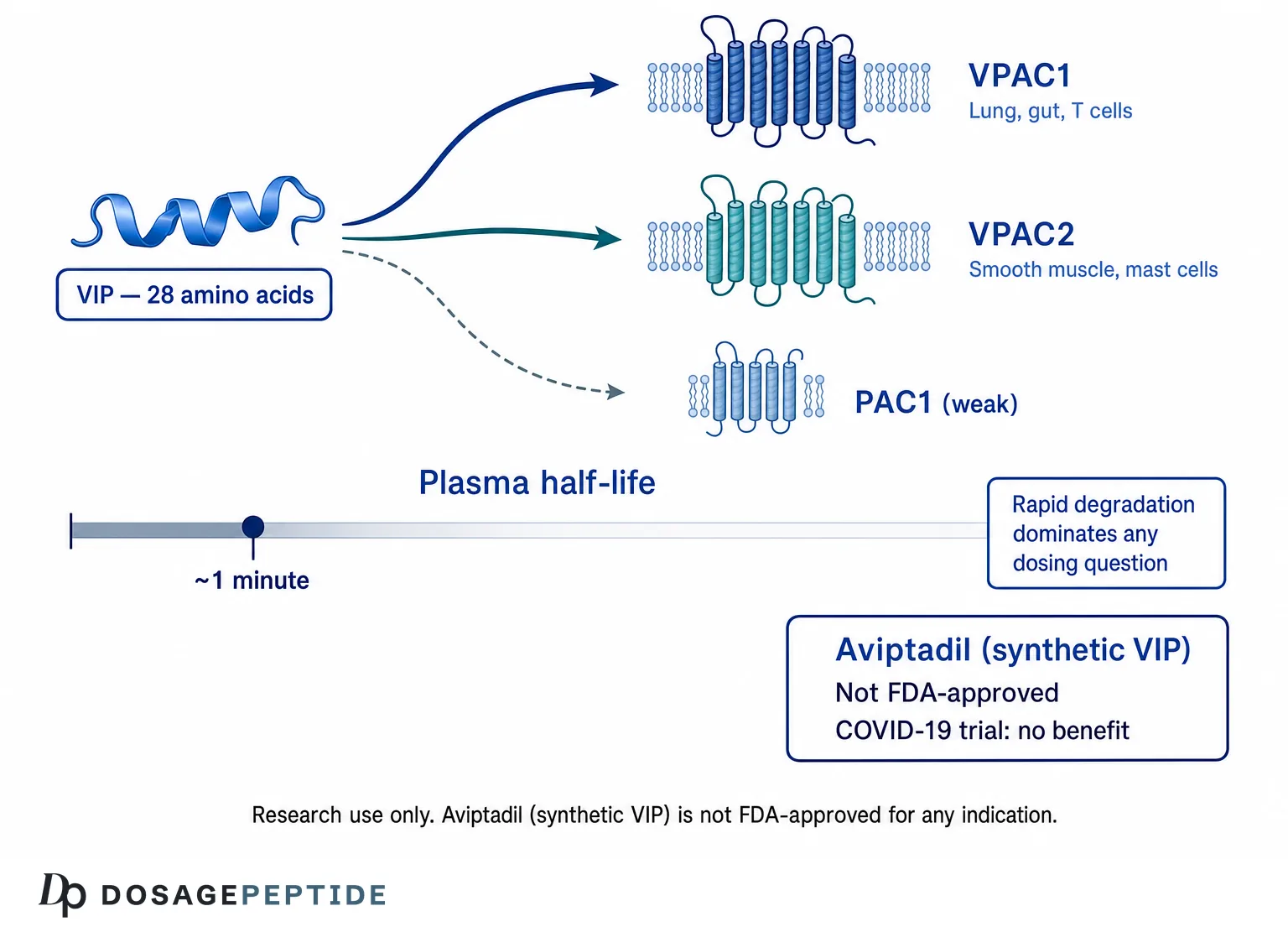
VIP signals through three related class B (secretin-family) G-protein-coupled receptors. All three couple principally to Gs and raise intracellular cAMP; PAC1 additionally couples to Gq/11. Ligand selectivity is the key discriminator: VIP is a high-potency agonist at VPAC1 and VPAC2 and a comparatively weak agonist at PAC1, where PACAP-27 and PACAP-38 are more than 100-fold more potent at most isoforms.[3]
| Receptor | Human gene | Agonist rank order | Coupling | Principal sites of expression |
|---|---|---|---|---|
| VPAC1 | VIPR1 | VIP ≈ PACAP-27 ≈ PACAP-38 >> GHRH, PHI, secretin | Gs / cAMP | Lung and airway epithelium, gastrointestinal tract, liver, T lymphocytes, kidney, cerebral cortex and hippocampus |
| VPAC2 | VIPR2 | VIP ≥ PACAP-38 ≈ PACAP-27 > PHI >> GHRH, secretin | Gs / cAMP | Vascular and gastrointestinal smooth muscle, pancreatic islets, suprachiasmatic nucleus, mast cells, activated lymphocytes |
| PAC1 | ADCYAP1R1 | PACAP-27 and PACAP-38 >> VIP | Gs and Gq/11 | Brain (widespread), adrenal medulla, trigeminal ganglion, pituitary |
Two practical consequences follow from this table. First, VIP is not a selective tool: it engages VPAC1 and VPAC2 with comparable potency, and those two receptors sit on very different tissues doing very different jobs. Systemic VIP therefore produces vasodilation, gut secretion, islet effects and immune effects simultaneously — you cannot dial in one of them. Second, both VPAC receptors are widely expressed on vascular smooth muscle, which is why the dose-limiting effects of VIP in humans are cardiovascular (flushing, hypotension, tachycardia) rather than anything immunological.
What is the half-life of VIP, and why does it dominate everything else?
This is the single most important practical fact about the molecule, and it is measured, not estimated. In a controlled human pharmacokinetic study published in Gut, graded intravenous infusions of VIP (0.6, 1.3 and 3.3 pmol/kg/min over 30 minutes) were given to healthy volunteers, and plasma VIP was measured by radioimmunoassay. After the infusions stopped, plasma VIP fell by first-order kinetics with an average disappearance half-time of one minute. The apparent metabolic clearance rate was about 9 mL/kg/min and the apparent volume of distribution about 14 mL/kg.[4]
A one-minute half-life means that roughly ten minutes after an intravenous bolus, less than one part in a thousand of the administered peptide remains in circulation. It also means that any claim about a “dose” of native VIP producing sustained systemic effects has to explain, mechanistically, what is still present to produce them. In practice, there are only four answers, and each has been tried:
- Continuous intravenous infusion. This is what the COVID-19 trials did — aviptadil was given as a 12-hour infusion daily for three days, not as a bolus.
- Local delivery to the target organ. Nebulisation into the lung, so that the peptide reaches its receptors before systemic clearance matters.
- Blocking degradation. VIP is a substrate for neutral endopeptidase 24.11 and dipeptidyl peptidase-4, so inhibiting those enzymes is a theoretical route to prolonging its action. No such combination has been tested against placebo in a published human trial.
- Engineering a longer-acting analogue. Pemziviptadil (PB1046) was an elastin-like-polypeptide-fused VIP analogue designed for once-weekly subcutaneous dosing. Its Phase 2 programme in pulmonary arterial hypertension was terminated.[5]
The authors of the 1978 pharmacokinetic study drew a further conclusion that is routinely omitted from marketing copy: their data “do not support a role for VIP as a circulating hormone, at least under physiological conditions.”[4] VIP is a local paracrine and neurotransmitter signal. Measuring it in serum and treating the number as a systemic hormone level — the premise of several online protocols — is not a straightforward reading of the physiology. If terms like paracrine, class B GPCR or amidation are unfamiliar, our peptide research glossary defines them.
Is aviptadil FDA-approved? The regulatory status in plain terms
Aviptadil is synthetic VIP, developed under the trade name ZYESAMI (and RLF-100) by NRx Pharmaceuticals and Relief Therapeutics. As of August 2026, aviptadil is not approved by the FDA for any indication. Nothing about that has changed since the COVID-19 programme concluded.
Several designations are routinely quoted in a way that implies more than they mean. To be precise:
- Orphan Drug Designation (granted for ARDS and for pulmonary hypertension) is an incentive status conferred on a drug intended for a rare disease. It grants development incentives and potential market exclusivity if the drug is later approved. It is not evidence of efficacy and it is not an approval.
- Fast Track Designation governs the frequency of FDA interaction during development. It is a process designation, not a verdict on the data.
- Emergency Use Authorization was requested and declined. The FDA declined the EUA request for ZYESAMI in critical COVID-19 with respiratory failure in November 2021, stating that the available data were insufficient to establish that the known and potential benefits outweighed the known and potential risks. A second, narrower EUA request, built on a post-hoc subgroup analysis, was declined in July 2022 — after the NIH trial had already stopped its aviptadil arm for futility.[6]
Separately, VIP appears in the US compounding ecosystem as a bulk substance nominated under section 503A of the FD&C Act. That framework governs what a compounding pharmacy may prepare under FDA enforcement discretion while nominations are evaluated; it is a completely different thing from FDA approval, involves no efficacy review, and confers no evidence.[7] A compounded VIP preparation is not an approved drug.
What does the VIP peptide clinical trial record actually show?
The human record for VIP and aviptadil is real but thin, and the single largest, best-controlled trial was negative. Here it is in full.
| Study / programme | Design and size | Route and dose | Result |
|---|---|---|---|
| TESICO (ACTIV-3b), 2023 — NIH-sponsored, 28 US sites | Randomised, placebo-controlled, Phase 3; 471 randomised to aviptadil or placebo, 461 in modified ITT | IV infusion 12 h/day × 3 days (600, 1200, 1800 pmol/kg on days 1–3) | Negative. Primary 6-category ordinal outcome at day 90: OR 1.11 (95% CI 0.80–1.55), p=0.54. Cumulative 90-day mortality 38% vs 36% (HR 1.04, 95% CI 0.77–1.41, p=0.78). Stopped for futility on DSMB recommendation[8] |
| AVICOVID-1, 2022 — sponsor-run, 10 US hospitals | Randomised 2:1, placebo-controlled; 196 patients with critical COVID-19 respiratory failure | IV aviptadil, 3 days | Primary endpoint missed. Alive and free of respiratory failure at day 60: OR 1.48 (95% CI 0.78–2.8) unadjusted, and OR 1.6 (95% CI 0.86–3.11) in the prespecified analysis controlling for baseline ventilation status — neither statistically significant. A secondary 60-day survival analysis was reported as OR 2.0 (95% CI 1.1–3.9, p=0.035)[9] |
| Petkov et al., 2003 — primary pulmonary hypertension | Open-label; 8 patients, within-patient (intraindividual) comparison with no external control arm | Inhaled VIP | Reported reduced mean pulmonary artery pressure, increased cardiac output and mixed venous O2 saturation. No placebo or parallel control group; the authors’ own stated conclusion was that the data justified further investigation[10] |
| Leuchte et al., 2008 — chronic pulmonary hypertension | Acute single-dose haemodynamic study; 20 patients (9 PAH, 8 PH in lung disease, 3 CTEPH) | Single inhaled 100 µg dose during right-heart catheterisation | “Small and temporary but significant” selective pulmonary vasodilation; 6 of 20 patients had a pulmonary vascular resistance reduction greater than 20%. Effect explicitly described as modest and short-lived[11] |
| Prasse et al., 2010 — pulmonary sarcoidosis | Open-label Phase 2, no placebo arm; 20 patients | Nebulised VIP 50 µg four times daily for 4 weeks | Safe and well tolerated; significantly reduced TNF-α production by BAL cells and increased BAL regulatory T cells. Mechanistic/biomarker endpoints only — not a controlled clinical-outcome trial[12] |
| Pemziviptadil (PB1046) — long-acting VIP analogue | Phase 2 in PAH (n=35 enrolled) and Phase 2 in COVID-19 (n=54) | Once-weekly subcutaneous | Both terminated. The PAH programme was ended before completing enrolment; no positive Phase 3 result exists for any VIP analogue[5] |
| Danish Headache Center infusion studies | Exploratory infusion study; 21 migraine patients enrolled (19 analysed) and 12 healthy volunteers | 2-hour IV infusion, 8 pmol/kg/min | Prolonged VIP infusion provoked migraine-like attacks in 15 of 21 migraine patients (71%), and in 3 of 12 healthy volunteers (25%). Plasma CGRP rose significantly during the infusion in migraine patients, but did not rise during the attacks themselves (p=0.219)[13] |
Why the COVID-19 sequence matters more than either trial alone
The AVICOVID-1 and TESICO pair is a textbook illustration of why trial size and independence matter. The sponsor-run 196-patient study missed its primary endpoint but reported a favourable secondary survival analysis — the sort of result that generates enthusiasm. The independent, NIH-funded, 461-patient TESICO trial then tested the same intervention in the same population and found an odds ratio of 1.11 with a confidence interval straddling 1, near-identical 90-day mortality (38% vs 36%), and a data and safety monitoring board recommendation to stop for futility.[8] The primary safety composite was numerically higher in the aviptadil arm (63% vs 56%; OR 1.40, 95% CI 0.94–2.08, p=0.10), though not statistically significant.
Any source that cites the smaller trial’s survival signal without reporting the larger trial’s futility stop is presenting half the record. Both trials exist; only one was designed and powered to answer the question.
What the pulmonary studies do and do not establish
The pulmonary hypertension and sarcoidosis work is scientifically interesting and honestly reported by its own authors — and it is small, early-phase, and mostly uncontrolled. Eight patients, twenty patients, twenty patients. Leuchte’s study was a single-dose acute haemodynamic experiment, not a treatment trial; its authors described the vasodilating effect as modest and short-lived and called for further studies at higher doses and with chronic dosing.[11] Prasse’s sarcoidosis study measured cytokine production and regulatory T-cell counts in bronchoalveolar lavage — genuine, first-in-human evidence of an immunoregulatory effect, and explicitly not evidence that the disease course changed.[12] Those studies were published in 2003, 2008 and 2010. In the fifteen-plus years since, no adequately powered controlled trial has confirmed a clinical benefit in either condition.
VIPoma: the honest counterweight to “more VIP is better”
There is a natural human experiment in VIP excess, and it is a disease. A VIPoma is a neuroendocrine tumour that autonomously secretes vasoactive intestinal peptide. In adults it usually arises in the pancreas; in children it more often arises from neurogenic tumours such as ganglioneuroblastoma in the retroperitoneum or mediastinum.[14]
The resulting clinical picture is called Verner-Morrison syndrome, or WDHA syndrome for its cardinal features: watery diarrhoea, hypokalaemia and achlorhydria. The diarrhoea is secretory, profuse and persists during fasting; it drives potassium loss, hyperchloraemic metabolic acidosis, dehydration and, untreated, a potentially fatal outcome. Diagnosis rests on an elevated plasma VIP level alongside the clinical syndrome, and definitive treatment is removal of the tumour, after which the diarrhoea resolves and electrolytes normalise.[15]
The pharmacology connects directly to the physiology: VIP stimulates intestinal water and electrolyte secretion through cAMP in enterocytes, so a sustained excess of VIP produces exactly the syndrome the receptor biology predicts. And the 1978 human infusion study makes the link explicit — at its highest infusion rate, plasma VIP in healthy volunteers reached concentrations “in the range of VIP values found in the Verner-Morrison syndrome,” accompanied by cutaneous flushing, increased pulse rate, widened blood pressure amplitude and small but significant rises in glucose, free fatty acids and calcium.[4]
Add the Danish Headache Center finding that a two-hour VIP infusion provoked migraine-like attacks in 71% of migraine patients — and in a quarter of the healthy volunteers who received it,[13] and the picture is complete: systemic VIP is a potent, dose-dependent pharmacological agent with a defined toxidrome, not an inert “anti-inflammatory support” molecule. Framing it as risk-free because it is endogenous is a category error. The same reasoning is set out in our overview of how peptide safety is actually assessed.
What about VIP nasal spray and CIRS protocols?
A body of online material promotes intranasal VIP as a treatment for chronic inflammatory response syndrome (CIRS), typically framed as a final step in a multi-stage protocol following mould or water-damaged-building exposure. This deserves a direct answer.
There are no published randomised controlled trials of intranasal VIP for CIRS. A PubMed search returns no controlled trial evidence for this indication. CIRS itself is not a diagnosis recognised in standard diagnostic classifications, and the biomarker panels used to define it are not validated against controlled outcomes. The supporting literature circulating for the VIP-nasal-spray step consists of uncontrolled case series published outside the indexed peer-reviewed literature — which is not the same evidence tier as the sarcoidosis or pulmonary hypertension work above, and is far below the tier of TESICO.
We are not going to reproduce any such protocol, dose, schedule or titration scheme, because doing so would imply a level of evidence that does not exist and would function as human-use guidance. What can be said accurately is: intranasal VIP preparations are compounded, not FDA-approved; the intranasal route has never been tested against placebo for any inflammatory indication in a published randomised trial; and the pharmacokinetics of intranasal delivery of a peptide with a one-minute plasma half-life have not been characterised in a way that would support claims about sustained systemic exposure.
The honest framing is that VIP for CIRS is a hypothesis, not a finding. That is not the same as saying it is impossible — it is saying that as of August 2026 there is no controlled human evidence, and confident claims to the contrary are not supported by the record.
How does VIP compare with other immune and gut research peptides?
VIP has an unusual evidence profile. Its receptor pharmacology is better defined than almost any comparator, its human pharmacokinetics are measured rather than modelled, and its toxidrome is described by a named disease. Yet its clinical efficacy, in the one setting where it was properly tested, was not demonstrated. By contrast, peptides studied for intestinal permeability and gut barrier research are largely at the preclinical or small-mechanistic-study stage, with no equivalent large trial to anchor expectations either way.
The lesson is not that VIP is uninteresting. VPAC1 and VPAC2 remain legitimate drug targets, and the industry response to the half-life problem — engineered long-acting analogues — is exactly the right scientific move. It simply has not yet produced a positive controlled result.
What should honest VIP peptide research account for?
For laboratory work with VIP as a research reagent, several handling and interpretation constraints follow directly from the pharmacology described above. These are analytical considerations, not use instructions.
- Enzymatic degradation is the default. VIP is cleaved by dipeptidyl peptidase-4, neutral endopeptidase 24.11 and other peptidases. Plasma samples intended for VIP measurement require appropriate protease inhibition and cold handling, or the result reflects degradation rather than biology.
- Reconstitution and stability matter disproportionately. Lyophilised peptide handling, solvent choice, concentration and storage temperature all affect the integrity of an amidated 28-mer. Our peptide reconstitution reference covers the general chemistry; the compound-specific vial parameters are documented on the VIP 5 mg vial reference page.
- Receptor selectivity cannot be assumed. Because VIP hits VPAC1 and VPAC2 with comparable potency and PACAP cross-reacts at all three receptors, attributing an observed effect to a single receptor requires selective agonists, antagonists or genetic models — not VIP alone.
- Route determines exposure entirely. Intravenous, nebulised, intranasal and subcutaneous VIP are, for practical purposes, four different experiments. Results from one route say little about another.
- Serum VIP is a poor systemic readout. Given that VIP acts locally and clears in about a minute, a circulating concentration is a snapshot of spillover, not a measure of tissue signalling.
Frequently Asked Questions
Is VIP peptide FDA-approved?
No. Neither VIP nor its synthetic form aviptadil (ZYESAMI/RLF-100) is approved by the FDA for any indication. Aviptadil holds Orphan Drug Designation for ARDS and pulmonary hypertension and previously held Fast Track Designation, but both are development-stage designations, not approvals. FDA declined Emergency Use Authorization requests for aviptadil in critical COVID-19 in November 2021 and again in July 2022.
What is the half-life of vasoactive intestinal peptide?
Approximately one minute. In a controlled human infusion study published in Gut in 1978, plasma VIP fell by first-order kinetics after infusion with an average disappearance half-time of one minute, an apparent metabolic clearance rate of about 9 mL/kg/min and an apparent volume of distribution of about 14 mL/kg. This is why every serious VIP programme has used continuous infusion, local delivery, degradation blockade or an engineered long-acting analogue.
What are VPAC1 and VPAC2 receptors?
They are the two high-affinity VIP receptors, encoded by the human genes VIPR1 and VIPR2. Both are class B (secretin-family) G-protein-coupled receptors that couple to Gs and raise cAMP. VPAC1 predominates in lung, gut, liver and T lymphocytes; VPAC2 predominates in smooth muscle, pancreatic islets and the suprachiasmatic nucleus. VIP is roughly equipotent at both, which is why it produces multiple effects simultaneously.
Did the aviptadil COVID-19 trial work?
No. The definitive trial, TESICO (ACTIV-3b), randomised 471 patients with COVID-19-associated acute hypoxaemic respiratory failure across 28 US sites. The primary day-90 ordinal outcome gave an odds ratio of 1.11 (95% CI 0.80–1.55, p=0.54), 90-day mortality was 38% with aviptadil versus 36% with placebo, and the data and safety monitoring board recommended stopping the aviptadil arm for futility in May 2022.
What is a VIPoma?
A VIPoma is a neuroendocrine tumour that autonomously secretes VIP, causing Verner-Morrison or WDHA syndrome: watery diarrhoea, hypokalaemia and achlorhydria. The diarrhoea is secretory, persists during fasting, and drives electrolyte loss and metabolic acidosis. It is the clearest demonstration that chronic VIP excess is harmful rather than beneficial, and it is why “more VIP is better” framing is not supported by human physiology.
Does VIP nasal spray work for CIRS or mould illness?
There are no published randomised controlled trials of intranasal VIP for chronic inflammatory response syndrome. The supporting material consists of uncontrolled case reports outside the indexed peer-reviewed literature. CIRS is not a recognised diagnostic entity in standard classifications, and intranasal VIP preparations are compounded rather than FDA-approved. Claims of efficacy for this use are not supported by controlled evidence as of August 2026.
Is VIP the same as aviptadil?
Essentially yes — aviptadil is the international non-proprietary name for synthetic vasoactive intestinal peptide, identical in sequence to the human 28-amino-acid peptide. The distinction is regulatory rather than chemical: “aviptadil” denotes the pharmaceutical product tested in registered clinical trials under the trade names ZYESAMI and RLF-100, whereas “VIP” refers to the endogenous molecule and to research-grade material.
Has a long-acting VIP analogue ever succeeded?
Not so far. Pemziviptadil (PB1046), an elastin-like-polypeptide-fused VIP analogue designed for once-weekly subcutaneous administration, entered Phase 2 in pulmonary arterial hypertension and in COVID-19. Both programmes were terminated before completion, the PAH study after enrolling 35 of its target. No VIP analogue has reported a positive Phase 3 result in any indication.
References
- Said SI, Mutt V. Polypeptide with broad biological activity: isolation from small intestine. Science. 1970;169(3951):1217–1218. PubMed
- Delgado M, Ganea D. Vasoactive intestinal peptide: a neuropeptide with pleiotropic immune functions. Amino Acids. 2013;45(1):25–39. PMC3883350
- IUPHAR/BPS Guide to Pharmacology. VIP and PACAP receptors (VPAC1, VPAC2, PAC1). guidetopharmacology.org
- Domschke S, Domschke W, Bloom SR, et al. Vasoactive intestinal peptide in man: pharmacokinetics, metabolic and circulatory effects. Gut. 1978;19(11):1049–1053. PMC1412244
- ClinicalTrials.gov. NCT03556020 — Phase 2 study of pemziviptadil (PB1046) in symptomatic pulmonary arterial hypertension (terminated). ClinicalTrials.gov
- Relief Therapeutics / NRx Pharmaceuticals. Company announcements of the two FDA Emergency Use Authorization refusals for ZYESAMI (aviptadil) in critical COVID-19 with respiratory failure: first refusal, 4 November 2021; second refusal for a patient subgroup, July 2022. (Company press releases, cited as the primary record of the regulatory decisions.)
- US Food and Drug Administration. Bulk drug substances used in compounding under section 503A of the FD&C Act. FDA.gov
- Brown SM, Barkauskas CE, Grund B, et al. Intravenous aviptadil and remdesivir for treatment of COVID-19-associated hypoxaemic respiratory failure in the USA (TESICO): a randomised, placebo-controlled trial. Lancet Respir Med. 2023;11(9):791–803. PMC10527239
- Youssef JG, Lavin P, Schoenfeld DA, et al. The use of IV vasoactive intestinal peptide (aviptadil) in patients with critical COVID-19 respiratory failure: results of a 60-day randomized controlled trial. Crit Care Med. 2022;50(11):1545–1554. PMC9555831
- Petkov V, Mosgoeller W, Ziesche R, et al. Vasoactive intestinal peptide as a new drug for treatment of primary pulmonary hypertension. J Clin Invest. 2003;111(9):1339–1346. PMC154449
- Leuchte HH, Baezner C, Baumgartner RA, et al. Inhalation of vasoactive intestinal peptide in pulmonary hypertension. Eur Respir J. 2008;32(5):1289–1294. doi:10.1183/09031936.00050008
- Prasse A, Zissel G, Lützen N, et al. Inhaled vasoactive intestinal peptide exerts immunoregulatory effects in sarcoidosis. Am J Respir Crit Care Med. 2010;182(4):540–548. PubMed
- Pellesi L, Al-Karagholi MA, De Icco R, et al. Plasma levels of CGRP during a 2-h infusion of VIP in healthy volunteers and patients with migraine: an exploratory study. Front Neurol. 2022;13:871176. PMC9011105
- Belei O, Basaca DG, Heredea ER, et al. Chronic diarrhea caused by vasoactive intestinal peptide-secreting tumor. Life (Basel). 2023;13(10):1974. PMC10608053
- Yeh PJ, Chen SH, Lai JY, et al. Rare cases of pediatric vasoactive intestinal peptide secreting tumor with literature review: a challenging etiology of chronic diarrhea. Front Pediatr. 2020;8:430. PMC7419468
Research use only. This article is an educational reference for laboratory and scientific research contexts. Vasoactive intestinal peptide and aviptadil are not approved by the FDA for any indication, and nothing here is medical advice, a treatment recommendation, a dosing protocol, or a suggestion that any peptide be used to diagnose, treat, cure or prevent any disease in humans. Trial data are reported as published, including negative results. Consult a qualified healthcare professional for any health-related question.