The MOTS-c dose repeated across vendor pages, forum threads and protocol PDFs is roughly 200 mcg per day, five days a week, subcutaneously. Say the important part first: that figure is a convention, not a finding. No human dose-finding trial of exogenous MOTS-c has ever been published, so nobody can tell you it is the right amount — only that it is the amount most protocols copied from one another.
This page gives you both halves. The practical half: the reconstitution math for the 5, 10 and 20 mg vials actually sold, what a 200 mcg dose works out to in U-100 syringe units, and how timing and cycle length are usually handled. The honest half: where the number came from, what the animal studies really dosed (0.5–15 mg/kg/day intraperitoneally — a different route and a different scale), and what would have to exist before any chart deserved the word “protocol”. Research-use-only reference material, not medical advice or human-use directions.
What Does a MOTS-c Dosage Chart Actually Show?
It is worth being precise about what a dosage chart for a research peptide is and is not. It is not a posology — there is no regulatory body, no approved label, and no dose-ranging study behind it. What it actually encodes is two separable things that are routinely conflated:
- A concentration calculation. Given a vial of X mg of lyophilised powder and Y mL of diluent, what volume contains a target mass of peptide? This part is pure arithmetic. It is verifiable, deterministic, and correct or incorrect in a way that can be checked with a calculator. This is the part of the chart that is genuinely reliable.
- A target mass per administration. The claim that the target should be 200 mcg rather than 20 mcg or 20 mg. This part is not derived from the arithmetic, and — as documented at length below — it is not derived from the published MOTS-c literature either.
Nearly every dosage chart on the internet presents these two components with identical visual authority, in the same table, in the same font. They do not carry the same epistemic weight. The first is a fact about dilution. The second is a convention whose provenance is, on inspection, remarkably difficult to trace to any primary source.
For readers who want the concentration mathematics immediately, the reconstitution tables are further down and the per-vial protocol pages carry the same numbers as the site’s peptide dosage calculator. For readers who want to understand why we decline to present the 200 mcg figure as a recommendation, the provenance section is the substantive part of this article.
The reference figures used throughout this article
Because a chart needs a reference point to demonstrate the arithmetic, this article uses 200 mcg as the worked example throughout. This is not an endorsement of 200 mcg. It is the figure that appears most often in circulation and therefore the one readers arrive looking to check. Every calculation shown can be repeated with any other target mass by substituting the number; the method is what matters, not the input.
| Parameter | Value used in this article | Where it comes from |
|---|---|---|
| Peptide | MOTS-c, 16 amino acids, approx. 2.2 kDa | Primary literature[1] |
| Vial sizes | 5 mg, 10 mg, 20 mg | Commonly sold research-chemical presentations |
| Diluent volume | 3 mL bacteriostatic water | Convention; chosen for arithmetic convenience |
| Reference dose | 200 mcg | Vendor/community convention — no trial basis |
| Syringe | U-100 insulin syringe (100 units = 1 mL) | Standard measurement device |
Research Context
MOTS-c (mitochondrial open reading frame of the 12S rRNA type-c) was described in 2015 by Changhan Lee and colleagues at the University of Southern California, working with collaborators at UCLA and the National Institute on Aging.[1] The finding was conceptually significant: a short open reading frame within the mitochondrial 12S ribosomal RNA gene encodes a 16-amino-acid peptide with signalling activity outside the mitochondrion. Mitochondria, in other words, appear to encode their own hormone-like messengers — a class now called mitochondrial-derived peptides (MDPs), of which humanin was the first and MOTS-c the most metabolically studied.[4]
This origin story matters for dosage discussion in a way that is usually missed. MOTS-c was not developed as a drug candidate and then dose-optimised. It was discovered as an endogenous signalling molecule — something the body already makes, circulates, and regulates. Almost all of the human data that exists concerns the peptide your own mitochondria produce, measured in blood or muscle. That is a fundamentally different object of study from a synthesised peptide reconstituted in a vial and injected subcutaneously, and the two literatures are not interchangeable, however often they are cited as though they were.
What the site’s other MOTS-c coverage handles
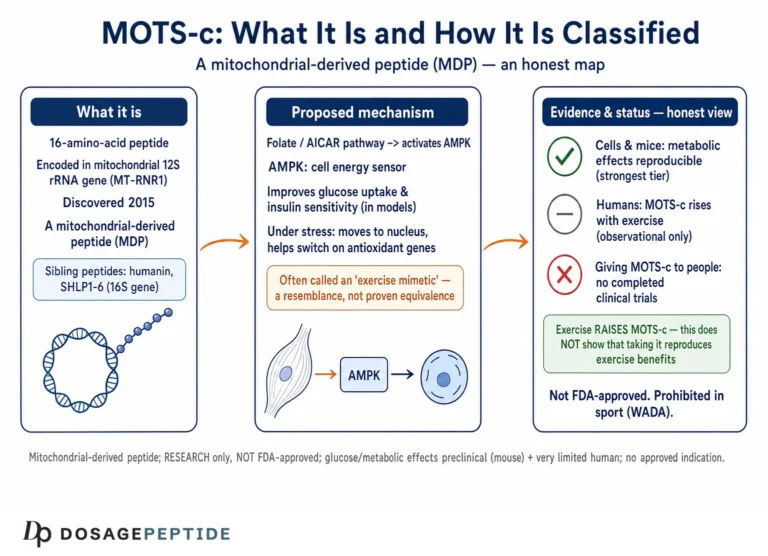
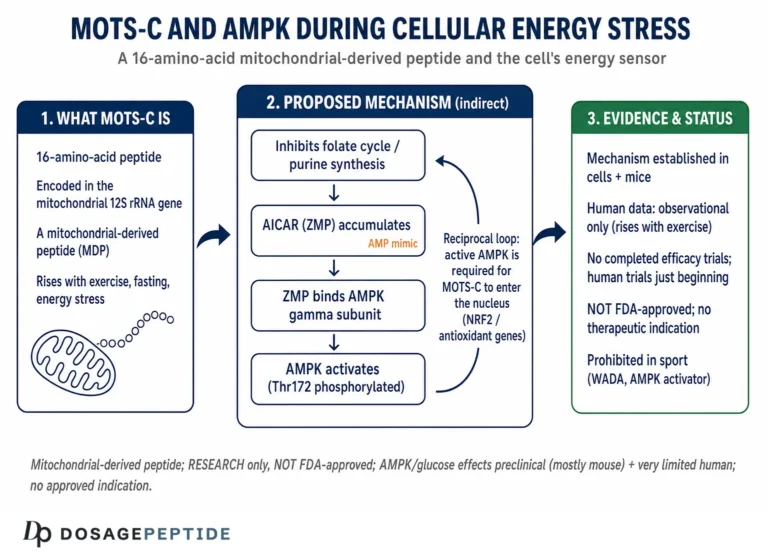
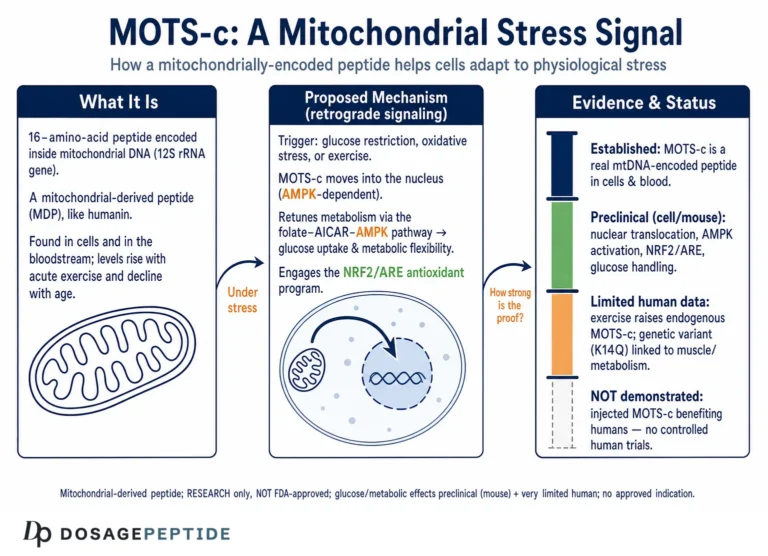
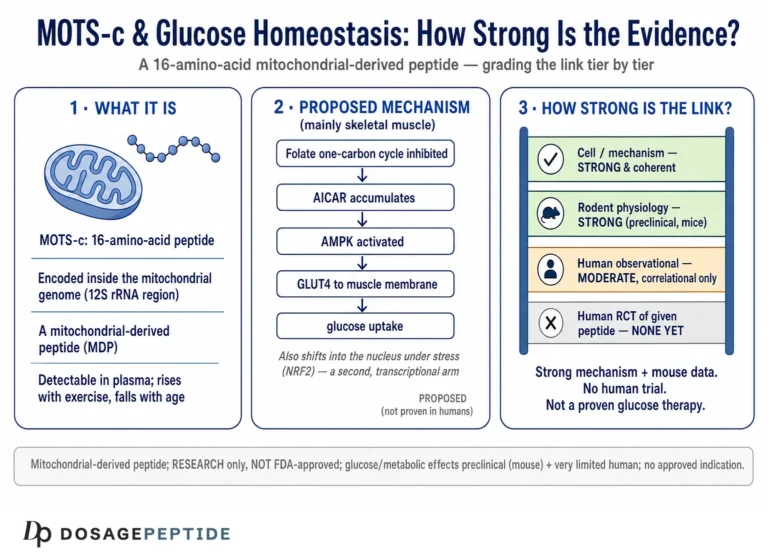
This article deliberately does not re-explain the mechanism at length. The signalling biology — folate-cycle inhibition, de novo purine biosynthesis, AMPK activation, nuclear translocation under metabolic stress — is covered in dedicated pieces: what MOTS-c is and how it is classified among mitochondrial-derived peptides and how MOTS-c regulates AMPK activity during cellular energy stress. Readers wanting the pathway detail should start there. What follows here is strictly about numbers: where the dose figures originate, why they are weaker than they look, and how the dilution mathematics works.
The regulatory position, stated plainly
MOTS-c is not approved by the FDA for any indication. There is no approved MOTS-c drug product in the United States or, to our knowledge, any other major jurisdiction. It is not a supplement, not a compounded medication with an established monograph, and not an investigational drug that a member of the public can lawfully obtain for personal use. Material sold online is a research chemical, labelled for laboratory use, and its purity, identity and endotoxin content are represented by the seller rather than verified by a regulator.
This is not boilerplate appended for legal comfort. It is directly relevant to the dosage question, because the absence of an approval pathway is precisely why no dose-finding data exists. Approved drugs have dosage charts because someone ran Phase 1 and Phase 2 trials, escalated doses in humans under monitoring, measured pharmacokinetics, and identified a therapeutic window. None of that has happened for MOTS-c. The chart exists anyway, which should prompt the obvious question about what filled the vacuum.
Where Do the MOTS-c Dosage Numbers Actually Come From?
This is the section that motivated the article. When you trace the 200 mcg/day figure backwards, the trail does not lead where readers assume.
Trail 1: the rodent studies
The most-cited MOTS-c papers are animal studies, and they do report doses. The 2015 Cell Metabolism paper administered MOTS-c to mice at 0.5 mg/kg/day intraperitoneally for 8 weeks in the high-fat-diet obesity experiments, and at 5 mg/kg/day intraperitoneally in shorter glucose-tolerance and hyperinsulinaemic-euglycaemic clamp protocols.[1] The 2021 Nature Communications paper on physical performance and ageing used 5 or 15 mg/kg intraperitoneally, daily for two weeks in the main protocols and three times weekly in the late-life intervention arm.[2] Later work on muscle-atrophy signalling used comparable intraperitoneal regimens in diet-induced obese mice — 0.5 mg/kg/day for three weeks and 5 mg/kg/day for eight weeks.[5]
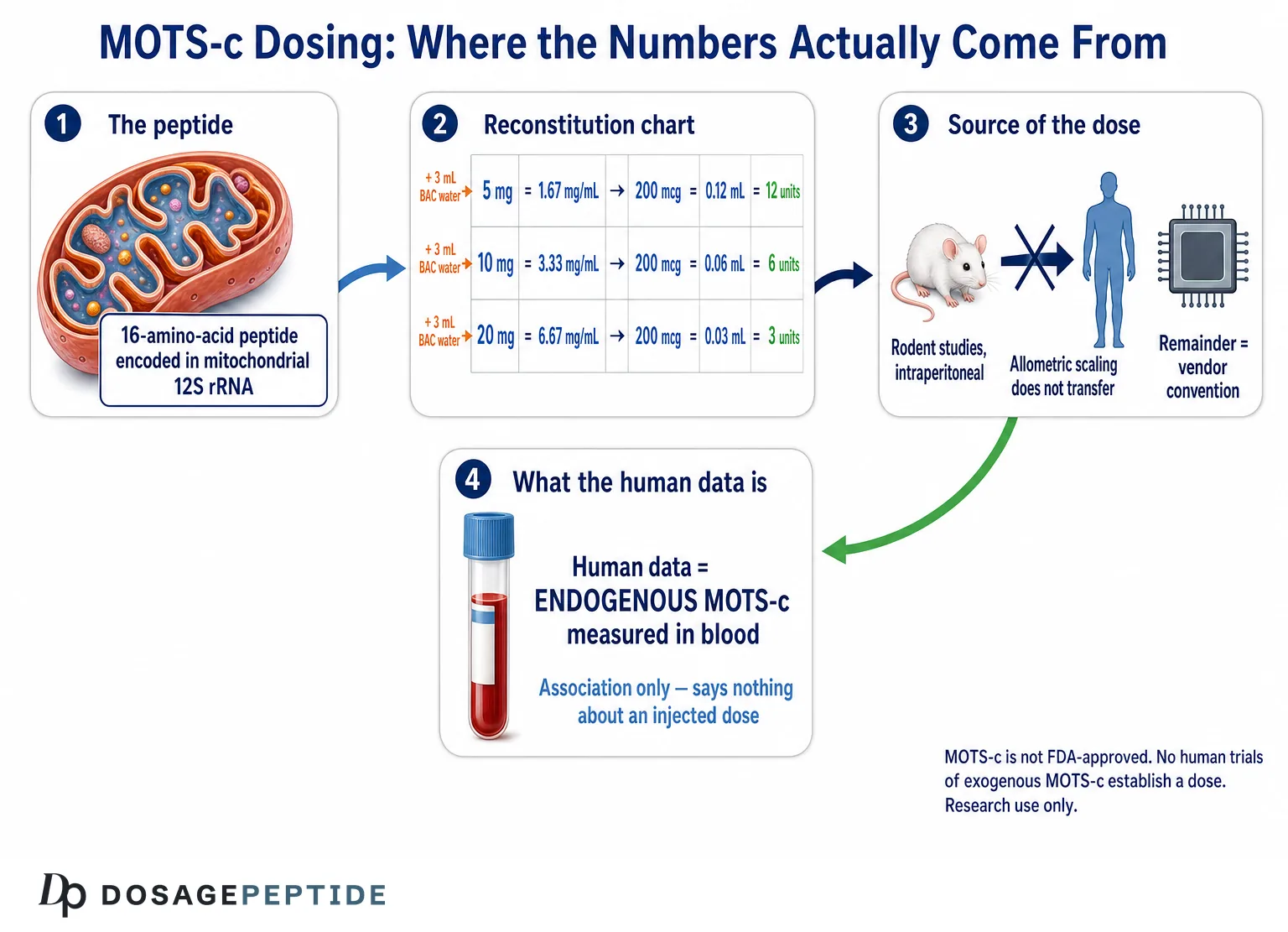
So the rodent literature clusters around 0.5–15 mg/kg/day, intraperitoneal. Now do the naive arithmetic that the 200 mcg convention would imply in reverse: 200 mcg in an 80 kg human is 0.0025 mg/kg. That is 200 times lower than the lowest mouse dose in the founding paper and 6,000 times lower than the highest dose in the ageing paper — on a raw mg/kg basis, before any species correction is applied at all. The 200 mcg figure is not a scaled-down version of the rodent dose. It is not related to it by any transformation anyone has published. Whatever produced it, it was not the animal literature.
Trail 2: the human studies
Here the trail ends almost immediately, because the human MOTS-c literature does not involve giving anyone MOTS-c. The human component of the 2021 Nature Communications paper measured endogenous peptide in 10 sedentary healthy young male volunteers who performed cycling exercise; skeletal-muscle MOTS-c rose roughly 11.9-fold after exercise and circulating levels rose approximately 1.5–1.6-fold.[2] No peptide was administered. A 2021 secondary analysis of a 16-week aerobic and resistance exercise intervention in breast cancer survivors likewise measured plasma MOTS-c, finding it rose with training in non-Hispanic White participants and correlated with reductions in fat mass, body weight, HOMA-IR and CRP — but again, the intervention was exercise, not injection.[6]
This distinction is the single most important thing on this page. Observing that trained people have more of a molecule tells you nothing about what happens when you inject that molecule. The inference runs in the wrong direction. Higher endogenous MOTS-c may be a consequence of mitochondrial adaptation rather than a cause of it; it may be a marker that tracks fitness without mediating it; and even if it were causal, the concentration, tissue distribution and pulsatility of an exercise-induced intramuscular signal bear no necessary resemblance to a bolus injected into subcutaneous fat. A 2023 review in Frontiers in Endocrinology summarising the field concluded plainly that MOTS-c “has been used less frequently in disease treatment, and no effective method of applying MOTS-c in the clinic has been developed.”[7]
Trail 3: the closest thing to a human dose that exists
There is exactly one instructive data point, and it is not MOTS-c itself. CohBar, a company co-founded by Pinchas Cohen — a co-author on the original MOTS-c paper — developed CB4211, described as an engineered analog of MOTS-c, and took it into a Phase 1a/1b trial in healthy non-obese subjects and subjects with non-alcoholic fatty liver disease (NCT03998514, 88 participants, completed April 2021).[8] The design matters here, and it is routinely misreported. This was a three-part ascending-dose study: Part A gave single ascending subcutaneous doses to healthy non-obese subjects, Part B gave once-daily doses over 7 days, and only Part C ran 28 days in 20 subjects with NAFLD. The registry lists six discrete dose arms — “CB4211 Dose 1” through “Dose 6” — plus a placebo arm, across all 88 participants.[8] Humans in this programme therefore received a range of doses, most of them below the top of the ladder. The company’s August 2021 topline announcement reported that the 28-day Phase 1b stage used 25 mg subcutaneously once daily in those 20 subjects, describing it as well tolerated with no serious adverse events, and describing reductions in ALT and AST and a decrease in glucose as statistically significant, with a trend toward lower body weight — though these were exploratory biomarker endpoints in a 20-person arm, reported only in a press release.[9]
Read that top-of-range figure again: 25 mg per day. The convention circulating for MOTS-c is 0.2 mg per day — roughly 125 times lower. That comparison is worth stating carefully, because it is easy to overread in either direction. It does not mean the chart is “125 times too low”: 25 mg was the selected top of an escalation, not a derived target, and lower doses were administered to other subjects in the same programme. What it does mean is that a team with access to the parent molecule’s full preclinical dataset escalated into the tens-of-milligrams range and stopped there — nowhere near the microgram figure being circulated as a chart.
Four caveats immediately qualify this comparison, and all four cut against using it as a dosing argument. First, CB4211 is not MOTS-c — it is a deliberately modified analog, and analogs are engineered precisely because the parent molecule’s potency, stability or pharmacokinetics were considered inadequate. A modified peptide may be more or less potent per milligram than its parent, and the direction cannot be assumed. Second, these are company-reported topline results in a press release; no results have been posted to the trial registry, and exploratory pharmacodynamic endpoints in a 20-person Phase 1b are hypothesis-generating, not confirmatory. Third, CB4211 was never advanced. This is the caveat most often omitted, and it matters most. In its annual report for 2022, CohBar stated plainly that it did not believe the formulation of CB4211 used in the Phase 1b stage was suitable for further development, that efforts to develop an improved formulation had not succeeded, and that it could give no assurance such a formulation would ever be found.[16] The same filing records that subjects in the Phase 1a stage developed mild but persistent injection-site reactions, prompting a mid-study formulation change and an earlier trial suspension in 2018. The company retained a financial advisor to explore strategic alternatives and was subsequently absorbed by merger, and no peer-reviewed publication of the dataset ever appeared. A programme that read out “positive” and then stopped is materially weaker evidence than one that read out positive and progressed — the stopping is itself information. Fourth, and following from all of the above: this comparison does not establish that 25 mg is a “correct” MOTS-c dose either. It establishes something narrower — that the people who understood this peptide well enough to take it into humans arrived at a number nowhere near the one being circulated as a chart, and still could not make it into a drug.
So what is the 200 mcg figure?
Our honest assessment, and we state it as an assessment rather than a finding: the 200 mcg/day convention appears to be a vendor-side heuristic. It has the fingerprints of one. It is a round number. It divides evenly into commonly sold vial sizes (25 doses from a 5 mg vial, 50 from a 10 mg vial, 100 from a 20 mg vial). It lands at a syringe volume that is easy to draw. It resembles the dose ranges conventional for other research peptides sold alongside it — many of which are secretagogues with genuinely different potency profiles. What it does not resemble is anything in the MOTS-c literature.
We cannot prove a negative about provenance, and we will not pretend to. It is possible that some unpublished rationale exists. But we searched the primary literature specifically for a human dose-ranging study of exogenous MOTS-c and found none; the first interventional trial of MOTS-c itself in humans only began recruiting in 2026, as detailed in the evidence section below. In the absence of such a study, a dosage chart is a chart of a convention. Presenting it as anything more would be misrepresenting the state of knowledge.
Why Mouse mg/kg Does Not Convert Cleanly to a Human Dose
A natural response at this point is: fine, the vendor number is unfounded — so let us just scale the mouse dose properly and get the real answer. This section explains why that instinct, while more rigorous than the vendor heuristic, still does not produce a usable human dose. It is worth working through carefully, because the reasoning generalises to essentially every research peptide.
The standard allometric conversion, performed correctly
The accepted method for translating an animal dose to a human equivalent dose (HED) is body-surface-area normalisation, not simple body-weight multiplication. Reagan-Shaw and colleagues made this point forcefully in FASEB Journal in 2008, noting that BSA correlates across mammalian species with oxygen utilisation, caloric expenditure, basal metabolism, blood volume and renal function in a way that body weight alone does not.[11] The formula, using the FDA’s Km correction factors, is:
HED (mg/kg) = Animal dose (mg/kg) × (Animal Km / Human Km)
For the mouse, Km = 3; for the human, Km = 37.[13][12] The conversion factor is therefore 3/37, or approximately 0.081 — roughly a twelvefold reduction. Applying it to the published MOTS-c mouse doses:
| Mouse dose (IP) | Study | HED (mg/kg) | For a 70 kg human | Ratio vs 200 mcg |
|---|---|---|---|---|
| 0.5 mg/kg/day | Lee 2015, HFD 8 weeks[1] | 0.041 | ≈ 2.8 mg | 14× higher |
| 5 mg/kg/day | Lee 2015, clamp studies[1] | 0.41 | ≈ 28 mg | 140× higher |
| 15 mg/kg | Reynolds 2021, performance[2] | 1.22 | ≈ 85 mg | 425× higher |
The arithmetic is unambiguous. A textbook allometric conversion of the published rodent doses yields a range of roughly 2.8 mg to 85 mg per administration for a 70 kg adult — one to two orders of magnitude above the circulating convention. If someone wanted to argue that the 200 mcg chart is derived from the animal data, this table is the refutation.
It is tempting to notice that this range also brackets the 25 mg/day used at the top of the CB4211 escalation and to read the two as corroborating each other. They do not. That convergence is coincidental and neither number validates the other: the conversion is formally inapplicable to subcutaneous dosing, as the next section explains, and 25 mg was the top of a dose-escalation ladder for a different molecule, not a derived target. Two figures that are individually unfounded do not become founded by landing near each other.
Why we are not therefore recommending 2.8 to 85 mg
Here is where intellectual honesty requires stopping rather than continuing. The table above is a demonstration that the vendor number lacks a derivation — it is not a derivation of a better number. Allometric scaling is a blunt instrument, and for this specific molecule and this specific route, at least four things break it:
1. The route is wrong, and the guidance says so explicitly. Every MOTS-c rodent study cited above used intraperitoneal injection. The research convention for MOTS-c is subcutaneous. These are not equivalent. IP administration delivers peptide into the peritoneal cavity with extensive serosal surface area and substantial absorption via the portal circulation, meaning a hepatic first pass that subcutaneous delivery largely bypasses. Subcutaneous absorption is slower, is partly lymphatic for molecules in this size range, and exposes the peptide to interstitial peptidases before it reaches circulation. Bioavailability by the two routes can differ several-fold in either direction. Critically, the dose-conversion guidance itself states that BSA normalisation is not appropriate for drugs administered by subcutaneous, intramuscular, topical or nasal routes.[12] The conversion in the table above is, by the standards of the method it uses, formally inapplicable to the route people actually use. We performed it to make a point about the vendor figure, not to produce a target.
2. BSA scaling was built for a different problem. The Km-factor approach originates in oncology, where it was developed to set conservative starting doses for cytotoxic agents whose toxicity tracks systemic exposure and whose clearance is broadly metabolic. It assumes a rough proportionality between body surface area and clearance. Peptides are not cytotoxics. A 2.2 kDa peptide is cleared predominantly by proteolysis in plasma and tissue and by glomerular filtration — processes that do not scale across species in the same way hepatic metabolism does. The FDA guidance that codified this approach was written to estimate maximum safe starting doses for first-in-human trials, deliberately conservative, explicitly a floor for cautious escalation rather than an estimate of an effective dose.[13] Using it in reverse, to reconstruct an efficacious human dose from a mouse efficacy dose, inverts its logic.
3. Nobody has published MOTS-c pharmacokinetics in humans. This is the quiet killer. The 2015 founding paper reports no half-life, no clearance, no volume of distribution, no plasma concentration–time curve — the methods describe daily intraperitoneal dosing and nothing about what the peptide does after it enters. Without a half-life you cannot rationally choose a dosing frequency, which means the “per day” in “MOTS-c peptide dosage per day” is as unfounded as the milligram figure attached to it. A peptide with a 10-minute half-life and one with a 10-hour half-life demand entirely different schedules from the same total dose. We do not know which this is in humans.
4. Species differences in the target biology. There is a reason for caution here, though it needs stating at its true evidence level. The exercise-induced endogenous MOTS-c response may vary across human populations: the breast-cancer-survivor analysis found that plasma MOTS-c rose significantly with training in non-Hispanic White participants but did not change significantly in Hispanic participants.[6] The authors raised ethnic-specific mtDNA variation as one candidate explanation — but that study stratified by self-reported ethnicity, performed no mtDNA genotyping and assigned no haplogroups, and its own discussion names socio-cultural influences and baseline metabolic differences as competing explanations it could not rule out. It is a secondary analysis of 49 women, unreplicated. So the honest statement is narrow: human MOTS-c biology may not be uniform across populations, the cause is unknown, and mtDNA background is a hypothesis rather than a finding. Even at that reduced strength, it argues for low confidence in transplanting a dose from a genetically controlled mouse colony into a heterogeneous human population.
The correct conclusion from all four points is not “use a bigger number.” It is that the calculation cannot be done with the information that currently exists. Both the vendor figure and the allometric figure are unfounded; they are merely unfounded in different directions. Anyone presenting either as a protocol is overstating what is known.
Mechanisms Studied
This section is deliberately compact — the mechanism is covered in depth in the linked articles, and repeating it here would not serve a reader who came for dosage. What follows is only the mechanistic detail that bears directly on why dosing this peptide is hard.
The core pathway, in brief
In the founding work, MOTS-c’s cellular actions were traced to inhibition of the folate cycle and its tethered de novo purine biosynthesis, producing an accumulation of AICAR and consequent activation of AMP-activated protein kinase (AMPK). Skeletal muscle appeared to be the primary target organ, and treated mice were protected against age-dependent and high-fat-diet-induced insulin resistance as well as diet-induced obesity.[1] A 2018 follow-up in Cell Metabolism added a second dimension: under metabolic stress such as glucose restriction or oxidative stress, MOTS-c translocates to the nucleus in an AMPK-dependent manner and regulates nuclear gene expression, interacting with stress-responsive transcription factors including NRF2 at antioxidant response elements.[3] Subsequent work described effects on myostatin and muscle-atrophy signalling via a CK2–PTEN–mTORC2–AKT–FOXO1 axis in mice and myotubes.[5]
Three mechanistic facts that complicate dosing
It is conditional, not constitutive. The nuclear translocation described in 2018 occurs in response to metabolic stress.[3] This is a stress-responsive signalling system, not a simple agonist–receptor relationship where more ligand reliably means more effect. A dose–response curve for a conditionally-acting intracellular signal is not guaranteed to be monotonic, and the metabolic state of the organism may matter as much as the quantity delivered.
The target is intracellular and partly nuclear. Unlike a peptide acting on a cell-surface receptor, where plasma concentration is a reasonable proxy for target engagement, MOTS-c must reach the cytosol and, under stress, the nucleus. Plasma concentration and target-site concentration may be poorly correlated, which means that even if human PK data existed, it would be an imperfect guide to effect.
The relevant biology overlaps with exercise itself. MOTS-c is framed in the literature as an exercise-induced mitohormetic signal — part of the machinery by which mild mitochondrial stress produces adaptive benefit.[2] If the endogenous signal is pulsatile, tissue-localised and stress-gated, a flat daily subcutaneous bolus is a poor structural mimic of it regardless of the milligram figure chosen. This is a design problem that no dosage chart can solve.
How Is MOTS-c Reconstituted? The Arithmetic Per Vial Size
Now the part that is genuinely reliable. Reconstitution mathematics is deterministic: it depends only on the mass in the vial and the volume of diluent added, and it can be checked. The general relation is:
Concentration (mg/mL) = Vial mass (mg) ÷ Diluent volume (mL)
Volume per dose (mL) = Target dose (mg) ÷ Concentration (mg/mL)
Everything below is those two lines applied to the three vial presentations in the site catalog, all at 3 mL of bacteriostatic water. The 3 mL figure is a convention, not a requirement — it is chosen because it produces workable syringe volumes across all three vial sizes and because it fits comfortably inside the vials in question. Changing it changes every number downstream, which is exactly why the arithmetic, not the chart, is what a reader should carry away.
The 5 mg vial
5 mg ÷ 3 mL = 1.67 mg/mL, i.e. 1,667 mcg per mL.
For a 200 mcg reference dose: 200 ÷ 1,667 = 0.12 mL.
On a U-100 insulin syringe, where 1 mL = 100 units: 0.12 mL × 100 = 12 units.
Total reference doses per vial: 5,000 mcg ÷ 200 mcg = 25.
The 10 mg vial
10 mg ÷ 3 mL = 3.33 mg/mL, i.e. 3,333 mcg per mL.
For a 200 mcg reference dose: 200 ÷ 3,333 = 0.06 mL.
On a U-100 insulin syringe: 0.06 mL × 100 = 6 units.
Total reference doses per vial: 10,000 mcg ÷ 200 mcg = 50.
The 20 mg vial
20 mg ÷ 3 mL = 6.67 mg/mL, i.e. 6,667 mcg per mL.
For a 200 mcg reference dose: 200 ÷ 6,667 = 0.03 mL.
On a U-100 insulin syringe: 0.03 mL × 100 = 3 units.
Total reference doses per vial: 20,000 mcg ÷ 200 mcg = 100.
The consolidated MOTS-c reconstitution chart
| Vial | BAC water | Concentration | mcg per mL | 200 mcg = | U-100 units | Doses/vial |
|---|---|---|---|---|---|---|
| 5 mg | 3 mL | 1.67 mg/mL | 1,667 | 0.12 mL | 12 | 25 |
| 10 mg | 3 mL | 3.33 mg/mL | 3,333 | 0.06 mL | 6 | 50 |
| 20 mg | 3 mL | 6.67 mg/mL | 6,667 | 0.03 mL | 3 | 100 |
The per-vial protocol pages carry these same figures: the MOTS-c dosage chart per day (10 mg vial) and the MOTS-c 5 mg vial dosage protocol. For general dilution method and technique, see the peptide reconstitution guide; for cross-compound comparison of how these tables are constructed, the peptide dosage chart guide covers the general method.
The precision problem nobody mentions
Look again at the 20 mg row. A 200 mcg reference dose is 3 units on a U-100 syringe. This is a real practical problem that dosage charts routinely paper over.
U-100 insulin syringes are typically graduated in 1-unit or 2-unit increments, and the accepted practical reading error is on the order of half a unit — better with a 0.3 mL syringe, worse with a 1 mL barrel. At 3 units, a half-unit error is a 17% dosing error. Add the dead space in the needle hub, the meniscus, and any air bubble not fully expelled, and the delivered mass at that volume is materially uncertain. At 12 units on the 5 mg vial, the same half-unit error is about 4% — still imperfect, but a different regime.
This has a consequence that runs contrary to how vials are usually marketed. The more concentrated vial is the worse instrument for a small target dose, because it pushes the measurement into the least accurate part of the syringe’s range. The 20 mg vial is better value per milligram and worse as a measuring system at 200 mcg. If someone were working with the 20 mg presentation at that target, the arithmetic argues for more diluent, not less — reconstituting in 6 mL would halve the concentration to 3.33 mg/mL and put the reference dose back at 6 units. That is a statement about measurement error, not a dosing recommendation. Whether the vial physically accommodates the larger volume is the constraint to check first; see the insulin syringe units guide for how unit graduations map to volumes.
Diluent and handling
Bacteriostatic water for injection is water containing benzyl alcohol — 0.9% (9 mg/mL) or 1.1% (11 mg/mL), depending on the presentation — added as a bacteriostatic preservative, supplied in multiple-dose containers precisely so repeated withdrawals can be made; the label carries an explicit warning that it is not for use in neonates, owing to benzyl alcohol toxicity in that population.[14] The preservative is what distinguishes it from sterile water and what makes multi-day use of a reconstituted vial conventional rather than reckless.
Peptide stability in solution is governed by well-characterised chemistry rather than by anything specific to MOTS-c: deamidation, oxidation, hydrolysis and aggregation proceed faster at higher temperature, at unfavourable pH, and with agitation or air–liquid interface exposure.[15] MOTS-c contains methionine and tryptophan residues, both readily oxidised. Lyophilised powder is far more stable than solution — which is why the peptide is sold dry. No published stability study of reconstituted MOTS-c at typical research concentrations exists that we could locate, so any specific claim about how many days a reconstituted vial “lasts” is extrapolation from general peptide chemistry, not measurement of this molecule.
What About Route, Timing and Frequency?
Having established that the milligram figure is convention, it would be inconsistent to now present route and schedule as though they were settled. They are not, and the reasoning is worth making explicit because it is the same reasoning.
Route
The research convention is subcutaneous. The published rodent studies are, without exception among those cited here, intraperitoneal.[1][2] The one human-dosed peptide in this family, CB4211, was given subcutaneously — but it is an analog, and analogs are frequently engineered specifically to make a route viable that was not viable for the parent.[8] So the honest statement is: the route used in research settings is subcutaneous, the route used in the efficacy literature is intraperitoneal, these are not equivalent, and no study has compared them for this peptide.
Frequency and the “per day” question
“MOTS-c peptide dosage per day” is a high-volume search precisely because the daily framing is ubiquitous. Its basis is thin. Dosing frequency in a rationally designed regimen is derived from half-life — you dose often enough to maintain exposure above whatever threshold matters, and no more often. No human half-life for MOTS-c has been published. The founding paper reports no pharmacokinetic parameters at all. In its absence, “daily” is inherited from the rodent protocols, where it was a practical laboratory schedule rather than a PK-optimised one — and note that even those varied: the 2015 obesity work used daily dosing over 8 weeks, some experiments used twice-daily dosing over 4 days, and the late-life arm of the 2021 ageing study used three times weekly.[1][2] The commonly circulated “5 days on, 2 days off” pattern corresponds to nothing in the literature; it is a work-week schedule.
Timing relative to exercise
A frequent claim is that MOTS-c should be administered around training, on the logic that it is an exercise-induced peptide. The premise is sound — exercise does induce endogenous MOTS-c, roughly 11.9-fold in skeletal muscle in the 10-volunteer cycling study[2] — but the conclusion does not follow from it. No study has tested whether administration timing relative to exercise alters any outcome of exogenous MOTS-c in any species. The peri-workout convention is an inference from mechanism, and inferences from mechanism have a poor track record of surviving contact with trials. It might be right. Nothing establishes that it is.
How Long Does a Vial Last, and What About Cycle Length?
Vial duration is arithmetic and therefore answerable; cycle length is not, and is therefore not.
Vial duration
| Vial | Doses at 200 mcg | If daily | If 5 days/week | If 3×/week |
|---|---|---|---|---|
| 5 mg | 25 | 25 days | 5 weeks | ≈ 8 weeks |
| 10 mg | 50 | 50 days | 10 weeks | ≈ 17 weeks |
| 20 mg | 100 | 100 days | 20 weeks | ≈ 33 weeks |
These figures expose a practical tension worth naming. A 20 mg vial at 200 mcg daily contains 100 days of material — more than three months of a reconstituted aqueous peptide solution sitting in a vial. Given that no stability data for reconstituted MOTS-c exists and that general peptide chemistry predicts progressive degradation in solution,[15] the effective content of that vial on day 90 is unknown and is probably not what it was on day 1. The large vial is economically attractive and pharmaceutically awkward for exactly the same reason.
Cycle length
There is no evidence-based cycle length for MOTS-c. We want to be direct about this rather than hedge it into something that reads like guidance. The commonly cited durations — 4 weeks, 8 weeks, 12 weeks — are not derived from any study of exogenous MOTS-c in humans, because there is no such study. For reference, the durations that do exist in the literature are: 8 weeks of daily intraperitoneal dosing in high-fat-diet mice,[1] 2 weeks in the main arms of the ageing study,[2] 4 weeks of subcutaneous CB4211 in the Phase 1b,[9] and 12 weeks in the treatment period of the Phase 2a trial now recruiting.[10] Those are study designs for different molecules, species and routes. None of them is a cycle recommendation, and the rationale usually offered for cycling — receptor downregulation — does not even map cleanly onto a peptide whose described mechanism is intracellular and transcriptional rather than receptor-mediated.[3]
Current Evidence Level
Rather than characterise the evidence with an adjective, it is more useful to sort it into tiers and say exactly what each tier can and cannot support.
| Tier | What exists for MOTS-c | What it can support | What it cannot support |
|---|---|---|---|
| FDA-approved | Nothing. No approved MOTS-c product, no approved indication, anywhere. | — | Any therapeutic claim whatsoever |
| Completed human trial of MOTS-c | None. | — | Any human dose, schedule or efficacy claim |
| Ongoing human trial of MOTS-c | One Phase 2a, recruiting, first posted 2026, primary completion Feb 2027[10] | That an interventional trial of MOTS-c itself is finally underway | Any conclusion — it has no results |
| Human trial of an analog | CB4211 Phase 1a/1b, 88 subjects, completed 2021[8] | That a MOTS-c-family peptide has been given to humans across an ascending-dose range, and tolerated at doses up to 25 mg/day SC for 4 weeks in 20 subjects — per company press release only, never published, programme discontinued[9][16] | A dose for MOTS-c itself — different molecule |
| Human observational | Endogenous MOTS-c measured vs exercise, age, metabolic status[2][6] | That MOTS-c is a real, exercise-responsive human biomarker | Anything at all about injecting it |
| Preclinical / animal | Substantial: mouse metabolic, ageing, performance, atrophy models[1][5] | A credible mechanistic hypothesis worth testing | A human dose, via any conversion |
| Cell culture | Extensive: AMPK, nuclear translocation, NRF2[3] | Molecular mechanism | Anything about organisms |
The first controlled human trial is now recruiting
The most newsworthy item on this page is the last row of that table’s third line. A Phase 2a randomised, double-blind, placebo-controlled trial of MOTS-c itself — not an analog — is registered and recruiting: 120 adults with prediabetes and overweight/obesity, randomised 1:1 to subcutaneous MOTS-c or placebo for 12 weeks, with a 4-week safety follow-up. The primary endpoints are change in OGTT-derived insulin sensitivity (Matsuda index) at 12 weeks and incidence of treatment-emergent adverse events at 16 weeks. It started February 2026 and has a primary completion date of February 2027.[10]
Its weight should be calibrated before it is celebrated. It is a single-site study, at Peking University Shenzhen Hospital in China, sponsored by Hudson Biotech — a sponsor with no disclosed track record in this space. ClinicalTrials.gov entries are self-reported by sponsors and are not verified by the registry; registration is a filing, not a certification. A single-site Phase 2a of 120 participants with an undisclosed dose is a starting point, not a resolution, and it may well raise more questions than it settles.
Two further observations. First, the registry entry does not disclose the dose — the intervention is listed simply as “MOTS-c (MDP)” with an unspecified regimen — so it does not resolve the question this article is about, at least not yet. Second, and more to the point: the first properly controlled human trial of this peptide is happening in 2026, eleven years after the molecule was described, and it has no results. Anyone who published a MOTS-c dosage chart before now did so without the benefit of a single controlled human data point. That is the cleanest possible summary of the evidence level.
What is genuinely solid
It would be a distortion to leave the impression that MOTS-c is vapour. It is not. The discovery is real, published in Cell Metabolism, replicated and extended by independent groups, and conceptually important — a mitochondrially-encoded peptide that regulates nuclear gene expression is a genuine contribution to biology.[3] The rodent metabolic data are consistent across models and laboratories. The human biomarker data are real. A company took an analog into humans and it was tolerated. This is a legitimate research programme at an early stage. The problem is not the science. The problem is the gap between what the science shows and what the charts claim.
Limitations
Applied to this article’s own conclusions as much as to the field:
Limitations of the evidence base
- No human pharmacokinetics. No published half-life, clearance, volume of distribution, or bioavailability for MOTS-c in humans by any route. This single gap makes rational dose and schedule selection impossible, not merely difficult.
- No human dose-ranging study. None completed, none published. The only registered interventional trial of MOTS-c itself is ongoing and resultless.[10]
- Route mismatch throughout. The efficacy literature is intraperitoneal; the research convention is subcutaneous. No head-to-head comparison exists for this peptide.
- Species and background narrowness. The rodent work is concentrated in a small number of mouse backgrounds, principally the inbred C57BL/6 strain and the outbred CD-1 (ICR) stock, under controlled diets, in male animals. The endogenous MOTS-c response to exercise differed by participant ethnicity in one human secondary analysis;[6] the cause is unknown, no mtDNA genotyping was performed in that study, and mtDNA background remains only a hypothesis. Laboratory mouse colonies on defined diets cannot model the genetic, dietary and lifestyle heterogeneity of a human population whatever the mechanism turns out to be.
- Direction of causation unresolved in humans. Whether higher endogenous MOTS-c drives metabolic fitness or merely accompanies it is not settled by observational data, and every human MOTS-c dataset is observational or a biomarker secondary analysis.
- Publication bias. The MOTS-c literature is dominated by a small number of closely connected groups, several of whom have commercial interests in the mitochondrial-derived peptide space. Independent replication of the metabolic phenotypes by fully unrelated laboratories is thinner than the citation count suggests.
- No reconstituted-solution stability data. Storage guidance for this specific peptide is extrapolated from general protein-formulation chemistry,[15] not measured.
- No safety database. Eighty-eight people received an analog in one Phase 1.[8] That is the entire human safety experience for this peptide family. Nothing is known about long-term exogenous administration, immunogenicity over time, or interactions.
Limitations of this article
- The provenance claim is an assessment. We argue that the 200 mcg convention is vendor-derived because we could not trace it to any primary source and because it is arithmetically unrelated to the animal doses. Absence of a traceable origin is strong evidence here, but it is not proof; an unpublished rationale could exist.
- The allometric table is illustrative, not prescriptive. We computed it to demonstrate that the vendor figure is not a scaled animal dose. By the guidance’s own terms it does not apply to subcutaneous administration.[12] It should not be read as a target.
- CB4211 data is a press release, and the programme is dead. The 25 mg/day figure and the biomarker results come from a company announcement.[9] No results are posted to the registry and we found no peer-reviewed publication of the full dataset. CohBar subsequently reported that the Phase 1b formulation was unsuitable for further development and that efforts to improve it had failed.[16] Treat it accordingly: this is an abandoned Phase 1, not a validated dose.
- Vial sizes and diluent volumes are conventions. The 3 mL standard used throughout is a choice, not a rule. The arithmetic is what transfers; the specific rows do not.
- This is a literature review, not laboratory work. We have not assayed any commercial MOTS-c product for identity, purity or content. Whether a vial labelled 10 mg contains 10 mg of MOTS-c is an assumption every calculation on this page inherits, and it is an assumption about an unregulated product.
Frequently Asked Questions
What is the MOTS-c dosage per day?
There is no established human dose. The figure circulated in charts is roughly 200 mcg per day, but it traces to vendor and community convention rather than to any published study. No human dose-finding trial of MOTS-c has been completed, and no human pharmacokinetic data exist to justify a daily schedule. The first controlled human trial of MOTS-c began recruiting in 2026 and has no results yet.
How do you reconstitute a 10 mg MOTS-c vial?
With 3 mL of bacteriostatic water, a 10 mg vial yields 3.33 mg/mL, or 3,333 mcg per mL. A 200 mcg reference dose is therefore 0.06 mL, which reads as 6 units on a U-100 insulin syringe, giving 50 such doses per vial. The arithmetic is simply vial mass divided by diluent volume, then target dose divided by that concentration.
How many units is 200 mcg of MOTS-c?
It depends entirely on concentration, which depends on vial size and diluent volume. At 3 mL of bacteriostatic water: 12 units from a 5 mg vial, 6 units from a 10 mg vial, 3 units from a 20 mg vial, on a U-100 syringe where 100 units equals 1 mL. Note that 3 units is a very small volume to measure accurately — a half-unit reading error there is roughly a 17% dosing error.
Why do MOTS-c doses in mouse studies look so much larger?
Because they are. Published mouse studies used 0.5 to 15 mg/kg intraperitoneally. For an 80 kg human, 200 mcg is 0.0025 mg/kg — hundreds to thousands of times lower on a raw mg/kg basis. Even after a standard body-surface-area correction, the animal doses translate to roughly 2.8 to 85 mg for a 70 kg adult. The convention is not a scaled-down animal dose; it is unrelated to the animal data.
Can you just convert the mouse dose to a human dose?
Not reliably. The standard body-surface-area method is explicitly documented as inappropriate for subcutaneously administered drugs, and the MOTS-c animal studies used intraperitoneal injection, a different route with different bioavailability and hepatic first pass. The method was also designed to set conservative first-in-human starting doses, not to reconstruct effective doses. Without human pharmacokinetic data, the conversion has no anchor.
Is MOTS-c FDA-approved?
No. MOTS-c is not approved for any indication, in any jurisdiction we are aware of. It is not a supplement or a compounded medication with an established monograph. Material sold online is a research chemical labelled for laboratory use, with purity and identity represented by the seller rather than verified by any regulator. There is one ongoing Phase 2a trial, which is registered but has no results.
What is CB4211 and does it tell us the MOTS-c dose?
CB4211 is an engineered analog of MOTS-c developed by CohBar, and it is the only peptide in this family given to humans in a registered trial. That trial was a single- and multiple-ascending-dose study with six registered dose levels across 88 participants; the 28-day Phase 1b stage in 20 subjects used 25 mg subcutaneously daily. It does not establish a MOTS-c dose, for three reasons: an analog is a different molecule with potentially different potency and pharmacokinetics; 25 mg was the top of an escalation range rather than a derived target, so it should not be read as “the” human dose; and CohBar never advanced the programme, stating that the Phase 1b formulation was not suitable for further development. It is informative mainly as a contrast — the developers escalated to a figure roughly 125 times the circulating convention — not as a target.
How long does a MOTS-c vial last once reconstituted?
At a 200 mcg reference dose, a 5 mg vial holds 25 doses, a 10 mg vial 50, and a 20 mg vial 100 — so 25, 50 or 100 days if used daily. However, no stability study of reconstituted MOTS-c has been published. General peptide chemistry predicts progressive degradation in aqueous solution, faster with warmth, agitation and oxidation, so the content of a large vial after months in solution is unknown.
Does MOTS-c cause fat loss?
This has not been demonstrated in humans. MOTS-c reduced diet-induced obesity and insulin resistance in mice given intraperitoneal injections. In humans, only endogenous MOTS-c levels have been studied, and those are associations — trained people having more of a molecule does not establish that injecting it produces the training result. The one human trial of an analog reported a trend toward lower body weight over four weeks in 20 subjects, which is not a demonstration of efficacy.
References
- Lee C, Zeng J, Drew BG, et al. The mitochondrial-derived peptide MOTS-c promotes metabolic homeostasis and reduces obesity and insulin resistance. Cell Metab. 2015;21(3):443–454. PubMed 25738459 · doi:10.1016/j.cmet.2015.02.009
- Reynolds JC, Lai RW, Woodhead JST, et al. MOTS-c is an exercise-induced mitochondrial-encoded regulator of age-dependent physical decline and muscle homeostasis. Nat Commun. 2021;12(1):470. PubMed 33473109 · doi:10.1038/s41467-020-20790-0
- Kim KH, Son JM, Benayoun BA, Lee C. The mitochondrial-encoded peptide MOTS-c translocates to the nucleus to regulate nuclear gene expression in response to metabolic stress. Cell Metab. 2018;28(3):516–524.e7. PubMed 29983246 · doi:10.1016/j.cmet.2018.06.008
- Lee C, Kim KH, Cohen P. MOTS-c: a novel mitochondrial-derived peptide regulating muscle and fat metabolism. Free Radic Biol Med. 2016;100:182–187. PubMed 27216708 · doi:10.1016/j.freeradbiomed.2016.05.015
- Kumagai H, Coelho AR, Wan J, et al. MOTS-c reduces myostatin and muscle atrophy signaling. Am J Physiol Endocrinol Metab. 2021;320(4):E680–E690. PubMed 33554779 · doi:10.1152/ajpendo.00275.2020
- Dieli-Conwright CM, Sami N, Norris MK, et al. Effect of aerobic and resistance exercise on the mitochondrial peptide MOTS-c in Hispanic and Non-Hispanic White breast cancer survivors. Sci Rep. 2021;11(1):16916. PubMed 34413391 · doi:10.1038/s41598-021-96419-z
- Zheng Y, Wei Z, Wang T. MOTS-c: a promising mitochondrial-derived peptide for therapeutic exploitation. Front Endocrinol (Lausanne). 2023;14:1120533. PubMed 36761202 · doi:10.3389/fendo.2023.1120533
- CohBar, Inc. A Phase 1a/1b Study of Safety, Tolerability, and Pharmacokinetics of CB4211 in Healthy Non-obese Subjects and Subjects With Nonalcoholic Fatty Liver Disease. ClinicalTrials.gov identifier NCT03998514. clinicaltrials.gov/study/NCT03998514
- CohBar, Inc. CohBar Announces Positive Topline Results from the Phase 1a/1b Study of CB4211 Under Development for NASH and Obesity. Press release, 10 August 2021. GlobeNewswire
- Hudson Biotech. A Phase 2a, Randomized, Double-blind, Placebo-controlled Study to Evaluate the Efficacy, Safety, and Pharmacodynamics of MOTS-c in Adults With Prediabetes and Overweight/Obesity. ClinicalTrials.gov identifier NCT07505745. clinicaltrials.gov/study/NCT07505745
- Reagan-Shaw S, Nihal M, Ahmad N. Dose translation from animal to human studies revisited. FASEB J. 2008;22(3):659–661. PubMed 17942826 · doi:10.1096/fj.07-9574LSF
- Nair AB, Jacob S. A simple practice guide for dose conversion between animals and human. J Basic Clin Pharm. 2016;7(2):27–31. PubMed 27057123 · doi:10.4103/0976-0105.177703
- U.S. Food and Drug Administration. Estimating the Maximum Safe Starting Dose in Initial Clinical Trials for Therapeutics in Adult Healthy Volunteers. Guidance for Industry, 2005. fda.gov
- Hospira, Inc. Bacteriostatic Water for Injection, USP — prescribing information. DailyMed, U.S. National Library of Medicine. DailyMed label
- Manning MC, Chou DK, Murphy BM, Payne RW, Katayama DS. Stability of protein pharmaceuticals: an update. Pharm Res. 2010;27(4):544–575. PubMed 20143256 · doi:10.1007/s11095-009-0045-6
- CohBar, Inc. Annual Report on Form 10-K for the fiscal year ended December 31, 2022. U.S. Securities and Exchange Commission. SEC EDGAR
Bibliographic metadata for the peer-reviewed references above was verified against PubMed records prior to publication.
Research use only. This article is an educational review of the published scientific literature, written for an audience of researchers and informed readers. It is not medical advice, and nothing in it is a recommendation, protocol or endorsement for human use. MOTS-c is not approved by the FDA or any comparable regulator for any indication; it has no established human dose, no published human pharmacokinetics, and no completed controlled human trial. The dose figures reproduced here are stated expressly as conventions circulating in research settings, presented so that readers can evaluate their provenance — not as targets to be used. Dosagepeptide.com is an independent reference library. It does not sell peptides, does not provide clinical services, and has no relationship with any manufacturer of the products discussed. Anyone with questions about a health condition should consult a qualified healthcare professional.